




 By Pepper Parr
June 11th, 2026
BURLINGTON, ON
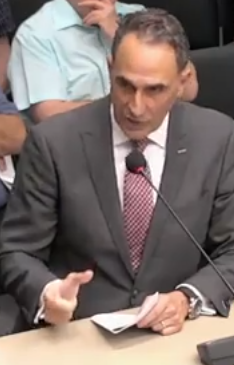
“It’s been a journey” said Lou Frapporti as he started into his delegation which he hoped would result in Council
Endorsing an expanded community facilities scope
Authorize a due diligence phase
Enable exploration of funding and partnerships
Return with the necessary analysis for implementation decision (early 2027)
Frapporti spoke of the greatest collective risk for a community is risking a missed opportunity.
“Development in the community, opportunities tend not to be missed when there is tenacity, political alignment, engaged constituencies, engaged bureaucracy, and partnerships that stuck with me, and all of our collective work to date.
 “Great thanks is owed to this council, your staff, and the community as a whole. This is far from the beginning of the process. Today is the latest and most significant milestone in a process that began years ago, when it is worth remembering Alenia came to the city, not simply asking what it could build, but asking a larger and more civic-minded question: What should be here?
“What would justify the development of one of the most important remaining parcels of land in this region?
“King Road, emerged through a long process of engagement with you and many others, including many here today. The answer to that question is a community where housing, recreation, health, education, employment, and transit are combined, and it’s appropriate that the event center and related infrastructure represents this first critical public step in moving this development forward, and that this asset is not an accessory to that city building, it is the catalyst, it is the piece that makes the rest of this ambitious plan tangible in this market during this time of housing and sports infrastructure need, and that is what the proposed event center and recreation district can do. I say this as part of an Alinia team that is deeply invested, literally in sports infrastructure and programming, in its investment in the TD Coliseum project in Hamilton, as well as its ownership interest in the Ottawa Senators NHL franchise.
“We saw how a modern arena can serve a university, a city, a private operator, and a community at the same time.
“We saw how a modern arena can serve a university, a city, a private operator, and a community at the same time.
“We saw how sport education, innovation, housing, and street life can create a dynamic district centered on young people. The best communities aren’t accidental; they are carefully and ambitiously curated. They require civic leaders to see beyond the immediate planning file to a future aspirational community.
“With sufficient resolve and the right partners communities can meet every challenge.
“The Oakview Group,(OVG) the world’s largest developer and operator of sport and recreational venues, and a key anchor in a number of cities, developed and operate the TD Coliseum in our neighboring community.
“Having been a part of the team that brought OVG and Live Nation to Hamilton, and in my current work leveraging the investment to revitalize the downtown core of the city, I’ve seen firsthand how a world-class venue operator can do more than manage a building. OVG has helped to restore confidence and a major civic asset has brought credibility, market discipline, operational expertise, and renewed sense of possibility to Hamilton.
“That work directly informed OVG’s interest in Burlington; it also helped with the credibility necessary to engage other critical partners, most notably the Ontario Hockey League (OHL), with whom we have been in conversations for months around an expansion franchise in Burlington, if the facility can be built in a timely fashion.
“For those unaware, the OHL is a powerhouse of economic and community impact. It is an organization that is geared towards the whole family and can transform a community’s identity. A notable additional OVG partner is Basketball Canada, whose interest in the performance facility in this community supporting basketball league and tournament play year round, presents yet another transformative opportunity this facility can unlock. We’re also collaborating with the YMCA, and a variety of other post-secondary and healthcare institutions who represent key stakeholders that can inform the creation of this ecosystem.
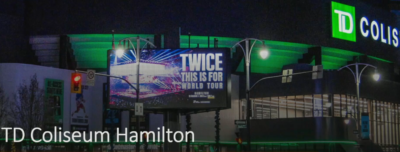
Should you secure OVG commitment, TD Coliseum can be the large format regional anchor programming synergistically with Burlington as a flexible mid-sized event, sport, and recreational platform.
“There is a regional opportunity here, which I’ll touch on briefly, and that is with OVG involvement. Hamilton and Burlington can align in a very innovative and powerful way. Should you secure OVG commitment, TD Coliseum can be the large format regional anchor programming synergistically with Burlington as a flexible mid-sized event, sport, and recreational platform connected by Go Rail, particularly between Aldershot and Hamilton’s downtown stations. These venues can create something larger than either city could create alone, a jointly programmed Hamilton-Burlington corridor for sport, entertainment, recreation, culture, and event tourism. This is how communities compete for major events, now; not municipality by municipality, but as connected regions with complementary assets. And Burlington is uniquely positioned to be at the center of that regional opportunity.
“There are moments in the life of a city when the future is unusually visible. This is one of them.
“Obviously, a great deal of that work has to do with the Alinea, but that isn’t the only reason.
Frapporti closed asking Council to advance to the next step, recommended in the staff report, to move this project forward with the seriousness, urgency, and imagination it deserves.
Members of Council had questions. Councillor Galbraith wondered “what risks we might have if we don’t move this forward today.”
Frapporti: There are broadly three major categories of risk. One is in the absence of speed, capital moves, corporate partners, particularly highly valued corporate partners, pursue other opportunities, and that is the case with OVG and the OHL. They’ve made it very clear that other communities are pursuing their investments and expansion franchise plans. So, delivery of the asset and the speed with which we do that is important.
Secondly, there is really an infrastructure risk in this sense, this is the catalyst of a very large project, as I said a few moments ago, but we’re living in a housing crisis, and investments of the magnitude that would constitute the full build out of King Road will require an enormous amount of energy and forward momentum.
The event center is an activator of. It brings serious corporate partners, and it will be absolutely necessary in accelerating the density of real estate construction that’s necessary to activate the site, and then lastly, as it relates to the event center, particularly.
I think everyone has seen the news the federal government’s recent pronouncements around sports infrastructure as being a key priority. The same messaging is coming from the province. We’ve been working with the province and federal government. I’ve been briefing both MP Gould, and MPP Pierre and other government leaders on the opportunity, and ensuring that we do this quickly enough, so that government can pour senior funding into a shovel-ready project is critical.
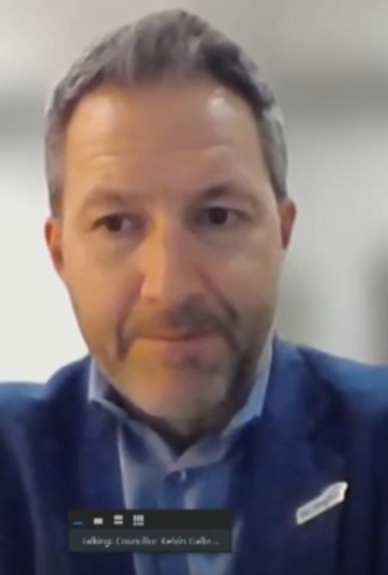
Galbraith: How soon? How, if this was approved today to move forward, you know how soon until someone’s skating on the rink.
Galbraith: “Which leads to my second question. So, shovel-ready, I keep getting the question, How soon? How, if this was approved today to move forward, you know how soon until someone’s skating on the rink.
Frapporti: “I wouldn’t dare to answer that question here, other than to say faster is better. There was some talk, and I wouldn’t presume to speak for the OHL, but wouldn’t holding the Memorial Cup games here in 2030 be fantastic?
Councillor Bentivegna: Pretty exciting stuff. My question is, the numbers are pretty staggering in terms of dollars and cents, and my understanding is that we’re talking somewhere in the range of $300 million. I know you talked about upper-level government support.
What do you feel the outcome will be in terms of the excitement that we have, making sure that they understand what you just presented, and it’s a win win win situation for all of us.
Frapporti: Let me start with this. First of all, projects of this magnitude, particularly as an activator for a site of this size, are not something that any one entity can do alone; they are developed and created through very close cooperation between multiple levels of government and private sector partners. Securing money from senior levels of government becomes much easier when the private sector has skin in the game and has made a significant investment, which is on the table here.
These are necessary ingredients for scaling up investment and ensuring that the asset and programming delivers its potential. Secondly, I think speaking directly to your question, this was very much an issue during the long conversation relating to the Commonwealth Games. There is, of course, because taxpayers are involved, a necessary preoccupation with taxpayer money, but it isn’t like with any business, simply a question of what it costs. It is a question of what it generates and what the value of the asset is. There is a, as a part of the development package, very comprehensive economic impact report that speaks to whether it’s with respect to development charges, property taxes, retail activity, employment, a whole host of verticals. The site, as a whole, is a massive propellant to the local economy. This event center is a necessary seeding investment to get that moving, and so this process will begin consultations and assessment by city staff and others around what the math looks like, and all sides of that balance sheet should I respectfully suggest, be investigated very carefully. What are the costs? Who is paying? Obviously, what are the returns? How can those returns be increased? But there’s enormous reason to be hopeful.
Thank you for that. My second question again, just expanding on that shovel-ready program in a perfect world, what timing from start to finish on a project like this
Frapporti: Again, I would not presume to speak with definitiveness about that, Councillor Bentonia. Except I would, I would say this time is of the essence. The event center project really will not move forward until planning approval for the site is secured, and if that is delayed beyond the next couple of months, we will have a great deal of difficulty in the cascading sequence of dates that we cannot meet with partners like OBG and the OHL in losing that opportunity. So, while I can’t say definitively what that looks like, I can say that. Faster is most decidedly better.
Councillor Sherman: As I think about the development, the where it is, and the traffic congestion we had through Burlington today, and the lack of infrastructure for decades by the province. I appreciate the potential risks with Metrolinx and the highways. Can you give us some insights as to how you see that unraveling in terms of congestion and getting relief, especially with the growth,
Frapporti: I can make an observation of what I think this opportunity presents. First of all, this is exactly where density is intended to be placed on a goal line with transportation, major transportation corridor access. As a consequence provincial and municipal planning priorities have been specifically curated to reflect that. Secondly, there’s a lot of vehicular traffic. I’m part of that traffic on a daily basis, but this particular asset, and I’m talking here specifically about the event center, presents a real opportunity around accessibility and transportation efficiency, and that is, if we’re talking about the citizens of West Burlington, the Aldershot, and the surrounding communities, they are almost without exception having to travel in their cars to take their children or to attend events. And when we develop the density at the site, there will be roughly 9000 units, a community of potentially 14,000 people or more. It would be advisable to keep them at home, walking to that event center, and the amenities that a community can provide. It is critical, I think, to mitigate population growth, which is inevitable, by creating assets and amenities within the community that keep people at home and not having to get on the highway.
Sharman: Can I just do a quick follow-up with respect to people coming to the arena, so that that also was going to add potentially add congestion.
Frapporti: It certainly would add it, would I hope it would add activation and dynamism to the site by people coming to the community, many of them from the community, but a great many not from the community who are here spending money, and I’ll make a point as this process moves forward, and something that I’ve endeavored to do in speaking with leaders from the BIAs within Burlington, that this was a part of the process in Hamilton, the ability to create activation and bridges between an asset like this and every part, every ward of the city, I think is very significant economically, in terms and in terms of the benefit of the community. So, the magnitude of these partners is such that these are multi-day events, whether it’s a hockey tournament or a basketball tournament; the convention, hotel, the downtown will be activated. there will be traffic as a consequence of that, but there will be an enormous amount of economic activity and a good deal of investment in the community and amenities that the community desperately needs.
Sharman: Perfect. Thank you. I have a second question. The second question is with respect to when you talk about amenities and community needs with another 9000 residential units, that leads to questions around more than entertainment, there is a significant aging population here, as well as, you know, everybody else who needs support and wellness mechanisms. Are we going to have amenities in mind in this very large development?
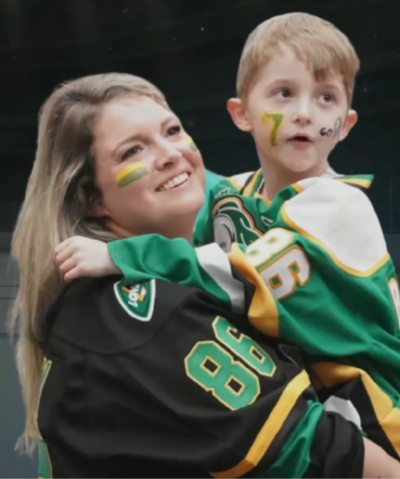
These facilities are intended to serve people of every age and ability, and the larger the investments the better.
Frapporti: That has been an area of particular interest and focus for us at Alinea, and let me explain why. When you have this density of investment around sports and recreation planning, yes, it’s very attractive and exciting to have elite sports like the OHL. These facilities are intended to serve people of every age and ability, and the larger the investments the better.
This gives us the capacity to create something that will help promote well-being in the community. That’s one, two. We’ve had the privilege, and this has been part of my journey in Hamilton, of working with and introducing to this opportunity some of the leaders of the two biggest anchor institutions in Hamilton that have a significant bearing and impact on health and wellbeing, and that is McMaster University and Hamilton Health Sciences, who are very interested in synergies with respect to programming and infrastructure that this degree of investment around sports, recreation, health, and wellbeing produce. So one of the priorities for me in collaboration with city staff as this process moves forward is to explore with those regional institutions the ability to have them program and participate in creating a health care and education destination at King Road that surrounds all of the health infrastructure, recreation infrastructure, and housing.
Councillor Nissan: I appreciate your passion for this project and the partners that you have pulled together for it as well. There are a lot of really impressive partners here. Obviously, nothing signed. I want to talk a bit about sequencing. The OHL economic uplift is very compelling. But what if some of these things don’t pan out and it becomes more of a burden on the city? What if we’re not the first or only ones to jump in with two feet, and then have to hope that the other partners come on board?
Frapporti: I think the staff report that was put together artfully puts or creates a framework and process to ensure that those concerns are addressed. It is staged appropriately. There is a due diligence process. There is, of course, further community engagement that’s required. There will be a good deal more discussion with these, the partners that I mentioned, and others over their interest. I think the city and senior levels of government ought not to make any commitment in the absence of commitments from the private sector and key partners that staging is critically important, and something that everyone, I’m sure, will be concerned about before anybody makes a decision, least of all those private sector partners. And you know, we know that we’ll be working closely with city staff and ensuring that those concerns are reflected in the process as it unfolds, but certainly acknowledge that that’s a key consideration in this.
Councillor Kearns: I want to talk to you about milestones and timelines. I find it difficult to reconcile what we’re being asked for today, which is to endorse the uses of the space from a recreational lens, with the request that you’ve identified as an expedited permit process for the planning portion of the lands, which you just stated that if there was a delay of a few months from today, it would compromise the project. Think you said that, you can correct me.
What you are asking for today is a report back in almost one full year, Q2, 2027 on the funding strategy partnership model and an implementation plan. Have you no way to get that to us sooner.
Frapporti: First of all, it’s not entirely within our hands. The staff recommendation is a process that the city is navigating and leading. We can go as fast as the city goes in relation to that process. A private sector tends to move faster than government.
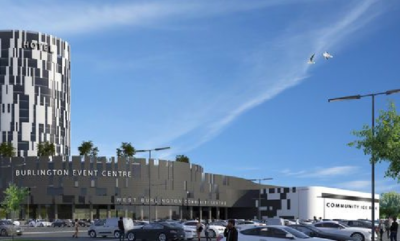
Frapporti: The realization that an events center is a necessary condition requires that we move forward with the planning application as quickly as we can.
“Generally, I think in this particular case, we will be moving with as much dispatch as possible in a coordinated fashion, I think it is going to be critical. I can’t my comment with reference to the planning application. The realization that an events center is a necessary condition requires that we move forward with the planning application as quickly as we can. What this council and staff do with the planning application is not a matter of my presentation here today, but I concede the point that this is a big vision that has a variety of partners and speed is absolutely necessary.
“We’ve been at this for almost five years with city staff and getting to this particular point, and in the last few months, the work that city staff has done in collaboration with us on a team basis and on a daily basis gives me hope that we have the ability to get there if there’s sufficient political Kearns: The information we gather today, would not allow us to have the same decision-making authority, because the information would be stale by Q 2027. We’re a board of governance, so it’s our role to make sure that we’re mitigating risk, and that would be a huge risk to come back in 2027 with decisions around funding, financing, and implementation based on data from a whole year ago with a whole new group of people, probably. So, what areas do you think council should focus on to help bring better alignment to the private sector sequencing and pacing with our roles here today. Where do you need to focus to get that speed?”
Frapporti: First, obviously speed with respect to the planning approval process is critical, otherwise it’s all for naught as it relates to the event center. I wouldn’t presume to get ahead of the city’s due diligence in terms of the economic impacts of and what it’s prepared to commit, but given the tight funding window from senior levels of government and the need to create clarity around what the private sector partners are prepared to commit, creating a structure, and this is entirely the purview of you and your fellow councillors, creating a structure that permits us to move forward to explore what the agreements would look like, what a funding structure would look like, so that everything is approval ready as soon as possible in the new year would be critical. It’s not a year, we’re into July right no so we’re looking at roughly six months. If there is clarity on those things I think a six-month time period is quite manageable from a business risk perspective.
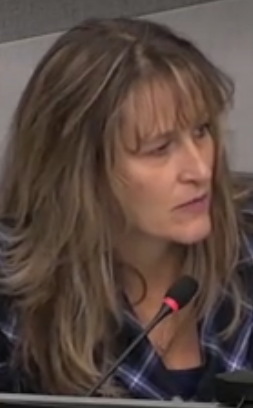
Mayor Mead Ward
Mayor Mead Ward: I recall how we, in the past, with much smaller projects, we’ve worked with community groups, ice users, soccer players, a whole range, gymnasts who have actually committed to partially funding, in some cases quite significantly, the facilities that we get. We know we can’t do it without community, without private money and without other levels of government. Can you talk to us about some of the conversations that you’ve had with some of our community groups. I know those who are here today are very supportive of what you’re doing?
Frapporti: There have been a lot of conversations, many of them have involved the business community, but we have also met with a wide range of sport and recreation partners in the area of aquatics, hockey, basketball, wellness, health, and recreation.
I know that your consultant has been introduced to a variety of these groups. The revenue performance from these organizations and the programming they bring, whether it’s aquatics, events, hockey tournaments, basketball, and so on, are very significant, and the venue operator, whether it’s OVG or the city in combination with OVG, will, as a function of it creating that business solution, will look at all of those revenue streams, assess them, and make a decision about what that investment looks like. I can say from the Hamilton experience what a massive difference it makes to have a world-class institution operated by a leading private sector partner. I’ve been in Hamilton long enough to have experience with Copps Coliseum, and how it was run before.
The 7000 seat arena we are talking about is perfectly sized. We’ll be active the entire week. The facilities will be active the entire week. When it comes to fitness and recreation, the work before us is significant, but it’s assembling the pro formas, engaging with all of these groups, determining what revenue potential exists. And then making an informed business decision. I’m enormously optimistic that the numbers will crunch and will make sense.
Councillor Bentivegna: What’s the impact of 9000 homes on our tax base?
Frapporti:
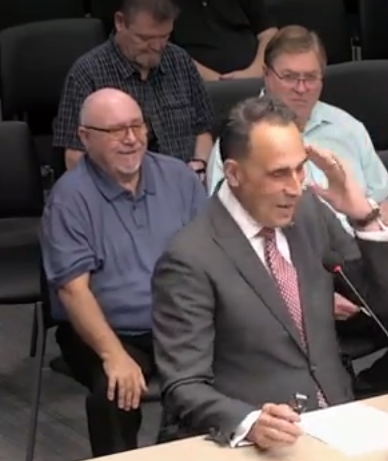
Lou Frapporti was doing a great job delegating – until he had a seniors’ moment and couldn’t recall Karina Gould’s name.
I went to law school because I was not great at math, so with that stipulation, 9000 residential units has a variety of revenue implications. There are clearly development charges, there are allotments and levies for school and education. There will be, of course, the property taxes that are created as a consequence of this density of development. There will be an enormous amount of construction and development, employment, and retail tax generation as a consequence of a project that will take 10 years or so. The numbers are in the billions.
Frapporti added as he left the podium: Can I just say, Councillor Bentonia, I share your pain. Italy is missing its third World Cup in a row.
It was a strong delegation, all the bases were covered, all the questions were answered and Council was given a challenge: There are moments in the life of a city when the future is unusually visible. This is one of them.
This article has been edited for length and clarity.

Discover more from Burlington Gazette - Local News, Politics, Community
Subscribe to get the latest posts sent to your email.

Leave a Reply