


 By Staff
May 1st, 2025
BURLINGTON, ON
The CBC Ideas crew was in Burlington late in March to record a broadcast for CBC radio,
The program went live on April 24th. The following is who said what to who; it turned out to be an exceptional look at how the library works internally and the role they feel they play in keeping our democracy alive while battling misinformation and disinformation, while the country was in the middle of an existential federal election.
I’m Nahlah Ayed – welcome to our series, Ideas for a better Canada today from Burlington, Ontario, and how we as a country revitalize our democracy?
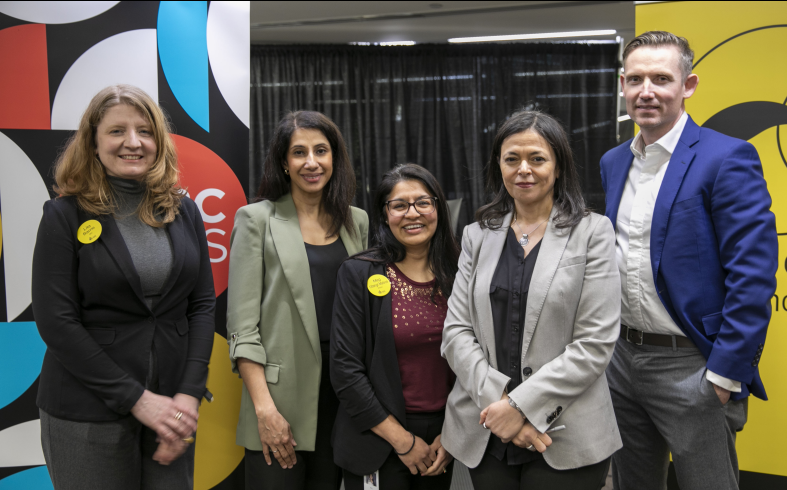
Lita Barrie (CEO, Burlington Public Library), Sabreena Delhon (CEO, The Samara Centre for Democracy), Meg Uttangi Matsos (Director, Service Design & Innovation, BPL), Nahlah Ayed (Host, CBC’s IDEAS), and Ira Wells (Professor, University of Toronto, critic & author).
This is a forum dedicated to intellectual freedom and democracy. What those terms mean and why they’re related. That’s what we’re here to discuss, because libraries have become a target in the culture wars of the United States and here in Canada too. Let’s start right here at this library whose story in this community dates back to 1872. With me are two members of the Burlington Public Library team. Can you introduce yourselves and tell me what it is that you do at the library?
My name is Lita Barrie, the CEO here at Burlington Public Library – I work with our community and our municipality to make sure that we’re continuing to offer library services and collections that are relevant and meet the needs of everyone that we serve.
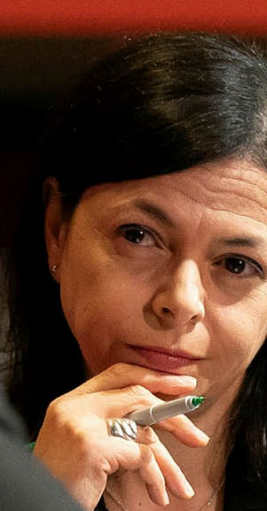
Nahlah Ayed
NA: Public libraries have been in the news quite a lot lately. In February here in Canada, local politicians in Valley View Alberta voted at a closed door meeting to close and move a small public library to a school, thereby restricting access to it.
In the United States, on March 14, an executive order by the Trump administration cut down an agency that provides federal funding for libraries there. They seem unconnected, but in both cases, these events were preceded by political objections to the contents of a library. .
NA: Does any of this surprise you at all?
LB: It absolutely surprises me. I didn’t expect to be in this moment where core values and concepts like intellectual freedom would be challenged at such a base level in so many different ways. I think as a sector we are really trying to rise to the opportunity and really reinforce the core role that libraries play in terms of upholding our democracy and how critical intellectual freedom is as one of our core values.
NA: Let’s, talk about that. As you say, intellectual freedom is a core value of public libraries, and it’s baked right into your official policy. What does it promise?
LB: I think that is really one of the pieces that’s being questioned: Is the lack of, potentially across our democracy, a shared understanding of what intellectual freedom means, that idea that everyone should have the right to access information and at the same time, that shared right and responsibility that none of us has the role to dictate how someone else might choose to select or access information. As an institution, we try and balance those two roles.
NA: What do you do here?
Meg Uttangi Matsos (Director, Service Design & Innovation, what that actually means is I work in our branches, offering customer service and the resources and the team that works with our digital resources and collections department. So that’s all of the items that you see in the library or online when you’re looking for material at the library.
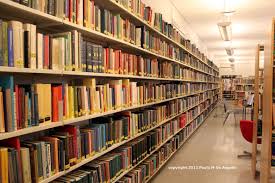
We don’t want to build a collection that just sits on our shelves.
NA: So do you guys actually choose the books and materials, keeping in mind the idea of intellectual freedom. How is it that you make your decisions?
MU: We’re not working in a vacuum; we are using a lot of different tools. We use reviewing media, we use bibliographies. We have conversations with the publishing industry, with other libraries. We’re talking about the authoritative nature of some of the sources that we are looking at.
MU: And then we think about the different needs of our community. What are people looking for in our community? What are they actually reading? We don’t want to build a collection that just sits on our shelves. We want to build a collection that people are interested in borrowing and taking home. We use a lot of data around that as well. When we look at the breadth of our collection, we are trying to think about. What is the information people want from an opposing viewpoint. We’re trying to fill gaps within our collection around that that as well.
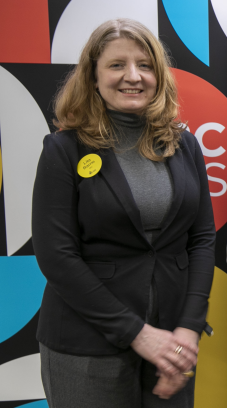
Burlington Public Library CEO Lita Barrie
NA: Your answer kind of suggests that maybe there’s a constant reviewing process as well, of what is on your shelves. What if a book isn’t being borrowed?
MU: We look at how that book communicates the content. Is it local to our region, and do we want to keep it because it’s unique? There are a lot of things that are considered. A glimpse of the diversity of voices that appear on our shelves is shown on the online BPL catalogue lists. For example, the book by infectious disease expert Dr Anthony Fauci, who promoted public health efforts and vaccinations in the US during the COVID 19 pandemic is on our shelves; the library also carries a recent book by Robert F Kennedy Jr, that argues that Anthony Fauci was part of a global conspiracy and questions the efficacy of vaccines. As you can imagine, the community comments are very lively.
NA: Why include both books in your collection?
MU: I think if we don’t have both books, we don’t have that broad understanding of both scopes of that topic. People are interested in reading both sides of that topic, whether they agree with it or not. They want to know what’s being said. I think one of the fundamental things that we do in the library is we don’t judge beforehand how somebody is going to read a book. We have the information available. We have it so that people can read it and receive the information that’s in it, and then they can determine for themselves how they’re going to respond to that information. If we remove some of those items, we don’t give people the opportunity to experience the full scope of the issue.
NA: How often have you heard a complaint about either of those books?
MU: We probably see more of the comments in our catalogue than official complaints.
NA: I understand that when you receive a complaint, you actually use the word democracy. And I’m wondering, one, how that sits with the complainants, and two explain why you go that deeply into the reasoning behind what you’re doing?

Freedom of thought, freedom of of expression, are really this concept of choice and access, and those are such important pieces in democracy.
MU: I think the key things around freedom of thought, freedom of of expression, are really this concept of choice and access, and those are such important pieces in democracy. I think when you’re living in a community where there is the ability to see people around you that are not like you, you want to be able to interact in a place where you have lots of choice and lots of different viewpoints, and the ability to access those materials as well. I think those are kind of the parts that connect it back to democracy.
NA: Of course we’ve heard the stories across North America, about LGBTQ plus themed books that in particular face customer challenges. Can you both talk about, the kinds of things you would consider in reviewing a complaint about those books as well.
LB: I think one of the reasons these conversations are so important is as a society, haven’t given enough space to talking about the whys of these collections.
LB: As much as we open that choice, and particularly as it relates to our children’s material, we also recognize that the parent has the right and the responsibility to determine what they would like their child to access from the library. But concurrent with that right is they don’t have the right to dictate what another parent might choose for their own child. Across the US, and some of the concerns that we’re seeing across Canada is this idea that that having that item in the collection is creating harm amongst children. And really what we want to do, and Meg led with this, is we want to make sure that everyone sees themselves in the collection, that there is something in our collection that really speaks to everyone’s experience.
LB: I think another piece that we’re really thinking about is what it means to have material on display from a values perspective. Intellectual freedom is one of our core values, and inclusion is one of our core values. So what we choose to display in the library is really about supporting that concept that everyone is welcome. And I think in this moment, we’ve really been reflecting internally that having something on display is not necessarily a harm.
LB: We’re never going to force you to read anything. You get to decide what you read, but we’re going to work on the premise that walking by a book that you disagree with is actually not an act that’s going to be harmful, and to hold those two things as separate, I think some of the complaints and the concerns that we’re seeing across North America sort of conflating those two pieces that by even just seeing the book that it’s causing harm.
LB: I think in this cultural moment we’re in, so many of us have phones in our pockets and we are so used to, through our social media algorithms, being able to swipe the second we find something that we don’t agree with, we’re used we’re used to being able to control what we see and making sure that what we see aligns with our values.
LB: I think we’re really seeing that in our branches how that’s translating into real life. There’s no real-life manifestation of the swipe except for the complaint process.
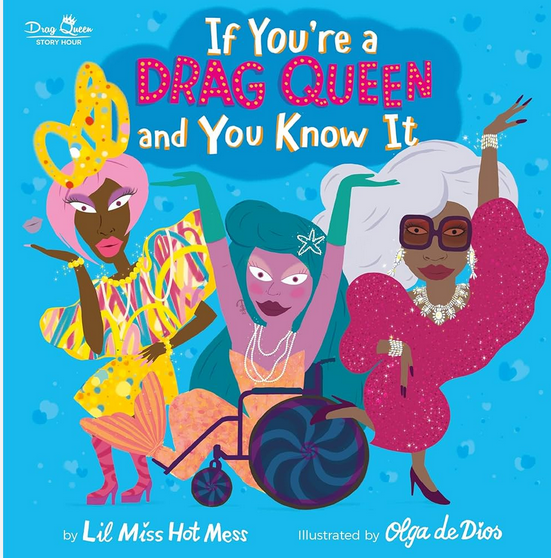
First of all, it’s a picture book. So it is designed in a way to be fun, colourful. It is based on a song, “If you’re happy and you know it”.
NA: I want to anchor this in an example, because I didn’t give one. The book that that I was going to mention is: “If you’re a drag queen, and you know it”, is a children’s picture book written by the founder of drag queen story time.
NA: What if someone came to you with a complaint about that book, which I understand some have; what it is that you outline in terms of the necessity of having that book in your shelves,
MU: First of all, it’s a picture book. So it is designed in a way to be fun, colourful. It is based on a song, “If you’re happy and you know it”. A lot of the themes within the book are really meant to be something that a parent could interact with their child, or that the child could interact with themselves in a fun way.
NA: In terms of the that concept, why would somebody ask us to not have that book in the library.
MU: I think in so many ways, people are looking at it through a single lens. They’re looking at it through I wouldn’t want my child to read that, so why would I let other people read that? Or they’re looking at it through a – this might teach my child about something that I don’t want them to learn about. I think what’s missing in that is there are different styles of learning. There’s different styles of parenting, and there’s different ways that people access pieces of that knowledge. So in terms of like that particular book, I think it’s that just because one person doesn’t feel it’s right for them, it doesn’t mean that other parents don’t feel that it’s right for their children, and the fact that we have something like that in the library means we are able to provide that choice to our community
LB: Our process is really ensuring that people feel heard and listened to, and that they have an opportunity to share their position about why they might disagree with us having a particular author, and from that point, being able to really have that conversation about why, and acknowledging that not all of our events are intended for everyone in the community.
LB: It comes back to that premise of not precluding other people from having that experience, and what we can all learn as a community by getting a little bit more comfortable with listening to perspectives that might be different than our own, and listening to lived experience that might be very different from our own as well.
NA: How do you navigate those conversations? As you say, it’s intellectual. It’s a challenging notion to persuade someone who maybe isn’t predisposed to accepting the idea of having to hear in opposing point of view.
LB: The core piece of that is just acknowledgement and empathy
We don’t try and challenge if someone feels hurt or sad about something that we have in the collection. First and foremost, we start by acknowledging that we’re never trying to challenge someone else’s feelings about another book or something that we’re doing in the collection. We’re not saying that their feelings are invalid or not true. And that really often creates a great place to be able to then listen to someone else’s concerns and, in turn, sort of share some of our rationale or reasoning for offering an event or offering an item in the collection, and at the end of the day, some of those conversations, they don’t necessarily end with someone being on board with our choice or really excited about what we’re doing, but we’re coming back to that place of mutual respect and being able to acknowledge someone else’s experience and hopefully have have left them with a sense of being heard, an increased understanding of what we’re trying to accomplish through the work that we’re doing in community.
NA: Could this way that you look at books and navigating these differences inform the rest of us in society.
This isn’t something that just comes easily.
MU: Sure, the first place it’s uncomfortable. This isn’t something that just comes easily, and we don’t always get it right. I think part of it is being brave to engage in some conversations, sometimes being brave to stand in your own values or the values that you believe in. But then I think in terms of what we do at the library is seeing others as humans, treating people with dignity and respect, regardless of what the argument that they is or the or the belief system they have. We treat privacy and impartiality as really important in the library as well. The idea of passing judgment on someone just because they happen to take a certain book out of the library; that’s not part of what we learn in our core – it is not something that we want to be doing. We choose to be patient with others. Treat people with respect and listen.
 NA: Finally, when we’re thinking about the next iteration of our democracy, this is an opportunity to make the argument, why do public libraries deserve the understanding and support personal beliefs?
LB: Again, did I ever expect to be in this moment. No, but I think if we see what’s happening across North America we can see how important it is for us to connect in person to each other when we talk about some of these issues. There is so much that we have gained from our online world, but there is so much that just needs to happen in person, and we are really one of the few public services that is a lifespan service. People are welcome within our doors from the day they are born throughout their entire lifetime, and that is really a unique privilege that we have in community, and I can’t think of a more important time to have libraries thriving across our country.
LB: We are also a place where you are going to have that kind of friction with other people in your community. Where else do you have that in your community where you can come in, you’re welcome and you’re going to see other folks in your community? It’s really an important part of our society.

Discover more from Burlington Gazette - Local News, Politics, Community
Subscribe to get the latest posts sent to your email.
