




 By Joe Gaetan
December 6th, 2025
BURLINGTON, ON
Burlington has spent years trying to improve its transit system. Routes have been redrawn, schedules adjusted, buses upgraded, consultants hired, and millions invested. Yet for all that work, the city keeps running up against the same frustrating truth: Burlington was built for cars, and no amount of tinkering can turn it into a city where traditional fixed-route buses operate efficiently.

QEW cuts through the city.
To understand why that matters, it helps to look at the physical reality of our city. Burlington is carved into pieces by major infrastructure. The QEW and 403 form a massive east-west barrier. The CN freight corridor and GO rail line slice along the south end of the city with only a few places to cross. Dundas Street creates a northern boundary that is fast-moving and difficult to navigate on foot. This patchwork leaves buses weaving in and out of neighbourhoods just to get from one side of the city to the other. The system we inherited cannot succeed using the same tools that work in big cities. Which is why residents choose to drive – even if they prefer not to.
Inside those neighbourhoods, the challenge grows. Burlington developed with winding crescents, cul-de-sacs, and subdivisions that were intentionally designed to discourage through traffic. It’s part of what makes the city pleasant to live, but a nightmare for bus routing. Traditional transit needs straight, continuous corridors to maintain reliability. Burlington is full of curves, loops, and pockets that require detours, long travel times, and the kind of indirect routing that turns a simple trip into a long one.
Layer on the fact that Burlington is largely low-density, with single-family homes spread far apart, and the problem becomes structural. A big bus passing through a neighbourhood where the nearest person might be a ten-minute walk from the stop is never going to attract large numbers of riders.
The Alternative
The alternative, ARGO’s Smart Routing™. A system used elsewhere and now being piloted in Brampton and Bradford West Gwillimbury. Instead of relying on fixed routes and large buses, it uses smaller electric vehicles that respond in real time to where riders actually are. In short, it’s a system designed for suburban cities like Burlington.
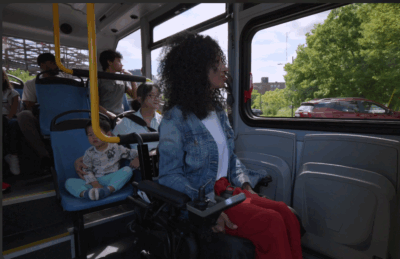
19 passenger electric buses that would work on an on-demand model.
ARGO’s Smart Routing adapts transit to where people actually are. Riders request a trip a day ahead, and the system then sends an electric vehicle to pick them up at or near their home. No more walking long distances to a stop, waiting in the cold or heat, dodging rain sleet or snow hoping a delayed bus will show up.
The door-to-door model can dramatically improve use for seniors and people with accessibility needs-something deeply important as the city plans for the future.
Perhaps most importantly, this model is cost-responsive. Instead of putting large, expensive buses on routes where they routinely carry one or two passengers, the ARGO system deploys vehicles where and when they’re needed. That means higher utilization, lower operating costs per trip, and a more efficient use of taxpayer dollars.
A pilot program would give Burlington the ability to test the concept, measure outcomes, and collect data before making long-term decisions. And on that note – we also need to ask riders to tap on and off each segment. The potential upside – better service, lower cost, and higher ridership.
Burlington spends millions on transit and has floated the idea of purchasing hybrid/electric buses at a cost of roughly $1.5 million each for buses that on average carry just one rider. The e-Jest buses used by Argo and deployed in cities like Sain John NB and Santa Maria CA run around $350,000.
Burlington has an opportunity to reinvent transit by integrating micro-transit alongside our existing system. Rather than pushing harder on a model that struggles no matter how much money we pour into it, why not explore a system designed for cities like ours.
ARGO may not solve every challenge. But it may be the solution that truly fits Burlington. Link to how ARGO works. Get a peek at what the electric 19 passenger buses look like.
Finally, this is exactly the kind of Canadian-made innovation that Prime Minister Mark Carney and Premier Doug Ford should be looking to champion, not only as a smarter transit solution for cities like Burlington, but as a strategic investment in a homegrown company with national and international potential.

Discover more from Burlington Gazette - Local News, Politics, Community
Subscribe to get the latest posts sent to your email.

I see a potential problem here…..I see it being useful to get to a destination, say a doctors appointment and I can see this maybe useful for workers (shifts), but how
can, say, shoppers/seniors use this when they want a ride back home? Any suggestions?
Uber Lyft
A thoughtful analysis of the issue and a reasonable solution to improve it. It would be interesting to see some comments from City planners before they commit taxpayers to spending on more big busses, as seems to be the plan.
I find this idea of the ARGO buses very interesting. It sounds like a good solution to our transit problems. It is certainly worth a try. I would be happy to pay if the service was more convenient. It is great to get a solution instead of complaints.