





 By Gazette Staff
July 13th, 2026
BURLINGTON, ON
What happened in Toronto
The Burlington Aquatic Devilrays (BAD) sent four swimmers to the 2026 Ontario Swimming Championships. They came home with two provincial silver medals, a top-20 provincial finish for every single athlete, and a team standing of 43rd among the 89 clubs entered — with 241 points, ahead of dozens of programs several times their size.
| Burlington Aquatic Devilrays | Meet-wide context | |
| Athletes qualified | 4 | 1,049 across 89 clubs (avg. ~12 per club) |
| Provincial silver medals | 2 | Markowsky (Open 50m free), Hilson (youth 50m free) |
| Athletes with top-20 finishes | 4 of 4 (100%) | Fields drawn from Ontario’s fastest qualified swimmers |
| Team standing | 43rd of 89 — 241 points | 89 clubs entered from across Ontario |
To understand what that paragraph actually means, you have to understand what this meet is.
This is not just a swim meet. It is the final round of a season-long elimination.
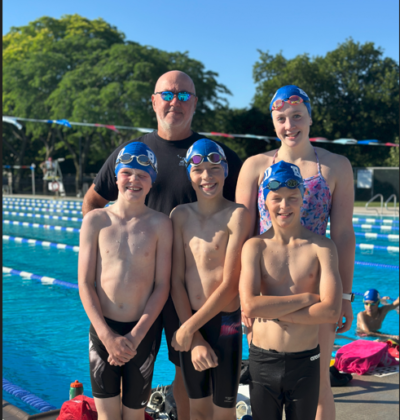
Devilrays CoachSergei Soloukhin with Ella Markowsky and the three youth swimmers: Seamus Hilson, Remi Jacquemart and Heinrich Meissner-Roloff.
The Ontario Swimming Championships is the province’s premier long-course competition, and there is no entering it on enthusiasm. Every event carries a qualifying time standard: an athlete must first swim fast enough, in officiated sanctioned competition, to earn each individual entry. That filter is applied across an entire season to the tens of thousands of registered competitive swimmers in Ontario — one of the deepest swimming provinces in Canada, the training ground of Olympic champions. The 1,049 swimmers who made it to the Toronto Pan Am Sports Centre are the survivors of that filter. Simply standing behind the blocks at OSC already places a swimmer in roughly the fastest one or two percent of the sport in this province.
Now consider what a placement inside that field means — in a sport that measures to the hundredth of a second. The margins at this level are fingertips: the difference between gold and silver, or between 10th place (which scores championship points) and 11th (which does not), is routinely a few hundredths of a second — less than the blink of an eye. And the field is so compressed that first through twentieth in the entire province can be separated by only a handful of seconds. To finish in the top 20 of an OSC event, then, is to be quite literally one of the twenty fastest swimmers in your category in all of Ontario, within seconds of the very best. A medal means that across every club and every pool in the province, exactly one swimmer touched the wall faster in that age category. At most clubs, a single top-20 provincial finish is a season highlight.
Burlington’s four swimmers produced, across the 19 individual entries; two silver medals, nine top 10 finishes, six top 20 and three top 25 finishes for the respective events and age categories.
Provincial silver at 15 and 11, top-5 provincial swim at 11, all swimmers in the top-20 at 11 — these are the results of athletes at the very beginning of their careers already standing among the fastest in Ontario.
Measured against the giants, the small club held its own
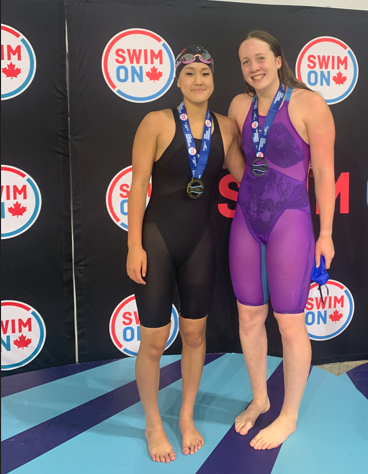
Ella Markowsky, on the right, earned silver in Open 50m free freestyle.
Championship team standings reward depth: Markham won with nearly 6,000 points, built by dozens of scoring athletes from a 70-swimmer entry, with relay points stacked on top. That is what resources buy, and Burlington’s four cannot be measured on the same scale. But on a per-athlete basis they more than held their own: three of BAD’s four swimmers produced top-10 scoring swims — a roughly 75% scoring rate, against something closer to 50–56% for larger programs like Markham, Oakville, and the Toronto Swim Club. It is not a clean, like-for-like comparison — a small, hand-picked squad will naturally convert at a higher rate than a large club that enters deep rosters knowing many swimmers will place outside the top 10 — but even read with that caution, three of four scoring, from the smallest tier of clubs, is a strong return, and it puts Burlington in the top half of the 89-club field.
The sharpest comparison, though, is with the meet’s other small delegations, which landed all across the table. A few similarly sized clubs — some of them fielding only senior swimmers — reached the top 30; others finished well down the standings, as a small handful of athletes up against clubs many times their size usually will. Burlington’s 43rd place sits in the upper band of that small-club field — achieved with a squad built around three 11-year-olds and one 15-year-old senior, the former being the profile with the most development still ahead of it.
There is one quieter measure worth knowing about, recorded in the meet’s official progression report, which sets every swim against the athlete’s entry time. Three of Burlington’s four swimmers bettered their seed times in some, most or all of their events — a modest but telling sign of athletes who arrived at the season’s biggest meet prepared, paced, and properly tapered, a telling sign of quality coaching.
And now the part that makes it extraordinary: the year this club just had
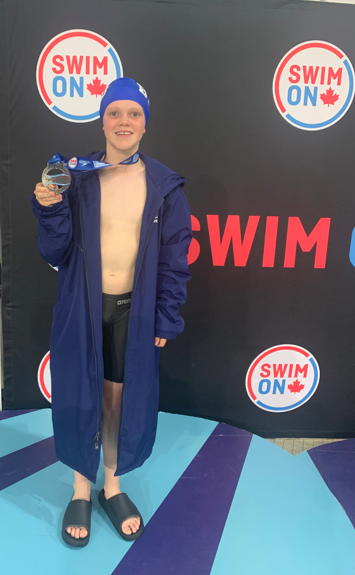
Seamus Hilson, earned silver in the youth 50m free -metre freestyle.
This result did not come from a program operating at full strength. It came at the end of a season in which Burlington’s only fully local, member-run competitive swim club essentially rebuilt itself from the ashes. BAD has been operating with a major cut to its pool time; the Ron Edwards YMCA in Burlington has since become the club’s partner and home, providing some of the most crucial water to keep it afloat. But less pool time has fed a slower, more corrosive problem: attrition. The roughly 180-swimmer club develops promising athletes and then, again and again, loses them — not only from its senior ranks but from the age groups beneath — to neighbouring programs several times its size, clubs drawing on memberships upwards of 500 to 600 with far more water to offer. Its senior track has thinned to just 27 athletes, and the same pull works its way down through the younger swimmers. At this very championship, a few of the former BAD elite swimmers who swam for BAD just a year ago, now swam for neighbouring clubs. A club that trains its swimmers up only to watch them leave cannot hold its competitive edge for long — and pool time is the thread all of it hangs on.
The club’s answer, all season, was to give more of itself. Three weeks before the championships, BAD hosted one of the region’s largest swim meets — more than 900 swimmers at Nelson Pool — staffed almost entirely by its own families, 97% of the volunteer shifts filled from within. And then four of its swimmers went to Toronto and finished the story. A comeback season, crowned.
The swimmers, coaches, parents and volunteers have done their part, emphatically. The open question this result should put in front of Burlington is whether these athletes will still be wearing Burlington caps in three years. That answer is no longer about talent or coaching. It is about pool time and whether or not Burlington will have a home for the team who carries its city’s name with pride.
This report was prepared by a BAD Board member using data from the official OSC 2026 point score, entry statistics, and athlete progression reports,Swim Ontario final results, July 12, 2026.

Discover more from Burlington Gazette - Local News, Politics, Community
Subscribe to get the latest posts sent to your email.

Even more Impressive after the corruption in the swimming bid, the BAD kids should be over the moon with how great they all have done this year. I hope the procurement teams kids did well this year at York or all the back room deals would be for nothing.