





 By Adam Radwanski
Under the dystopian haze that settled over Toronto this week, I could feel my frustration boiling over.
It’s a sensation I was mostly able to avoid, while spending more than five years — late 2019 until early 2025 — writing primarily about policies to address climate change. Despite mounting evidence that we weren’t acting quickly enough to address worsening consequences of our greenhouse gas emissions, at least Canada — like many countries — was moving far more ambitiously than previously toward a low-carbon economy.
Good luck telling myself that story this week.
This is the world my son is growing up in
Partly it was personal. When three days in a row you have to pull your six-year-old from the baseball camp he’s been excited about for months — first because of extreme heat, then because burning forests are creating some of the worst air quality anywhere in the world — you can’t help but feel down about the world he and his peers are growing up in.
Partly it was visceral. When the sky is a colour you’ve rarely seen before, when the sidewalks of your normally bustling neighbourhood are nearly empty save for people whose mental health crises are exacerbated by the heat or smoky air, it’s hard not to feel like you’re living in a dystopian sci-fi movie.
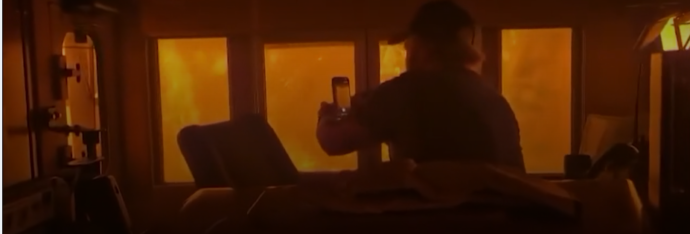
An engineer on a CN train photographs raging flames that surround the train.
Partly it was knowledge that we weren’t seeing anything near the worst of it. That was reserved for northern communities — mostly First Nations — evacuating as fires blazed through.
I acknowledge these sorts of extreme conditions have happened in the past, and no one can prove any single event is due to climate change. It’s also impossible to ignore that they’re becoming more frequent and more intense, to the extent that summer is depressingly at risk of becoming a season we dread.
Betting against a global energy transition
But what really made it hit so hard was that it came amid a sharp pivot from Canada at least attempting to be an international leader in reducing emissions. Instead, we’re now actively betting against a global energy transition from the fossil fuels contributing to these events.
It’s one thing to accept that for as long as there’s international demand for Canadian oil and gas, government should not stand in the way of meeting it. That was, to some extent, the approach under Justin Trudeau — even if there was some validity to sectoral complaints about regulatory processes being clunky or needlessly overlapping.
It’s quite another to try to push that industry beyond investments in new capacity that it would make if left to its own devices, which is where we’re at now.
A new west-coast oil pipeline, which only makes economic sense if there’s a predictably strong Asian market for that product for decades to come, found no private-sector backers when Mark Carney’s newish federal government expressed conditional openness to it.
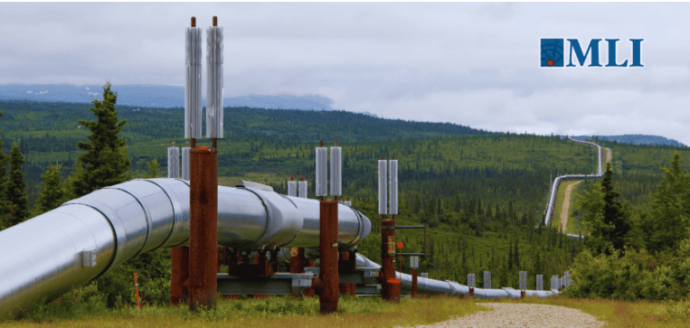
Pipeline winds its way over uneven terrain. Photo from McDonald-Laurier Institute
So now, Ottawa plans to pair with Alberta to pay for almost the whole thing, while prodding and potentially subsidizing oil-sands giants — which have in recent years been more interested in profiting from existing assets than expanding them — to build enough new wells to fill the pipeline with up to a million barrels daily.
Meanwhile, claims that the industry is eager to minimize the environmental impact of its product now play as farce.
To start this grim week, Ottawa released the latest agreement around the carbon-capture megaproject that was once supposed to put the oilsands on a pathway to net zero. Its target has now shrunk to six megatons of emissions reductions by 2035, which is roughly seven per cent of what companies there currently pollute.
And if the largely government-funded project actually gets built, those companies will get more lenient treatment under the industrial carbon pricing system that’s supposed to be driving their sustainability push.
Mark Carney was once a leading voice for clean energy
That all of this is being orchestrated by a prime minister who was previously one of the financial world’s leading voices for clean energy, as both an economic and moral imperative, just adds to the cognitive dissonance.
Putting some water in that wine has been understandable, as national unity (amid Alberta unrest) and sovereignty (in the face of U.S. belligerence) have taken priority.
But the way Carney has sometimes talked about ambitious climate policy suggests that he believes Canadians nationwide have similarly moved on, because they’re convinced (not least by our impressive fossil-fuel lobby) that it was a Trudeau-era frivolity incongruous with more pressing economic and geopolitical concerns. And his sky-high approval ratings haven’t proved hm wrong.
A climate optimist’s view would be that we may soon see that dynamic shift again.
Last month, Abacus Data released public-opinion data suggesting that Canadians’ concern about climate change has risen (to 80 per cent of people at least somewhat concerned, up from 62 per cent in 2024) even as it has slid down their list of priorities. That suggests, the polling company noted, that it could become more politically salient if triggered by major events.
Maybe what we’ve seen this week qualifies as one such event. And maybe there are the makings of a response from Carney to it, if you squint hard enough through the smoke.
In some of his recent pronouncements, including his video address to Canadians right before the pipeline deal with Alberta was announced, he’s flirted with what might be called the Norway approach. That’s the idea that, while we ship our oil and gas elsewhere, we’ll make up for it (and take advantage of the growing price advantage of EVs and heat pumps and renewable power) by aggressively moving away from those fuel sources domestically.
PM’s messaging undermined by rollback of Trudeau efforts
But he’s delivered that message rather half-heartedly so far. And it’s been undermined by his rollback of Trudeau’s regulatory efforts (aimed, for instance, at curbing natural gas use for domestic power) and fairly modest approach to consumer incentives.
It feels woefully inadequate, during days like the ones we’ve just experienced.
I reminded myself, as my own internal temperature rose, that around much of the world the move away from fossil fuels has still been ramping up. It would have been more consolation if it felt as though we were doing our own part, rather than trying to undermine that momentum.

Discover more from Burlington Gazette - Local News, Politics, Community
Subscribe to get the latest posts sent to your email.

Leave a Reply