





 By Pepper Parr
May 13th, 2026
BURLINGTON, ON
What became clear very quickly at the City Standing Committee meeting earlier this week was that there is an election coming.
Chair of the meeting Rory Nisan, wore a tie for the first time in a long time: he is now a candidate for the Office of Mayor.
Time and attention were given to approve a new governance framework for advisory committees, with a comprehensive review scheduled for Q1 2027 to assess the effectiveness, structure, and engagement of these committees.

This approach to Community Engagement could disappear if the proposal outlined in the Staff Report get adopted by the new Council that will be elected in October.
Advisory committees were led by staff with smiles while residents pleaded their arguments for change. With votes to be had come October, Council said they were prepared to listen.
Those who pay attention to what happens at city hall have complained for years that Councillors gave less than lip service to what the Advisory Committees did with their time.
Some time after the election, in Q1 of 2027, we will see the Staff report. What Staff are setting out to do is set out in detail below. What comes of it will depend on the makeup of Council and who the Mayor is. Two candidates so far: Mayor Meed Ward has yet to file nomination papers. Ward 2 Councillor Lisa Kearns and Ward 3 Councillor Rory Nisan.
During the Council debate, there was agreement that the Advisory Committees need help.
Councillor Sharman said: “In the 16 years of being on Advisory Committees, I’ve often wondered why I was there. Despite the fact that we all know we are engaging advice, but we don’t actually take advice all that often. There is no formal way for them to give us advice … we haven’t figured out how to bake that into it.”
The Staff Report that was being debated suggested an approach.
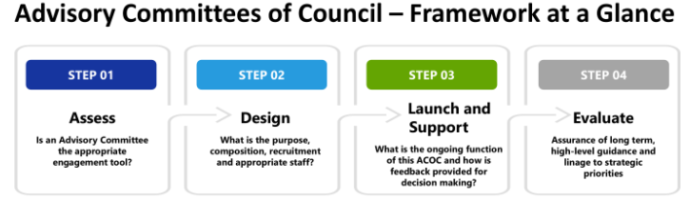
Step 1: Is an Advisory Committee the appropriate engagement tool.
In Step 1, ACOCs should be viewed as one tool within the broader suite of engagement options outlined in Burlington’s Community Engagement Charter spectrum of participation. An ACOC should be considered when the level of engagement identified meets the criteria for Involve/Collaborate on the spectrum. In Step 1 identify whether an ACOC is the best community engagement option for the issue or topic at hand.
Consider the following:
Is the ACOC required by provincial legislation?
Is the topic appropriate for an ACOC? In consultation with the city’s transformation office team, determine the topic is appropriate if: or it is linked to the city’s strategic priorities or a major plan or project with significant community impact; or it requires ongoing attention for at least the term of Council; or it will benefit from information and ideas generated through a deliberative approach; and o it is not already being addressed through another community engagement tool.
Is an ACOC an appropriate engagement tool?
In consultation with the city’s engagement team determine an ACOC is an appropriate engagement tool if:
A program is being designed and implemented that requires multiple sector buy-in and participation;
Interested parties expertise and actions form an integral part of the solution; The solution requires changes at the system level across various institutions and organizations – policies, procedures, bylaws, and programs; and
o Long term commitment and sustainability are key considerations.
Are there adequate resources to support an ACOC on this topic?
Adequate resources for an ACOC include:
A subject matter expert from a city department has capacity to act as staff liaison to the ACOC, including but not limited to attendance at meetings, providing strategic guidance, support training, work with ACOC Chair to set agenda,
support reporting and communication functions between the ACOC and Council, will provide the ACOC with information, opportunities to influence decision making by sharing views and values and setting priorities and respond to
requests for information;
Legislative Services has capacity to provide operational, logistical and procedural support for the ACOC, including but not limited to attendance at meetings, meeting documentation, procedural guidance, recruitment, training, operational
and logistical support; and funds to compensate and cover the participation-related expenses of ACOC members.
Step 2: Design the ACOC
In Step 2, once a decision to establish an ACOC is made, its purpose, formation, and design must be clearly articulated. Consider the following:
What is the mandate/purpose of the ACOC?
All ACOCs are intended to provide the City with considered, long-term, high-level guidance that is aligned with its strategic priorities; and
What is the anticipated level of activity and expected duration?
What should the membership composition of the ACOC be? Consider:
Which members of the community may be impacted by the outcome or decision; Ensure residents from a variety of locations, languages, cultures, abilities and other demographics are invited to participate;
How lived and professional expertise will benefit the work of the ACOC; and
Which stakeholder groups should be engaged.
What recruitment methods should this ACOC use?
ACOC members should be recruited using a combination of strategies, including open recruitment, targeted recruitment, and representative random sampling.
Who is an appropriate staff liaison for this ACOC?
Staff liaisons should be senior staff members with subject matter expertise who can support high-level decision-making and bring a strong understanding of the City’s strategic goals and priorities.
How long is the ACOC required? Will the ACOC remain in place until the long-term project, plan, or policy is finalized?
Step 3: Launch and Support the ACOC
Step 3 outlines key operational components of ACOCs and serves as a checklist for staff responsible for proposing and establishing an ACOC, ensuring all necessary
details are considered.
Create the Terms of Reference (TOR);
Confirm the department staff liaison and Legislative Services support;
Identify budget requirements and available resources to support those needs;
Determine the expected duration and end date of the ACOC’s work;
Seek approval from City Council;
Develop a training plan for ACOC members and City staff who interact with and
support the ACOC;
Plan and prepare the agenda for the first meeting; and
Clearly articulate the methods of communication between the ACOC, staff and Council. How does input from ACOC’s contribute to the work of staff and decisions of
Council.
Step 4: Evaluate the ACOC
Step 4 outlines the process for reviewing and evaluating ACOCs to ensure they continue to provide long-term, strategic guidance aligned with the City’s priorities.
Conduct a review of the Terms of Reference (TOR);
Complete a self-assessment to evaluate the ACOC’s engagement process, identify its effectiveness, and highlight considerations for future engagement;
Assess the current duration of the ACOC and determine whether it should remain unchanged or be revised; and
Prepare an interim report to City Council that includes the TOR review, self-assessment findings, and any recommended changes.
Note: This framework is adapted from the City of Guelph’s Advisory Committee framework and modified to reflect local context and needs.

Discover more from Burlington Gazette - Local News, Politics, Community
Subscribe to get the latest posts sent to your email.
