





 By Tom Parkin
January 5th, 2026
BURLINGTON, ON
>
Liberals and Conservatives are down while the NDP, Greens and Bloc Quebecois are up. But the poll respondents weren’t in an election, were they?
Polling averages to December 2025
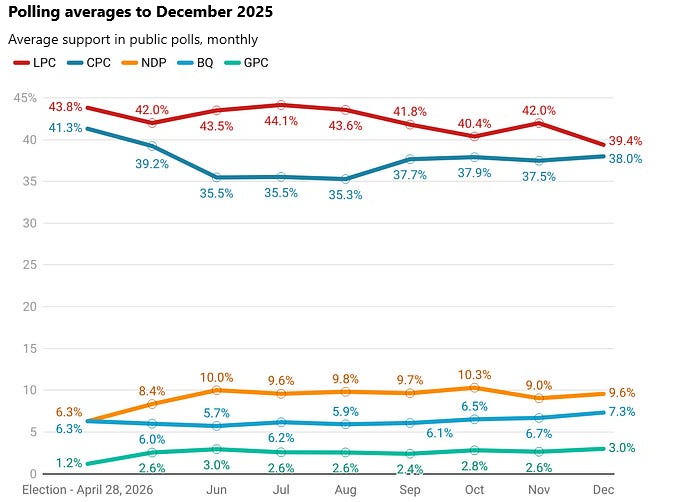
Pollsters’ December reports framed federal political support as “deadlocked,” “a coin toss” and “gripped in a tie.” Left unsaid was that both the Liberals and Conservatives have lost ground and the smaller parties are up. But are those smaller party gains bankable?
Data Shows’ average of the 14 publicly released polls in December shows the Liberals down 4.4 points and Conservatives down 3.3 since the April election. The NDP is up 3.3, Greens up 1.8 and BQ up 1.0.
Before NDP supporters get excited, there’s good reason to think, for now anyway, the pollsters’ framing isn’t wrong.
In the abstract, you’re my choice
There was no threat of an election in December, as Canadians responding to pollsters were well aware. So their responses were about an abstract decision, one not pressurized by the real risks voters face in a real election.
If their responses were amid an election campaign and polls were showing the big two parties “gripped in a tie,” minds of many liberal-left supporters of the NDP would be churning over a key thought: the Conservative are a threat, “strategic voting” is required.
Maybe before the next election call the NDP can rally back to 20 per cent. But in the heat of a “deadlock” election campaign, those gains can melt before election day.
Perhaps there are more pathways, and comments are open, but it seems there are three ways the NDP’s strategic voting countdown bomb can be diffused. By surpassing the Liberals. By hardening its own support. Or by eliminating the Conservative threat.
Surpassing the Liberals
The NDP surpassing the Liberals in the polls would make it the strategic choice for the “Not Conservative” liberal-left voter. Though it’s difficult to believe this support gap can be bridged before the next election, politics can be unpredictable.
The problem is, banking on surpassing the Liberals and reversing the logic of strategic voting is an all-in wager. If they don’t surpass, and it’s a “coin toss” election, any gains made vaporize.
But despite the strategy’s unlikely medium-term success, it should be pursued. If the NDP gains from the Liberals but cannot surpass them, any partial success toward the goal can be reaped if another strategy can successfully diffuse strategic voting.
Hardening NDP supporters
Hardening supports means increasing voter loyalty, regardless of anticipated electoral outcome. It requires either strong affinity to the NDP or strong antipathy to the others. It needs a unique party identity in sharp contrast to the others — so sharp that supporters will cast an NDP vote and let the chips fall where they may.
To be successful, hardening doesn’t need supporters who believe the other choices are the same, only that both are no good. It benefits from a strong sense of personal identity about where a supporter “fits” into politics. Bargaining over material gains, such as a dental plan or some money for this or that, tends to undermine political identity. Something that can be bargained can be divided. An identity cannot.
As Carney moves right, hardening support is certainly possible. But data tables provided by IPSOS shows how far the NDP is Delmar the goal.
IPSOS shows that while the NDP now holds about 10 per cent support, only 41 per cent of them disapprove of Mark Carney. From that we might think the NDP’s hardened core is 4.1 per cent of the electorate.
Only 41% of NDP voters disapprove of Carney’s performance
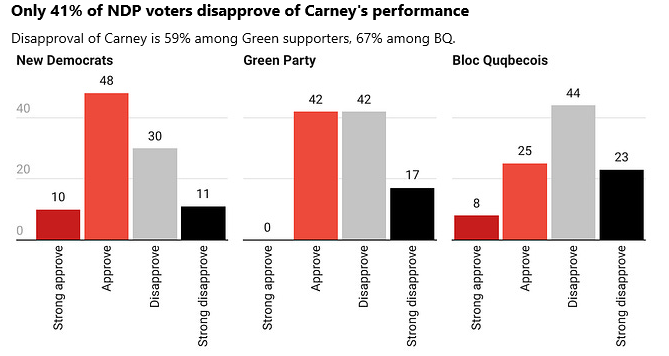 Disapproval of Carney is 59% among Green supporters, 67% among BQ.
But unlike surpassing, a payoff from hardening support isn’t contingent on another strategy’s success if hardening isn’t fully successful. If no other party is good for someone’s personal political identity, that vote is decided, regardless of the conditions.
Eliminating the Conservative threat
Finally, there is the strategy of eliminating the threat that activates strategic voting, high Conservative support. Poilievre’s party is current at 38 per cent. The experience of the 2019 and 2021 elections suggests if the Conservatives were at about 34 per cent the perception of a threat would be abated.
We saw in November’s polling analysis that while Carney’s rightward move is helping the NDP it is also eroding the Conservatives. And perhaps there is more of that to be had. But the NDP should be looking to shave at least three points off the Conservatives if they want to eliminate the threat.
Like the goal of surpassing the Liberals, a payoff from driving Conservative support to 34 per cent or lower requires that either the strategy is fully successful or another successful strategy protects partial gains made. In a “coin toss” election, Conservatives may be able to call home “Not Liberal” voters who shifted to the NDP.
All of the above
While hardening support is the most reliable strategy, surpassing the Liberals and eliminating the threat of a Conservative government probably have the greatest payoff.
The issue is not to select between the strategies, but to create a harmonizing grand strategy that ties together three campaigns in the three theatres: the first between the NDP and Liberals, another with the NDP and its own supporters, and the third between the NDP and the Conservatives.
If a new NDP leader in 2026 can find that harmony, the party has a good chance of making gains, and holding them until day the votes are cast.

Discover more from Burlington Gazette - Local News, Politics, Community
Subscribe to get the latest posts sent to your email.
