





 By Tom Parkin

October 16th, 2025
BURLINGTON, ON
They’re called “global tariffs,” but as the top supplier of steel, lumber and aluminum to the U.S., Canada is being hit harder than any other country. Is that the point?
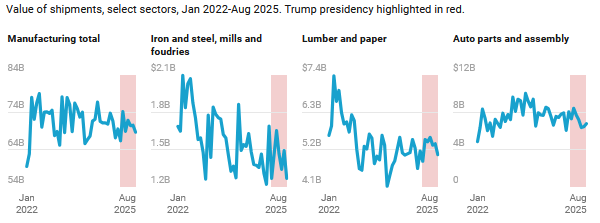
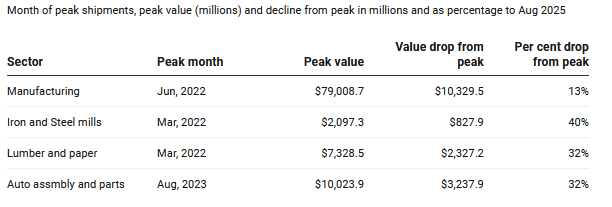
When the latest Trump presidency started, Canada was both a large import source and already weak in the sectors he later targeted with global tariffs. And it raises the question whether Trump tariffed them because Canada’s vulnerabilities were in those sectors — that hitting them was his way to specifically target Canada. Counter-factually, it raises the question or what Trump might have done differently if our key industries were in stronger shape.Maybe that’s a bit conspiratorial. Or narcissistic for Canadians. But there is a pattern to at least consider.Trump has introduced significant global tariffs on steel, lumber, vehicles and aluminum. All those manufacturing sectors were already significant down before his tariffs, according to Statistics Canada’s Survey of Manufacturing for August, released on Wednesday.Canada’s recent manufacturing peak was in mid-2022. Some of that peak was possibly a rebound from shipping and production delays caused by COVID in 2020 and 2021. But 2023 and 2024 generally did not see improvements, except in the auto sector, which peaked in mid-2023 and has slid significantly since.StatsCan’s data on aluminum isn’t full enough to include as a chart with timeline and Wednesday’s report didn’t include August data for the industry. But data for July, 2025 showed the lowest month of production since at least January 2022.
Steel, aluminum and lumber tariffs are attacks on Canada
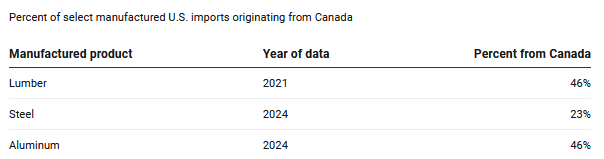
Because of Canada’s significant role as a supplier of manufactured goods to the United States, when Trump puts a global tariff on steel, lumber or aluminum he is hitting Canada far harder than any other country. Canada is the top provider of steel, lumber and aluminum to the United States.And that raises the question of whether the target is Canada and the selected “global” tariffs are just the mechanism of the attack. Further, if those global tariffs were selected for their impact of Canada, was the weakness of the sectors going into the Trump presidency the reason for their selection?Or is that all just a bit narcissistic of a Canadian to think taking production from Canada is a central pieces of Trump’s thinking?
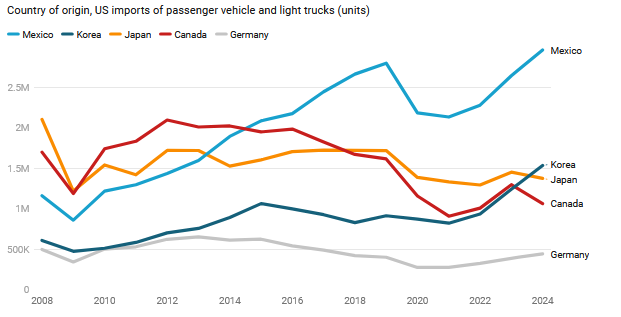
The auto industry export declineWhile the downturn in Canadian lumber, steel and aluminum has been more recent, the tumble in vehicle manufacturing has been more long term.Auto imports from Canada have been on a decline for more than a decade. From being the top U.S. provider in 2012, Canada was last year fourth. Passenger vehicles and light trucks imported from Canada fell form 2.1 million in 2012 to 1.1 million units last year. Vehicles assembled by Canadians comprised 30.2 of U.S. imports in 2012 falling to 13,3 per cent in 2024.Unlike the Canada focus of tariffs on aluminum, lumber and steel, Trump’s auto tariffs have a much more global scope. In auto, Mexico is the primary victim as its workers assembled 36.9 per cent of imported passenger vehicles and light trucks last year.
The auto industry export declineWhile the downturn in Canadian lumber, steel and aluminum has been more recent, the tumble in vehicle manufacturing has been more long term.Auto imports from Canada have been on a decline for more than a decade. From being the top U.S. provider in 2012, Canada was last year fourth. Passenger vehicles and light trucks imported from Canada fell form 2.1 million in 2012 to 1.1 million units last year. Vehicles assembled by Canadians comprised 30.2 of U.S. imports in 2012 falling to 13,3 per cent in 2024.Unlike the Canada focus of tariffs on aluminum, lumber and steel, Trump’s auto tariffs have a much more global scope. In auto, Mexico is the primary victim as its workers assembled 36.9 per cent of imported passenger vehicles and light trucks last year.

Discover more from Burlington Gazette - Local News, Politics, Community
Subscribe to get the latest posts sent to your email.

This is what Canadian’s don’t get, Trump is on a mission to reduce the US deficit and he believes tariffs are a way to work to that goal. You can agree or disagree, but that is what he is doing, and what most in the US voted for.
There is direct revenue from tariffs, and in addition to investment, and GDP growth that investment brings. Add to this revenue, the cost savings from DOGE, the cost savings associated will illegal migrants, cost savings from war in Ukraine (the EU is now picking up their fair share), cost savings from fighting terror proxies from Iran, cost savings from illegal drugs, it all begins to add up.
He’s targeted steel and aluminum because he can use legislation related to security to override CUSMA.
Needless to say, the results are obvious, Carney as been an abject failure in this regard as news breaks daily of more business moving to the US.