



By Hadrian Mertins-Kirkwood and Davic McDonald
April 18th, 2026
BURLINGTON, ON
Fast facts
Oil and gas prices are rising due to the war on Iran. This analysis examines how the Canadian oil industry stands to profit as a result. While every effort should be made to end the war on Iran, Canadian governments should, given the circumstances, tax the current and upcoming corporate windfall and reinvest that money for the greater public good.
Cashing in: If oil prices remain at current levels for the next 12 months, the Canadian oil industry is on track to make $90 billion in profits, which is $60 billion more than it would have earned without the war.
A new recovery dividend: In 2022, the federal government introduced a one-time, 15 per cent tax on excess pandemic profits from the financial sector. Applying that 15 per cent rate on the excess profits of the oil industry could generate $9 billion over the next 12 months.
A more ambitious model: Tax fairness advocates have called for a 33 per cent windfall tax on profits above 120 per cent of pre-crisis profit levels. Applied to the oil industry today, that approach could generate $18 billion over the next 12 months.
Learning from the war effort: In 1940, the Canadian government applied a 75 per cent tax on all profits above a company’s pre-war average profits. Applying that rate to the oil industry in our current price scenario could generate a staggering $46 billion over the next year in public revenues on top of regular royalties and taxes.
For Canada’s oil regions, the current windfall could very well be the industry’s final boom. That makes it all the more important that proceeds be reinvested into economic diversification and industrial planning.
The Canadian oil and gas industry is making an extra $170 million in profits every day due to the U.S. and Israeli war in Iran, which has driven up global oil prices by more than 50 per cent.
In the first month of the war, the Canadian oil industry made after-tax profits in excess of $6 billion dollars, which is $4 billion more than it pocketed the month before. If oil prices stay this high for 12 months, the industry is on track for $90 billion in profits, which is $60 billion more than it would have earned without the war.
These rough estimates, which are based on our own economic modeling of the oil industry, hinge on two big questions: How high will oil prices go? And how long will they stay high?
Despite the periodic assurances of the U.S. administration, there is little indication that the conflict in Iran will resolve either quickly or smoothly. To better understand the potential impacts of different oil prices on industry profits, we have developed one baseline scenario and two forward-looking scenarios.
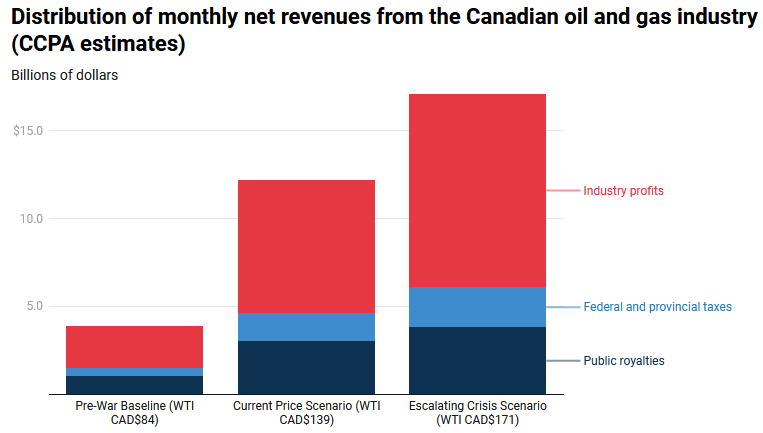
First is the Pre-War Baseline, which is based on data from the six months leading up to the war, including an average oil price of US$65 per barrel (Brent crude, converted to a West Texas Intermediate price of CAD$84). Second is a Current Price Scenario, which assumes the average oil price over the past two weeks of US$105 (CAD$139) per barrel continues to hold for the next 12 months. Third is an Escalating Crisis Scenario, wherein oil prices rise to US$130 (CAD$171) per barrel—a doubling of pre-war levels, which is a similar trajectory to the 1979 oil shock. For each scenario, we estimate revenues, expenses (including royalties and taxes) and profits for the Canadian oil industry.
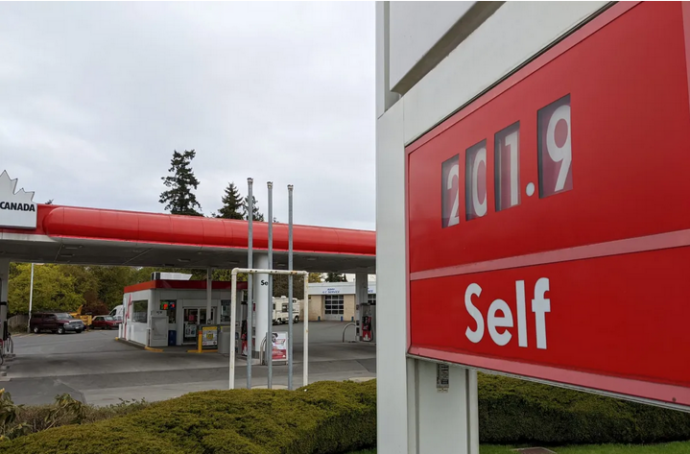
The sign speaks for itself.
The difference between the baseline and current price scenarios represents the trajectory we are on right now. As noted above, it amounts to a potential $60 billion in excess profits for the Canadian oil industry over the next 12 months. The gap between the baseline and escalating crisis scenarios—a potential situation where prices go even higher than they are today—amounts to $100 billion in excess profits for the industry. In either case, those windfalls are piled on top of the $30 billion in profits the Canadian oil industry was already expected to rake in over the next 12 months.
The war on Iran is a humanitarian, environmental and political crisis that is likely to do far more harm than good for Iranians and the international community. Profiteering by the oil industry is just one of the many dark and predictable consequences of American Imperialism.
If there is a silver lining here, it is in rising public revenues due to the royalties and taxes paid by the oil industry in Canada. In the first month of the war, net revenues from the sector jumped from an estimated $4 billion up to $10.6 billion. Although the industry captured 61 per cent of that increase—a rise in estimated after-tax profits from $2.4 billion to $6.4 billion—the other 39 per cent went to the public. We estimate that royalty payments in March 2026 increased from $1 billion to $2.8 billion while corporate income tax payments (federal and provincial) increased from $500 million to $1.4 billion.
Already, the Government of Alberta is raking in an extra $40-60 million per day due to the war-induced oil shock. Just last month, the province projected a $9.4 billion deficit, but it is now on track to balance the budget within months (and post a major surplus by the end of the year).
(Note that the preceding figures are based on an average oil price of CAD$128 during the month of March, but will be higher in each month moving forward due to a higher baseline oil price.)
While the public is receiving a share of the proceeds from the oil shock, it is not automatically a fair share. What the federal and provincial governments need to decide is whether the oil industry should be allowed to profiteer on this crisis or whether a greater share of those profits should be redirected toward the public good.
In our current price scenario, the oil industry is on track for $90 billion in after-tax profits over the next 12 months, which is equivalent to more than three per cent of GDP. That’s a lot of money. But, more importantly, that money is coming from somewhere. The oil industry did not suddenly get more productive. Those profits are the result of a redistribution away from global energy consumers, including Canadian workers and businesses.
Canadian households spend upwards of $5 billion per month on transport fuels, so the consumer price tag of war on Iran due to higher gasoline and diesel prices alone is already closing in on $1 billion. Costs to businesses, supply chains, home heating and more push the actual economic costs even higher, which will almost certainly be reflected in higher inflation for months to come. Indeed, the last oil price shock in 2022 cost the average Canadian household $12,000, and this one is looking to be much worse.
In other words, the Canadian oil industry is getting rich on the back of a global economy struggling with high fuel prices and deep instability. To make matters worse, a large share of those proceeds will go to the majority American shareholders of the biggest oil companies operating in Canada, such as Imperial Oil, a subsidiary of ExxonMobil. Oil workers, in contrast, receive nothing but higher gas prices, as increased profits have little bearing on wages or hiring in an industry where jobs have been in structural decline since 2014.
In that context, Canadian governments should be considering options for taxing the excess profits of the oil industry, something that the Alberta Federation of Labour, 350.org and others have recently called for. There are several models to consider for ensuring that the benefits of this crisis, such as they are, offset some of the costs.
In 2022, the federal government introduced the Canada Recovery Dividend, a one-time, 15 per cent tax on excess pandemic profits from the financial sector. Applying that 15 per cent rate on the excess profits of the oil industry—that is, applying it only to profits that exceed the pre-war baseline—would generate around $800 million per month ($9 billion over the next 12 months) in our current price scenario.
A more ambitious model comes from Canadians for Tax Fairness, which proposes a 33 per cent windfall tax on profits above 120 per cent of pre-crisis profit levels. Applied to the oil industry in our current price scenario, that would generate $1.5 billion dollars per month ($18 billion over the next 12 months).
History, however, provides an even more radical model. In 1940, the Canadian government introduced the Excess Profits Tax Act, which applied a 75 per cent tax on all profits above a company’s pre-war average profits (with various nuances). Applying that rate to the oil industry in our current price scenario would generate $4 billion per month (a staggering $46 billion over the next year) in public revenues on top of regular royalties and taxes.
Incredibly, even if the public assumed such a large cut of the industry’s war-driven proceeds with a 75 per cent windfall tax in place, the oil industry would still make $44 billion in after-tax profit in the next year, which is still $14 billion more than it would have made without the war on Iran. In our escalating crisis scenario, where prices go even higher than they are now, a 75 per cent windfall tax would direct $78 billion into public coffers and the oil industry would still enjoy $55 billion in profit.
Consider what the federal government could do with an extra $46 billion.
On the one hand, any money that goes into general revenues could be used to advance any number of public policy priorities. It could address the problem of hallway medicine and doctor shortages, for example, or fund years of public pharmacare and dental care. It could increase the federal government’s affordable housing budget several times over. It could help stabilize a post-secondary education sector in crisis. It could also cover the majority of Canada’s $63 billion in new defence spending.
However, there is a strong case to be made that any windfall revenues should be reinvested in addressing the direct costs and structural causes of the current crisis.
At its core, vulnerability to the oil shock is a function of fossil fuel dependence. The less we need to burn oil, the less the price of oil matters. That has implications for Canada as both a producer and a consumer of fossil fuels.
On the consumption side, we should be aggressively decarbonizing our economy to insulate households from future (or continued) oil price shocks. That $46 billion could pay for five to 10 years of free public transit across the country, for example. It could pay for the purchase and installation of four to five million heat pumps—more than enough to replace most home heating oil systems and gas furnaces in Canada. Or it could pay for a million electric vehicle charging ports, meeting all of Canada’s consumer EV infrastructure needs for the next two decades.
On the production side, we need to recognize that the current windfall will not last forever. Oil demand was already forecast to peak within a decade, and the Iran crisis may have pushed the peak forward by several years. Rather than seeking new sources of oil, which would be to the benefit of the Canadian oil industry, the crisis is encouraging energy-importing countries to double down on renewables and other clean tech. The UK, for example, just required all new homes to be built with heat pumps and rooftop solar panels as a direct response to the war on Iran.
For Canada’s oil regions, the current windfall could very well be the industry’s final boom. That makes it all the more important that proceeds be reinvested into economic diversification and industrial planning, especially in Alberta, where the government may collect tens of billions of dollars in unexpected revenues this year even without a new windfall tax.
We need to skate where the puck is going to be. A windfall tax on the oil industry can help us get there.
About the authors:
 Hadrian Mertins-Kirkwood (he/him) is a senior researcher and political economist at the Canadian Centre for Policy Alternatives. His work focuses on federal economic, social and environmental policy, especially in the areas of climate change, artificial intelligence and industrial strategy. Hadrian edits the monthly Shift Storm newsletter on climate and labour.

Discover more from Burlington Gazette - Local News, Politics, Community
Subscribe to get the latest posts sent to your email.

Pure socialism, this happens every time oil prices spikes. Of course there are no calls for help to the industry when oil was at $30/b. I bet on the US being successful in Iran, sold half my position in Canadian energy 3 weeks ago, switched to Canadian banks which were low. I was buying canadain oil companies when they were low 10 years ago and in some cases tripled my money while collecting a 4% dividend. I’ll buy back Canadian oil and gas when prices stabilize as they generate free cash flow like no one else. These guys, if they’re so smart should quit complaining and learn real world economics and finance and lobby Carney for a pipeline to the west coast so we can have a steady flow of tax revenue for many years to come. Pathetic!