




 By Pepper Parr
February 6th, 2026
BURLINGTON, ON
Is there finally going to be a reckoning over what social media has done to us?
Toronto Star reporter Allan Woods writes: “As Ottawa readies a bill to protect Canadians — particularly children — online, the view from the front lines of this fast-shifting digital world shows there is a need to act even in the face of bracing American headwinds.
That’s the assessment of Dr. Susan Sawyer, a University of Melbourne pediatrician and the chair of Adolescent Health at the Murdoch Children’s Research Institute.
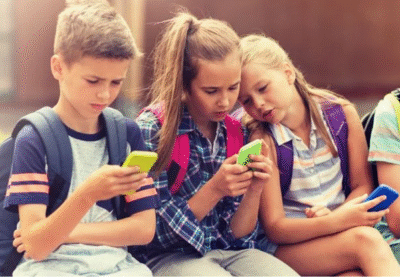
Watching the art of conversation being lost.
Sawyer is studying of the effects of Australia’s two-month-old social media ban for kids under 16, and fielding inquiries from across the world. That includes Canada, which is reportedly considering a similar ban for young Snapchatters, TikTokkers, Instagrammers and Xers (formerly Tweeters).
Last week, Toronto’s Hospital for SickKids was picking her brain. Later this spring, she’s off to Stanford University, which is evaluating the impacts of Australia’s online safety laws.
“(It) feels like it’s an absolute tectonic shift in what has been a complete power imbalance in favour of the tech companies,” Sawyer said in an interview.

Parents at a Community gala.
“Social media has become a failed state, a place where laws are ignored and is endured, where disinformation is worth more than truth, and half of users suffer hate speech,” Sanchez said this week. “If we want to protect them, there’s only one thing we can do: take back control.”
Prime Minister Mark Carney’s government is moving in the same direction. There are reports a social-media ban is under consideration. The Liberals campaigned on a promise to “make sure that social media platforms and other online services are held accountable for the content that they host.”
The measures will undoubtedly be met by support — from parents most of all.
When Sawyer was talking to SickKids last week, she said the consensus was: “Every other industry is regulated, so why do the tech bros have this belief in tech exceptionalism?”
“These are commercially driven enterprises. They are there to make money,” she said. “Why would we have any expectation of them putting up guard rails that most parents and most governments would be expecting?” But with U.S. tariffs against Canadian goods and a looming review of the Canada-U.S.-Mexico free trade deal, the pressing political question is how far Culture Minister Marc Miller’s online safety legislation will go in limiting the likes of Elon Musk, Mark Zuckerberg and the other American tech titans.
After all, Carney’s opening offer to Trump last summer in the unresolved trade dispute was the scrapping of a Digital Services Tax, which was mostly paid by U.S. firms.
Trump signed into law a bill to criminalize the publication of AI-generated nude images — deepfakes. At the ceremony, his wife, Melania, described artificial intelligence and social media as “the digital candy for the next generation: sweet, addictive and engineered to have an impact on the cognitive development of our children.”
But the reality in the White House and the Republican-controlled Congress is that measures touted in Madrid, Paris, Canberra or Ottawa as online protection are perceived as anti-American persecution.
Just a few weeks before Australia’s online safety legislation took effect, the country’s eSafety Commissioner, Julie Inman Grant, was summoned to testify before a congressional committee about a law that “imposes obligations on American companies and threatens speech of American citizens.”
The Republican committee chair, Rep. Jim Jordan, referred to Grant as a “noted zealot” for legal takedown orders issued to tech and social media companies.
And the state of Wyoming has recently begun considering a bill dubbed the Guaranteeing Rights Against Novel International Tyranny and Extortion (GRANITE) Act.
It would allow Americans to sue foreign governments for violations of their free speech and prohibit American officials from acting on the orders of foreign social media or internet regulators to remove material deemed harmful or illegal.

Two teachers at an awards event in Milton, Ontario
That is the rumbling from south of the border that the Carney government will need to listen to as it balances online harms against the many other types of political and economic pain the Trump administration may try to inflict.
That should not shake the resolve to act. Sawyer says there are early signs from Australia and elsewhere showing a definite association between heavy social media use and negative emotional health and well being, though the numbers are “not as large as I think many parents might assume.”
“But that doesn’t mean that a small effect size doesn’t matter.”
They have also found that parents who spend too much time on social media tend to have kids who do the same.
Monkey see, monkey do.
Allan Woods is a Paris-based staff reporter for the Star.

Discover more from Burlington Gazette - Local News, Politics, Community
Subscribe to get the latest posts sent to your email.
