





 By Pepper Parr
December 21st, 2025
BURLINGTON, ON
Pipeline to Permit
The name given to a computer program created by the Planning department that tells you what is taking place in the way of development.
It is a brilliant application that tells you more than you will ever want to know about any development that is on the books.
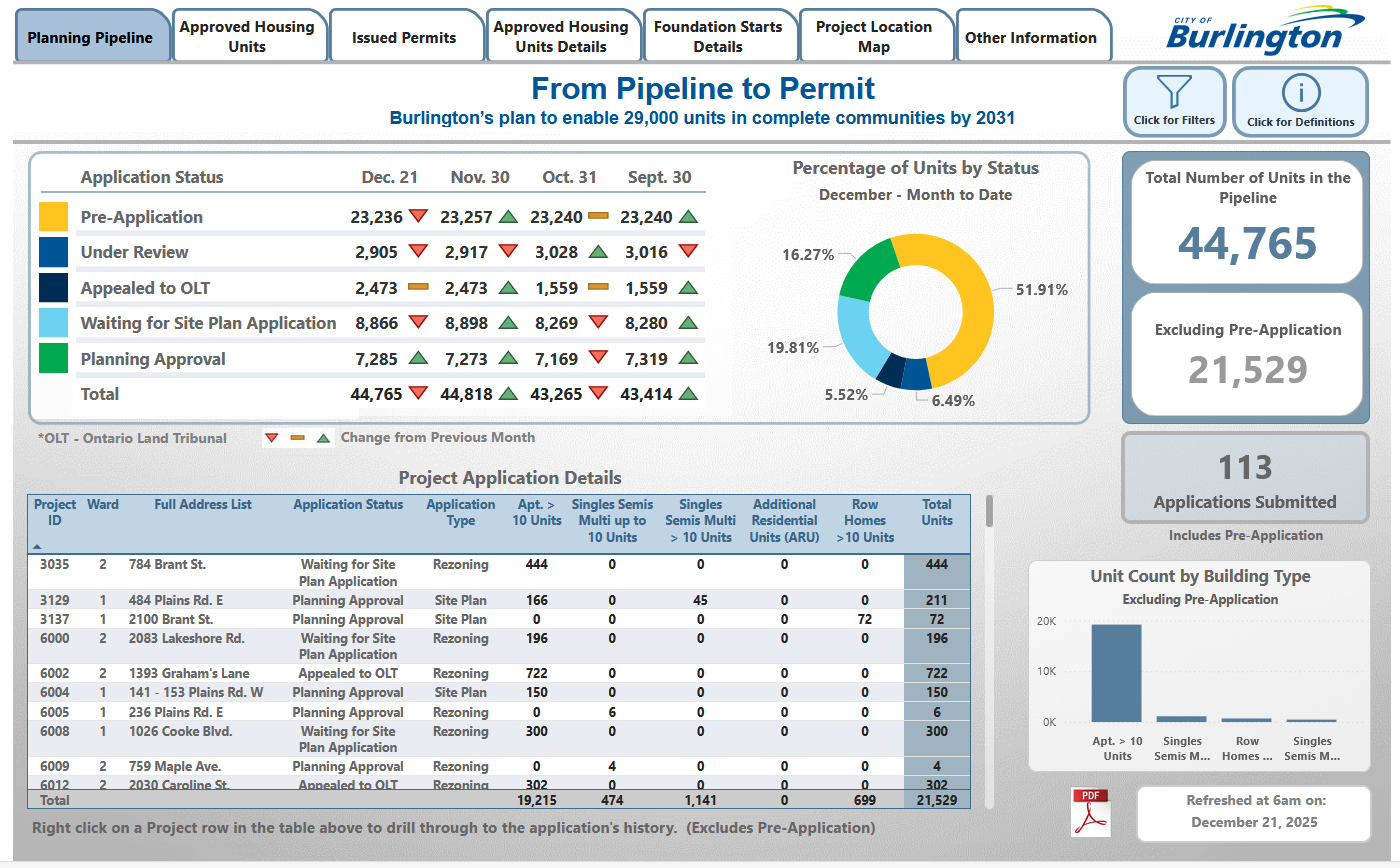
This is what the opening page of Pipeline to Permit looks like. It’s one of the smartest things the Planning department has ever done.
Where it is located, what it consists of and where it stands in terms of actual development.
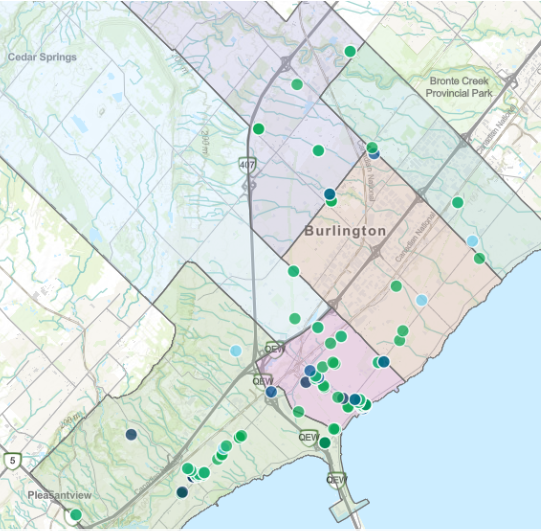
This page shows where the developments are located. Click on one of those dots, and you get taken to the development where everything you want to know is there – including a “Dig Deeper” button.
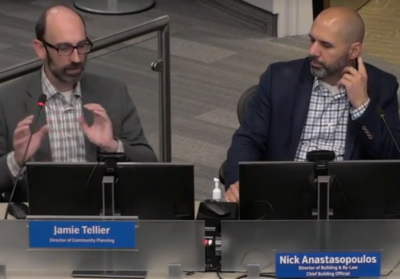
Jamie Tellier and Nick Anastasopoulos worked together to make this happen. When the idea was clear, they turned to Chad MacDonald, Executive Director, Digital Service and Chief Information Officer to make it happen.
It would be easy to spend a couple of hours scrolling through all the developments that are underway.
The idea came out of the Planning department and was crafted by the people in Digital Services.
Mayor Meed Ward can’t stop boasting about the program – and well she should. She speaks of selling the concept to other communities – good idea – no word on just how far that idea went.
If you want to know how the city is going to grow, this is the best place to start.
Click HERE to get there. Bookmark this address – you will want to return to it often. The moment there is a change with any development the dashboard is updated.

Discover more from Burlington Gazette - Local News, Politics, Community
Subscribe to get the latest posts sent to your email.

Burlington’s decision to make its permitting pipeline and related web data publicly accessible is a welcome step toward transparency. For residents, builders, and policy watchers alike, it offers a robust, detailed view of where projects sit in the approval process and helps demystify a system that is often criticized for being opaque. In that respect, the city deserves credit for providing the tools needed to understand the paper pipeline.
However, transparency alone does not substitute for outcomes. The contrast between what the data shows and what is actually being delivered on the ground is stark. As of 2024, Burlington recorded just 67 housing starts against a provincial target of 2,417, despite having 45,599 housing units in various stages of approval. That gap between approvals and construction is now carrying tangible consequences, including the loss of provincial grant opportunities tied to housing performance metrics.
City officials, including Mayor Marianne Meed Ward, have argued that the province’s criteria are unfair and fail to account for market conditions, labour shortages, financing challenges, and infrastructure constraints that municipalities do not fully control. That critique may have merit. But from the province’s perspective, funding is increasingly tied not to intentions or approvals, but to measurable housing delivery.
The permitting pipeline data is therefore a double-edged sword. It demonstrates openness and effort, but it also reinforces the reality that Burlington’s challenge is no longer visibility – it is velocity. If future funding and development opportunities are to be protected, the focus must shift from documenting readiness to removing barriers that turn approved units into built homes.
In short, the data is useful, honest, and necessary – but without corresponding construction progress, it also underscores why Burlington is struggling to meet provincial expectations and retain critical funding.