




 By Norman Coles
September 17th, 2025
BURLINGTON, ON
I treat the board as a quick break I can start and finish on time. A ball drops, bounces through a set of pegs, and lands in a slot with a posted multiplier. Because the path is random, I focus on what I actually control: tiny stakes, short blocks, clear rules, and a clean exit. I keep a simple log after each block—stake, number of drops, result, mood. That one line helps me start the next round calmer and avoid myths. I also set a short timer so the session stays light. When the timer rings, I stop even on a win; that one habit protects tomorrow’s focus and makes this hobby easy to repeat without stress.

How I set up a clean, quick session
How I set up a clean, quick session
The first minute is for comfort: screen brightness, sound off, and a row count I can read at a glance. I want a layout that shows stake, recent results, and the payout map in one view so I don’t dig through menus. After that warmup I run a tiny demo on a trusted hub, and if I decide to test live with a few drops, I use a simple entry like plinko casino mid-sentence in my notes as a reminder that each drop costs what I choose and nothing more. I keep the first stake small enough to forget by bedtime. If I see stutter, fuzzy labels, or hidden toggles, I switch fast. A clean loop reduces mistakes that look like luck but are actually rushed hands, and that clarity is what I’m after.
Three numbers and one timer
Before the first drop I write three numbers on a sticky note: stake per drop, number of drops, and two stop lines—one for gains, one for losses. The note stays in view, so I don’t renegotiate mid-run. If the board offers low, medium, and high risk tiers, I start in the middle and hold that choice for the whole block. When I feel tilt—tight jaw, quick clicks, restless eyes—I pause, sip water, and either finish calmly or end early. I am not “beating” a pattern; I’m keeping a routine that fits busy days and leaves me clear-headed for the next task. That’s the point of a short session.
Here’s the small checklist I run after a long paragraph or two, never at the start:
- Keep one tiny stake for the entire first block.
- Set gain and loss lines you will not cross.
- Use a timer and stop when it rings, even on a win.
After block one, I audit the flow: did the board accept input quickly, did the history log update instantly, did the cashout page load without delay? If yes, I repeat the same numbers for one more short block and call it a day. If any part felt sticky, I fix it or I walk. Small, repeatable steps turn scattered urges into a simple, repeatable hobby.
What I expect from a fair board and a tidy app
Good design makes itself invisible. I tap, the ball falls, the result posts, and I can act at once. Clear text beats loud themes. Buttons should sit within easy reach on a phone so my thumb doesn’t stretch. A reliable history tab with timestamps lets me audit a block later. I like help pages that explain random draws and payouts in plain language. Deposits and cashouts should feel boring—in the best way—no surprise screens, no odd loops. If any piece of the flow feels vague, I leave before the next drop. I also try both portrait and landscape on mobile to see where the drop button feels natural; fewer mis-taps means fewer “losses” that were really input errors.
Speed, clarity, and support
Speed keeps the loop short and helps me stick to limits. Clarity means I can read the payout map and my last drops without guessing. Support is the safety net when something odd happens. I run a tiny pipeline test—one small deposit, a handful of drops, one small cashout—and judge by how ordinary it feels. A short, specific reply from help earns trust; a wall of canned lines does not. For reference, I keep this table near my keyboard; it follows a calm paragraph so it doesn’t jump in cold:
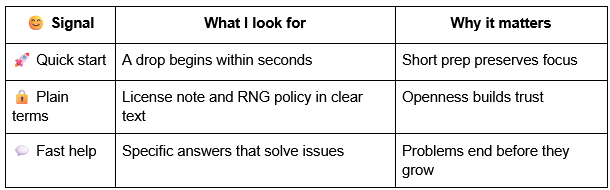
| Signal | What I look for | Why it matters |
| Quick start | A drop begins within seconds | Short prep preserves focus |
| Plain terms | License note and RNG policy in clear text | Openness builds trust |
| Fast help | Specific answers that solve issues | Problems end before they grow |
Once a board passes these checks, I give it modest time and keep my plan stable. If it fails, I close it rather than argue with it. Smooth tools protect my limits by removing friction that nudges bad decisions. Fancy visuals don’t matter if they slow the interface or hide key buttons. I want brisk admin and a lively ball—nothing else.
After another paragraph, I’ll add one more compact list, spaced away from the last one:
- Try demo first for layout, speed, and mute settings.
- Run one micro live block to test history and receipts.
- Save a screenshot of terms and your first receipt for the folder.
Reading randomness without myths
I describe the board to myself as a chain of small forks I cannot steer. That framing keeps me from chasing the idea of a perfect drop point. I still vary drop starts to keep the act playful, but I don’t treat those choices as a strategy. Words guide behavior, so my notes avoid “due,” “hot,” or “cold.” I write about inputs I control: stake, block length, time of day, posture. When I fix those, the session becomes a quick, focused task instead of a mood ride. I also treat energy like a resource; late blocks with low focus tend to stretch, so I move them earlier when I can. The goal is a loop I can run and end on time, not a streak I try to extend.

Handling streaks without chasing
Streaks cluster. A quick run of wins tempts me to scale up; a run of misses tempts me to recover fast. Both urges break the plan. I defend the plan with rules set while calm. When I hit the gain line, I pocket some and finish the block at the same or smaller stake. When I hit the loss line, I stop for the day—no “one last drop.” I also track tilt: rushed clicks, tight shoulders, shallow breath. If those show up, I reset with water and a short walk. Fixing the body often fixes the play better than more drops do. For readers who like a single, neutral landing page to try a short demo and a tiny live block, I point to this simple entry I keep bookmarked: plinko.
Here, spaced away from the last list, is a final compact trio that I use when streaks try to steer me:
- Write gain and loss lines before the first drop.
- Pocket early and avoid scaling mid-block on a hunch.
- End on the timer; a calm exit is the win that compounds.
A weekly rhythm and a lightweight log
I play three or four short blocks per week, never back to back on heavy days. Morning coffee fits five drops; lunch fits ten; evenings are optional and shorter. If I feel rushed, I skip the day. This stays a hobby by staying small. I rotate devices to see what suits my hands. On desktop I aim for readable slots and a drop button that stays put after resize. On phone I check whether the button sits under a natural thumb arc and whether haptics help or distract. I revisit terms monthly and retire any build that adds clutter or delay. Moving on is faster than adapting to pain points, and the habit of moving on keeps the routine clear.
A template that actually helps
My log is plain text so it opens fast. I name files by date and group blocks by morning, noon, or evening to track energy. Instead of “luck good” or “luck bad,” I write “focus steady” or “focus low.” One line per block: device, row count, stake, drops, result, mood, friction (if any), and whether I ended on time. On Sundays I skim the page and choose one small tweak for the next week—stake, block length, or time of day—and change nothing else. That single-change rule lets cause and effect show up without noise. If I add a new board, I run the same demo-to-live pattern and compare notes to my baseline. The habit matters more than a hot run, and the habit is what improves the next ten minutes.
I also keep language clean when I talk with friends about this hobby. I rarely say “plinko game” out loud; I usually say “the board,” because that phrasing removes drama. If we play together, we set limits before starting and share one lesson after, not during. Mid-drop advice adds noise; post-session notes add learning. When the timer rings, I stretch, drink water, and step away from the screen. The board will be there tomorrow; my attention is the part I protect. And if an app starts to creep in extra friction, I retire it early rather than tolerate it. A simple routine deserves simple tools.
I’m closing with a direct nudge because this works best when you try it. Pick a readable board, set one tiny stake, plan ten calm drops, and run a short demo before a single live block. Keep a one-line log—stake, drops, mood—then end on your timer. If the loop felt smooth, repeat tomorrow; if it felt rushed, adjust one thing and try again. Start now, and send me that single-line note so we can shape your next short run together.

Discover more from Burlington Gazette - Local News, Politics, Community
Subscribe to get the latest posts sent to your email.
