




 By Tom Parkin
December 1st, 2025
BURLINGTON, ON
Improved net imports kept GDP positive, but falling household consumption and higher capital investment arising only from a narrow increase in weapons systems is not a win.
Canada’s quarterly change in GDP, Q1 2022 to Q3 2025
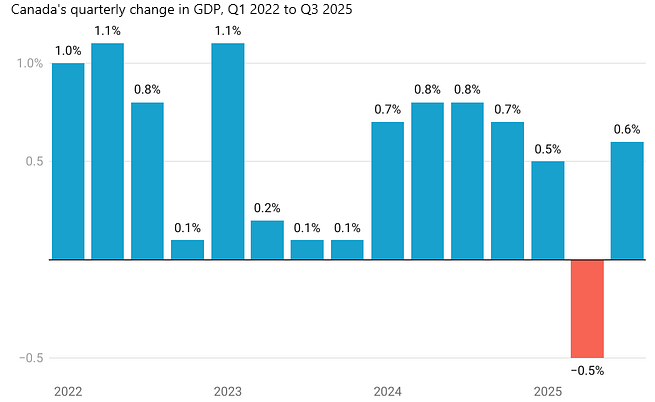
Last Friday’s report of a 0.6 per cent GDP increase in the third quarter had the prime minister practically popping champagne bottles. But a deeper data look suggests any self-congratulations should be put on ice and a focus on jobs and affordability needs to become more urgent.
A 0.6 per cent GDP boost in Q3 is just 2.4 per cent annualized, a pretty mediocre growth rate at any time. And this year’s GDP growth isn’t going to be 2.4 per cent, or anywhere near it.
Canada’s GDP grew 0.5 per cent in Q1 then shrank 0.5 per cent in Q2. So with three of four quarters now played, we are at an annual GDP growth rate of 0.6 per cent for 2025.
And in its Friday report, Statistics Canada provided its “advanced estimate” for October, which showed GDP shrank 0.3 per cent that month.
Champagne, anyone?
Improved net trade drives positive GDP topline
And even in the Q3 data there are worrying signals.
Statistics Canada breaks GDP into several components. The one that pushed GDP into positive terrain was improved net imports, which gained $19.3 billion.
Components of GDP
Major components of GDP and change Q2 to Q3
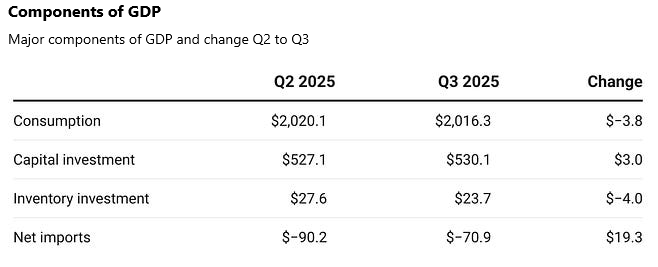
Q3 imports fell $17.9 billion on a seasonally adjusted and annualized basis while exports rose $1.3 billion, a $19.3 billion net change.
Imports were down for consumer goods, overall. Food imports were almost unchanged while medicines or health product imports increased $3.8 billion. But there were declines in imports of furniture and fixtures (down $612 million), appliances and supplies (down $3.1 billion) and clothing (down $1.9 billion).
A deeper look into household spending data shows that where consumer goods imports have fallen, it doesn’t necessarily mean household spending has fallen. Though furniture and fixtures spending was down $1.3 billion, appliance purchases fell a very slim $20 million, and clothing and footware purchases were up $1.1 billion. We may be seeing some effect from Canadians’ strengthened preference for purchasing Canadian-made products. More of that, please.
But lower imports for businesses may not be the same positive story. Imports of industrial machinery were down $7.0 billion and “intermediate metal products,” such as steel to build cars, were down $5.8 billion.
It’s great to have lower imports. But Canadian workers need more investment in machinery and equipment to improve productivity so they can try to bargain higher wages. And a drop in demand for intermediate metal products may be a further signal of weakness in manufacturing.
It would be great news if lower imports were due to domestic substitution. But if lower imports are due to lower business demand, that’s not a good sign.
But that will take a deeper investigation. We’ll do that deeper dive into business investment and imports later this week.
Consumer consumption falls, government capital up
StatsCan’s other major components of GDP are consumption and investment.
Total consumption fell $3.8 billion, a very bad sign. And within that category, household consumption fell $1.5 billion, which should not be a surprise when there are 1.4 million Canadians without a paycheque to spend. Government consumption tumbled $2.4 billion. Government consumption includes spending on programs (like healthcare and education) and administrative spending, not capital.
But capital investment rose $3.0 billion. Overall, business capital investment was flat. Private investment in housing rose a very welcome $2.6 billion in Q3. Somewhat worryingly, investment in machinery and equipment fell $2.2 billion, intellectual property was down $377 million and commercial building investment was down $347 million. It’s this kind of data that make the decline in business imports perhaps not seem so wonderful.
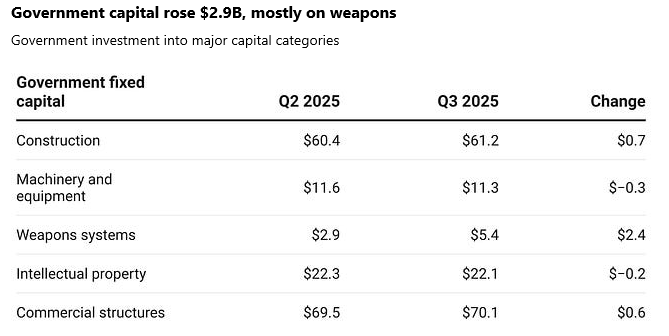
Capital investment growth came almost entirely from the public sector, and a very specific section of it. Government spent $2.9 billion more on public capital in Q3 with a big boost in weapons systems investments, which jumped $2.4 billion. Hmmm.
Government capital rose $2.9B, mostly on weapons
Government investment into major capital categories
In Q3, businesses added $4.0 billion less to their inventory of goods — that is, goods produced but not yet sold.
A troubling time for working Canadians
While we haven’t finished the analysis of this quarterly GDP report, we can confirm all champagne should remain in refrigeration.
As Data Shows has been reporting for months, the economic challenges for Canada, and especially in Ontario, are not new. GDP in 2023 and 2024 were pretty paltry at just two per cent nationally. It was less than that in Ontario.
Ontario has had rising unemployment for over two years. Now Trump has launched his campaign of economic force against Canada, targeting our manufacturing sectors. Trump would love to turn Canada into nothing more than a resource landscape that ships him logs, not lumber, or metal ingots, not steel beams or machinery or assembled cars or airplanes. That outcome would be devastating to Canadians workers.
The response from the Ontario Doug Ford government is about as lumbering and ham-fisted as would be expected. There is no plan for jobs or affordability.
The Carney government has turned attention to economic development, but needs to feel the urgency and pick up the pace on jobs and housing. Mega-projects that take many years to be realized aren’t wrong. But Canada cannot be strong when 1.4 million Canadians aren’t working and aren’t spending a paycheque into the economy. Canada cannot be strong when affordability is crushing household spending.
When we have full employment and a return to affordability we can pop some corks. Until then, Canadian workers need governments to show urgent attention to their needs, which are this nation’s needs.

Discover more from Burlington Gazette - Local News, Politics, Community
Subscribe to get the latest posts sent to your email.
