



 By Pepper Parr
December 2nd, 2025
BURLINGTON, ON
Eric Stern delegated to Council this morning on the 2026 city budget.
He was speaking for a community group, Focus Burlington, that has followed the creation of city budgets and the level of spending that has resulted in tax increases that should be seen as unsustainable.
I’d like to thank the city for giving us a few extra days to review the budget by releasing a draft. This is an improvement over last year, but still far short of the 30 days Oakville residents are permitted to review their draft budget. That being said, can we all admit that the Budget Blueprint Document is too high-level? Focus Burlington is a group of citizens working to engage with the city. We can’t effectively and meaningfully engage without details.
I’d also like to thank the city for responding to our questions.
Is it time for clarity? The budget is increasing 5.8%, the overall tax bill will increase 4.6ish percent, that’s clear and easy to understand. In a budget town hall, we heard: “The city chooses to share the tax increase as 2.98%”.
I choose to continue to object.
City Talk magazine is delivered to every home, at a substantial cost to taxpayers, showing 2.98% as the “City of Burlington’s share of the total tax increase” when the budget, and the Burlington line on our tax bill, is increasing 5.8%. Is this respectful to residents and taxpayers?

Stern: Is this respectful to residents and taxpayers?
We asked the city: “When I receive my final tax bill for 2026, how can I calculate the 2.98% increase by comparing my final 2026 bill and my final 2025 bill?”
With every other bill or salary increase, you calculate the percentage increase by looking at last year’s amount and comparing it to this year’s amount. The city didn’t show how to calculate 2.98% using our final tax bills. Is this respectful to residents and taxpayers?
Jim Barnett, in his delegation, asked serious questions about staff salary increases and the increase in consulting fees. If this information had been available in the budget town halls, a more fulsome discussion may have taken place.
Holding budget town halls before releasing a draft budget is like putting the cart before the horse. Is this respectful to residents and taxpayers?
If, and I’m emphasizing the word if, the goal of the city is to have meaningful engagement, detailed budget information providing evidence for the numbers presented is essential.
I was confused when I heard statements about cuts to the capital budget not leading to a tax rate decrease. Page 18 of the budget book clearly shows that $53,514,000 is being transferred from the operating budget to the capital budget. Does it not stand to reason that a reduction in capital expenses would lead to a reduction in the transfer amount, and this, in turn, would lead to a reduction in property taxes? Is there no opportunity for input on the $105,700,000 in spending in the capital budget. Is this respectful to residents and taxpayers?
Looping back to the budget blueprint, we learned that 2% was for inflation, 2% was for infrastructure, and 1.8% for additional pressures.
Our analysis shows a different story
A 5.8% property tax increase adds almost $17.5 million to the city’s coffers.
Where is the money going?
All we have to do is look at page 42 of the budget book for the answer
The change in salaries, wages and benefits is shown as $11,412,000. Meaning $11,412,000 of the $17,477,000 tax increase is going to salaries, wages and benefits.
Using the blueprints terminology, 3.79% of the 5.8% tax increase is going to salaries, wages, and benefits. Is stating: 2% is for inflation, 2% for infrastructure, and 1.8% for additional pressures, respectful to residents and taxpayers?
If the city wants to argue that all of the increase in Total Revenues from sources other than property taxes is for salaries, those costs still consume 3% of the 5.8% tax increase, exceeding the 2% for inflation number.
If the 1.8% for additional pressures is accurate, that leaves just 1% of the 5.8% for infrastructure.
Elect Respect is an important initiative. A safe and respectful workplace is essential for everyone. Is it time for a Taxpayer Respect initiative? One where members of the community, residents and taxpayers are treated with respect? After all, we are the source of the revenue on which the city is dependent.
Thank you for your time today.”
The delegation wasn’t going to end at the five-minute mark. Both the Mayor and several of the Councillors had comments and wanted to engage with Stern, which surely came as a surprise to him.
Mayor Meed Ward: You talked about the calculation of the 2.98; that was explained at one of the Town Hall meetings.
Eric Stern: I’ve heard many, many explanations, but I am looking for a town hall over the years that I’ve been talking about this, but I would really like to see an explanation that shows how to calculate that from the bill, because when we talk every other thing you talk about 4% increases. You can calculate that percentage increase from the bill. The city has calculations that involve a 51% of the property tax bill being for Burlington, which effectively means you divide the increase by half. That’s your choice to share that number. That’s not a meaningful number to residents, and it’s not reflected on the bill.
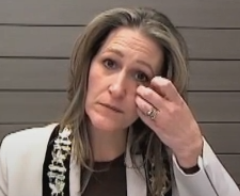
You just have a different perspective.
Mayor: You were at the Town Hall meetings where the numbers were explained. You just have a different perspective, which which is fair. My second question is around the salaries piece, and I’ll ask staff about this as well. I hope you can stick around for some additional questions to get more information on the matters you’ve raised the the salary piece wise, it’s included in inflation. Do you know that there’s a, there’s a part of that that is related to cost of living, which is inflation, and that’s why that sits there.
Stern: I understand that there’s inflation, everybody understands that. In our question to the city …
Mayor: I’m going to stop you there for a second; your internet connection might be a bit unstable. I just want to make sure we can hear your answer.
Stern: We understand that people need to paid fairly. There are no objections there. The objection is saying that 2% of the increase is for inflation, when it’s not okay.
Mayor: We will get some clarity for you on that. You have a question coming from Councillor Nissan.
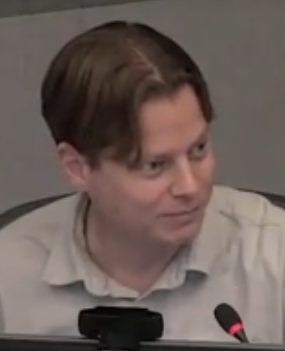
Ward 3 Councillor Rory Nisan
Nisan: Thank you for all the questions and being so actively involved. Just wanted to ask, I know you recommended that taxes be kept to inflation when it comes to the capital program, where inflation on goods and labor have greatly increased. Do you still want to keep it to the overall national inflation, or do you want to keep it to the inflation in those goods? Because if we don’t, then obviously we’re not going to able to do nearly as many projects and get ahead of our capital program.
Stern: I’m trying to stay on the budget. We did ask some questions about the non construction inflation rate, and we got some very confusing responses. One answer was it’s only 32% over 10 years. Another answer was 52% over 10 years. But I don’t want to get into the weeds in a discussion like this, because it’s too complicated.
Burlington’s Taxes are up, I think, 100% now over 10 years, so at a much higher rate than the non residential construction price increase. That’s one factor. But really, in terms of this delegation, if you need money for infrastructure, great. If you tell us that 2% is for infrastructure, great. But if, in reality, only 1% of that is for infrastructure, that’s not great. That’s what I want to stick to. If Burlington needs more money to keep their assets in good working order, then you need more money. Just be honest about it and say it. Don’t say the money’s for infrastructure when it’s really for salaries.
Mayor: Not seeing any further questions. I did have one question around your comments related to capital, and I’ll also ask staff about this. Were you at the town hall where we talked about the the infrastructure gap, which is the required capital needs all in versus the funding each year of the gap is roughly 340 and that all of the capital items, including that 50 to 3 million, roughly, are trying to close that gap. So if you take money out of it, you make the gap bigger. I’m just wondering if you were part of that town hall to understand why we don’t cut capital.
Stern: “I participated in two town hall meetings. This whole capital thing is a very complex discussion, non construction inflation for 2026 is only 3% we can assume. We don’t know what’s going to happen in the next 50 years. And in my head, I don’t have a full analysis of every asset in the city and the condition and when they need replacing. So it’s very difficult to answer the question that way. What I can say is, I don’t see money going into reserve funds. I see money coming out of reserve funds. Our taxes were increased 2% last year for infrastructure. We sort of expect some money, if we’re talking about a 50 Year Plan, we’d expect some money to be going into reserve funds from that 2% I don’t, I don’t see it and that.
Mayor: We will get that clarity for you.
Stern: You’re telling us the spending is for infrastructure – we think it is going into salaries.
Mayor: “That’s not accurate, but I’ll let staff talk, talk to you about that. My last question is, have you seen the city’s detailed asset management plan, which does spell out all the needs, the funding required, and the gap that we currently have, which is why there’s an infrastructure levy. We’d be happy to get that for you, too.
Stern: I’ve seen, I’ve read it. We have objected to the 50 Year full replacement cost every 50 years. When people don’t do that in their houses, people don’t do that in other jurisdictions. You go to Europe, every town hall is 400 or 500 years old. So I don’t understand why assets can’t be maintained and kept in a good state of repair. A director of the art gallery said, “you know, it’s 48 years old. We have to fully replace it in two years.” That doesn’t make sense.
Mayor: You’ve seen the plan, which is a mix of replacement and renewal. You have a question coming from Councillor Kearns.
Kearns: I was just wondering how you felt coming to delegate today.
Stern: This is my third year. I find the continued discussion around the accuracy of the numbers being presented the way they were presented to residents as frustrating. And I really debated whether or not I wanted to delegate. As you know, we’re trying other means to reach the community and explain what’s going on at City Hall.
Mayor: I am not seeing any further questions. Thank you so much for joining us this morning, Eric. We always appreciate hearing from our residents.
That was it. Later in the day Council did put a number of questions to staff. We will share that dialogue for a different report.
A couple of hours after the budget meeting adjourned the city released the following statement:
Burlington City Council has concluded the City’s 2026 Budget with a focus on investments in the services and infrastructure that support a vibrant, high quality of life.
Property tax increase
The completed City of Burlington 2026 Budget includes a 5.80% increase in the City’s budget.
With the most recent proposed tax figures from Halton Region, Burlington’s completed budget results in an overall property tax increase for residents of 4.49%. This percentage includes services delivered by the City of Burlington, Halton Region (including Police Services), and the Boards of Education and represents the impact residents will see on their property tax bill. The 4.49% increase is an additional $43.68 in property taxes for every $100,000 of residential current value assessment.

Discover more from Burlington Gazette - Local News, Politics, Community
Subscribe to get the latest posts sent to your email.

Let’s counter with,
Seniors should not need to pay taxes for education.
It is unsettling to see so much effort of Council and staff devoted to spinning the numbers, more focussed on justifying the percentages than simply stating the facts.
“Oakville Budget Committee outlines path for 2026 budget with tax increase of 1.96 per cent
Monday, December 01, 2025”
Why can Oakville accomplish this and Burlington cannot??
Excellent!Thanks Eric.
After reading the City’s response to Mr. Stern’s very detailed outline of questions, I clearly understand why he is so frustrated with Council’s method in approaching the City Budget.
Why not give Focus Burlington access to City Staff for clear and concise answers.