




 By Gazette Staff
February 5th, 2026
BURLINGTON, ON
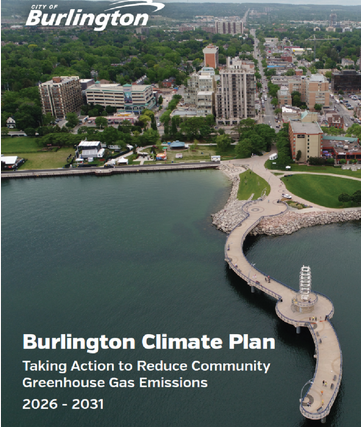 The City has released its updated Burlington Climate Plan – a guide to help the community use less carbon-heavy fuels like natural gas and gasoline. This will cut the greenhouse gases that cause climate change. The plan focuses on buildings and transportation because they create most of our local emissions.
Check out this important Plan and its proposed 17 action items. Consider sending your feedback about the plan to the Mayor and Members of Council and/or register to speak directly about the urgent need to accelerate action on climate.
Read the staff report on the City’s Feb 9th Committee meeting agenda here.
Some of the detail in the Staff report:
Burlington Climate Plan (2026 – 2031)
The Burlington Climate Plan proposes 17 action items grouped by topic into three themes and five subthemes:
Theme 1: Buildings & Energy
Subtheme: Energy Efficient Retrofits (2 Actions)
This subtheme focuses on how the City of Burlington can help support residents to make existing buildings more energy efficient such as speeding up the rate of home energy retrofits. This will decrease the emissions of the existing buildings, by supporting residents to overcome barriers and connecting them with information, resources, and financial incentives.
Subtheme: Low Carbon New Development (2 Actions)
This subtheme focuses on how the City of Burlington can encourage developers to make new buildings more energy efficient. We need to ensure that we are not only building new homes faster, but that energy efficiency and climate resiliency strategies are used within the development and design process.
Subtheme: Community Energy (3 Actions)
This subtheme focuses on how the City of Burlington can support the adoption of low carbon energy sources to reduce our demand on energy sources like diesel, gasoline and natural gas. As we electrify the buildings and vehicles, we need to ensure that the electricity grid can support this increased demand, while remaining resilient and low carbon.
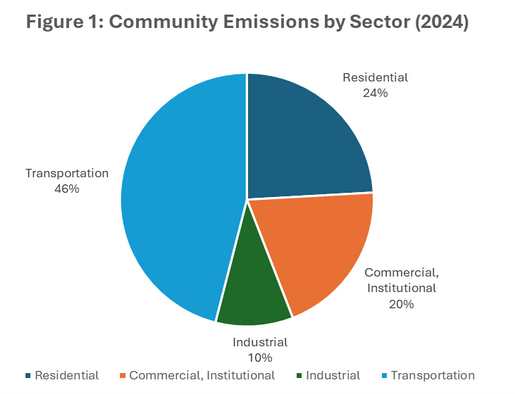
The push is going to be to reduce the transportation part of the pie chart. Get people out of their cars and onto public transportation. This is not going to be easy. Burlington was designed as a city where everyone would use a car to get around.
Theme 2: Integrated Mobility
Subtheme: Transportation (4 Actions)
In Burlington, more than 71 percent of the trips that start and end in the city are completed by car. Short trips (under 5 km) make up a large share of urban car travel. Switching these trips to forms of active transportation can have a big impact on community emissions.
Subtheme: Transit (4 Actions)
Public transit offers a wide range of benefits that can improve the lives of individuals and communities. It is a cost-effective alternative option to driving, helping to reduce traffic congestion and air pollution. Getting more people to use public transit instead of driving alone will help reduce local air pollution.
Theme 3: Local Economy (2 Actions)
Climate change reduction efforts, such as investing in green technologies and infrastructure can stimulate economic growth, innovation, and job creation. Energy efficiency programs and environmentally sustainable business practices can save businesses money and improve their competitiveness. There is an opportunity for the City of Burlington to become a leader in the green economy and support local businesses through their decarbonization transition.
What We Heard: Community Engagement
A community engagement strategy was developed as part of the plan update and included 22 engagement opportunities for residents to share their priorities for climate action and feedback on the proposed action items for the updated plan.
This stuff matters! Did you get to one of the 22 engagement opportunities?

Discover more from Burlington Gazette - Local News, Politics, Community
Subscribe to get the latest posts sent to your email.

Yes to your comment on snow cleaning. Kids and adults struggling for footing at bus stop shelters was hard not to notice on Friday.
Get everybody on transit? Why not find out what in-city trips are FOR before you start dreaming. Who’ll carry groceries 200 meters and wait 20 min for a bus or take 2 buses to carry 10kg of melting frozen fish, ice cream… or a hot roast chicken? How’ll you take your kids 15kg of hockey gear when you drop them off? How about going to the doctor when you are sick and sneezing all over a bus full of passengers? Or waiting 20 min for a bus at a windy 10 below or 30 above? There are dozens of reasons to use a vehicle. And one or two to use a bus. Sounds like politicos scrambling to justify insufficient traffic routes in new areas and poor planning years too late as highway exit traffic increases. Let’s all look green, and no one will see how yellow we are, right? Strongly promote electric vehicles, build chargers and stop reducing lanes. Increase NEED VERIFIED, low cost ride-on-demand, from or to city locations like supermarkets, malls etc when cargo carrying capacity is needed. Stop wasting money on 3-season cute scooters with no cargo capacity for (ha-ha) “in city commuting” largely by those who have no physical needs for it and are ideally suited to use buses. And since we can’t even clean sidewalks of snow within a reasonable time to access transit stops who would choose buses for anything other than a school or work commute, or to tour the city and view all the ridiculous wastes of money by this council. Real actions to confront climate change challenges require more than just throwing money around to look righteous.