





 By Alexander Blanchet
May 21st, 2025
BURLINGTON, ON
Over the past two decades, NHL teams decision-making has evolved from purely observational and subjective to become sophisticated, data-supported processes. Early metrics like Corsi and Fenwick quantified puck possession by counting shot attempts for and against, laying the groundwork for richer analyses in the future.
This started in 2021, with the league’s NHL Edge system deployed cameras and infrared sensors to capture puck movement 60 times per second and player positions 15 times per second, thus generating millions of data points per game. Concurrently, expected goals (xG) models assign scoring probabilities to individual shots based on historical data, allowing teams to evaluate shot quality in real time.
Traditional Scouting and the Quest for Objectivity

Hockey talent scouts could be a dying breed.
Historically, NHL teams relied heavily on the “eye test”, where hired scouts and coaches would judge players by observable skills and intangible qualities, like leadership and hockey sense. While invaluable, these assessments could be subjective and inconsistent, often leading to overdrafted prospects or overlooked talent. Recognizing these limitations, front offices began seeking quantitative methods to complement qualitative judgment. Early attempts were focused on basic counting stats, such as goals; assists; plus-minus… but these metrics proved insufficient for forecasting future performance, as they failed to account for team context and randomness.
Corsi and Fenwick metrics
In the mid-2000s, analysts introduced shot-attempt metrics to capture puck possession more reliably. Corsi was the first kind of measure. It measured the net difference between all shot attempts for and against at even strength (shots on goal, missed shots, and blocked shots). Fenwick followed afterwards, and it was quite similar, but it put its focus on offering a slightly different lens on offensive pressure. The users of Fenwick thought that shot attempts occur far more frequently than goals, roughly 25 Corsi events per goal, so it provided a larger sample size and reduced variance, allowing teams to evaluate players’ on-ice impact more rapidly and objectively.
Real-Time Tracking Thanks to NHL Edge
Starting in the 2021-22 season, the NHL rolled out the NHL Edge puck and player tracking system, installing cameras and infrared emitters in all 32 arenas of the league. This technology records puck movement up to 60 times per second and player positions 15 times per second, yielding data on skating speed, distance traveled, shot velocity and location, and zone entries/exits. Then, third party providers like Sportlogiq apply computer vision and machine-learning algorithms to extract advanced event data, such as passes, backchecking intensity, and defensive disruptions; enabling coaches to dissect every shift with more granularity than ever.
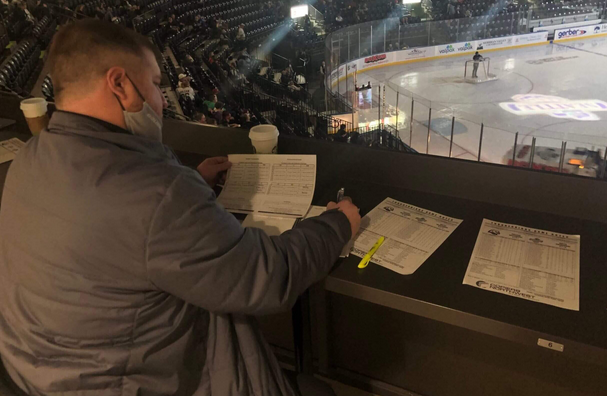
Data on printed reports is just part of the information now collected.
The data provided through NHL Edge, also helps in the world of sports betting. Bookmakers can provide more accurate and dynamic odds during live games whilst, bettors can use this granular data – such as player speed, shot quality and possession metrics – to identify opportunities and refine their strategies. As this kind of data-driven betting becomes more common, some platforms aim to make it easier for newcomers to get started—for instance bonuses. You can find information about the Stake sign up bonus, which can be activated when signing a new account and offers a 200% Deposit bonus. This bonus can give new users extra time to explore different strategies and get familiar with the platform.
Expected Goals to Measure Quality of Scoring Chances
While Corsi and Fenwick gauge volume, expected goals (xG) models assess the quality of every scoring chance. It uses shot location, shot type, pre-shot movement, and game context in its analysis, so xG algorithms are able to estimate the probability that any given shot will become a goal. Academic work by Brian Macdonald demonstrated that including contextual factors substantially improves predictive accuracy over raw goal total.
Today, teams use xG in real time to adjust line matchups, evaluate power-play formations, and identify undervalued players whose shot profiles suggest higher scoring potential than their goal totals indicate. That way, it’s a powerful stat to work with what the teams have and future prospects.
Case Study: Tampa Bay Lightning
One of the teams that have been relying the most on data analysis is the Tampa Bay Lightning. The franchise has a partnership with TIBCO Spotfire, a data-visualization firm that allows integrating real-time tracking and performance data into daily workflows, influencing lineup decisions, shift timing, and even ticket sales strategies.
The Lightning’s front office, which includes analysts with baseball sabermetrics backgrounds, credit this “Moneyball”-style approach for improved roster construction, optimal deployment of star players, and a rapid response to in-game trends.

Tools like player-tracking dashboards and xG overlays inform decisions – how do they explain situations like this ?
Case Study: Toronto Maple Leafs
Under General Manager Kyle Dubas, the Toronto Maple Leafs expanded their analytics department, leveraging advanced metrics to guide draft selections, trade evaluations and contract negotiations with their players. Tools like player-tracking dashboards and xG overlays inform decisions ranging from defensive pairing adjustments to power-play unit construction.
The Future for This Kind of Analysis

Metrics can miss certain intangibles, such as locker-room leadership, situational “clutch” play, and unpredictable bounces.
There are clear benefits from analytics-driven choices in ice-hockey, there is still some resistance from within the franchises. Critics argue that metrics can miss certain intangibles, such as locker-room leadership, situational “clutch” play, and unpredictable bounces. Small sample sizes for individual players and model biases, especially in limited power-play or penalty-kill data, can lead to misleading conclusions if used uncritically.
Moreover, integrating analytics requires cultural shifts that only a new guard of coaches and players would accept fondly: coaches must trust data-driven recommendations, and players must adapt to performance monitoring. As new GMs, head coaches, and players enter the league, the acceptance of this kind of analysis will likely grow.

Discover more from Burlington Gazette - Local News, Politics, Community
Subscribe to get the latest posts sent to your email.

I have often thought that there is a hidden agenda to turn professional sports into a video game which can ultimately replace actual (expensive) players. And the evolve the game itself into a lucrative gambling opportunity. All this data-gathering technology paves the way.
I feel like if the Maple Leafs are doing something, the best advice is probably: do the opposite.
The Leafs coach seems like a guy who has never used a computer!