



 By Tom Parkin
March 23rd, 2026
BURLINGTON, ON
Will the coming price shock be contained to fuel costs? Or “leak” into other products, maybe bringing damaging Bank of Canada rate hikes?
War, what is it good for?
Not the price of bonds, and that’s a prediction of job losses for Canadian workers unless the coming wave of inflation can be contained, or at least contained just to oil prices.
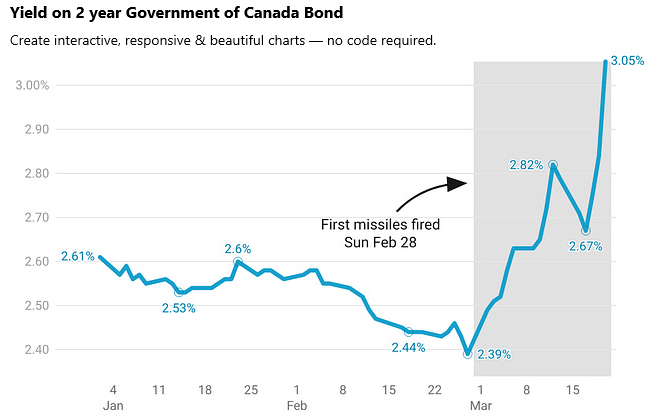
A deep drop in the price of Government of Canada two year bonds drove yields way up last week, Bank of Canada data shows. The two-year bond is considered a strong predictor of where traders think the Bank’s key rate is headed.
Data from the London Stock Exchange Group now points to a 75 basis point increase to the central bank’s key overnight rate, rising from its current 2.25 per cent to 3.00 per cent by year end. But the LSEG data still only assigns a 20 per cent chance the Bank of Canada will start this rate increase next month.
Interest rate hikes would kill jobs at a dangerous time
Interest rate hikes add costs for households and businesses that hold loans, shrinking the money available for purchasing and investment. Their entire point is to cut aggregate demand by killing growth and jobs.
Heck of a way to run an economy.
It’s always damaging. And this timing is terrible. StatsCan’s Labour Force Survey for February shows Canada lost 110,000 jobs since December. The country is under an attack of “economic force” from Donald Trump as he attempts to deindustrialize us. And though some provinces and the federal government are fighting back with a major projects agenda, and the Carney government deploys defence Keynesianism, those shifts will not deliver in the short-term.
On the other hand, higher interest costs will start inflicting economic damage almost immediately.
Interest rate hikes can kill jobs but can’t create oil
The possibility of rate hikes arises from the attacks on oil production facilities in Iran, Kuwait, UAE, Saudi and Bahrain, and on tankers in the Persian Gulf, have pushed up the global price of oil.
Though the fuel Canadians buy today was probably refined from crude before the war, prices at the pump are already way up.
The price hike is driven by a supply shortage. But hiking interest rates will do nothing to create more oil and therefore will be ineffective at pushing down oil prices.
U.S. Federal Reserve Chairman Jerome Powell said his central bank might be able to “look through” the fuel price hikes, accepting the impact, which would be a hard hit, but just one-time. However, Powell expressed concern fuel price hikes might “leak” into other areas. It’s those other price increases that can be affected by turning down economic growth using rate hikes.
This time, can oil inflation be contained?
The previous wave of inflation took off when sanctions on Russia over its attack on Ukraine hiked oil prices. It was pushed higher by interrupted production of key products, like computer chips, and supply chain break-downs, particularly trans-pacific shipping.
But cost increases were not contained to those items. As work by Canadian economist D.T. Cochrane shows, domestic companies used the opportunity of external price shocks to add to their mark-ups, spreading inflation. The Bank of Canada originally believed inflation was “transitory.” But when it clearly had been allowed to become generalized the Bank pushed up rates, with the predicable damaging results.
To the degree Canadian governments can moderate an oil price surge or contain it —by prevent businesses from taking the opportunity to hike prices — the Bank’s intervention will be less. And the damage to Canada at this dangerous time will be less.
It should be a priority of governments to arm themselves with tools to prevent inflation’s “leak,” which will hurt the spending power and the jobs of Canadian workers at a time they are already under attack from out enemy in the White House.


I’ve worked on pricing for complex goods all over the world. The price will be determined by the market, plain and simple. There are always moving parts, a business will try to drive price when it can – its necessary for the health of the business, because there are times when costs increase and the market won’t bare the cost.
I don’t have a crystal ball, but have been watching these things for a very long time. The price for Brent just dropped $15 today, the high price of oil is a flash in the pan due to geopolitical situation. I placed my bets at market open this morning, putting my money where my mouth is.
The point is, oil prices will stabilize and likely come down, so the BOC is not going to increase rates for this reason.
Food inflation is the devil, its out of control, increasing rates will add to food inflation, Carney knows this.
The economy is on life support, increasing rates will put another nail in the coffin, Carney also knows this.
Carney just put forward a budget with a $80 billion dollar deficit and has made further promise that could expand the deficit to $90 billion or $100 billion. Increasing rates will increase the cost of borrowing for the feds, they will not do this.
The BOC in my opinion is stuck between a rock and a hard spot, it cannot increase rates, and decreasing rates to help the economy will reduce the strength of the Canadian dollar, which will add to inflation.
I predict the BOC will watch the US Fed, if it drops rates it will follow in a quarter or two. And coming into the mid terms I would bet my last dollar the US Fed will be dropping rates.
But what do I know?