




 By Gazette Staff
August 21st, 2025
BURLINGTON, ON

Rory Nisan
Ward 3 Councillor Rory Nisan makes mention of the forthcoming City Budget and explains that “Budgets are more than dollars and cents. They fund the services you depend on like safe streets, reliable transit, resilient infrastructure, welcoming parks, flood protection and swift emergency response.
“Work to build the 2026 budget is underway, beginning with the 2026 Financial Forecast report (FIN-24-25). The forecast report is one of the first steps in the annual budget process and provides a preliminary look at the economic pressures and service needs that will shape the 2026 city budget. Burlington City Council approved the 2026 Financial Forecast report on July 15, 2025, with a focus on limiting tax impacts for residents.
The Burlington Finance people continue to fudge the numbers.
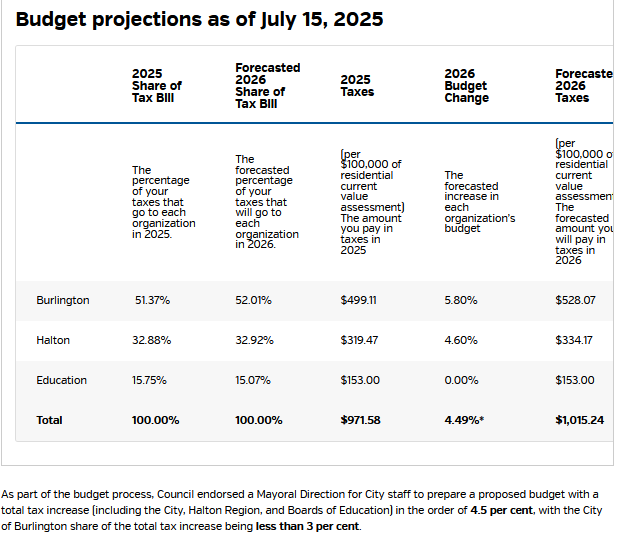
In the column: 2026 Budget Change the number that matters to you is the 5.80%. The 4.49% at the bottom of that column is pure mathematical rubbish.
The less than 3% mentioned in the cut line is a hope – that probably doesn’t have even a prayer going for it.
Watch for those occasions when the Finance people tell you what the impact of the budget is likely to be. Impact is not a unit of measure. Each person is “impacted” differently depending on their circumstances.
There is a lot of mumbo jumbo to the way Burlington Finance people tell you what you are going to be taxed.
You deserve better in the way of financial stewardship from the city.

Discover more from Burlington Gazette - Local News, Politics, Community
Subscribe to get the latest posts sent to your email.

SUPER grifter Nisan …. why do you continue to give this guy “airtime” ???? His words …his actions …his overall performance don’t meet the very low bar you’ve set for this group of political parasites. STOP !!!!
Meanwhile Oakville council endorsed Mayor Burtons 3.5% overall increase for 2026. The Oakville 2025 increase was 4.9%, compared to the Burlington 5.8% increase.
Make sure you ask about this during the Food for Feedback event Sept 13.
Bruce, thanks for raising the point about percentages and base numbers — it’s a fair observation that a percentage increase can mean different things depending on the starting point. A 5% increase on a smaller base can certainly be less in dollar terms than a 3% increase on a larger base.
That said, when it comes to property taxes and how they impact residents — especially renters — the percentage is not “misleading,” it’s illustrative. Here’s why:
Municipal councils frame it in percentages. Burlington, Oakville, Hamilton — they all report tax increases in percentage terms. That’s the language of council, staff reports, and budget communications. If the percentage wasn’t meaningful, city halls wouldn’t rely on it year after year.
Renters feel the percentage directly. Landlords who apply for Above Guideline Rent Increases (AGIs) cite tax hikes in percentage form, not in dollar values. A 5.8% increase in Burlington doesn’t just hit the property owner — it flows down to tenants, who don’t have the luxury of averaging things out across neighbourhoods or property classes.
Oakville vs. Burlington is about trends, not absolutes. You’re right that Oakville’s base property values and taxes are generally higher. But what matters for residents is the trajectory of increases. If Oakville is holding closer to 3–4% while Burlington trends closer to 6%, that signals a governance issue on Burlington’s side — one that deserves public discussion.
So yes, dollar amounts matter, but percentages tell the story of relative effort and burden. And right now, Burlington’s numbers show we’re trending higher than our neighbours. That’s why it’s worth asking about at the Food for Feedback event on Sept. 13 — not to argue semantics, but to ensure council is held accountable for the choices driving those higher percentages.
Bruce, I think you’re underplaying the importance of comparisons here. Yes, every municipality has its own challenges. But if we accept that logic too easily, then no one is ever accountable for running above or below provincial norms. At some point, numbers have to be measured against something.
Let’s look at Burlington specifically. Between 2024 and 2025, our municipal residential tax rate (RT) rose from 0.858851% to 0.971590% — that’s a 16.02% year-over-year jump. Out of Ontario’s 470 municipalities, only 17 of them (3.7%) saw increases above 10%. Burlington wasn’t just a little higher; we were in the top tier of tax hikes in the entire province. That is not “misleading,” that’s math.
Both municipalities face growth, infrastructure demands, and pressures from inflation. Yet one council is finding a way to manage the load more steadily, while the other is hitting taxpayers harder. That isn’t just “different circumstances” — it raises real questions about fiscal discipline and governance.
And let’s be clear: percentages matter because they’re how municipalities themselves communicate the burden. Landlords applying for AGI increases don’t talk in dollar figures, they talk in percentages. Council doesn’t announce that “your bill went up $500,” they say “your taxes rose 5.8%.” By that same logic, comparing Burlington’s 5.8% to Oakville’s 4.9% is not misleading or disingenuous — it’s exactly how residents experience the hit.
Comparisons are not only meaningful, they’re necessary. Without them, we’re left judging Burlington’s performance in a vacuum — and when you do that, accountability disappears.
Nice how Councillor Rory Nisan pretends to work by showing up for photo ops instead of spending Tim min his office. Thank goodness is 2026 election is around the corner
The fraud continues. The city has no influence on the education levy and only a minor influence on what the Region charges yet the councilors persist in using these low numbers to make their increases appear smaller that then actually are. Shame on them.
I am reminded of a quote by Harry Truman (with apologies to Benjamin Disraeli): “There are 3 kinds of lies–lies, damn lies, and statistics.”