




 By Joe Gaetan
January 14th, 2026
BURLINGTON, ON
When a Burlington Councillor publicly describes a transit technology as “game-changing,” it naturally raises expectations.
Councillor Kearns’ recent Facebook post noting that city staff and officials had been “introduced” to ARGO did exactly that.
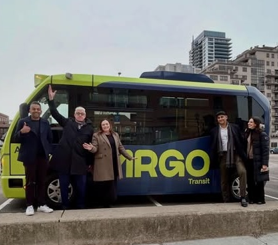
Will the ARGO service get any further than a photo op?
For residents who have watched Burlington struggle with the same transit challenges for years, the word introduced is both encouraging and incomplete.
Burlington is very good at listening to new ideas. What residents are less certain about is how quickly those ideas move from presentation to practice. If ARGO’s Smart Routing™ system truly represents a different way of delivering public transit – one designed for suburban cities rather than dense urban cores – then the next step matters far more than the introduction itself.
ARGO’s on-demand, electric, dynamically routed model addresses a problem Burlington knows well: neighbourhoods that were never designed for straight-line bus routes. Highways, rail lines, crescents, and cul-de-sacs all work against traditional fixed-route transit. This is not a new discovery, but it is one that has rarely led to a different approach. That is why ARGO has drawn attention.
The only meaningful way to evaluate a system like this is through a real-world trial. Not a multi-year study, and not another theoretical comparison, but a limited pilot that lets residents use the service and staff measure results. Questions about reliability, accessibility, and rider uptake can be answered quickly once people are actually riding.
The timing of this conversation matters. Transit affects daily life, particularly for seniors, people with mobility challenges, and residents trying to reduce their dependence on cars. Every year spent studying alternatives is another year many residents conclude that transit simply isn’t for them.
Councillor Kearns’ post suggests genuine interest inside City Hall, and that’s a positive sign. The challenge now is maintaining momentum. Burlington doesn’t need to decide today whether ARGO is the future of its transit system. But it does need to decide whether it is ready to test something that appears better suited to the city it has.
Residents have seen plenty of introductions. What they are waiting for is a clear signal that Burlington is prepared to move from curiosity to action.
Related news story
Is ARGO a possible answer for Burlington?

Discover more from Burlington Gazette - Local News, Politics, Community
Subscribe to get the latest posts sent to your email.

The editor sounds like Trump. If he does not like the information, he calls it fake news. What is his number for average ridership?
Editor’s note: I have yet to be on a bus in Burlington that has had just one rider.
I have been on busses in Burlington during the day, not rush hour, and I had to look for a seat. I don’t have a number of what the average number of riders is.
The current Burlington Transit is very inefficient and costly. Just over one passenger per bus on average an a bus that costs over a million dollars. Joe is right in his analysis. It is worth a try.
Editor’s note: Statements like this (Just over one passenger per bus on average) are just not true; they are fake and misleading written to advance an agenda.
Why not compare it to subsidized Uber?
Grahame, yes Uber subsidization is also an option. Bloomington Ind, have such an approach. I also believe there is room for a P3 approach similar to Uber Eats but using the ARGO buses and algorithms, that I have been trying to flesh out.
Oakville also has an interesting ride-on-demand service, check it out. We need leaders who can think outside the box.