





 By Gazette Staff
January 19th, 2026
BURLINGTON, ON
When ski mountaineering makes its Winter Games debut next month, its arrival will reflect the decades of history, bureaucracy and regional influence that determine which sports the world sees on the Olympic stage.
Though it may only now be reaching the radar of sport enthusiasts across the globe, Brock University Assistant Professor of Sport Management Taylor McKee says the endurance sport, also known as “skimo,” is deeply rooted in European alpine culture.
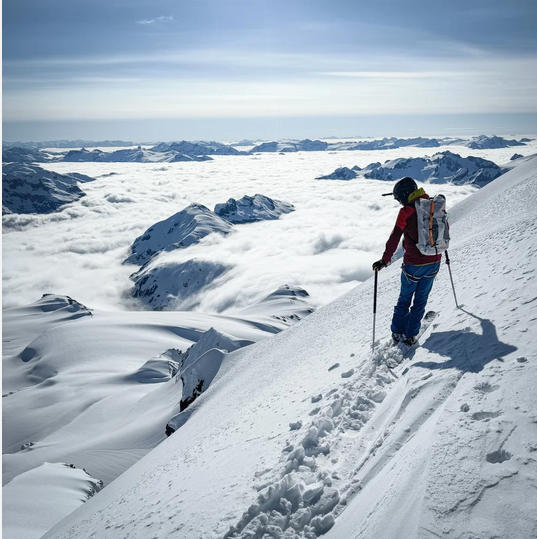
The terrain is treacherous at times, but always beautiful when there is an opportunity to pause and take it all in.
Ski mountaineering combines uphill climbing and downhill skiing, with athletes using specialized lightweight equipment to ascend snow-covered mountains before racing back down technical alpine terrain.
The sport, which emphasizes endurance and technical skill, is rooted in mountaineering tradition rather than stadium-based competition.
McKee says sports “very rarely” appear on the global stage without a robust history backing their climb.
Whether a sport is included in the Olympics also depends largely on bureaucracy, he says, as a sport must have an international governing body, national federations and the capacity to organize international competition.
“It takes years to create an International Federation recognized by the International Olympic Committee (IOC),” he says. “While The IOC governs the Olympic Games, for the most part, the administration of the sport is really governed by their international federations.”
But meeting those formal requirements is only the starting point, especially for the Winter Olympics, which follow a different philosophy than the Summer Games.

This is the downhill part.
The Winter Olympics did not begin as a global showcase, but as a Nordic alpine festival rooted in Western Europe. That legacy continues to shape today’s Olympic program.
“The Winter Games are still very rooted in Swiss, French and German tradition, it’s not Canadians or Americans setting the agenda,” says McKee. “If it involves skiing, mountaineering or alpinism in general, it’s going to get some Olympic attention because of the core values of the Winter Olympics themselves.”
That context helps explain why ski mountaineering fits naturally within the Winter Olympics ecosystem. Particularly, McKee says, when the Games are hosted in alpine regions as is the case this year in Milan and Cortina d’Ampezzo, Italy.
“It’s not so much that ski mountaineering fever is taking over the world,” says McKee. “It’s very important to a core group of people who carry a lot of influence in the way that the Winter Olympic program is put together.”
Those dynamics have become even more pronounced as the Olympics have evolved into a global media enterprise. Since 1984, McKee says, the Games have operated in what historians describe as the “rocket fuel era.”
“Every square inch of it has a sponsor,” he says. “How have they succeeded in the last 40 years? Because of big business.”
The private sector’s involvement transformed the Olympics into a broadcast-driven event, where audience appeal now matters alongside athletic tradition.
“It is very much about locating an audience,” says McKee. “‘Is this compelling content?’ is a question that’s being asked in IOC circles these days.”
Since the inception of the modern Olympic Games in 1896, sport inclusion has never been permanent.
While ski mountaineering is on the Olympic program for 2026, there’s no telling what 2030 and beyond will hold, McKee says.
Sports, he adds, routinely move in and out of the Games. Tennis, golf and lacrosse, for example, have all disappeared and returned over time.
The fluidity challenges the idea that Olympic status defines legitimacy.
“To get in the Olympics is a bureaucratic question and a marketing question these days, as much as it is a question of sport legitimacy,” McKee says.
A sport’s absence often reveals regional priorities rather than participation or skill, he adds.
“If the sport doesn’t resonate in Austria, Germany or Switzerland, the path to the Winter Olympic program is a difficult one.”
McKee favours a broader understanding of what the Olympics represent in the modern era.
“It’s still an entertainment product,” he says. “We as a sporting public need to be less precious with what we consider to be an Olympic sport or not.”
 Brock University has a Sports Management program, thought to be the only one in Canada. They have focused not only on the sports but on the business side of different sports. Brock, founded in 1964, opening its first classes in September of that year with 127 students, though the groundwork and community efforts began earlier, stemming from the Allanburg Women’s Institute‘s initiative in 1957. The university was officially chartered by the province in March 1964 and named after Major-General Sir Isaac Brock
In 1964, the Bill Davis government introduced a Department of University Affairs within the Ministry of Education. In the same year, the provincial government founded Brock University , the University of Guelph and Trent University.
Brock has succeeded in creating something that is much more than a niche.
– 30 –

Discover more from Burlington Gazette - Local News, Politics, Community
Subscribe to get the latest posts sent to your email.
