




 By Elfrida Stokes
June 12th, 2026
BURLINGTON, ON

Online gambling has quietly moved from a niche industry story into something Burlington households see every day.
Online gambling has quietly moved from a niche industry story into something Burlington households see every day. The ads now appear in places where readers are not looking for them at all:
- alongside sports broadcasts
- in social feeds
- between search results
- on Canadian comparison sites
This article is not a ranking of casinos and not an invitation to gamble. This article treats online gambling the way it would treat any financial-risk topic: explain it, point to official sources, and flag the warning signs.
Why online gambling is now a local consumer issue
Provincial regulation does not stop at the city line. Ontarians see the same ads, the same bonus language, and the same payment promises whether they live in Toronto or Burlington.
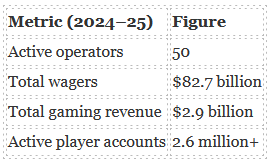 One caveat sits inside that table. Active player accounts are not unique people, because the same person can hold accounts with several operators. A large account number is a measure of market reach, not a measure of how many Ontarians are gambling.
Local impact is harder to quantify than provincial revenue. Household budgets, family stress, and youth exposure to advertising do not appear in operator filings, but they show up in Burlington living rooms.
What “online gambling” means in Ontario
Before evaluating any site, it helps to separate the players in the system. Online gambling in Ontario covers casino-style games, sports and event betting, poker, bingo, and lottery-style products delivered through a website or app.
Four kinds of websites tend to get confused:
- Operators: companies that run gambling sites and take wagers.
- Platforms: the underlying technology a brand uses to deliver games.
- Comparison or information directories: third-party sites that explain terms, list operators, or summarize bonuses.
- Regulators: government bodies that license, register, and enforce the rules.
The Alcohol and Gaming Commission of Ontario sits in the last category. Its player-support page for online gambling explains the regulator’s role in registering and supervising online gambling sites and setting standards for player protection and game integrity. Marketing copy from any other site, however polished, is not a substitute for that information.
Where casino directories fit, and what they cannot verify for you
Canadian casino-information directories should be treated as a starting point for vocabulary and comparison, not as a substitute for checking Ontario regulatory status or reading the operator’s own terms.
When readers search for terms like “wagering requirement,” “fast withdrawals,” or “Canadian-friendly casino,” they often land on comparison directories rather than regulator pages. These directories can help with vocabulary, but they should not be treated as official authority.
Readers may see licensing notes, payout claims, bonus language, and review-style summaries on Canadian casino-information directories such as https://casinocanada.com/, but those details should be treated as a starting point for vocabulary and comparison, not as a substitute for checking Ontario regulatory status or reading the operator’s own terms.
A directory can:
- Explain what a wagering requirement or a no-deposit bonus is.
- Show categories of payment methods or game types.
- Summarize an operator’s claims.
A directory cannot:
- Confirm that a particular operator is currently registered in Ontario.
- Replace the operator’s full terms and conditions.
- Promise outcomes such as fast payouts or fair play on your behalf.
The rule of thumb is simple. Use directories to learn the words, and use the AGCO and the operator’s own legal pages to learn the facts.
What Ontario regulation is supposed to do
The provincial igaming market launched on April 4, 2022, with iGaming Ontario conducting and managing the legal market and AGCO acting as regulator. The same iGaming Ontario annual report describes that mandate alongside work on responsible gambling, anti-money laundering, and a centralized self-exclusion system.
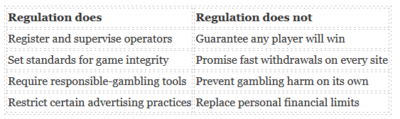 It helps to be specific about what regulation covers and what it does not. That distinction matters when reading any marketing message. Regulated status tells you the operator has agreed to rules. It does not tell you that gambling is risk-free for you personally.
Advertising, bonuses, and the fine print readers should notice
Bonus language is one of the most common ways readers encounter online gambling, and it is also one of the most misread. The word “free” rarely means free without conditions.
AGCO’s marketing and advertising guidance sets out that advertising materials communicating gambling inducements, bonuses, and credits are prohibited in Ontario except on an operator’s own gaming site and through direct marketing after a player has given consent.
When a bonus offer does appear in a place where it is permitted, the details that matter sit in the fine print:
- Wagering requirements: how many times the bonus must be wagered before any winnings can be withdrawn.
- Eligible games: some games count fully, others only partially or not at all.
- Time limits: bonuses often expire within days.
- Maximum bet caps: betting above a stated amount while a bonus is active can void winnings.
- Withdrawal conditions: minimum amounts, identity verification, and processing times.
Reading those five items takes a few minutes and changes how an offer looks. A headline number says little until the conditions are checked.
Risk signals: when gambling stops being entertainment
Gambling problems rarely announce themselves in a single moment. CAMH’s overview of problem gambling describes harm as a continuum that can affect work, school, mental and physical health, finances, reputation, and relationships, rather than a single threshold to cross.
ConnexOntario’s gambling treatment service page lists warning signs that are easier to notice in everyday life:
- Spending more time or money on gambling than planned.
- Struggling to stop or cut back.
- Chasing losses by gambling more to win back what was lost.
- Borrowing money or building debt to keep gambling.
- Hiding gambling activity from family or friends.
- Feeling anxious, irritable, or low when not gambling.
Gambling harm is not only about losing money. It can quietly shift sleep, focus, mood, and trust inside a household well before a financial crisis is visible.
Noticing one of these signs is not a diagnosis. It is a reason to pause and consider whether the activity still looks like entertainment.
Scams, fake trust signals, and basic checks before money or ID changes hands
Not every gambling site that looks Canadian is regulated in Ontario, and not every trust badge on a homepage corresponds to a real audit. Practical caution comes before money or identity documents are shared.
A short checklist covers most situations:
- Verify regulatory status separately. Look up the operator through official regulator information rather than relying on the site’s own claims.
- Read the withdrawal terms, not just the deposit offer. Check minimums, processing windows, and verification steps.
- Identify who actually operates the site. The company name in the footer or terms is the entity behind the brand.
- Be skeptical of guarantees. Promises of guaranteed wins, instant payouts, or risk-free play are marketing, not facts.
- Treat bonus-heavy messaging as a prompt for extra caution, given Ontario’s restrictions on public advertising of inducements and credits.
- Do not share ID or payment details with operators whose registration and contact information cannot be confirmed.
If a check fails, the safer move is to walk away. Lost time is recoverable. Lost identity documents and deposits often are not.
Self-exclusion and support resources in Ontario
 Self-exclusion is a voluntary tool that puts a barrier between a person and gambling for a defined period. The same iGaming Ontario annual report describes a centralized self-exclusion system that will allow Ontarians to self-exclude from all regulated igaming sites in the province, with registered operators required to participate.
For people who want to talk to someone before, during, or after taking that step, ConnexOntario offers free, confidential support that is available 24/7 across Ontario and does not require a referral.
A few points worth keeping in mind:
- Self-exclusion is most useful as one part of a wider plan, alongside conversations, financial steps, and professional support where needed.
- Help is not reserved for severe cases. ConnexOntario and CAMH services treat gambling concerns along a continuum.
- Family members can also reach out for guidance about supporting someone else.
A household checklist for Burlington families
Conversations are easier before a crisis than during one. The warning signs listed by Ontario health and support sources translate naturally into household questions.
Topics worth raising at the kitchen table:
- Money rules: a clear, separate amount for entertainment, never drawn from rent, food, savings, or debt payments.
- Time rules: limits on sessions, especially in the evening when judgment fades.
- Shared devices: whether gambling apps belong on phones or tablets that teenagers also use.
- Advertising literacy: how to read sports-broadcast and social-media gambling ads as marketing, not advice.
- Hidden losses: an agreement that financial mistakes can be raised without immediate blame.
- When to ask for help: which Ontario resource the family will contact first if signs appear.
These are not legal or clinical answers. They are starting points that lower the cost of speaking up later.
Bottom line: read gambling information like any other financial-risk claim
A useful frame for the whole topic is this: online gambling material deserves the same scrutiny as an investment pitch or a credit offer.

Online gambling material deserves the same scrutiny as an investment pitch.
A short summary for readers who want one paragraph to remember:
- Comparison directories explain vocabulary. Regulators define legality.
- Advertising and bonus headlines are marketing. The conditions are in the terms.
- Warning signs are personal and practical, not abstract.
- Help in Ontario is free, confidential, and available before things reach a crisis.
Read with that frame, the noise tends to fall away, and the questions that actually protect Burlington households move to the front.

Discover more from Burlington Gazette - Local News, Politics, Community
Subscribe to get the latest posts sent to your email.

Leave a Reply