




 By Tom Parkin
February 3rd, 2025
BURLINGTON, ON
Foreign currency exchange rates are complex. A deep understanding is vital for any organization buying or selling products and services. Values and profits can vanish in a second because of a change in an exchange rate.
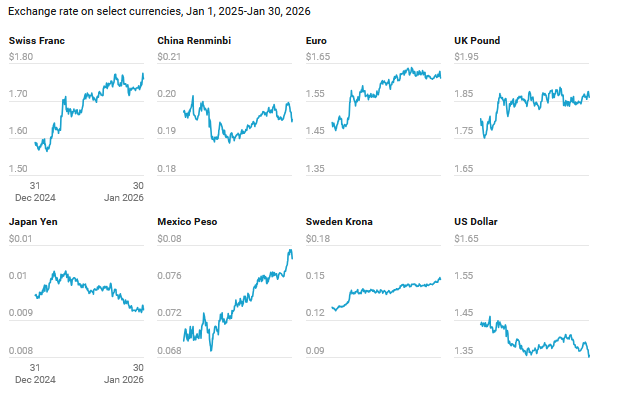
Canadian dollar down against Krona, Peso, Euro and Pound
Change in exchange rate value, Jan 1, 2025 to Jan 30, 2026
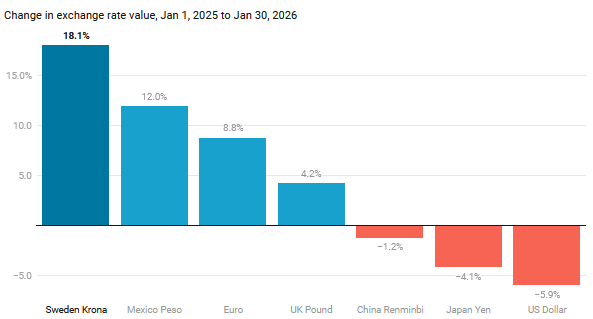
The constant chaos of Donald Trump has pushed the United States dollar down against all major currencies including six per cent against the Canadian dollar since January 1, 2025, according to Bank of Canada data.
From C$1.44 on January 1, 2025, the U.S. dollar dropped from C$1.38 to C$1.36 — 2.52 cents — against the Canadian loonie since just January 21, 2026 when Trump gave his bizarre, meandering and overtime speech in Davos amid threats to invade Greenland and counter-threats from European Union countries, the UK and Canada to aid the defence of the Denmark territory.
Mexican peso, Swedish krona strong against loonie
Currency used by Sweden
But the Canadian loonie is only looking strong compared to the falling US dollar. The Swedish krona is up over 18 per cent against the Canadian dollar and the Mexican peso is up over 12 per cent. The euro and pound are also more expensive for Canadians than a year ago.
Despite the krona’s strong appreciation, which pushes up the cost of imported goods, Sweden has very low inflation, just 0.3 per cent in December. The Nordic nation has keep it’s bank interest rate at 1.75 per cent, helping GDP growth, which was tepid in 2025 but expected to hit 2.6 per cent in 2026. Sweden joined the European Union in 1995 but did not adopt the Euro and the European Central Bank.
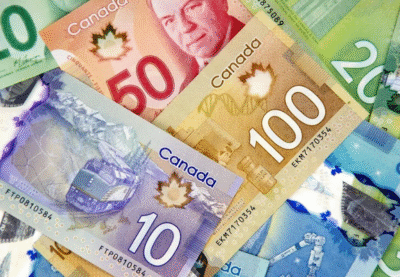
The rate at which the Canadian dollar trades against the American dollar will impact the price of just about everything we buy.
Canada’s bank rate remains at 2.25 per cent with inflation at 2.4 per cent in December and a 2026 economic growth forecast of 1.3 per cent.
Mexico’s 1.2 per cent growth outlook for 2026 is similar to Canada. But inflation is running hotter. At 3.69 per cent in December, inflation is above its target of 3.00 per cent and Mexico’s central bank is still holding interest rates at 7.00 per cent. That high interest rate is attractive for investors outside Mexico, boosting foreign exchange into the peso.
Global mistrust driving US dollar downward spiral
Sentiment about global politics has increasingly moved toward pessimism. In times of uncertainty the U.S. dollar has often been a “safe haven” for investment, pushing up the dollar. But in this situation, it is the United States — its president, specifically — that is the cause of uncertainty.
There has been a growing lack of currency trust as Trump threatens war against a fellow NATO county, throws out tariff threats on a nearly daily basis and moves to load cronies onto the Federal Open Market Committee, which sets U.S. interest rates.
The result is a U.S. dollar down more than 10 per cent against the Euro, which makes stock returns from even the most profitable United States companies less appetizing to Europeans managing capital pools. For an investor operating in euros, a 10 per cent stock return in 2025 was reduced to zero by dollar depreciation. That, in turn, drives a spiral of further dollar depreciation as foreign exchange into dollars to make investments drops, amplifying the mistrust of the U.S. dollar under Trump.
The European Union’s annual GDP of about $20 trillion represents a significant global base of wealth and European mistrust for the Trump currency can inflict damage. The EU’s GDP combined with that of the UK, at almost $5 trillion, and Canada, at $2 trillion, nearly matches the US economy at $28 trillion.

Discover more from Burlington Gazette - Local News, Politics, Community
Subscribe to get the latest posts sent to your email.

How does one write a piece about F/X and not once mention the bond market, its only the largest factor on F/X.
Smart money follows returns, it does not follow feelings. In 2025 the US Fed cut rates three times and the 10 year treasury dropped. This means two things, the US borrows money more cheaply, and investors get less – hence money flows out.
Canada on the other hand saw an increase in our 10 year Treasury, our government/tax payers pay more for borrowed money and investors get more.
Why will the BOC not cut interest rates with a soft economy and high unemployment in Canada? If they do that will further weaken the Canadian dollar increase inflation.
By contrast, the US can cut rates, its already in a strong position. A weaker US dollar is good for exports. Don’t think this was done by accident or unintentionally.