 By Gazette Staff By Gazette Staff
September 10th, 2025
BURLINGTON, ON
Halton Regional Councillor Paul Sharman, representing Halton Regional Chair Gary Carr, joined members of Regional Council and Oakville Council as well as community partners to celebrate the opening of Halton’s newest assisted and supportive housing development at 265 Kerr Street in Oakville.
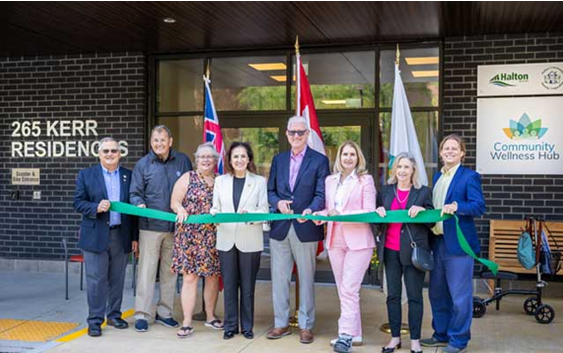 Left to right: Regional Councillor Colin Best, Oakville Councillor Ray Chisholm, Regional Councillor Cathy Duddeck, MPP Effie Triantafilopoulos, Regional Councillor Paul Sharman, Laura Smith, Parliamentary Assistant to the The Honourable Rob Flack, Minister of Municipal Affairs and Housing, Elizabeth Chalmers, Constituency Manager for The Honourable Anita Anand, MPP Oakville East and Minister of Foreign Affairs and Regional Councillor Rory Nisan cut the ribbon at the official opening of 265 Kerr Street in Oakville. This new 52-unit building includes 22 dedicated supportive housing units and a Community Wellness Hub operated by Links2Care through the Connected Care Halton Ontario Health Team. The hub provides social, recreational, and health education services to help seniors stay healthy and independent.
“The 265 Kerr Street development is a testament to what we can achieve when we work together,” said Halton Regional Chair Gary Carr. “We are grateful to our federal and provincial partners for helping us deliver housing for those who need it most.”
As the national housing crisis continues to impact individuals, families, and seniors, Halton Region is working with all levels of government and third parties to create more assisted and supportive housing options. This latest development was funded by all three levels of government:
Provincial Government: $14.9M ($11.9M joint Canada-Ontario Community Housing Initiative (COCHI), $3M Last Mile Funding)
Federal Government: $9.3M (Canada Mortgage and Housing Corporation Rapid Housing Initiative Funding)
The Future is Housing
The Region has four assisted rental housing projects in active construction, and four shovel-ready projects (or 548 units), with more in pre-development stages. To learn more about these projects, visit the Assisted and Supportive Housing Construction page on halton.ca.
 This latest development was funded by all three levels of government. The Region also plays a key role in delivering the infrastructure needed to support all new housing developments across Burlington, Halton Hills, Milton and Oakville. This includes water and wastewater system capacity to support local pledges of 92,500 housing units by 2031.
“The opening of 265 Kerr Street Assisted and Supportive Housing brings increased affordable housing for seniors here in Oakville. With the federal government’s $9 million investment, 52 affordable and supportive housing units are available to seniors in our community who have a need for this type of housing, along with an on-site Community Wellness Hub to help improve the health and wellbeing of seniors in our community. Bringing affordable housing supply to address needs in Oakville and communities across the country is a priority our government will continue to meet through Build Homes Canada.” – The Honourable Anita Anand, Member of Parliament, Oakville East and Minister of Foreign Affairs
“Congratulations to Halton Region on completing this project, which will provide local seniors with supportive homes where they can stay healthy and maintain their independence. Working together with partners like Halton Region, we will continue to invest in ambitious projects like this and build the housing that people across Ontario need.” – The Honourable Rob Flack, Minister of Municipal Affairs and Housing.
Editor’s note: Not sure why this story required eight people to cut a ribbon and get their pictures in the paper. The development is certainly needed.

By Nicolai Ryan Klausen
September 9th, 2025
BURLINGTON, ON
Visitors are drawn to Peru because it offers the perfect base for an epic adventure that blends history, adrenaline, and breathtaking scenery. The main attraction is Machu Picchu, the site of the ancient Inca ruins perched high in the Andes mountains. Long regarded as the cultural stop in South America, Machu Picchu’s popularity is overwhelming, so limits have been set on the number of visitors who can explore the ruins to preserve the UNESCO World Heritage site. The most favorable time to experience Peru is between April and December, with the highest visitor numbers seen from May to August, when temperatures typically go beyond 30°C.
 Peru offers excellent value for money compared to many international destinations, which means it’s accessible for budget-conscious travelers while still providing meaningful experiences. No matter where you go, Peruvian cuisine is on the map. Many dishes contain meat and potatoes, but Peruvians don’t consider a meal complete without plenty of rice because it balances the strong spices. Lima boasts an incredible restaurant scene that introduces you to classics such as adobo, anticuchos, or pachamanca. English isn’t widely spoken outside tourist areas, but the Peruvian Spanish accent isn’t hard for Spanish language beginners to understand. Peru offers excellent value for money compared to many international destinations, which means it’s accessible for budget-conscious travelers while still providing meaningful experiences.
Packing for the Andean mosaic isn’t just about tossing a couple of shirts and socks into a bag. You must prepare for icy mountain mornings, tropical downpours, and everything in between, for a smooth, enjoyable, and safe experience. Preparing for a trip to Peru is about understanding the unique challenges and opportunities this incredible country presents. Please continue reading to discover how to build the perfect travel kit.
A SIM Card
You should pack a SIM card, either your home SIM or a local/international SIM card, to have data access as soon as you land in Peru, which allows you to use navigation, book transport, and stay connected without using Wi-Fi. You can make calls or send messages in emergency situations, contact your accommodation if plans change, or reach out to your friends and family to provide peace of mind. You won’t have Wi-Fi when you’re out exploring, navigating or in transit. If your phone supports dual SIM, you can use both a physical SIM and an eSIM for larger data allowances.
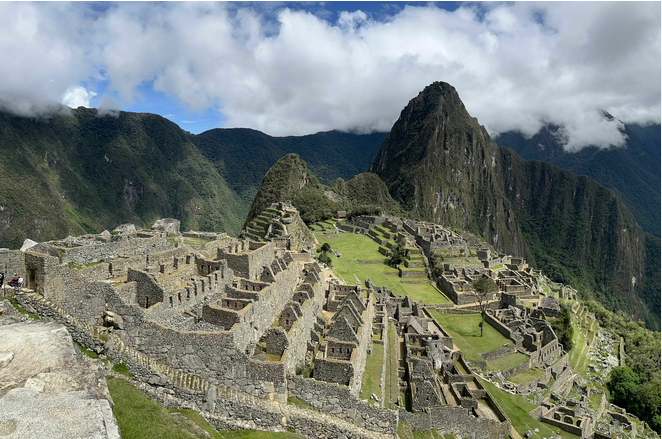 The ancient Inca ruins of Machu Picchu in Peru. By equipping your device with the best eSIM for Peru prior to departure, you can traverse ancient ruins, navigate winding Andean roads, and livestream vibrant local festivals without resorting to a physical SIM swap. The carrier securely transfers the profile to the eSIM on the device, and this profile contains all the information needed for the phone to connect to the carrier’s network, including authentication and access credentials. eSIM technology improves connectivity by allowing you to switch between network providers, ensuring optimal service based on location, price, or network quality.
Sunscreen
If you’re visiting Peru in the summer, you can expect hot, dry heat, with temperatures ranging between 25°C-35°C or even higher. Peru is situated in the Southern Hemisphere, where extreme heat waves can occur since the Earth is closer to the sun, and this translates into high levels of UV radiation. It’s easy to get sunburns. The most important thing to pack, and the one that should never be forgotten, is sunscreen, which protects your skin from the sun’s damaging rays. It’s recommended to use a sunscreen with at least SPF 30, especially if you’re spending time outdoors, to prevent sunburn, premature aging, and the risk of developing skin cancer.
A Portable Charger
 The brand of phone charger is something you can decide on – having charger with you is important – don’t leave home without one. An eSIM offers much cheaper data rates than international roaming charges from your home carrier, and the plan activates within minutes of purchase, giving you immediate connectivity upon arrival. Many providers offer unlimited data in Peru, but the data allowance depends on the specific plan you purchase from a mobile carrier or eSIM provider. That being said, a portable charge is highly recommended, and often essential, when traveling because it ensures your phone stays powered in situations where access to traditional outlets is limited or unavoidable. Your device is your camera, memory keeper, and social media hub, and running out of battery means running out of special moments.
A Spanish Phrasebook
English isn’t an official language in Peru, but estimates suggest that around 11% of the population can communicate in English to some degree, especially in urban and tourist-focused areas. Peruvians overwhelmingly speak Spanish, plus one or more indigenous languages (e.g., Quechua), and learning even just a few phrases makes navigating daily life easier and enhances your travel experience. A compact Spanish phrasebook allows you to bridge the local culture, so ask questions, listen attentively, and be respectful of local customs and etiquette. Having essential phrases at your fingertips is useful when asking for directions, ordering food and drinks, booking transportation, and shopping/bargaining.
If you need more versatile and comprehensive translation capabilities, consider using a translation app, which can be a dictionary app with a built-in automatic translator or something more sophisticated like an AI-powered chatbot. If you’re visiting Quechua- or Aymara-speaking regions, see if the app offers those packs, or if it mostly covers major languages. You can point your phone at menus, signs, and maps for instant text overlaps, or tap the microphone for both you and the local speaker. Some translation apps, such as Microsoft Translator and iTranslate, have pre-translated common expressions, meaning you can access common sentences without typing.
Bug Spray
Peru is rich with biodiversity, including insects, especially in jungle regions like the Amazon, which is home to beetles, moths, dragonflies, bees, grasshoppers, and more. Even if you encounter some bugs in Lima, the greatest diversity of insects is found in the jungle, so you should be prepared for biting insects by packing bug spray. Mosquitos, sandflies, ticks, and triatomine bugs are vectors for diseases like Zika virus, dengue fever, and others. Bug repellents are designed with a simple pump that is easy to use, but it’s necessary to rub it in; otherwise, the repellent stays in isolated areas.
Wrapping It Up
Having a packing list helps ensure a smoother, more organized, and stress-free trip to Peru. Being well-prepared helps you be more in control and confident, which can improve your overall travel experience.
 By Pepper Parr By Pepper Parr
September 9th, 2025
BURLINGTON, ON
The City is going to get what Council members have been pressing for – high-rise units with two and three-bedroom units that are not skimpy, small rooms.
Changes made from the original application are:
The number of one-bedroom units was decreased from 78 units to 21 units;
The number of two-bedroom units was increased from 24 units to 82 units;
The number of three-bedroom units was increased from 17 to 61 units;
In exchange for that, the developer will get an additional three stories in height. The original application was for 20 storeys.
 The rendering shows the development looking east. If what we heard at the Standing Committee on Monday holds through to the Council meeting on the 15th – the city will have avoided an Ontario Land Tribunal Hearing (OLT) hearing that they would have lost.
The site is in the western end of the football – a space that was at one time a serious hope for keeping some of the land in the core of the city open and available for some stunning development.
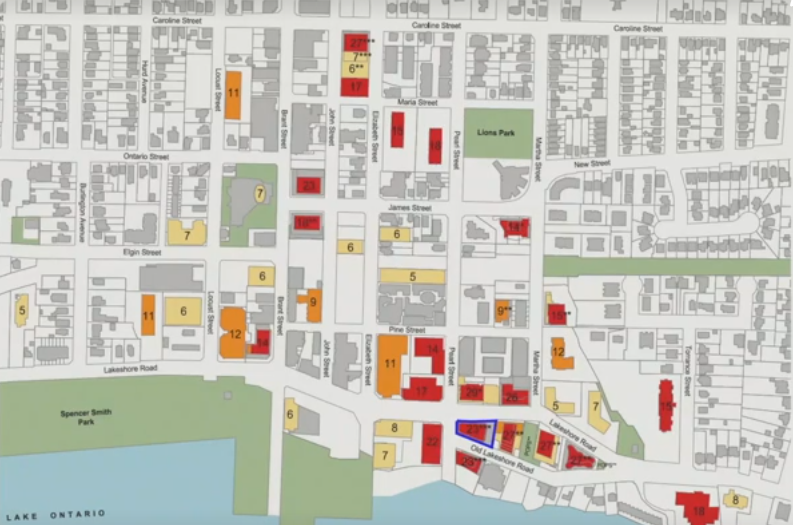 Where the height has been built in the downtown core. That possibility disappeared when the Beausoleil and the Nautique were built on the north side of Lakeshore Road between Martha and Elizabeth streets.
 The red part of the illustration shows where the city has given up some space to allow for wider sidewalks. The sidewalks will be wider on the eastern end – there was some deft negotiation that made that possible.
There are some minor holds on the issuing of a building permit -but they don’t appear to be something that will result in an building where 80% of the units will be two and three bedroom units.
Parking will be slightly less than one space per unit.
The decision at the Standing Committee was not unanimous. Mayor Meed Ward said it was her view that building like this should be built in the MTSA xxx. She added that was the reason for moving the Urbangrowth Centres north and out of the downtown core.
 Mayor Meed Ward on the right with Ward 2 Councillor Lisa Kearns above.  The back and forth between the Mayor and ward 2 Councillor Lisa Kearns gave us a bit of an insight into what we will see should Kearns decide that she can take on Meed Ward during the 2026 municipal election and become the Mayor of the city. That is a very real possibility. The back and forth between the Mayor and ward 2 Councillor Lisa Kearns gave us a bit of an insight into what we will see should Kearns decide that she can take on Meed Ward during the 2026 municipal election and become the Mayor of the city. That is a very real possibility.
The graphic above shows where the height in the downtown core is located.
 By Stephen Atcheler By Stephen Atcheler
September 9th, 2025
BURLINGTON, ON
Canadian poker players seeking substantial cash game action and tournament guarantees require platforms that maintain consistent traffic at elevated stakes. The selection of an appropriate platform depends on several factors, including game availability, rakeback structures, and the depth of player pools at various stake levels. This assessment examines five platforms currently serving Canadian players with high-stakes poker options.
GGPoker Commands the International Market
GGPoker maintains the largest player pool among international poker sites accessible to Canadian players. The platform recorded 13,157 concurrent cash game seats in early 2024, establishing a benchmark that other operators have yet to approach. Current traffic data shows approximately 13,000 active cash game players on average, though seasonal variations have brought this figure to around 10,000 players during mid-2025 periods.
 During peak hours, Canadian players find over 100 tables at low and mid-stakes, with more than 20 high-stakes games running simultaneously. The platform’s market position accounts for more than half of the international online poker market. This concentration of players ensures game availability across multiple formats and stake levels. During peak hours, Canadian players find over 100 tables at low and mid-stakes, with more than 20 high-stakes games running simultaneously.
The Fish Buffet loyalty program provides returns up to 60% fixed cashback through Platinum ranks. Players accumulate Fish Buffet Points at an average rate of 100 points per dollar in rake and fees, though this rate varies based on game type, player behavior patterns, and deposit history. The highest GGPlatinum tier offers consistent 60% rakeback, positioning this reward structure among the most generous available to Canadian players.
Tournament offerings include the $1,050 GGMasters HR with a minimum $1 million guaranteed prize pool. The standard GGMasters series runs daily tournaments from $25 buy-ins up to $1,050 High Rollers, guaranteeing over $4,000,000 Monday through Saturday. The 2025 GGPoker World Festival maintained its $250 million guarantee and distributed $324.7 million across 1,419 completed tournaments.
High-stakes cash games underwent restructuring in November 2024. Games at $25/$50 blinds and above now operate as invite-only tables under an Exclusive tab. VIP games continue at $500/$1,000/$2,000 blinds for qualified players, while $10/$20 tables became publicly accessible in both PLO and NLH formats.
WPT Global Ascends Through Aggressive Market Positioning
WPT Global has transformed from a minor operator to a platform processing approximately 2,000 concurrent players. This growth trajectory placed the site in third position according to PokerScout rankings in March 2024, surpassing both IDNPoker and iPoker networks.
The platform’s expansion coincided with strategic marketing initiatives and software improvements that attracted players from established sites. Canadian players accessing WPT Global find game selection concentrated in Texas Hold’em and Omaha variants, with stakes ranging from micro limits through mid-stakes games.
WPT Global’s connection to the World Poker Tour brand provides tournament series that complement cash game offerings. The platform schedules regular events that feed into live WPT tournaments, creating pathways for online qualifiers to participate in televised events.
PokerStars Maintains Presence Despite Traffic Decline
PokerStars continues operating as a recognized platform for Canadian high-stakes players, though traffic patterns show contraction from previous peaks. The site’s cash game population decreased from approximately 4,500 players in late 2022 to about 2,000 by mid-2025, placing it at comparable levels with WPT Global.
 Concentration The platform retains advantages in game variety, offering formats beyond standard Hold’em and Omaha games. Canadian players find mixed games, draw variants, and specialty formats that smaller platforms cannot support due to limited player pools.
PokerStars’ tournament schedule includes the Sunday Million and other established series that maintain consistent guarantees. The platform’s history of hosting major championship events provides tournament players with structured paths to live events and substantial online prizes.
partypoker Serves Niche High Stakes Markets
partypoker operates within specific market segments, maintaining a smaller but dedicated player base. The platform focuses on particular geographic regions and player demographics, resulting in concentrated traffic during specific hours that align with European and North American peak times.
Canadian players on partypoker encounter a different competitive environment compared to larger platforms. The smaller player pool creates dynamics where regular players become familiar with opponents’ tendencies, potentially affecting game selection strategies.
The platform’s PowerFest series and other promotional events periodically increase traffic and prize pools. These scheduled events provide opportunities for high-stakes action beyond regular cash game offerings.
888poker Rounds Out Available Options
888poker provides another alternative for Canadian players, though its market share remains smaller than the previously discussed platforms. The site maintains operations across multiple jurisdictions, creating segregated player pools that affect game availability for Canadian users.
The platform’s Blast Poker format offers a fast-fold variant that differs from similar offerings on other sites. Canadian players seeking variety in game formats may find 888poker’s unique features worth considering, though high-stakes action occurs less frequently than on larger platforms.
Technical Considerations for Platform Selection
Platform stability affects high-stakes play where connection issues can result in substantial losses. GGPoker experienced technical difficulties during major tournaments, including problems with the rescheduled $5 million guaranteed GGMasters Anniversary event when over 12,000 players remained on Day 2.
Software policies vary between platforms regarding third-party tools. GGPoker’s Security & Ecology agreement prohibits third-party software while allowing players to download hand histories for offline review. Other platforms maintain different policies that may affect players who rely on tracking software or heads-up displays.
Fast-fold game availability provides action-oriented players with increased hands per hour. GGPoker’s fast-fold Hold’em games accommodate over 500 players during prime time at stakes from NL2 to NL200, with Rush & Cash Omaha featuring more than 500 connections around the clock.
Market Dynamics Affecting Canadian Players
The concentration of traffic on GGPoker creates both opportunities and considerations for Canadian high-stakes players. The platform’s acquisition of the WSOP brand in 2020 provided visibility that attracted players globally, contributing to current traffic levels that rarely drop below 10,000 players.
 A strong hand indeed. The geographic distribution of players affects game quality at different times. GGPoker’s analysis indicates soft traffic in cash games and tournaments except at high stakes, where world-famous regulars participate. Asian market players contribute to weaker lineups during specific hours.
Promotional campaigns influence platform selection decisions. GGPoker’s January 2025 New Year Giveaway distributed $25 million through format-specific races, daily missions, and cash drops. The WSOP Express promotion enables players to begin with $0.50 buy-ins and progress through step-based ladders toward WSOP Main Event passes worth up to $30,000.
The selection of a high-stakes poker platform requires assessment of multiple factors beyond simple traffic numbers. Canadian players must consider rakeback structures, game availability during preferred playing hours, tournament schedules, and technical reliability when choosing where to invest their bankrolls.
 By Pam Pitz By Pam Pitz
September 9th, 2025
BURLINGTON, ON
Pam Pitz was responding the a member of the Mayor’s staff
Thank you Renee for your response and for taking time for our phone conversation today. While I want to maintain a collaborative tone, I must be clear: the current pool allocation decisions threaten the survival of Burlington Aquatic Devilrays (BAD), a 40+ year community club dedicated exclusively to Burlington families. These concerns cannot be brushed aside — they require an independent audit and a review by the Integrity Officer.
The responses provided below generally align with your points:
- Residency rules.
Residency rules have not been followed by GHAC. The rule clearly states that 85% of a club’s overall swimmers must be residents. It does not allow for calculations to be adjusted on a community-by-community basis. Applying the rule in that way undermines both its fairness and its purpose, which is to safeguard long-standing community clubs that serve local families.
Further, between the displacement of BAD swimmers and GHAC’s recruitment practices, other issues are arising. For example, it now appears there are too few Burlington swimmers in either club to meet the swimmer-per-lane requirements that the City established for efficiency and capacity maximization.
GHAC should never have recruited Burlington swimmers without following Swim Ontario protocols in the first place, which require consultation to ensure it does not damage the viability of the existing community club and to determine whether the City can reasonably and efficiently accommodate a second team. The lost pool time and lack of certainty has meant a decline in BAD swimmers and loss of economies of scale – leaving BAD with no choice but to raise fees — so unfair to Burlington families. This situation demonstrates exactly why those protocols exist — for continuity, fairness, and to minimize disruption for swimmers and families.
The Nelson Park meet is not a compromise — it’s a trap.
The City’s assurance that BAD will host next year’s Nelson outdoor meet has been presented as a gesture of balance. In reality, it sets BAD up for collapse. Once the meet is handed over to GHAC (after next year), BAD loses its premier fundraising event, which is critical to sustaining programs and keeping fees affordable. For GHAC, which operates in multiple municipalities with broader revenue streams, the Nelson meet is optional. For BAD, it is existential.
- GHAC’s pre-planned expansion.
There is a clear sequence of actions demonstrating GHAC’s long-term intent to capture Burlington pool time, particularly Centennial. For years, GHAC has recruited Burlington swimmers and used “outreach” more as a tactical gesture than genuine collaboration. Most recently, GHAC has actively pursued Burlington Aquatic Devilrays (BAD) coaches. These actions are inconsistent with swim club etiquette and Swim Ontario expectations, The pattern is unmistakable: this was not organic growth, but a deliberate strategy designed to maximize advantage, at the expense of the long-standing BAD program.
GHAC disregarded Swim Ontario protocols both when it began recruiting Burlington swimmers and again in pursuing out-of-home (Dundas) meets in Burlington (e.g. Nelson). Any attempt to seek Swim Ontario sanctioning after the fact occurs only after the disruption has already taken place, undermining the intent of these rules — to ensure fairness, protect existing community clubs, and minimize disruption to local programs.
The fact that GHAC has engaged high-priced lawyers to pursue this plan is striking, particularly when compared to a genuine not-for-profit club like BAD, which, in the normal course, would not even contemplate such legal services. BAD operates with limited resources and focuses entirely on serving its swimmers, not on orchestrating expansion for competitive advantage and increased revenue, accompanied by expensive legal maneuvers, for personal or organizational gain. While BAD has found it necessary to seek legal guidance, it does modestly and responsibly, highlighting the stark contrast in approach and priorities between the two clubs.
- Program choice and coaching quality.
BAD has been careful to offer a range of programs, including options that do not require competitive participation, to ensure accessibility, choice and affordability. BAD’s coaching team includes former national and Olympic athletes, and the club invests in land training, guest speakers, sport science expertise, and even international training camps. A current Canadian Olympian has also contributed to athlete development.
In short, BAD provides depth and variety of choice, while GHAC’s expansion simply displaces BAD swimmers. BAD has already scrambled to secure costly private pool time to survive. GHAC, a regional club, could have — and should have — rather than pushing to capture the majority of Burlington pool time knowing it would come at the expense of the established community club (BAD)
- RFPs and not-for-profit realities.
The City must recognize that allocating time to not-for-profit sports clubs is fundamentally different from contracting with a commercial supplier. Clubs like BAD rely heavily on volunteers and develop athletes over many years — often from age six into adulthood. This long-term process requires consistency, trusted coaching, and strong community bonds. It cannot be disrupted every few years without severe harm to the swimmers’ development and hardships for their supporting families.
- Integrity and transparency.
The City’s stated principles — prioritizing community-based clubs, ensuring transparency, and protecting affordability — have not been applied consistently. In hockey, Burlington-based teams are clearly prioritized. Why has BAD, with 40+ years of Burlington history, not been given the same respect?
BAD’s roots and activities are 100% Burlington. Its community contributions are a source of pride for the club, its swimmers, and their families. For instance, on September 14th, BAD will fundraise, support and participate in the Burlington Terry Fox Run — an organization who recently recognized BAD for all its efforts over the last decade.
GHAC, given its regional nature, will not be able to give Burlington its undivided attention, yet it has received preferential treatment and that is damaging to public trust — it must be addressed.
I have sat for hundreds, if not a thousands, of hours in pools throughout the Province and elsewhere in support of my grandkids. You get to know those clubs that are most respected. You understand the pride and mutual respect that exists from community club to community club and the nurturing and pride that exists within the City that those clubs represent. It’s those community to community relationships, and their City’s supporting stance, that creates and preserves the competitive spirit. Almost every community has one club that is their Tier 1 community club – why doesn’t Burlington see those advantages and want that pride? It’s the Burlington Aquatic Devilrays —embedded in the name — Burlington.
Requested Actions
- Commission an independent audit and direct the Integrity Officer to review how GHAC’s expansion and allocation process were handled.
- Require GHAC to provide full documentation proving compliance with Swim Ontario’s residency and sanctioning requirements. I have filed a formal complaint with Swim Ontario.
- Re-examine pool allocations with the principle that Burlington-based clubs must come first, as they do in other sports.
- Protect BAD’s future by guaranteeing that the Nelson meet remains with BAD beyond next year, recognizing both its financial importance and BAD’s exclusive dedication to Burlington.
- Commit to restoring BAD’s historic allocation (36–40 hours) effective the fall of 2026, with clear notice provided to GHAC so they can plan accordingly. This must be done quickly as budgets and schedules take considerable time and effort. Unfortunately, it’s too late from a scheduling and budgeting point of view for either club to significantly alter plans for the ensuing year. BAD will remain in survival mode through the next year, but cannot survive without restored stability thereafter. Many families have already indicated they would return if BAD’s future were secured including swimmers who quit due to this circumstance or have accepted placement outside Burlington (limited given residency restrictions elsewhere). Most have not opted to join GHAC for reasons that can be easily understood — unless they felt restricted by uncertainty and travel limitations – i.e. under duress. All swimmers want to train as close to home as possible.
BAD has never wanted to displace any swimmer. It simply wants its rightful place restored and preserved. With this in mind, it’s my understanding that BAD respectfully recommends that Council utilize the Shared-Use Framework based on Tiered Access (a best practice):
- Tier 1: Local, not-for-profit, volunteer-led community clubs (e.g. BAD)
- Tier 2: Regional or private, fee-based programs (e.g GHAC)
- Tier 3: Short-term rentals, camps, or revenue-driven events
Simply put, why didn’t a Tier 1 club like BAD get 36-40 hours allotted with residual to GHAC rather than the other way around?
Summary
This is not about one season or a single dispute. It’s about whether Burlington chooses to support its own long-standing, community-based clubs — or allows them to be displaced by regional organizations whose roots, resources, and loyalties lie outside our city. It’s also about ensuring the City works only with organizations that operate with integrity and put Burlington’s youth first.
I’ve copied the appropriate parties because this matter demands serious and immediate attention. Competitive swim programs require planning that begins a full year in advance. Every day of delay makes recovery more difficult — and the longer this goes unaddressed, the greater the harm to athletes, families, and the broader community. I continue to believe that Council has the ability — and the responsibility — to correct course and protect BAD swimmers. I believe cancellation provisions within the contracts allow for this. A course correction as described above would certainly afford GHAC much more time to adjust than was given to BAD for the current season (about three months in total). In the end, the swimmers are the ones most deeply hurt. Older athletes who placed their trust in the City and in BAD are now left with a mere shadow of the community that existed only a few months ago. It’s not about the clubs themselves.
On a personal level, the impact on my family has been heartbreaking. The uncertainty over the summer led to decreased BAD enrolment, rising costs, and a decline in volunteer support — all of which strained BAD’s ability to function effectively. BAD, which once held a clear affordability advantage over GHAC, has largely lost that position. My daughter had no choice but to withdraw her two youngest children due to rising costs — a shameful and unnecessary outcome. She isn’t alone. She will continue with BAD for my eldest grandchild since she has been in BAD since 7 years of age, however with only two years until university, she too has been negatively impacted. She has seen her nine-year journey with BAD unravel as her teammates and close friends were scattered. Her trust has been broken. Burlington families like mine are now facing these rising costs simply to maintain what they had — a place within BAD. They did nothing to cause this. It’s not fair.
What makes this situation even more distressing is how disconnected the City’s actions seem from the broader value BAD provides. BAD isn’t just a swim club — it’s a community built over decades, encompassing not only current swimmers and parents but generations of alumni who remain deeply invested in its future. This was clearly demonstrated by a recent petition, which received overwhelming support far beyond what current enrolment alone might suggest. BAD’s legacy was intentionally created through decades of dedication and community engagement, and it deserves not just recognition, but preservation and continuation.
BAD has given thousands of young people far more than swimming skills. It has instilled confidence, time management, a sense of belonging, and lifelong friendships. It supports local events, promotes healthy lifestyles, and keeps youth engaged and focused. BAD is a Burlington success story — and it must not be allowed to fall apart. Yet its survival is increasingly threatened by decisions that could have been avoided and, in my view, are inconsistent with the “Tiering” best practice. Any further delay in correcting course will only deepen the harm already done and the probability of collapse.
How could something so positive, so deeply rooted in this community, be dismantled? Why? BAD did nothing wrong. It defies logic, undermines fairness, and — above all — is morally wrong. It is worthy of repeating — BAD’s legacy should be recognized, valued, and protected — not erased.

Pam Pitz
Burlington, Ontario
Editor’s note: The Integrity Commissioner is not the level at which a complaint/concern can be registered. There is a member of Council in the process of bringing a Motion to have this issue reviewed by the City’s Audit Committee.
By Gazette Staff
September 7th, 2025
BURLINGTON, ON
Edited for clarity and condensed for length
Finally, something from Sound of Music (SoM) on where they are, what they are up against and what they are trying to do.
Stay alive would be the best way to put it.
 Joel Macleod Joel Macleod was in conversation with Brent Kinnaird, the Executive Director of the festival on a podcast
MacLeod (JK) asked: Is there a chance the festival could transforms into a paid event to offset those costs? Or is the determination we are keeping it free, come hell or high water? What is going to happen? What are the possibilities down the road?
Brent Kinnaird (BK) “So first and foremost, the goal is to keep it free, absolutely. The reality is that it may not be possible. Could there be a paid component, or could it turn into a ticketed or paid event? That’s one of the things that we’re looking at – absolutely – yes.
“Do we alter how we present it in some way? And that means, you know, does it stay as a four-day event, or do we go from three stages down to two or on and on and on. Anything is on the table right now is the honest answer, and is the reality, you know, but ultimately, what we would love is to keep this festival free in its current format, because that’s where the magic has been, and that’s where the biggest impact has been.”
MacLeod calls it an institution.
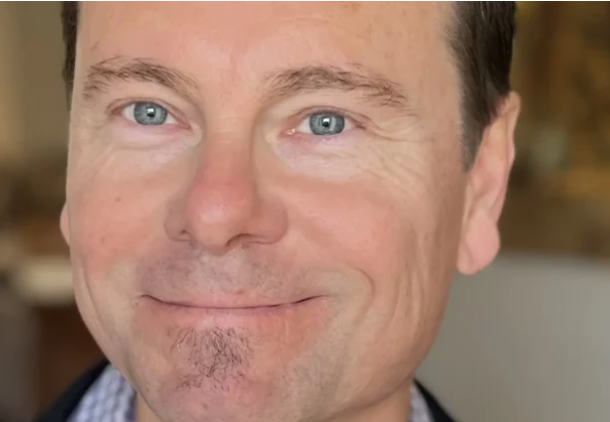 Brent Kinnaird, the Executive Director Sound of Music BK: “Thank you. for calling The Sound of Music an institution. Because, you know, it really is.
“The Sound of Music Festival is Canada’s largest free music festival since 1980 – 45 years in the city of Burlington. We basically build a small city within the city, in Spencer Smith park for a week, and we preside over that city. And how do we preside over it? We have music, we have midway rides, we have vendors, we have food trucks, we have activities for the kids. We have sampling activations and, oh yeah, by the way, there’s some pretty good music too. So it is, it’s a beast. It’s a labor of love. You can’t imagine it unless you’ve been to it.
“Unfortunately, the reason we’re having this conversation, is the festival is in dire straits. And I’m wondering if you can maybe elaborate a bit on that, because this isn’t a new this is really a new a new state of affairs. This kind of has been coming for a while, if I’m not mistaken.
BK: This will come as no surprise to anyone – to continue to sustain an event of our size and scale and continue to offer it for free, which is absolutely the mandate. This is, a barrier free event.. This is families. This is everyone is welcome to come out and enjoy and and you know, there should be no barrier to enjoying a community event, enjoying live music, enjoying an experience like this with your with your family.
“We have incredible support from all three levels of government. You know, the piece that we’re missing is this: it is getting increasingly more expensive every year.
“Government grant funding is on the decline. Sponsorship sales are becoming increasingly more challenging. There’s a lot of competition from other events. We have a couple of great beer gardens. We have a VIP area that does pretty well. Unfortunately it is not enough. The reality of the situation is the sound of music costs in excess of a million dollars to put on every year, and finding the revenues to balance that out has been a challenge that is, is not new.”
BK: “ But we continue to make it do and make it work every year, but we’re reaching that breaking point, and that breaking point to sustain what we do on the size and scale that we do it and keep it free and accessible for everyone is now, frankly, a near impossibility.”
 The Arkells: Appeared at Sound of Music when they were just beginning. JK: “I can remember the attractions that you’re bringing into the band, so that you’re bringing in. I remember seeing like the Arkells just before they kind of rested and became the Arkells. But I remember seeing them and, you know, the whole town boys, finger 11 will come back, and they’ll play every now and again, like you’re not, you’re not getting Nick No Name acts like, these are these, are these are real acts. These are artists.”
“How do you do it? How do you scope out those acts, kind of on the cusp of greatness, reach out to them and then, because I figured they’re not going to play for free, they’re not going to, you know, they’re not, no matter how charming you might be.”
BK: A very big part of the mandate of sound and music is promoting local and emerging artists and providing a stage the size and scale of ours; providing a professional production and stage crew, and taking a band who’s here and ready for their career to take the next step. And we help them do that. I want to underline, we help them. We’re not responsible for, you know, the Arkells, being, the sensation that they are, or finger 11, or Walk off the Earth. We’ve played a part in that. We have had a role to play in propelling artists to the next level of their career, and we continue to do that with our Battle of the Bands competition, our local stage with our partner, our current presenting sponsor is the Burlington Performing Arts Center. But back to your overall question about, you know, how we go about this? There’s some interesting little nuances in in the business.
“There’s terminology, you know, use, like routing and radiuses and other clauses and that sort of thing. And what all of this means is, you know, it’s a negotiation, what bands are available, what bands are touring, what bands might be routing, coming, you know, through the area in southern Ontario, maybe playing a show in Oshawa or Toronto or up in London. And, you know, is there an opportunity to stitch some things together and have them make one of their stops along the way at sound and music? So we start by sort of looking, you know, at who’s out there, who might be on the road, who might be putting a tour together. Maybe there are some dates in our area that have already been announced, and is there an opportunity to get them to make a stop here we also look at, you know, making sure that we continue to diversify the lineup in genre and in every other way, and so we sort of start with headliners.
 Here’s our wish list, here’s who we’d love to get, here’s who’s available and is a real possibility. And once we get those headliners locked in, then we start to build the lineup, you know, down from there. And we love the theme nights too. You know, having some retro 80s stuff is super fun. Having classic rock, of course, you know, great stuff that the 90s, alt, some country in there as well.” Here’s our wish list, here’s who we’d love to get, here’s who’s available and is a real possibility. And once we get those headliners locked in, then we start to build the lineup, you know, down from there. And we love the theme nights too. You know, having some retro 80s stuff is super fun. Having classic rock, of course, you know, great stuff that the 90s, alt, some country in there as well.”
“What else responsibly should we be looking at – what’s important, to make sure that there’s something for everyone? So, you know, jazz and blues and roots and folk. You know, we haven’t done a lot of those genres, but we’re slowly working our way into rounding out the lineup with, some more of that, so long winded answer, I apologize, but you know, it really, really does start with kind of who’s a good fit, who’s available, right? Who do we think? And then, you know, the pieces start to come together. And about how far in advance are you doing this, live, this leg work.
“We’ll start, usually in September, October, with some initial conversations around, you know, what our vision is, and start doing some of that research, you know, on some of the things that I mentioned. And then usually by around Christmas time, we’ve got some early pieces. And usually the top end of the lineup is starting to take shape from there.”
JK: “What’s the state of the festival right now? Then, as you’re seeing it coming off the most recent one? Well, you know, I go from smiling and talking about happy stuff and here, you know, here comes the doom and gloom.
BK: “You know, the reality is, it’s been a bit of a slow burn over the last few years, with resources starting to to dwindle a little at a time, and up against, you know, post covid era and the rising costs of of everything. This is not a new problem. It’s been something that we’ve seen coming. It’s been something that we’ve tried to stave off, you know, as best as we could over the last, you know, few years. But the reality is, you know, I, I hate to, you know, push the dramatic, but, you know, it’s, it’s the it’s the reality too, and that is, it is entirely possible that we may well have seen the last sound of music this past June. We are in a position, you know, right now today, where, unless we have an injection of support, it is very sadly, probably the end.”
“You know, most people who know know me associated with sound music know that. You know, it’s not just a job for me. It’s, it’s a it’s a passion. I love it more than anything, and it gets me very emotional because of that. I’m a crier. Joel, just so, you know, I might cry at some point in this space.
JK: I think there’s a there’s a sense of family, there’s a sense of purpose and determination to like, you know, this year has to outdo last year’s festival. And it was kind of refreshing to see me. You know, there’s a lot of cynicism out in the world. It was kind of nice to see a group of people that just know, I just want to have a party.
 She knows why she is there! In the press release that you sent out, you had mentioned, you know, the dwindling government funds coming in, both at the Ontario and federal levels. And I just want to talk with that because, I mean, I’ll try to start a pop but I did notice the notice goes out, and there seems to be a quick distancing on a part of the city. And I know at the federal level, I haven’t heard anything at the provincial level, just to say, Oh, well, we know we’re giving as much as we can. And that I was always puzzled by it says, How well, how much of the cuts back from from public arts grants and festival grants would be impacting into this decision to where we are now.
BK: Look, is it a factor. The fact of the matter is, government grant funding is on the decline. That is, that is an indisputable fact. It is happening. We are not the only event or festival. Others are echoing the same thing. So anyone who tells you that government grant funding for arts and culture and events like ours isn’t going down. They’re not telling the truth. That’s a fact.
We also know that we have a responsibility to sustain ourselves, and we have to find alternate sources of funding. And you know, none of this is saying a single disparaging word about any level of government that that has funded us and continues to fund us. That’s not what this conversation is about. That’s not what our press release was about. Never once did we say that we were not appreciative of the support that we’ve had. What we’re saying is the reality in today’s world of doing what we do, it’s not possible to do it at the current levels that we are being funded. It simply takes more it’s more expensive to run it than what it was last year and the year before and so on and so forth.
They have been amazing partners. They have supported us in many, many ways, and we have always been grateful for that. What we are saying is we’re at a place in time now, finally, where the tree limb is is cracked and it’s almost broken.
The levels of funding that we receive from all three levels of government covers a decent amount of our budget, but we need to find more resources and more funding. And we know if the government is maxed at, this is what they’re able to provide, or these are the funds that are out there, obviously there has to be caps, and, you know, ceilings on it. We all, we all get that. If that’s the case, where do we find the other resources that we need. We need to tell our story, and the story is our partners, our funders, our government agencies, all wonderful, but you put all of that together, it still is not enough to be up to be able to present the festival that we present, and everyone has has come to know and love. So we need to find more corporate sponsors. We need to find donors in the community that you know, believe in city building and believe in the arts and believe in tourism and putting Burlington on the map.
We have, we have a very strong story to tell of our economic impact. We bring visitors into the city. They spend money in hotels and B and B’s and restaurants and retail and on and on. So there’s, there’s absolute economic uplift and impact in the city that is significant from sound and music. And we have the data to show that we introduce people to the city visitors for the first time, we incentivize them to come back. So, you know, we’re helping the City of Burlington to be prosperous and be a city that people look to and want to come to, we absolutely make a positive contribution to that. And so what we’re saying is we need to find some additional resources and partners and support to help us continue to do what we’ve done, which is put on a great party.
JK: What is it that you’re asking of them? What is your offer on the table? So to speak to them, to say, Well, what did they get out of, you know, signing a big check over to you guys for next year’s festival. Yeah. So a great question.
BK: You know, we’ve never been a, you know, write us a check. We’ll slap your logo on a screen, and, you know, we’re done. We’ll call it a day. This is about building relationships. This is about cultivating partnerships that bring mutual value. So what we’re asking is people that believe in community, people that have a passion for music and for the arts, people that want to support artists, people that understand the value of bringing people together in an event like this, the power of music, the power of, you know, a community based event. As big as we are, we’re still, you know, a little community-based thing at heart. That’s what we are. And so, you know, all of those intangibles, you know, we want to kind of pull on the hearts and minds of folks and say, Yeah, this is important. We can’t lose this. This can’t die for all of that, all of those reasons, but you know, from a pure sponsor relationship perspective, you know what we can offer is incredible name recognition.
 How do you monetize crowds like this? We can offer the respect of this community people have come to know and love and respect sound and music. So do you want to be synonymous with something that has a great reputation, that has a storied history, that you know, brings people together, and if you want to, you know, talk just pure economics and dollars and cents, we can, we can put you as a sponsor, as a partner, in front of a huge audience, which is an opportunity that, if your goal is to build business. We have an audience for you that is probably bigger than any other audience you can find.
JK: Well, I do want to touch upon that because, you know, each year it seems to be numbers get to get put out after the event. You know, we brought in so many people.
What’s the running average that you would say it’s how many hundreds of 1000s of people you bring into the downtown core of Burlington for four days on Father’s Day weekend?
BK: “Our estimate, and we have, you know, some scientific data to back this up, not the least of which, we do some drone flying, and we can take pictures of the crowd and run it through a software program, and it basically estimates crowd size at a moment in time.
 The crowds are there. Asking them to pay a fee of $5. for the weekend. 5 x 250,00 people – do the math! “With that and some other tools, we estimate over the last three years, kind of the post covid festival years, something in the neighborhood of about 400,000 visits. I want to emphasize visits. It’s not 400,000 people, because you may have the same people that are coming back multiple days, maybe all four days so, but 400,000 visits.
“How does that translate? Well, this this past year, Saturday night, we had Big Wreck as a headliner on the main stage, and our crowd estimates are between 12 and 15,000 people just watching Big Wreck. That doesn’t include the West stage. Doesn’t include the people in the Midway – just Bih Wreeck on the Main stage – 12 to 15,000 people.
“We estimate that at the height of the festival, Friday, Saturday are the two, the two biggest days attendance wise, that when we have a jam packed Park, there’s, you know, something in the neighborhood of, at any one time, 50,000 people in the park. So, you know, if you want your brand to be in front of an audience, that is an audience that, you know, there’s a segment that’s, you know, reasonably affluent. There’s a lot of families, a lot of, you know, families with young children. The demographic targets that brands and companies are trying to reach – we have it. In the course of four days, you can be in front of 10s of 1000s of people, not to mention you’d have the PR credentials of being the savior of the SoM festival.”
BK: “I had someone pitching me with this idea. How would you like to contribute? X, and you will be known as you know, the company, or one of a handful of companies that saved a 45 year tradition.”
JM: My mind always goes back to the to the Arkells. The only reason why is, I remember hearing their album, kind of the first album on the radio a bit notice, just playing other the articles are playing out there. I’ll go down check him out, right? It’s a free concert. I’m not gonna I don’t lose anything. And like, the one or two songs I heard, and I come down, and I’m standing in the back just, you know, one of those 400,000 heads in the crowd, and I’m blown away, like these guys are put on a show. Before that they were doing like, clubs and and concert venues; they just, they blew me away. It was one of those things, like, I became a fan in that moment, like, I’m sitting there watching the show, and I was like, Okay, I’m on the bandwagon. Now I’m a fan, and I have been a fan ever since I am.
“That’s the kind of what you have a chance to salvage.”
 Hamilton Super Crawl Hamilton Super Crawl is similar in a way. It’s barrier free access to music on artists, you know, all weekend long. A different focus, a little bit different genres. And, you know, not necessarily the size and scale that we are from a concert perspective. The event has lots of different pieces, but, you know they’re, they’re kind of in spirit. You know they’re, they’re not, you know, all that unlike us in that way. But that aside, I think you’re right. If you talk about a, Pure Music Festival in the province of Ontario, there’s nothing like us, you know, you’ve got a blues Fest in Ottawa, which is much, much bigger than we are. And you know, they’re getting, you know, a list of headline artists, you know, Foo Fighters and Def Leppard and Motley Crue and you know, bands that are, you know, they’re not in the same, you know, level that we are. But you know, it’s also a paid event.
BK: ‘There’s some other great festivals around the province, Rock the Park in London, the River Fest and Elora. Great music festivals, great people. But there’s something about the spirit and the vibe of sound and music that I, you know, bias, yes, but I don’t, I don’t really think that there’s anything like it, and certainly not the history and the longevity that that we have.
 “The Arkells played very early in their career at Sound and Music. And this is the same kind of kind of thing, you know, that we’re doing we’ve done with some of these local bands we mentioned.” “The Arkells played very early in their career at Sound and Music. And this is the same kind of kind of thing, you know, that we’re doing we’ve done with some of these local bands we mentioned.”
BK: “Fast forward to this year. We did a Battle of the Bands competition. We’ve done that for several years. We had over 160 bands from Southern Ontario apply for for battle the bands. What does that tell you about the music scene in Ontario? It’s incredible, right?
 Black Paint, from Ajax. “The winner of the Battle of the Bands competition this year, got a spot on the Main stage at the festival on Saturday afternoon to open up the festival. So you talk about when you saw the Arkells then and where they are now. This incredible band, a trio. They’re called Black Paint, from Ajax. They win the battle of the bands, great guys, super duper unbelievable musicians. They’re actually playing in Hamilton. In a couple days, these guys arrive to load in.
 Big Wreck Big Wreck was headlining the show that night. These three young dudes from Black Paint who play, you know, bars around Toronto and Southern Ontario. They walk up on the main stage to load up their gear and get ready to play their show. And I can see in their eyes, they’re like, whoa. Like, this is big and for me, love Big Wreck, love all the bands we’ve had play. That’s the moment for me; this is why we do what we do.
JK: “I know what you’re talking about.”
 By Paul W. Bennett By Paul W. Bennett
September 7th, 2025
BURLINGTON, ON
Consider these everyday experiences in today’s digitally dependent world rich with artificial intelligence (AI). A convenience store cashier struggles to make change. Your Uber driver gets lost on his way to your destination. A building contractor tries to calculate the load-bearing capacity of your new floor. An emergency-room nursing assistant guesses at the correct dosage in administering a life-saving heart medication.
All of these are instances of an underlying problem that can be merely an irritant or a matter of life and death. What happens when brains accustomed to backup from phones and devices must go it on their own?
Increasingly we are relying upon technology to do our thinking for us. Cognitive offloading to calculators, GPS, ChatGPT and digital platforms enables us to do many things without relying on human memory. But that comes with a price.
 As AI-powered tools become more capable, our brains may be bowing out of the hard mental lift. Leading cognitive science researchers have begun to connect the dots. In a paper entitled The Memory Paradox, released earlier this year, American cognitive psychologist Barbara Oakley and a team of neuroscience researchers exposed the critical but peculiar irony of the digital era: as AI-powered tools become more capable, our brains may be bowing out of the hard mental lift. This erodes the very memory skills we should be exercising. We are left less capable of using our heads.
Collective loss of memory
Studies show that decades of steadily rising IQ scores from the 1930s to the 1980s — the famed Flynn effect — have levelled off and even begun to reverse in several advanced countries. Recent declines in the United States, Britain, France and Norway cry out for explanation. Oakley and her research team applied neuroscience research to find an answer. Although IQ is undoubtedly influenced by multiple factors, the researchers attribute the decline to two intertwined trends. One is the educational shift away from direct instruction and memorization. The other is a rise in cognitive offloading, that is, people habitually leaning on calculators, smartphones and AI to recall facts and solve problems.
The AI literacy gap facing Gen Alpha
AI threatens Indigenous data sovereignty and self-determination
Surveying decades of cognitive psychology and neuroscience research, Oakley and her team show how memory works best when it involves more than storage. It’s also about retrieval, integration and pattern recognition. When we repeatedly retrieve information, our brains form durable memory schemata and neural manifolds. These structures are indispensable for intuitive reasoning, error-checking and smooth skill execution. But if we default to “just Google it,” those processes so fundamental for innovation and critical thinking may never fully develop, particularly in the smartphone generation.
A key insight from the paper is the connection between deep learning behaviours in artificial neural networks (consider “grokking” in which patterns suddenly crystallize after extensive machine training) and human learning. Just as machines benefit from structured, repeated exposure before grasping deep patterns, so do humans. Practice, retrieval and timed repetition develop intuition and mastery.
Atrophy of mental exercise
The researchers sound a cautionary note. Purely constructivist or discovery‑based teaching, starting with assumptions that “students know best” and need little guidance, can short‑circuit mental muscle‑building, especially in our AI world. The team found that when students rely too early on AI or calculators, they skip key steps in the cognitive sequence: encoding, retrieval, consolidation and mastery of the brain’s essential building blocks. The result is individuals whose mental processes are more dependent upon guesswork, superficial grasp of critical facts and background knowledge and less flexible thinking.
 Even techno skeptics see a role for digital tools. Oakley and her colleagues argue for what they term cognitive complementarity — a marriage of strong internal knowledge and smart external tools. ChatGPT or calculators should enhance — not replace — our deep mental blueprints that let us evaluate, refine and build upon AI output. That’s the real challenge that lies ahead. Even techno skeptics see a role for digital tools. Oakley and her colleagues argue for what they term cognitive complementarity — a marriage of strong internal knowledge and smart external tools. ChatGPT or calculators should enhance — not replace — our deep mental blueprints that let us evaluate, refine and build upon AI output. That’s the real challenge that lies ahead.
The latest cognitive research has profound implications for educational leaders, consultants and classroom teachers. Popular progressive and constructionist approaches, which give students considerable autonomy, may have exacerbated the problem. It’s time to embrace lessons from the new science of learning to turn the situation around in today’s classrooms. This includes reintegrating retrieval practice (automatic recall of information from memory), spaced repetition and step-by-step skills progression in Grades K-12.
Using your head
What are the new and emerging essentials in the AI-dominated world? Oakley and her team deliver some sound recommendations, including:
- Teaching students to limit AI use and delay offloading.
- Training teachers to design AI‑inclusive but memory‑supportive curriculums, demonstrating that effective AI use requires prior knowledge and the ability to distinguish fact from fiction
- Guiding institutions to adopt AI in ways that build upon, not supplant, the human brain, such as editing original prose or mapping data.
Using our heads and tapping into our memory banks must not become obsolete. They are essential mental activities. Access to instant information can and does foster lazy habits of mind. British education researcher Carl Hendrick put it this way: “The most advanced AI can simulate intelligence, but it cannot think for you. That task remains, stubbornly and magnificently, human.”
The most important form of memory is still the one inside our heads.
 Originally published by Policy Options. Originally published by Policy Options.
Paul W. Bennett, Ed.D., is a senior fellow at the Macdonald-Laurier Institute, a director at the Schoolhouse Institute and chair of researchED Canada. Widely known for producing three nationally recognized Canadian history textbooks in the 1980s, he is an executive board member of the Canadian Association for the History of Education and the author of Saving History in Canada’s Schools.
*Composed in a fierce dialectical encounter with ChatGPT.
 By Gazette Staff By Gazette Staff
September 6th, 2025
BURLINGTON, ON
Stage Directions
October 4 & 5, 2025
Two days of strategy, connection, and skills-building for Hamilton theatre and performance makers.
“How can we all build a stronger, more sustainable Hamilton theatre community together?”
In 2014, attendees at the first Stage Directions Symposium gathered to address this question, and the work resulted in partnerships, projects, programming, and planning decisions that continue to positively impact the city’s art scene.
It’s time to re-open the discussion.
Do you want to play a part in shaping the future of theatre and performance-making in Hamilton? Join us for Stage Directions – The Symposium on Day One (Oct 4) and get involved in this vital conversation. Then come back for Day Two (Oct 5) with two incredible skills-building workshops and end the night with the return of The Monologue Slam!
Register Today
Registration Pricing
 DAY ONE | Saturday, October 4, 2025 DAY ONE | Saturday, October 4, 2025
The Symposium – $40 (includes pizza lunch)
DAY TWO | Sunday, October 5, 2025
From Seed to Story with Chantal Lim (Workshop) – $30
Stage Combat: Introduction to Swordplay (Workshop) – $30
The Monologue Slam (tickets and/or performer application fee) – $15
*Stage Directions All-Access Bundle – $92
Save $23 when you book for all four events!
*Stage Directions Day Two Bundle – $60
Save $15 when you book for all three Sunday events!
*Bundle discounts only apply if you register for multiple events in the same transaction. Discounts cannot be applied retroactively. Questions? Email info@HFTco.ca.
 By Tom Parkin By Tom ParkinSeptember 6th, 2025
BURLINGTON, ON
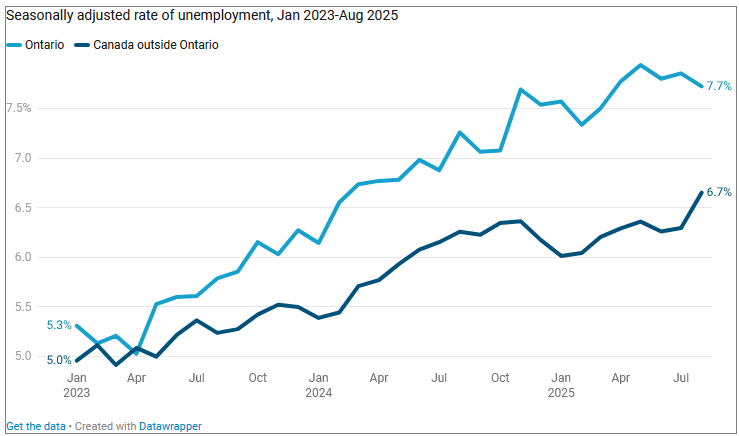
Ontario’s unemployment rate continued to run well above the rest of Canada in August, as it has now for more than two years, according to seasonally-adjusted data released by Statistics Canada Friday morning.
In April 2023 rates of unemployment in Ontario and Canada sat at 5.0 per cent. But over the past 29 months, Ontario unemployment has grown to 7.7 per cent while in the rest of Canada the rate has increased 6.7 per cent.
True unemployment rate unclear as 41,000 give up hope
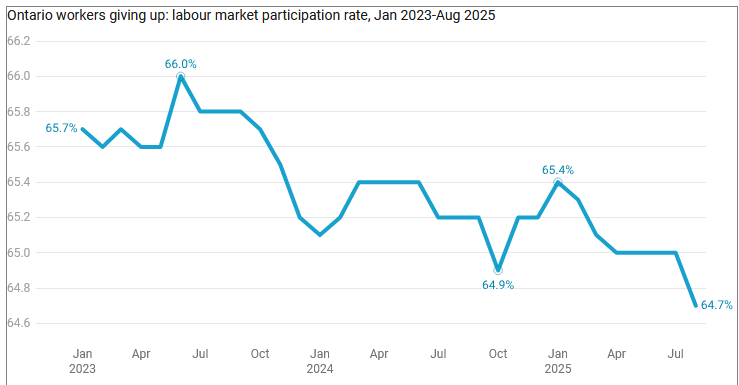
Officially, 807,000 Ontario workers were unemployed in August, according to Statistics Canada. But the true number appears to be perhaps 40,000 higher.
Ontario’s labour market participation rate hit a new low as 41,000 Ontario workers left the job market. Because workers are giving up faster than than jobs are being lost, the official Ontario unemployment rate ticked down 0.2 percentage points in August.
But if the labour market hadn’t shrunk by 41,000 workers last month, Ontario’s unemployment rate would have hit 8.1 per cent.
Media elite continues unconcerned, Ford offers stunts
Auto towns Windsor and Oshawa have the highest rates of unemployment in Ontario at 11.1 and 9.0 per cent, respectively. Toronto, where the local economy has been depressed by unaffordable cost of living, has the third highest jobless rate at 8.8 per cent.
As in previous months, the Toronto Star’s coverage of Toronto’s rising unemployment has been limited to national stories written by Canadian Press. CBC Toronto and the Toronto Sun both do not appear to have posted a story about today’s jobs numbers. Global Toronto assigned a reporter, whose report was based on the Canadian Press story.
Ontario’s economic weakness has been years in the making, and without media attention, the Ontario premier has faced no penalty for inaction. Now into a third year of rising unemployment, Ontario premier Doug Ford is yet to provide a strategy to create jobs.
 Premier Ford pouring the contents of a bottle of Crown Royal whiskey onto the ground. But this week the premier did offer a stunt for news TV cameras, pouring out a bottle of of rye whisky after a Windsor-area bottling plant announced it would shift jobs to the United States. The company’s planned job cuts remained unaffected.
And media was there a week before when Premier Ford announced the Volkswagen battery plant originally announced in 2023 is still going ahead. Less attention from media or Ford has focused on the existing Brampton and Oakville assembly plants where not one vehicle has rolled off the line in more than two years.
However, some close to the labour movement are grouping together to set a plan to push jobs up the political and media agenda.
The Canadian Centre for Policy Alternatives, the Centre for Future Work and several other jobs-focused think tanks are holding a strategy summit in Ottawa in mid-September.
And Ontario NDP finance critic Jessica Bell is convening a round table of economists and stakeholders next week to strengthen the opposition’s jobs push when the Ontario legislature returns, which the government has delayed until October.
Discussion about this post
 By Pepper Parr By Pepper Parr
September 6th, 2025
BURLINGTON, ON
 Waiting. You had to be in what was the Old Montreal Forum.
He stood there, arm over the handle of his hockey stick. Waiting.
He seemed too big to be a goalie – that thought disappeared when the puck came his way.
He was the starting goalie in Canada’s 1972 Summit Series team that defeated the Soviet Union in the decisive 6-5 victory in Game 8.
He was superb.
We lost Ken Dryden on Friday.
 Few could do what he could do.
 By Gazette Staff By Gazette Staff
September 6th, 2025
BURLINGTON, ON
Burlington Beach Catamaran Club (BBCC) is holding the 2025 Hobie Cat 14 North American Championships in Burlington September 8-11, 2025.
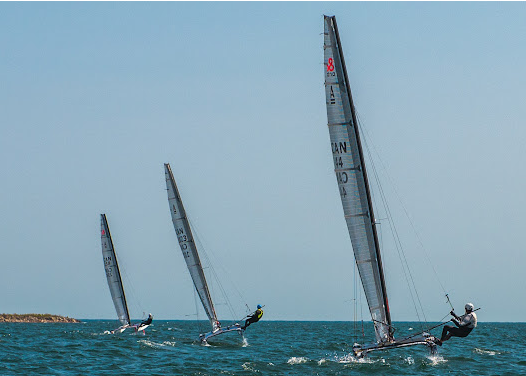 The Championship will follow the BBCC BUMS Regatta, which will be held on September 5-7, 2025. The Championship will follow the BBCC BUMS Regatta, which will be held on September 5-7, 2025.
7 days of Great Racing.
Where: At Burlington Beach – follow the trail – you can’t miss the place.
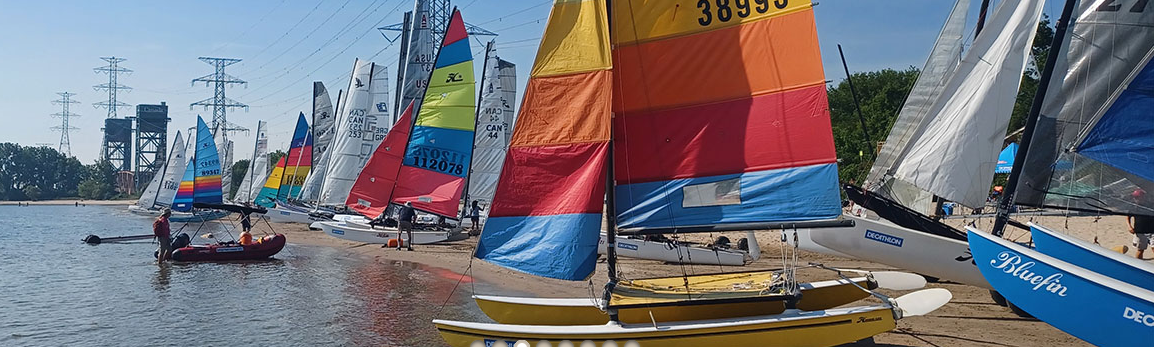
 Take the Waterfront Trail – you won’t miss the place.  This is thrilling to watch. Mastering the wind
 By Gazette Staff By Gazette Staff
September 6th, 2025
BURLINGTON, ON

Vintage Wheels & Wings. See hundreds of vintage vehicles along with our famous vintage aircraft collection!
September 21, 2025 at the Canadian Warplane Heritage Museum
Time: 9 am to 2 pm
Admission: BUY ONLINE & SAVE –
 Vintage cars at the Wheels and Wings event. Adults $16 (Age 18+), Kids $12 (Ages 6-17).
At the door – Adults $20 & Kids $15 (tax included). Free admission for museum members and children 5 & under. Complimentary passes are not valid for this special event.
VINTAGE VEHICLE PRE-REGISTRATION SOLD OUT! We are now at maximum capacity for vintage vehicles. Unregistered vintage vehicles will not be admitted to the show.
A VINTAGE vehicle is one that was manufactured 20 years ago or more (so 2005 or older).
As this is an outdoor event, some car owners may elect to leave early if inclement weather is expected.
 By Tom Parkin By Tom Parkin
September 5th, 2025
BURLINGTON, ON
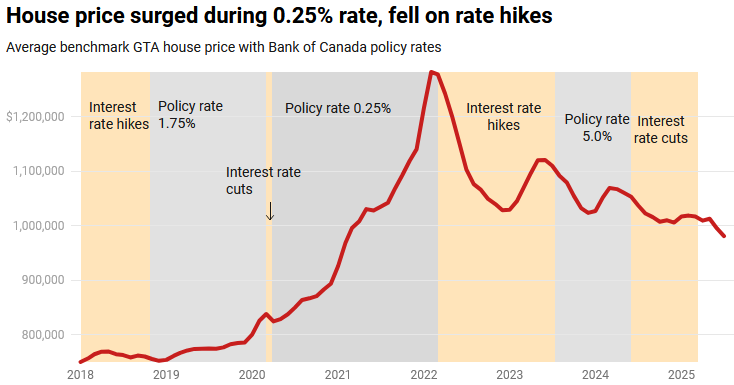
Housing costs skyrocketed on low mortgage rates. But some blame immigrants, and it’s mostly partisan hackery.
Housing price surge came during low in-migration period
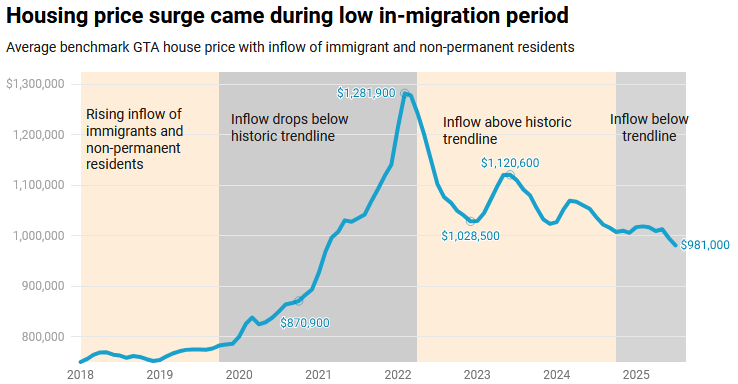
Average benchmark GTA house price with inflow of immigrant and non-permanent residents
No matter how much the facts show they are wrong, some people won’t stop blaming immigration for the cost of housing.
No doubt some of it is driven by anti-immigrant sentiment. But it often just seems to be sheer partisan hackery. Since immigration is a federal responsibility, blaming the housing price surge on in-migration puts the blame solely on former prime minister Justin Trudeau. As a bonus it neatly exonerates any Conservative premiers.
But the data is crystal clear. The immigrant theory of the housing price surge is flat-out wrong. Unless effects can come before their causes.
Prices surged while in-migration hit historic lows; they fell as in-migration increased
Our chart above shows the surge in housing prices started Q1 2020 and ended Q1 2022. Prices rose fastest in the Greater Toronto Area, up 53 per cent in 23 months, creating space for rents to rise behind them. Since Q1 2022, when the boom went bust, prices have fallen almost 24 per cent.
So if the immigration theory is right, high in-migration would be associated with rising prices while low in-migration would be associated with falling prices. But that’s exactly opposite what happened.
In Q1 2020, as prices began their surge, flows of immigrants and non-permanent residents fell to lows not seen for years (see chart below). This was the time of COVID restrictions. In Q3 2020, in-migration even went negative as a net 67,000 non-permanent residents left Canada and only 9,000 immigrants entered. Contrary to the “immigration caused it” theory, prices surged when in-migration was historically low.
In-migration moved above the historic trendline in Q1 2022. But house prices that quarter didn’t increase, as the immigration theory would predict. They fell. And contrary to the immigration theory, as in-migration increased to a peak in Q3 2023, house prices kept falling.
The immigration theory of the housing crisis is a totally false narrative, probably invented for partisan gain, though the Trumpian deportation urge no doubt also plays a role.
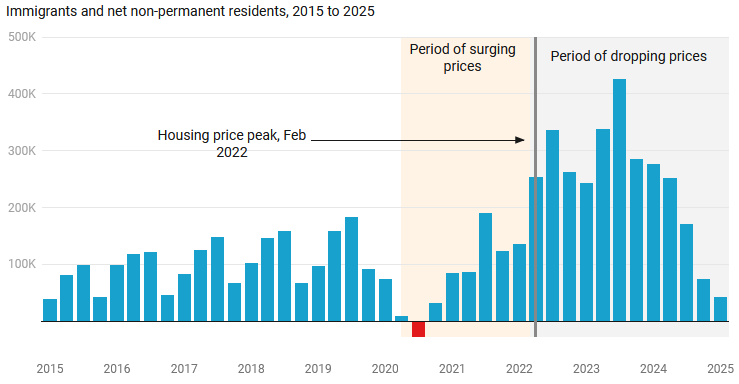
Causality 101: causes come before effects, not after
Some people are so committed to their partisan or anti-immigrant bias they will look at this data and still declare in-migration caused the price spike that preceded it.
Actually, they won’t. If they started reading this post they stopped long ago, the moment they realized it didn’t confirm their bias. All the facts and data in the world will never change instrumentally-geared minds. And there’s always a pandering politician waiting to tell them they’re right and the facts are wrong.
But for those who like causes to precede effects, the below chart goes a lot further in explaining what happened, though other factors, including government action and inaction, played a role.
A $600,000 mortgage amortizing over 25 years at 5.5 per cent interest cost over $3,600 a month. At 2.0 per cent — a rate commonly available from 2020 to 2022 — the cost of that same mortgage was just over $2,500 a month. Suddenly, a lot of people qualified for a mortgage that could buy a house, setting off a buying frenzy.
And maybe it’s just another very wild coincidence, but the very month the 0.25 per cent rates ended with rate hikes, the boom went bust. Odd, that.
House price surged during 0.25% rate, fell on rate hikes
By Gazette Staff
September 5th, 2025
BURLINGTON, ON
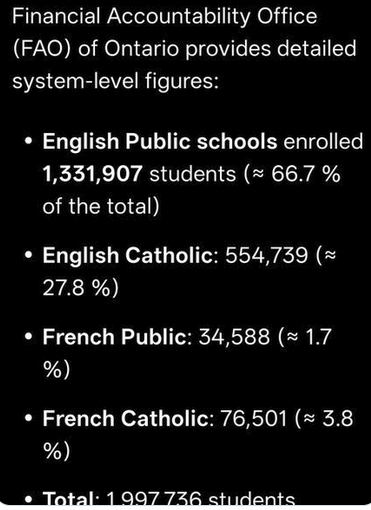 Grebenc: Looks like if you want any kind of voice, you will need to be in the French Public board… How is that for equity? Rumours abound about how Education Minister Paul Calandra intends to change Ontario’s school board system.
A source said earlier today that “… I’m hearing he’ll do the following: take all 72 boards and reduce them to just 4: English Public, English Catholic, French Public, & French Catholic.
Andrea Grebenc, a former chair of the Halton District School Board asked: “How is that for equity?”said:
By Gazette Staff
September 5th, 2025
BURLINGTON, ON
Sometimes it is more than a photo op.
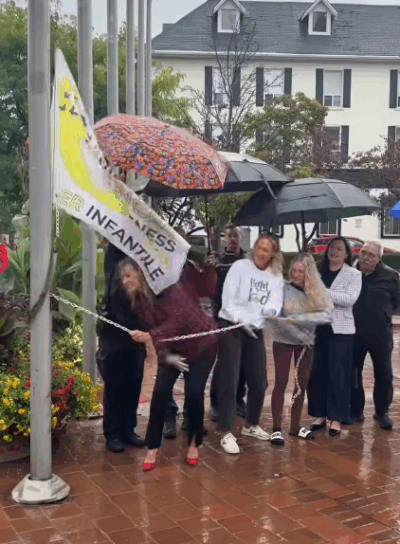 Mayor Meed Ward and Councillors Kearns and Bentivega took part in raising a flag.  The umbrella helped but not that much. Give them credit for getting soaked while hoisting a flag that makes mention of Children’s Cancer Awareness month.
How did Councillor manage to miss this opportunity?
 By Gazette Staff By Gazette Staff
September 5th, 2025
BURLINGTON, ON
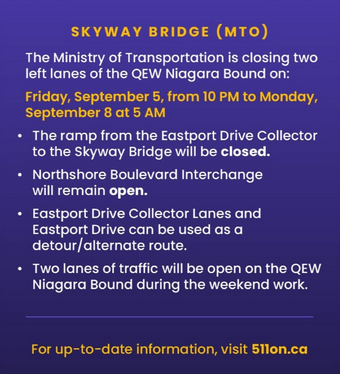
The Ministry of Transportation is getting better at informing people of road closures on the Skyway Bridge.
 By Pam Pitz By Pam Pitz
September 5th, 2025
BURLINGTON, ON
I am writing in the spirit of goodwill, responsibility, and respect for the City of Burlington. I ask that you carefully review this complaint and take appropriate action to address the concerns raised.
This note relates to the recent developments involving the Burlington Aquatic Devilrays (BAD) and the Golden Horseshoe Aquatic Club (GHAC).
Pam Pitz I am a Burlington resident and a 73-year-old grandmother with a lifelong love of sport, particularly swimming. Four of my grandchildren have swum with BAD, three of them quite recently. While I am not a BAD parent, I feel compelled to speak out due to the impact these developments have had on my family and Burlington’s broader swimming community.
BAD has operated successfully in Burlington for more than 40 years as a not-for-profit club, supported by skilled coaches, committed volunteers, and strong community partnerships. Traditionally, the City allocated pool time sufficient for approximately 400 swimmers, with a residency requirement to ensure the vast majority were Burlington families. BAD has long been recognized as a trusted, well-run program dedicated to swimmer development and competitive opportunity.
This year, when pool contracts were renewed, GHAC was allocated Burlington pool time. While competition between clubs can be healthy, I believe GHAC’s actions—and the City’s handling of the matter—raise serious concerns that require investigation.
Elements of a Successful Swim Program
- Building a quality club takes years. Success depends on a broad base of swimmers across age groups, a long-term development model, and resources to attract strong coaches to sustain operations.
- Team Spirit and Trust: Swimmers, coaches, and families build deep bonds over time, and continuity is essential for growth and wellbeing.
- Volunteers: BAD relies on hundreds of volunteers who dedicate time and resources. Their efforts are sustainable only in a stable, reliable environment. Families cannot be expected to rebuild these bonds in another club, especially under duress. Many swimmers enter clubs at 7 or 8 years of age and continue until their late teens.
Concerns Regarding GHAC and Current Arrangements
 Some of the following issues fall within Swim Ontario’s jurisdiction and unique interests. However, the comments and nuances contained in my separate communication to Swim Ontario, ]which are shared below, are important for the City to consider, since municipal pool allocation decisions directly affect fairness, community impact, and the long-term viability of Burlington based programs. GHAC’s actions may be inconsistent with the usual Swim Ontario sanctioning protocols for regional expansion and for hosting meets outside a club’s traditional home base. Some of the following issues fall within Swim Ontario’s jurisdiction and unique interests. However, the comments and nuances contained in my separate communication to Swim Ontario, ]which are shared below, are important for the City to consider, since municipal pool allocation decisions directly affect fairness, community impact, and the long-term viability of Burlington based programs. GHAC’s actions may be inconsistent with the usual Swim Ontario sanctioning protocols for regional expansion and for hosting meets outside a club’s traditional home base.
- Expansion into Burlington: GHAC, traditionally a regional club, has actively recruited Burlington swimmers for years, well before securing pool access. GHAC’s website was recently amended to move Burlington to second place among its service areas, despite its official address being in Dundas. There appears to have been a calculated approach to building a base of Burlington swimmers in advance of their bid for Burlington pool access. While families are free to choose where they swim, this strategy seems questionable when measured against Swim Ontario’s expectations/protocols regarding expansion and the well understood and accepted swim club etiquette of respecting other established clubs and communities. There is no benefit for the swimmers to move to GHAC — not from a coaching, reputation, or cost point of view.
- Club Structure and Governance: BAD operates under a traditional not-for-profit model with independent volunteer oversight. By contrast, GHAC appears to follow a more fee-based, volume-driven model, with administrative and coaching roles concentrated within a single family. While families are entitled to choose programs that suit them, this approach—combined with aggressive expansion—raises questions about governance, transparency, and whether growth is being pursued in a manner aligned with community values and not-for-profit principles.
 Residency Requirement: At the time of renewal, 79% of BAD’s swimmers were Burlington residents—slightly under the 85% target but within historical fluctuations. Reduced pool time has since forced enrolment down from nearly 400 to 163 swimmers, although this number fluctuates, especially in the face of uncertainty. GHAC, by comparison, had only 28% Burlington residents yet was reportedly given months of flexibility to improve its numbers. Applying the residency rule unevenly disadvantaged BAD while benefiting GHAC. Residency Requirement: At the time of renewal, 79% of BAD’s swimmers were Burlington residents—slightly under the 85% target but within historical fluctuations. Reduced pool time has since forced enrolment down from nearly 400 to 163 swimmers, although this number fluctuates, especially in the face of uncertainty. GHAC, by comparison, had only 28% Burlington residents yet was reportedly given months of flexibility to improve its numbers. Applying the residency rule unevenly disadvantaged BAD while benefiting GHAC.- Capacity and Costs: Burlington pool capacity is finite. For every Burlington GHAC swimmer who has been training elsewhere, and will now swim in Burlington, a Burlington BAD swimmer is displaced. The overall result is duplication of overhead, increased costs for families, and weakened stability for both programs. Many swimmers have already dropped out in the face of uncertainty and betrayal. It’s difficult to find training in other communities who have their own residency requirements. BAD swimmers are facing rising costs which are prohibitive for many Burlington families who previously enjoyed BAD’s lower fee structure. Overall confidence in Burlington’s commitment to a sustainable competitive swim club that gives the City of Burlington undivided attention, pride and community support is declining. The destruction of BAD’s 40 year history does not bode well for the future as swimmers worry about a similar circumstance at the next contract renewal. Their sense of stability and trust has been severely weakened.
While GHAC may suggest it can satisfy Burlington’s expectations by keeping Burlington-addressed swimmers in Burlington pools and directing swimmers from other communities elsewhere, this is unrealistic. Their recruitment has taken the total number of Burlington swimmers, between BAD and GHAC, to well beyond Burlington City capacity. Obviously, some will be displaced or be unfairly forced to swim outside of Burlington. In addition, as swimmers progress, they require higher-calibre coaching, stronger peer support, and access to the best facilities. Just as importantly, for a club to operate efficiently and effectively, senior swimmers must be consolidated under the highest-level coaches in the strongest facilities. Naturally, senior swimmers from both Burlington and beyond will migrate to train together at the City’s premier venues—particularly Centennial Pool. This pattern is consistent across all clubs: senior swimmers with similar needs inevitably come together at the strongest facility available. It will be impossible for the City to monitor or restrict this, yet the effect is clear: for every non-Burlington swimmer training here, a Burlington swimmer is also displaced. If GHAC truly had the swimmers best interests in mind, any Burlington resident expressing interest in competitive swimming over the last several years should have been referred to BAD in the first place — rather than bringing into the GHAC program and having them and their families endure inconvenient travel to training facilities outside of Burlington.
 Swim Meet Sanctioning: Nelson Pool has been awarded to GHAC for an outdoor swim meet— historically a BAD signature event (14+ years), drawing clubs from across Ontario and beyond (e.g. Newfoundland and Mexico). It serves as a key fundraiser supported by hundreds of Burlington volunteers and is a source of tourism for the City. GHAC’s efforts to secure this event, despite Burlington not being its traditional home base, appear to be a further calculated step in consolidating its presence in the City. If sanctioned by Swim Ontario, this would severely undermine BAD’s ability to sustain its operations. Swim Meet Sanctioning: Nelson Pool has been awarded to GHAC for an outdoor swim meet— historically a BAD signature event (14+ years), drawing clubs from across Ontario and beyond (e.g. Newfoundland and Mexico). It serves as a key fundraiser supported by hundreds of Burlington volunteers and is a source of tourism for the City. GHAC’s efforts to secure this event, despite Burlington not being its traditional home base, appear to be a further calculated step in consolidating its presence in the City. If sanctioned by Swim Ontario, this would severely undermine BAD’s ability to sustain its operations.
Community Impact: BAD, a community pillar for over four decades, is now at risk. Families are disheartened, children are leaving the sport, and Burlington’s swim culture is being eroded. This outcome serves no one—not the athletes, not the families, and not the City.
Requested Action
I respectfully ask the City of Burlington to conduct a thorough review/audit of this matter to ensure:
- GMAC, and all Swim Ontario sanctioned clubs, are required to confirm they are in full alignment with Swim Ontario’s rules, sanctioning protocols and codes of conduct. It’s important that communities and Swim Ontario encourage and embrace a spirit of cooperation for their mutual benefit.
- Residency requirements are enforced fairly and equally.
- Not-for-profit governance remains transparent and accountable.
- Longstanding community-based clubs like BAD are protected and supported.
- Burlington families are provided a sustainable, cost-effective environment for swimming.
- Traditional commercial RFP processes/documents are no longer utilized for children’s sports facility allotments. Contracts should be extendable to ensure stability and sustainability unless, of course, there are breaches in contract requirements such as proper facility treatment, etc.
Closing
This is not simply about pool time or BAD —it is about fairness, community, and the future of sport in Burlington. I strongly believe GHAC’s tactics, combined with the City’s approach, warrant a complete and independent review. The BAD contract, and I assume the GHAC one, has a clause that allows either party to cancel subject to a 90 day notice period. With this in mind, and the strength to do what is right, a reinstatement of BAD’s previous allotment of pool time is necessary to restore and preserve its longstanding position within Burlington and the overall swim community, and to give the swimmers confidence that they will have the protection and stability they deserve. GHAC’s approach and eventual encroachment into Burlington facilities is simply not acceptable.
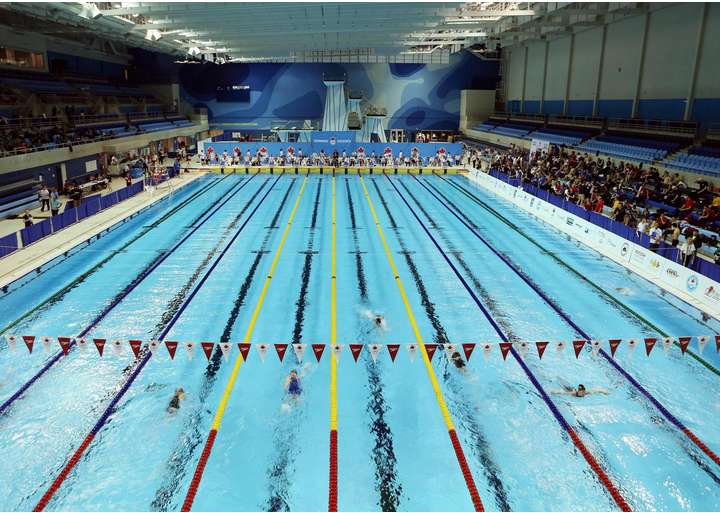 Burlington needs an Olympic-level pool For transparency, in addition to filling a complaint to Swim Ontario based on their unique interests, I have copied this email to City Council, the Integrity Commissioner, the Burlington Sports Alliance, and other relevant stakeholders. There is concern among many sports clubs in Burlington and beyond that the current situation, if not remedied, will set a precedent detrimental to their sustainability.
While I am reluctant to involve myself in controversial matters, there comes a time when one must act in the best interest of children, families, and the community. Therefore, I respectfully repeat my request that this matter receive the scrutiny it deserves.
Thank you in advance for your attention. I trust you will act in the best interest of our athletes, families, and the sport of swimming.
 By Gazette Staff By Gazette Staff
September 5th, 2025
BURLINGTON, ON
The Performing Arts Centre has created a Burlington Local Participation Program
These are events or opportunities that are local in every sense of the word.
They are an addition to the MainStage and Community Stage events – and they are usually less expensive.
One of the events that come under the program is the Nutcracker Suite; a traditional event in the GTA – not sure about other parts of the province.
Nutcracker Youth Participant Program gives young dancers the opportunity to perform with a professional dance company. They will interact with professional dancers and gain invaluable performance experience as they dance roles in
Ballet Jörgens Dance: The Nutcracker: A Canadian Tradition
 Jörgen’s Ballet: Photo by Jim Orgill
Audition Registration is Open!
Saturday, September 27: 9:30am-12:45pm
Dancers cast in the production will learn their roles over the course of the audition weekend & then rehearse weekly on Sundays.
Detailed schedule with live updates available here.
Performances
Tuesday, November 25 – 7:30pm
Wednesday, November 26 – 7:30pm
*Please note that the Wednesday afternoon show is part of our Education Series, and is not on sale to the general public
 By Ray Rivers By Ray Rivers
September 4th, 2025
BURLINGTON, ON
It was an interesting development this week as India’s Modi, Russia’s Putin and North Korea’s Kim exchanged hugs and kisses with China’s president Xi.
This unlikely group of (mostly) autocrats represents almost half of the world’s population, rapidly increasing economic power, and an enormous collection of massive war machines, collectively surpassing that of the USA, the G7 and NATO. Only Donald Trump was missing.
For the first time in five generations, America is no longer the global leader which can command the respect of the global community. And the prognosis is sadly negative for the western coalition of the democratically minded – as third world nations look to China for leadership and support in their development aspirations. Trump cancelling US AID may have been the icing on the cake.
It’s only been a few months since the US presidency changed, but America has already changed more than anyone could have imagined. Trump has broken with tradition and the inviolable US Constitution to put American armed soldiers on America’s streets.
 Masked police officers on the Street of America arresting people.  Masked police officers are detaining people until they can be deported. His deportation policy echos the early days of the third Reich, as even legal immigrants are snatched from their homes, workplaces and the streets to be sent to concentration camps at home and abroad. He has raged Putin-like revenge on his political opponents, though apparently not assassinated any yet.
 The Gaza Strip left in ruins by the Israelis with almost complete support from President Trump. Trump stupidly attacked America’s neighbours, friends and historical allies in a unilateral and unprovoked economic war. And his abandonment of what little the US was doing to curb Russian aggression in eastern Europe has branded him as an unreliable security partner. And finally his support for the ethnic cleansing ambitions of the Israeli fascist leadership reveals a man whose moral status is bankrupt, which should not be a surprise to anyone.
This should all be very troubling to us in Canada, who have long felt secure in the belief that America was a like-minded adult in a world that occasionally goes berserk. It is clear Canada should no longer rely on the US to help us defend our homeland. In the end, we’re on our own.
In that vein, we should argue for America, Hungary and Slovakia, to leave NATO unless they change their perspectives. Canada needs to seriously rethink all of its policies regarding American military supplies and defensive arrangements, including NORAD. We need to build and buy Canadian.
We must learn to defend ourselves. There will be a significant cost – and we are going to have to find a way to pay for it. It may require military conscription of some sort, a discussion we need to have. And we need to face the global confrontations sooner, including Ukraine. The lessons of the Second World War are there to instruct us. We should look to Scandinavia and Poland, of late, for inspiration. They know that good fences make better neighbours.
 Ray Rivers, a Gazette Contributing Editor, writes regularly applying his more than 25 years as a federal bureaucrat to his thinking. Rivers was once a candidate for provincial office in Burlington. He was the founder of the Burlington citizen committee on sustainability at a time when climate warming was a hotly debated subject. Ray has a post graduate degree in economics that he earned at the University of Ottawa. Tweet @rayzrivers Ray Rivers, a Gazette Contributing Editor, writes regularly applying his more than 25 years as a federal bureaucrat to his thinking. Rivers was once a candidate for provincial office in Burlington. He was the founder of the Burlington citizen committee on sustainability at a time when climate warming was a hotly debated subject. Ray has a post graduate degree in economics that he earned at the University of Ottawa. Tweet @rayzrivers
Background links:
America Collapsing Making US Foes Great Again Conspiring Against USA
By Gazette Staff
September 4th, 2025
BURLINGTON, ON
The Burlington Library reports on their Big Borrows stories which is now an annual tradition, as “we explore what Burlington readers are borrowing most from their public library. Now that our Kids Summer Reading Club is wrapped up for another year, it’s a great time to check our borrowing statistics to see what titles are tops with kids so far this year. Here’s what we found.”
The BIGGEST Borrows
 There were 29 children’s titles borrowed at least 70 times, for a whopping 2,433 total borrows “We’re so impressed with the incredible enthusiasm our young customers have for reading this year! The breakdown of the most borrowed physical books (includes children’s fiction, graphic novels, children’s readers & pre-readers, and picture books) goes like this: five titles were borrowed 100 or more times; three titles were borrowed 90-99 times; six titles were borrowed 80-89 times; and 15 titles were borrowed 70-79 times—that’s 29 children’s titles borrowed at least 70 times, for a whopping 2,433 total borrows January through August!
“And here’s the best thing: the kids exceeded last year’s numbers—by a lot. From January to August 2024, BPL members borrowed 37 children’s titles at least 50 times for 2,256 total borrows. In comparison, if we counted children’s physical titles borrowed at least 50 times since January 2025, they would number over 100, with nearly 6,800 total borrows. Wow!
“Let’s take a look at the books that are inspiring these super-readers.”
Top Children’s Fiction
“Not surprisingly to us, Jeff Kinney’s Diary of a Wimpy Kid series saw lots of check-out action, with Diary of a Wimpy Kid Double Down taking top spot with 125 borrows and Cabin Fever (tied with a Dav Pilkey graphic novel) at #3 with 103 borrows. Fifteen books by the author landed in the top 20 children’s fiction titles borrowed since January.
“Respectfully removing Kinney’s titles from the list since they are always mega-hits with the kids, here are the most borrowed physical children’s fiction titles so far this year, each with 50 or more loans.”
Harry Potter and the Philosopher’s Stone by J.K. Rowling
The Wild Robot by Peter Brown
Harry Potter and the Chamber of Secrets by J.K. Rowling
Harry Potter and the Prisoner of Azkaban by J.K. Rowling
Geronimo Stilton. The Haunted Castle by Geronimo Stilton
Harry Potter and the Deathly Hallows by J.K. Rowling
Dork Diaries. Tales from a Not-so-Secret Crush Catastrophe by Rachel Renee Russell
Diary of a Pug. Pug Blasts Off by Kyla May
Dragon Masters. Power of the Fire Dragon by Tracey West
Harry Potter and the Order of the Phoenix by J.K. Rowling
Dork Diaries. Tales from a Not-so-Happy Heartbreaker by Rachel Renee Russell
The Wild Robot Escapes by Peter Brown
Harry Potter and the Half-Blood Prince by J.K. Rowling
Magic Tree House. Soccer on Sunday by Mary Pope Osborne
Harry Potter and the Goblet of Fire by J.K. Rowling
The Wild Robot Protects by Peter Brown

|
|





 Labour-oriented groups and politicians setting strategy