 By Pepper Parr By Pepper Parr
September 30th, 2025
BURLINGTON, ON
It didn’t take Ward 2 Councillor Lisa Kearns to move back into her photo op mode.
She did a photo op with a really pathetic sign nailed to the northern wall of Spencer Smith Park. Many, perhaps most people, don’t know that the Park was named after Spencer Smith who came to Canada as a xxx in xxx
He ran a grocery store on Brant Street and was Chair of the Horticulture Society, which at the time was the most influential group of citizens in the city.
That was at a time when Burlington grew produce that was shipped around the world.
 148,000 plus of these benches have been sold. Burlington installed its first yesterday. Later the same day, Kearns slipped over to the Pier to celebrate the installation of a yellow bench. It’s supposed to make you feel better when you are depressed.
Kearns has been out of the country, serving as one of the Canadian team of people visiting Africa on behalf of the Federation of Canadian Municipalities, part of a program funded by the federal government and delivered by FCM.
If we can catch Kearns between photo ops, we will ask her how the trip went. She did tell us that the story about her trip is on her Facebook page.
For the person who is the Deputy Mayor on Engagement issues – referring to a Facebook page isn’t really up to par. Was there a pun in there somewhere?

 By Tom Parkin By Tom Parkin
September 30th, 2025
BURLINGTON, ON
Ontarians are paying the price in money, emissions and uncertainty about where Ontario’s future electricity will come from.
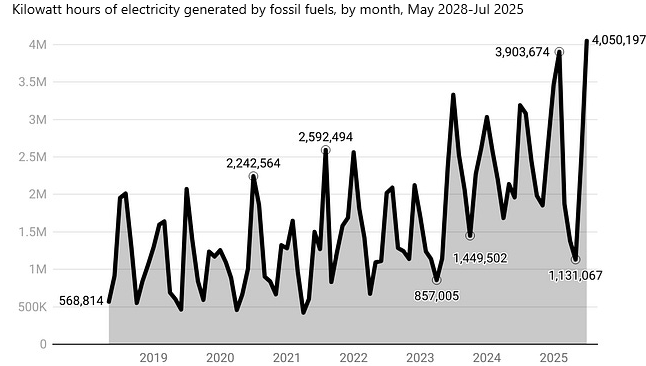
Kilowatt hours of electricity generated by fossil fuels, by month, May 2018-Jul 2025
 Premier Doug Ford is emptying a bottle of Crown Royal whiskey during a photo op. While he eats ice cream, pours out Crown Royal and works hard to distract people, Ontarians are paying a price for Doug Ford’s electricity muddle.
After the PCs’ June 2018 election, their first major energy move was to cancel contracted generation projects, some mid-construction.
The cost paid by Ontarians was $231 million to get nothing.
Then his government lost more than four years in a muddle over how to contract new power supplies, not releasing a framework until December 2022. And all the while their muddle was costing time and money, long-scheduled maintenance and a couple turbine retirements were reducing generation capacity. The cost has been a stopgap return to fossil-fuel generation, a lot of hype about four small modular reactors with very large price tags, and uncertainty.
Fossil-fuel generation up 273% since PCs elected.
This July, almost 4.1 million kilowatt hours of power was generated by burning fossil fuels, according to a Statistics Canada report released Monday morning. That’s the highest level since at least 2007.In the twelve months before the PCs were first elected, a monthly average of about 0.9 million kilowatt hours was generated from fossil fuels, according to the Statistics Canada report. But during that period, Ontario’s nuclear power stations were generating a monthly average of 7.5 million kWh.
Now, in the most recent reported twelve months, because of long-planned maintenance, nuclear generation is down to a monthly average of 6.9 million kWh. While Ontario grew. And factories electrified.
The result is, in the most recent reported twelve months, average monthly fossil fuel generation is up 273 per cent at 2.4 million kWh, according to today’s report.
And the Independent Electricity System Operator’s 2025 Annual Planning Outlook shows no substantial reduction in fossil fuel use until 2034.|
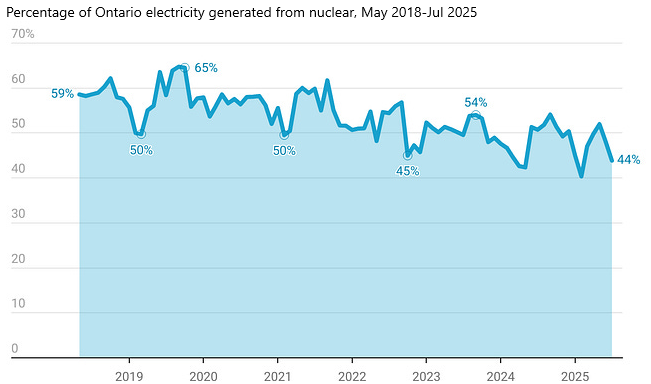 Percentage of Ontario electricity generated from nuclear, May 2018-Jul 2025PCs’
SMR plan: inadequate and over-hyped.
Now the Ford PCs are hyping a plan for four small modular reactors (SMR) as a noisy distraction from the problem they created.
The SMRs come at the extraordinary price of $21 billion to produce just 1,200 MW. In contrast, refurbishing Darlington’s four reactors will cost $12.8 billion to produce 3,512 MW. And that 1,200 MW is like a raindrop in the desert for a province of Ontario’s size, not some salvation.
The IESO’s 2025 Annual Planning Outlook shows even with the SMRs Ontario faces uncertainty about where future power will come from.
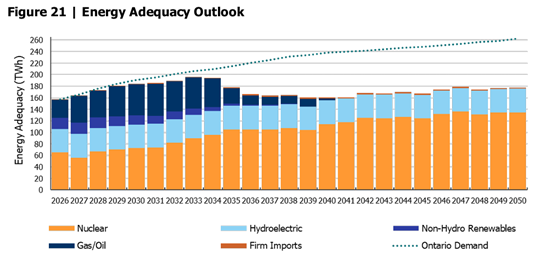 Source: Annual Planning Outlook, April 2025, IESO  GE Vernova is aiming to deploy small nuclear reactors across the developed world over the next decade, staking out a leadership position in a budding technology that could play a central role in meeting surging electricity demand and reducing carbon dioxide emissions. The SMR, is designed to reduce the cost of building new nuclear plants. And there are energy security concerns. All existing Canadian nuclear generation uses CANDU technology, intellectual property owned by federal crown corporation AECL and licensed to CANDU Energy, with head office in Montreal. CANDU uses uranium mined in Saskatchewan and processed at plants in Blind River, Port Hope and Peterborough, forming a nationally secure energy supply chain. But the SMRs come from a company majority owned by GE Verona with its head office is in Wilmington, South Carolina. And its technology creates a dependence on a foreign supply chain for uranium enrichment.
Only six countries have uranium enrichment facilities, and Canada isn’t one of them. An estimated cost to build such a facility is $100 billion over a 20 year timeline.GE Verona plans to enrich uranium at Urenco USA’s plant in Eunice, New Mexico and ship it across the boarder to Ontario, raising the risk of an increasingly authoritarian United States gaining more leverage to wield “economic force” to gain control of our resources and preferential trade and security arrangements.
This is a very expensive government in many ways. Ontarians need to start asking themselves how much of Doug Ford’s distraction tactics they can afford as jobs tank, housing stalls, ERs overflow — and an electricity muddle costs money, emissions and uncertainty.
 By Gazette Staff By Gazette Staff
September 30th, 2025,
BURLINGTON, ON
 Amy Schnurr, Executive Director of BurlingtonGreen has kept the organization effective by getting grants and now support from the city for doing work the city used to do.
Thanks to Eco Canada funding support, BurlingtonGreen has a 6-month employment contract, with an opportunity for extension!
They are seeking a passionate, organized, flexible, self-motivated, experienced professional to join our team serving as our Marketing Coordinator, responsible for the planning, implementation and evaluation of all promotions of our environmental programs, events, and services and various environmental topics.
Applicants must be pre-approved by Eco Canada’s Digital Skills For Youth program in order to apply for this opportunity.
This is an opportunity to help advance BurlingtonGreen’s strategic priorities while making a meaningful community and environmental impact.
Link to job application
 By Pepper Parr By Pepper Parr
September 30th, 2025
BURLINGTON, ON
Isn’t this sweet.
 The trucking sector is said to have been one of the groups buying tickets to the last fundraiser. The lobbyists will be writing their cheques – just a cost of doing business. The Provincial Progressive Conservatives are reminding people to: “Save the date: The Premier’s big-ticket Leader’s Dinner is back on.”
DOUG FORD and the PCs scrapped the lucrative event — which brought in a record $6 million for party coffers — amid the Greenbelt scandal, but they’re bringing it back on November 19, the night before Ford’s birthday.
Perhaps the RCMP can add their forthcoming report (at least we hope so – it has been more than a year in the making) to the list of gifts that will be lavished upon Dougie.
 By Sheila Cote-Meek By Sheila Cote-Meek
September 30th, 2025
BURLINGTON, ON
With ten years of Truth and Reconciliation behind us Brock University researcher Sheila Cote-Meek writes on the impact of Calls to Action in post-secondary education.
It certainly could be better.
 Sheila Cote-Meek As many people across the country don orange shirts to observe the National Day for Truth and Reconciliation on Sept. 30, Sheila Cote-Meek finds herself encouraged by the support.
“But responding to those calls shouldn’t be confined to a moment in time”, says the Professor and Director of Indigenous Educational Studies at Brock University.
Cote-Meek, a member of the Temagami First Nation, is looking back on the 10 years since the Truth and Reconciliation Commission of Canada (TRC) first published its 94 Calls to Action.
Reconciliation, she says, is a journey. “It’s an ongoing commitment to move forward together and build institutions that are more inclusive of Indigenous Peoples and knowledges,” she says.
Cote-Meek says the TRC report was “a wake-up call” to all Canadian institutions — especially in education.
“Universities and colleges began — and continue — to respond to the calls, which were established as part of the Indian Residential Schools Settlement Agreement, but we need to keep the conversation going 12 months of the year,” she says.
 Nationally recognized for her work to advance change in higher education through Indigeneity, decolonization and equity, Cote-Meek is working on a second edition of her publication, Colonized Classrooms – Racism, Trauma and Resistance in Post-Secondary Education, which was first published in 2014. Nationally recognized for her work to advance change in higher education through Indigeneity, decolonization and equity, Cote-Meek is working on a second edition of her publication, Colonized Classrooms – Racism, Trauma and Resistance in Post-Secondary Education, which was first published in 2014.
By gathering perspectives of Indigenous faculty members and students across the Ontario post- secondary landscape, Cote-Meek is exploring how Canadian universities and colleges are making structural changes towards reconciliation through decolonization.
“I am interested in how the sector is making deeper, systemic changes in ways that are not performative; in ways that are truly changing how Indigenous and non-Indigenous Peoples interact on campuses,” she says.
Among those, Cote-Meek says, are curriculum changes, a rising number of Indigenous faculty, staff and students, and the creation of dedicated spaces and buildings on campuses to support them.
“This increase in Indigenous presence on campuses is positive and encouraging; as a sector, we are moving forward and enacting curriculum changes to incorporate Indigenous content,” she says.
Even with this momentum, Cote-Meek says it is critical to acknowledge that forms of racism in post-secondary education systems still exist and operate in different ways.
Across the sector, support needs to be built in for Indigenous faculty whose course material often includes challenging and difficult subject matter, including the history and impact of the residential school system, she says.
“The emotional labour and responsibility Indigenous faculty members bear can be a heavy weight to carry,” she says. “We need to work together to mitigate feelings of isolation and minimize potential classroom tensions for Indigenous students and educators.”
While true reconciliation is not going to happen overnight, Cote-Meek says “we are beginning to see deeper shifts in attitudes about Indigenous Peoples and their beliefs. It starts with education.”
By Ivan Puzachov
September 30th, 2025
BURLINGTON, ON
 They come in several sizes and numerous brands. Know what you’re buying and get it right the first time. Snooozzz. It might be challenging to choose the correct mattress since there are so many different kinds available. Different kinds of mattresses may help you sleep better, feel more supported, and last longer. Each kind is intended for a certain way of sleeping and a certain taste. The more you know about different sorts of mattresses and how comfortable they are, the better you’ll sleep and the more you’ll be doing for your health and well-being over time.
Why Mattress Type Matters
A mattress is more than just a place to sleep; it may change how your body heals and relaxes while you sleep. You can feel bad, have difficulties sleeping, or even have back or joint discomfort if you choose the incorrect variety. Picking the proper size and shape is important for obtaining a good night’s sleep and having a lot of energy throughout the day.
For those looking for compact yet supportive options, a twin mattress is often ideal. It provides the right balance of comfort and practicality for single sleepers, children, or smaller spaces, while still offering a variety of materials and firmness levels to match individual needs.
Overview of Mattress Types
varying kinds of mattresses are made, feel, and last for varying periods of time. Here are the most common options, along with their benefits and downsides.
Innerspring Mattresses
 The innerspring mattress is the most prevalent: the quality of the spring is what matters most. The innerspring mattress is the most prevalent variety. It has steel coils within that provide the cushion strength and bounce. They let air circulate well, which makes them a better alternative for those who sleep overheated. It’s simple to locate and inexpensive to buy innerspring beds, but if the coils aren’t good, they could wear out quicker than other varieties.
 Memory foam is shapes itself to the body. Memory Foam Mattresses
Memory foam is well-known for being able to shape itself to the body and relieve pressure spots. It does an excellent job of blocking off movements, which is perfect for couples. On the other side, traditional memory foam tends to trap heat in. However, many modern varieties feature cooling technology that fix this issue.
Latex Mattresses
Latex mattresses are made from natural or synthetic latex. They provide a buoyant, responsive feel and are often praised for durability and breathability. Natural latex is hypoallergenic and resistant to dust mites, making it a healthy choice. The main drawback is cost, as latex mattresses are often more expensive.
Hybrid Mattresses
There are layers of foam or rubber and coils within hybrid beds. This design has both the stability of mattress systems and the softness of foam or rubber. A lot of individuals may use hybrid mattresses, although they are usually larger and more expensive than pillows made of just one material.
Adjustable and Specialty Mattresses
Some mattresses may be made harder or softer, or they are created in a manner that makes them appropriate for particular purposes. For instance, adjustable airbeds allow people modify how firm each side is. Some specialty pillows may employ innovative materials to aid with back discomfort or fit the spine better.
Comfort Levels Explained
Even though everyone has a distinct sense of what is comfortable, mattress producers normally create them in several levels of hardness to assist you pick. These data assist users choose the optimal option for their body type and how they sleep.
Soft Mattresses
Soft pillows are usually preferable for those who sleep on their sides because they maintain the spine straight and relieve pressure on the hips and shoulders. You may need extra assistance if you sleep on your stomach or back.
Medium Mattresses
A lot of various kinds of individuals appreciate medium-firm mattresses because they can be adjusted. They are great for folks who move about a lot at night since they provide the correct amount of support and cushioning.
Firm Mattresses
People who sleep on their backs or stomachs are generally urged to purchase firm mattresses since they are useful for support. They maintain the spine straight and stop the center from lowering too much, which might injure the back.
Matching Mattress Type to Sleeping Style
Another important factor in choosing the correct mattress is how you sleep. Depending on how you sleep, your body has to operate in various ways. Getting the appropriate mattress might help you relax and sleep better.
 Side sleepers that snuggle. Side Sleepers
If you sleep on your side, you need support to keep your shoulders and hips from aching. A lot of the time, memory foam and softer combination beds work well, especially ones that are medium to soft.
Back Sleepers
Back sleepers need support that is evenly distributed to keep their spine’s natural curve. Some of the best beds for this type of person are medium-firm to firm mattresses, especially blends or high-quality innerspring models.
Stomach Sleepers
People who sleep on their stomachs need strong support so they don’t sink into the mattress, which can hurt their back or neck. Most of the time, latex and hard innerspring beds are stable enough.
Combination Sleepers
If you move around a lot, a medium-firm combination mattress can give you the right amount of warmth and support in all situations.
Other Factors That Influence Comfort
The kind of mattress and how hard it is are significant, but there are additional elements that determine how pleasant and long-lasting your sleep surface is.
Temperature Regulation
Latex and mattress coils are two examples of materials that allow air flow and keep people cool. If you favor memory foam, versions with cooling gels or open-cell designs may help keep you cool.
Motion Isolation
If you share a bed, motion separation may be quite helpful. Memory foam is perfect for this since it makes less noise when one person moves about at night.
Durability and Longevity
The materials selected are typically related to how long something will survive. More expensive mixes and latex beds tend to last longer, whereas inexpensive innerspring mattresses may droop more quickly. You may enjoy things for years if you spend more on superior ones.
Conclusion
Mattresses come in a wide variety of types, each designed to meet different needs in terms of support, comfort, and durability. From classic innerspring models to advanced hybrids and natural latex, understanding these options helps you make a confident choice. Comfort levels — soft, medium, or firm — further refine the selection process based on your sleeping position and personal preferences.
 There are retail locations in every city of a decent size. Test them – and be sure you are comfortable before you purchase. Your sleep quality depends on choosing a mattress that suits your body and lifestyle. Taking the time to evaluate materials, construction, and firmness levels will ensure restful nights and healthier mornings. For those ready to explore high-quality options, check out the latest mattress deals to find the right balance of comfort and value.
 By Gazette Staff By Gazette Staff
October 1st, 2025
BURLINGTON, ON
The annual Canadian Cancer Society CIBC Run for the Cure will be taking place on Sunday, Oct. 5, 2025. To meet the needs of the festival and to ensure public safety, road closures are noted below.
Run route streets will re-open as soon as possible after the event. Vehicles parked illegally in the event area will be tagged or towed for emergency access.
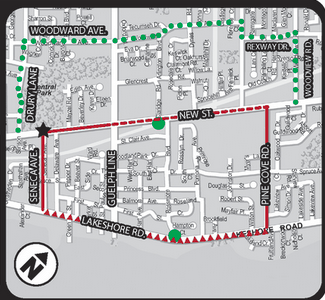 Road Closures – 10 a.m. to noon Road Closures – 10 a.m. to noon
Seneca Avenue from Lakeshore Road to New
Pine Cove Road from Lakeshore Road to New Street
New Street from Drury Lane to Guelph Line
Lane Closures – 10 a.m. to noon
Lakeshore Road from Seneca Avenue to Pine Cove Road westbound and centre lane closed. The eastbound lane will be kept open for traffic with no left turns along the event route.
New Street from Guelph Line to Pine Cove Road, eastbound lane closed. The westbound lane will be kept open for traffic with no left turns along the event route.
Access to and from roads intersecting the event route will be unavailable.
Residents located within the road closure needing to exit the area during the race need to be cautious of pedestrians and follow Police instructions, and follow these routes:
Between the hours of 10 to 11 a.m., please exit via Guelph Line at Lakeshore Road.
Between the hours or 11 a.m. and noon, please use Guelph Line at New Street, and Rossmore Boulevard at New Street.
 By: Joseph A. Gaetan BGS By: Joseph A. Gaetan BGS
September 29th, 2025
BURLINGTON, ON
I no longer delegate or comment directly on the Burlington municipal budget. Not because I lack interest, but because the process has become predictable. Council listens politely, then proceeds as they intended. For this taxpayer, very frustrating — and it raises deeper questions about accountability.
Having been a Condominium Board Director and Treasurer for 10 years I can attest to the fact that under Ontario’s Condominium Act, 1998, a condo board operates with a much higher standard of stewardship. A Board cannot simply add significant new expenses. Section 97 requires them to notify owners, allow for a meeting if requisitioned, and in some cases obtain a two-thirds vote of approval. As an example, if the cost of a change is greater than 10% of the annual budgeted common expenses, it is automatically considered a “significant change.”
 If condo rules applied to municipalities, the development of this site would have had much more public involvement. Still not a firm date on when the project will be completed. Example:
If the corporation’s annual budget = $1,000,000
Any change costing over $100,000, triggers the significant change process. This means the board cannot approve the project on its own – it must notify owners, and in some cases, call a meeting and hold a vote.
Reserve funds are tightly regulated, supported by professional studies, and restricted to major repairs and replacements. Owners are not just consulted; they are formally protected.
By contrast, the Municipal Act gives councils broad latitude. Councils can create or draw from reserves, introduce new programs, and make spending decisions entirely within the annual budget process. While municipalities do consult, the statutory framework does not provide the same direct safeguards that the Condominium Act requires for unit owners. Yet taxpayers contribute far more each year in property taxes than most pay in condo fees.
This imbalance is hard to justify. If stewardship of a condominium’s budget and reserve funds requires statutory guardrails, why not municipal finances? Both involve compulsory contributions. Both are meant to preserve shared assets and services. And both deserve protection from short- term decision-making.
It is time for the province to strengthen the Municipal Act by borrowing from the Condominium Act’s best practices:
Require thresholds that trigger direct taxpayer approval for substantial new spending. Restrict reserve funds to their intended purposes, with clear rules against diversion.
Municipal councils will always need flexibility. But flexibility without stewardship risks eroding public trust. Adopting condominium-style safeguards would restore confidence that taxpayer dollars are managed with the same care, discipline, and transparency already required of condo boards.
 Joseph A. Gaetan is a Burlington resident who comments frequently on municipal matters. He has been wise enough to refrain from thinking about elected office. Joseph A. Gaetan is a Burlington resident who comments frequently on municipal matters. He has been wise enough to refrain from thinking about elected office.
By Pepper Parr
September 29th, 2025
BURLINGTON, ON
It is difficult to keep up with the allocation of swimming pool time issue. In the very early stages people at the Burlington swimming club (BAD – Burlington Aquatic Devilrays) were stunned with the decision.
 Parents with Burlington Aquatic Devilrays (BAD) at a swimming meet. Worse, the reasons that were given made no sense. Those reasons dribbled out bit by bit.
CHCH recently did a short broadcast that summed up everything. If you want an overview, this link gives it to you.
One of the requirements was that both the Burlington club and the Hamilton club had to prove verifiable membership numbers. They are due today.
Stay tuned.
https://share.google/AcPIf3e6RID2JFYAi
By Lauren Thomas, Environmental Defence
September 29th, 2025
BURLINGTON, ON
 Species at risk: Eastern Musk Turtle and Cougars.  Nearly four months after Progressive Conservative MPPs forced approval of a law that will repeal Ontario’s Endangered Species Act, the Ontario government is confirming experts’ gravest warnings about what it will mean for at-risk plants and wildlife. The Ontario government has announced that once the law comes into force, it will cease even to recognize more than 106 different species at risk, ranging from the Eastern Mole, Eastern Musk Turtle and Cougars, to the endangered Redside Dace, and Red-headed Woodpecker. Nearly four months after Progressive Conservative MPPs forced approval of a law that will repeal Ontario’s Endangered Species Act, the Ontario government is confirming experts’ gravest warnings about what it will mean for at-risk plants and wildlife. The Ontario government has announced that once the law comes into force, it will cease even to recognize more than 106 different species at risk, ranging from the Eastern Mole, Eastern Musk Turtle and Cougars, to the endangered Redside Dace, and Red-headed Woodpecker.
This decision should light a fire under the federal government to strictly enforce the existing federal Species at Risk Act and existing habitat protection orders in Ontario, but also to expand and broaden federal protections and monitoring. Federal protections will now be the only real protection for many habitats. In particular, because the Ontario government will remove all provincial recognition of endangered and threatened birds and fish, the government of Canada should issue emergency protection orders that extend to all species and habitats previously protected by provincial habitat regulations and the Ontario Species at Risk list.
The Ontario government also intends to remove all recognition of species that are currently recognized as being of “special concern” and monitored due to their susceptibility to identified threats. This means that federal agencies will step up their monitoring of these species’ federal jurisdiction.
 Ford has shown a pattern of constantly prioritizing his developer friends and unnecessary projects over wildlife and nature. Premier Ford has shown a pattern of constantly prioritizing his developer friends and unnecessary projects over wildlife and nature. The federal government must not do the same. Now more than ever, it is crucial that the federal government uphold and enforce the appropriate federal laws and deny the approval of permits that would allow harmful development projects to destroy critical habitat.
ABOUT ENVIRONMENTAL DEFENCE (environmentaldefence.ca): Environmental Defence is a leading Canadian environmental advocacy organization that works with government, industry and individuals to defend clean water, a safe climate and healthy communities.
 By Sadie Smith By Sadie Smith
September 30th, 2025
BURLINGTON, ON
 Online or in-house – either way it’s a pretty good hand Gambling and online gambling establishments have been trending across the globe, with Canada seeing massive growth in the sector. There is now considerable evidence indicating an increase in interest from new Canadian players, amid a thriving industry in Ontario since the province legalized iGaming. Platforms have experienced massive turnover for the past few years. For August 2025 alone, Ontario generated a significant CA$8.14 billion in gaming revenue.
To locals, the convenience of quick cashouts and a variety of table and card casino action to choose from is what you gain playing from Canada. Most operators also provide a wide range of bonuses, various payment methods for added convenience, and the appeal of iGaming, which includes several different games, from slots to poker to live dealer table games.
 A gambling site with both guests at the playing table and slot machines for those online. iGaming may eventually render physical casinos outdated if they do not step up to the demand. Easy access is a major contributor to the surge in revenue. With most businesses today operating online, iGaming now competes extensively with the traditional casino business. Although a disruptor, in recent years, an increasing number of individuals have chosen convenience over traditional casino experiences in real life. The decline in visitors to casinos worldwide suggests that iGaming may eventually render physical casinos outdated if they do not step up to the demand.
For Ontario, the August figures are a significant 35% year-over-year increase compared to the same month in 2024. This kind of massive growth provides clear evidence that the sector is now maturing. With other provinces like Alberta set to follow Ontario’s lead, the nation is set for another major boost in tax revenue in the coming years.
 Online sites have also started offering progressive jackpots, where prizes accumulate until one is ultimately claimed. These jackpots create a sense of excitement that drives players back for more. Mobile-first design has been among the factors allowing operators to respond quickly to users who expect to play swiftly and smoothly. A slot game on a mobile phone or an online lottery ticket purchased over a coffee break has become the norm. Online sites have also started offering progressive jackpots, where prizes accumulate until one is ultimately claimed. These jackpots create a sense of excitement that drives players back for more.
Accessibility is not limited to security. Having the capacity to gamble at home or on the move has provided access to those who may otherwise have avoided gambling because of time or travel needs. Typically, you would visit the casino for your adrenaline fix, but by removing barriers, operators create a more flexible community of players.
 The Township of Milton gets a payment from the race track every year. It works out to be tens of millions. The economic impact of the broader gaming industry is also substantial. Briefly, the more individuals play, the more it equates to the platform’s revenue generation, and naturally, the revenues are higher with higher participation. The game corporations also reinvest portions of their revenues back into the communities. This cooperation is a win-win for everyone, whether you play or not. Communities across Canada benefit from social improvement programs. Lottery and casino businesses contribute to the employment industry by creating jobs and stimulating local economies.
The analysis of Ontario gaming helps put broader trends into context in the Canadian market. Merging the thrill of vintage games with the advantages of the digital era. Internet gambling has changed the manner in which Canadians engage in gambling, providing an opportunity for engagement, socialization, and recreation through a secure and safe environment.
 By Pepper Parr By Pepper Parr
September 29th, 2025
BURLINGTON, ON
For once Council has taken a firm stand and decided not to spend.
While we will not see a decision until later in the month the Staff report says the following:
 Will the Sound of Music come to an end? Decline Burlington’s Sound of Music Festival Inc.’s 2026 funding request and discontinue municipal financial support due to ongoing financial instability and non-compliance with Agreements conditions; and
Approve the reallocation of $150,000—originally designated for Sound of Music in the 2026 Operating Budget—to the Community Investment Fund. This adjustment will enhance support for a broader range of festivals and events across Burlington, promote greater equity and sustainability in cultural programming, and create opportunities to potentially support a new music festival and/or provider in 2026; and
Direct staff to report back to Council on exploration of potential opportunities for a different form of music festival and/or a different operator of a music festival at Spencer Smith Park, following a call for expressions of interest from potential event organizers; and
Remove Council’s Ex Officio appointment from the Burlington Sound of Music Inc. Board of Directors. A Council Member was appointed in 2022 for the duration of the term, building on a 2019 request from SOM to reinstate a Council-appointed ex officio position.
Not what most people were expecting.
Was it the right decision?
Council has begun to hear the concerns about the out-of-control spending.
Love to hear what you think.
By Marshall Piano
September 29th, 2025
BURLINGTON, ON
Humans have consistently pushed the limits of what is possible in the realm of invention. It is modifying lives and altering how people view and engage with the world.
 The arrival of electricity and the growth of the internet have shaped society. Creative brains have always risen to the occasion throughout history and advanced humanity with their inventions. Each period has seen developments that have shaped society from the discovery of fire and the development of the wheel to the arrival of electricity and the growth of the internet.
Different countries like Canada have established themselves as leaders in digital transformation even in the entertainment industries because of a strong dedication to research and development and a highly qualified labor force.
The world-class educational facilities worldwide are one of the leading forces behind the world’s technological achievements. Different nations are home to universities and colleges that emphasize STEM education and consistently send out graduates with excellent credentials. This talent pool has created a thriving startup ecosystem where bold ideas can flourish.
Internet Speeds Will Increase by Ten Times
 6G would bring speed capabilities nearly 100 times quicker than 5G. 6G would bring speed capabilities nearly 100 times quicker than 5G.
Additionally, it might result in the creation of more sophisticated machine-learning systems and immersive metaverse experiences. By 2030, when the technology is anticipated to become widely available, IT companies must determine that.
Numerous industries, including entertainment and gaming have been transformed by the internet’s rapid development. The rise of multi-player gaming applications or amusement games like online slots in Canada shows how faster connections enable more immersive and interactive digital experiences. With 6G on the horizon, players could benefit from seamless gameplay and enhanced security. This evolution reflects a larger trend. The improved connectivity is reshaping how Canadians engage with digital platforms from work and education to gaming and streaming.
In addition, it may grant players exclusive access to high-stakes games or competitions or priority customer service. It uplifts players to increase their internet connections by matching bonus offers to internet speed, guaranteeing they enjoy the finest gaming experience while taking advantage of the bonuses.
Electric Flying Taxis
Electric air taxis could make their way to Montreal as early as 2026 which indicates that the not-so-distant future might look like a scene from a Jetsons episode. To introduce 70 of their eVTOL (electric vertical take-off and landing) aircraft to La Belle Province, Texas-based Jaunt Air Mobility and the Quebec aerospace and aviation component maker Vertiko Mobility have teamed together.
Each vehicle has a seating capacity for one pilot and four passengers, a 195-kilometer driving range, and looks like a cross between a helicopter and a turboprop. Vertiko intends to begin extensive testing the following year. The Montreal-based startup VPorts plans to construct 1,500 terminals (also known as “vertiports”) in various cities worldwide to enable such flights.
Jobs with Magnets
 Calgary to Edmonton in just 45 minutes – trip will cost 44% less than a plane ticket. Pods that magnetically hover in a vacuum tube at up to 1,000 kilometers per hour. Toronto-based transportation technology company TransPod manufactures it. Elon Musk, step aside; some countries will soon have its high-speed hyperloop, and Canada is one. The FluxJet claims to transport people between Calgary and Edmonton in pods that magnetically hover in a vacuum tube at up to 1,000 kilometers per hour. Toronto-based transportation technology company TransPod manufactures it. Just 45 minutes will pass, and the trip will cost 44% less than a plane ticket.
A 10-kilometer track is proposed with a goal of being operational by 2027, and TransPod is now concentrating on land acquisition and doing environmental evaluations. The company has already raised $550 million from foreign investors and anticipates government funding for a portion of the project even though the project is anticipated to cost $18 billion.
 A 10-kilometer track is proposed with a goal of being operational by 2027. TransPod is now concentrating on land acquisition. As a result, various technology trends and innovations are now recognized as significant global drivers of advancement. Thanks to a thriving ecosystem that encourages innovation because the world has become a hub for development.
By Gazette Staff
September 29th, 2025
BURLINGTON, ON
 City of Burlington administrative offices will be closed on Tuesday, Sept. 30 to observe National Day for Truth and Reconciliation. For a list of which City services and facilities are available on Sept. 30, please see the summary below or visit burlington.ca. City of Burlington administrative offices will be closed on Tuesday, Sept. 30 to observe National Day for Truth and Reconciliation. For a list of which City services and facilities are available on Sept. 30, please see the summary below or visit burlington.ca.
Orange Shirt Day
Sept. 30 is also recognized as Orange Shirt Day, an Indigenous-led grassroots day inspired by the story of Indian Residential School Survivor Phyllis Webstad. As part of Orange Shirt Day, residents can come to Spencer Smith Park (1400 Lakeshore Rd.) to reflect and take part in a Walk for Reconciliation and Peace, hosted by local Indigenous people.
Opening remarks will begin at 5 p.m., from the pavilion at the east end of the park, with a walk to follow along the Waterfront Trail ending at Beachway Park for a tobacco ceremony. Additional details can be found on the city’s online events calendar at burlington.ca/calendar. Participants are encouraged to wear orange shirts and moccasins if they have them.
We encourage residents to visit the National Centre for Truth and Reconciliation website for educational materials and resources.
| City Service |
Holiday Closure Information |
| Animal Services |
The Animal Shelter at 2424 Industrial St. will be closed to appointments on Tuesday, Sept. 30. To report an animal control related emergency on a holiday, please call 905-335-7777. |
| Burlington Transit |
Burlington Transit will operate on a regular weekday schedule on Tuesday, Sept. 30.
Find real-time arrival information and plan your trip using Google Maps. From a mobile phone, access Google Maps and click on your bus stop to see arrival times. From a computer, select your bus stop, then click on ‘See Departure Board’ to view arrival times.
Customer Service and Specialized Dispatch will be closed on Tuesday, Sept. 30. |
| City Hall |
Service Burlington and the Building, Renovating and Licensing counter on the main floor of City Hall at 426 Brant St., will be closed to all appointments and walk-in service on Tuesday, Sept. 30.
Many service payments are available online at burlington.ca/onlineservices. If your request is urgent, call 905-335-7777 to connect with the City’s live answering service.
For online development services, MyFiles can be used by residents who have applied for Pre-Building Approval. Check the status of Pre Building Approval applications at burlington.ca/MyFiles. |
| Halton Court Services – Provincial Offences Office |
Court administration counter services at 4085 Palladium Way will be closed on Tuesday, Sept. 30.
Except for the Sept. 30 closure, telephone payments are available at 905-637-1274, from 8:30 a.m. to 4:30 p.m., Monday to Friday. All in-person services are available from 8:30 a.m. to 4:30 p.m. Monday to Friday. Many services are also available by email at burlingtoncourt@burlington.ca or online at Halton Court Services. Payment of Provincial Offences fines is available 24/7 at paytickets.ca. |
| Parking |
Paid parking will be in effect on Tuesday, Sept. 30.
NOTE:
- The Waterfront parking lots (east and west at 1286 Lakeshore Rd.) do not provide free parking on Sept. 30.
- Parking exemptions or City-Wide Parking Permits are required to park overnight on city streets and for longer than five hours. Visit bylaw.burlington.ca for parking exemptions.
- Parking Lot 4 at 421 John St. is closed for construction on Tuesday, Sept. 30.
|
| Recreation Programs and Facilities |
Recreation facilities are open for rentals and registered/drop-in programs on Tuesday, Sept. 30. Drop-in recreation program schedules are available at burlington.ca/dropinandplay.
Customer Service
Recreation, Community and Culture customer service is available to assist you in person at recreation facility counters during program times. Customer service is also available:
- By email at liveandplay@burlington.ca
- By phone at 905-335-7738, from 8:30 a.m. to 4:30 p.m., Monday to Friday (including Sept. 30) and from 9 a.m. to 4 p.m. Saturday and Sunday
|
| Roads, Parks and Forestry |
The administrative office will be closed on Tuesday, Sept. 30. Essential services will be provided as required. |
Burlington is a city where people, nature and business thrive. Sign up to learn more about Burlington at burlington.ca/subscribe and follow @CityBurlington on social media.
Links and Resources
By Pepper Parr
September 28TH, 2025
BURLINGTON, ON
This week – on the 29th, Golden Horseshoe Aquatic Club (GHAC) and Burlington Aquatic Devilrays (BAD) must report their membership numbers and show that they have reached the 85 % residency rule.
There is some doubt that neither club will be able to show that their number have reached that 85% level. BAD is very close, GHAC is thought to be some distance from that 85% level.
What happens then?
 Exactly how many members swimming for either club live in Burlington and swim in Burlington? The folks at BAD have a terrible feeling that the way the memberships are counted is going to be changed to using a “regional” approach which would favour GHAC.
There is very little trust within the BAD organization for the people in the Procurement group at City Hall. Suspicions of conflicts of interest dominate much of the discussion between parents. The BAD executive say nothing – a gag order is reported to have been put in place.
There is a lot riding on what the numbers submitted turn out to be and how the Procurement people interpret them.
 By Joseph Gaetan, Bsc By Joseph Gaetan, Bsc
September 28th, 2025
BURLINGTON, ON
By any fair measure, the Burlington Aquatic Devilrays (BAD) saga has left our community shaken. Parents, athletes, and residents have watched a respected club—one that has served Burlington for decades—pushed aside in a process that raises more questions than answers.
Until now, it was right that Council respected procurement protocols and did not wade in. Rules exist to prevent elected officials from interfering with active bidding processes. But the procurement phase is over, and with it, the firewall that shielded staff decisions from political scrutiny. What remains is not just a contract, but a matter of public trust.
A Timeline That Demands Scrutiny
The Gazette has laid out a troubling timeline. From March to June, BAD followed the rules, submitted documents in good faith, and even provided a legal opinion to support its standing. Yet on June 25, after 5:00 p.m., the club was told it was rejected on a technicality over a document that does not exist in Ontario law. Hours later, GHAC was elevated to the status of “successful bidder.” Days later, the City had to quietly change its press release to account for GHAC’s failure to meet the 85% Burlington residency threshold.
These are not trivial details. They are red flags.
The Stakes for the Community
The most painful part of this story is not buried in policy—it is visible in the faces of the young swimmers who came to Council chambers. BAD has 400 members and 100 more on a waiting list. GHAC, by contrast, is still building its Burlington base. This is not a transition of equals. It is, as one councillor bluntly put it, a zero-sum game. Children will lose opportunities. Families will face higher fees. Burlington risks losing a legacy program that has carried our city’s name across the country.
Why an Audit is the Right Next Step
 The allocation of swimming pool time touches on governance, fairness, and whether Burlington families can trust the City to act in their best interests. Councillor Lisa Kearns’ per the Gazette, has expressed an intention to request an independent audit of the procurement process. This is not interference—it is accountability. An audit would examine whether staff applied the rules in good faith, whether the process aligned with best practices.
This above all is a matter of public interest because it touches on more than pool time. It touches on governance, fairness, and whether Burlington families can trust the City to act in their best interests.
Council’s Duty
No one is suggesting that procurement staff acted with malice. But the appearance of inconsistency, combined with shifting explanations, is enough to warrant a thorough and independent review. Council owes it to the public to ensure that this decision—and any future ones—are beyond reproach.
In the end, this is about restoring trust. Council was right not to interfere while the process was live. After many months BAD and the public is still asking questions. An audit is the only way to answer that.
 By Chun-Kai (Jason) Wang By Chun-Kai (Jason) Wang
September 28th, 2029
BURLINGTON, ON
It’s been more than 18 months since the federal government announced a sharp cap on international student permits, and the ripple effects have begun to hit hard.
Dwindling international student enrolment is hurting the bottom line of universities and colleges throughout the country. For decades, they had been a key financial lifeline because their tuition fees were often at least three times higher than domestic students, thus plugging the hole left by stagnant provincial funding.
In some cases, international tuition provided nearly half of an institution’s revenue. With that model now disrupted, the consequences are increasingly dire. Some universities will scrape by with layoffs and cutbacks. Others, particularly smaller schools, may not survive at all.
While Ottawa and the provinces, which have the constitutional responsibility for education, continue to dither about how to fix this problem, there’s one key step the post-secondary institutions themselves can and should take – create branch campuses in other countries as some foreign universities have done.
Canada’s growing reliance on international students
Stronger boards can help universities adapt to challenging environments
Branch campuses abroad do not conflict with whatever domestic strategies are possible in Canada. Rather, they would complement them, providing a parallel stream of revenue and reputation-building that domestic subsidies alone cannot achieve.
They would also give Canada new leverage in global education, enhancing soft power and creating pathways for skilled immigration that directly serves our long-term economic needs.
While some assistance from Ottawa and the provinces may be beneficial to the schools in this area, the key is the independent resolve of each individual institution to get this done. That’s what happened with schools in the U.K., Australia and the U.S.
Action with consequences
Unfortunately, the federal government limited international student permits in response to allegations that their previous large number was contributing to the housing affordability crisis and thus rising inflation.
However, when it did this, Ottawa did not offer any tangible solutions or start discussions with the provinces on how universities and colleges are supposed to weather the resulting financial storm.
In addition, the situation in Canada could soon be complicated by the changing global economic environment. The number of international students could drop further as U.S. President Donald Trump’s tariffs abroad weaken the economies of countries where many international students tend to come from.
Malaysia as a starting point
Schools in the U.S., the U.K. and Australia have spent decades building global networks of branch campuses in other countries so that students don’t have to leave their homes to get a Western higher education.
However, Canada has remained strikingly absent in this arena. That is no longer just embarrassing, it is an existential threat given the current crisis.
As a starting point, Canadian schools should consider Malaysia. The country has positioned itself as an international education hub, welcoming foreign universities with clear regulatory frameworks and government incentives since the 1990s. English is widely used, operational costs are far lower than in Canada and demand from ASEAN, South Asian and Middle Eastern countries continues to rise.
 Australia’s Monash University offering degrees identical to those in their home countries at a fraction of the cost while also feeding students into their graduate programs. Australia’s Monash University and the U.K.’s University of Nottingham are two of the established players thriving there, offering degrees identical to those in their home countries at a fraction of the cost while also feeding students into their graduate programs.
These branch campuses offer a new source of revenue, enhance international reputation and strengthen research collaboration between the host and the provider country.
Inaction is a greater risk
Canadian universities could do the same – but only if they act fast. Other non-Western universities, such as those from China and Japan, are rapidly entering this arena.
The risk of inaction is obvious. Our dependence on international student tuition was a structural weakness – one that our competitors foresaw many decades ago, when they faced a similar environment of decreased public funding amid an uncertain global economic outlook.
It’s thus very clear. Unless Canadian institutions expand beyond our borders, they will continue to be forced to manage decline while those in other countries prosper.
Of course, opening branch campuses abroad is not without risk. Quality assurance, cultural adaptation and financial sustainability all require careful planning.
Canada does not, however, have to be alone in this venture. Indeed, notwithstanding the existing, mature frameworks of collaboration already in place in host countries, academic resources that include management experiences of universities operating branch campuses are also available as possible blueprints for operational consideration.
 McMaster University could establish a presence overseas and run a program that included one year on campus in Hamilton. The real problem is the far greater risk of refusing to take the initial step. If even a handful of Canadian schools later face financial troubles because they didn’t expand abroad, the consequences for our economy, workforce and global reputation will be far worse than the challenges of expansion.
The bottom line is this: the era of easy money from international students coming to Canada is over. Our universities can either cling to a dying model or take the bold step of going where the students are. Canada needs to hurry up because it’s already late to the race.
This article draws on research from the author’s undergraduate work under the guidance of political science professor David Matijasevich. The work focuses on international education policy with a particular focus on Canadian universities and global competition.
 Chun-Kai (Jason) Wang: Independent Policy Researcher and Analyst, Doctor of Traditional Chinese Medicine, Registered Acupuncturist, Traditional Chinese Medicine Practitioner, Graduate of International Studies Major at SFU with Distinction Chun-Kai (Jason) Wang: Independent Policy Researcher and Analyst, Doctor of Traditional Chinese Medicine, Registered Acupuncturist, Traditional Chinese Medicine Practitioner, Graduate of International Studies Major at SFU with Distinction
By Gazette Staff
September 28th, 2025
BURLINGTON, ON
 Catherine Baldelli at a Burlington Food for Feedback event Catherine Baldelli announced today that: “After more than 30 years in GIS, IT and Transit across both private and public sectors, I have decided it’s time to retire. It has been an incredible journey. I am grateful for the opportunities that I have had, particularly at the City of Burlington. I will be continuing in this role until mid-December.
“The City of Burlington is now looking for someone to step into this position. If you’re passionate about transit, eager to make a positive impact and lead an amazing team – this is a perfect opportunity for you. This is a fulfilling role that will shape the future of transit in the City of Burlington.”
The transit service both grew and the buses were on time for the most part while Catherine was behind the wheel.
By Pepper Parr
September 28th, 2025
BURLINGTON, ON
 The three-term Progressive Conservative premier has long triggered Tories who feel he’s drifted too far to the mushy middle of the political spectrum due to his reliance on public-opinion polling. The Ontario Hospital Coalition wasn’t wrong when they said the provincial government wanted to privatize the current health care service.
Project Ontario, a group of people who want to see changes in the way the provincial government operates, said recently that they are advocating for an expansion of privately delivered health care and smaller government at Queen’s Park.
The group is just talking at this point. With Doug Ford’s polling numbers at 52%, it’s going to be an uphill slog to being about any change at the Progressive Conservative Party annual event later this year.
Related news story:
Ontario Hospital Coalition sounds a warning
 By Ron Nikhill By Ron Nikhill
September 29th, 2025
BURLINGTON, ON
Alberta is moving closer to reforming its online gambling laws, trying to balance the potential benefits against concerns about safety and regulation.
 Alberta iGaming Corporation Right now, only one government-run site, PlayAlberta, operates legal iGaming in the province. But recent steps like Bill 48, known as the iGaming Alberta Act, aim to open up the market. That bill would set up a Crown corporation (the Alberta iGaming Corporation) to handle online gambling more broadly, allowing private operators under regulation. Alberta is also seeking feedback through Phase 2 of its iGaming strategy to set out regulations, social responsibility standards and ways to reduce red tape.
Ontario’s regulated online gaming market offers a useful comparison. Between April 2024 and March 2025 it recorded CA$82.7 billion in wagers, up 31% year-on-year and gross gaming revenue of CA$3.2 billion, which is a 32% increase over the prior year. Casino games that consist of slots, table games, and live dealer games dominate in both revenue and wagering volume in Ontario, with CA$2.4 billion of the GGR coming from casino games and about CA$69.6 billion of wagers in that category. According to CasinoBeats Canada, players can access valuable information on which regulated casinos offer strong payment methods, competitive bonuses, or safer gaming tools. For example, the site highlights Interac casinos, which let people move money in and out directly from their bank without the usual delays or extra charges. Interac’s security is on par with major financial institutions, making it the most widely used payment method in the country.
When thinking about games, bonus offers and other benefits, players in Ontario have access to a large variety of casino games, sports betting, poker and virtual or instant win titles. Bonuses tend to be competitive, especially for new players, but there are wagering or play-through requirements to watch out for. Experts suggest people should always check the terms attached to a bonus, especially how much wagering is required and whether certain games count differently towards those requirements. Another tip is to prefer regulated sites for player protection, transparency about odds and payouts, and for consumer safeguards like self-exclusion tools.
 Rules are needed in a well-regulated, competitive iGaming market. For Alberta, the advantages of reform would include increased tax revenue going back into public services, more choice for players and a safer regulated environment. On the other side, risks include possible problem gambling, ensuring that regulations are robust and making sure that illegal offshore sites are discouraged. Alberta’s government has said its aim is not to promote more gambling but to move what already happens outside regulation into a safer, more accountable system.
All in all, Ontario’s recent gains show what can happen under a well-regulated, competitive iGaming market. Alberta is now evaluating its own path moving forward, trying to learn fro Ontario’s success while making sure protections are in place. If Alberta moves ahead with reforms as proposed, players there could see more choice, better games, safer platforms and more transparent bonus and payment options very soon.
|
|