Has the creation and declaration of Proclamations by the Mayor gotten out of hand?
At the city Council meeting last Monday the mayor issued 20 proclamations and Declared that a specific day was being named as the day to celebrate whatever was being celebrated.
Eight of the proclamations were for events that had already passed.
Are these proclamations not “photo-ops” – part of the process of keeping your name before the public?
Should politicians not be known, recognized and rewarded for the quality of the work they do?
They had every reason to be smiling. Councillors Meed Ward and Lancaster pose with five members of the Friends of Freeman Station after the Council meeting that approved the entering into of a Joint Venture that would have the Friends moving the station and taking on the task of renovating the building.
Councillors Marianne Meed Ward and Blair Lancaster don’t do coffee all that often but they deserve gallons of credit for the way they joined forces and made sure that the Freeman station for to stay alive. They made that happen.
Here is what our Mayor read out at Council Monday evening. You decide.
The effort to create a bigger sense of compassion for each other is noble and is certainly worth proclaiming.
Terry Fox Day – September 18, 2016 Franco Ontarian Day/Jours de Franco-Ontarien – September 25, 2016 National Coaches Week – September 17-25, 2016 Legion Week – September 18-24, 2016 Culture Days – September 30-October 2, 2016 Prostate Cancer Awareness Month – September 2016 Doors Open Burlington – October 1, 2016 National Seniors Day – October 1, 2016 Hospice Palliative Care Day – October 8, 2016 Gift of Giving Back Day – October 12, 2016 Pregnancy & Infant Loss Awareness Day – October 15, 2016 Workplace Bully Awareness Day – October 18, 2016 United Nations Day – October 24, 2016 Child Care Worker & Early Childhood Educator Day – October 26, 2016 Compassionate City Week – October 2-8, 2016 Fire Prevention Week – October 9-15, 2016 Ontario Public Library Week – October 16-22, 2016 Local Government Week – October 16-22, 2016 Spiritual and Religious Care Awareness Week – October 17-23, 2016 Teen Driver Safety Week – October 19-25, 2016 National Occupational Therapy Month – October 2016
The Character Area Studies for Roseland, Indian Point, and Shoreacres neighbourhoods are nearly complete. City staff are preparing a report about these studies and their impact on other low density residential areas.
Indian Point – a small neighbourhood with a rich history – and a very divided population. Old timers wanted it to stay as it was – the “nouveaus” had plans for bigger homes and thoughts of dividing properties. Some of the early public meetings got pretty hot and heavy.
There will be a series of open house meetings you can drop in on anytime to learn more about these planning initiatives, ask questions, and share your comments.
The Character Area Studies for Roseland, Indian Point, and Shoreacres neighbourhoods were received by Council on February 29, 2016.
Staff have prepared policy and by-law amendments to implement these studies and for low density residential areas outside of the character areas.
Together, they will provide a proactive approach to support all established low density residential areas through an enhanced regulatory framework. The proposed drop in open houses are the final opportunity for you to provide input on these initiatives prior to a Council decision on the proposed amendments.
Lastly, the Statutory Public Meeting for Council to consider the proposed amendments to the Official Plan, Zoning By-law, Site Plan By-law, and Site Alteration By-law is being targeted for December, 2016. Confirmation of the Statutory Public Meeting date will be provided at a later date.
The Gazette will report during the weekend on how city council handled this matter.
The Gazette gets a couple of dozen request each week asking us to promote an event – more often tan not a store opening where the Mayor sometimes cuts a ribbon.
We explain two things to people who send in these requests – there is a line between our promoting an event and the business people advertising their events.
We got a request to mention the Shred It event Crime Stoppers is putting on – this is a really valuable public service and we have in the past promoted them.
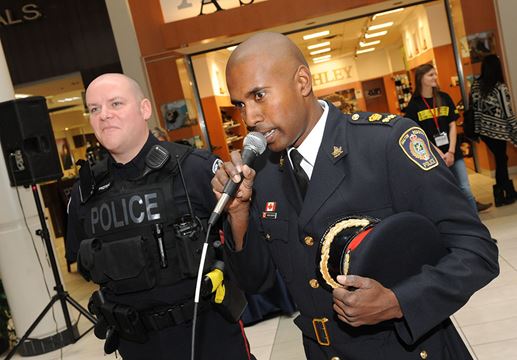
Halton Regional Police Detective Constable Paul Proteau at an event with Deputy Chief Nishan Duraiappah
This year the Shred It event was to take place in Oakville and Georgetown. We explained to Detective Constable Proteau that we cover Burlington events – he responded with: “I know but I’m trying to serve as large an area as I can – that is why I chose half way between Burlington/Oakville right at HQ here.
Proteau added that in the spring we did Milton and now in the fall I’m doing Georgetown. I’m having this issue with the other papers too as they say if it isn’t in our city so we shouldn’t print it. I have to try and serve everyone in the region.
He mentioned as well that “we raised approximately $3100.00 with our combined spring shreds; hoping to make the fall outcome better as we didn’t do as well on the Sunday which was Mother’s Day.
Proteau made an important point – so here is what they want to say to the public about their Shred It event.
Halton Crime Stoppers needs your help to keep our communities safe and secure.
Not only do we require the eyes and ears of everyone watching out for each other, but you must make sure your own private and personal information doesn’t fall into the hands of criminals.
In an effort to protect area residents from becoming victims of identity theft and other fraud, Halton Crime Stoppers will host a Community Shred Event through our semi-annual Feed the Beast fundraising campaign.
The events run on Saturday, October, 15th at the Halton Region Centre, 1151 Bronte Road, Oakville (lot A) and, Sunday, October, 16th at The Real Canadian Superstore, 171 Guelph Street, Georgetown. Both the Region of Halton and The Real Canadian Superstore are graciously donating the space on their property for the events.
On both days the event runs from 9:00 am until 3:00 pm. The cost for the events are $5 per grocery bag, $10 per bankers boxes and $15 per larger bags and/or boxes. When you arrive look for the distinctive FileBank Canada truck with the large beast on the side which will be ready to gobble up your person documents so no one else can get them.
Autumn is traditionally a clean-up time when people get rid of clutter around the house, but Detective Paul Proteau, coordinator of Halton’s Crime Stoppers program, warns against throwing invoices, bank statements, old tax records or credit cards receipts in trash cans for local pick-up.
“Criminals routinely steal garbage left outside homes to obtain information that can be used to defraud people through various scams, including identify theft,” said Proteau.
“Shred all personal items to ensure your private information doesn’t get into the hands of those who will victimize you,” he said. “Scam artists can create phony credit cards to make purchases anywhere in the world; they can obtain mortgages in your name; they can get loans or they can produce documents and take over your identity.”
Proteau said victims of these crimes are forced to spend considerable amounts of money and countless amounts of time straightening out the problems that these criminals cause. “It is truly a nightmare for victims of identity theft,” he said.
Through the years Halton Crime Stoppers has set up Community Shred Events in partnership with FileBank Canada, not only to raise money to assist the program to combat crime, but more importantly to protect residents from the horrendous difficulties they can face through identity theft and other crimes that can be perpetrated when personal information gets into the hands of criminals.
FileBank Canada – an innovative shredding and record storage company established 28 years ago – provides a mobile, state-of-the-art pulverizing unit, free of charge to Halton Crime Stoppers, to instantly destroy any documents you bring to our Community Shred Event. Personal papers are reduced to tiny fragment and later recycled to produce other paper products.
So you are not only helping to keep our communities safe from crime, but you are also being green and protecting the environment. It’s a win-win situation for everyone when you shred your sensitive papers at the Halton Crime Stoppers Community Shred Event.
“Last year we destroyed hundreds of pounds of personal documents, that’s a lot of paper that didn’t find its way to a landfill” said Proteau.
Ward 4 Councillor Jack Dennison was miffed when name Liz Benneian made mention of the date December 12th – as a deadline for an extensive review of the details, data and background by the City Manager of the proposed water break the LaSalle Park Marina Association says is needed to keep the boats safe from damage.
Where did you get that information asked Dennison – Liz Benneian smiled and said she saw it in an email.
Ward 4 Councillor Jack Dennison.
Dennison wanted to know who the email came from – Benneain smiled again but demurred – Jack was going to have to dig a little deeper to find out just how information he saw as confidential got into the hands of the Save the Trumpeter Swan coalition.
Later in the council meeting that took place on Monday Dennison asked the Clerk what was done with the memo he had sent to all the members of council saying he was going to bring an amendment to a motion.
Meed Ward, who has chosen to be paperless, didn’t get a printed copy. All the other members of council got printed copies – several members of council apparently didn’t see or read their copies before the meeting.
Councillor Marianne Meed Ward
It “appears” that Meed Ward may have shared the information she was given electronically with the Trumpeter Swan people.
This isn’t the first time this Council has suspected Meed Ward of leaking information to people. She has never leaked anything to the Gazette, for which we will never forgive her.
Expect the Councillor for Ward 1 to be reading up on the city’s procedural bylaw to see if Meed Ward committed an infraction.
He came to this country with very little money, the clothing he owned in a single suitcase and the determination to create a life for himself in Canada
Domenic Molinaro has put up more than 50 buildings in Ontario – he is the developer who lined Lakeshore Road with condominiums and is in the process of building Paradigm – a five structure project that will house 2000 people steps away from the Burlington GO station.
Spencers Landing; the Strata and the Brock are Molinaro projects clustered around Maple Avenue.
And he isn’t finished yet.
Thursday evening Domenic will be feted by his colleagues and peers at the Distinguished Entrepreneur event being hosted by the Burlington Chamber of Commerce at the Performing Arts Centre.
Vince Molinaro will speak for his Father as son Robert and daughters MaryLou and Antonella and wife Lina listen proudly.
It is civic recognition well deserved by a man with a limited education but the grit and guts to keep doing what he knew he could achieve.
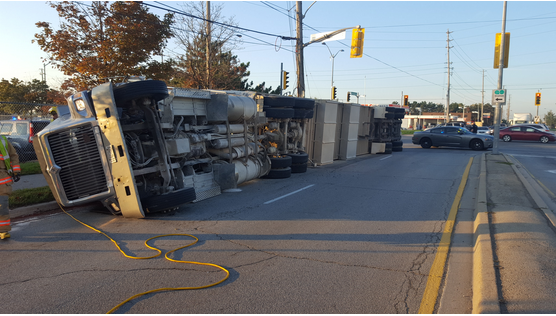
It was difficult to fully understand how grim things were at the intersection of Appleby Line and Harvester Road until you get the hear the squealing of pigs trapped in a truck that flipped over on its side when the driver lost control.
A reported 40 pigs were killed in the accident – those that got out of the trailer were walked to the slaughterhouse.
A 49 year old woman Anna Krajnc was arrested for obstructing police and released on a Promise to Appear in court.
It was hectic at the accident site and very difficult for people who cared about the animals.
The Halton Regional Police Service has charged Anita KRANJNC, 49, of Toronto with Obstruct Police and Breach of Recognizance in connection with rolling over of a truck carrying 180 pigs to a slaughter house.
Anita Kranjnc under arrest.
KRANJNC has been released on a Promise to Appear.
Kranjnc is currently being tried for “mischief” for giving pigs in a transportation truck water on a sweltering hot day. That trial was scheduled to take five days – three days of hearings have been held so far.
It wasn’t that good a deal but it was the only deal on the table and the people running the Friends of Freeman Station (FoF) were afraid, perhaps, that the city would walk away from the table and the structure they wanted to save and rehabilitate would be gone for ever – so they took the deal.
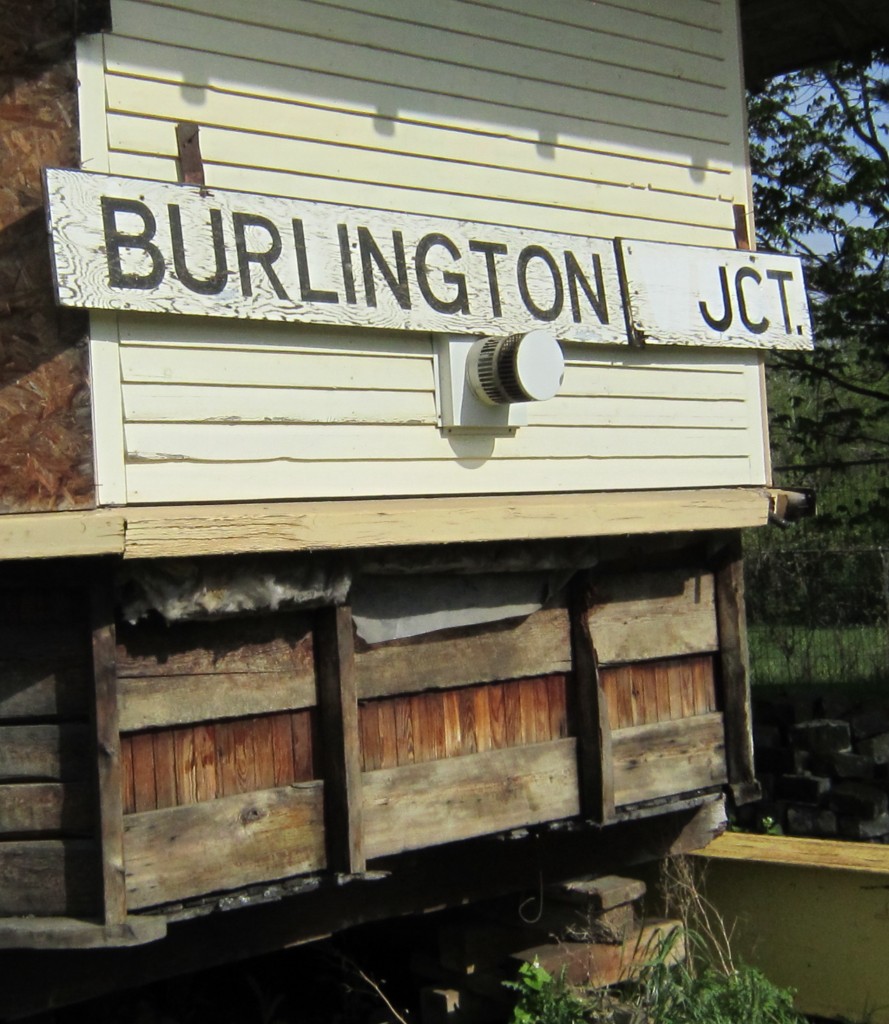
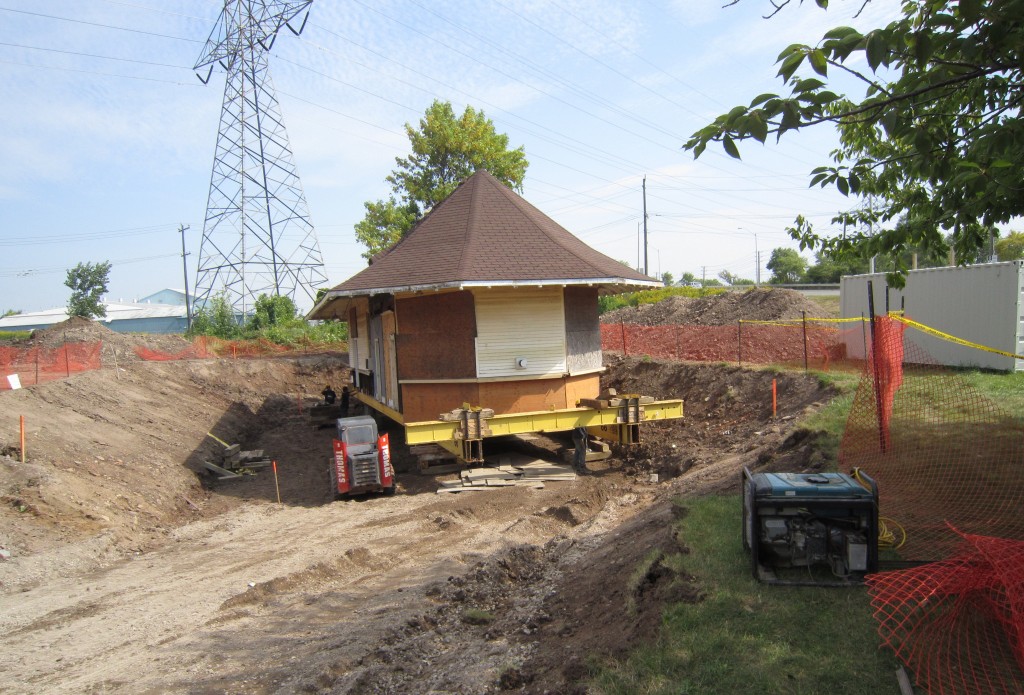
Sitting on some “cribbing” with a sign badly in need of several coats of paint, the Freeman Station gets ready for its big move.
The Friends of Freeman have spent $300,000 on moving the station the couple of hundred yards from where it was behind the fire station to a small piece of land next to the fire station.
They did get some money from the city – but it wasn’t “fresh money” it was money committed for one project and given to the FoF.
The structure was moved about 100 yards and settled into the space so that a basement could be poured.
The first chunk of change was $20,000 the city had budgeted to get rid of the structure, given that FoF were about to save the building it was appropriate that they get those dollars; the second bit of cash was $25,000 that was contributed by the Molinaro Group as a Section 37 payment. These are sums that a developer gives the city under a section of the Planning Act, in exchange for additional height or density on a project.
Molinaro had agreed to pay the city $25,000 for additional density on their Strata high rise on Maple Avenue. Ward 2 Marianne Meed Ward managed to get the city to give the funds to the FoF.
There was about $8000 in a trust account that was also given to the FoF.
They have put every penny they raised in both cash and in kind to very good use. During the Open Doors event on Saturday they had counted 250 visitors and the afternoon as far from over.
The outside of the structure is basically done – work on the inside is underway.
The structure is owned by the city, it sits on land that is leased from a corporation headquartered in Kentucky.
The 2.5 acre piece of land is landlocked – the only way to get a road to it is from the fire department parking lot.
The current lease is good until 2019 – at some point the land will have to be purchased. That lease is a Joint Venture situation where the FoF are on the lease on behalf of the city.
The mess with the proposed wave break at the LaSalle Park arena has made the city realize that their Joint Venture policy is in need of an upgrade.
What was basically scrap is being turned into a valuable building that will add to the history of the city. The value of the building will be upwards of half a million dollars – which goes on the city’s balance sheet.
The FoF have done a great job – but it isn’t over yet. They are going to need an additional $200,000 – and it should come from the city.
Early telephone with a headset.
The Mayor is reported to have told the FoF that when the need is needed – he will be there for them. Let us hope that he comes through for them – they deserve it.
During the Open Doors event the public got to see what is becoming an impressive collection of railway artifacts. While taking some pictures one of the FoF volunteers mentioned that the delivery book would show what had come to Burlington from Eaton’s – and the high school student looked surprised and asked – What is Eaton’s? We shuddered.
Every piece of freight -large and small was entered into a delivery book.
The collection is superb – but it does need some help in the way in the way it is being presented. The creation of the way artifacts are displayed is now an art form. Some of that expertise is going to be needed – but let’s get the structure completed.
The structure has a full basement that at some point will have a full blown model railroad set up.
At some point the FoF volunteers want to lay fifty yards or so of railway track and, with a gleam in their eyes they will tell you about the steam engine they really want to put on that railway track. Given the success these people have had – expect to see an old steam engine on the property at some point.
Telegraph keys – used to send messages in Morse Code. That was the way messages were sent up and down the railway line before telephones were introduced.
The FoF have sought provincial and federal funds/grants but do not qualify for various reasons; one of which is that they don’t own the building.
Also some grants require that people wait for the funding to arrive before starting a project, and the FoF didn’t time – they had to move the building because the fire department needed the space.
All they could do was get on with their own fund raising – and they have come up with $300,000
Anita Krajnc, 49, a woman currently on trial on mischief charges for giving water to pigs that were headed to slaughter last summer was arrested again Wednesday morning, this time at the scene of an accident where another truck full of pigs headed to the same pork plant flipped over in Burlington, Ont.
Krajnc testified in her own defence in court on Monday.
It is unclear what charges Krajnc is now facing. “We will release further information in regards to this occurrence at a later time,” said Halton Police Sgt. Barry Malciw.
Truck transporting 150+ pigs flips over yards away from slaughterhouse – pigs walk that last distance.
The truck lost control and flipped over just after 7 a.m., Halton Police say, near the corner of Appleby Line and Harvester Road. That’s on the corner of the Fearmans Pork Plant, where the animals were headed for slaughter.
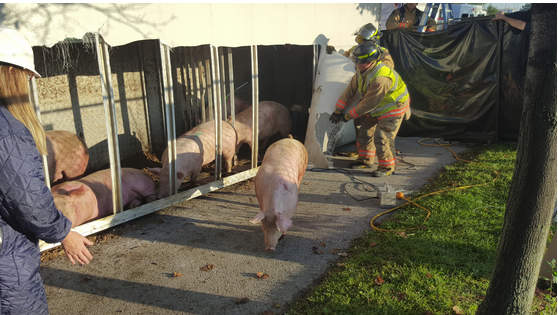
Some of the pigs were roaming free for a time, but Halton police Staff Sergeant Peter Corner told the CBC that they have since been “corralled.”
The Gazette thanks CBC Hamilton for much of the material in this piece.
Halton Region is hosting its third job fair of 2016 on Wednesday, October 19 from 1 to 5 p.m. at the Burlington Convention Centre (1120 Burloak Drive, Burlington). Job seekers are invited to bring their resumes and prepare to meet with more than 50 local employers.
Region holds Job Fair at Burlington Convention Centre
“Halton Region’s unemployment rate is significantly lower than both the provincial and national rates and by partnering with local Halton employers we’re not only keeping our economy strong, we’re also helping to make a real difference in the daily lives of our residents,” said Halton Regional Chair Gary Carr. “With a growing population, easy access to major markets and commitment to high-quality infrastructure, Halton is a great place to do business, as well as a great place to live and work.”
Whether it’s technology, government, manufacturing, retail, hospitality or healthcare, October’s job fair will have employers from a diverse range of industries and is expecting approximately 1,000 skilled and motivated job seekers to attend.
Every year, the two Employment Halton offices in Oakville and Milton offer a comprehensive range of programs and services to more than 8,000 job seekers and over 200 employers. Employment Halton also provides extensive services to the region’s employers to support their recruiting efforts with annual averages of more than 250 direct placement matches.
As a service provider for Employment Ontario, Employment Halton offers resource centre services, one-on-one job search support, training incentives for employers, an online job board at haltonjobs.ca, apprenticeship opportunities and programs such as Second Career which provides assistance to participants as they retrain for a new career.
Demonstrators descended on the truck laying on its side at the intersection of Appleby Line and Harvester Road that was carrying 150+ pigs headed for a nearby slaughterhouse.
At 11 am this morning it was getting a little rowdy with one demonstrator arrested and police pushing others out of the way.
The police were handling the demonstrators while the firemen did their best to handle the pigs – who seemed a little perplexed by it all. A video attached to a tweet is set out below – enjoy.
The crisis management people at Fearmans must be wondering how to deal with this one.
Approximately 160 pigs are being removed after a tractor trailer rollover at Appleby Line and Harvester Road in Burlington. #BurlOnpic.twitter.com/zJON3PC7Hz
Eastbound Harvester Road will be closed for an extended period of time today, October 5th, while police investigate an accident involving a truck roll over.
Truck carrying 150+ pigs flipped over while making a turn on its way to the slaughterhouse.
Just after 7:00 am Wednesday morning, a truck carrying a reported 160 pigs lost control and flipped over at Apply Line and Harvester Road.
No other vehicles were involved in the accident. The driver of the truck is being treated for minor injuries.
Firemen round up pigs that were in a truck that flipped over yards from the entrance to a slaughterhouse.
The pigs were being transported to Fearmans Pork Plant.
A number of pigs escaped from the truck; one radio report had a pig walking through a Tim Hortons drive through – take that report with a grain of salt.
There is no report of any of the animals being killed – what makes the event relevant is the trial taking place on how these pigs can be treated by those he feel they are being mistreated.
Burlington is in the third day of what look like a five day trial that has Anita Krajnc being charged with mischief for giving pigs in a truck water on a sweltering hot day.
Those guys over at Burlington Hydro know how to make the system work for them.
Last Saturday the city held an Open Doors event. Dozens of places around the city opened their doors – the Fire Station, Freeman Station, and the Union Burial Grounds to name a few. Hundreds of people poured in.
How do you compete against attractions like that?
Don’t compete – put you tent up on another day.
Thinking like that explains why we pay the hydro people the big bucks.
Burlington Hydro is holding their Open House this Friday at the Hydro office on Brant Street from 10 am to 2 pm.
Activities are taking place in different locales on the property: EVs along the front – displays and exhibits in the back garage – charity BBQ, bucket rides, and equipment on the back lot. North parking lot will be used for visitor parking.
One of the several EV’s that were available for a test drive at a recent historical auto show. Four or five EV will be available for test drives at the Burlington Hydro Open House.
The EV cars will be lined up at the front of the building.
Plug n’Drive brings 4 or 5 EVs that people will be able to test drive through the neighbourhood.
They do it every year – and every year the number of tickets issued and the number of rigs that get taken off the roads seems to climb.
The 2016 Annual Truck Inspection Blitz at Mohawk Racetrack Starts Wednesday
Halton Regional Police have a unit dedicated to inspecting commercial vehicles.
Halton Regional Police, in partnership with other police and law enforcement agencies, will be conducting a two-day commercial motor vehicle inspection & enforcement blitz October 5-6, 2016. The inspection site will be located at the Mohawk Racetrack on Guelph Line in the Town of Milton.
Enforcement officers will deploy across Halton Region, which includes the 400 series highways, looking for commercial vehicles that appear to be deficient in mechanical fitness or display a safety or load concern. Those vehicles will then be escorted back to the inspection site at Mohawk.
Police officers trained to know what to focus on when they are inspecting commercial vehicles.
This annual initiative is an integral part of Halton’s traffic enforcement strategy. Any vehicles found to be unsafe will be taken off the road. Cargo and the corresponding administrative paperwork required to be carried by the drivers will be inspected. Light commercial vehicles such as small panel trucks, cube vans and pick-up trucks with trailers will also be subject to this inspection.
Last year a total of 472 trucks were inspected over a two-day period. Out of those inspected commercial motor vehicles 167 were taken out of service; a 35 percent failure rate.
Traffic issues are seriously addressed in Halton Region. Enforcement campaigns such as this are essential to ensuring our roads and highways are safe for all users. We hope to send a message out to the thousands of commercial motor vehicle operators who travel on our roadways or through our region each day that compliance to rules and regulations is non-negotiable and community safety will not be compromised.
One gets the impression that putting a rig that is known to be deficient and risking getting caught and paying a fine is just part of the cost of doing business and it cheaper than keeping equipment in top shape. Public safety doesn’t appear to be a major concern.
Deputy Chief Nishan Duraiappah, on the right, will be on hand to give the 75 officers that will be deployed a pep talk and emphasize the importance of the work they will be doing for the next two days. Detective Constable Paul Proteau listens carefully.
To kick-off the event, Halton’s Deputy Chief of Police, Nishan Duraiappah, will be addressing the media and law enforcement officers at approximately 7:30 a.m. Wednesday morning. Approximately 75 law enforcement officers from across the GTA have confirmed attendance. The media are invited to attend and observe those remarks made to the inspecting officers before they embark on the blitz and for photo opportunities.
Mohawk Raceway is located at 9430 Guelph Line (Highway 401 and Guelph Line) in the Town of Milton.
A change in the configuration of traffic lanes on New Street has everyone up in arms – both those wanting the change and those opposed to a change.
The Halton District School Board has told the public, via the release of the agenda for the October 5th regular board meeting, that two of the city’s high school “could” be closed effective June 2018.
Burlington has seven high schools:
Aldershot High School, Burlington Central High School, Dr. Frank J. Hayden Secondary School, Lester B. Pearson High School, Nelson High School, M.M. Robinson High School and Robert Bateman High School
A recommendation to close two of the seven Burlington Central High school and the Lester B. Pearson high School, has left the community thunderstruck.
Central High – the school in th downtown core is where the biggest battle to remain will take place. The ward alderman has already come out against closing the school – fortunately the school board trustee might give the decision more thought and wait until there is more in the way of public feed back.
Feathers flew, school board trustees were inundated with phone calls and emails. One can expect all kinds of misinformation to get in the way of what the board is being asked to approve.
The spunk and school pride at Lester B. Pearson may not transfer to M.M. Robinson where most of the students will transfer to in the 2019 school year.
Some things to keep in mind: Staff prepare reports, they work within the provincial guidelines and have a collection of acronyms that that can’t be used in a Scrabble game. The staff report goes to the trustees – those men and women you elected two years ago – they are going to make the decision on your behalf.
There is a well-developed process for community input – use it before you lose it.
The proposed time line, assuming the trustees, go along with the staff recommendation is as follows:
If the Program and Accommodation Review proceeds as scheduled the following is a proposed timeline for the implementation staff recommended (they are considering 19 different options)
Completion of a PAR with a Final Decision in 8 – 9 months
Capital Priorities Application and Funding takes 3 – 6 months
Transition Planning takes 1 year
Pre-Construction and Construction (project dependent) 1-3 years
School Closing June 2018
Now to those acronyms – try to remember them – the process doesn’t make much sense without some understanding of what the Gazette has come to call “board speak”
PAR – Program and Accommodation Review
As outlined in the Board PAR policies, the Director must prepare a Preliminary Report which identifies a school or group of schools that may be considered for a Program and Accommodation Review. In order for a PAR to be initiated, one of five conditions must be met. The conditions are as follows:
1. The school or a group of schools has/have experienced or will experience declining enrolment where On-The-Ground Capacity (OTG) utilization rate is below 65%;
2. Reorganization involving the school or group of schools could enhance program delivery and learning opportunities;
3. Under normal staffing allocation practices, it would be necessary to assign three or more grades to one class in one or more schools;
4. The current physical condition of the schools negatively impacts the optimum operation of the building(s) and program delivery;
5. In respect of one or more of the schools under consideration there are safety, accessibility and/or environmental concerns associated with the building of the school site or its locality.
LTAP – Long Term Accommodation Plan is something done by all school boards annually. The plan is adopted by the Board of Trustees. The document provides enrollment projections for the upcoming ten years for all schools in Halton.
PARC Program and Accommodation Review Committee is an advisory group that acts as an official conduit for information shared between the Board of Trustees and their communities. The PARC will meet, review information, provide feedback from the community, and suggest options.
Each PARC consists of a Trustee and Superintendent from an area outside of Burlington; Principal or designate, two parents/guardians
Utilization rate – the percentage of the capacity that is being used.
The table set out above shows enrollment estimates for the next ten years, the capacity of all the high schools in the city; the percentage of that capacity that is being utilized and the amount of space that is available. These numbers are for all the high schools – a breakdown of the numbers for each school is set out below.
Staff are recommending that two high schools be closed in June of 2018:
Lester B. Pearson be closed and the current student population be sent to M.M. Robinson which is 1.6 km away.
The Utilization rate is just too low to justify keep the school open. Lester B. Pearson High School, Grades 9-12, located north of the QEW between Guelph Line and Walker’s Line. The school offers English and Late French Immersion programming. It is the only school in Halton to have Late French Immersion. Late French Immersion begins in Grade 7 at Sir E. MacMillan Public School. Growth from infill developments are included in projections. The utilization is 65% and it is expected to decline. There currently is an excess of 220 spaces in the facility. Enrollments in Grades 9-11 English are expected to be less than100 students per grade. The board staff may have failed to recognize the changes taking place between Guelph Line and Walkers Line – east and west and between Upper Middle and Mainway – north south. Real Estate agents will quickly tell you that multiple families are living in a single detached house with basements being converted into a bedroom for four and six children. Many of these families are from the Middle East and culturally they are comfortable with a large family in the house – this is the way they choose to live because it is the only way they can afford houses in that community.
The Burlington Central facility houses elementary and secondary school classes (Grades 7-12) and is located within the downtown core. Combined with adjacent Central PS (K – Grade 6), this facility forms a part of a K-12 campus. This school offers English and French Immersion programming. Enrolments are projected to be stable. Growth from infill developments are included. The high school’s utilization is expected to remain stable at 68% capacity. In 2015, there were 376 available pupil places in the facility. Burlington Central is the only facility without an elevator/stairlift. The sports field lands are not owned by the Halton District School Board.
Staff is recommending that Burlington Central HS be closed effective June 2018. All secondary students, west of Brant St., will be redirected to Aldershot HS and secondary students east of Brant St to be redirected to Nelson HS.
This recommendation does not include the redirection of Grade 7 and 8 students from the Burlington Central Elementary PS.
In the event that the decision is made to close this high school, there is a potential that a Program and Accommodation Review may be required for the elementary schools that currently feed into Burlington Central PS for Grades 7 and 8.
The enrollment, utilization ans space available in the other five schools is as follows:
Located within the Aldershot community in southwest Burlington, the Aldershot facility houses elementary (Grades 7-8) and secondary classes (Grades 9-12). It is the only Grade 7-12 school available west of QEW/407 ETR. This school offers English and French Immersion programming. Enrolments are projected to decline beyond 2020. In 2015, there were 327 available pupil places in the facility. Growth from infill developments and North Aldershot Planning Area developments are included in the projections. The high school’s utilization is currently 78% and is expected to increase to 83%, by 2019. It is projected there will be close to 100 English secondary students per grade (excluding Grade 12).
Aldershot High School
Nelson High School, Grades 9-12, is located south of the QEW between Walker’s Line and Appleby Line. This school offers English, French Immersion, and Secondary Gifted Placement. Enrolments are expected to increase over the next ten years. Growth from infill developments are included in the projections. Nelson HS utilization rates are expected to remain above 80%. Nelson HS has the second highest high school utilization in Burlington. There is an excess of 343 available places at this school in 2015. There is support for a Nelson Stadium Revitalization project between the community, Board and Burlington staff.
Nelson High School
M.M. Robinson High School, Grades 9-12 is located north of the QEW between Guelph Line and 407 ETR. The school offers English, French Immersion and SC-SPED programming. It is one of two schools to offer SC-SPED programming in Burlington. The SC-SPED program was added to the school in 2013. Growth from infill developments are included in the projections. The utilization is below 55% and is expected to decline. There is currently an excess of 617 spaces in this facility.
M.M. Robinson High School
Robert Bateman HS Robert Bateman High School, Grades 9-12, is located south of the QEW between Appleby Line and Burloak Drive. A small area known as Samuel Curtis Estate in Oakville is directed to this school. The school offers English programming, International Baccalaureate programming (IB) and a variety of Self Contained-Special Education (SC-SPED) programs. Robert Bateman High School is the only school in Burlington to offer the IB program. This program attracts students from senior elementary schools in the Burlington area. This high school is one of two schools to offer SC-SPED classes and as such, this school has specialized facilities to accommodate the programs. Growth from infill development is included in the projections. Utilization is below 65% and is expected to decline. There currently is an excess of 500 spaces in the facility. The combined English program and IB program is expected to be under 100 students per grade (excluding Grade 12), by 2022. Hayden is already over-utilized and there are three new developments that are going to feed into the school – the third is the development at Dundas and Walkers Line.
Dr. Frank J. Hayden Secondary School, Grades 9-12, is Burlington’s newest high school located in Alton Village, north of Dundas St. It opened in 2013 and offers English and French Immersion programming. Enrolments are expected to increase. It is the only high school in Burlington that is currently above total capacity (2016) and is expected to continue to grow until 2021. Growth from new development west of Guelph Line and north of Dundas Street, and infill development is included in the projections. Current utilization is 118%. A major development application has been submitted after projections have been created for the 2015-2016 LTAP in the Evergreen Community, located north of Dundas St., and west of Tremaine Line. This area has not been assigned to a specific school. The development consists of 907 residential units. The City of Burlington is in the midst of creating a secondary plan. It is anticipated that there will be approximately 50 secondary students from this area. The closest high school to this development is Dr. Frank J. Hayden SS.
Using the space that is available in a school if there aren’t enough bums to put in the seats.
The province recently gave the school boards permission to rent out some of their space to community organizations.
The Community Planning and Partnership Guidelines directs Boards to identify potential partnership opportunities and to share such opportunities with government agencies and parties that expressed interest for such opportunities.
In response, the Halton District School Board adopted the new Community Planning and Partnership Policy on October 21, 2015. The first annual Community Planning and Partnership meeting was held on June 22, 2016, in Burlington.
Approximately eight organizations had representatives at this meeting. There have been three follow up meetings and preliminary inquiries with interested partners since June 2016. At this time, there has been expressed interest in potential partnerships, but no specific details related to a partnership within a Burlington secondary school.
So that opportunity isn’t going to save either of the two high schools.
What is possible with both is re configuring them into affordable housing which is a Regional responsibility. However, surely the Region could pick up the telephone and call the school board and ask: ‘What do you think of the idea of selling the buildings to a developer we can convince to take on such a project.’
Have a chat with the four major developers who want some additional height and density and suggest a proposal to turn a high school into affordable housing units might elicit a favourable response to more height and density.
None of the developers in this city are interested in including affordable units in their buildings – they are marketing a lifestyle that doesn’t include people who can’t afford a unit that is going for something north of $400,000
Closing one high school in a community the size of Burlington would be a big deal – suggesting that two be closed at the same time is a bigger piece of meat than th school board can chew through in the time frame they have given themselves.
These decisions are Burlington decisions – but there are school board trustees from Oakville, Milton and Halton Hills – what impact will their votes have on a Burlington situation?
I’d heard about it; drove by the place hundreds of times, knew what it was but had never had a chance to actually go into the place.
It was the Union Burial grounds on Plains Road established in 1848 by ten pioneer families who were members of the Methodist Union.
A brick wall, first built around 1882 to enclose the Union Burial grounds, now needs both renovation and repair
The chief architectural feature is the fine brick wall surrounding the 138-by 104-foot burying ground. The wall was built around 1882 by brick mason Jabez Bent. There are also fine wrought iron gates at the front and side. The memorial markers commemorate some of the earliest pioneers in this area.
The site was originally farm land owned by Asahel Davis, a Methodist, a community who wanted burying grounds separate from those established by the Anglican Church at St Luke’s and St John’s. Religious differences were a big deal in those days.
The Ghent’s were prominent farmers in Burlington. Both Thomas and hos wife Elizabeth rest in the Union Burial grounds.
The families holding plots in the Union cemetery were major contributors to the early growth, prosperity, and well-being of Nelson and the Village of Wellington Square which are parts of what we know as Burlington today.
The Baxter’s, the Crosby’s, the Cummins’s, the Davis’s, the Fisher’s, the Gage’s, the Galloway’s, the Ghent’s, the Kerns’s and the Pearl’s – the families whose names identify many of our strrets created their own cemetery.
It is quite run down these days. The families moved on and there aren’t that many descendants of its founders around to continue to manage and maintain this historic burial place.
The brick wall is, sadly, in need of restoration. The wrought iron gates and original name plaque also date from 1888. The grave markers are invaluable historic records and also merit preservation. This cemetery feels especially unique given it’s setting of urban development.
“The families who created this cemetery came to Canada during the American Revolution. They were British and chose to remain part of the British Empire in North America. The Americans were in the process of creating their own country, there were just 13 colonial states at the time, who didn’t want the British imposing taxes on them. Out of the struggle between the Thirteen Colonies and their mother country emerged two nations: the United States and what would later became Canada.
The smaller markers recognize members of the family – several for children that died at a very young age.
“Those that left the colonies became known as The United Empire Loyalists who wanted to remain faithful to the Crown and wished to continue living in the New World. Therefore, they left their homes to settle eventually in what remained of British North America.
For many years after those people would put the letters UE after their names – United Empire. Many of the markers in the Union Burial ground have those letters on the stones.
“The Loyalists came from every class and walk of life. Some depended on the Crown for their livelihood and status and had considerable wealth and property. Many were farmers and craftsmen. There were clerks and clergymen, lawyers and labourers, solders and slaves, Native Americans, college graduates, and people who could not write their own names. Recent immigrants from Europe also tended to support the Crown.
“They had little in common but their opposition to the revolution. Their reasons for becoming Loyalists were as varied as their backgrounds. Some had strong ties with Britain: others had simply supported what turned out to be the losing side. Local incidents, fear of change, self-interest, political principles, emotional bonds – one or any combination of these influenced their decision to remain loyal to the Crown. The common thread that linked these diverse groups was a distrust of too much democracy which they believed resulted in mob rule and an accompanying breakdown of law and order. The Reverend Mather Byles mused, “Which is better – to be ruled by one tyrant three thousand miles away or by three thousand tyrants one mile away?” Loyalists believed that the British connection guaranteed them a more secure and prosperous life than republicanism would.
“Historians estimate that ten to fifteen per cent of the population of the Thirteen Colonies – some 250,000 people opposed the revolution; some passively, others by speaking out, spying, or fighting against the rebels. Approximately 70,000 Loyalists fled the Thirteen Colonies with roughly 50,000 settling in British North America.
“Of less practical value than land and supplies, but of more lasting significance to the Loyalists and their descendants, was the government’s recognition of the stand that they had taken. Realizing the importance of some type of consideration, on November 9, 1789, Lord Dorchester, the governor of Quebec, declared “that it was his Wish to put the mark of Honour upon the Families who had adhered to the Unity of the Empire…” As a result of Dorchester’s statement, the printed militia rolls carried the notation: U.E., alluding to their great principle The Unity of the Empire.
“Those initials “U.E.” are rarely seen today, but the influence of the Loyalists on the evolution of Canada remains. Their ties with Britain and their antipathy to the United States provided the strength needed to keep Canada independent and distinct in North America.
“In the two centuries since the Loyalists’ arrival, the myths and realities of their heritage have intertwined to have a powerful influence on how we, as Canadians, see ourselves. Truly, the arrival of the United Empire Loyalists not only changed the course of Canadian history by prompting the British government to establish the provinces of New Brunswick and Ontario, but it also gave them special characteristics which can be seen today. Perhaps the most striking of these is the motto on the Ontario coat of arms: Ut incepit Fidelis sic permanet that is, “Loyal she began, Loyal she remains.”
One of the people telling the story of the Union Burial grounds on Saturday was Stephen Davis, a surveyor who works for the Region; his descendants are buried on the grounds.
“We restored the rear wall and we will re-build the west wall. Trees planted too close to the wall grew and pushed over the brick work. It is a lot of work and we don’t have that much time – we are busy raising our family’s and some of the families buried here have moved on” said Davis.
Davis is working on some ideas on how young people can develop an interest in their ancestry and take part in the rehabilitation of a significant part of Burlington’s history.
Halton Regional Police are seeking the public’s assistance in identifying two persons of interest (POI). It’s believed that these two persons are connected to a series of distraction type purse thefts throughout the region of Halton since mid-June.
One of two “persons of interest” the Halton Regional Police would like to talk to – whenever they are around hotel lobbies purses seem to disappear. Better quality cameras would have these suspects in handcuffs by now.
Suspects have been attending hotel restaurants during the breakfast hour and stealing purses left on chairs while patrons are distracted and/or getting food from buffet tables. Many of the victims are females visiting from other countries. As such, they are often carrying passports, jewelry and large sums in cash needed for travel.
Is this someone you think you recognize? Crime Stoppers would like to hear from you.
In one incident in Oakville, it was reported that suspects stole a purse containing approximately $25,000.00 worth of jewelry and $8,000.00 in cash. Police believe that this large amount has motivated those responsible to target additional hotels. Eight similar thefts have occurred in Halton since July 1.
Residents are reminded that anyone can become a victim of a crime of opportunity and the best safeguard is to remain vigilant of your surroundings and keep valuables directly on your person at all times.
Anyone with information about these incidents is asked to contact Detective Tom Hockney at 905-825-4747 ext. 2491 (Milton and Halton Hills), Detective Mick Leighton at 905-825-4747 ext. 2218 (Oakville), or Detective Phil Vandenbeukel at 905-825-4747 ext. 2343 (Burlington).
Tips can also be submitted to Crime Stoppers at 1-800-222-8477 (TIPS), through the web at www.haltoncrimestoppers.com, or by texting “Tip201” with your message to 274637 (crimes).
What does 2334 people gathered together in the shape of a J in Spencer Smith Park look like?
You saw it here first in the Gazette.
An additional 1039 people could have filled those empty patches. There is an opportunity for those who didn’t take part to do the right thing with the Paletta Matching $5 million campaign goes into high gear.
Was the reason for falling short of that 3373 + 1 target because of the weather?
There were a number of hearty souls who braved the rain – and it was raining when the first 700 people showed up,
Or was there some other reason – it would be useful for the hospital to fully understand why we didn’t exceed the target.
Is support for the hospital a mile while but just an inch thick?
They will say of course it isn’t – it’s a mile wide and a mile deep. The Gazette doesn’t share that view. It could be and should be a mile wide and a mile deep.
That it does not appear to be so is a serious issue for this community.
Medicine is science; science is based on facts and evidence. It would be worth the while to look at the evidence.
The 2334 total was nothing to sneeze at – but when you look at that magnificent J – there are a lot of empty patches aren’t there?
Why?
The objective was to get 3373 + 1 people inside that yellow rope so the person in the cherry picker could verify the count – we have no idea how they did that.
In a media release the hospital Foundation said:
The Joseph Brant Hospital Foundation kicked off its “Join the J” fundraising campaign yesterday in Spencer Smith Park with over 2,334 people forming a giant J. In large part due to significant rain, the attempt fell just short of the goal of breaking a Guinness world record for creating the largest human letter.
However, the Foundation’s primary goal of raising awareness for the start of its fundraising campaign was met and those in attendance had a good time, learned about the campaign, and the new Joseph Brant Hospital.
“We were on track and expected to set the Guinness record today, but not surprisingly the weather kept a number of community participants away,” says Anissa Hilborn, president, Joseph Brant Hospital Foundation. “The real goal of engaging people from across our community to launch “Join the J” in a unique way was definitely met. We are encouraged by the support from so many members of our community.”
The “Join the J” campaign will run until the goal of $60 Million is raised. The Foundation recently announced they have raised $50 Million to date, and with the Pasquale & Anita Paletta Family Match Challenge hope to raise the remaining $10M before the new Hospital opens in 2018-2019.
It was a great time for the kids – rain and rubber boots plus a nifty poncho – that was all they needed to make a day of it.
“We had planned for a number of factors, including the weather, but you can’t always anticipate how people will respond in these situations,” adds Hilborn. “The event was still fun, and we want to thank all those who made the effort, and our sponsors and partners including TD, Hill’s Video, Access Storage, City of Burlington, Super Save Group, Bell Media, Burlington Mall, Kernels Mapleview Mall, Access Printing and Attridge Transportation. Everyone has been very supportive and we look forward to their continued support as we have many more events and initiatives planned for the months ahead.”





 By Pepper Parr




 Staff have prepared policy and by-law amendments to implement these studies and for low density residential areas outside of the character areas.
 Halton Crime Stoppers needs your help to keep our communities safe and secure.



 Domenic Molinaro has put up more than 50 buildings in Ontario – he is the developer who lined Lakeshore Road with condominiums and is in the process of building Paradigm – a five structure project that will house 2000 people steps away from the Burlington GO station.





 Our apologies