 By Penny Hersh By Penny Hersh
June 17th, 2019
BURLINGTON, ON
BILL 108 – It is a definite “wake-up” call for Municipalities. I am probably in the minority, but perhaps it is needed. I have watched the Planning Department not be able to process an application in 210 days – WHY! Some of the answers provided by some city planners were “we had an understanding with some developers to allow us to work together and not be concerned about the time frame”. Is this the way to do business?
 The ADI Nautique development on Lakeshore at Martha, I guess not because the City has been taken to the OMB/ LPAT for non-decision and with regard to the ADI Development on Lakeshore/Martha failed to defend its position. I doubt that ADI ever expected to get 26 storeys on that site.
The claim that the new 120 days does not give Municipalities enough time – perhaps the process the planning department is using is flawed. Why meet, as we have been led to believe, individually. Have all the players in the room at the same time – and have an understanding of who has to do what with definite time frames.
 The sky appears to be the limit for a proposed development on Old Lakeshore Road across from Emmas Back Porch. Note the scale with the two storey heritage structure that the developer proposes to keep. What I have heard at Council Meetings from the planning department is that the wind, the shadow, the parking , and transportation studies etc. have all been completed and the development application is “good to go”. Every development application is taken as a one off – not looking at the other three applications in the same area that are asking for the same if not more.
Try walking on Lakeshore across from the Bridgewater Development – we now deal with a wind tunnel that on days makes it almost impossible to walk. We have traffic congestion on Lakeshore Road when at certain times there are long lines of cars trying to get off of Lakeshore ( and there are no accidents anywhere), and Bridgewater is not completed. Potential owners have been told that their move in date is now June 2020. Residents get to look at this unfinished construction for yet another year. ADI is scheduled to start construction on the 26 storey condo on Lakeshore/Martha shortly. All those studies and we are dealing with a canyon effect on Lakeshore with only one development partially completed, and not occupied.
We have insufficient parking for condominium owners and their guests. Anyone who cycles along Lakeshore and in the downtown takes their lives in their hands. Sharrows on narrow streets do not provide a safe place for cyclists. New developments with less retail space does not make Burlington the “most livable , etc. city” that is always being touted. We have enough nail and hair salons, we need retail that will keep people from using their cars.
 We have a public transportation system that does not meet the needs of the residents and certainly will not prevent people from using their cars. Free transportation from 9-2:30 Monday-Friday for seniors, while a nice thing to offer, is not the answer. It is a band aid approach to a more serious issue. Did you know that if someone takes a Handi-van into Hamilton, they have to change vans and get on a Hamilton Handi-Van to complete the journey? People who are eligible to use the Handi-Van have mobility and other medical conditions – and they have to change vans in all kinds of weather. Municipalities should have been working together, but they have not. We have a public transportation system that does not meet the needs of the residents and certainly will not prevent people from using their cars. Free transportation from 9-2:30 Monday-Friday for seniors, while a nice thing to offer, is not the answer. It is a band aid approach to a more serious issue. Did you know that if someone takes a Handi-van into Hamilton, they have to change vans and get on a Hamilton Handi-Van to complete the journey? People who are eligible to use the Handi-Van have mobility and other medical conditions – and they have to change vans in all kinds of weather. Municipalities should have been working together, but they have not.
Is it really the responsibility of a developer to provide affordable housing? Perhaps Burlington should have used the money they spent on the Pier to provide some affordable housing? It’s all about priorities and “legacy projects”.
 For a few years I have said that the OMB/LPAT has to go. I now question if all Municipalities are able to act alone to meet Provincial Mandates. Developers are in the business to develop. It is the responsibility of Municipalities to have in place an Official Plan that meets the mandates of the Provincial Government. Some municipalities seem to have done this. It seems, unfortunately, that Burlington has not, and I question if any new Official Plan that is passed will stand the test. For a few years I have said that the OMB/LPAT has to go. I now question if all Municipalities are able to act alone to meet Provincial Mandates. Developers are in the business to develop. It is the responsibility of Municipalities to have in place an Official Plan that meets the mandates of the Provincial Government. Some municipalities seem to have done this. It seems, unfortunately, that Burlington has not, and I question if any new Official Plan that is passed will stand the test.
We are ill-prepared to deal with what is coming down the road, and complaining and blaming others is definitely not the answer. Things have changed.
Get your house in order. Hire people who can do the job, and get rid of those who cannot. This is how business operates in the real world.
 Penny Hersh was part of the driving force that created ECoB – Engaged Citizens of Burlington. She serves at the co-chair of ECoB Penny Hersh was part of the driving force that created ECoB – Engaged Citizens of Burlington. She serves at the co-chair of ECoB

 By Staff By Staff
June 16th, 2019
BURLINGTON, ON
CATCH (Citizens at City Hall) uses transcripts and/or public documents to highlight information about Hamilton civic affairs that is not generally available in the mass media. The Gazette has republished one of their reports that is relevant to Burlington.
The Citizens at City Hall in Hamilton are shouting as loudly as those in Burlington and across the province over a piece of legislation introduced in May and made law in June – an astounding pace for any government. Bill 108 has upended planning at the municipal level.
It “came out of nowhere”, changed thirteen statutes, and was pushed through the provincial legislature so fast that city staff could only tell councillors after the fact about the multiple problems it imposes.
Dubbed by the Ford government “the more homes, more choice act”, Bill 108 upends Hamilton’s downtown secondary plan, imposes severe challenges for municipal efforts to rationally plan and pay for growth, and makes it more difficult for citizens to challenge new development.
“The winners appear to be land developers and speculators who can avoid the current comprehensive land planning process and have been given new rights to push for urban boundary expansions. Burlington’s mayor describes it as “welfare for developers” and an analysis by Environmental Defence found it largely aligns with the requests made to the province by the Ontario Home Builders Association.
“The legislation was introduced on May 2, with a comment deadline of June 1. It was finalized two days later and will likely be imposing planning nightmares by early July when city staff expect to be inundated with developer attempts to expand the urban boundary.
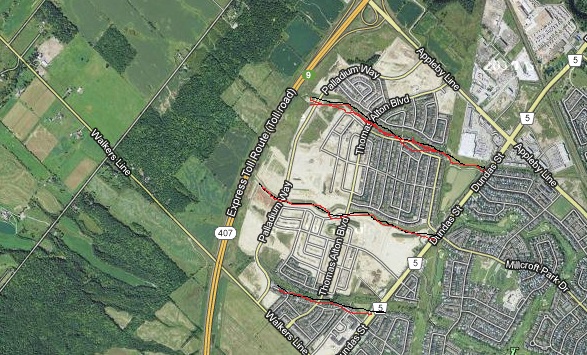 Burlington’s Urban-rural boundary was Dundas – when the 407 Hwy was created that boundary got shifted. Will Bill 108 allow additional boundary shifts? “The legislation tears up the long-standing rule that only municipal governments can propose an urban boundary expansion and only with detailed justifications. Under Bill 108, expansions of up to 40 hectares can now be applied for by individual landowners at any time and must be decided on by council within a much reduced time-frame that will be very difficult to meet.
“Official plan amendments, for example, now must be decided within 120 days of being submitted by a private developer instead of 180 days, and zoning changes must be finalized within 90 days. Failure to meet these deadlines allows the developer to bypass council and appeal directly to the provincial tribunal.
“Staff told Councillors last week that they had asked for longer periods to adequately respond but were unsuccessful. So it will now be much harder for city planners to assess developer proposals, undertake traffic and other studies, receive input from other city departments and commenting agencies, consult with the public in affected communities and then make a recommendation to council within the timeframes. And multiple developer proposals will likely arrive at the same time.
“We could have multiple 39.5 hectare applications all being submitted more or less simultaneously and then trying to figure out how to deal with all of those applications,” warned Hamilton’s chief planner Steve Robichaud. “We could have everybody applying individually and I think that is what will happen. As soon as the first person comes in, the rest will want to start piling on.”
“Among many other changes “it means the matters that were worked out with community in terms of the downtown secondary plan bonusing – that’s gone by the wayside,” Robichaud told councillors.
“That’s partly because of the severe limits that have been put on the use of the inclusionary zoning that allows cities to require affordable units in new residential developments. These were demanded by citizens last year and acceded to by the city for the full downtown, but now will be limited to major transit stops such as the proposed LRT.
“Councillor Whitehead asked staff if the province had explained why it was shortening the timeframes, and was told that no justification has been provided. Whitehead predicted there will be “a lot more cases that will bypass the democratic process and go straight to appeal”.
“Those appeals will no longer give deference to council positions. And residents registering to participate in the appeal hearings will no longer be permitted to speak at the tribunals, but only submit written statements. There’s also a reference to different fees for “different classes of persons” but no explanation of what this means.
“The changes to the Planning Act alone overturn many of the reforms of the last 15 years, including reversing the changes to the Ontario Municipal Board adopted in 2017 after nearly two years of consultations. “
 has Bill 108 put parts of the Escarpment at risk? From a Burlington perspective you can bet developers are looking at the 40 hectare boundary expansion that is now permissible and wondering how it can be applied to land north of the 407 Dundas border that has kept the escarpment safe.
These border expansions can now be applied for by individual landowners at any time and must be decided on by council within a much reduced time-frame that will be very difficult to meet.
 By Pepper Parr By Pepper Parr
June 14th, 2019
BURLINGTON, ON
City council should be getting very close to having made a decision on who they want as a city manager. The original intention was to have someone in place in July – that might slide a bit.
Filling that critical job is one of the more than a handful of tasks this council has to face. Hiring at the city manager level is something few if any of the current council members are qualified to do. They are going to have to use whatever wisdom they have and hopefully not base their decision on an “I like the guy”.
There are only so many qualified people in the province that can serve as city manager. The choice is of course not limited to Ontario – but with the close to chaos that is coming out of Queen’s Park having someone who has contacts and connections in the province would be useful to say the least.
There are 28 large urban municipalities in Ontario. They are:
Ajax, Barrie, Brampton, Brantford, Cambridge, Chatham-Kent, Greater Sudbury, Guelph, Hamilton, Kingston, Kitchener, London, Markham, Milton, Mississauga, Oakville, Oshawa, Ottawa, Pickering, Richmond Hill, St. Catharines, Thunder Bay, Toronto, Vaughan, Waterloo, Whitby and Windsor.
We can take Hamilton, Guelph, London, Toronto and Milton off the list; they have either just hired new city managers or we have done business with them in the past and it didn’t go all that well.
The choice could well come from what is left.
Burlington wants either an experienced, proven administrator who is ready for a change and is up to the challenge of growing a new, young city council with a feisty Mayor – and prepared to put in the eight to ten years needed to create a truly creative team.
Or, a younger deputy city manager who feels he (or she) is ready for a step up and can convince Burlington’s city council that they have the growth potential to lead them to a better place.
One of the metrics is to look at the quality of the civic administration the candidate comes from. I want to use two examples to make the point: Welland and Thunder Bay.
A full page article on Welland in a recent issue of the Globe and Mail is the kind of news a city would go to some length to get.
 Vehicles go under the Welland while ships sail past. A significant engineering feat. Part of the content reads: “A unique convergence presents itself to truckers, engineers and helmsmen approaching the Townline Tunnel from the north, south, east or west of Welland Ontario. While it’s not a regular occurrence, big rigs and Canadian Pacific Railway trains have been known to simultaneously pass under the Welland Canal in Ontario’s Niagara Region at exactly the same time as lake freighters ply the waters directly overhead.
“That intersection is priceless,” says Welland Mayor Frank Campion. “Our industrial amenities and transportation infrastructure are attracting industry and the jobs associated with it, and align perfectly with the federal government’s plans for transporting goods on an international scale.”
“Combine this with bountiful incentives and a wealth of newly zoned land, and it’s no wonder commercial and industrial real estate development is growing at an unprecedented rate in the Rose City.
Welland’s building boom, which started about two years ago, owes much to the continuing divestment of some 1,600 hectares of federally-owned land along the working canal. “There are several plots we will be interested in purchasing as soon as they come up for sale,” Mr. Campion says. “Given our current levels of residential and industrial growth, we need to have enough land inventory for the future.”
 The Welland canal is a huge plus for the city – and they have made the best of it. But the ships that float through the canal don’t put all that much money into the local economy. A recent federal transport and infrastructure committee recommendation to use canal corridor lands to boost Niagara’s economy has only strengthened the city’s bid to build a dock and loading area on the working canal with financial support from Ottawa’s $2-billion National Trade Corridors Fund, which began a call for proposals in January.
The value of the 726 construction permits issued in Welland in 2017 – $164,548,600 – was more than double that of 2016, with the 802 permits issued in 2018 setting a new record.
 Welland made good use of what they had. The original route of the fourth Welland Canal, which passes through the city centre, is lined with bike paths, parks, a 750-seat amphitheatre, and the 12-year-old Welland International Flatwater Centre, which hosted canoeing and rowing events during the 2015 Pan American Games.
“The proximity to the U.S. border and major highways, combined with the ability to apply for tax, duty and tariff exemptions, gives us a real advantage,” said Mayor Frank Campion. “The City of Welland has a very proactive team, and that’s attracting skill sets to the region and bringing the younger generation back. It’s exciting to see all the momentum.”
Dan Degazio, the City of Welland’s director of economic development said: “Companies are paying $200,000 an acre for commercial-industrial property in the GTA. In Welland it’s $125,000 an acre – serviced, configured for drainage, and ready to go. You can be in the ground in eight weeks. In the GTA, I’m hearing stories of 30 months for a permit. We work to accommodate whatever needs to be done. When GE bought here in 2016, they needed to be operational in less than two years. We had them in the ground in eight weeks.”
Can you even imagine a developer in Burlington getting much beyond the application stage in eight weeks?
Mr. Degazio also credits the area’s relatively low wages and cost of living for enticing industry. “I’ve been in touch with a decent-sized GTA employer that’s looking at putting in a 200,000-square-foot building. The owner asks me, ‘Am I going to be able to hire anyone for $18 an hour?’ And I told him: ‘All day long.’ Here, your employees get twice the house for a third the cost.”
“In the last few years, city council has done what needed be done to create an environment that encourages growth,” he says. “Instead of just policing, the Welland Development Commission assists in expediting projects. One of our clients came to Welland last June to set up a 75,000-square-foot food production facility. By the end of September he had purchased the land and in October we were building. That’s unique. In most communities, it takes much longer to complete the process.”
In Burlington Mayor Meed Ward is doing her best to improve the way business gets done with a Red Tape Red Carpet initiative that has her listening to what people from different sectors have to say; there were some positive comments – but they were outweighed by the problems that were impacting every sector.
Now take a look at Thunder Bay where the Police service has been severally criticized by more than one investigation. Growth has stagnated and there is little in the way of hope, energy or enthusiasm to be shared.
Thunder Bay’s problems with its indigenous community have scarred the city. The racism is rampant and sucks the pride, the energy – the very lifeblood out of the community.
A series of external investigations, including a 2015 Ontario coroner’s inquest into the deaths of seven young First Nations people in the city; an Ontario independent police review, released last December, which found the Thunder Bay police force to be racist at an “institutional level”; and a report, released two days after that, by Senator Murray Sinclair, in which he pilloried the city’s police board for failing Indigenous people who are the targets of hate crime.
The problems Thunder Bay faces today are the result of the bad roots that were put down decades ago and allowed to grow out of control and kill what was good in the community. Thunder Bay is a classic example of what hate can do to a city.
According to Statistics Canada’s police-reported crime statistics for 2017, the homicide rate in Thunder Bay was 5.8 per 100,000 population making the city the murder capital of Canada.
News coming out of Thunder Bay is so relevant to the problems Canada has with its indigenous community that the Globe and Mail opened a Thunder Bay bureau.
How does a city get to this point?
 A bleak looking skyline of a city with a bleak looking future until it cleans up the social rot that civic leaders allowed to exist and destroy the social fibre. There are other cities with large indigenous communities; Winnipeg and Saskatoon are examples. Historically Canada has not served its indigenous people very well. There are still hundreds of indigenous communities with Boil Water advisories. Burlington MP Karina Gould spoke with some pride that the federal government has erased 85 Boil Water advisories last year. We should be ashamed that we have even one community where the residents have to boil the water they use.
In a recent article the Gazette published on the two Special Advisers appointed by the provincial government to do a review of the governance of nine Ontario Regions; Ken Seiling, a now retired politician who served as Regional Chair for 30 years, talked about the values that are needed to serve at the municipal and provincial levels.
“There are things that leaders do not let happen” – that leadership was missing in Thunder Bay for decades.
Burlington is now looking for the administrative leadership it needs as it stares at 30 + development proposals that need to be responded to; a change in the required level of growth in the city and a keen desire to see the right kind of growth in the right place take place.
The citizens made it plain that they wanted a different form of leadership at city hall and elected basically a brand new council and bumped one of the old Councillors up to Mayor – who believes she has a mandate to bring about change. The day after she was sworn in she ended the contract with the existing city manager.
The significant seven who sit in the new (but drab) council chamber are now going through the interviews to determine who they want to hire as the city manager who will re-shape what is currently in place.
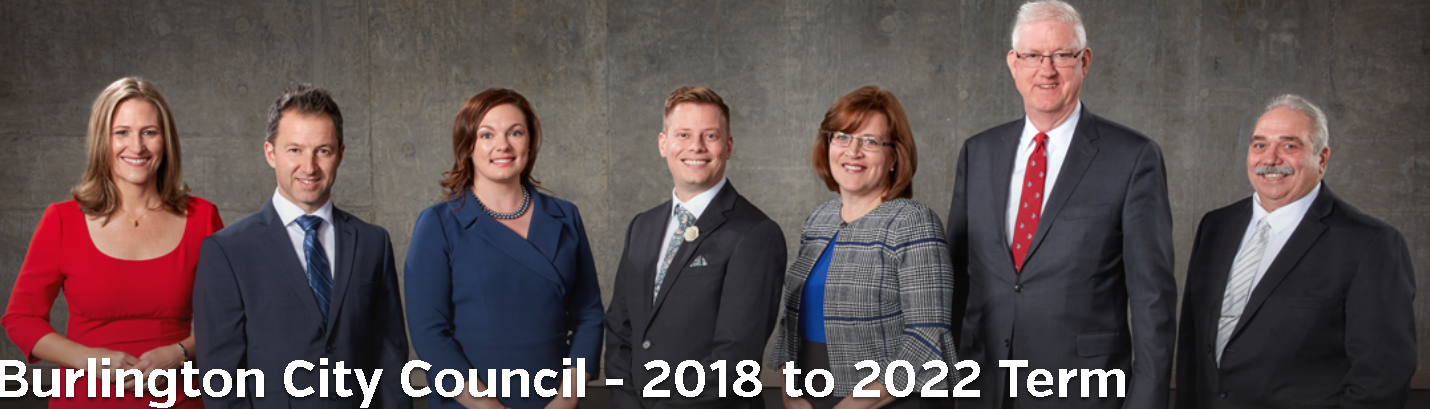 The budget is a big deal, the revision of the Official Plan is a BIG deal – the hiring of a new city manager is the biggest deal these seven people will complete this term of office. Hopefully they will take a hard look at where the candidate came from – hopefully a Welland type where the attitude is progressive, the people are keen and the municipality is just roaring. That is perhaps why the Burlington Herd, the amateur baseball club in the Inter County Baseball League left Burlington for Welland.
What Burlington wants to avoid is choosing someone from a Thunder Bay situation where the problems are deep and will require years to reverse.
It is all about leadership and past experience is one of the best indicators on what to expect from the person hired.
Salt with Pepper is the musings, reflections and opinions of the publisher of the Burlington Gazette
 By Ray Rivers By Ray Rivers
June 13th, 2019
BURLINGTON, ON
“Ben…I’ve got one word for you – Plastics” (The Graduate 1967.)
Read the polls, there isn’t much good to say about the government Ontario voted into office just over a year ago. So the announcement that it is planning to shift the costs of managing packaging waste from the tax base and onto the companies which create it, is worth celebrating.
We shouldn’t get too excited yet, however. The province is really only thinking about appointing a special advisor to recommend options, and results could take months, or even years. Still, this announcement is an encouraging headline from a premier who seems totally anathema to all things environment – killing the cap and trade carbon program, cancelling renewable energy and tree planting projects and fighting the federal government over the carbon tax, and so on.
But there is an ever-growing parade of doom-and-gloom environmental stories which frequent the news media these days. The fact is that an estimated 100 millions tonnes of plastic float in our oceans and some eight million tonnes are added to waterways globally every year.
Virtually all fish species now contain some plastic in their bodies – and so do we.
 How the waste got out of the country is the first question and why we were so embarrassing long it bringing it back and then fining the people who shipped it out in the first place. And when it comes to plastic waste, Canada recently became an international environmental pariah. China had stopped importing plastic waste, forcing large generators of the stuff, including Canadians, to divert exports to a number of third world Asian nations, ostensibly for recycling. But much of the waste was burnt or dumped anyway – but over there – out of our sight.
And a lot of it was too contaminated for recycling, prompting some of these nations to send the refuse back. Our own green PM looked particularly red-faced, caught in a squabble over our waste with the mad-dog president of the Philippines, even though the shipments had been made under the former PM’s watch.
 The sign says it all. Earlier this year 186 nations, signatories to the UN sponsored Basel Commission, added plastic waste to the list of toxic substances not to be exported and dumped in developing nations. The US, almost alone as a non-signatory to the convention, opposed the motion but Canada signed on.
Mr. Trudeau has been under pressure to do more about the plastics problem notwithstanding the Basel amendment. For example, there was a Canadian Council of Ministers of the Environment report out last year calling for zero plastic waste. The EU and some other nations have already announced plans to ban single-use plastics.
Then Mr Singh and the federal NDP recently declared they would ban single-use plastics by 2022, were they to assume the throne. So Trudeau had no option but to announce he’d do a ban even a year earlier (2021). But given the legislative agenda it couldn’t happen until after the election in October anyway. So it’s a perfect election promise.
 The damage from single use plastics is seen at a painful environmental level. Now everyone is wondering whether Mr. Scheer will fall in line and also announce a ban on single use plastics when he brings out his long-promised environment plan. This plan which has been promised and delayed almost since he assumed the leader’s mantle is now targeted for the end of this month. People need to contain their excitement though, recalling that his predecessor, Mr. Harper, never did deliver his promised climate action plan.
It is a reasonable assumption that Mr. Ford’s primary motivation for wanting to shift the cost of waste to industry is to improve his government’s bottom line. Nevertheless this initiative should provide an incentive for manufacturers to reduce the amount of packaging they use.
Economists call it internalizing the externalities – companies will need to find better ways of packaging their products or the products will cost more and be less competitive in the market place. Ironically for Mr. Ford, that is exactly the logic behind the federal carbon tax – get off the carbon bandwagon or be prepared to pay more.
Ford may also be thinking ahead about a possible increase in blue box items should his tearing up the Beer Store’s contract result in termination of their role as a used alcohol container depot. In any case one must remember that the Blue Box program was never intended to reduce our waste, just to divert it from landfill or incineration.
 Beer bottles in Blue Boxes? And the blue box has been more or less successful in that regard. But the program is costly in economic terms as well as in other ways – given the duplication of collection, etc. So shifting the responsibility for packaging waste back to industry might lead to a better option. In any case, not all of the waste, and plastic in particular, can be recycled and much of it ends up in landfill anyway.
Getting rid of single use plastics will have an impact on the oil producing sector, as well. While estimated at only 3% of today’s 100 million barrel global production, a universal single-use plastics ban will amount to another shovel of dirt on the grave of a dying industry. And how long will it be before even more plastics are heading for this future?
That must concern Mr. Ford’s ideological twin and defender of all that’s back to the future in Alberta. Mr. Kenny won his election on a promise go back in time, to expand rather than oversee the demise of Alberta’s number one revenue maker. Shuttering oil sands production and cancelling proposed pipelines was never something he’d dreamt of.
 Most of us had even heard of climate change when Back to the Future was on our screens., But Albertans who read the papers should have understood that Kenny’s promises to expand the province’s oil industry were nothing more than dreams, and an unattainable fantasy. I’m also a fan of ‘Back to the Future’, the epic 1980’s sci-fi movie. But even then, in 1985, before most of us had even heard of climate change, Doc and Marty’s DeLorean ended up being powered with garbage instead of petroleum.
 Ray Rivers writes regularly on both federal and provincial politics, applying his more than 25 years as a federal bureaucrat to his thinking. Rivers was once a candidate for provincial office in Burlington. He was the founder of the Burlington citizen committee on sustainability at a time when climate warming was a hotly debated subject. Ray has a post graduate degree in economics that he earned at the University of Ottawa. Tweet @rayzrivers Ray Rivers writes regularly on both federal and provincial politics, applying his more than 25 years as a federal bureaucrat to his thinking. Rivers was once a candidate for provincial office in Burlington. He was the founder of the Burlington citizen committee on sustainability at a time when climate warming was a hotly debated subject. Ray has a post graduate degree in economics that he earned at the University of Ottawa. Tweet @rayzrivers
Background links:
The Graduate – Blue Box Changes – Blue Box – Ford’s Shift –
Philippines Squabble – US Waste Export – Consuming Micro Plastics –
Banning Single-Use – Basel – Oil Industry –
Harper Environment Plan –
By Pepper Parr
June 13th, 2019
BURLINGTON, ON
Burlington now has more than one group advocating for better government and a better Burlington.
ECoB – the Engaged Citizens of Burlington proved to be very effective.
They sponsored debates in every ward during the municipal election and this evening they are sponsoring a discussion between Mayor Marianne Meed Ward and Oakville Mayor Rob Burton on the Tale of Two Cities at the Performing Arts Centre. “Tip off” for that event is 7:00 pm.
There are 575 people who have free tickets – if you don’t have a ticket – worry not as there are about 50 seats still available. Just walk in and you will be welcomed.
After a solid meal of civic politics one can wander on down to Spencer Smith Park and see if the Raptors can beat the Golden State Warriors and cover Canada in Glory. The Toronto Maple Leafs were never able to do that.
The advocacy newcomers – We Love Burlington are a much smaller group with no plans for involving the community to the same degree that ECoB has
 We Love Burlington – we are calling them “The Lovelies”, are delivering mailers to different neighbourhoods to spread awareness about the group and talk about what folks can do to be heard. We Love Burlington – we are calling them “The Lovelies”, are delivering mailers to different neighbourhoods to spread awareness about the group and talk about what folks can do to be heard.
We Love Burlington has prepared the following set of principles which they believe should be followed by the City of Burlington when considering development applications, particularly in the downtown and in waterfront areas city-wide.
They submitted these as commentary on the latest development application, for 2069-2079 Lakeshore/383-385 Pearl Street and will submit it going forward for all relevant applications, as it seems citizens do have to keep repeating their arguments over and over again. Depending on the specific circumstances of individual development applications, we may add further details and comments as we see fit.
Among the issues they want to sprinkle some star dust on are:
• Burlington’s downtown belongs to all the citizens of Burlington and should be developed as a vibrant, inclusive place for people to live, work, shop and entertain themselves.
• Burlington’s downtown is the cradle of its waterfront – a natural asset belonging to all citizens and deserving of completely open access, and careful, responsible stewardship.
• Access to Burlington’s waterfront includes visual and line-of-sight approaches. It must neither be blocked from public entry nor blocked from a reasonably unobstructed view. What is or is not “reasonable” is a determination that must be made carefully and by fairly considering all affected parties and interests.
• The height of buildings that border Burlington’s waterfront and core downtown areas must be carefully regulated to allow open access and appropriate sight lines to the waterfront and green spaces. Again, the degree of regulation must reflect the fair and careful consideration of all affected interests.
• The City’s approved Official Plan and the plan in force is the 2008 version that has been judged to be consistent with the overriding 2014 Provincial Policy Statement and Growth Plan. As such, all development proposals being submitted for approval should be assessed using the terms, conditions and provisions of the 2008 Official Plan.
• Optimization of provincial intensification objectives should not be accomplished solely or primarily through the construction of ‘tall’ buildings in the City’s downtown core. Alternate approaches and locations must be considered and “optimization” should not be considered to be synonymous with “maximization”.
• Development proposals that seek approval to construct in the downtown core must provide clearly identified/identifiable, valued, measurable community benefits. The determination of these benefits must be an open and collaborative process involving all affected parties and must be pre- rather than post-approval. The nature and scope of community benefits will, ultimately, be approved by council and should be directed to areas of greatest community need (i.e. affordable housing).
• Development proposals should always consider and identify the cumulative effects for things such as traffic, parking, shadowing, wind tunnelling etc. rather than those specific and isolated to only the development being proposed.
• Full development costs should be borne by the developer or development proponent and not passed on to taxpayers in the form of higher property taxes or greater municipal debt.
• Good policy and planning involves the appropriate balancing of local, regional and provincial interests. When these interests do not align, local concerns should not be subordinate nor should the developer’s voice predominate.
By Pepper Parr
June 13th, 2019
BURLINGTON, ON
There is an agency in the Region that has served for several decades that is going through significant turmoil as it comes to terms with change.
We are not going to name the agency, nor will we name any of the individuals involved.
The agency is in the non-profit sector; it is suffering from the loss of funding at the provincial level and to some degree from the federal level.
 Social services at this point in time are, for the most part, a Regional responsibility. The provincial government downloaded a lot of this responsibility to the municipalities who do not have the financial resources to deliver. The 2014-18 Burlington city council made little effort to take up any of the slack that resulted in funding changes at the Regional level. Social services at this point in time are, for the most part, a Regional responsibility. The provincial government downloaded a lot of this responsibility to the municipalities who do not have the financial resources to deliver. The 2014-18 Burlington city council made little effort to take up any of the slack that resulted in funding changes at the Regional level.
The agency of concern has not managed to keep up with the way information is gathered and distributed – infographics for which the the city and the Board of Education have staff in place to create, is not a luxury this agency has – thus they are quite a bit behind in the quality of the information they can send out.
The dollars they get from their funders are put into creating policy papers and developing courses that other small non-profits can use to improve their operations and running programs to meet different needs in the Region.
The Trillium fund in the past was a significant source of funding for the agency we are focused on. That source has dried up.
Staff and Executive leadership at the agency are going through some deep re-thinking as they struggle to determine their direction and the validity of the mission.
Change is painful, the pressure on the Board of Directors is immense – finding people with the experience, depth and time needed to handle complex issues is difficult.
Leadership at the operational level is impacted by the quality of leadership at the policy level. Every leader has to take what former Prime Minister called “a walk in the snow” to think through if this is the time to make way for new leadership.
Everyone likes to leave on a high note – what if the high note’s time has passed?
Reputations and a life’s work should not just be trashed by a report that was not as well researched as it could have been.
The not for profit sector is hurting – this is the case in Ontario and across the country. The struggle to find new leadership and put them in place so that those who have been in place for decades can move on to new opportunities, requires judgement, wisdom and tact on the part of the Boards of Directors.
Salt with Pepper is the opinions, reflections,musings and observations of the Gazette Publisher
By Pepper Parr
June 12th, 2019
BURLINGTON, ON
They are under incredible pressure.
The work load is daunting.
The learning curve is just beginning to level out for five of them – it has been incredibly steep.
Some nod off during meetings.
The city council elected last October is sweating it out and for the most part they are doing a really good job and changing the way the city gets its work done.
Staff is still getting its measure as to just who the five new members are.
Both staff and council are badly in need of the kind of leadership a new city manager will bring.
When you see a council member – give them a hug.
Yesterday they put in a 12 hour day – with meal breaks as short as 20 minutes.
They approved a recommendation that Standing Committee meetings begin at 9:30 am instead of the past start time of 1:00 pm.
Staff is struggling to keep up with the work load and setting out deadlines that are going to be very hard to meet.
The challenge for both council and staff is to turn the good ship Burlington around as they set a new course realizing that the charts they had expected to use have been changed.
They need your support – be generous.
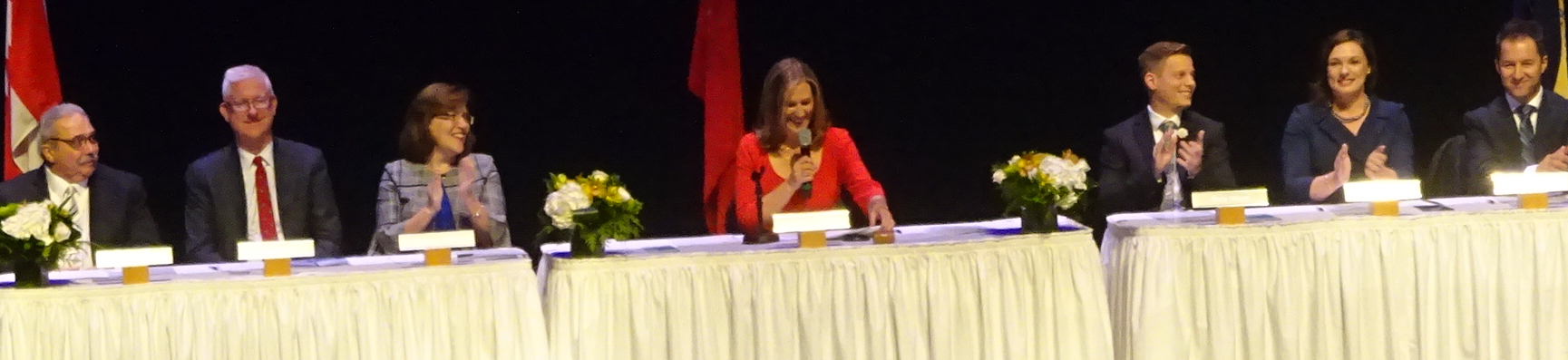 The 2018 city council on the day they were sworn in. Salt with Pepper is the musings, reflections and opinions of the publisher of the Burlington Gazette.
By Roland Tanner
June 12th, 2019
BURLINGTON, ON
It is eleven months since this council considered the application for 409 Brant Street.
At that time 24 storeys was a new and unwelcome maximum, blowing past the maximums set out in the then newly adopted Official Plan.
That was just the beginning. Since then we have seen multiple proposals come forward which approach 30 storeys.
ECoB – Engaged Citizens of Burlington hope and expect that Council’s eventual decision on this building, which will not be for some time, will be not to approve it in anything remotely like it’s current configuration. That will be the correct decision, and it is the decision the voters expressed their wish for last year. Sadly, however, we also need to acknowledge the likely futility of that decision, whenever it comes.
Because this application is about who controls planning in Burlington.
 This Carriage Gate development will inevitably be appealed to the new LPAT/OMB, an un-elected, un-answerable, faceless, undemocratic agency of government which will decide Burlington’s fate on this development, as it will on most of the other developments which will be coming to Council in the months and years ahead. With the passing of Bill 108 into law and the return of the rules of the old OMB, but with slashed timelines, the minor improvements in planning procedure achieved by the introduction of the LPAT have been lost. This Carriage Gate development will inevitably be appealed to the new LPAT/OMB, an un-elected, un-answerable, faceless, undemocratic agency of government which will decide Burlington’s fate on this development, as it will on most of the other developments which will be coming to Council in the months and years ahead. With the passing of Bill 108 into law and the return of the rules of the old OMB, but with slashed timelines, the minor improvements in planning procedure achieved by the introduction of the LPAT have been lost.
A de novo hearing can enforce any decision it likes on Burlington, and precedent suggests the tribunal will not show any interest in the years of work staff and council have put into developing a vision for downtown.
To deal specifically with the problems with this development, I could, as so many have done on other occasions, talk about concerns with wind studies and setbacks, traffic effects and heritage protection. But I would simply be repeating what we’ve all heard many times before.
Certainly this building is inappropriate for downtown. It has hardly any stepbacks. The 45 degree angular planes across Pearl and Lakeshore run smack-dab into the 29 storey vertical wall the building creates at about the 8th floor.
All the design elements in the world to break up the tower’s appearance cannot hide the fact that this it is attempting to fit the most units it possibly can on a restricted lot size. It will worsen what has already become a problem area for wind on Pearl. It will be another large block in what has become the Lakeshore Chasm, a high-walled concrete tunnel channeling wind and traffic into our downtown.
It is an application, which if successful, will drive another nail into the coffin into what was once a promising urban promenade between Pearl, Old Lakeshore Road and Spencer Smith, losing a large percentage of the lake views that set Burlington apart from other cities.
 Carriage Gates Homes president Nick Carnacelli We have to recognize what this proposal is: it is a statement that Carriage Gate Homes considers the wishes of Burlington City Council and the democratically stated wishes of the residents of Burlington to be irrelevant.
They recognize that the power lies elsewhere, and their application has been designed with that in mind. And that was before Bill 108 became law. It is designed to be negotiated at LPAT, not to be approved by council. The Interim Control Bylaw, while allowing the City time to work out its own approach to downtown planning, is likely to be simply a delaying process.
However, and council can correct me if this understanding is wrong, we believe developers can still submit their appeals to LPAT even while the ICBL is in place. The city’s greatly reduced timelines are not changed.
This is a bleak picture, not just for those who want to see a reasonable and balanced approach to development in Burlington, but for anyone who believes in local democracy. Urban planning is now the preserve of whoever can pay for the best lawyers. Millions upon millions of dollars are being wasted – money that could make developments more affordable, and money that the City desperately needs to make up for the revenue it is losing under Bill 108. Ironically, In ECoB’s discussions with developers, it seems there’s one thing we can all agree on – the appeals process is a costly waste of time for all parties. Moreover, it is a process which most other provinces in Canada avoid completely.
So we need to urgently address the few things that can be done in Burlington to reduce the focus on downtown, and which the province has made clear are within the city’s powers to do.
First. ECoB urges council to do all it can to immediately remove the Mobility Hub designation from downtown.
Secondly, also founded on information received from the province, we urge the City to explore everything it can to consider changing the boundaries of the Urban Growth Centre to focus on Burlington’s real transit-corridor around the Go Station and Fairview and to work for that to be adopted in the next Regional Plan.
Without doing so, ECoB believes whatever changes the city makes to the Official Plans and zoning are largely irrelevant. The expectations of development in the Urban Growth Centre will always trump the limits made by Official Plans in the eyes of LPAT/OMB.
Thirdly ECoB urges council to start doing everything it can to engage the leadership of other cities in a campaign for renewal in municipal authority. It is a campaign that needs to persuade all political parties to put local democracy and root and branch reform of the provincial planning process on the agenda. Local planning, by cities in partnership citizens, is literally the only way in which we have ever built cities we can be proud of.
Finally, ECoB urges Council not to approve this development when it eventually comes before them, and to continue to make a case at every level for the implementation of a democratically informed planning vision.
 Roland Tanner, PhD, is co-chair of ECoB and was a member of the Shape Burlington report committee. Roland Tanner, PhD, is co-chair of ECoB and was a member of the Shape Burlington report committee.
Related link: Strange bed fellows.
By Pepper Parr
June 12, 2019
BURLINGTON, ON
The dynamic was delicious.
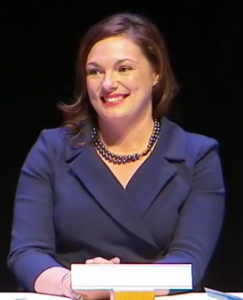 Ward 2 Councilor Lisa Kearns There was the candidate, Lisa Kearns, who won the ward 2 seat; there was the candidate, Roland Tanner, who lost to the current Councillor and then there was the Chair of the meeting, Paul Sharman, who was hearing people speak at a Statutory meeting about a project that no one spoke favourably about, other than the developers’ consultants.
The chair, Paul Sharman, was a member of the Shape Burlington committee. Roland Tanner, who did not win the ward 2 seat, was also a member of the Shape Burlington committee. The two men didn’t get along at the Shape Burlington committee meetings and they didn’t get along Tuesday evening either. At one point Sharman did his best to shut Tanner down.
Tanner was also a member of ECoB – Engaged Citizens of Burlington, the organization that held election debates in every ward of the city, including ward 5 where Paul Sharman sought and won re-election.
 Paul Sharman’s seat at the ward 5 ECoB debate. Sharman did not take part in the ward 5 debate sponsored by ECoB. What he did do was trash the organization as illegitimate and misguided.
Roland Tanner While Sharman didn’t take part in the ward 5 debate he did have some of his people on hand passing out literature.
Tuesday evening, Roland Tanner was delegating, answering some very direct questions from the ward 2 Councillor, Lisa Kearns and dealing with interruptions from the chair.
Politics does have the strangest of bed fellows.
Salt with Pepper is the musings, reflections and opinions of the publisher of the Burlington Gazette.
Related opinion piece: The delegation the chair wanted to cut short.
 By Gary Scobie By Gary Scobie
June 7th, 2019
BURLINGTON, ON
I am writing this to expose the absurdity of the Province’s growth centre density targets and how this absurdity is working against good municipal planning, against the livability of Ontario cities where targets apply, against the democratic right of citizens to control their own neighbourhood growth and for just one group – developers.
 Mobility Hubs can be either full-fledged Gateway Mobility Hubs along GO Transit lines or Anchor Mobility Hubs where municipal transit stations occur. Is this really an Anchor hub? Henceforth when I refer to growth centres I mean official Urban Growth Centres assigned to municipalities by the Province and Mobility Hubs assigned either by the provincial Metrolinx organization or created by municipalities themselves. The Mobility Hubs can be either full-fledged Gateway Mobility Hubs along GO Transit lines or Anchor Mobility Hubs where municipal transit stations occur. Each has a density target assigned consisting of the number of People and Jobs (P&J’s) per hectare. Not all growth centres have the same areas or density target, but for simplicity I will use the largest area and the highest density target to describe the maximum effect, unless I use an actual growth centre that has been designated.
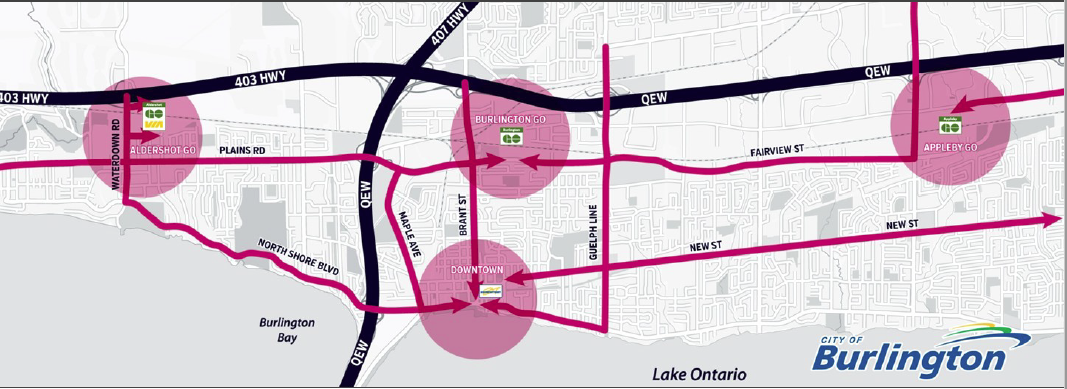 The thinking was to create four mobility hubs and allow significant growth. The studies needed to flesh this out have been put on hold, A theoretical growth centre is circular and can have up to an 800 metre radius. The area is calculated by the pi X r-squared formula we learned in school, where pi is 3.1416 to four decimals and r is the radius in metres. In this case the area could be up to 3.1416 X 800 X 800 = 2,010,624 square metres. A hectare is 10,000 square metres. So the maximum area of a theoretical growth centre is 2,010,624 / 10,000 = 201.0624 hectares. Let’s round this off to 200 hectares for simplicity.
The growth target for most growth centres is 200 P&J’s per hectare. So theoretically the largest growth centres could have up to 200 X 200 = 40,000 people and jobs within it. That in itself is quite a staggering number, when you consider that Burlington has a population today around 180,000 and if just one growth centre had a maximum area and no jobs, it would have to house 40,000 people in a relatively small area, about 22% of the current total Burlington population.
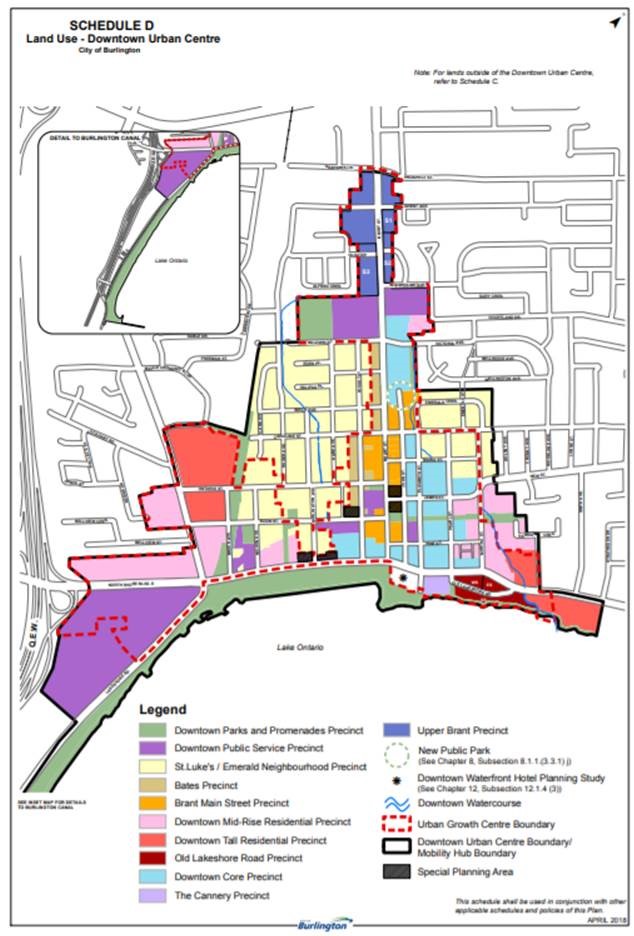
 Going up opposite city hall – sales centre is operational. But let’s pause here and examine a real growth centre in Burlington, the Urban Growth Centre in the downtown. It is smaller than the circle I described as theoretical and it is shaped more like a upside down capital “T”, stretching up Brant street and adjacent streets and along Lakeshore Road. It is about half the size at 104.6 hectares. So its target is 104.6 X 200 = 20,920 P&J’s. Yes, that’s pretty dense. We were at 157 P&J’s in 2016, over 78% toward target. So we need to get to 200 P&J’s in this growth centre by 2031. At the pace of current approved and constructed or awaiting construction buildings, we will handily reach target well before 2031.
In actual fact, we will not need one more high rise building, beyond those approved, added in the Urban Growth Centre in the next 12 years. We could get to target with a mix of low and mid-rise new buildings. Even though overall Burlington population growth (again assigned by the Province without our consent) will have a new higher target assigned for 2041 compared to 2031, the growth centre density targets are unchanged for both dates. The new assigned population will be expected to be housed at the three GO Station Gateway Mobility Hubs that have been spec’d out for up to 69,000 people and jobs. So even with more assigned growth of population, it would seem that our downtown just might be able to survive and still be liveable at about 21,000 people and jobs by meeting its density target.
 Citizens are arguing for some limits on just how much development takes place in the downtown core. Interim Control Bylaw has halted any development for a year. But wait, there’s more! You see, the density target for growth centres of 200 P&J’s per hectare is a minimum target, as developers often point out. So what, you may say. We’ll make our minimum target and no municipality is being threatened by the Province with nasty repercussions if they don’t make theirs. But the Halton Home Builders Association is recommending density targets be increased once municipalities reach the minimum. So municipalities wouldn’t get rewarded for meeting the minimum target, they would get penalized by being forced to densify even further if this recommendation ever went through. Some reward.
Now here’s the real absurdity. The Province “encourages” municipalities to go beyond the minimum density target. OK, but how much beyond? Well, er, there is no “how much”. In the absence of a maximum density or a suggested maximum, there is no number given by the Province nor a hint of what it might be if there was one.
As an Applied Math grad, that can only mean one thing to me. The maximum is infinity. And most people know that means there is no maximum whatsoever. You can bet that the developers and their planners and lawyers, who are smart people by the way, certainly know this and love this gift from our Province. And they make good use of this phraseology of encouraging higher than minimum targets to lobby cities, the OMB and the LPAT that it is their civic duty to go, as Buzz Lightyear would say “to infinity and beyond”. It’s like a license to build ever higher, ever more high rises in growth centres “because the Province wants us to do it”.
 Approved – at 24 storeys – the city opposed the development – the OMB said they could. No hole in the ground yet – they are testing to determine just where the water table is. Would any Official Plan (OP) that doesn’t allow infinite growth in a growth centre therefore be not “in compliance” with the Provincial Policy Statement and the Provincial Growth Plan? So OP’s might be useless to stop this quest for infinite density? Good city planning might also be in danger, although the LPAT & OMB often refer to “good planning” as something they can identify and appreciate, especially when it comes from “experts” (most Planning Departments need not apply since only the Province decides who’s an expert, it seems). All these are worrisome issues for citizens who care about Burlington and support reasonable growth.
Confused? Don’t be. The latest suggestions for changes to the LPAT from the Province are to dismiss a municipality’s OP if it isn’t “good planning” and decide for them what “good planning” is and how many high rises should be allowed and how high these building should be in growth centres, so that we can reach toward infinity by 2031, by 2041, or by infinity I guess.
How many P&J’s should be stuffed into growth centres? An infinite number apparently. And developers are lining up to feast like they’ve never feasted before with high rises everywhere in growth centres, foisting these on unsuspecting municipalities.
In our capitalistic society, where money trumps all reason, municipalities and their citizens seem nearly powerless to stop this. Welcome to the absurd world of growth centre math and the greed that is satisfies.
Now I fully realize that the target is not infinity, but citizens must realize that the impetus from developers to build higher and higher is strong and steady and the Province with its proposed weakening of citizen input to the LPAT process and its proposed takeover of decisions on just how far we go with density and height (under its “good planning” auspice) are putting all cities in Southern Ontario at risk for destruction of the character of their downtowns, the increase of congestion in both people and vehicles and the lowering of livability standards.
 Looking south down Brant the light shaded building has been approved at 24 storeys, the building to the south of that has been ok’s at 17 – they are appealing to get 24 – same as the guy next door. Is this what Ontario city populations desire? Is this what Ontario citizens thought they were voting for a year ago? I don’t think so. Yes, there will be more people coming to cities and for many that will mean being housed in high rises around GO stations. Citizens realize and accept this. In Burlington we have room for this. So we’re not against growth, only growth in inappropriate places, like our downtown.
Developer is asking for 24 storeys – same as the approved building to the east, What can we do? Contact the Mayor and your Councillor and support their efforts to stand against over-development of the downtown and also of the numerous plazas and strip malls that are or will face the same sort of pressure to infill at high density numbers far out of character with the surrounding neighbourhood. City governments and their planning departments must stand firm against what may seem an impervious and imponderable regime constructed by the latest version of our Provincial masters, who apparently think they know best how to manage our cities. Contact your MPP and let her know you want a made in Burlington development plan.
Citizens must attend local meetings on development hosted by the City and delegate at City Hall when Statutory Public Meetings are called. Let the Province know that we care about our city and our elected officials know better how to manage growth than the Province does.
Only the sky is the limit to developers. We need to lower that limit.
 Gary Scobie is a frequent commentator on how Burlington can grow – he advocates for responsible and thoroughly thought through growth. Gary Scobie is a frequent commentator on how Burlington can grow – he advocates for responsible and thoroughly thought through growth.
By Pepper Parr
May 27th, 2019
BURLINGTON, ON
There has been a lot of material published in the Gazette on the Red Carpet Red Tape initiative that Mayor Marianne Meed Ward brought to city hall.
The Small Business Sector, the Large Manufacturers, the Developer and Real Estate and the Rural Sector all had strong points to make and serious concerns that they wanted addressed.
In the midst of all this is a full time staff that comes to work each day
Moral at city hall cannot be very high. Staff have seen four city managers in a six year period and are now directed by an interim who had some prior experience with city hall; the planning department has seen huge changes, engineering had to deal with The Pier fiasco.
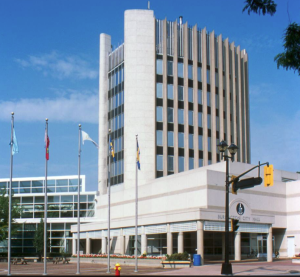 Is it the building or the people who work in it that are the problem? Something isn’t right. Roy Male, a former Executive Director of Human Resources was an active advocate of the municipal sector as a great place to work.
But there are not that many people who will rave about the service they get from city hall. Some of the decisions are just plain stupid.
The Gazette has worked with people in a number of departments and we can say that there are some very good people toiling away on behalf of the public. We have watched a number of those people grow in their jobs, become more skilled and more mature. There are some who are not going to make the grade and there are some who found the environment was just not for them and moved on.
We talked recently to a staffer who moved from a department in city hall to a city service that had operations elsewhere. He was a happier man and loving the job he was doing.
We talked to one planner who moved into the private sector after saying “the Mayor threw me under the bus”.
Municipalities are where we live, the quality of day to day life is determined to a large degree by the people who work for the city.
We need to be proud of them and they need to give us reason to be proud.
These are good jobs, with good pay scales and great benefits. People who work for a municipality are in place to serve the public. These are not just ordinary jobs – public service is noble work. People might scoff at the use of that word. If a person doesn’t see the job as a noble calling – they are perhaps not in the right industry.
One resident with a high profile and some valuable city hall experience gave serious thought to running for Mayor and decided the place was just too toxic and not likely to change.
Jeff Fielding did his best while he was city manager to create a different ethic and attitude. When he got an opportunity to work for the city of Calgary which has a great civic administration and one of the best mayors in the country he couldn’t pack fast enough. He loved the city, returns frequently to play golf with friends – he just might decide to retire in Burlington.
The most recent full time city manager once wrote staff a memo saying that he “had their backs” referring to comments made by the public during the October election. The role of a city manager is to ensure that the people working under his direction are always accountable to the public.
The objective is to get to the point where a city hall staff member asks: What can I do for you today?
Salt with Pepper is the musings, reflections and opinions of the publisher of the Burlington Gazette.
Related article:
What has been learned so far from the Red Carpet initiative?
By Ray Rivers
May 23, 2019
BURLINGTON, ON
Seven in ten Canadians say they’d rather speak to their doctor over the internet than have to truck on down to one of those disease-laden offices where one spends more time in the waiting room than with your doctor. Health monitoring technology, most of which is delivered in a laboratory or specialty clinic (ultrasound, X-ray, MRI, etc.), has virtually obviated the need for the traditional annual physical examination.
This doesn’t mean one shouldn’t ever have, and see, a family doctor. But should we stop progress? There was a time when we only read the news in a newspaper. Today anyone reading my column has transitioned to reading on-line. So why can’t we also make the transition from the physical doctor’s visit to a more virtual reality?
Not to diminish the value of front line medicine, but increasingly the family GP has become a gate keeper and medical tour guide. Once a potential health issue has been identified the patient is typically off to a specialist.
So the Canadian Medical Association (CMA), the Royal College of Physicians and Surgeons of Canada (Royal College) and the College of Family Physicians of Canada (CFPC) are launching a task force to examine virtual care technology and how it can improve access and quality of care for patients from coast-to-coast-to-coast.
 Demonstration of a computer-based doctor-patient interface. Hamilton’s own Dr Richard Tytus, a CMA board member, Past President of Hamilton Academy of Medicine and resident physician at Steel City Medical clinic is leading a virtual care project using a computer-based doctor-patient interface. With the assistance of local health support staff, Dr. Tytus conducts limited medical exams for his patients, then diagnoses and prescribes on-line as needed.
Dr. Tytus has largely been focusing on those with mobility challenges, for example patients in nursing homes who can’t easily make the journey to his office. And while he has been successful working with that sub-group of the public, he also sees the potential to generalize this approach for a broader cliental including those with mental health issues, where accessibility and the benefits of immediate attention may be even more valuable.
Still, CMA president Dr. Gigi Osler says one big hold up is the matter of privacy. On-line data is thought to be less secure than files in a doctor’s office or the (hopefully) more protected E-health patient files . It’s one of the reasons your doc may not allow you to schedule an appointment directly over the internet. Dr. Tytus gets around the privacy issue in using his Skype-like appointments by obtaining permissions from the patient at the outset.
Another big hold up is government support. Governments may not simply be convinced of the cost/benefits of Telehealth yet. Ontario has actually slashed e-health spending in its latest budget. And besides the province still has its own, so-called Telehealth phone-in line, which generally defaults to directing you to your local emergency ward, because liability prevents real diagnosis.
Health care is primarily a provincial responsibility operating within the Canada Health Act. But, most provinces don’t even fund real telemedicine, so entrepreneurial medical practitioners and companies like the Maple group, are starting to fill the gap, offering private services.
Even after a century and a half of living together Canada’s provinces still dwell in silos of parochialism, limiting our progress as a nation vis-a-vis the rest of the world. And health care is no exception. One of the promises of Telehealth is the ability to bring the best health care professionals to your screen no matter where you live. But that would mean tearing down artificial provincial barriers.
A medical licence, for example, in one province does not transfer to another. Each province and territory has its own regulatory college and its own set of standards to license its doctors. And yet 9 out of 10 physicians support either a national licensing regime or universal recognition of provincial/territorial license.
It is expected that the joint medical task force will conclude to call on governments to implement a real Telehealth strategy with inter-provincial portability at the heart of any subsequently hatched program. Clearly Telehealth has a future beyond Dr. Tytus’ experiments among senior citizens in Hamilton. The challenge for governments, as always, is to work together to make it happen.
Ray Rivers writes on both federal and provincial politics, applying his more than 25 years as a federal bureaucrat to his thinking. Rivers was a candidate for provincial office in Burlington where he ran against Cam Jackson in 1995, the year Mike Harris and the Common Sense Revolution swept the province. He developed the current policy process for the Ontario Liberal Party.
Background links:
The Annual Exam –
Virtual Care –
Ontario Telehealth –
Telehealth Task Force –
Canada Falling Behind –
CMA Sees Hope –
Maple Telehealth –
Ontario Cuts E-health –
 By Staff By Staff
May 17th, 2019
BURLINGTON, ON
A number of months ago the provincial government announced a review of how municipalities are providing vital services to residents and local businesses.
The announcement came as a surprise – it hadn’t been mentioned during the provincial election that made Doug Ford Premier of the province.
However it did send shivers down the spines of municipalities across the province – was the Premier about to do to them what he did to Toronto – cut the size of city council in half.
The provincial Review was established to review eight regional governments (Durham, Halton, Muskoka District, Niagara, Oxford County, Peel, Waterloo, York), Simcoe County and their lower-tier municipalities. In total, 82 municipalities are included in the review.
The objective of this review is to ensure that these municipalities are providing the vital services that residents and local businesses depend on.
The province appointed Ken Seiling and Michael Fenn as special advisors to assist with the Minister of Municipal Affairs and Housing with the Review. Michael Fenn was once a member of the management team in Burlington.
The province asked the public to “share your thoughts on the municipalities where you live, work or spend time.
“We want to hear your views on the way your elected municipal representatives make their decisions and represent your community. We also want your thoughts and observations on the efficiency, effectiveness and cost of the various municipal services that your municipalities provide.
“In particular, we are looking for your feedback on:
regional governance
decision-making
service delivery
“We will work with this feedback to ensure that our regional government system provides accountability, service delivery and governance that is best for the people of Ontario.
“We will report back on what we heard during this consultation in fall 2019.”
Seiling and Fenn will be listening to delegations at the Regional offices on Friday.
Here is what a Burlington grass roots delegation said:
Good Afternoon Mr. Fenn; Mr. Seiling
 We are the We Love Burlington Advocacy Group. We are distinctly ‘grass roots’ and non partisan. We advocate on a broad range of issues that affect the City of Burlington and its citizens. We are the We Love Burlington Advocacy Group. We are distinctly ‘grass roots’ and non partisan. We advocate on a broad range of issues that affect the City of Burlington and its citizens.
- We mobilized as a very small action group about 6 weeks ago around the regional government review with a primary mission of raising public awareness that the review existed and what its implications could be. We believe that we have been extremely successful within the very limited time frame available to us.
- We recognize that the regional government review’s aim is to find efficiencies for the municipalities involved, to improve services and to address governance issues if they are found to exist. We support these objectives generally.
- We oppose any suggestion of amalgamation of the City of Burlington into a broader Halton Region organizational structure because we know, as reported in the 2015 Fraser Institute Report, that such actions are seldom fiscally prudent or operationally effective. We are concerned with a potential:
-
- loss of direct access to local decision-makers and a loss of sensitivity to local needs
- Loss of Burlington’s distinct and proud heritage
- Increased bureaucracy and increased government, though potentially fewer politicians which is good
- Reduced or lost services, and
- Higher costs resulting in a higher tax burden and larger municipal debt.
- At present, Burlington has the highest ratio of councillors to citizens of any municipality in the region and we believe, the province (1:30,500 for Ward Councillors and 1:26,143 for Council as a whole). We believe therefore that we have an “efficient governance structure” which also has the requisite sensitivity to local issues not possible in a larger, less directly accountable and more distant governance model.
-
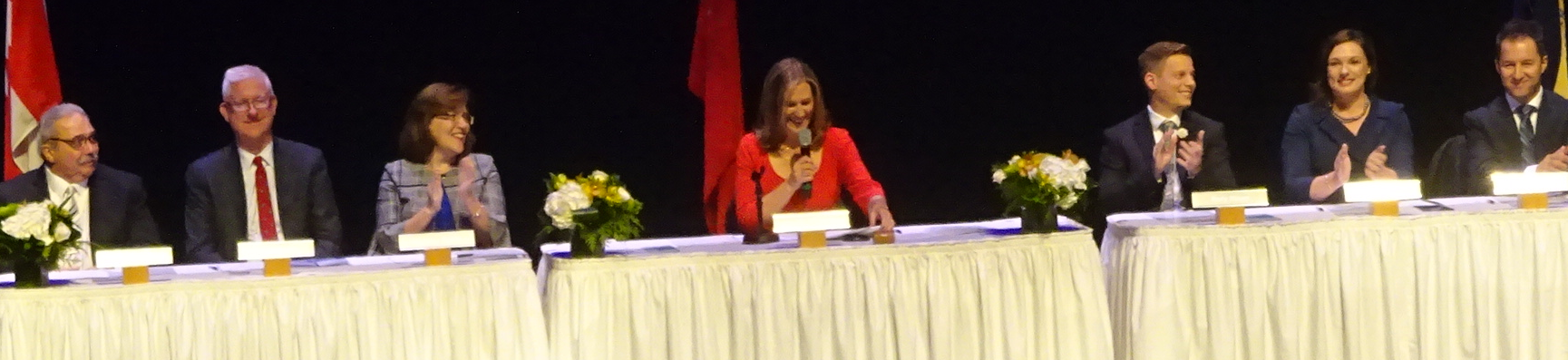 Burlington city council they day they were sworn in: Said to be the best bargain around when it comes to civic government. We understand that similar concerns have been put forward in detail by other delegations and in other jurisdictions. However, we would like to offer some additional cautions arising from challenges in the recent Provincial budget and other initiatives which have been implemented since the announcement of this review in January or which are on the government’s current policy agenda.
- In particular, the context of local municipal program delivery has changed dramatically in the last few months as a result of the:
- Opening of private cannabis stores which are now the subject of municipal regulation and enforcement.
- Reductions in transfers and support to public health entities and the potential for further consolidation of such services
- Reductions in transfers and support for child care, legal aid and a number of other social assistance programs
- Elimination of the LHINs and CCACs, with unclear catchment areas and successor organizations, which at the very least creates uncertainty and confusion around any local responsibilities for health care delivery.
- The proposed availability of wine and beer in corner stores which will create an additional regulatory burden on municipalities and, as in the case of cannabis, require a local focus in such areas as proximity to schools.
- Proposed changes to planning approvals through Bill 108 which appear to suggest a return to the substance (if not the fact) of the OMB model creating further uncertainty for local and regional planning directions.
- Potential changes to the Development Charges Act, again through Bill 108, that would download a number of additional costs to municipalities.
- Proposed changes to the Conservation Authorities Act, Environmental Assessment Act and 11 other pieces of legislation – all with downstream but unclear impacts on municipalities.
- In light of these considerations, we would submit that a better immediate focus for your review would be a “who does what exercise” prior to any consideration regarding governance and/or the redistribution of program delivery responsibilities.
- In particular, such a review would provide valuable insight into the optimal organization of service delivery at the local level in what has become a very dynamic policy context. It should also include an analysis of the net impact to taxpayers when all of the above initiatives are fully implemented.
- Indeed, how can we identify the overall cost/benefit of anything coming from the regional government review when the impact of provincial downloading to the municipalities is still unknown? We’re not saying that benefits won’t be derived but what will be the net result?
- In addition, there are processes and process improvements to the existing environment that could be mandated by the review; such things as a commitment to a defined exercise of self analysis by the municipalities in the region or common targets for further efficiencies in the current structure; a process of continuous improvement.
- There are also possible specific efficiency opportunities within the existing governance model.
- For example, consider optimizing/rebalancing procurement responsibilities.
- Could the region execute contracts and procurement deals with broader scope of application, hence greater potential savings?
- Are regional vendors of record a viable option?
- Are provincial vendors of record available to the region with even greater potential scope for application and savings?
- Is regional fleet management a possibility since, historically, discreet organizations often over buy and under utilize?
- Are the information technology platforms common across the region and truly interoperable? Is full advantage being taken of a common data resource/catalogue across all municipalities?
- We believe that before significant change is made to our existing governance and service delivery environment, available but non-disruptive improvements should be made first. Our overriding concern is that that there is a limited capacity for the quantum of change to municipalities that is anticipated over the coming months. And the system is in danger of being overloaded and becoming dysfunctional.
- Large business transformation and restructuring projects often fail not because they are ill-conceived but because too many projects at once, no matter how worthwhile, result in overloading what is essentially a ‘closed system’. Each project is critical on its own merits but the final tally of impact can be devastating. Cultural and organizational change is not inherently ‘open-ended’.
- We believe that it is prudent that you, as the Reviewers, help the government take the time to understand the complexity of the various organizational, governance and service delivery models that are being reviewed.
- We also believe that it is equally critical for you to identify where the true problems lie and the distinctive and varied nature of the opportunities for improvement. We support recent announcements that suggest that distinct and varied solutions are being sought; that there is no “cookie cutter” approach contemplated.
- We understand that change is both necessary and positive as long as it is thoughtfully done with better service to the citizen and better stewardship of public resources as the goal.
- However, even necessary changes imposed without a solid, well-understood environment for service delivery and decision-making can lead to system-wide confusion if not failure.
- We know that you are searching for “good ideas” but even the best ideas can be injurious to a system that is overtaxed with unclear outcomes and dwindling, uncertain resources. Today there are simply too many undecided elements in the policy and funding framework that municipalities have been handed by the province.
- We welcome examination of services that could possibly be more effectively planned, funded, delivered and/or co-ordinated at the regional rather than City/town level; that would benefit through broadening the scope of operation. However, we have not conducted a detailed analysis and will not offer candidates carelessly.
- We are opposed to any direction that would further distance the citizens of Burlington from those whom they elected.
- Although we may not always agree with the decisions of our chosen officials we support the decision-making process and would argue that the citizen’s voice is both heard and respected in Burlington and in Halton generally.
- In closing, we understand the objectives of the review and support them.
We believe that Halton Region is well run with a governance model that works and a service delivery model that is continually reviewed with necessary adjustments and improvements made.
- It has even been referenced by one of our provincial representatives as a “poster child” for regional excellence.
-
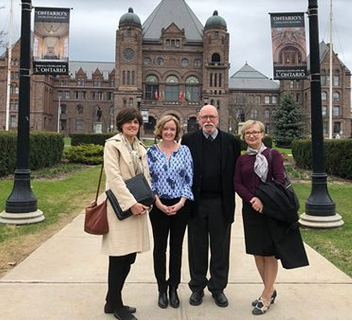 They took an appeal to the Burlington MPP at Queen’s Park – and came away basically empty handed. From left to right: Deborah Ruse Lynn Crosby, Blair Smith and Josie Wagstaff We are concerned, however, that the review may impose change on a structure that has already experienced multiple shocks and can no longer absorb their impact. We caution you to proceed slowly and with a view to the cumulative financial and operational impacts of recent provincial policy directions.
- Finally, we firmly believe that the citizens of the affected communities should have a decisive and deciding voice in any proposed changes.
- We understand that the review and its consequences are entirely within the powers and prerogatives of the provincial government. We do not challenge that. But not one individual voted for them a year ago when they were unannounced and perhaps not even contemplated. As Blues guitarist Joe Bonamassa opined – “Just Cos You Can, Don’t Mean You Should”.
By Jim Young
May 15th, 2019
BURLINGTON, ON
In recent Gazette pieces on Citizen Action Labs and Engagement many valid points have been raised, some with which I agree, others on which I differ and offer my experience.
There are two different types of groups advocating for the citizens of Burlington. City appointed Citizen Advisory Committees and Independent Groups who advocate on issues of particular interest to them. Both types can, and have, enjoyed varying degrees of success in their advocacy and engagement with the city.
Some thoughts on why some of them work and some don’t may help start a conversation on Citizen Engagement and the future of City Advisory Committees.
 ECoB filled church halls – raised thousands of dollars – they were as grass roots as it gets. The difference in influence between Citizen Advisories may simply be this: Citizen Advisory Committees where there is a directly associated department exert less influence on council. Those Committees where there is no associated department, often exert more influence.
 Transit Advisory meeting – staff talent shows up – members appeared to have missed the bus. Burlington Seniors Advisory is successful because there is no “Department of Seniors”. This absence of departmental influence allows them to pursue seniors’ issues across multiple departments like Transit and Adult Programming. Without departmental affiliation, they are also free to work with Non-City groups like BfAST on issues like Free Seniors Transit. Most importantly, BSAC gets to make its cases directly to council or other city departments without any overshadowing staff influence.
Burlington Cycling Advisory (BCAC) has similar freedom from “Departmental Influence” and given the popularity of cycling with citizens, staff and council, they take full advantage of that.
Two non-city advocacy groups which have had remarkable success, for different reasons, are BfAST (Burlington for Affordable Sustainable Transit) and ECoB (Engaged Citizens of Burlington).
 Jim Young taking part in a Bfast panel discussion with Director of Transit Sue Connor BfAST are mostly ex-members of the old Transit Advisory, frustrated by years of anti-transit positions of former councils and staffs. Their success rests in not having to advise City Council. Free from staff control BfAST brings together advocacy from city and non-city groups and departments as diverse as Burlington Transit, BSAC, ECoB, BSC Inc. and many more in a way that City Advisory rules can prevent. With a new Transit Director and a new outlook on council, a rapport has developed with BfAST which may provide a model for what advocacy and engagement might look like.
 Engaged Citizens of Burlington came out of nowhere and energized the citizens of the city through the election debates they organized in every ward – packed audiences in most cases – and incumbents who failed to show. ECoB started as a protest against downtown over-intensification. Castigated by council and censured by planning and communications staff, it grew to become a massive voice for engagement and change. In the October election, ECoB’s organisation of mayoral and candidate debates changed the make-up of council and has given us a council who seem to genuinely want to engage.
Unfortunately, not all citizen advisories work. The old Transit Advisory failed because of a council and Transit Department that did not want advice from transit users or citizens, and the restrictive procedural rules imposed by committee clerks. In an attempt to recover, council created ITAC the city’s Integrated Transit and Transportation Advisory, a committee overweight with staff from Roads, Transit, Transportation and Parking and that same clerical forbearance that spoiled its predecessor.
ITAC were the torch bearers at council for the failed Cycling Lanes on New Street and who advised council to reject Free Transit for Seniors. Surely that says all that needs to be said about committees which don’t work.
 Jim Searle, at one time the chair of the CHAT team poses with the then Mayor Rick Goldring. Some Advisory groups get too close to the elected officials and not close enough to the people they are supposed to represent. I would like to finish on a positive note but CHAT (Charter Action Team), the committee responsible for Burlington’s engagement charter cannot escape a degree of criticism. CHAT was formed in 2014 under the auspices of Burlington Corporate Communications Department to implement engagement ideas from the 2011 Shape Burlington Report.
Any engagement undertaking, eight years in the making and only now reaching out for “Citizen Action” can hardly be considered a resounding success.
However, given the renewed attitude on council, I am more optimistic and hopeful that under their direction, CHAT will be more amenable to real engagement than the past suggests. If we could be sure of more council direction than staff on this new initiative, I would be even more hopeful. Let us get engaged with Citizen Action Labs and give CHAT one more try.
Related content:
City announces Civic Action labs
Jim Young doesn’t like the look of what he sees
Gazette opines on where it think the problem can be found.
By Pepper Parr
May 10th, 2019
BURLINGTON, ON
Media and members of city council have an odd relationship.
We first get to see the people elected to council during the election phase.
Some ask for help – we are generous and tell them as much as we can about the job they are seeking.
We get to know some of them very well. And every time we tell them – “we are not your friends. We are delighted you are running for office and we wish you well.”
The moment we become their friends our usefulness ends and our integrity dies.
The Gazette has always had a strong interest in encouraging candidates for public office that share our view of what public service means – and that is – An informed public can make informed decisions. We are consistent and persistent in digging out information politicians decide they don’t want to share.
Once the candidate is elected the rules of the game change – we are now one of the organizations that works at ensuring the council member is accountable and transparent.
 Something happens to people when they are elected. They begin to see whatever they say as important. They expect every word of their media releases to be published just the way they gave it to us. Something happens to people when they are elected. They begin to see whatever they say as important. They expect every word of their media releases to be published just the way they gave it to us.
We point out that they have confused reporting with public relations. The only person who really cares about what a young member of council has to say is their parents.
I was recently covering a photo-op event in the east end of the city – most of the Council members were on hand and the two members of Parliament who represent Burlington.
There was one council member in particular I wanted to talk to. Up until the meeting last week I thought there was a good working relationship but had begun to notice that this particular council member tended to want the conversations to be off the record.
On this occasion, as I approached the council member he said: “I can’t talk to you”. “What” I asked – “what do you mean you can’t talk to me. Why not?”
“Can this be off the record” was the response. “No” was my response. “Then I don’t want to talk to you” and the council member walked away.
I tend to be persistent – and pressed the issue. “Who said you can’t talk to me.”
That’s when the first shoe hit the floor. “I have been advised not to talk to you until your situation with the city is cleared up.”
Where did that advice to the newly elected council member come from?
This was an individual who looked to me for advice, comment and direction while running for office.
This was the individual who asked if we would publish comment and opinion pieces and help him create a stronger profile in the city.
What I found astounding is that an elected member of council decides to heed the advice of an unnamed person (we are pretty sure we know where the advice came from) without questioning the source.
It is a little late in the game for a council member to decide that they don’t want to talk to media.
Anyone who asks what the issue is with city hall has only to read the Gazette. We have been brutally honest – and written at length about just what the issue is.
The details can be read by anyone.
In one of the documents we received from the city the word “vexatious” was used. We had to pull out our Oxford English Dictionary to be sure we fully understood the word.
Vexatious – causing or tending to cause annoyance, frustration, or worry.
synonyms: annoying, vexing, irritating, irksome, displeasing, infuriating, maddening, exasperating, provoking, galling, rankling, grating, jarring, harassing, harrying, bothersome, tiresome, troublesome, niggling.
That would describe me; something I am proud of.
The council member has less than a year under his belt – perhaps he will learn over time. I’m not betting on it.
We are waiting for the other shoe to drop.
Salt with Pepper is the musings, reflections and opinions of the publisher of the Burlington Gazette
By Jim Young
May 10th, 2019
BURLINGTON, ON
Recently the Gazette reported that the City of Burlington will seek improvements in the working of Citizen Advisory Committees and Citizen Engagement in general via three Citizen Action Labs.
External consultants will conduct the labs to “Help us shape the way we move forward with citizen committees and citizen engagement at the City of Burlington!” They will pass citizen input and lab results on to city staff.
I want to feel positive about these labs. I have filled out the on-line survey and have signed up to participate. But when our city’s Corporate Communication Group, the department charged with corporate, government and citizen communications, hires an outside group to conduct communication exercises I worry. We have been down this road before.
The City’s Charter Action Team (CHAT), responsible for The City Engagement Charter was formed by Council in 2014 in response to The Shape Burlington Report of 2011.
No doubt CHAT believe they are engaging and communicating well. Yet, most of the anger around citizen engagement and many Non-City Advocacy Groups have sprung up over that same period due to frustration with Citizen Advisories. Some of these Non-City groups have helped shape Burlington more than the city sponsored ones. So the question becomes: Can Citizen Action Labs improve engagement where previous efforts have failed?
The Gazette article provided a link to a delegation I made at council on behalf of ECoB on citizen engagement in April 2018. Re-reading that delegation, not much has changed. However, with a new council, elected on pro-engagement platforms, and apparently committed to that, I am hopeful that things will be different this time.
However, CHAT’s record leaves me looking at Citizen Action Labs through a cautious lens.
 Gary Scobie, far right, was a member of the Waterfront Access and Protection Advisory Committee which was sunset by the city. Chair Nicholas Leblovic is far right with Michael Sullivan to his left. So why do some citizen advisory committees work while others don’t? How is it that some non-sponsored advocacy groups are more effective than city sponsored ones? I offer my thoughts based on experience with both types of groups, starting with a general explanation of Citizen Committee workings then examples of what seems to work, what doesn’t and a few caveats for Council, Staff and Citizens seeking greater engagement.
There are currently sixteen Citizen Advisories. Essentially they exist to “Advise Council”. That advice is fed to council via Committee Staff. So city council gets advice from two streams. From its professional departmental staff and from well-meaning, but non-professional Citizen Advisory Committees. If these two advice streams were equivalent, with equal access to council, all might be good. However they are not.
Advisory Committees are made up of citizens and interested stakeholders, appointed by council, who have a vote. Then there are non-voting staff from the department related to the advisory committee’s work. Staff from the city clerk’s department guide the advisory committee through council processes and procedures and record meeting minutes which, as any committee person knows, is a very influential position.
In essence, city departmental staff get two kicks at the can. They recommend actions directly to council then get to weigh in on advisory committee decisions. Citizen members can be, and are often swayed by the weight of staff expertise. This can leave citizen members feeling that unless they are cheer leading for staff recommendations, their views are not valued or appreciated.
Advice from Committees is funneled through staff as guidance or recommendations to council. Unfortunately such guidance often slants towards staff positions. This can be frustrating for citizen members. In instances where departmental staff recommendations are at odds with citizen committees, historically citizen advice is overlooked.
The next piece will be on examples of what seems to work, what doesn’t for committees and a few caveats for Council, Staff and Citizens seeking greater engagement.
 Jim Young is an Aldershot resident who delegates frequently at city council. He once sat on the Seniors Advisory Committee. Jim Young is an Aldershot resident who delegates frequently at city council. He once sat on the Seniors Advisory Committee.
Related news articles.
News story on the creation of the Citizen Action labs.
Young column on why Advisory committees can never work.
By Ray Rivers
May 9th, 2019
BURLINGTON, ON
My conservative friends are forever lecturing me that governments should always run a balanced budget and avoid debt like the plague. But then they also tell me that government should operate like a business or a household. So which is it?
The average family today, particularly those starting out, finance their biggest expenses: their home, automobiles and major appliances. The choice often is to buy on credit to replace a major appliance or automobile, or face even higher operating and maintenance costs when the item becomes totally cost-ineffective. So personal debt is a fact in our lives – and thus all those annoying commercials for Credit Karma.
 Modern business also runs on credit for just about everything they need. In fact the level of corporate debt continues to increase – and why not? When interest rates are low, below the potential rate of return of new investments, time is right to invest and grow their markets and build their capacity to better meet increased demand. The ability to afford and to manage debt is what matters, not the absolute amount. Modern business also runs on credit for just about everything they need. In fact the level of corporate debt continues to increase – and why not? When interest rates are low, below the potential rate of return of new investments, time is right to invest and grow their markets and build their capacity to better meet increased demand. The ability to afford and to manage debt is what matters, not the absolute amount.
As with business and your average household, it is an outdated economic notion that government should always have to balance income and cash outflow in the short term. During the last federal election the two leading parties were promising balanced budgets which would have necessitated more economic austerity and pushed the economy deeper toward recession and greater unemployment.
So the voters opted for the party with a positive program to take advantage of low interest rates to expand the economy. And sure enough Canada’s economy responded with higher levels of growth, lower unemployment and the best performance in the G7. Given the economic success of that policy, Canada is in less danger of losing its triple A credit rating regardless of its deficit spending.
In fact our ability to afford debt is the best it has been since 1981, and the debt to GDP ratio is projected to continue to decline even as the government maintains relatively high annual deficits. That is because, much like a householder’s credit rating, it is not the absolute size of the deficit or debt that matters but its relationship to income and wealth.
The latest big thing in economics is called Modern Monetary Theory (MMT). It may help explain why Donald Trump can run-up debt like a drunken sailor with his head stuck in a barrel full of rum – and the US economy doesn’t capsize.
MMT says that a government which prints its own currency can almost spend till the cows come home – providing inflation is kept penned up in the barnyard. That is particularly the case if the debt is largely held domestically, which has been the case in Canada.
 The data isn’t all that current – but it does show how often the federal government ran a deficit. Perhaps the New Democrat or Green parties will go out on the limb as far as advocating a Canadian green new deal in our federal election this October. That would be gutsy given the controversy surrounding the proposal in the US, even among Democrats. And it is a full year before the concept will be tested on the US voting public.
But we shouldn’t expect to see the Liberals back away from their rather more modest spending plans. They are unlikely to knee jerk to austerity because some of yesterday’s voters and the conservative opposition parties still harbour a hollow and dated notion of always paying your way with what you are carrying in your pant’s pocket.
Today’s interest rates are the lowest in a couple of generations and investing now to build capacity, enhance incomes and reduce unemployment is a wise option for our national government. It might also be the best time to expand those social programs in which economies of scale end up costing society less even if it costs government more.
Programs like pharmacare or mitigating climate change come to mind. That kind of investing is exactly what a smart household or business would do. Would our children’s children really value a fiscal debt-free inheritance over one with the kind of environmental deficit we are heading towards?
This coming election can be expected to see fixated discussion, ad nauseum, about the size of Canada’s deficits and debt. Alarmists on the opposition benches will promise another imaginary fiscal balance should they get elected. But in the end, the math is simple. Budgetary deficits are a consequence of either too much spending or too little taxation. And financing, be it in business, the home, or government, is a just bridge over troubled waters.
 There are always strong and opposing views when it comes to taxation. Finally, it is a rare moment when any of today’s ‘arm chair economists’ will even mention increasing taxation – the price of government services. And since there are important economic consequences associated with all fiscal levers, their hesitancy is warranted.
Still if government is supposed to be a business, shouldn’t it try to operate like one?
Ray Rivers writes regularly on both federal and provincial politics, applying his more than 25 years as a federal bureaucrat to his thinking. Rivers was once a candidate for provincial office in Burlington. He was the founder of the Burlington citizen committee on sustainability at a time when climate warming was a hotly debated subject. Ray has a post graduate degree in economics that he earned at the University of Ottawa. Tweet @rayzrivers
Background links:
Household Debt
Business Debt –
Modern Monetary Theory –
Green New Deal
By Pepper Parr
April 26, 2019
BURLINGTON, ON
The Gazette has run a comments section since the day we started up.
There are some people who abuse the privilege – there are some who think writing comments in the Gazette is a God given right.
There are a number of people, far too many if I do say so myself, who see the comments as irresponsible and not really serving any purpose.
There are others who comment frequently and add significantly to the body of information we use to make decisions.
We got a comment from Phillip Wooster this morning that we want to share.
He was responding to a comment made by another reader who had commented on the decision city council made to declare a Climate Emergency.
Let Phillip tell you what he learned.
I can attest about your comment about building in a flood plain. In 1979, while I was considering buying a house backing onto Tuck Creek, I had a choice between one north of Spruce on Regal Road and another south of Spruce. I happened to have a chance meeting with a farmer who had owned property at Lakeshore and Pine Cove in the 1950’s. He told me to buy south of Spruce–when I asked why, he told me that north of Spruce was a flood plain. In 1954, Hurricane Hazel turned the area into a lake; he said if there was another such weather event, the same thing would happen. And in 2014, guess where the flooding occurred. WHO KNEW????
 Tuck Creek There are few real estate agents in town who will tell you what Phillip has known for years.
Thank you Phillip.
Salt with Pepper is the opinions, reflections,musings and observations of the Gazette Publisher
 By Pepper Parr By Pepper Parr
April 23rd, 2019
BURLINGTON, ON
Two people who were heavily involved in the campaign to elect Marianne Meed Ward, the Mayor of Burlington, have come out with strong statements on the new Customer Relations Management system the city is in the process of adopting.
A third citizen has commented on just how unfriendly the city hall atrium is.
There is something amiss here.
 The crest would at least add some colour to a dull boring looking council chamber. The woman who is now Mayor has been a citizen’s champion from the day she first stood at the podium in city hall to delegate. That “new – re-modeled” council chamber is even less friendly than the atrium. If there was ever a bland space made up of dull grays the council chamber would be it. Having a copy of the city crest made up and put up on the space beside the name Burlington, would do something for the chamber.
The podium that can be raised for people of different heights was a good idea – but when the seating area for the members of council was lowered it meant that people in the audience could not see all that well.
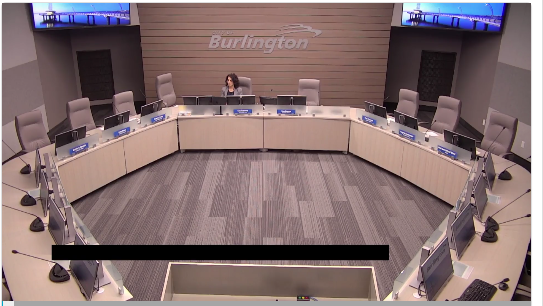 This is what bland looks like. The design of the new chamber is a botched job – reportedly carried out by the Clerk’s office with no public input.
Blair Smith, a person with considerable experience in the running of government services, having served as an Assistant Deputy Minister with the Ontario government said in a Gazette comment that:
“There is nothing inherently wrong in a Customer Relations Management System” wrote Smith, “but it needs to be coupled with a customer service philosophy that permeates through the organization and gives staff energy and focus.
“CRM can make operations more efficient if used properly but it can never replace personal contact and commitment; it was never intended to be a replacement. The City of Burlington needs to ‘open up’. It needs clear and understandable program descriptions with accountable staff identified and contact information clearly displayed. Accountability and visibility go hand in hand. It needs performance dashboards with metrics that are measurable to report on commitments and progress against plan.
 Blair Smith in conversation with Director of Planning Heather MacDonald “It needs transparent citizen engagement instruments so that the public actually contributes to decision-making and can see how operational and strategic directions evolved. And to ensure that the process is not merely cosmetic, it needs a comprehensive customer service program with an executive lead and performance metrics that are in every staff contract and commitment.
“There are established and successful models for true Customer Service Management in operation in other municipalities and levels of government. Seek them out, adapt and adopt them.”
 Transparency was her trademark – which looks a little faded these days. The Gazette thinks Smith is dead on. We all thought that what Smith had to say is what Meed Ward thinks; it is certainly what we have heard in all her public remarks, right back to the days when she would walk backwards as she spoke into a camera explaining what was wrong with the thinking about the pier and that piece of property between Lakeshore Road and Old Lakeshore Road.
 Lynn Crosby; one of the front line workers in the drive to keep Central High School open and a trooper in the Meed Ward campaign. Lynn Crosby, who worked tirelessly on the Meed Ward campaign, running the office they had on Brant Street is “betting this is a system created by staff and was not something the new council or Mayor created. This would beg the question of why staff members might want to vet emails that come in and also begs the question of whether all emails that come in are actually forwarded to the appropriate person, and if so, are they forwarded in a timely manner – i.e., same day – or not.”
Crosby is also no fan of the “big Security desk that greets visitors to city hall” and adds that “it is not exactly welcoming”
“I think it’s early days with the new council and there’s lots of work to be done on making changes to how the city communicates with the citizens and what the tone is. It can be done.
“Looking at this system should be a priority because transparency and ease of communicating with the mayor, council and staff members should be easy to implement.”
Crosby also asks: “Where is the staff directory naming all individuals in key positions with clear contact information?”
When Kim Phillips was a General Manager with the city she was against such a directory. She didn’t want the public “pestering staff”.
Smith and Crosby are pushing in the right direction – we think they had hoped the Mayor would be leading in that direction.
By Pepper Parr
April 23, 2109
BURLINGTON, ON
This evening council will meet to put the rubber stamp and the required signatures on the documents that rule the way we live in this city.
The Interim Control bylaw that halts all development in the Urban Growth centre of the city will be made law. It is a brutal piece of legislation that will cause significant financial stress for at least one developer and dash the hopes of another for the immediate term.
The Paradigm development on Fairview between Brant and Guelph next to the GO station which has three of the five towers in place needed a site plan approval before they could begin construction on the final two towers. The ICBL prevents that site plan from being approved.
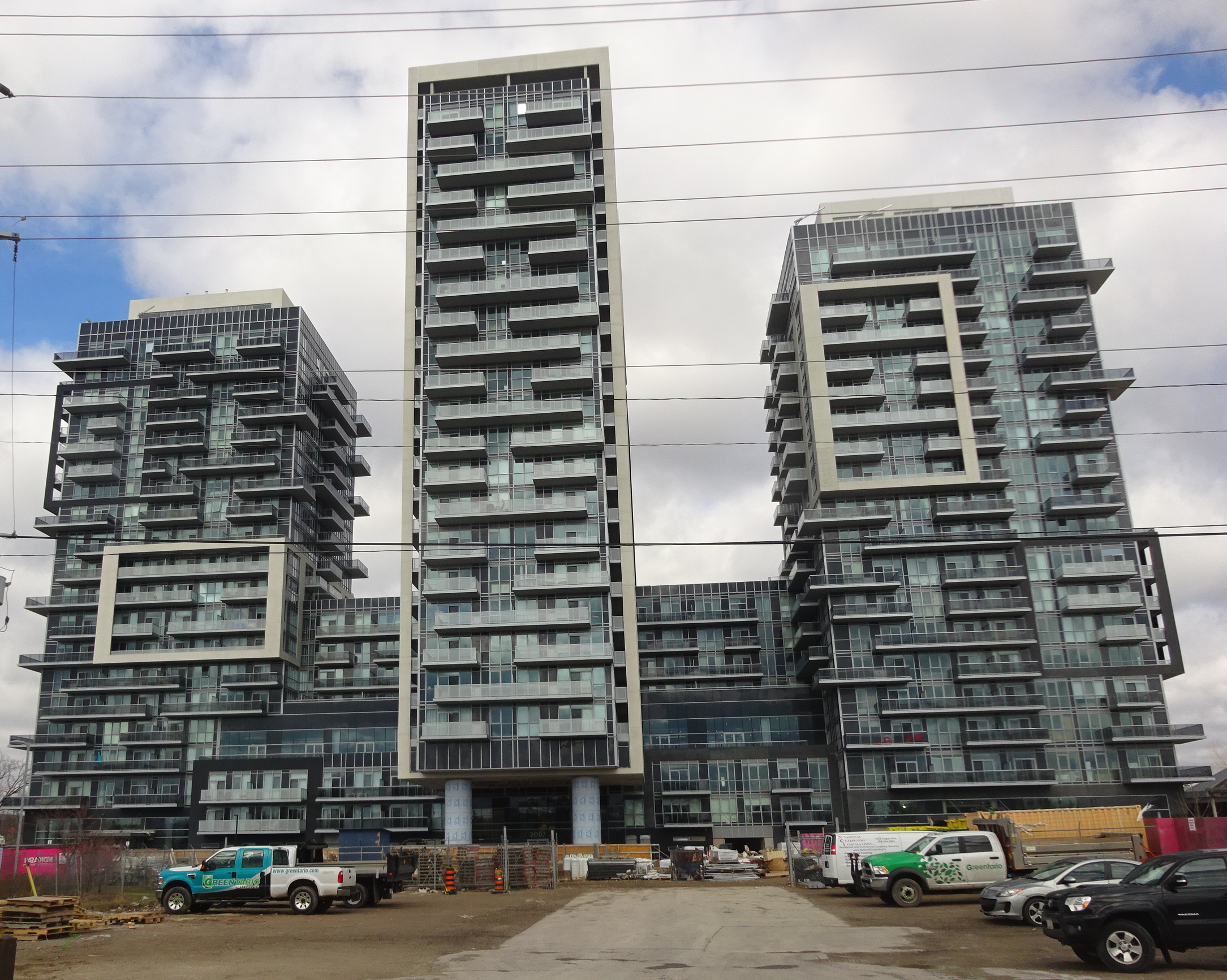 Phases 1,2 and 3 of the five tower development. Phases 4 and 5 are being delayed due to the ICBL council will approve this evening. The Paradigm was the type of development that created the kind of housing the city needed to reach the residential targets set for the city by the province.
Due to a complicated set of agreements that were part of the purchase of the land the Paradigm is being built on the registration of the condominiums is impacted.
The Amica proposal for a large retirement home development on North Shore Blvd never did have much traction with this council. Their representative will be at council this evening pleading for an exemption to the ICBL – short of a total reversal of their position that plea is likely to fall on deaf ears.
However politics being what it is – one never knows what will get decided.
There is a Special meeting of city council the day after – it will be closed to the public so that council members can discuss freely what they have in mind in the way of a new city manager.
 The job is critical – if they get this right – there is a better than even chance that the mandate this council was given is one they can deliver on. The job is critical – if they get this right – there is a better than even chance that the mandate this council was given is one they can deliver on.
There are many who knew the city manager had to be replaced; others who think that a wholesale clean out is needed – from the City Solicitor; the Clerk, the Deputy city manager and at least one of the Directors – perhaps two of them.
Finding a City Manager that understands what council wants and what they believe they need is going to be the challenge.
 The second step of the Meed Ward political ladder: Mayor of Burlington Hiring talent that can lead and understand is not easy – expecting a team made up of people who have no experience doing this is asking for more than they can deliver.
Will this council choose and be able to find someone who can advise and direct them?
Franks Towes made a comment during his recent delegation on the Lakeshore Village Plaza development. “You are the gatekeepers” he said. Indeed they are – what they bring through those gates is what will determine what kind of a Burlington we have going forward.
It will determine as well just what kind of a politician Marianne Meed Ward will be – serving as Mayor is just part of the ladder she will climb.
Salt with Pepper is the opinions, reflections,musings and observations of the Gazette Publisher
|
|