 By Ivan Puzachov By Ivan Puzachov
September 30th, 2025
BURLINGTON, ON
 They come in several sizes and numerous brands. Know what you’re buying and get it right the first time. Snooozzz. It might be challenging to choose the correct mattress since there are so many different kinds available. Different kinds of mattresses may help you sleep better, feel more supported, and last longer. Each kind is intended for a certain way of sleeping and a certain taste. The more you know about different sorts of mattresses and how comfortable they are, the better you’ll sleep and the more you’ll be doing for your health and well-being over time.
Why Mattress Type Matters
A mattress is more than just a place to sleep; it may change how your body heals and relaxes while you sleep. You can feel bad, have difficulties sleeping, or even have back or joint discomfort if you choose the incorrect variety. Picking the proper size and shape is important for obtaining a good night’s sleep and having a lot of energy throughout the day.
For those looking for compact yet supportive options, a twin mattress is often ideal. It provides the right balance of comfort and practicality for single sleepers, children, or smaller spaces, while still offering a variety of materials and firmness levels to match individual needs.
Overview of Mattress Types
varying kinds of mattresses are made, feel, and last for varying periods of time. Here are the most common options, along with their benefits and downsides.
Innerspring Mattresses
 The innerspring mattress is the most prevalent: the quality of the spring is what matters most. The innerspring mattress is the most prevalent variety. It has steel coils within that provide the cushion strength and bounce. They let air circulate well, which makes them a better alternative for those who sleep overheated. It’s simple to locate and inexpensive to buy innerspring beds, but if the coils aren’t good, they could wear out quicker than other varieties.
 Memory foam is shapes itself to the body. Memory Foam Mattresses
Memory foam is well-known for being able to shape itself to the body and relieve pressure spots. It does an excellent job of blocking off movements, which is perfect for couples. On the other side, traditional memory foam tends to trap heat in. However, many modern varieties feature cooling technology that fix this issue.
Latex Mattresses
Latex mattresses are made from natural or synthetic latex. They provide a buoyant, responsive feel and are often praised for durability and breathability. Natural latex is hypoallergenic and resistant to dust mites, making it a healthy choice. The main drawback is cost, as latex mattresses are often more expensive.
Hybrid Mattresses
There are layers of foam or rubber and coils within hybrid beds. This design has both the stability of mattress systems and the softness of foam or rubber. A lot of individuals may use hybrid mattresses, although they are usually larger and more expensive than pillows made of just one material.
Adjustable and Specialty Mattresses
Some mattresses may be made harder or softer, or they are created in a manner that makes them appropriate for particular purposes. For instance, adjustable airbeds allow people modify how firm each side is. Some specialty pillows may employ innovative materials to aid with back discomfort or fit the spine better.
Comfort Levels Explained
Even though everyone has a distinct sense of what is comfortable, mattress producers normally create them in several levels of hardness to assist you pick. These data assist users choose the optimal option for their body type and how they sleep.
Soft Mattresses
Soft pillows are usually preferable for those who sleep on their sides because they maintain the spine straight and relieve pressure on the hips and shoulders. You may need extra assistance if you sleep on your stomach or back.
Medium Mattresses
A lot of various kinds of individuals appreciate medium-firm mattresses because they can be adjusted. They are great for folks who move about a lot at night since they provide the correct amount of support and cushioning.
Firm Mattresses
People who sleep on their backs or stomachs are generally urged to purchase firm mattresses since they are useful for support. They maintain the spine straight and stop the center from lowering too much, which might injure the back.
Matching Mattress Type to Sleeping Style
Another important factor in choosing the correct mattress is how you sleep. Depending on how you sleep, your body has to operate in various ways. Getting the appropriate mattress might help you relax and sleep better.
 Side sleepers that snuggle. Side Sleepers
If you sleep on your side, you need support to keep your shoulders and hips from aching. A lot of the time, memory foam and softer combination beds work well, especially ones that are medium to soft.
Back Sleepers
Back sleepers need support that is evenly distributed to keep their spine’s natural curve. Some of the best beds for this type of person are medium-firm to firm mattresses, especially blends or high-quality innerspring models.
Stomach Sleepers
People who sleep on their stomachs need strong support so they don’t sink into the mattress, which can hurt their back or neck. Most of the time, latex and hard innerspring beds are stable enough.
Combination Sleepers
If you move around a lot, a medium-firm combination mattress can give you the right amount of warmth and support in all situations.
Other Factors That Influence Comfort
The kind of mattress and how hard it is are significant, but there are additional elements that determine how pleasant and long-lasting your sleep surface is.
Temperature Regulation
Latex and mattress coils are two examples of materials that allow air flow and keep people cool. If you favor memory foam, versions with cooling gels or open-cell designs may help keep you cool.
Motion Isolation
If you share a bed, motion separation may be quite helpful. Memory foam is perfect for this since it makes less noise when one person moves about at night.
Durability and Longevity
The materials selected are typically related to how long something will survive. More expensive mixes and latex beds tend to last longer, whereas inexpensive innerspring mattresses may droop more quickly. You may enjoy things for years if you spend more on superior ones.
Conclusion
Mattresses come in a wide variety of types, each designed to meet different needs in terms of support, comfort, and durability. From classic innerspring models to advanced hybrids and natural latex, understanding these options helps you make a confident choice. Comfort levels — soft, medium, or firm — further refine the selection process based on your sleeping position and personal preferences.
 There are retail locations in every city of a decent size. Test them – and be sure you are comfortable before you purchase. Your sleep quality depends on choosing a mattress that suits your body and lifestyle. Taking the time to evaluate materials, construction, and firmness levels will ensure restful nights and healthier mornings. For those ready to explore high-quality options, check out the latest mattress deals to find the right balance of comfort and value.

 By Sadie Smith By Sadie Smith
September 30th, 2025
BURLINGTON, ON
 Online or in-house – either way it’s a pretty good hand Gambling and online gambling establishments have been trending across the globe, with Canada seeing massive growth in the sector. There is now considerable evidence indicating an increase in interest from new Canadian players, amid a thriving industry in Ontario since the province legalized iGaming. Platforms have experienced massive turnover for the past few years. For August 2025 alone, Ontario generated a significant CA$8.14 billion in gaming revenue.
To locals, the convenience of quick cashouts and a variety of table and card casino action to choose from is what you gain playing from Canada. Most operators also provide a wide range of bonuses, various payment methods for added convenience, and the appeal of iGaming, which includes several different games, from slots to poker to live dealer table games.
 A gambling site with both guests at the playing table and slot machines for those online. iGaming may eventually render physical casinos outdated if they do not step up to the demand. Easy access is a major contributor to the surge in revenue. With most businesses today operating online, iGaming now competes extensively with the traditional casino business. Although a disruptor, in recent years, an increasing number of individuals have chosen convenience over traditional casino experiences in real life. The decline in visitors to casinos worldwide suggests that iGaming may eventually render physical casinos outdated if they do not step up to the demand.
For Ontario, the August figures are a significant 35% year-over-year increase compared to the same month in 2024. This kind of massive growth provides clear evidence that the sector is now maturing. With other provinces like Alberta set to follow Ontario’s lead, the nation is set for another major boost in tax revenue in the coming years.
 Online sites have also started offering progressive jackpots, where prizes accumulate until one is ultimately claimed. These jackpots create a sense of excitement that drives players back for more. Mobile-first design has been among the factors allowing operators to respond quickly to users who expect to play swiftly and smoothly. A slot game on a mobile phone or an online lottery ticket purchased over a coffee break has become the norm. Online sites have also started offering progressive jackpots, where prizes accumulate until one is ultimately claimed. These jackpots create a sense of excitement that drives players back for more.
Accessibility is not limited to security. Having the capacity to gamble at home or on the move has provided access to those who may otherwise have avoided gambling because of time or travel needs. Typically, you would visit the casino for your adrenaline fix, but by removing barriers, operators create a more flexible community of players.
 The Township of Milton gets a payment from the race track every year. It works out to be tens of millions. The economic impact of the broader gaming industry is also substantial. Briefly, the more individuals play, the more it equates to the platform’s revenue generation, and naturally, the revenues are higher with higher participation. The game corporations also reinvest portions of their revenues back into the communities. This cooperation is a win-win for everyone, whether you play or not. Communities across Canada benefit from social improvement programs. Lottery and casino businesses contribute to the employment industry by creating jobs and stimulating local economies.
The analysis of Ontario gaming helps put broader trends into context in the Canadian market. Merging the thrill of vintage games with the advantages of the digital era. Internet gambling has changed the manner in which Canadians engage in gambling, providing an opportunity for engagement, socialization, and recreation through a secure and safe environment.
 By Marshall Piano By Marshall Piano
September 29th, 2025
BURLINGTON, ON
Humans have consistently pushed the limits of what is possible in the realm of invention. It is modifying lives and altering how people view and engage with the world.
 The arrival of electricity and the growth of the internet have shaped society. Creative brains have always risen to the occasion throughout history and advanced humanity with their inventions. Each period has seen developments that have shaped society from the discovery of fire and the development of the wheel to the arrival of electricity and the growth of the internet.
Different countries like Canada have established themselves as leaders in digital transformation even in the entertainment industries because of a strong dedication to research and development and a highly qualified labor force.
The world-class educational facilities worldwide are one of the leading forces behind the world’s technological achievements. Different nations are home to universities and colleges that emphasize STEM education and consistently send out graduates with excellent credentials. This talent pool has created a thriving startup ecosystem where bold ideas can flourish.
Internet Speeds Will Increase by Ten Times
 6G would bring speed capabilities nearly 100 times quicker than 5G. 6G would bring speed capabilities nearly 100 times quicker than 5G.
Additionally, it might result in the creation of more sophisticated machine-learning systems and immersive metaverse experiences. By 2030, when the technology is anticipated to become widely available, IT companies must determine that.
Numerous industries, including entertainment and gaming have been transformed by the internet’s rapid development. The rise of multi-player gaming applications or amusement games like online slots in Canada shows how faster connections enable more immersive and interactive digital experiences. With 6G on the horizon, players could benefit from seamless gameplay and enhanced security. This evolution reflects a larger trend. The improved connectivity is reshaping how Canadians engage with digital platforms from work and education to gaming and streaming.
In addition, it may grant players exclusive access to high-stakes games or competitions or priority customer service. It uplifts players to increase their internet connections by matching bonus offers to internet speed, guaranteeing they enjoy the finest gaming experience while taking advantage of the bonuses.
Electric Flying Taxis
Electric air taxis could make their way to Montreal as early as 2026 which indicates that the not-so-distant future might look like a scene from a Jetsons episode. To introduce 70 of their eVTOL (electric vertical take-off and landing) aircraft to La Belle Province, Texas-based Jaunt Air Mobility and the Quebec aerospace and aviation component maker Vertiko Mobility have teamed together.
Each vehicle has a seating capacity for one pilot and four passengers, a 195-kilometer driving range, and looks like a cross between a helicopter and a turboprop. Vertiko intends to begin extensive testing the following year. The Montreal-based startup VPorts plans to construct 1,500 terminals (also known as “vertiports”) in various cities worldwide to enable such flights.
Jobs with Magnets
 Calgary to Edmonton in just 45 minutes – trip will cost 44% less than a plane ticket. Pods that magnetically hover in a vacuum tube at up to 1,000 kilometers per hour. Toronto-based transportation technology company TransPod manufactures it. Elon Musk, step aside; some countries will soon have its high-speed hyperloop, and Canada is one. The FluxJet claims to transport people between Calgary and Edmonton in pods that magnetically hover in a vacuum tube at up to 1,000 kilometers per hour. Toronto-based transportation technology company TransPod manufactures it. Just 45 minutes will pass, and the trip will cost 44% less than a plane ticket.
A 10-kilometer track is proposed with a goal of being operational by 2027, and TransPod is now concentrating on land acquisition and doing environmental evaluations. The company has already raised $550 million from foreign investors and anticipates government funding for a portion of the project even though the project is anticipated to cost $18 billion.
 A 10-kilometer track is proposed with a goal of being operational by 2027. TransPod is now concentrating on land acquisition. As a result, various technology trends and innovations are now recognized as significant global drivers of advancement. Thanks to a thriving ecosystem that encourages innovation because the world has become a hub for development.
 By Chun-Kai (Jason) Wang By Chun-Kai (Jason) Wang
September 28th, 2029
BURLINGTON, ON
It’s been more than 18 months since the federal government announced a sharp cap on international student permits, and the ripple effects have begun to hit hard.
Dwindling international student enrolment is hurting the bottom line of universities and colleges throughout the country. For decades, they had been a key financial lifeline because their tuition fees were often at least three times higher than domestic students, thus plugging the hole left by stagnant provincial funding.
In some cases, international tuition provided nearly half of an institution’s revenue. With that model now disrupted, the consequences are increasingly dire. Some universities will scrape by with layoffs and cutbacks. Others, particularly smaller schools, may not survive at all.
While Ottawa and the provinces, which have the constitutional responsibility for education, continue to dither about how to fix this problem, there’s one key step the post-secondary institutions themselves can and should take – create branch campuses in other countries as some foreign universities have done.
Canada’s growing reliance on international students
Stronger boards can help universities adapt to challenging environments
Branch campuses abroad do not conflict with whatever domestic strategies are possible in Canada. Rather, they would complement them, providing a parallel stream of revenue and reputation-building that domestic subsidies alone cannot achieve.
They would also give Canada new leverage in global education, enhancing soft power and creating pathways for skilled immigration that directly serves our long-term economic needs.
While some assistance from Ottawa and the provinces may be beneficial to the schools in this area, the key is the independent resolve of each individual institution to get this done. That’s what happened with schools in the U.K., Australia and the U.S.
Action with consequences
Unfortunately, the federal government limited international student permits in response to allegations that their previous large number was contributing to the housing affordability crisis and thus rising inflation.
However, when it did this, Ottawa did not offer any tangible solutions or start discussions with the provinces on how universities and colleges are supposed to weather the resulting financial storm.
In addition, the situation in Canada could soon be complicated by the changing global economic environment. The number of international students could drop further as U.S. President Donald Trump’s tariffs abroad weaken the economies of countries where many international students tend to come from.
Malaysia as a starting point
Schools in the U.S., the U.K. and Australia have spent decades building global networks of branch campuses in other countries so that students don’t have to leave their homes to get a Western higher education.
However, Canada has remained strikingly absent in this arena. That is no longer just embarrassing, it is an existential threat given the current crisis.
As a starting point, Canadian schools should consider Malaysia. The country has positioned itself as an international education hub, welcoming foreign universities with clear regulatory frameworks and government incentives since the 1990s. English is widely used, operational costs are far lower than in Canada and demand from ASEAN, South Asian and Middle Eastern countries continues to rise.
 Australia’s Monash University offering degrees identical to those in their home countries at a fraction of the cost while also feeding students into their graduate programs. Australia’s Monash University and the U.K.’s University of Nottingham are two of the established players thriving there, offering degrees identical to those in their home countries at a fraction of the cost while also feeding students into their graduate programs.
These branch campuses offer a new source of revenue, enhance international reputation and strengthen research collaboration between the host and the provider country.
Inaction is a greater risk
Canadian universities could do the same – but only if they act fast. Other non-Western universities, such as those from China and Japan, are rapidly entering this arena.
The risk of inaction is obvious. Our dependence on international student tuition was a structural weakness – one that our competitors foresaw many decades ago, when they faced a similar environment of decreased public funding amid an uncertain global economic outlook.
It’s thus very clear. Unless Canadian institutions expand beyond our borders, they will continue to be forced to manage decline while those in other countries prosper.
Of course, opening branch campuses abroad is not without risk. Quality assurance, cultural adaptation and financial sustainability all require careful planning.
Canada does not, however, have to be alone in this venture. Indeed, notwithstanding the existing, mature frameworks of collaboration already in place in host countries, academic resources that include management experiences of universities operating branch campuses are also available as possible blueprints for operational consideration.
 McMaster University could establish a presence overseas and run a program that included one year on campus in Hamilton. The real problem is the far greater risk of refusing to take the initial step. If even a handful of Canadian schools later face financial troubles because they didn’t expand abroad, the consequences for our economy, workforce and global reputation will be far worse than the challenges of expansion.
The bottom line is this: the era of easy money from international students coming to Canada is over. Our universities can either cling to a dying model or take the bold step of going where the students are. Canada needs to hurry up because it’s already late to the race.
This article draws on research from the author’s undergraduate work under the guidance of political science professor David Matijasevich. The work focuses on international education policy with a particular focus on Canadian universities and global competition.
 Chun-Kai (Jason) Wang: Independent Policy Researcher and Analyst, Doctor of Traditional Chinese Medicine, Registered Acupuncturist, Traditional Chinese Medicine Practitioner, Graduate of International Studies Major at SFU with Distinction Chun-Kai (Jason) Wang: Independent Policy Researcher and Analyst, Doctor of Traditional Chinese Medicine, Registered Acupuncturist, Traditional Chinese Medicine Practitioner, Graduate of International Studies Major at SFU with Distinction
By Gazette Staff
September 27th, 2025
BURLINGTON, ON
Is the thought of making dinner filling you with dread? Or are you looking for somewhere to go for a great night out?
Purchase a ticket to the Eagles Nest Dine Out Charity Raffle and you could win one of two gift card collections to exceptional local restaurants!
First Prize is valued at $1800 and includes gift cards to:
Second Prize is valued at $400 and includes gift cards to:
All proceeds from the raffle help Eagles Nest provide affordable mental health services to the community.
Full details and purchase tickets from this link.
Raffle ends Sunday, September 28, 2025 at 8:00pm!
Eagles Nest is a not for profit organization that provides mental health services the the Burlington, Waterdown and Hamilton Communities –check them out
 By Samantha Serle By Samantha Serle
September 27, 2025
BURLINGTON, ON
As you approach your exams at a Canadian university, the pressure can be overwhelming. With a busy schedule filled with lectures, assignments, and extracurricular activities, it can feel like there’s just not enough time to adequately prepare. However, with the right study strategies in place, you can set yourself up for success and make the most of the time you have. Whether you’re a first-year student or nearing graduation, these top study strategies will help you ace your exams with confidence and ease.
1. Plan Ahead with a Study Schedule
 Setting specific, measurable goals for each study session can keep you on track. One of the most crucial aspects of exam preparation is time management. Procrastination is often the enemy of success, and without a proper study schedule, it’s easy to feel like you’re scrambling at the last minute. The first step in creating an effective study plan is to break down your study sessions into manageable chunks.
Start by determining how much time you have before your exams and then assign specific subjects or topics to each study session. Be realistic about how long each session should last, and allow for breaks to keep your mind fresh. Remember, quality matters more than quantity. A focused 60-minute session is more productive than a distracted 2-hour session. Be sure to integrate review days into your schedule, giving you time to revisit the material you’ve already covered.
Additionally, setting specific, measurable goals for each study session can keep you on track. For example, aim to master several practice problems or memorize key concepts within a set period. This will give you a sense of accomplishment as you progress through your study materials.
2. Use Active Learning Techniques
It’s easy to fall into the trap of passively reading textbooks or notes in an attempt to “cover” the material. However, active learning has been proven to be much more effective. Active learning means engaging with the material in ways that reinforce your understanding and retention of it.
Some effective active learning strategies include:
- Summarizing: After reading a chapter or section, take a few minutes to summarize the main points in your own words. This forces you to process the information and identify the most important concepts.
- Teaching: One of the best ways to ensure you understand something is to teach it to someone else. Find a study buddy or even explain concepts to yourself out loud. If you can explain it clearly to another person, you know you’ve grasped it.
- Practice Problems: For subjects like math, science, and engineering, practice problems are essential. They not only help you apply what you’ve learned, but they also familiarize you with the format of the questions you may face on the exam.
- Flashcards: Use flashcards to test your knowledge on key terms, formulas, or concepts. Writing out the flashcards by hand can help reinforce the material more effectively than simply reading through notes.
By incorporating these active learning techniques into your study routine, you will find that you’re able to retain more information and understand concepts more deeply, ultimately leading to higher exam scores.
3. Organize Your Study Materials
Effective study begins with well-organized materials. If you’re constantly flipping through disorganized notes or scrambling to find the right textbook, you’ll waste precious time during your study sessions. Take some time before your exams to organize your study materials.
Consider using a binder or digital tool to categorize your notes by topic or lecture. This will save you time when you’re reviewing key concepts and prevent you from feeling overwhelmed by clutter. If you prefer digital resources, applications like Notion or Evernote can help you organize your notes, while tools like Quizlet allow you to create digital flashcards for easy review on the go.
You can also organize your study materials by subject, ensuring that each area receives the appropriate amount of attention. Some students find it helpful to color-code their materials or to use tabs to mark important concepts.
4. Prioritize Difficult Subjects and Concepts
As you organize your study schedule, it’s important to prioritize the subjects or concepts that you find most challenging. It’s easy to fall into the trap of spending more time on the subjects you enjoy or feel most confident about, but this won’t help you improve in areas where you’re struggling.
To stay on track, focus your energy on the most difficult subjects during your peak hours of productivity, whether that’s early in the morning or late at night. For the subjects you’re more confident in, use them as a way to wind down during less focused periods.
Additionally, remember to reach out for help if you’re stuck on a concept. Canadian universities are known for their academic support services, and most offer tutoring, office hours with professors, and peer study groups. Take advantage of these resources to get clarification on material that you find difficult to understand.
5. Take Care of Your Health
A major factor in exam success is your physical and mental well-being. While it’s tempting to pull all-nighters and sacrifice sleep to cram for exams, this is counterproductive. Lack of sleep can affect your memory, concentration, and overall cognitive performance. In fact, research has shown that students who get adequate sleep before exams tend to perform better than those who stay up all night.
Get enough sleep (ideally 7-9 hours) each night, especially during the week before your exams. Eating well and staying hydrated are also crucial for maintaining focus and mental clarity. Your brain functions best when you fuel it with nutritious food, so opt for brain-boosting snacks like nuts, fruits, and vegetables.
Exercise is another excellent way to relieve stress and improve focus. Even just a 20-minute walk can boost your mood and energy levels. Incorporating physical activity into your daily routine can help you stay sharp during study sessions and maintain your overall well-being.
6. Stay Motivated and Avoid Burnout
Exam preparation can feel like a marathon, and it’s important to pace yourself. Without proper breaks and motivational strategies, it’s easy to become burnt out before the exam day arrives. To stay motivated, consider rewarding yourself after completing a study session or achieving a study goal. Rewards could include a break, a treat, or a short time for relaxation.
Additionally, don’t hesitate to mix up your study methods to keep things fresh. If you’re finding it hard to stay engaged with one subject, switch to a different one. This will keep you from feeling bogged down by monotony and help you maintain your focus.
As you navigate the challenges of exam preparation, you may find yourself overwhelmed by numerous assignments and deadlines. In such situations, seeking professional help is a practical solution. If you ever think, I need someone to write my essay online for cheap, it’s important to choose a reputable service that offers quality work at an affordable price. Many online platforms provide expert assistance that can help you manage your workload and focus on your studies, allowing you to excel in your exams without compromising on your academic integrity.
7. Utilize Past Exams and Practice Tests
One of the best ways to prepare for your exams is to review past exams and practice tests. Many professors provide previous exams or sample questions that reflect the format and content of the upcoming exam. Working through these practice tests will help you become familiar with the structure of the questions and the types of topics that may be covered.
Additionally, try to simulate exam conditions when taking practice tests. Set a timer and complete the test in one sitting to mimic the pressure of the real exam. This will help you manage your time and reduce test anxiety.
Conclusion
 Acing exams at Canadian universities requires a combination of effective study strategies, good time management, and self-care. Acing exams at Canadian universities requires a combination of effective study strategies, good time management, and self-care. By planning ahead, using active learning techniques, staying organized, prioritizing difficult subjects, and taking care of your health, you can significantly improve your chances of success. And remember, it’s not just about cramming right before the exam—it’s about consistent preparation, maintaining a healthy balance, and staying motivated throughout the entire exam season.
By Samanthat Serle
September 25th, 2025
BURLINGTON, ON
As international students flock to Canada for higher education, many of them look for ways to ease the financial burden of tuition fees and living expenses. One effective solution is participating in work-study programs, which offer students the chance to earn money while gaining valuable work experience. These programs allow students to balance both earning and learning in a way that enhances their academic journey. As part of managing their time, some students may even consider using services that can help them stay on top of their academic workload, such as those offering to write my essay with attention to detail, ensuring that their assignments are polished while they manage work commitments.
What are Work-Study Programs?
 One of the most significant challenges students face is finding time to focus on their studies while working part-time. It is easy to feel overwhelmed, leading to burnout or declining academic performance. Work-study programs are designed to help students earn income by working part-time while they study. These programs are offered by various Canadian universities and colleges and provide students with the opportunity to work on or off-campus in positions related to their field of study. Not only do these programs allow students to support themselves financially, but they also offer opportunities to gain practical experience that enhances their resume and makes them more competitive in the job market after graduation.
Work-study programs often come with specific eligibility criteria. For example, they are typically available to full-time students who have demonstrated financial need. In some cases, students may be required to maintain a certain academic standing to participate. The hours are usually limited, allowing students to maintain a balance between their academic responsibilities and their work commitments.
Benefits of Work-Study Programs
- Financial Support
One of the primary benefits of participating in a work-study program is the financial support it offers. For international students, the cost of tuition and living expenses can be daunting. A work-study job can provide a steady income to help cover these costs, reducing the need for loans or financial assistance from family members. This financial independence can alleviate stress, allowing students to focus more on their studies.
- Gain Practical Experience
In addition to financial benefits, work-study programs offer valuable opportunities for students to gain hands-on experience in their field of study. Many of these positions are closely related to the student’s academic program, which can help them apply the knowledge gained in class to real-world situations. This experience is not only beneficial for personal growth but also for enhancing future job prospects.
- Networking Opportunities
Work-study positions also provide students with the chance to build professional networks. Whether it’s connecting with professors, fellow students, or industry professionals, these connections can open doors to future career opportunities. Networking within the university or local community can be particularly useful for students who are planning to remain in Canada after graduation.
- Time Management Skills
Managing both academic work and a part-time job is an excellent way to develop time management skills. Students quickly learn how to prioritize tasks, meet deadlines, and balance different responsibilities. These skills are invaluable in the professional world, where the ability to juggle multiple projects and deadlines is essential.
Challenges of Balancing Work and Study
While work-study programs offer many benefits, balancing work and academics can be challenging, especially for international students who may be adjusting to a new cultural and educational environment. Here are some common challenges that students face:
- Time Constraints
One of the most significant challenges students face is finding time to focus on their studies while working part-time. Many students find it difficult to strike a balance between their coursework, exams, and work shifts. Without proper time management, it can be easy to feel overwhelmed, leading to burnout or declining academic performance.
- Stress and Fatigue
Juggling academic responsibilities with a job can lead to increased stress and fatigue. Many students may find it difficult to get adequate rest, which can affect their mental and physical well-being. Lack of sleep and constant pressure to perform well both at work and in school can take a toll on a student’s health, impacting their ability to focus and perform optimally in their studies.
- Work-Study Balance
The key to success in a work-study program is finding a balance between work and study. Some students may struggle to maintain this equilibrium, leading to a negative impact on their academic performance or work output. For example, a student might feel compelled to work longer hours during exam periods, which can compromise the quality of their studying or lead to lower grades.
- Cultural and Language Barriers
International students, in particular, may face cultural and language barriers that affect their ability to perform well in both work and study. Adapting to a new culture and language can be challenging, and the added stress of a job may exacerbate these difficulties. For some students, finding a job in a different language or work environment can be a source of additional stress.
How to Balance Earning and Learning
 Get enough sleep, eat nutritious meals, exercise regularly, and find ways to relax and unwind. While balancing work and study can be challenging, it is not impossible. Here are some strategies that can help students succeed in a work-study program:
- Plan and Prioritize
Effective time management is essential to success in a work-study program. Students should create a weekly schedule that allocates sufficient time for classes, study sessions, work shifts, and personal activities. By setting realistic goals and prioritizing tasks, students can stay organized and ensure they have time for both work and study. Additionally, students can use tools like calendars and task managers to keep track of deadlines and work schedules.
- Communicate with Professors and Employers
Open communication with both professors and employers is crucial. If a student feels overwhelmed, they should inform their professors or teaching assistants so they can seek additional support or extensions if necessary. Similarly, students should communicate with their employers about any upcoming exams or busy periods in their academic calendar, so work hours can be adjusted accordingly.
- Avoid Overworking
Although it can be tempting to take on extra shifts for financial reasons, students should avoid overworking themselves. Working too many hours can interfere with academic performance and overall well-being. It is essential to remember that academics should remain the primary focus, and the work-study position should not take precedence over coursework or exams.
- Make Use of Campus Resources
Many universities and colleges in Canada offer resources to help students manage the challenges of work-study programs. These may include counseling services, academic advising, time management workshops, and career services. Students should take advantage of these resources to improve their overall well-being and academic success.
- Maintain a Healthy Lifestyle
Maintaining a healthy lifestyle is vital when balancing work and study. Students should ensure they are getting enough sleep, eating nutritious meals, exercising regularly, and finding ways to relax and unwind. Practicing mindfulness, yoga, or engaging in hobbies can also help reduce stress and improve focus.
Conclusion
Work-study programs in Canada offer a valuable opportunity for students to gain financial independence, work experience, and develop essential life skills. While balancing work and study can be challenging, with proper time management, clear communication, and a focus on self-care, students can successfully navigate the demands of both. The key is to ensure that academic success remains the primary goal while making the most of the opportunities work-study programs provide. By finding the right balance, students can gain the best of both worlds: a fulfilling academic experience and a rewarding work-life balance.
 By Tom Parkin By Tom Parkin
September 24, 2025
BURLINGTON, ON
Ontario’s residential construction sector is small and getting smaller, but sector unions appear reluctant to publicly raise concerns as the Ford government weaponizes a key grant program.
Ontario’s shrunken residential construction industry
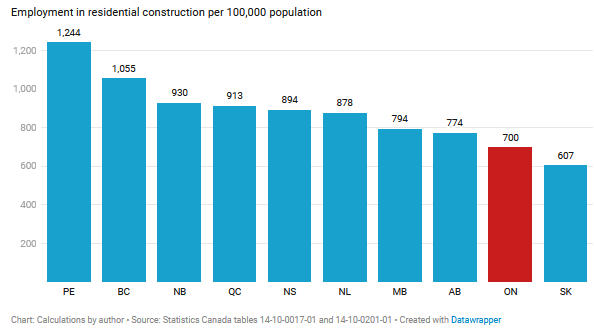 Employment in residential construction per 100,000 population Kick-starting Ontario’s residential construction sector to build thousands of much-needed new homes could create up to 30,000 jobs, an analysis of Statistics Canada jobs data shows.
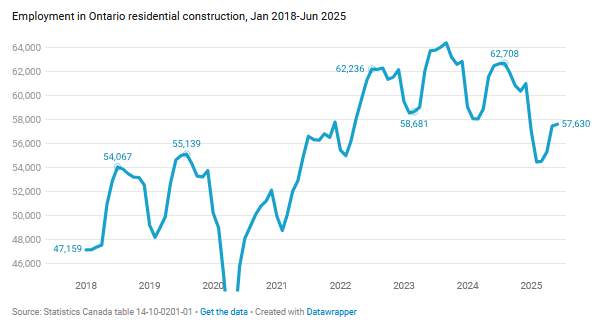
Just 57,600 workers were employed in Ontario’s residential construction sector this June, according to StatCan’s survey of employment by industry. In other provinces with better housing results, employment is much higher.
Residential construction: small and getting smaller
Residential construction employs a smaller percentage of workers in Ontario than any other province except Saskatchewan. For every 100,000 employed workers, Ontario residential construction generates just 700 jobs compared to 913 in Quebec and 1,055 in British Columbia.
An Ontario home-building strategy that developed a sector as robust as in B.C. would add over 29,200 badly-needed jobs building badly-needed housing. At Quebec levels, Ontario would have about 17,500 more jobs. Over 800,000 Ontario workers were unemployed in August.
But Ontario housing construction has gone from bad to worse. In August, only 5,100 housing units were started in Ontario, according to Canada Mortgage and Housing Corporation. That result falls far short of the 12,500 starts per month the PCs in 2021 promised their policies would deliver.
The PCs’ housing flame-out has become a big jobs killer, making Ontario’s small sector even smaller. Employment is down almost 10 per cent in two years.
In June 2025 there were 6,100 fewer jobs in the sector than June 2023 when almost 64,000 Ontarians were employed in residential construction.
Lack of building also affects jobs outside the construction sector, particularly in forestry, which is heavily reliant on providing lumber to homebuilders. But other sectors, like utilities, are also affected.
 Employment in Ontario residential construction, Jan 2018-Jun 2025 Unions quiet on jobs as PCs weaponize key training fund
Despite the job losses, significant unions in the sector appear to be self-censoring their concerns as the Ford government politicizes the Skills Development Fund (SDF) that union apprenticeship programs depend on.
The SDF has come under scrutiny after news reports of PC political meddling and grants going to private companies with a history of PC Party support. The Auditor-General has opened an investigation into the Fund.
A $17 million grant to Scale Hospitality was approved after the political intervention of an assistant to Ontario Premier Doug Ford and despite their application being submitted after the deadline and receiving a low score from bureaucrats. The assistant has since left Ford’s office, setting up a lobby firm that was then paid by Scale Hospitality.
Scale Hospitality proposed to train workers for several swanky downtown Toronto restaurants including some owned by significant PC Party donors. The $17 million project trained only 5,300 workers, according to the Ministry of Labour.
The Fund also supplied about $9 million to Canadian Niagara Hotels, whose CEO, Dino DiCienzo, has also been a generous PC Party donor. The grants raised the ire of instructors at Niagara College, which has been forced to cancel hospitality training due to Ford’s cuts to colleges. Their union, OPSEU, has publicly raised concerns the training grants to private companies are undermining the very stressed college system.
SDF cash has also gone to other private companies whose owners have deep PC Party connections.
Unions in the building and construction sector have for many years been large recipients of SDF money to operate their apprenticeship and skills programs. But the SDF’s recent politicization now puts all grant recipients at risk of political threat or manipulation by the PCs.
After OPSEU raised concern about the government’s use of SDF money to help PC campaign donors, the Labourer’s Union last week distanced itself from the criticisms, pulling out of the Ontario Federation of Labour and saying it was “nothing but bad politics” to attack the Ford government or the SDF.
 Tom Parkin is a social democratic columnist and commentator based in Toronto Tom Parkin is a social democratic columnist and commentator based in Toronto
He can be reached at: tparkin@impact-strategies.ca
By Samanthat Serle
September 23rd, 2025
BURLINGTON, ON
University life is often romanticized as a period of independence, exploration, and academic achievement. Yet, for many students, it also comes with overwhelming challenges that can affect academic performance, mental health, and overall well-being. The transition from high school to university requires students to adapt to new environments, academic rigor, and personal responsibilities, often all at once. Understanding these challenges – and more importantly, how to overcome them – can help students make the most of their university experience.
This article explores the top challenges university students face today and provides practical strategies to overcome them.

1. Academic Pressure and Workload
The Challenge
One of the most significant struggles students encounter is adjusting to the intense academic demands of university. Unlike high school, where assignments are spread out and teachers often provide reminders, university coursework is more self-directed. Students juggle multiple subjects, extensive reading lists, research papers, projects, and exams – all while meeting strict deadlines. This pressure to succeed can be overwhelming for many, leading them to seek support. It’s not uncommon for students to turn to services when they need to get quality paper writing help to ensure their work meets academic standards.
Many students feel overwhelmed by the volume of work and the high expectations placed on them. This pressure can lead to stress, burnout, or even academic failure if not managed effectively.
How to Overcome It
- Time Management: Use planners, digital calendars, or task management apps to prioritize tasks and avoid last-minute cramming.
- Break Work Into Smaller Tasks: Dividing big projects into smaller steps reduces anxiety and makes progress more visible.
- Seek Academic Support: Most universities offer writing centers, tutoring, and study workshops. Taking advantage of these resources can ease the burden.
- Study Smart, Not Just Hard: Techniques like active recall, spaced repetition, and summarizing notes can improve retention and reduce study hours.
2. Financial Stress
The Challenge
For many students, university represents their first real encounter with financial independence. Tuition fees, textbooks, housing, food, and transportation can add up quickly, leaving students stressed about money. Many resort to part-time jobs, which, while helpful financially, can interfere with academic focus. International students, in particular, face additional expenses like higher tuition and visa costs.
How to Overcome It
- Budget Wisely: Track expenses and set spending limits for non-essential items. Free budgeting apps can simplify this process.
- Apply for Scholarships and Grants: Universities, governments, and private organizations often provide financial aid opportunities.
- Work Strategically: If part-time work is necessary, choose flexible jobs on or near campus that won’t heavily interfere with studies.
- Learn Basic Financial Literacy: Understanding credit, debt, and savings can help students avoid common financial pitfalls.
3. Mental Health and Stress
The Challenge
University students often face high levels of stress, anxiety, and depression. Pressure to succeed academically, maintain social relationships, and plan for the future can feel overwhelming. According to numerous studies, mental health issues among students have increased in recent years, partly due to academic pressures and the lingering effects of the pandemic.
How to Overcome It
- Prioritize Self-Care: Regular exercise, adequate sleep, and balanced nutrition are essential for mental well-being.
- Seek Counseling Services: Most universities provide free or low-cost counseling. Talking to a professional can help students navigate stress and anxiety.
- Build a Support Network: Having friends, mentors, or family members to talk to reduces feelings of isolation.
- Practice Mindfulness: Techniques like meditation, journaling, or deep breathing exercises can help regulate stress.
4. Adapting to Independence and Responsibility
The Challenge
For many students, university is the first time they live away from home. Suddenly, they must manage their own meals, laundry, finances, and schedules – on top of academic obligations. The sudden independence can feel liberating but also daunting, especially when poor organization leads to missed deadlines or unhealthy routines.
How to Overcome It
- Create Routines: Establishing consistent habits around studying, eating, and sleeping helps maintain balance.
- Set Realistic Goals: Break large responsibilities into smaller, manageable ones. For example, start with meal prepping one or two times per week.
- Ask for Guidance: Universities often provide workshops on adulting skills like budgeting, cooking, and time management.
- Learn from Mistakes: Struggles are part of growing into independence – view them as lessons rather than failures.
5. Social Adjustment and Loneliness
The Challenge
Moving to a new environment often means leaving behind established social circles. For many students, especially those studying abroad, building new friendships can be intimidating. Cultural differences, language barriers, and social anxiety can make it harder to connect, and students may feel isolated or lonely as a result.
How to Overcome It
- Join Clubs and Societies: Universities offer a wide range of student organizations, from sports teams to cultural groups, which provide opportunities to meet like-minded people.
- Attend Social Events: Freshers’ week, campus fairs, and academic seminars are excellent ways to build connections.
- Use Peer Support Programs: Some universities assign mentors or peer buddies to help new students adapt.
- Stay Connected With Home: Maintaining communication with family and old friends can provide comfort during tough times.

6. Balancing Work, Study, and Personal Life
The Challenge
Many students take on part-time jobs to support themselves financially. Others engage in extracurricular activities, internships, or volunteer work to boost their resumes. While these commitments are valuable, they can lead to exhaustion when combined with coursework and personal obligations.
How to Overcome It
- Set Priorities: Decide what’s most important at any given time – sometimes academics may need to come first, while other times personal well-being takes priority.
- Use Scheduling Tools: Color-coded calendars can visually separate work, study, and personal activities.
- Learn to Say No: Overcommitting can lead to burnout. Choose activities that align with your goals and values.
- Build Downtime Into Your Schedule: Rest and leisure are just as important as productivity.
7. Career Uncertainty and Pressure About the Future
The Challenge
University is not just about academics – it’s also about preparing for the future. Many students feel anxious about career prospects, especially with competitive job markets and rising expectations for internships and experience. Uncertainty about whether their chosen field will lead to stable employment can add extra stress.
How to Overcome It
- Use Career Services: Universities often provide resume reviews, career counseling, and networking events.
- Pursue Internships: Practical experience not only builds resumes but also gives students insights into potential careers.
- Stay Flexible: Career paths are rarely linear. Keeping an open mind helps students adapt to changing opportunities.
- Network Early: Building professional connections through alumni, professors, and LinkedIn can open doors to opportunities later.
8. Cultural and Language Barriers (For International Students)
The Challenge
International students often face additional hurdles, including adapting to new cultures, learning in a second language, and managing homesickness. These challenges can impact both academic performance and social integration.
How to Overcome It
- Participate in Orientation Programs: These are designed to help international students adapt to local customs and campus life.
- Improve Language Skills: Enroll in language workshops or use language-learning apps.
- Seek Community: Joining cultural clubs or international student groups can create a sense of belonging.
- Stay Connected Globally: Regular calls with family and friends can ease homesickness while fostering cross-cultural resilience.
Conclusion
University is a transformative stage of life, filled with opportunities for growth, learning, and self-discovery. However, it also presents real challenges – academic pressure, financial stress, mental health struggles, independence, social adjustment, and career uncertainty. By acknowledging these obstacles and adopting proactive strategies, students can not only survive but thrive during their time at university.
The key lies in balance: balancing work with rest, independence with support, and ambition with self-compassion. University is not just about achieving a degree – it’s about building resilience, acquiring life skills, and preparing for a fulfilling future.
 By Ray Rivers By Ray Rivers
September 20th, 2025
BURLINGTON, ON
OPINION
After Dalton McGuinty was elected in 2003, one of the first things his government did was to develop Canadian/Ontario-made renewable energy. Solar systems were as much as 80% Canadian made. Canadian Solar, a private company established in 2001 became a global leader in renewable energy, and still is today.
 There are thousands of small solar panel installations like this across the province – they work very well and in many cases provide revenue for the owners. The solar panels for Ontario’s systems were manufactured largely by Canadian Solar in Guelph Ontario and the steel frames were locally sourced. Unfortunately McGuinty was accused of breaking international trade rules by demanding in-province manufacturing. The Harper government, who never supported renewable energy, presumably pressured McGuinty to discard his buy Ontario policies as violating GATT international trading rules (General Agreement on Trade and Tariffs).
Some twenty years later, GATT and it’s successor WTO (World Trade Organization) have become a sad joke. The so-called leader of the free world imposed tariffs and other trade restrictions willy-nilly to suit his mood of the day. He imposed 50% tariffs on everything Brazilian because his buddy there had been convicted for trying to stage a coup – ironically what Trump is alleged to have attempted on January 6th 2001.
 Canadian steel mills are among the best in the world. Keeping them alive is a critical part of realigning the Canadian economy. So Canada’s new prime minister is pushing ahead with a broad-based buy Canada policy. The steel industry hopes that this could move Canadian content of their products to 80% from its current 30% and help offset Trump’s whacking big steel tariffs. Carney is hoping for the buy Canadian policies to be in place by next year at the latest.
 The true story behind this photograph is yet to become public. Prime Minister Mark Carney with Chrystia Freeland as she ends her political career. Her memoirs should be fascinating. But a good place to start would be cancelling the loan the federal infrastructure bank is giving the BC government to purchase four Chinese built ferries. Shame on Premier Eby for not getting the message. He was one of the loudest critics of Trump’s tariffs yet allowed BC ferries to develop an acquisition tender which effectively excluded Canadian ship builders. There is an email trail indicating that Chrystia had almost gone almost postal with rage about the Chinese aspect of this project. Perhaps that why she thought it a good time to leave.
No premier made more noise about against the tariffs than Ontario’s Doug Ford. But his highest priority has long been to build an American led mini-nuclear facility. And once built it will require a steady diet of imported American enriched nuclear fuel for its twenty or thirty year life cycle. That is if it even lasts that long. It is first off the block with untested technology and expected to generate more nuclear waste than the current Candu reactors. No other nation is interested in this kind of reactor- why is Ford?
 Doug Ford’s highest priority has long been to build an American-led mini-nuclear facility. And this experiment will take longer to get into production and will cost an estimated two to eight times more per kWh than the renewable wind and solar Ford killed in his first term. So one has to wonder why Mark Carney would even allow this pig of a project to make into the first five major projects for consideration under Bill C5.
Perhaps Carney is catering to these premiers just in the interests of keeping them onside. I mean they talk a good story about buying Canadian but are full of it when it comes to walking the talk, Still, sucking up to these hypocrites may keep Carney in their favour for the short run but risks destroying his credibility and our national unity in the longer term. Just tell them no!
 Ray Rivers, a Gazette Contributing Editor, writes regularly applying his more than 25 years as a federal bureaucrat to his thinking. Rivers was once a candidate for provincial office in Burlington. He was the founder of the Burlington citizen committee on sustainability at a time when climate warming was a hotly debated subject. Ray has a post graduate degree in economics that he earned at the University of Ottawa. Tweet @rayzrivers Ray Rivers, a Gazette Contributing Editor, writes regularly applying his more than 25 years as a federal bureaucrat to his thinking. Rivers was once a candidate for provincial office in Burlington. He was the founder of the Burlington citizen committee on sustainability at a time when climate warming was a hotly debated subject. Ray has a post graduate degree in economics that he earned at the University of Ottawa. Tweet @rayzrivers
Background links:
Big Five Projects Canadian Solar BC Ferries Eby Complaint Ford’s Folly –
By Norma Williamson
September 19th, 2025
BURLINGTON, ON
Withdrawing money from an online casino shouldn’t feel mysterious or complicated. When properly done, it is safe, transparent, and quick. The following guide shows exactly how to withdraw money from online casino platforms safely. This article covers everything from verifying your account to optimizing for speed, avoiding pitfalls, and choosing the best options based on your goals.
Understanding the Basics
When wondering how to withdraw money from online casino, the first step that you need to take is visiting the websites cashier or banking system. In most cases you’ll need to:
Ensure your casino is registered and controlled in reputable jurisdictions such as Malta, the UK, or Gibraltar. For extra peace of mind, check trusted industry media, where operators are reviewed and unreliable ones are flagged.
How big online gambling has grown: by 2025, almost 1 in 5 adults around the world will have placed Internet bets, almost 882 million people, many of them mainstream and with real-world impacts.
For players starting with small stakes, spending less upfront can still offer full withdrawal flexibility, consider trying a casino 5$ deposit site and platform. These sites usually allow you to deposit with only five dollars, entertain, and test casino websites while spending very little money.
E-wallets also make it easier to manage your gambling budget, keeping funds separate from daily expenses, a big help for responsible play.
Skill vs. Chance
 Slots are purely luck. Although withdrawing money is a matter of logistics and not a game on its own, by wise game selection you can win. The game Slots relies mostly on luck; playing games such as poker or blackjack leaves the potential to play a strategy. No matter which you choose, it is important to know the terms of bonuses and what is required to be bet; at most casinos, you cannot withdraw money until you roll over the bonuses.
Remember:
- There are withdrawal limits that could restrict the maximum cash out that you could have on a day or any amount on a monthly basis.
- The charges of processing can consume your earnings; read conditions.
- The initial minimum withdrawal monitoring tends to be 20-50 dollars according to method.
Budget and Time Commitment
Establish some restrictions for yourself: set a limit (this could be $100 in winnings) at which you will cause yourself to withdraw in order to mold it into a habit, not something you think about at the end of the day. This helps avoid rashly reinvesting. Players with even tighter budgets often begin on 3$ deposit casino platforms, where they can try out their Lady Luck. You’ll be amazed by the fun you’ll have with only three bucks. These platforms provide Canadian and other gamblers with a great experience.
Long-Term Profitability
Online casinos run on the house edge, and one is not assured to make uninterrupted profit. You can maximize returns, however, by:
- Preferring high RTP (Return to Player) slots.
- Withdrawing, such as using a method that does not charge a withdrawal fee.
- Doing profit extraction rather than reinvesting it.
Choosing What Suits You Best
Which is the best withdrawal procedure to use will depend on your priorities regarding the type of speed you wish, the level of security, convenience, and cost. E-wallets, such as PayPal or Skrill, are usually the most convenient in case you cherish gaining immediate access to your winnings. They are popular with many players, as transactions can be handled in a span of 24 hours and separate casino money and regular living expenses. Keep in mind, bank transfers are the best way to go when the recipient desires the best possible security and is not in a hurry to receive the money. They will typically take 2-7 days of business; however, they are very reliable and universally accepted.
 Bear in mind that cryptocurrencies vary in value, so your withdrawal can also gain or be lost before it finds its place in your wallet. Ensuring that you play with crypto is becoming more popular among tech-friendly players. Transactions can clear within less than an hour at certain platforms, an experience that is unmatched in speed. Nevertheless, it is important to bear in mind that cryptocurrencies vary in value, so your withdrawal can also gain or be lost before it finds its place in your wallet.
Statistics will also reveal that tastes differ: although a significant portion of deposits is still carried out through bank transfer, e-wallet withdrawals are also increasing more and more due to the convenience they offer. It is a shrewd consideration to choose a way that fits your lifestyle; that is, whether it is focusing on instant or minimal fees or just sticking with the time-tested traditional banking. However, eventually, the best choice is the choice that will leave you in control of your wins.
To learn more, you could read regulatory reports by agencies such as the UK Gambling Commission or find out independent media sources like Burlington Gazette, where you can find additional information about your preferred topics.
Final Word
Learning how to withdraw money from online casino safely is just as important as understanding how to play the games themselves. It is a thrill only after the money ends up in your hands and you feel that the victory is all yours. With the right withdrawal technique and the cautious consideration of boundaries and charges, you preserve every penny and every tranquillity of mind.
Various players will instinctively tend to respond to various options. E-wallets are fast, bank transfers are reliable, and crypto is creative and efficient. The most important thing is to match the process of withdrawal to your own choices, whether it is to gain money as fast as possible, have maximum security, or spend less.
It is also important to draw boundaries for yourself. Having a sense of responsible gambling involves more than planning deposits. Now that online gambling has become a worldwide event where hundreds of millions of people take part in it, effective withdrawal strategies can make the process more enjoyable, harmless, and quite easy. In conclusion, the most important ingredients are knowledge and discipline; that is, these two items will make your gaming fun and your income guaranteed.
By Burlington Gazette
September 17th, 2025
BURLINGTON, ON
What can women who aspire to become chief executive officers (CEOs) in America’s “Bible Belt” expect from their careers?
“Traditional theories suggest religion reinforces patriarchal norms, potentially limiting women’s rise to the top,” says Brock University Professor of Accounting Samir Trabelsi.
 But Trabelsi and his team turned that stereotype on its head in their study, “Religiosity and Gender Dynamics in Executive Leadership: Impact on CEO Appointments and Pay Disparities,” published June 1 in the Journal of Business Ethics. But Trabelsi and his team turned that stereotype on its head in their study, “Religiosity and Gender Dynamics in Executive Leadership: Impact on CEO Appointments and Pay Disparities,” published June 1 in the Journal of Business Ethics.
Trabelsi and then-master’s student Maryam Vashahi (MSc ’23), the study’s co-author, found no significant relationship between local religiosity and the appointment of female CEOs.
Even more surprising, the researchers say, is that women who become CEOs in highly religious states earned more than their male peers.
“Women continue to be significantly underrepresented in CEO positions, making it essential to understand the factors that either create barriers or open pathways for their advancement,” says Vashahi.
The team analyzed 2,936 CEO transitions in U.S.-listed firms between 1998 and 2021 along with religiosity measures from the Pew Research Center.
Religiosity is defined as being the expression of beliefs and practices in institutionalized religion and their influence on social behaviours and cultural norms in local settings.
The researchers expected that firms in states with stronger religious cultures would be less likely to appoint women CEOs, and that if women did attain the role, they would earn less than men.
 Instead, the findings revealed an “exceptionalism premium,” says Trabelsi. Instead, the findings revealed an “exceptionalism premium,” says Trabelsi.
“Because female CEOs are rare in these environments, they’re seen as extraordinary and are compensated accordingly,” he says.
The study also revealed a paradox: women CEOs continued to be paid less than their male counterparts in more secular states.
“We suggest some firms may promote women to signal diversity but fail to back that up with equitable pay, a practice sometimes described as performative diversity,” says Trabelsi.
He also points out that both male and female CEOs in religious states earned less overall than their peers in secular states.
“So even though a woman CEO might out-earn a man in Alabama or Mississippi, she’s still likely earning less than a woman CEO in California or New York,” he says.
Another key finding was that companies with more women on their boards were significantly more likely to appoint a woman CEO, underscoring governance as a powerful lever for equity, he says.
 There was a time when shares of public companies were traded in this building.. There was never a single woman on the trading floor. Changes do take place – even in the American Bible Belt. In Canada, Trabelsi says only about five per cent of TSX-listed companies had a woman CEO as of 2024, and Canadian women executives still earn about 40 per cent less in total compensation than their male counterparts on average.
“From a governance perspective, Canadian regulators and boards could strengthen diversity and pay equity initiatives — for example, through enhanced transparency and leadership diversity targets — to help more women reach CEO roles and ensure they are compensated fairly once there,” he says.
Trabelsi says the research team, which also included Professor of Organizational Behaviour and Human Resource Management Dave Bouckenooghe and Professor of Accounting Kareen Brown, hopes the study will spark broader conversations about governance and gender equity.
“Breaking the glass ceiling is only the first step,” he says. “The real challenge is ensuring women are supported, compensated fairly and empowered once they get there.”
By Diana Kharchenko
September 17th, 2025
BURLINGTON, ON

Researchers in multiple countries are advancing stem cell trial research aimed at repairing the inner ear to restore hearing in people with tinnitus and neural hearing loss. The initial research investigations aim to determine if cochlear hair cells, which transform sound into brain signals, can be regenerated.
The 2022 JAMA Neurology review established that tinnitus impacts 14.4% of adults worldwide, resulting in more than 740 million cases, while severe tinnitus affects 2.3% of the population (JAMA Neurology). The available treatments, including hearing aids and cochlear implants, and sound therapy, provide symptom relief, but they cannot restore typical hearing function.
Researchers at Harvard Medical School’s Mass Eye and Ear used a drug-like cocktail to stimulate hair cell regeneration in mice, which shows promise for human clinical applications.
Dr. Zheng-Yi Chen from Harvard Medical School’s Otolaryngology-Head & Neck Surgery department described hair cell regeneration in the inner ear as the ultimate goal of hearing research. The research shows that clinical applications are possible for the future (Harvard Medical School).
Advances in Regenerative Research
Tinnitus and many forms of neural hearing loss result from damage to cochlear hair cells or their neural connections. The therapy with mesenchymal stem cells (MSCs) works to establish a supportive environment for the body’s repair mechanisms by delivering growth factors and enhancing immune responses and microcirculation.
Traditional treatments, including hearing aids and cochlear implants, and medications, help millions of people, but they cannot fix the complete damage to the ear.
Dr. Chris Cunningham from the University of Pittsburgh (Eye & Ear Foundation) explained that these devices bring revolutionary life-changing benefits, yet they cannot restore normal hearing completely.
Many stem cell trial programs now focus on MSCs, adult multipotent stromal cells sourced from a patient’s tissue or donated placental and umbilical cord tissue. MSCs avoid the ethical concerns associated with embryonic stem cells and have a lower risk of immune rejection.
According to reviews in Frontiers in Cellular Neuroscience (Warnecke et al., 2021) and Molecular Biology Reports (2020), MSCs have been shown to reduce inflammation, protect nerve cells, repair synaptic connections, and promote new blood vessel growth to improve circulation.
Global and Clinical Perspectives
 Scientists throughout the world continue to study cell-based hearing loss treatments in laboratories and clinics because they share a common goal of developing treatments that surpass symptom relief. Beyond university laboratories, some private clinics are also exploring regenerative approaches for tinnitus and neural hearing loss. The European clinic Swiss Medica operates among multiple facilities that provide stem cell therapy for tinnitus through MSCs. The clinic explains that these treatments work to decrease inflammation while defending auditory nerve structures and promoting tissue regeneration.
The U.S. medical institution AdventHealth initiated a Phase I/II clinical trial to evaluate autologous umbilical cord blood infusion for treating acquired hearing loss in children while focusing on safety and practicality. The MHRA granted approval to Rinri Therapeutics in 2025 for starting human trials of Rincell-1, which functions as a regenerative cell therapy to fix damaged auditory nerves.
Scientists throughout the world continue to study cell-based hearing loss treatments in laboratories and clinics because they share a common goal of developing treatments that surpass symptom relief.
Future Outlook
While early results are encouraging, experts emphasise that stem cell therapies for hearing disorders remain experimental.
According to a systematic review in the International Journal of Otolaryngology and Head & Neck Surgery (Ganchi, 2025), stem cell therapy shows promise for potentially curing congenital hearing loss via cochlear regeneration. However, significant hurdles in protocol development, long-term efficacy, and safety must still be addressed.
Conclusion
Recent developments in stem cell trials are shifting the treatment of tinnitus and neural hearing loss toward addressing the underlying damage rather than just managing symptoms. While still in trials, these regenerative therapies could significantly change the landscape of hearing restoration.
 By Steve Simons. By Steve Simons.
September 15th, 2025
BURLINGTON, ON
 Random Number Gaming uses a mathematical algorithm to generate random numbers that determine what happens in the game, ensuring events are not entirely predictable and keeping gameplay fresh. RNG is crucial for creating engaging experiences, though its implementation can be debated, affecting a player’s fun, skill ceiling, and the overall perceived fairness of a game. The iGaming industry has always thrived on innovation, and hybrid games are the latest evolution, reshaping the way players engage with online casinos. Sitting at the crossroads of RNG mechanics and live host interaction, hybrid titles blend the efficiency of automated gameplay with the social and immersive qualities of human presentation.
Unlike traditional RNG games, which rely solely on algorithms to generate outcomes, hybrid formats introduce a host or presenter into the experience, creating a balance between speed, fairness, and human engagement. This approach reflects a growing demand for more interactive casino content, Winshark Casino is one of those operators that invests a lot resources into hybrid games. Hybrid games are popular particularly among younger audiences who are accustomed to video game dynamics and real-time entertainment.
Hybrid gaming represents a broader industry shift toward experiences that feel both digital and human at once, reflecting the convergence of technology, entertainment, and social interaction.
How Hybrid Games Work
At the core of hybrid online casinos is the Random Number Generator (RNG), which ensures that outcomes are determined with complete fairness and speed. This automated system drives the mechanics behind spins, card draws, or roulette results, making gameplay scalable and efficient for operators while maintaining the integrity of results.
What sets hybrid games apart is the addition of a live host. Instead of a purely digital interface, players are guided through the session by a presenter who explains the rules, builds anticipation, and reacts to outcomes in real time. The host doesn’t influence the results but acts as a bridge between the cold logic of algorithms and the warmth of human interaction.
This dynamic creates a middle ground between traditional live dealer studios, which can be resource-intensive, and fully automated RNG games, which sometimes lack atmosphere. By combining both, hybrid titles deliver:
- Efficiency – RNG ensures fast gameplay cycles without delays.
- Engagement – live presenters add personality, humor, and interaction.
- Scalability – one host can engage thousands of players simultaneously, unlike conventional table limits.
The result is an experience that feels both authentic and entertaining: fast like a digital slot, yet social like a live dealer table.
Benefits for Players
 Hosts behind a live game are personalities who interact with the players. One of the biggest advantages for players is the transparency and trust. Hybrid games bring together the best of both worlds, creating an experience that feels fair, exciting, and dynamic for players.
One of the biggest advantages is transparency and trust. Having a live host present throughout the game reassures players that the process is authentic and transparent. Even though the outcomes are still determined by RNG technology, the human presence builds credibility and reduces the sense of playing against a faceless machine.
For players, the combination translates into:
- Authenticity – the host explains results and keeps the game moving.
- Speed – RNG guarantees rapid outcomes and short rounds.
- Variety – hybrid mechanics allow for innovative features and side bets.
- Immersion – players enjoy both the social aspect and game efficiency.
In essence, hybrid formats address two common player demands simultaneously: the reassurance of human interaction and the excitement of fast, seamless digital gameplay.
Industry Impact
How does RNG work in slots? The rise of hybrid games signals a strategic shift for the iGaming industry, as operators expand their portfolios beyond the familiar categories of RNG slots and classic live tables. By merging RNG-driven speed with interactive hosting, providers are creating entirely new verticals that don’t neatly fit into existing definitions of casino content.
For operators, hybrid titles offer a way to differentiate their platforms in an increasingly competitive market. Unlike traditional table games, hybrids can scale more efficiently, appeal to broader demographics, and introduce unique mechanics that keep players engaged for longer sessions.
The result is a redefinition of what hybrid online casino gameplay can look like: faster than live, more social than RNG-only, and versatile enough to capture players across multiple demographics.
Challenges
While hybrid games present clear opportunities, their adoption also comes with notable challenges.
 The first is technical complexity and higher operational costs. Developing a platform that integrates RNG outcomes with live host presentation requires sophisticated infrastructure, seamless streaming capabilities, and careful synchronization between automated systems and human interaction. Compared to pure RNG games, hybrid titles demand more resources to produce and maintain, making them a heavier investment for operators. The first is technical complexity and higher operational costs. Developing a platform that integrates RNG outcomes with live host presentation requires sophisticated infrastructure, seamless streaming capabilities, and careful synchronization between automated systems and human interaction. Compared to pure RNG games, hybrid titles demand more resources to produce and maintain, making them a heavier investment for operators.
Another hurdle lies in player education. Many users are already familiar with the distinction between slots (pure RNG) and live dealer tables (human-run gameplay). Hybrid games occupy a middle ground that can be confusing at first. Operators must clearly communicate that the outcomes are RNG-driven while the host’s role is to enhance engagement, not influence results. Without this transparency, players may misinterpret the format or feel skeptical about its fairness.
In addition, operators must strike the right balance between innovation and accessibility. Overly complex mechanics may deter casual players, while oversimplified formats risk losing the interactive edge that makes hybrids unique.
Conclusion
Hybrid games are quickly moving from experimental concepts to a growing trend shaping the future of iGaming. By blending the digital efficiency of RNG mechanics with the human touch of live hosts, they deliver a format that is both scalable and engaging.
For players, this means faster gameplay cycles without sacrificing trust or authenticity. For operators, hybrids open up new categories beyond slots and traditional tables, appealing to casual players and high-engagement audiences alike.
As technology continues to advance and audiences seek more immersive, interactive forms of entertainment, hybrid games are well-positioned to become a cornerstone of the modern online casino portfolio, bridging the gap between automation and human connection.
By Raymond Baylor
September 15th, 2025
BURLINGTON, ON
 Nearly nine out of ten Canadians rely on Interac to handle their day-to-day spending. It has become second nature to use the payment network for groceries, gas, coffee, rent transfers, and even government payments. The network moved more than 20 million transactions a day in 2024 alone, with the Interac e-Transfer option processing 1.4 billion payments in the same year. Interac works as a vital component of Canada’s financial sector in addition to providing individuals and businesses with a reliable, but convenient payment option. Nearly nine out of ten Canadians rely on Interac to handle their day-to-day spending. It has become second nature to use the payment network for groceries, gas, coffee, rent transfers, and even government payments. The network moved more than 20 million transactions a day in 2024 alone, with the Interac e-Transfer option processing 1.4 billion payments in the same year. Interac works as a vital component of Canada’s financial sector in addition to providing individuals and businesses with a reliable, but convenient payment option.
Its reach goes much further than your local checkout counter. Interac works as a payment method throughout various sectors, including retail businesses, online gaming platforms, and even betting operations. Views shared by Esports Insider on Interac casinos reveal how online casinos now support the payment network for deposits and withdrawals. The system provides players with easy access and includes fast deposit options, withdrawal services and encryption-based fraud protection.
 The platform is considered one of the most dependable systems for performing online transactions. The service does have some advantages, including fast transactions and low fees, but users could be limited by some drawbacks. This could include delayed cashouts, limited access to Canadian residents, and reduced international support compared to credit cards. Despite this, the platform is considered one of the most dependable systems for performing online transactions.
User trust in Interac is perhaps one of the biggest competitive advantages for the network. Not only does it provide users with an easy-to-use interface, but the system also operates through an existing bank account. So there’s absolutely no need to create additional accounts or remember multiple passwords. People can now easily use email addresses and phone numbers as a way to send money directly to each other. This speed and simplicity do not come at the cost of security. Features like EMV chip technology, encryption, and two-factor authentication make fraud far less likely compared to cash or older card systems.
The system offers businesses the same level of convenience that users experience. Around half of Canadian companies use Interac e-Transfer, with the “Request Money” feature alone accounting for 89 million transactions in 2024. Small and mid-sized businesses have been especially quick to adopt it, with debit transactions climbing by more than 15 million in just a few months between April and July 2025 compared to the previous year. Entrepreneurs allow customers to use Interac services for easy payments while helping them steer clear of expensive credit card costs.
The product’s broad market distribution makes the system more dependable. Interac is linked to almost every Canadian bank, supported by roughly 60,000 ATMs, and accepted at about 450,000 business locations nationwide. Online checkout systems now integrate Interac payment methods with mobile payment options like Apple Pay and Google Pay. This allows customers to perform instant bank-to-merchant transactions without sharing their card information. Government agencies like the Canada Revenue Agency also accept Interac, proving its widespread use in daily financial operations.
 Canadians continue to place their trust in Interac, proof that reliability matters more when it comes to money. There are limits to the service, though. Interac has daily spending limits, which prevent some small businesses from using it for payments. For example, real estate transactions would be limited, preventing you from using Interac to buy a home. This limits, if not restricts, higher limit transactions. Instead, users are required to settle for cheques or wire transfers. International merchants usually won’t accept it unless the card is co-branded with Visa or Mastercard. However, those exceptions don’t change the fact that for most day-to-day spending, Interac is the go-to choice.
Interac’s position today is the result of decades of consistent use. By combining speed, security, and affordability, it has managed to stay relevant while newer payment services come and go. Whether paying for dinner, sending rent, or funding an account online, Canadians continue to place their trust in Interac, proof that reliability matters more when it comes to money.
By Louis Tasker
September 10th, 2025
BURLINGTON, ON
If you’ve ever dipped your toes into the world of online casinos—or you’re thinking about it—you’ve probably noticed just how popular online gambling has become in Canada. Canadian online casinos are booming, and for good reason, they offer convenience, a wide variety of games, and some seriously attractive bonuses.
But with so many options out there, how do you pick the right one? What makes a great Canadian online casino stand out from the crowd? This guide will walk you through the key things to look for, so you can dive in with confidence and enjoy the experience safely and smoothly.
The Rise of Online Casinos in Canada
Before we get into the “what to look for” part, let’s take a quick look at why online casinos have become so popular in Canada.
Over the past few years, online gambling has exploded in popularity. It’s estimated that millions of Canadians regularly visit online casinos. The reasons are simple: accessibility, variety, and the sheer fun factor.
 A high-end smartphone and a good internet connection are all you need. With smartphones and high-speed internet, you can now play your favorite slots, poker, or blackjack game anytime, anywhere. Plus, Canadian regulations have evolved to create a safer environment, making players feel more secure about trying their luck online.
What Makes a Great Canadian Online Casino?
Now, onto the good stuff! When choosing an online casino in Canada, here are the most important factors you should consider.
- Licensing and Regulation
This is the foundation of trust. Always make sure the casino is licensed by a reputable authority. In Canada, many casinos operate under licenses from jurisdictions like Malta, Gibraltar, or the UK, but some are also regulated by provincial bodies.
A licensed casino means it meets strict standards for fairness, security, and responsible gaming. It also means your money and data are protected.
- Game Selection
 Classic slots and live roulette are offered on many gambling web sites.  Variety is the spice of online casinos. Look for a platform that offers a wide range of games—from classic slots and table games like blackjack and roulette to live dealer options and specialty games. Variety is the spice of online casinos. Look for a platform that offers a wide range of games—from classic slots and table games like blackjack and roulette to live dealer options and specialty games.
Some Canadian casinos partner with top game developers like Microgaming, NetEnt, or Evolution Gaming, which is a great sign of quality and variety.
- Bonuses and Promotions
Who doesn’t love a good bonus? Canadian online casinos often offer bonuses such as welcome bonuses, free spins, and ongoing promotions.
But don’t just chase the biggest bonus—read the terms carefully. Pay attention to wagering requirements, game restrictions, and expiry dates. The best casinos have fair and transparent bonus policies.
- Payment Options
Canada is a diverse country with many payment preferences. The top casinos offer multiple safe and convenient options like Interac e-Transfer, credit/debit cards, e-wallets (PayPal, Skrill), and even cryptocurrencies.
Look for casinos with safe payment options and also quick withdrawal times and reasonable limits.
- Mobile Compatibility
Chances are you’ll want to play on your phone or tablet at some point. The best Canadian online casinos have mobile-optimized websites or dedicated apps that offer a seamless experience without sacrificing game quality or functionality.
- Customer Support
Good customer support is a hallmark of a trustworthy casino. Look for 24/7 live chat, email, and phone options. Responsive, friendly, and knowledgeable support can make a huge difference if you ever run into issues.
- Security Measures
Your data and money need to be safe. Top casinos use strong encryption technology (like SSL) to protect your information. They also have clear privacy policies and robust fraud detection systems.
- Responsible Gambling Features
Responsible gaming is taken seriously in Canada. Look for casinos that provide tools to help you stay in control, like deposit limits, self-exclusion options, and links to gambling help organizations.
 Find a platform that fits your style and keeps your experience fun and safe. Why Canadians Love Online Casinos
It’s not just about convenience. Canadians appreciate online casinos for the variety, the community, and the ability to try new games risk-free thanks to demo modes and free spins.
And with legal clarity improving, more Canadians feel confident about playing online, making the market more vibrant than ever.
Wrapping It Up
Choosing the right Canadian online casino might seem daunting at first with so many choices, but focusing on licensing, game variety, payment methods, and customer support will help you find a platform that fits your style and keeps your experience fun and safe.
Remember, online gambling is meant to be entertaining. Always play responsibly and set your limits.
 By Stephen Atcheler By Stephen Atcheler
September 9th, 2025
BURLINGTON, ON
Canadian poker players seeking substantial cash game action and tournament guarantees require platforms that maintain consistent traffic at elevated stakes. The selection of an appropriate platform depends on several factors, including game availability, rakeback structures, and the depth of player pools at various stake levels. This assessment examines five platforms currently serving Canadian players with high-stakes poker options.
GGPoker Commands the International Market
GGPoker maintains the largest player pool among international poker sites accessible to Canadian players. The platform recorded 13,157 concurrent cash game seats in early 2024, establishing a benchmark that other operators have yet to approach. Current traffic data shows approximately 13,000 active cash game players on average, though seasonal variations have brought this figure to around 10,000 players during mid-2025 periods.
 During peak hours, Canadian players find over 100 tables at low and mid-stakes, with more than 20 high-stakes games running simultaneously. The platform’s market position accounts for more than half of the international online poker market. This concentration of players ensures game availability across multiple formats and stake levels. During peak hours, Canadian players find over 100 tables at low and mid-stakes, with more than 20 high-stakes games running simultaneously.
The Fish Buffet loyalty program provides returns up to 60% fixed cashback through Platinum ranks. Players accumulate Fish Buffet Points at an average rate of 100 points per dollar in rake and fees, though this rate varies based on game type, player behavior patterns, and deposit history. The highest GGPlatinum tier offers consistent 60% rakeback, positioning this reward structure among the most generous available to Canadian players.
Tournament offerings include the $1,050 GGMasters HR with a minimum $1 million guaranteed prize pool. The standard GGMasters series runs daily tournaments from $25 buy-ins up to $1,050 High Rollers, guaranteeing over $4,000,000 Monday through Saturday. The 2025 GGPoker World Festival maintained its $250 million guarantee and distributed $324.7 million across 1,419 completed tournaments.
High-stakes cash games underwent restructuring in November 2024. Games at $25/$50 blinds and above now operate as invite-only tables under an Exclusive tab. VIP games continue at $500/$1,000/$2,000 blinds for qualified players, while $10/$20 tables became publicly accessible in both PLO and NLH formats.
WPT Global Ascends Through Aggressive Market Positioning
WPT Global has transformed from a minor operator to a platform processing approximately 2,000 concurrent players. This growth trajectory placed the site in third position according to PokerScout rankings in March 2024, surpassing both IDNPoker and iPoker networks.
The platform’s expansion coincided with strategic marketing initiatives and software improvements that attracted players from established sites. Canadian players accessing WPT Global find game selection concentrated in Texas Hold’em and Omaha variants, with stakes ranging from micro limits through mid-stakes games.
WPT Global’s connection to the World Poker Tour brand provides tournament series that complement cash game offerings. The platform schedules regular events that feed into live WPT tournaments, creating pathways for online qualifiers to participate in televised events.
PokerStars Maintains Presence Despite Traffic Decline
PokerStars continues operating as a recognized platform for Canadian high-stakes players, though traffic patterns show contraction from previous peaks. The site’s cash game population decreased from approximately 4,500 players in late 2022 to about 2,000 by mid-2025, placing it at comparable levels with WPT Global.
 Concentration The platform retains advantages in game variety, offering formats beyond standard Hold’em and Omaha games. Canadian players find mixed games, draw variants, and specialty formats that smaller platforms cannot support due to limited player pools.
PokerStars’ tournament schedule includes the Sunday Million and other established series that maintain consistent guarantees. The platform’s history of hosting major championship events provides tournament players with structured paths to live events and substantial online prizes.
partypoker Serves Niche High Stakes Markets
partypoker operates within specific market segments, maintaining a smaller but dedicated player base. The platform focuses on particular geographic regions and player demographics, resulting in concentrated traffic during specific hours that align with European and North American peak times.
Canadian players on partypoker encounter a different competitive environment compared to larger platforms. The smaller player pool creates dynamics where regular players become familiar with opponents’ tendencies, potentially affecting game selection strategies.
The platform’s PowerFest series and other promotional events periodically increase traffic and prize pools. These scheduled events provide opportunities for high-stakes action beyond regular cash game offerings.
888poker Rounds Out Available Options
888poker provides another alternative for Canadian players, though its market share remains smaller than the previously discussed platforms. The site maintains operations across multiple jurisdictions, creating segregated player pools that affect game availability for Canadian users.
The platform’s Blast Poker format offers a fast-fold variant that differs from similar offerings on other sites. Canadian players seeking variety in game formats may find 888poker’s unique features worth considering, though high-stakes action occurs less frequently than on larger platforms.
Technical Considerations for Platform Selection
Platform stability affects high-stakes play where connection issues can result in substantial losses. GGPoker experienced technical difficulties during major tournaments, including problems with the rescheduled $5 million guaranteed GGMasters Anniversary event when over 12,000 players remained on Day 2.
Software policies vary between platforms regarding third-party tools. GGPoker’s Security & Ecology agreement prohibits third-party software while allowing players to download hand histories for offline review. Other platforms maintain different policies that may affect players who rely on tracking software or heads-up displays.
Fast-fold game availability provides action-oriented players with increased hands per hour. GGPoker’s fast-fold Hold’em games accommodate over 500 players during prime time at stakes from NL2 to NL200, with Rush & Cash Omaha featuring more than 500 connections around the clock.
Market Dynamics Affecting Canadian Players
The concentration of traffic on GGPoker creates both opportunities and considerations for Canadian high-stakes players. The platform’s acquisition of the WSOP brand in 2020 provided visibility that attracted players globally, contributing to current traffic levels that rarely drop below 10,000 players.
 A strong hand indeed. The geographic distribution of players affects game quality at different times. GGPoker’s analysis indicates soft traffic in cash games and tournaments except at high stakes, where world-famous regulars participate. Asian market players contribute to weaker lineups during specific hours.
Promotional campaigns influence platform selection decisions. GGPoker’s January 2025 New Year Giveaway distributed $25 million through format-specific races, daily missions, and cash drops. The WSOP Express promotion enables players to begin with $0.50 buy-ins and progress through step-based ladders toward WSOP Main Event passes worth up to $30,000.
The selection of a high-stakes poker platform requires assessment of multiple factors beyond simple traffic numbers. Canadian players must consider rakeback structures, game availability during preferred playing hours, tournament schedules, and technical reliability when choosing where to invest their bankrolls.
By Laura Fuerte
September 1st, 2025
BURLINGTON, ON
 The situation is workable sometimes, but messy. Since single-event wagering got the green light in 2021, the market has shifted fast—maybe faster than regulators planned for. What looked like a simple yes to betting turned into a maze of provincial rules, fees, and enforcement styles that don’t always match. Some provinces opened doors. Others kept the locks on. International platforms are left threading a needle between licenses, gray zones, and gaps in national policy. The situation is workable sometimes, but messy.
Provincial licensing: the operational maze
 Did the paperwork, paid the checks, and got in. Not cheaply, and not casually. Here’s the crux: every province plays by its book. Different taxes, different audits, different “do this, not that.” Ontario is the clear outlier with a structured, open program for private operators. DraftKings, FanDuel, BetMGM—names you’d expect—did the paperwork, paid the checks, and got in. Not cheaply, and not casually.
Elsewhere, the approach is entirely unique. British Columbia, Alberta, Quebec—government-run platforms rule the roost, such as PlayNow and Espacejeux. This forces a choice for sport betting canada operators: try for limited, pricey licenses where they exist, or risk the awkward “is this allowed?” lane in provinces without them. Getting coverage across the whole country requires managing several playbooks at once.
Gray market use and uneven enforcement
Plenty of Canadians still click into offshore sites. The legality of these sites varies depending on who you ask. They’re not explicitly authorized by provinces, and federal rules are not exactly crystal clear either. Some regulators push hard. Others appear to have bigger worries.
That limbo cuts both ways. Players may get weak consumer protections or no real dispute process. If money vanishes, getting help is difficult. Operators, on the other hand, may face reputational hits and possible penalties later—even if enforcement today feels light. It’s a risk calculation, not a free pass.
Consumer protection isn’t one-size-fits-all
 Without a single national standard, safety rules jump around. Ontario leans heavy on responsible gambling tools, audits, and clear disclosures. Other provinces, especially where government platforms dominate, may apply a simpler set of checks—some would say too simple. The result is that international platforms end up building different versions of the same product just to stay compliant. Without a single national standard, safety rules jump around. Ontario leans heavy on responsible gambling tools, audits, and clear disclosures. Other provinces, especially where government platforms dominate, may apply a simpler set of checks—some would say too simple. The result is that international platforms end up building different versions of the same product just to stay compliant.
Age checks add to the complications. In some provinces it’s 18, in others 19; cooling-off periods and deposit limits also shift by province. That means duplicate systems, more cost, and fewer economies of scale than operators might expect in a unified market. This is annoying. For now, it is necessary.
Sports integrity
On match-fixing and integrity, Canada mostly relies on general fraud and conspiracy laws. That likely covers many scenarios, but not all, and it leaves operators guessing where the hard lines are. Compared with places that spell out sports bribery and data misuse in detail, Canada is lighter on specifics.
So platforms build their own playbooks: data monitoring, suspicious bet alerts, cooperation with leagues. This approach works to a point. Lower-tier events and cross-border competitions are trickier, where the signals are fuzzier and oversight changes. The lack of a uniform standard makes “good enough” hard to define.
 Advertising:these can change from province to province and, occasionally, mid-season. Marketing rules and age checks: moving targets
Advertising is another patchwork. Celebrity endorsements, bonus offers, placement rules—these can change from province to province and, occasionally, mid-season. Brands trying to grow quickly may find themselves rewriting campaigns more than they expected. Verification follows the same pattern. Different legal ages, different proof, different timelines. The tech can handle it, but seamless onboarding takes a hit when every region tweaks the checklist. Now, many apps are available on both Android and iOS.
 The entire industry is regulated by provincial authorities in Canada, adding layers of complexity to the compliance process. What this all adds up to
International sportsbooks can succeed in Canada, but the road isn’t straight. Ontario offers a clear door; several other provinces keep it mostly shut. Gray-market usage lingers, enforcement is uneven, and integrity rules could be sharper. For now, the pragmatic path is careful compliance planning, province by province, with a willingness to adapt as the rules shift. This situation is not ideal. With patience and a good legal team, it is probably survivable. The entire industry is regulated by provincial authorities in Canada, adding layers of complexity to the compliance process.
By John Davis
August 26th, 2025
BURLINGTON, ON
Canada’s digital entertainment sector has experienced explosive growth, with the video game industry contributing $5.1 billion to the nation’s GDP in 2024, representing a 3% increase since 2021. This remarkable expansion occurs against a backdrop of significant youth unemployment challenges, where rates for Canadians aged 15-24 have climbed to 14.6% in July 2025, nearly triple the rate for adults over 25. The gaming industry’s success story provides a compelling counternarrative to these employment struggles, demonstrating how digital innovation can drive economic prosperity while creating high-quality career opportunities.
 The gaming industry’s success story provides a compelling counternarrative to employment struggles. The scope of Canada’s gaming exports is particularly impressive, with 88% of industry revenue derived from international markets. This export-focused approach has positioned Canada as a global powerhouse in video game development, with 821 active studios employing 34,010 people at an average salary of $102,000 annually. The industry’s resilience during economic uncertainty contrasts sharply with traditional sectors that have struggled to provide meaningful employment for young Canadians.
Parallel to the traditional gaming sector, Canada’s Igaming industry, which includes the Best Online Casinos Canada market, has also emerged as a significant economic force, representing a different facet of the broader gaming ecosystem. The igaming industry, encompassing online casinos, sports betting, and digital gambling platforms, generated $3.20 billion in gross gaming revenue in Ontario alone during 2024-25. This represents a 32% year-over-year increase, demonstrating the rapid growth of regulated online gambling markets. The igaming sector now supports approximately 15,000 jobs across Ontario, contributing substantially to provincial and federal tax revenues while providing consumers with regulated alternatives to offshore gambling platforms.
Burlington’s Strategic Position in Gaming Exports
 Burlington has emerged as a strategic location within the province’s gaming ecosystem. The city’s proximity to Toronto’s thriving tech corridor, combined with its business-friendly environment and skilled workforce, has attracted several gaming companies. While Ontario leads Canada with 276 gaming studios, Burlington has emerged as a strategic location within the province’s gaming ecosystem. The city’s proximity to Toronto’s thriving tech corridor, combined with its business-friendly environment and skilled workforce, has attracted several gaming companies seeking cost-effective alternatives to major metropolitan centers. Burlington’s economic development strategy explicitly focuses on Information & Communications Technology (ICT) as a key industry, creating an environment conducive to gaming and tech companies.
The Greater Toronto Area, including Burlington, now hosts over 300 game development studios, with the region employing approximately 7,000 people directly in video game development. This concentration has created a cluster effect, where smaller studios benefit from proximity to talent, resources, and potential partners. Burlington’s position within this ecosystem allows companies to access Toronto’s deep talent pool while maintaining lower operational costs, making it an attractive location for both established studios and emerging developers.
Revenue Statistics and Market Performance
Canada’s gaming industry revenue streams demonstrate remarkable diversity and growth potential. The sector generated $4.3 billion in total revenue in 2021, with exports accounting for 84% of this figure. By 2024, total contributions had grown to $5.1 billion in GDP impact, reflecting not just direct revenue but also broader economic effects including supply chain benefits and employee wage impacts.
The mobile gaming segment has shown particularly strong performance, with Canada hosting approximately 11.8 million mobile gamers in 2023, projected to reach 14.1 million by 2028. The broader Canadian gaming market is expected to grow at a compound annual growth rate of 12.5% from 2025 to 2030, potentially reaching $21.01 billion by 2030.
Export performance varies significantly by company size, with large companies (over 100 employees) generating more than 90% of their revenue from international markets. This export concentration has proven beneficial during domestic economic challenges, as Canadian studios can tap into global demand while operating with favorable exchange rates and competitive production costs.
The iGaming Industry Connection
 Ontario’s regulated market has expanded from 17 licensed websites to 84 gaming platforms run by 49 licensed operators. One area of Canada’s digital entertainment economy that is growing quickly is the igaming industry. Since its April 2022 launch, Ontario’s regulated market has expanded from 17 licensed websites to 84 gaming platforms run by 49 licensed operators. Over 1.1 million player accounts are currently active on the market, and in Q2 of 2024–2025, the average monthly spending per account was $308.
Since many traditional gaming companies are looking into opportunities in the igaming space, this growth has important ramifications for them. Traditional video game development skills and the technical know-how needed to create online casino games, sports betting platforms, and associated digital gambling products are very similar. By utilizing their current technological capabilities and gaining access to new revenue streams, Canadian studios are expanding their portfolios to include igaming products for global markets.
The regulatory framework established in Ontario has created a template for other provinces, with Alberta preparing to launch its licensed igaming market in late 2025. This expansion will likely create additional opportunities for Canadian gaming companies to develop products for domestic and international igaming markets.
Strategic Advice for Aspiring Gaming Exporters
Companies entering the gaming export market should focus on several key strategies based on successful Canadian examples. First, building strong technical capabilities while maintaining lean operational structures has proven effective for companies like Tiny Titan Studios, which grew from a one-person operation to 25 employees while maintaining low overhead costs.
Market research and targeted expansion represent critical success factors. Aspiring exporters should utilize resources like the Trade Commissioner Service to identify international opportunities and build relationships with foreign partners. The Canadian government’s Creative Export Canada program offers funding for projects that forecast generating export revenues, providing financial support for market entry activities.
Building development capabilities across multiple platforms is essential, as mobile gaming continues to drive market growth. Companies should invest in cross-platform development skills,
 Opportunities for new entrants remain strong, particularly for companies that can combine technical innovation with effective international market development strategies. Financial planning should emphasize sustainable growth over rapid expansion. Technical specialization in high-demand areas such as multiplayer gaming, live services, and cross-platform development can provide competitive advantages in export markets.
The combination of government support, technical expertise, and strategic market focus has positioned Canada as a leading gaming export nation. As the industry continues to grow and diversify, opportunities for new entrants remain strong, particularly for companies that can combine technical innovation with effective international market development strategies.
 By John Tomase, Editor at LinkedIn News By John Tomase, Editor at LinkedIn News
August 26th, 2025
BURLINGTON, ON
 Are these things still used? Working a 9-to-5 used to mean those exact hours, but the post-pandemic time clock has been scrambled. Prompt arrival is a must, The Wall Street Journal reports, yet when to punch out is flexible. It could be “productivity theater” to please an early-bird boss who tends not to notice when later tasks are performed at home. Compared with 2019, workers are leaving the office an average of 13 minutes earlier in New York and 26 minutes earlier in San Francisco, according to commercial real estate company JLL.
Linda O’Neill : My first reaction reading this was: We are sometimes so silly about the things we pay attention to and judge.
 Slipping out just a little early – a new trend? This WSJ piece highlights one of those funny-but-true dynamics in the modern workplace: we’re more comfortable leaving the office early than arriving late. Even if both scenarios balance out in hours and productivity, the optics feel different. It’s a reminder of how much “productivity theater” still shapes our work habits—and how much of it is driven by perceptions, not actual output.
Have you ever caught yourself adjusting your schedule not for efficiency, but for appearances?
At Vigilant we’re still fully remote, so this is not an issue. I’m curious about the experience of others.
|
|