BY Tom Parkin BY Tom Parkin
February 5th, 2026
BURLINGTON, ON
Air travel to USA hits new low in December: 161,000 fewer air passengers to the USA in December 2025 than the same month a year before.

December is always a strong month for Canadian travel to international destinations as the snow starts to fly and the holiday season unites families across boarders.
But for those with family in the United States, it may have been a year for them to come north, as Trump’s domestic chaos and violence, his new and invasive border rules and his threats against Canada each month get worse.
And while Canadians escaping the cold may have enjoyed temperatures in Florida or Arizona in the past, Mexico and the Caribbean have the quaint charm of not being ruled by madman.
In December 2025, just 41 per cent of passengers screened for international travel were heading to the United States, the lowest percentage since at least 2019.
Screenings for USA travel was down 161,000 passengers from December 2024. For trips to other international locations, screenings were up 133,000. And screenings for travel inside Canada was also stronger, up 57,000 from December 2024.
Compared to December 2023, domestic screenings were up 267,000 and other international passengers were up 195,000. But passengers to the USA were down by 74,000.
Previous GDP data has shown strength in the Canadian tourism industry. But that strength is happening despite a decline in incoming travelers, a sign that Canadians discovering their own country is helping offset Trump’s tariffs and threats. Canadians spending their money in Canada on Canadian products made by Canadian workers appears to be making a difference.
The latest data on travel to Canada by residents of other countries, from November, shows about 92,000 fewer people travelling into Canada than November 2024. Travel from Europe, Asia, Africa and the Americas excluding the USA were all up. Travel from the USA was down 131,000.
In the peak July tourism month, 102,000 fewer US residents visited Canada in 2025 than 2024, but 93,000 more residents of other states visited.
Visits from European states were up by 46,000 people, with visits from UK, France, Italy and Belgium up about 10 per cent from July 2024. Visits from residents of Asian states increased by 26,000 with 19 per cent more visitors from Japan, 28 per cent more from South Korea, and 31 per cent more from China.


By Ray Rivers
February 3rd, 2026
BURLINGTON, ON
In many ways, there has been too much discussion about Canada’s EV mandate, introduced during the Trudeau years as a climate change initiative. It is one of the few remaining vestiges of climate policy that we associate with former PM Justin Trudeau.
 Gaz guzzlers: Advertising taught us to love them. An EV mandate has long been opposed by the big three US automakers since it would ultimately mean the end of the gas guzzler. They are opposed to essentially scrapping their outdated internal combustion infrastructure. A second reason has to do with the symbiotic relationship of these large corporations and those in the petroleum sector.
The mandate included a 20% interim 2026 target for EVs. When PM Carney, realized, among other factors, that the 20% target would not be attainable this year he paused the interim requirement. That pausing raised the hopes of the conventional auto industry that the entire mandate was also on its way out the door.
EV sales in North America have fallen off a cliff since Mr. Trump put a curse on them after returning to office. And the father of the modern EV, Elon Musk, almost killed the Tesla as buyers penalized him for all he did during his disastrous stint at the White House.. That is the USA, but too many of us Canadians tend to follow America’s lead – so Canadian EV sales here have also crashed.
Built into the federal EV mandate is an option for a kind of EV trading scheme. The mandate allows credits to be created by those overachieving the mandated levels and allowing them to sell credits to those who don’t. This is a bizarre provision which complicates the mandate and creates potentially unintended consequences.
 50,000 of these Electric Vehicles will arrive in Canada – what will the take up be? The domestic makers complain that imported Chinese EVs will be able to earn credits. And selling those credits would hypothetically put an estimated billion dollars into Mr. Xi’s Beijing bank account. That should be enough to kill the mandate, they say.
As for the so-called Big Three, nobody serious about the environment should ever take their advice. GM and Ford were heavily complicit in masking and hiding how their products would hasten the advent of climate change. For over 50 years ago they have hidden this truth from the public. They can’t be trusted with our future.
Those American based auto makers are on their way out anyway, being called home by Mr. Trump. The number of vehicles the big three produce in Canada and the number of people they employ to make them have dramatically tumbled over the last decade. Honda and Toyota have replaced them and they also build better cars, according to most reviews. So Canadians need to say good riddance as the last factory built US car plant in Canada eventually closes.
The EV mandate, notwithstanding disappointing sales of those vehicles this past year, has probably already been a success in signalling to the industry and consumers that it is time to change up their ride. The history of subsidies for EV purchases has been moderately successful, particularly when there had been a significant price differential.
What is lacking is adoption of a standardized universal auto charging system and a national highway of reliable, easy to use EV chargers from sea to sea to sea. That is currently one of the biggest drawbacks to broader EV adoption. Otherwise EVs should sell themselves. They are faster, quieter, less costly to operate and virtually maintenance free – with or without an EV mandate.
There is a place for mandates and prohibitions. A federal appeal court has just ruled that plastic is a toxic substance allowing the continued banning of unnecessary plastic products like shopping bags and drink straws. Surely no reasonable person would argue that car exhaust is any less toxic.
 Ray Rivers, a Gazette Contributing Editor, writes regularly applying his more than 25 years as a federal bureaucrat to his thinking. Rivers was once a candidate for provincial office in Burlington. He was the founder of the Burlington citizen committee on sustainability at a time when climate warming was a hotly debated subject. Ray has a post graduate degree in economics that he earned at the University of Ottawa. Tweet @rayzrivers Ray Rivers, a Gazette Contributing Editor, writes regularly applying his more than 25 years as a federal bureaucrat to his thinking. Rivers was once a candidate for provincial office in Burlington. He was the founder of the Burlington citizen committee on sustainability at a time when climate warming was a hotly debated subject. Ray has a post graduate degree in economics that he earned at the University of Ottawa. Tweet @rayzrivers
Background links:
Auto Complaints – GM/Ford complicity – Big Three on Their Way Out – Plastic Toxicity –
By Tom Parkin
February 3rd, 2025
BURLINGTON, ON
Foreign currency exchange rates are complex. A deep understanding is vital for any organization buying or selling products and services. Values and profits can vanish in a second because of a change in an exchange rate.
Canadian dollar down against Krona, Peso, Euro and Pound
Change in exchange rate value, Jan 1, 2025 to Jan 30, 2026

The constant chaos of Donald Trump has pushed the United States dollar down against all major currencies including six per cent against the Canadian dollar since January 1, 2025, according to Bank of Canada data.
From C$1.44 on January 1, 2025, the U.S. dollar dropped from C$1.38 to C$1.36 — 2.52 cents — against the Canadian loonie since just January 21, 2026 when Trump gave his bizarre, meandering and overtime speech in Davos amid threats to invade Greenland and counter-threats from European Union countries, the UK and Canada to aid the defence of the Denmark territory.
Mexican peso, Swedish krona strong against loonie
 Currency used by Sweden But the Canadian loonie is only looking strong compared to the falling US dollar. The Swedish krona is up over 18 per cent against the Canadian dollar and the Mexican peso is up over 12 per cent. The euro and pound are also more expensive for Canadians than a year ago.
Despite the krona’s strong appreciation, which pushes up the cost of imported goods, Sweden has very low inflation, just 0.3 per cent in December. The Nordic nation has keep it’s bank interest rate at 1.75 per cent, helping GDP growth, which was tepid in 2025 but expected to hit 2.6 per cent in 2026. Sweden joined the European Union in 1995 but did not adopt the Euro and the European Central Bank.
 The rate at which the Canadian dollar trades against the American dollar will impact the price of just about everything we buy. Canada’s bank rate remains at 2.25 per cent with inflation at 2.4 per cent in December and a 2026 economic growth forecast of 1.3 per cent.
Mexico’s 1.2 per cent growth outlook for 2026 is similar to Canada. But inflation is running hotter. At 3.69 per cent in December, inflation is above its target of 3.00 per cent and Mexico’s central bank is still holding interest rates at 7.00 per cent. That high interest rate is attractive for investors outside Mexico, boosting foreign exchange into the peso.

Global mistrust driving US dollar downward spiral
Sentiment about global politics has increasingly moved toward pessimism. In times of uncertainty the U.S. dollar has often been a “safe haven” for investment, pushing up the dollar. But in this situation, it is the United States — its president, specifically — that is the cause of uncertainty.
There has been a growing lack of currency trust as Trump threatens war against a fellow NATO county, throws out tariff threats on a nearly daily basis and moves to load cronies onto the Federal Open Market Committee, which sets U.S. interest rates.
The result is a U.S. dollar down more than 10 per cent against the Euro, which makes stock returns from even the most profitable United States companies less appetizing to Europeans managing capital pools. For an investor operating in euros, a 10 per cent stock return in 2025 was reduced to zero by dollar depreciation. That, in turn, drives a spiral of further dollar depreciation as foreign exchange into dollars to make investments drops, amplifying the mistrust of the U.S. dollar under Trump.
The European Union’s annual GDP of about $20 trillion represents a significant global base of wealth and European mistrust for the Trump currency can inflict damage. The EU’s GDP combined with that of the UK, at almost $5 trillion, and Canada, at $2 trillion, nearly matches the US economy at $28 trillion.
By Ray Rivers
January 31st, 2926
BURLINGTON, ON
One day Canadians may actually be thanking Donald Trump for slamming Canada with tariffs and shaking us into standing up for Canada. CUSMA re-negotiations won’t be completed this year, but it is unlikely it’ll be anything like previous ‘free trade’ deals. And this past year has been one of economic uncertainty which we’d all like to move past.
The South Korean automotive giant Hyundai had once made cars in Canada. But with the implementation of the 1989 Canada/US free trade agreement, unlike Japanese car makers Toyota and Honda, it left only to set up operations in the USA.
So, just last week the Carney government released information that signifies the potential return of Hyundai. The details have yet to be released of a memorandum (MoU) with the South Korean government, but it sounds like Hyundai and other South Korean industrial giants are expected to bring their operations over here. In the mix are other potential manufacturing opportunities including Canada’s new submarines, EV batteries and vehicles, satellites, AI and nuclear technology.
 Algoma Steel has begun to use “arc” based technology in its steel plant in Sault St. Marie. This announcement comes on the heels of a partnership agreement between Sudbury’s Algoma steel and the Hanwha Ocean submarine maker for a quarter billion dollar investment in Algoma and a long term term profit-sharing agreement. Algoma had recently been forced to close down some of its older operations and lay off staff, in part because of the 50% Trump tariffs on steel products from Canada.
This agreement, should it pan out as expected, embodies the kind of message that Mr. Carney had previewed with his well received Davos address. Middle nations finding their own way to economic welfare and security out from the control of their powerful and more autocratic neighbours.
 The intention is for the Canadian Navy to have a fleet of12 submarines. Ending free trade with America may well be the best thing Canadians will have done for their economic future. One door opens when another shuts.
Ray Rivers, a Gazette Contributing Editor, writes regularly applying his more than 25 years as a federal bureaucrat to his thinking. Rivers was once a candidate for provincial office in Burlington. He was the founder of the Burlington citizen committee on sustainability at a time when climate warming was a hotly debated subject. Ray has a post graduate degree in economics that he earned at the University of Ottawa. Tweet @rayzrivers
Background links:
Video – MoU – Korea Agreement – More Agreement – Algoma –
By David Barker
January 31st, 2026
BURLINGTON, ON
The following is a comment David Barker made on the Focus Burlington website; they have given us permission to reprint the opinion.
I understand Gary’s frustration with the way the delegation process works. But I would suggest unless the delegate can show that his/her position is supported by more than just himself/herself It is unlikely that Council will take much note of it. And why would it? Let’s say you get up and delegate a certain position on a matter and then I get up and delegate the complete opposite position. Who should they listen to? Who should they act upon? I suggest one needs to be able to show that one’s delegation is for and on behalf of a large and representative grouping. An exception to this might be when a delegation is made by a particular individual of repute, knowledge and expertise.
 David Barker delegating at a City Council meeting. Having said that, as I understand it, one can only delegate to council in regards to a matter on its agenda. If that is so I would suggest it is a little bit stupid. I believe a resident should be able to delegate to council on any matter at any time.
So I would suggest that a separate day or maybe two half days each month be set aside for delegations to be made to council in regard to any matter affecting the city. I suggest one would still have to register in advance the intention to delegate in order to allow Council and staff to manage time effectively.
This, in my opinion, would truly expand the democratic process.
The same issues that I have highlighted above will still exist.
But miracles might happen, and maybe a delegate will bring to council’s attention an issue and make a suggestion as to how to deal with the issue and a light will go on in each of the council members’ heads and they will take up that idea.
 David Barker One may make a delegation, but again the delegation is on behalf of the single person making it unless it can be shown otherwise.
People might say that residents can bring up any item they like through their ward Councillor. Theoretically, that is true. In practice, it is not. Ward Councillors act as filters.
Personally, I am not a fan of providing information about what I wish to delegate upon and give advance notice to council members. I think that allows them to turn off and not really listen to the delegation. I think they need to be taken by surprise so to speak. Maybe that would encourage more questioning from the council members.
So to reiterate my main suggestion is – let’s have a delegation day or days when anybody can make a delegation about any matter they wish to bring to council’s attention.
 David Barker is a Burlington resident, a retired insurance executive. He lives in a historical home on Lakeshore Road for which he has been given grants to upgrade the home. David Barker is a Burlington resident, a retired insurance executive. He lives in a historical home on Lakeshore Road for which he has been given grants to upgrade the home.
By Joe Gaetan
January 26th, 2026
BURLINGTON, ON
Special To the Gazette
 Doug Ford in a classic photo op. You know Doug Ford is coming in hot when his voice jumps three octaves and he uses one of his trademark catchphrases such as, when the cheese slips off the cracker. As he did recently over the Crown Royal bottling plant closure in Amherstburg. In the wake of that, Ford threatened to pull all Crown Royal off Ontario’s LCBO shelves. Why is he doing this? Aside from doing his job standing up for Ontario jobs, this makes no sense – and here’s why.
Wab Kinew Premier of Manitoba will tell you Crown Royal is made in Gimli, Manitoba. If you don’t know much about Gimli, it became famous for the Air Canada “Gimli Glider” incident. Air Canada Flight 143, from Montreal to Edmonton, ran out of fuel on July 23, 1983. The incident was caused by a series of issues, including a failed fuel-quantity indicator sensor (FQIS) and confusion over pounds and kilograms. Canada’s transition to the metric system started in 1970 and continued until 1985. But I digress.
The distillery, located on a 360-acre site, operates 24/7, mashing, distilling, and aging all Crown Royal products on Seagram Road. Another opportunity to digress, but I won’t. The site has 51 warehouses, draws fresh water from Lake Winnipeg, and employs Canadians. So there you have it. Going forward, bottling of Crown Royal for the Canadian market will take place at Diageo’s plant in Valleyfield, PQ – again, employing Canadians. On paper, most of the value-add is Canadian.
Diageo PLC is a British multinational alcoholic beverage company headquartered in London, England. It operates 132 sites in nearly 180 countries. Diageo announced it will bottle Crown Royal for the U.S. market in Plainfield, Illinois. Which makes little to no sense, as the plant is actually about 100km further north than Amherstburg, Ontario. However, the plot thickens, as Diageo just built a large plant and warehouse operation in Montgomery, Alabama.
“The new facility, which will be referred to as ‘Diageo Montgomery,’ will provide a new point of operations closer to the company’s beverage distributors in the southern region. The site’s strategic location is expected to reduce required road travel, significantly helping to further mitigate carbon emissions associated with logistics operations. The new facility will also employ state-of-the-art technology for more efficient water and energy usage across the site.”
(Source: Diageo Montgomery, AL – January 30, 2025)
 Wab Kinew Premier of Manitoba: “What I don’t understand is how pulling Crown Royal products off LCBO shelves – products with close to 100% Canadian content – solves the problem.” I fully understand why Premier Ford is upset and wants to stand up for Ontario jobs. What I don’t understand is how pulling Crown Royal products off LCBO shelves – products with close to 100% Canadian content – solves the problem. Diageo also produces many other products stocked by the LCBO – so what, exactly, is the point of singling out Crown Royal?
Seems to me this goes against the grain of the “all-Canadian, no provincial barriers” discussion. Standing up for Ontario jobs matters – but punishing Canadian workers elsewhere while shrinking consumer choice here doesn’t get us any closer to that goal.
 Joe Gaetan: Full disclosure: The author enjoys the odd dram of Speyside Scotch – and yes, Crown Royal Black – which may explain why he cares as much about good policy as he does about good whisky. Joe Gaetan: Full disclosure: The author enjoys the odd dram of Speyside Scotch – and yes, Crown Royal Black – which may explain why he cares as much about good policy as he does about good whisky.
By Joe Gaetan
January 24th, 2026
BURLINGTON, ON
As epic as Mark Carney’s Davos speech was, the real story isn’t just what he said – it’s how Carney got here, and what that says about us as voters.
Let’s be honest: Carney didn’t become prime minister in a vacuum. Carney may be PM in part due to Pierre Poilievre, and the Carbon Tax. Who can forget how he relentlessly hammered away at “axing the tax”. The tax imposed on Canadians to be rebated in full (but not before or without adding the cost of administering the merry-go-round). That drumbeat like it or not may have helped reshape our and possibly the worlds political landscape.
Looking back, instead of using our energy resources to help friendly countries, we were told we should leave it in the ground. When we knew LNG is cleaner than coal, we were told there was “no business case for LNG,” while some provinces said, “not through our land.” And while EVs are part of the solution, instead of investing first in nationwide charging infrastructure, we were about to impose an EV mandate on the entire country. While there was more going on than the energy file, it serves as a proxy for, be careful what you vote for. Who we elect is just as important – if not more – than what our leaders say on the hustings or on the world stage.
 When we elect someone because we are charmed by appearance, rather than substance, we get what we deserve. When we elect someone because we are charmed by appearance, rather than substance, we get what we deserve. When we elect someone who sees the bigger picture – who understands we can be green while still ethically developing and exporting oil, gas, and SMRs – then we start firing on all cylinders.
 Democracy isn’t just about showing up. If you don’t think who you vote for matters as much as what you vote for, ask yourself: where would Canada be today if, collectively – not unanimously, but meaningfully – we hadn’t given Carney a chance to show what he was made of? For some the jury is still out on that question. While others are giddy over Carney.
And now, due to floor-crossing and political volatility, we may be heading back to the polls sooner than later.
So here’s the real question for voters:
Will you only vote for the party you’ve always voted for?
Will you vote just because you like your local candidate?
Will you vote because a candidate says its 2026?
Will you vote after taking a serious look at the effect your vote has on the future of our country?
Will you vote at all?
The last year has been a wake-up call. Not just about politics – but about our voting responsibility. Because democracy isn’t just about showing up. It’s about thinking harder, digging deeper, voting smarter, and understanding that leadership choices shape everything from your tax bill to Canada’s place in the world. And just in case you think this only applies to federal elections, think again. We will soon be voting on Municipal candidates. And this is not the time to sleepwalk through it.
By Joe Gaetan
January 17th, 2026
BURLINGTON, ON
Special to the Gazette
Strong mayor powers were supposed to make municipal government more efficient. What we are now seeing, however, is a shift in democratic balance that risks weakening Council, concentrating authority, and confusing accountability.
A recent exchange sparked by Hamilton Councillor Rob Cooper, and then echoed here in Burlington, should not be dismissed as sour grapes or rookie frustration. Cooper’s observation that council feels “ornamental” under strong mayor powers cuts to the heart of the issue: elected Councillors increasingly lack the authority to meaningfully shape budgets, staffing decisions, and strategic direction – the very things voters care most about.
Mayor Marianne Meed Ward’s response in the Hamilton Spectator, is legally correct and politically careful. Yes, Councillors can propose amendments. Yes, mayors can choose to collaborate. Yes, vetoes can be overridden with a two-thirds vote. But those are procedural safeguards, not structural guarantees.
The real issue is not whether collaboration is possible – it is whether it is required.
 Mayor Marianne Meed Ward wearing the Chain of Office and exercising Strong Mayor Powers. Under strong mayor powers, collaboration depends entirely on the goodwill of the person wearing the chain of office. That is not governance by design; that is governance by discretion. Democracy should never depend on the restraint of one individual.
In Burlington, Council formally asked the mayor to delegate discretionary strong mayor powers, including control over hiring and firing the Chief Administrative Officer. That request was declined. Two CAOs have been hired in two years. Tax increases have exceeded those of the previous council term. And despite claims of broad support, Council does not vote on the budget as a whole – a striking departure from decades of democratic practice.
Pretending this represents shared governance confuses participation with power.
 Ward 2 Councillor Lisa Kearns  Ward 3 Councillor Rory Nisan – chooses to live in ward 2 Councillors Lisa Kearns and Rory Nisan are correct to call out the erosion of council authority. Their argument is not partisan. It is principled. It is rooted in a simple democratic premise: authority must come with accountability, and accountability must come with consent.
What makes this moment particularly consequential is that strong mayor powers are now shaping the electoral landscape. Hamilton Councillor Cooper’s comment – “My name will be on the ballot. The question is, where?” – signals what many are beginning to realize: if the mayor alone controls the budget, staffing, and strategic direction, then the mayoral race becomes disproportionately powerful, while Councillor campaigns risk becoming little more than advisory exercises.
Strong Mayors cannot wash their hands.
The province deserves blame for creating this framework, but mayors cannot wash their hands of responsibility while retaining the powers. You cannot hold the authority of the office and disclaim responsibility for its outcomes. Leadership means owning both.
“Strong Mayor Powers” versus Reality
Strong mayor powers were supposed to strengthen municipal governance. Instead, they are weakening trust, distorting accountability, and centralizing decision-making in ways that voters neither asked for nor endorsed.
Efficiency without legitimacy is not progress.
Authority without accountability is not leadership.
And democracy without meaningful council participation is not democracy at all.
As voters head toward the next municipal election, the question is no longer just who should lead – but what kind of governance we are willing to accept.
 Joe Gaetan a resident of Burlington who comments frequently on civic matters Joe Gaetan a resident of Burlington who comments frequently on civic matters
By Pepper Parr
January 15th, 2026
BURLINGTON, ON
OPINION
There is a cute little squabble between two city Councilors and the Mayor over the use Mayor Meed Ward makes of the Strong Mayor Powers (SMP) given to her by the Provincial government.
Mayor Meed Ward has an iffy success in choosing City Managers (CAO) The Mayor gave away much of the SMP – she held on to the right to hire and fire the City Manager (CAO). A fair question is to ask: How has that gone sofar?
The day after she was sworn in Mayor, Meed Ward fired James Ridge – that decision cost the city a bundle.
 Commisso left the city he loved – his Mayor treated him poorly. She hired Tim Commisso as the Interim and later made that a permanent position. Commisso, after getting a hefty increase in salary some time later, advised Council shortly after that he would not be renewing his contract. He wasn’t prepared to put up with the Mayor’s backstabbing.
 Hassaan Basit With Commisso out of the picture, the Mayor hired Hassaan Basit. Basit started out strong, but 16 months after starting he resigned to take on a job at the Deputy Minister level with the province.
Council was nearing the end of its term, and the Mayor needed a City Manager (CAO) She made Curt Benson the CAO. At the time Benson was the Commissioner for Development and Growth Management for the city. His CAO job is in place until the Day the next City Council is sworn in – which will be in November – a short 10 months away.
 Curt Benson came to the city as the head of Planning, and was appointed the CAO when Basit left before his contract expired. Too early to tell how well Benson will develop as an administrator. He did very well as a Planner with the Region and was doing very well as the Commissioner.
He has had to acquire the skills needed to administrate along the way.
The Mayor cannot lay claim to being skilled at picking and then learning how to work with the people she chooses. Holding Strong Mayor Powers didn’t make much in the way of a difference.
Related news stories:
The squabble
Commission leaves early
Basit moves from Conservation to City Hall
Curt Benson made City CAO
By Tom Parkin
November 19th, 2025
BURLINGTON, ON
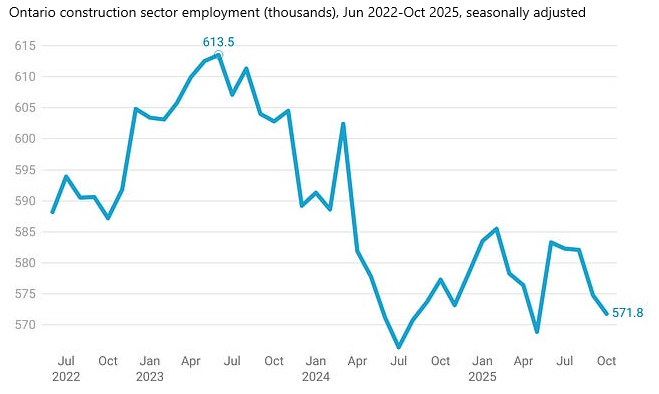
42,000 fewer workers were employed in construction in October than two years ago.
Why does a sector hurt so damaged by bad government policy continue loyalty to the PC Party?
Ontario housing starts second-lowest
Ontario housing unit starts, per month, Jun 2022-Oct 2025

It’s now been 41 months since Ontario’s Ford PC government pledged to meet housing targets requiring a pace of 12,500 housing starts per month. Data released Tuesday by CMHC shows in October, as in the previous 40 months, the actual number of starts was nowhere close to meeting the promise.
In October, only 3,567 housing units started construction in Ontario, just 28.5 per cent of the monthly target. It was the second-worst result since the promise was made.
The collapse of residential construction under the Ford PCs, and their refusal to spur starts by tapping non-profit or co-op development, has killed construction sector jobs and business revenues. Ontario’s construction sector now employs 42,000 fewer workers than two years ago, seasonally adjusted, according to StatCan’s most recent Labour Force Survey.
Ontario construction employment down by 42,000 jobs
Ontario construction sector employment (thousands), Jun 2022-Oct 2025, seasonally adjusted.

By Tom Parkin
November 12th, 2025
BURLINGTON, ON
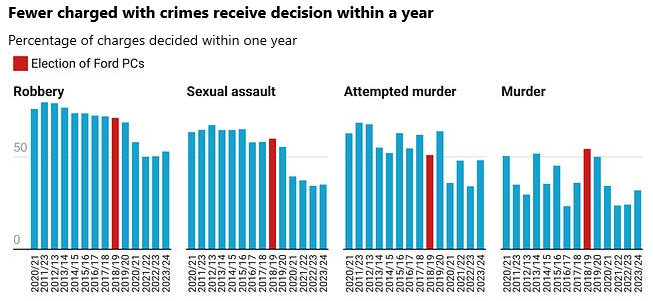
Doug Ford deflects responsibility for crime-on-bail onto judges and federal politicians, but it’s his own trial delays that are putting more people on bail.
Fewer charged with crimes receive decision within a year
Percentage of charges decided within one year:

After a disappointing leadership support vote in September, opposition NDP leader Marit Stiles has vowed to “take down” the Ford PC government with a strategy that aims at the legs of PC support and competes with Ford on the central concerns of votes.
The fist salvo in that plan has been a persistent line of attack on Doug Ford’s over his poor jobs record. Ontario unemployment has been persistently above the national average under the Ford PCs and while 800,000 Ontarians are jobless, the premier offers no jobs plan or even any Buy Canada policy.
Another line of attack serving the same strategy could be to actively redirect Ford’s “crime-on-bail” deflections. Certainly there is a clear path.
Ford has frequently picked up on crime-on-bail incidents, a problem he deflects onto judges and federal legislators. But it’s a problem Ford has caused and cynically seeks to benefit from.
Up to now, his deflections haven’t received much push-back. For both electoral and deeply principled reasons, they should.
Numbers out on bail up due to Ford’s trial delays
Longer trial delays mean longer time on bail for those charged. It means more people on bail awaiting trial. And Ontario’s trial delays are getting significantly longer, data shows.
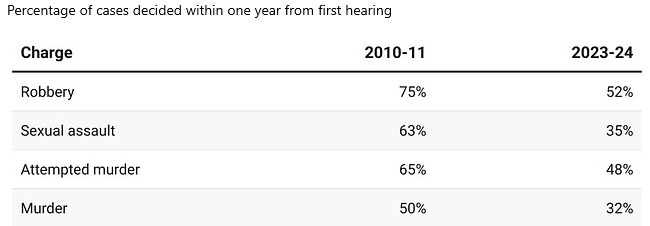
For example, in 2010/11, over 75 per cent of robbery trials were decided in less than a year. But by 2024/25, only 52 per cent of robbery charges were decided in less than a year. The result of delayed trials is a lot more people on bail for robbery.
And while bail time of a year or less used to be the norm for those charged with sexual assault, attempted murder and murder, under the Ford PCs the norm is bail lasting longer than a year.
Percentage of cases decided within one year from first hearing

No evidence of a provincial bail-check program
And even as Ford’s trial delays increase the numbers on bail, it appears that once a judge sets bail conditions there is no provincial follow-up program to ensure bail compliance.
Despite research and requests to police forces and the Ministry of the Solicitor-General, Data Shows can find no evidence of any provincial strategy, or even data being provincially collected, on bail checks by police, who are responsible for enforcing bail orders.
Perhaps municipal speed cameras could free many officers from traffic duty, allowing them to be reassigned to enforcing bail conditions.
A public safety agenda is open to NDP
A public safety agenda that cuts trial delays and checks bail compliance is wide open for Ford’s political competitors. Adopting it may be strategically valuable both electorally and as an important counter-move against conservative anti-charter politics.
For Conservative politicians, it’s been open season to use crime-on-bail incidents to bolster their campaign against the Charter and to normalize notwithstanding clause use.
Feelings of fear, victimization and rage about crime-on-bail are being used by conservatives to build an emotional reservoir of antipathy against the Charter. That reservoir is then used to drown Charter rights for any reason, as is currently being done in Alberta, where Premier Smith justifies elimination of workers’ rights “because I can”
Those feelings need to be redirected and that reservoir needs to flood back as disgust against those who create a crisis by mismanaging public institutions then cynically attempt to political benefit from the crisis their mismanagement created.
Opposition counter-attacks — or better yet, pre-emptive attacks — on crime-on-bail incidents by citing Ford’s failure to manage public institutions can likely redirect at least some of the emotional flow, protecting democratic rights.
And those opposition attacks would be strengthened if backed by propositions, tested with stakeholders, to reverse court delays and implement a provincial bail-check program.
Such attacks and propositions could advance Stiles’ “take down” strategy, undermining strength of another leg of PC support, a perceived advantage on crime and public safety. But they would also serve a historic purpose: defending rights and freedoms from the conservative campaign against them.
By Tom Parkin
November 11th, 2025
BURLINGTON, ON
Fewer employers who skirt workplace safety laws are paying consequences under the Ford PCs, according to data from the Ontario Court of Justice.

But workers continue to pay the price. At least 305 Ontario workers died from workplace injuries or exposures in 2023, the most recent year of settled data from the Workplace Safety and Insurance Board. That’s an eight per cent increase from 2015, when 283 were killed.
Yet the number of employers who pay any court cost for violating health and safety law has dropped by more than half under the Ford PCs.
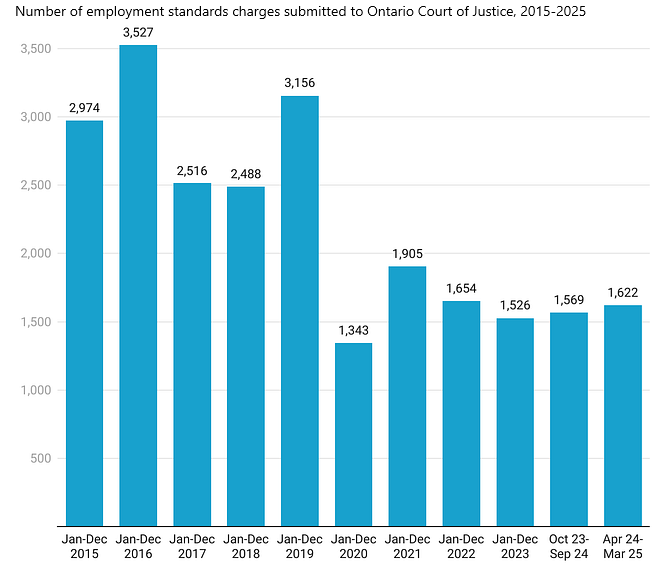
In 2015, prosecutors working for the Ministry of Labour brought 2,974 OHSA charges to court. By 2023 it had fallen by half to 1,524.
Workers paying the price for Ford PCs, says OFL
“Doug Ford lowers costs for unsafe employers, and workers are the ones left paying the price – sometimes with their lives,” said Laura Walton, president of the Ontario Federation of Labour.
Under the PCs, not only have OHSA charges dropped by half, but charges against employers for violating the Employment Standards Act have fallen 90 per cent, the Ontario Federation of Labour and Data Shows recently revealed.
The Employment Standards Act (ESA) is intended to protect workers and prosecute employers who commit wage theft, stealing tips or not paying wage premiums, such as vacation pay, holiday pay or overtime rates.
By Joe Gaetan
November 10th, 2025
BURLINGTON, ON
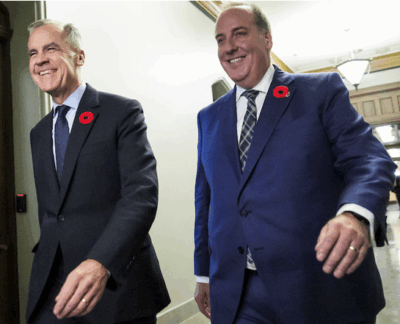
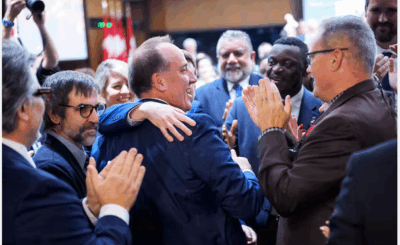
Nova Scotia MP Chris d’Entremont resigned from the Conservative caucus to join the Liberals, a move that nudges Prime Minister Mark Carney closer to a majority government.
 Prime Minister Mark Carney and MP Chris d’Entremont. In Canadian politics, this kind of move isn’t new. From time to time, an elected member who ran under one party’s banner decides to “cross the floor.” One side pops the champagne, the other fumes. It’s the political version of a player switching teams mid-season, except the fans who bought the tickets don’t get a refund.
Crossing the floor always comes down to choice. A member can stay loyal to the party they ran for, sit as an independent, or, as d’Entremont just did, join another party altogether. Those who defend the move often say it’s about principle. Maybe the party changed. Maybe the leader lost their confidence. Maybe they believe they can do better somewhere else. Fair enough.
But here is another side to this story that rarely gets airtime: What about the people behind the scenes?
Every election campaign runs on an army of volunteers, ordinary folks who knock on doors in the rain, answer phones after work, deliver and collect lawn signs, and stay up until midnight as scrutineers making sure every vote is counted properly. Then comes election night, the hugs, the cheers, the victory speech, and the thank-you. Everyone there feels part of the winning team.
So when an elected MP decides to cross the floor, it’s not just their party that’s blindsided, it’s the very people who helped put them there. Were they given a heads-up? An explanation? Or did they find out on the evening news, coffee in hand, wondering what all that hard work was really for?
 Politics will always be a mix of principle and pragmatism. This image is the pragmatism angle. Politics will always be a mix of principle and pragmatism. But at the heart of it, what about the lost trust, what about the people who believed in you enough to give you their time, effort, and vote.
Standing up for your values is one thing. But crossing the floor sends a confusing message: are you standing on principle, or simply finding a more comfortable seat?
Maybe it’s time Canada and the Provinces took at a better look at how to handle this. When an MP of MPP, MLA,OR MNA changes teams, voters deserve a say. A simple rule should be: Holding a by-election. This would give constituents the final word. It would restore trust, show respect for the volunteers who made it possible, and remind every elected official who they really work for: us the people, not the party.
By Tom Parkin
November 10th, 2025
BURLINGTON, ON
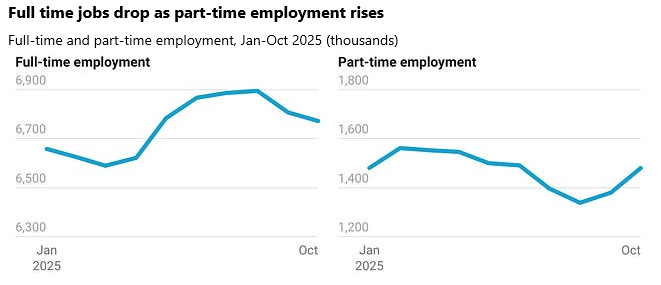
In October, Ontario lost 14,700 full time jobs and total hours worked fell by 20.7 million hours.

Though full-time employment fell by 14,700 jobs in October, Ontario’s unemployment rate dropped 0.2 points to 7.6 per cent due to a large increase in part-time employment, according to Statistics Canada’s October Labour Force Survey, released Friday.
Part-time work increased by 100,400 positions, offsetting the full-time job losses.
The trend to part-time work and a cut in average hours of full-time employees resulted in 20.7 million fewer paid work hours in October.
StatsCan estimated the total hours worked in October was 256.9 million, down from 277.6 million hours in September.

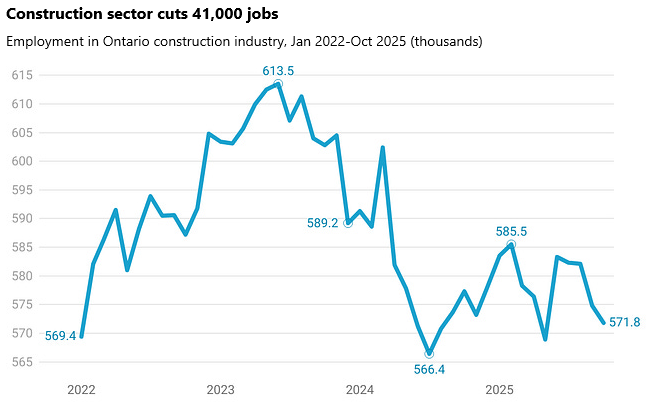
Ontario’s construction sector lost 3,000 more jobs in October, seasonally adjusted. Construction job losses now total 41,000 since an employment peak in 2023.
Despite falling job numbers, the Labourers Union continues to publicly praise the Ford PCs and very activity deflect corruption concerns over management of the government’s $2.5 billion Skills Fund, from which LIUNA has received tens of millions of dollars.
LIUNA representatives have characterized the opposition NDP’s questions about public fund misuse as an attack on workers. LIUNA recently withdrew from the Ontario Federation of Labour after the labour umbrella group raised concern about misappropriation of money intended for worker skills training.
Jobs in retailing rebounded in October after slumping to a 13 month low of 821,000 in September. Jobs rose by 23,000 to 844,300, but October employment in retailing remained the second-lowest over the past years and remains 5,300 jobs below levels of October 2024.
Retail sector employment strength is an indicator of affordability and consumer strength.
By Aria Wilson
October 31st, 2025
BURLINGTON, ON
Smooth talking and buzzwords just won’t cut it for the upcoming Canadian generation. Until action is taken, we all know the truth—talk is a whole lot cheaper than rent.
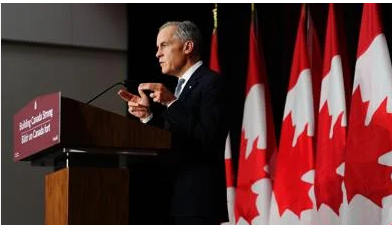
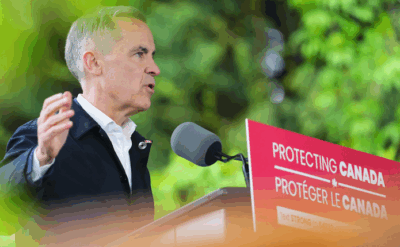
 Prime Minister Mark Carney speaking to students at the University of Ottawa. Prime Minister, Mark Carney, delivered a speech at the University of Ottawa last Wednesday detailing the Liberal government’s plan looking to the budget drop on November 4.
As a second-year journalism student living in Canada’s capital, I wanted to feel hopeful about the November 4 budget drop, but these glossed-over promises seemed more like fancy marketing to soothe my generation’s fears than any proof that it’s really possible to conquer them.
At a time more disconnected than ever, it’s important that young Canadians and the Canadian government are on the same page.
“My generation was connected by wires, your’s is connected by code, and yet our society today is becoming ever more disconnected,” Carney said.
 This is not a partisan issue, it’s a generational problem that will shape the future of our nation. This is not a partisan issue, it’s a generational problem that will shape the future of our nation.
Carney spoke at length about the fantastical plans he has for the nation—affordable housing, job opportunities, immigration standards and legislation to make Canada safe, but is he biting off more than he can chew?
Students and young adults are tired of hearing the same promises jumbled around a rephrase machine and spat back out; they’re nothing but a campaign poster slogan until we see real action.
The Trudeau government launched the National Housing Strategy in 2017, a plan that pledged $82 billion to build affordable housing, but between 2015 and 2024 the average house price doubled, making housing feel more like a privilege than a fundamental right.
But housing isn’t supposed to be a privilege. It’s a fundamental right under the National Housing Strategy Act and affirmed by international law.
While former strategies mapped out the building of more homes, it’s clear that the government was not on the same page as young Canadians when it comes to affordability.
The government built homes, just not ones that we young adults could dream of affording any time soon.
Now Carney says he will double construction in half the time, which seems almost too good to be true.
To restore hope in young Canadians is going to take a lot more than just affordability, but efficacy and efficiency. We want to see economic, societal, and environmental change.
 Canadians wondering whether their future careers are secured or being used as a gambling chip. We no longer dream of buying our first house, but of being able to rent an apartment using less than half of our paychecks every month.
It’s difficult to rely on promises of affordability when you’re nineteen and coughing up $1000 a month for a room barely big enough to fall asleep in, let alone dream of a better future.
Carney didn’t neglect environmental concerns in his plans. Investing in cleaner construction done for and by Canadians gives hope to young people like me looking for opportunities in the workforce.
“We will be our own best customer, so the welder who’s working on a contract in St. John’s can get a full-time job,” Carney said.
Unfortunately, it just feels as though students have been asking for more job opportunities for years with very little to show for it. In fact, a 2025 CBC survey found that 40% of newcomer students would consider leaving Canada if given the opportunity.
With the job market being so sparse, this isn’t a question of why people want to leave, but why can’t we seem to generate innovation in Canada?
Luckily, it seems like Carney has some ideas for this as well.
“We used to build things in this country,” he said. “We can build again.”
If this is the case, maybe it’s possible to rebuild the trust and hope young people once had in the Canadian government. With this will come the stronger economy, a larger job market, and new opportunities for Canadians.
Carney says it’s time to take big, bold risks, which leaves young Canadians wondering whether their future careers are secured or being used as a gambling chip.
There’s no doubt that we need change. Maybe big risks are the only way forward, but it’s difficult to feel enthusiastic about these drastic changes being taken on our behalf.
These are huge promises from the Prime Minister, and young Canadians will be watching closely to see if Carney can stay true to his word.
Carney says, “Canada has what the world wants” and if by that he means young Canadians sitting in wait for change he’s absolutely right.
 Aria Wilson is a second year journalism student at Carleton University specializing in Health Sciences and minoring in Neuroscience and Mental Health. She graduated from Nelson High School in 2024, after serving as Student Council President. Aria Wilson is a second year journalism student at Carleton University specializing in Health Sciences and minoring in Neuroscience and Mental Health. She graduated from Nelson High School in 2024, after serving as Student Council President.
At University, she has been a part of the Carleton Journalism Society as the VP of Communications and writes for The Charlatan frequently. She is also an Associate Editor for the Carleton branch of Her Campus.
By Tom Parkin
October 28th, 2025
BURLINGTON, ON
Almost $1.2 billion in steel and lumber was imported in August even as Canadians paid the price in jobs and gold for Trump’s steep tariffs on saw mill and steel mill workers.

Despite 10 months of Trump and his campaign of economic force against Canada, neither Canada or Ontario has yet put in place “Buy Canada” laws. The federal government has refused to match tariffs. The import of lumber and steel continues.
 Budget due in November will include Buy Canada provisions to come into effect in spring 2026. Prime Minister Mark Carney has recently said his budget next month will include Buy Canada provisions to come into effect in spring 2026.
Ontario Premier Doug Ford has yet to signal any timeline for Buy Ontario provisions, though Opposition NDP leader Marit Stiles recently announced her plan to give priority to Ontario-made products
In August, 2025, $945 million in basic and semi-finished iron or steel products were imported into Canada and $217 million in lumber came into our country, according to Statistics Canada’s report on August merchandise trade, released earlier this month.
While the imports continue, Canada is paying the price in workers’ jobs and taxpayer subsidies.
The Canadian government is spending hundreds of millions to keep steel mills afloat and has recently vowed to accelerate saw mill access to $1.2 billion subsidy fund.
Meanwhile, saw mills close in Ear Fall, Ontario, and go on temporary idle in Atitokan and Ignace, Ontario.
 When a sawmill shuts down – it is very hard to reopen. A failure to defend industries at this key moment can result in closures impossible to recover from. When plants are closed and equipment torn out and sold, the jobs rarely come back. Many Canadian communities will rust if Trump’s economic force leaves Canada exporting logs rather than lumber or minerals rather than steel.
If Canada allows Trump to crush value-adding industries, Canadians, who live on a land of forests and minerals, will become dependent on imported lumber and steel.
By Pepper Parr
October 15th,2025
BURLINGTON, ON
OPINION
City Council killed the current iteration of Sound of Music; a musical festival that entertained millions during the decades; they put on a great show that was free.
When it was evident that the city was going to put the boots to the ask submitted by the Sound of Music (give us more money and forgive our debts) I was a bit surprised when the city said they would put out a Request for Expressions of Interest; first thing that came to mind was: Is the fix already in?
In a media release, the city announced that:
 The City of Burlington is taking steps to ensure that a community-focused music festival remains part of Burlington’s waterfront experience. In the coming weeks, the City will issue an Expression of Interest (EOI) inviting event organizers to deliver a refreshed festival at Spencer Smith Park beginning in 2026 — one that continues to bring people together while reflecting the evolving needs and values of our community. The City of Burlington is taking steps to ensure that a community-focused music festival remains part of Burlington’s waterfront experience. In the coming weeks, the City will issue an Expression of Interest (EOI) inviting event organizers to deliver a refreshed festival at Spencer Smith Park beginning in 2026 — one that continues to bring people together while reflecting the evolving needs and values of our community.
This next step is about renewal and continuity — building on a long-standing tradition while ensuring future events are inclusive, sustainable, and reflective of Burlington’s priorities. The City’s goal is to see a waterfront music festival continue to thrive in a way that evolves with the community and continues to bring people together for years to come.
The city put out a survey – the usual and expected questions were asked. The city said the feedback will play a vital role in shaping the future of music programming in Burlington and ensuring it continues to celebrate community, creativity, and connection.
To complete the survey, visit GetInvolvedBurlington.ca/MusicFestival. The survey will be open until Nov. 17, 2025.
The lingering question for me was: Who is there out there that could pull together a decent event for June of 2026 – eight months away?
If you think about it – and there are people both on Council and within the community, who have done a lot of thinking about this. While the EOI has yet to be released, there are people already talking to people about who could do what.
Does whoever comes forward have to be a not-for-profit? It would have more flexibility if it were an Ontario Business Corporation.
If there were experienced business people holding the equity, expect much better business decisions. People with money are not in the habit of losing money.
The Sound of Music was always terrible at governance.
Deciding if the city is going to do business with a new organization is not something the public should expect anything in the way of public engagement.
My take: The fix is already in.

By Tom Parkin
October 15th,2025
BURLINGTON, ON

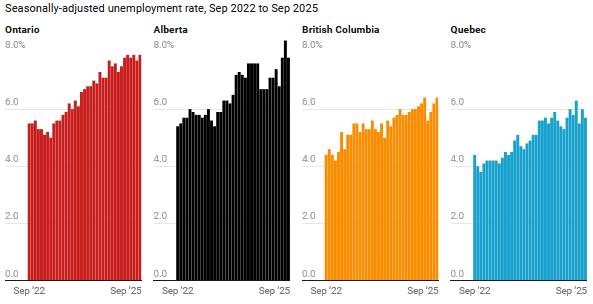
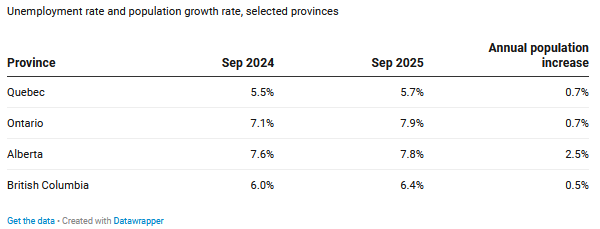
Unemployment is up in Canada, most sharply in Ontario, where joblessness has gone from 5.1 per cent to 7.9 per cent over the past 39 months.
At a moment when working families need a job creation plan to kick-start a struggling economy, federal Conservatives leader Pierre Poilievre is diverting people’s attention to the scapegoats historically used by conservatives to protect the status quo.
Poilievre is complaining about immigrants taking jobs.
Poilievre has recently called for expelling temporary foreign workers. Many temporary foreign worker programs were built to suppress wages. But Poilievre opportunistically hides behind that injustice, one conservative governments never cared about before, as he tries to conflate a demand to end an exploitative wage program with a push to expel immigrant workers.
And notice this is not a job creation plan. It’s a depopulation plan. It’s a claim that kicking out one working person will free up a job for someone else. But economics just doesn’t work that way — and if Poilievre doesn’t know it, he has smart people around him who do. They just doesn’t care.
Economists can explain the theory of why depopulation is a doomed economic policy. In short, it’s less people working and less people consuming. Depopulation shrinks GDP. Shrinking GDP kills jobs.
But the best explanations are from evidence. And right now, as Poilievre blames immigration for unemployment, the fact is Canada has had near-zero population growth for the past year — even as unemployment rises.
Statistics Canada estimates Canada’s population increased by only 389,000 people from July 31, 2024 to July 31, 2025. On a population of about 41.5 million, that’s less than one per cent annual growth. It’s like watching the population of a room increasing from 100 to 101 — over a year. It’s no change.
But though population has almost ceased, unemployment continues its climb.

Poilievre’s claim has the benefit of getting him off the hook for having not much of a job creation plan. And it helpfully gives permission to the small group of outright racists to push their race-war agenda under the pointy-hooded guise of Poilievre’s legitimate-sounding argument. Great job, Pierre, I’m sure they appreciate it.
But surely last weekend we all discussed our thanks for being in Canada — and not on the United States where division pushed by the president and his corrupt billionaire friends have everyone wondering whether the mid-term 2026 elections will even happen. Or when confrontations with hooded ICE agents will trigger mass violence. Or if what’s coming are even more catastrophic outcomes that lie on the trajectory they are travelling.
Emotions are running high in America, and when that starts, it doesn’t matter what the facts say. You can’t argue facts against a feeling. And that’s something to consider as we try to stop Canadians from getting swept into U.S. political currents.
Yes, the fact is Canada’s population growth is non-existent. That it may even show negative growth in Q4 2025. That we have controlled boarders. They we have processes to determine asylum cases from those that are not. That claims of “mass immigration” or “mass migration” are completely manufactured fantastical nonsense.
But the feelings don’t stop — not even in the people who may not feel happy or proud about having them. But they still do have them.
For us in Canada, our ability to resist being drawn into the MAGA nightmare rests heavily on developing feelings that displace the MAGA emotion, ones that instead build social solidarity.
Against those in Canada who pit worker against worker using zero-sum stories, pressing political leaders for their plan for job creation and renewed economic growth may be an important project of unity in diversity, of building feelings that we are all together in defending jobs and Canada.
By Gazette Staff
October 11th, 2025
BURLINGTON, ON
Susan Delacourt, a columnist with the Toronto Star did a piece that has to be widely shared.
She asked: “… is the perfect time to ask what kind of friend the United States is to us now, or even if it’s a friend at all. Do real friends ask us to shut up and accept what’s being hurled in our direction — no matter what — with a smile? Is it real friendship when it has to be constantly couched in flattery and genuflection?
 U.S. Commerce Secretary Howard Lutnick: He was clearly talking with Trump’s consent. Lutnick was the president and chief executive of Cantor Fitzgerald, a a global financial services firm that had offices on the 101st and 105th floors of the North Tower of the World Trade Center. He invested significantly in technology, establishing an electronic trading platform. In the September 11 attacks, Cantor Fitzgerald lost 658 employees, including Howard’s brother, Gary. Lutnick decided to no longer pay salaries to families of deceased employees after the tower collapsed.. Several days before the column appeared U.S. Commerce Secretary Howard Lutnick offered Canadians a glimpse into what this U.S. administration expects of this country, and it also could be summed up as: shut up and smile through whatever Trump is throwing this way.
Although Lutnick had been hoping his remarks would remain private, he was talking to a roomful of chatty people and the Star managed quickly to confirm his provocative words as they reverberated through the corridors of the conference.
“America is first, and Canada can be second,” Lutnick said at one point, also advising that this country should be braced to see its auto industry migrate south. Moreover, he said, Canada should just get used to the idea that the trade relationship of the past three decades is over.
“If you look at it where Canada was to where it will be, you’ll be disappointed.”
That, in sum, is where the Canada-U.S. relationship stands now under Trump — in an existential struggle to define how to manage what feels like an affront to the professional and the personal. It’s about where to draw the line.
Even Trump acknowledged that this line is in flux when he was sitting with Carney in the Oval Office. “It’s a complicated agreement, more complicated maybe than any other agreement we have, on trade because, you know, we have natural conflict,” he said. “We also have mutual love.”
 “I wore red for you,” “I wore red for you,” Carney told Trump at the White House.
For a man of Mark Carney’s stature to have to make a comment like that has to be humiliating, unless it is part of a strategy.
At a conference the day after the White House visit Carney repeatedly returned to this whole business of how Canada can be a friend and a business competitor to Trump’s America.
“We also understand it’s America first, not America alone. So the question is where does it go from there?”
“Nostalgia isn’t a strategy. Our relationship will never again be what it was. In terms of that aspect of it, that’s and that’s not a criticism,” he said. “It doesn’t lessen the ties between us as a people,” the prime minister said, but it does alter the economic ties, irreversibly.
That’s a pretty shaky ground on which to navigate a personal or a professional relationship, no matter what business you’re in, let alone the colossal and complicated ties between Canada and the United States. The audience at the Canada-U.S. summit was all ears when any speaker gave them glimpses into how Trump works. Little wonder. It’s ever-shifting terrain.
All over the country this weekend, Canadians will be sitting down with friends and family for Thanksgiving dinner. As often happens when people gather around the table, the conversation may take an unexpected turn. Someone may say something outrageous. Some may realize that a relationship they thought of one way has changed, maybe for the worse, maybe for the better. People will weigh whether to say things out loud or opt for diplomatic silence.
 Susan Delacourt, currently a 10-year veteran with the Toronto Star has worked for the National Post, a columnist and feature writer at the Ottawa Citizen and, for sixteen years, a parliamentary correspondent and editorial board member of The Globe and Mail. She is a graduate the University of Western Ontario (1982, majoring in Political Science). She is also a Masters student in the School of Political Studies at Carleton University. This week in Canada-U.S. relations has very much been an exercise in that same realm, unfolding in front of us at the top levels — Trump and Carney in Washington; top business leaders and players on the field of politics between the two nations, absorbing it all at the summit in Toronto.
It all comes back to one man — Trump, who reportedly just wants to make friends. But Canadians at all levels are asking whether the friendship even works any more and more importantly, what it is going to cost this country.
By Tom Parkin
October 10th, 2025
BURLINGTON, ON

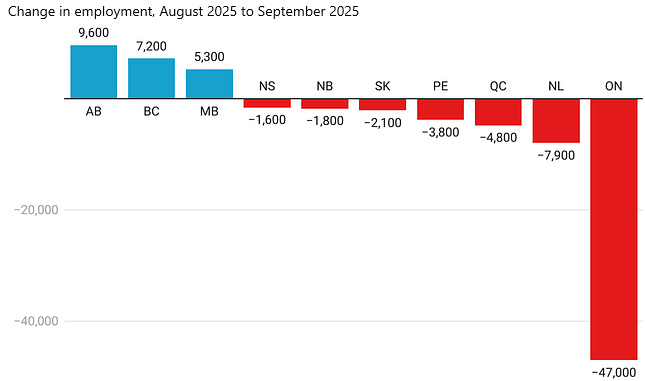
It will be pretty hard for Ontario PC Premier Doug Ford to today distract from 47,000 fewer jobs in Ontario in September, but he’ll come up with something. Or maybe hide until he makes his Thanksgiving pumpkin pie video.
 Opposition NDP leader Marit Stiles has routinely pivoted from Ford’s distractions to his jobs record. Ford has been under opposition attack for having no jobs plan despite an unemployment rate that has been on a steady rise since spring 2023. Opposition NDP leader Marit Stiles has routinely pivoted from Ford’s distractions to his jobs record, which has seen 172,000 jobs disappear in the past three months.
Stiles has also seized on recent comments from Ford when he told an elite downtown Toronto business luncheon club that workers just need to “look harder” to find a job.
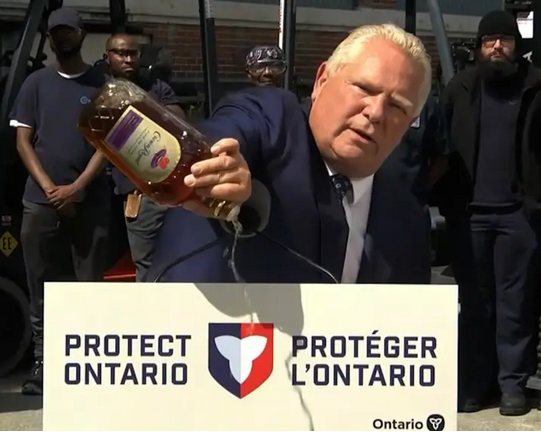
 A classic Ford distraction. The premier has fought back by pouring out whiskey bottles, doing ice cream photo ops, reviving his fantasy tunnel plan, and picking a fight with municipalities over speed cameras, a tactic that seems to be backfiring. Ford has done everything but acknowledge the province has a severe jobs problem and workers are paying the price for no job creation strategy.
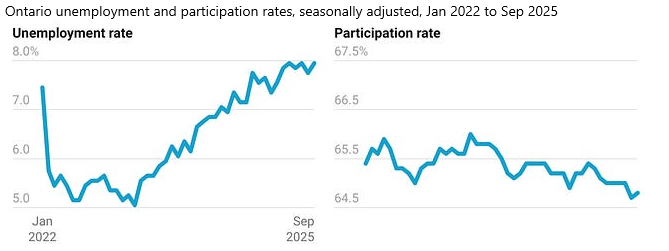
Ontario’s seasonally adjusted unemployment rate rose 0.2 percentage points to 7.9 per cent in September. While some may try to divert the discussion to Trump’s tariffs or immigrants taking jobs, neither fits the data.
Ontario’s unemployment rate has been steadily rising for more than two years, long before Trump’s election. And it now continues to rise even as Ontario’s population barely even rises, adding only 10,000 people over age 15 in September after adding just 7,000 people in August. Those are increases of just 0.07 and 0.06 per cent, respectively. Ontario’s total population increase thus far in Ontario has been just 0.77 per cent. Ontario’s population has essentially stopped growing this year.
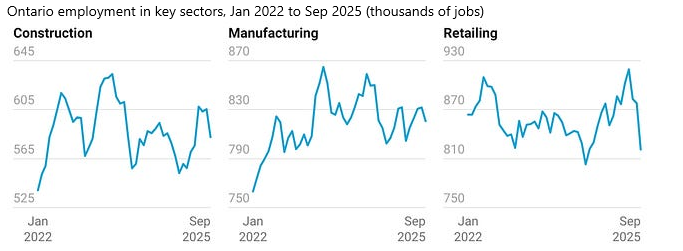
Diversions aside, the problem is in Ontario’s sick economy, which has been hit by manufacturing and construction job losses. Two of eight Ontario vehicle assembly plants have not build a vehicle since 2023. And construction is down from the 2022 housing bubble bust. Those trends and a have rippled into the service economy, especially retail jobs as consumers pull back. And it’s all been deepened by Trump’s tariffs and a mood of malaise.
Ontario’s jobs gloom is showing up in the labour participation rate, the percentage of people 15 years or older who are employed or looking for work. In September a seasonally-adjusted 64.8 per cent of Ontarians were participating in the labour market, down from 66.0 per cent in April 2023.

In September, construction was down by 51,000 jobs since the peak in July 2023 and down 32,000 jobs since the same month in 2023.
In manufacturing, 44,000 jobs have been lost since its peak in July 2023 and down 7,000 jobs from the same month in 2023.
Retail jobs have nosedived, dropping 98,000 jobs since June, after finally climbing back above a jobs peak set back in May 2022, the month after the Bank of Canada raised interest rates from historic lows, busting the real estate bubble.

|
|





 BY Tom Parkin


 By Ray Rivers

 Ray Rivers, a Gazette Contributing Editor, writes regularly applying his more than 25 years as a federal bureaucrat to his thinking. Rivers was once a candidate for provincial office in Burlington. He was the founder of the Burlington citizen committee on sustainability at a time when climate warming was a hotly debated subject. Ray has a post graduate degree in economics that he earned at the University of Ottawa. Tweet @rayzrivers



 By David Barker

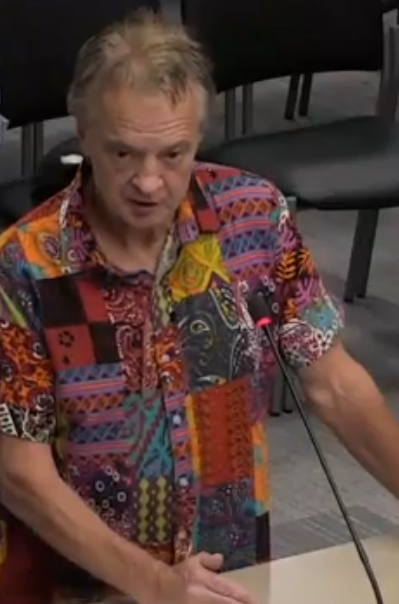 David Barker is a Burlington resident, a retired insurance executive. He lives in a historical home on Lakeshore Road for which he has been given grants to upgrade the home.
 By Joe Gaetan

 Joe Gaetan: Full disclosure: The author enjoys the odd dram of Speyside Scotch – and yes, Crown Royal Black – which may explain why he cares as much about good policy as he does about good whisky.

 By Joe Gaetan


 Joe Gaetan a resident of Burlington who comments frequently on civic matters
 By Pepper Parr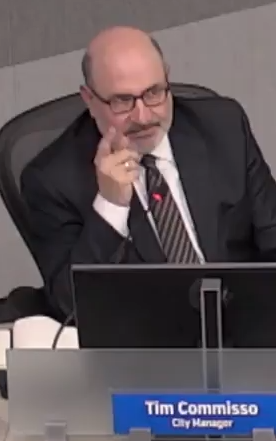

 By Tom Parkin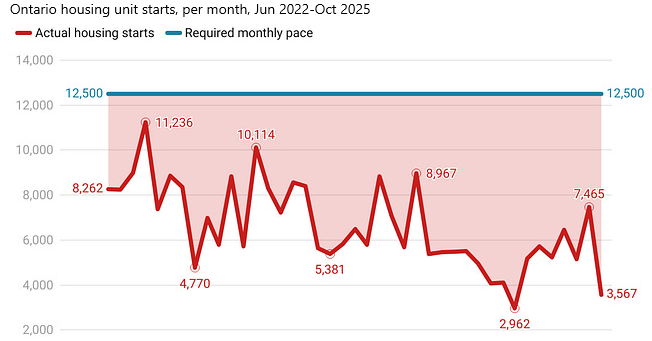


 Aria Wilson is a second year journalism student at Carleton University specializing in Health Sciences and minoring in Neuroscience and Mental Health.
  By Tom Parkin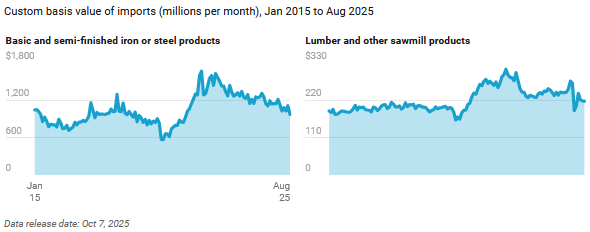

 The City of Burlington is taking steps to ensure that a community-focused music festival remains part of Burlington’s waterfront experience. In the coming weeks, the City will issue an Expression of Interest (EOI) inviting event organizers to deliver a refreshed festival at Spencer Smith Park beginning in 2026 — one that continues to bring people together while reflecting the evolving needs and values of our community.
 By Gazette Staff