 By Tom Muir By Tom Muir
January 16th, 2017
BURLINGTON, ON
Tom Muir, an Aldershot resident, has been an active participant in civic affairs. Our colleague, Joan Little described Muir as “acerbic”, a fair term for Tom.
He has outlined, in considerable length, a large part of why the parents at Central and Pearson high schools are in the mess they are in as a result of the recommendation to close their schools.
There is a lot of material; it gets dense at times. Living in a democracy mans you have to accept the responsibility of citizenship and stay informed. This is a multi part story.
1. How was this problem created and why is it a mess?
Everyone needs to appreciate that there is a lot of Long Term Accommodation Plans (LTAP) and other reports and information on the Board website, but knowing how to find them, and have the time to read and comprehend it all, are daunting for people not used to this kind of analysis. And if they have both jobs along with their kids and home responsibilities, this just gets much worse.
The Board writes these long LTAP reports but the trustees I think seem to be snowed under by them, over time. There are plenty of warnings and facts presented about what is going on, but somehow it doesn’t fizz on them, and parents and residents are not given any warning of what lies ahead on the path the Board is on. That’s the case I found here, and it’s not hard to find if you know how to look and take the time.
One thing that is missing on the accessible website are enough years of the LTAPs and reports to go back to the time that Hayden SS in Alton was being rationalized and justified and a new SRA 101 was created..
 This Secondary Review Area contains one school. Dr. Frank J. Hayden SS opened with grades 9 and 10 in September 2013, and grew one grade each year. Enrolment currently exceeds OTG capacity, resulting in the placement of 6 portables on site. A high percentage (30%+) of grade 8 students from Orchard Park PS and Alexander’s PS enrolled in a secondary school other than Dr. Frank Hayden SS in 2015. More than 90% of grade eight students from the following elementary schools attend Dr. Frank J. Hayden SS: Charles R. Beaudoin PS FI program, John William Boich PS FI program Alton Village PS Dr. Frank J. Hayden SS is projected to be over-utilized. Enrolment is approaching Total Capacity by 2016. Boundaries may need to be re-evaluated as part of a future Program and Accommodation Review. To Be Determined Area, students are projected in this area within the next five years. Consideration should be given to establishing school catchments for this area as development approvals move forward. Data is avalable for as far back as 2010-2011 where toy can already see the troubles looming. But there is no hint of how Hayden was justified on pupil place needs – there weren’t any – when it was already known that building the school would drain all the students from the existing high schools and create large and growing surplus places there, while overfilling Hayden, even with Portables, right from the start.
 Secondary Review area 100 shows the high schools south of the QEW where the population was concentrated. The creation of the Halton community when the 407 highway was built suggested the need for an additional high school. For example, in 2010-2011 LTAP report, we see the following.
The Board data for 2010 indicates there were 495 actual empty seats, and 92% space utilization, in the 6 then existing schools in Burlington. There was obviously no problem with surplus places and the trends stayed in a 90 to 80% bracket to 2020.
With the projected opening of the Alton school, the transfer of students from the other schools to the Alton school began, and the steep increase in available places in the existing 6 Burlington schools began.
From the 2010-2011 LTAP commentary:
– New subdivision development in SRA 101 contributes to the high utilization of Lester B. Pearson H.S., M.M. Robinson H.S., Nelson H.S. and Robert Bateman HS
– Opening of the proposed Alton community high school (2011) will cause enrollment to drop in most schools.
– A boundary review for the proposed Alton community high school has been initiated.
– There is potential for a PARC (Program and Accommodation Review Committee) Process to be initiated.
The plans were to build another school in Alton – add 1200 seats plus about 280 in portables.
The Board set out to build the new high school and decided to make it both a public library, a recreation centre and a high school and opened it in 2013 (at first it was 2011/2012), filled it with about 1400 students by 2017 from schools within the six existing high schools. These 1400 now become empty seats in the south Burlington six schools.
Together with the 495 cited above, this adds up to about the 1800-1900 empty seats now cited as unsustainable.
So this was basically already known before 2010, but the possible consequences were never made public or explained to anyone, from all appearances.
As well, in this 2010-2011 LTAP, there is no business case, or any other rationalization, based on a deficit in pupil places, for building a new school in Alton. This may have been done in earlier years, but there is no visible evidence of the need anywhere, and it is not available or provided for public information right now.
This rationale needs to be provided.
2. How did we stay on this path to problems?
The path Burlington was put on by these Board decisions continued unabated, but the consequences continued to be unexplained to the public, and seemingly were not appreciated or were ignored by Trustees.
I went back to the LTAP for 2012-2013. It quite clearly states that opening Hayden was going to cause problems.
Here’s something I copied out of that report (my underlining). SRA 100 contains the 6 Burlington High schools, besides Hayden the new one.
BURLINGTON – Secondary Review Areas
With the development of the new Secondary Review Areas (SRA) 101 Burlington NE High School (1200 pupil places) in the Alton Community, a school boundary review process was undertaken and completed in June 2012.
The opening of the new high school would result in students being redirected from SRA 100 to this new school. The additional capacity meant a reduction in the number of students in classroom seats. The Board appears to have convinced itself that Alton needed a high school and built one – at a time when the high school population wasn’t growing.
 Enrollment projections indicate the utilization of space in SRA 100 secondary schools is currently at 87% in 2012, which will decline to 60% in 2022. Moreover, given the capacity of the schools, it is projected once the new high school opens there will be 2503 secondary pupil places available in 2022 within SRA 100. Enrollment projections indicate the utilization of space in SRA 100 secondary schools is currently at 87% in 2012, which will decline to 60% in 2022. Moreover, given the capacity of the schools, it is projected once the new high school opens there will be 2503 secondary pupil places available in 2022 within SRA 100.
In reviewing SRA101, it is projected that the new school will continue to grow in enrollment to the point that by
2019, On the Ground (OTG) building and portable capacity could be exceeded, with a utilization rate of 131% by 2022.
Overall for Burlington, by 2022 the OTG utilization is projected to be 72%, with approximately 2129 empty
pupil places. It would appear that within the next few years, consideration should be given to undertaking a
PAR for all secondary schools in Burlington.
So you can see again, that the building of Hayden, the lack of a rationale, and the plan for filling it, was a root cause of the current problem.
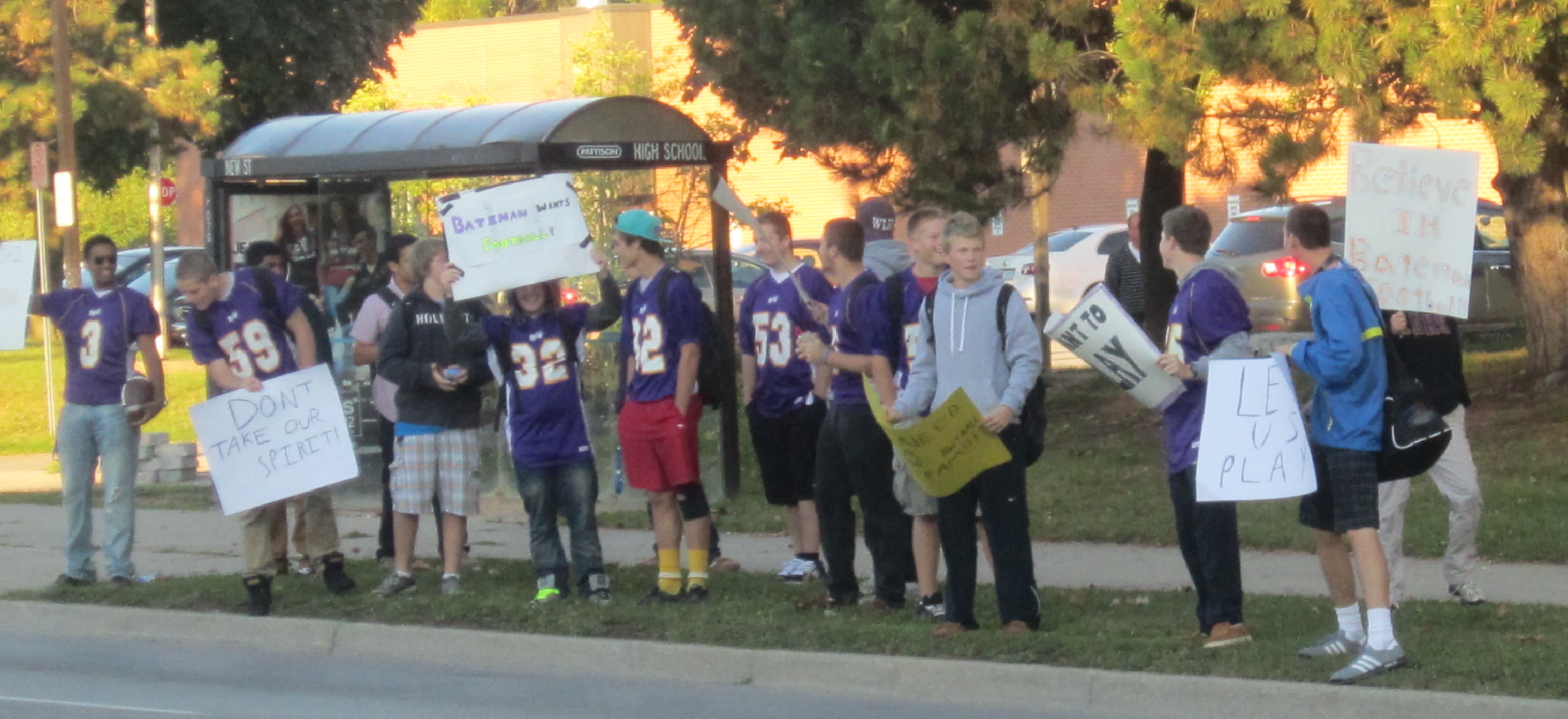
 A number of years ago Bateman students demonstrated to keep their football team – parents may find themselves demonstrating to keep their high schools open. Looking at another Table shows that the actual student numbers in SRA 100 was 5530 in 2012 and was projected, by opening Hayden in 2013, to decline down to 4913 in 2013.
So in that time period, the Board moved about 600 Grade 9 and 10 students from the SRA 100 to Hayden, and then in time would drain other grades and feeder students greatly to get to the overshoot of capacity that they are at now.
The student numbers in Hayden went to 860 in 2014; 1250 in 2015; 1350 in 2016; about 1400 in 2017; and is projected to grow to about 1600 in 2020.
The students could have remained in, and new ones put into, other schools of the 6 existing, and Hayden was not really needed given the pupil places already available at the time as indicated. Further, the school is already overfull, with portables, and this will continue with the present catchment and policy.
From another section of the LTAP 2012-2013 I copied this. I had to take the format from a Table, so that’s why it is what it is.
SRA 100, includes Aldershot, Burlington Central, Lester B. Pearson, MM Robinson, Nelson and Robert Bateman where school enrollments are below OTG capacity and will continue to decline from 87% in 2012 to 60% of OTG
capacity in 2022.
This is a result of the opening of the new school in the Alton High School.
By 2022 there will be approximately 2500 available pupil places in this review area and all schools will be operating below their OTG capacity.
Hayden is already overcapacity in 2016. This is just getting worse and will continue unless policy changes are made.
All these decisions and descriptions are made by the Board, and then rubber-stamped by the Trustees, who I think didn’t really comprehend what was happening.
The near total turn over of trustees in Burlington in the 2014 election didn’t help.
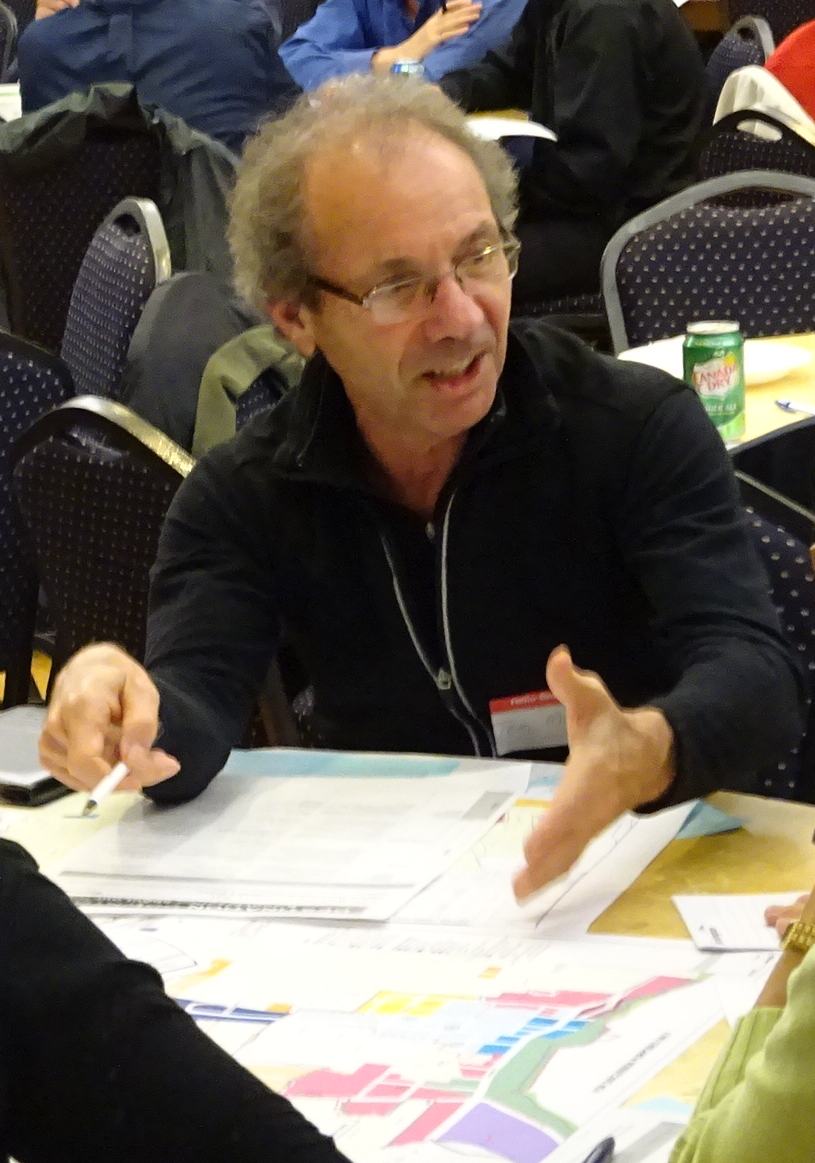
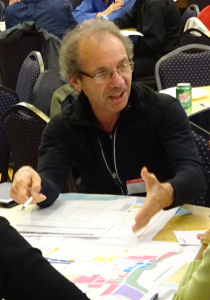 Tom Muir is a resident of Aldershot who has been a persistent critic of decisions made by city council. He turns his attention to the current school board mess. He recently suggested to Burlington city council that “If you are so tired of and frustrated by, listening to the views of the people that elected you, then maybe you have been doing this job too long and should quit. Tom Muir is a resident of Aldershot who has been a persistent critic of decisions made by city council. He turns his attention to the current school board mess. He recently suggested to Burlington city council that “If you are so tired of and frustrated by, listening to the views of the people that elected you, then maybe you have been doing this job too long and should quit.
Muir explains that the PARC will only get what people send in, what they come up with from their own efforts, and what they ask/demand from the board. They have to decide what they want and go after it ruthlessly. They will have to fight with tooth and claw and take no prisoners.

 By Pepper Parr By Pepper Parr
January 15th, 2017
BURLINGTON, ON
The development that council voted not to go forward with in the Alton Village got punted to the Ontario Municipal Board faster than the lawyers could lick the envelope and get the postage on it.
The city now has to go looking for legal talent to represent them on what is going to be a difficult case.
The city planner did her job – she asked council for specific direction – got it and set out working with the developer.
The project gets brought back, the community delegates against the project and council votes it down
The developer says he is “shocked” and notes that he never did like the Mayor; we now have personalities introduced to a sticky legal case.
 Planning department and council talked past each other on this project. Did the city manager not see the disconnection? Apparently not. How did this mess happen?
A regular reader, who is not identified for good reasons, wrote some comments that are strong enough to be passed along.
The writer is well qualified to make the comments:
“It’s obvious the city has a monumental challenge at the OMB, having to hire outside planners against the staff recommendation.
“I found watching the meetings on video revealing and alarming at how decisions are made at city hall. What struck me is how the planning department and council talked past each other, not understanding what the other was saying and what they were agreeing to. The planning department was presenting a new approach to handle the application – yet no one seems to have a hand on the tiller, guiding the process so ensure good decision making and mitigate the city’s risk.
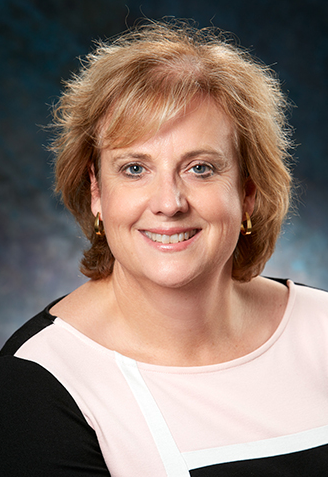 Director of Planning Mary Lou Tanner “Back at the July 11, 2016 meeting, the Planning Director was clear what she was asking for. Her focus was on seven design principles she identified and pointed out that she did not yet have agreement with Adi because two of these principles were not yet met:
Principle 5 – Implement tall building best practices. The modified design recommendations from staff (below) achieve this principle.
Principle 6 – Provide appropriate transitions between buildings. This is achieved with the modified design recommendations.
“She was asking council members to endorse the design approach and recommendations and direct staff to prepare an official plan and zoning bylaw amendment subject to these design recommendations (i.e. the remaining two principles) being met.
“When the majority of council voted in favour of the Planning Director’s requests, she thought she had their support to negotiate with ADI to make these design changes and develop recommendations based on the outcome of these negotiations.
Lots of talking; not enough listening.
“Back at the July 11, 2016 meeting, a few council members, including the Ward 6 councillor, expressed concern about the tower height. However, the report they approved never committed to reviewing the number of storeys, only “to optimize building placement and ensure an appropriate fit and transition in scale.”
 Is this city council so deeply into a group think that they no longer know ho to listen? “People were talking around the horseshoe, but seems like there was not enough listening. With no amendments to the report, it’s surprising that council would be surprised that the December report contained no changes to the number of storeys.
“Most of council didn’t seem to know what they were voting for, given the comments that this was just “going forward for discussion”. It wasn’t – the planning director was asking for approval to negotiate several design changes – but nothing to do with height – and in fact she did just that and brought back the file for approval. Their approval set off the chain of events that directly lead to Adi appealing to the OMB. We’re now in the soup we’re in because of that ill-considered decision and poorly thought through process.
“The director of planning never corrected the statements that this report was “just to continue discussions:” She should have been very clear about what she was asking. That lulled everyone, including the public, into thinking substantive changes were coming when clearly they were not – only the two design tweaks staff mentioned in the report. So the public didn’t show up in force till the 11th hour, and then council flips because as Tom Muir said, “it’s politics stupid”.
“Meanwhile, the public was ignored for months – with many council members waking up to their firm opposition only at the December meeting.
The lesson here is to:
a) know what you’re voting on;
b) get the public involved EARLY not at the end. I suspect (hope) this is the first and last time this process will be followed on a planning file given the mess it has created.
Chasing the shiny new object:
“The Planning Director’s recommendations were based on the Tall Building Guidelines – not the Official Plan or public input.
“The influence of outside consultants like Brent Toderian are obvious. From a professional perspective, city planners are captivated by the Vancouverism urban form, which they regard as the exciting, fresh approach to planning. They’re keen to import his thinking to Burlington.
“The Planning Director rushed through these guidelines earlier in the year, with most of council supporting her request, with only an “interim” proviso slapped on it.
“However, no effort was expended to get public input. Planning staff calls them “best practices”, but the guidelines have never been evaluated or debated to determine if Vancouver’s urban form is right for Burlington neighborhoods.
“An honest discussion on intensification desperately needed. This slipshod decision-making process is in the context of never having a healthy public discussion and getting broader buy-in on the right kind of intensification for Burlington.
 Consultant Brent Toderian – the chief evangelist for the tall narrow buildings on a podium-planning model. “The mayor had a “rah-rah” presentation at his Inspire Series – leaning heavily on Brent Toderian – the chief evangelist for the tall narrow buildings on a podium-planning model.
“We should be asking if intensification is the city’s highest ambition, or is it simply a means to a higher goal. Instead all we get are the empty “Grow Bold” platitudes.
“The lack of clarity on the meaning and limits of intensification, the disregard for the Official Plan and the embrace of the Tall Building Guidelines, coupled with the public being bypassed raises concerns about the nature of the relationship between the city’s planning department and the development industry.
“These factors breed uncertainty in our community for who decides what gets developed where.
“Once again, I wonder whose city is it?”
Indeed!
 By Staff By Staff
January 14th, 2017
BURLINGTON, ON
There is a neat little service the city has – you can go to a map and see which streets have been plowed.
Looking at a map to learn which streets have been plowed is nice – I guess.
What this map has though is something else – that is really useful.
 There are small symbols along the line that is the QEW – each of those symbols is one of the cameras that broadcast what the traffic load is like in real time. There are small symbols along the line that is the QEW – each of those symbols is one of the cameras that broadcast what the traffic load is like in real time.
You might want to book mark this one – really useful.
Click to check it out.
 By Staff By Staff
January 13th, 2017
BURLINGTON, ON
The Halton Regional Police Service (HRPS) is pleased to announce that its annual Toys for Tots holiday fundraising campaign raised $248,810 in toys, gift cards, cash and food for local families in Halton. All told, more than 4,350 Christmases were made brighter because of the generosity of area citizens, businesses, schools and sports teams.
 Not sure if that little girl returned the hat to the police officer. In its sixteenth year, this latest drive ran from November 15 until December 24, 2016.
“Once again, the people of Halton have gone above and beyond,” said Stephen Tanner, Chief of Police. “Residents, businesses and groups not only exemplified the spirit of Christmas; they gave us all another reason to be proud to call our Region home.”
For the past eight years, the Service has partnered with the Burlington Lions Optimist Minor Hockey Association (BLOMHA). This year, the organization raised more than $60,000, bringing their grand total to over $275,000. Their efforts are spearheaded by parent representative, Shari Carruthers.
Meanwhile, a local corporation, that wished to remain anonymous, donated $21,000 worth of toys.
Other community partners who made significant contributions include Budds Subaru, Burlington Cougars, Canadian Tire, East Side’s Auto Group, Halton Catholic District School Board, Halton District School Board, Georgetown Raiders, G.E. Water, Halton Honda, Longo’s Fruit Market, Mandarin Restaurants, Rotherglen School, Royal Bank, TD Canada Trust, Tiger Jeet Singh Foundation, True Mentality, and Woodbine Entertainment Group.
Sworn (uniform), civilian, Auxiliary and other volunteer Service members donated their time to support collection efforts at Canadian Tire locations region-wide, at each city/town Santa Claus Parade, at three Cram-a-Cruiser challenges, and at numerous other community events.
HRPS members raised more than $6,400 of their own funds through individual initiatives and platoon challenges. Service volunteers were also responsible for packaging and delivering toys to area families in their homes and in hospital.
 By Staff By Staff
January 13th, 2017
BURLINGTON, ON
Recall that piece we did on the men who were seen by police walking away from a dark coloured Mazda Protégé with a stolen licence plate in a parking lot near Appleby Line and Dundas Street in Burlington last on Thursday.
It was determined that the same vehicle and licence plate was involved in several armed robberies where a firearm was used and as a result, a perimeter was quickly established.
The two men were later found inside a nearby Starbucks.
 Police dog was used in the apprehension of the first two suspects. That two led to four males who were arrested. Charges being laid against all four individuals in relation to recent armed robberies in both Halton and Peel region.
Hassan ALI, 18 years of Mississauga
• Robbery with Firearm, Point Firearm, Disguise with Intent (Royal Bank – Oakville)
• Possession of Property Obtained by Crime (Burlington)
• Robbery with Firearm, Disguise with Intent (Macs Milk Store – Brampton)
• Robbery with Firearm, Disguise with Intent (Hasty Mart Variety Store – Brampton)
• Robbery with Firearm, Disguise with Intent (7-11 Convenience Store – Mississauga)
• Robbery with Firearm, Disguise with Intent (Macs Convenience Store – Mississauga)
Ibrahim MOHAMED, 18 years of Mississauga
• Possession of Property Obtained by Crime (Burlington)
Young person – 17 years of Mississauga
• Robbery with Intent, Point Firearm, Disguise with Intent (Royal Bank – Oakville)
• Possession of Property Obtained by Crime (Burlington)
Young Person – 16 years of Mississauga
• Possession of Property Obtained by Crime (Burlington)
• Robbery with Firearm, Disguise with Intent (Mac’s Milk Store – Brampton)
• Robbery with Firearm, Disguise with Intent (Hasty Mart Variety Store – Brampton)
• Robbery with Firearm, Disguise with Intent (711 Convenience Store – Mississauga)
• Robbery with Firearm, Disguise with Intent (Macs Convenience Store – Mississauga)
All four accused were held in custody pending a bail hearing in Milton Court on January 13th 2017.
A lot gets done when observant police officer are on the job.
Anyone who may have further information pertaining to these incidents is asked to contact the Oakville Criminal Investigations Bureau at 905-825 4747 ext. 2216, Crime Stoppers “See something, Hear something, Say something” at 1-800-222-8477 (TIPS, through the web at www.haltoncrimestoppers.ca or by texting “Tip 201” with your message to 274637 (crimes)
By Pepper Parr
January 13th, 2016
BURLINGTON, ON
That December 8th meeting that was held by the Halton District school board has come to be an experience the Board has learned something from.
Trustees were telling staff that many people didn’t feel they had had a real opportunity to ask questions or voice their concerns.
 Director of Education Stuart Miller getting ready to address parents at Central high school. Director of Education Stuart Miller admitted that there was something to be learned from that first experience and has said that the Board’s administrative committee will review what has taken place so far and decide if there should be another public meeting at which people can voice their concerns and grievances.
Miller didn’t sound all that happy with the idea of a meeting at which he has to stand up in front of a couple of hundred unhappy people who get quite emotional about the possibility that there local school might be closed.
But he did say that if the view was that another public meeting was necessary then he would take part and listen.
Miller isn’t sure what the public expects. He refers again and again to the facts he has to deal with – 1800 empty seats – something that just isn’t sustainable on a long term basis.
He argues that the data provided by the Boards Planning department has been accurate in the past and he believes that what he is getting from them now is also accurate.
That might not really be the case.
The board was caught by surprise when it found registration at the Alton public school to be much higher than projected – then realized that a significant number of the houses in the relatively new community was housing two and sometimes three families.
These elementary school students will move on to the high school in the community which is already well over its intended capacity.
Miller told staff that his planners work closely with the city of Burlington and share information.
One of the problems is that the city can only pass along what it has in hand in the way of new residential projects. There is a project well past the drawing board stage for the intersection of Brant and Ghent streets that will involve three of the four corner properties at that intersection.
 The properties within the black outline are part of a development that is well past the drawing board stage. The hold up is at city hall where the planners need more time to figure out how this will fit in with their mobility hub plans. City hall has asked the developer to wait a little longer before talking about the development – which means that development is not real yet from the city’s point of view. The plan is for there to be a mobility hub at the Burlington GO station where a five tower project is currently under construction. The city to get its mobility hub thinking completed before looking at additional new projects.
The developers are way ahead of the city. They have measured the market, done their research and determined what the public wants and have put their money on the table and begun construction.
It is very real in the minds of the developer – several housing were recently demolished to clear the Brant Ghent site.
The board isn’t even aware of that development which is a couple of blocks from Central high school.
There also appears to be an assumption that there will be very few families living in the five condominiums that are going to be part of the Paradigm project on Fairview next to the GO station.
 A five tower project currently under construction is less than a ten minute walk from Central high school. To assume that a community of 2000 people is going to be made up of foot loose and fancy free singles or seniors that want to downsize may turn out to be a mistake equal to the problem that cropped up in the Alton village when the board got caught with close to hundreds of additional students.
The board of education needs to find a way to meet privately with the larger developers to get a sense of where they want to go long term. There is vital data that is being missed.
The sense one gets is that the Planning department isn’t all that sophisticated and appears to rely on the tried but not always true demographic tools when perhaps something that permits the planners to dig down a lot deeper is needed.
 School boards know about the project – their signs warn parents that there may not be space in local schools for any children living in the project. There is little argument that the role of the board is to educate our children – but the job doesn’t stop at that border – an education is vital – a community is the space within which the student is going to exist and make their mark in this world.
There is a lot more talking to be done and some parents at Central high school are not convinced that the board really wants to listen.
One parent sent in these comments: “I think the PAR process will be a sham. But the Ministry designed it so it would be. There are PAR committee members in Ontario quitting in disgust of the whole thing before it’s even over. I talked with our MPP Eleanor on my thoughts about all this from a provincial perspective a while ago. She actually said “there is nothing wrong with the funding formula” and “I have faith in the process.” Our meeting was over the phone so I couldn’t tell if she said it with a straight face or not, but really!
There are two public meetings scheduled as part of the PAR process – no word yet on the format of those meetings.

By Staff
January 12th, 2017
BURLINGTON, ON
Identity theft is real – very real.
The Halton regional Police got to see it happening here in Burlington when they investigated a call from the Royal Bank located on Pearl Street in Burlington where branch staff had alerted police to a fraud in progress on January 11th 2017 shortly after 1:00 PM.
It was reported that a male was attempting to open a personal and business account using fraudulent identification.
 Police arrived and after some investigation, it was confirmed that the male was not who he claimed to be and was arrested for fraud. The male provided a name and date of birth which was also later determined to be false. Police arrived and after some investigation, it was confirmed that the male was not who he claimed to be and was arrested for fraud. The male provided a name and date of birth which was also later determined to be false.
Upon arrest, the male was found to be in possession of fraudulent identification and various debit/credit cards in various names.
The male was properly identified as Jonathon William KELL (28 yrs-old) of No Fixed Address (formerly from Oakville). Kell was held for bail and charged with the following offences:
• Personation with intent
• Identity fraud
• Possession of a counterfeit mark
• Unauthorized possession of credit card data
• Obstruct Peace Officer
• Fail to Comply with Recognizance
Anyone with information is asked to call the Halton Regional Police Service – Regional Fraud Unit at 905-825-4747 ext 8739 or Crime Stoppers “See something, Hear something, Say something” at 1-800-222-
 By Staff By Staff
January 13th, 2017
BURLINGTON, ON
This is interesting.
Whenever there is some new art placed in the community there are the couple of dozen people who complain about public money being spent on “nice to have” and often questions about the credentials of the people making the decisions.
 The grade separation on King Road had art painted on the bridge. Cobalt Connects, an organization that manages things that get done in the arts community is recruiting people who will sit on juries that select what gets chosen. They handle most of the administrative side of the city’s public art program and consult for the city.
Participate in a Public Art Jury
They are looking for ordinary people who love art and their community and are asking people who want to make their mark on the city’s public art program by participating in a public art jury.
They are looking for local artists, creative professionals and residents to evaluate public art applications throughout the year.
No experience is necessary! Each jury is made up of a mix of arts professionals and residents to represent a broad cross-section of the community.
 This pice of art work was painted on the side of the Freeman Station. A small honorarium will be paid to all jury members as a thank you for participating. (That should pull in a significant response)
If you are interested in volunteering there is an application form to be placed on the jury roster.
Click on the link to access the form.
Kim Selman can answer any questions you might have. She can be reached at 905-548-0111 or at
kim@cobaltconnects.ca
By Pepper Parr
January 13th, 2017
BURLINGTON, ON
It is just an opinion but it is based on significant experience and many years in the real-estate business.
Having said that here is what the Rocca Sisters and Associates have to say about the Burlington real estate market.
When all was said and done, 2016 turned out to be a good year for sellers – prices up 16%, year over year, days on market down by 34.7% – and a not so great year for buyers.
Compared to our other trading areas, however, Burlington was somewhat moderate in terms of wild fluctuations. With the exception of the Orchard, the neighborhoods with the higher increases in prices paid were those that, it could be said, were somewhat undervalued to start with.
 Palmer Drive – an older community (most built in the 50’s, 60’s and 70’s) has lagged behind in terms of sale price growth. Aldershot South, Central Burlington, Dynes, Longmoor, Tyandaga and Palmer all older communities (most built in the 50’s, 60’s and 70’s) had lagged behind in terms of sale price growth while newer communities like the Orchard, Millcroft and Headon Forest increased exponentially.
These more mature areas, with the exception of Tyandaga offered smaller homes with bigger yards but the absence of modern conveniences such as a bathroom for every member of the household and closet space to accommodate bursting wardrobes made them less attractive to many buyers.
 Tyandaga community saw a huge increase year over year – the biggest surprise is that it took so long. When demand outstripped supply in the newer neighborhoods to the point that the purchase prices were swelling dangerously, these older communities became the next best thing. It’s no surprise that Tyandaga saw a huge increase year over year – the biggest surprise is that it took so long. Large gracious homes on huge mature lots with mature landscaping finally came on buyer’s radar when at the end of last year the average price of a house in Millcroft was over $900,000 and the average price of an equivalent sized house on a bigger lot was just over $800,000 in Tyandaga.
These properties, along with Roseland and Shoreacre properties still tend to take a little longer to sell – we chalk that up to a lot of non- Burlington sales reps not knowing the neighborhoods that well and just a general reticence to buying an older home. All in all, 2016 was not nearly as tumultuous in Burlington as in the rest of the world so Burlingtonians should be quite satisfied with the result.
Predictions for 2017 – many overextended homeowners are going to be re-evaluating their finances and for some, the choice will be obvious – downsize.
The result will quite possibly be a glut of move-up houses on the market later in the year, forcing a minor correction and a continued shortage of inventory in the $500-$700,000 price range.
Notwithstanding, we expect to see much of the same in early 2017 – a seller’s market for the foreseeable future.
By Staff
January 12th, 2017
BURLINGTON, ON
On January 12th 2016 at approximately 3:18 PM, a uniformed officer observed several males walking away from a dark coloured Mazda Protégé with a stolen licence plate in a parking lot near Appleby Line and Dundas Street in Burlington.
It was determined that the same vehicle and licence plate was involved in several armed robberies where a firearm was used and as a result, a perimeter was quickly established.
Members of Tactical and Rescue Unit (TRU), Police Dog Services, Community Mobilization Bureau (CMB), Uniform Patrol and the Burlington Criminal Investigations Bureau (CIB) worked together and ultimately located and arrested four male suspects inside a Starbucks.
That’ a total of five different police units – much mote to come on this case.
The arrested males were taken to 20 Division in Oakville for further investigation which is being conducted jointly by members of Burlington & Oakville CIB’s and Peel Regional Police Central Robbery Bureau.
A further media release is anticipated with additional information on the outcome of the investigation.
Anyone with information is asked to contact Detective Constable Mike Tidball of the Oakville Criminal Investigations Bureau at 905-825-4747 ext 2275, or Crime Stoppers “See something, Hear something, Say something” at 1-800-222-8477(TIPS) or through the internet at www.haltoncrimestoppers.com or by texting “Tip201” with your message to 274637 (CRIMES)
By Staff
January 12th, 2017
BURLINGTON, ON
The Halton Regional Police in Burlington are seeking assistance in identifying those responsible for a commercial break and enter.
Sometime between 7:00 PM on January 10th 2016 and 9:00 AM on January 11th 2016, unknown culprit(s) broke into the Pharmasave located 2501 Guelph Line in Burlington.
 Row of bottles and pills on a chemists counter Once inside, unknown culprit(s) entered a safe and stole a quantity of narcotics. Culprit(s) also removed cash from the cash register and a quantity of Tylenol with codeine from a cabinet before leaving.
The exact type, quantity and value of narcotics stolen is still being determined.
Anyone with information is asked to call the Halton Regional Police Service – Criminal Investigations Bureau at 905-825-4747 ext 2216, or Crime Stoppers “See something, Hear something, Say something” at 1-800-222-8477(TIPS) or through the internet at www.haltoncrimestoppers.com or by texting “Tip201” with your message to 274637 (CRIMES)
 By Staff By Staff
January 12th, 2017
BURLINGTON, ON
The nightmare is” said Halton District School Board Director of Education Stuart Miller, “for me to decide that the school buses should not run and then see a significant change in the weather hours later.”
Miller was explaining to school board trustees last night how the decision to cancel school bus service when the weather is bad.
 Stuart takes those 5:30 am weather report phone calls. “I got a phone call at around 5:30 (my wife remembers exactly what time the call came in) telling me that the weather reports were not good.
Miller then makes a number of call to other school board’s in the area to see what they have planned. He has to make a decision by 6:30 am and prefers to have made up his mind by 6:00 am.
“There is freezing rain in Toronto but the local spotters report nothing in Oakville or Burlington – but the reports have the weather heading west.
“So I decide that the roads are not good enough for safe passage and I cancel the service.
“And sure enough – it is close to balmy sunshine weather in the southern part of the region and blizzard like weather in the rural areas.”
Miller explained that his decision is based on what he determines to be in the best interests of the students and the men and women who have to drive those school buses.
 Winter weather means slower bus service and at times a decision to cancel the service. Many of the buses he explained have several runs – and if they are late completing one run the students are left standing in the cold for as much as half an hour while the bus drivers work with difficult roads.
So now you know – the decision gets made at the very top – and he gets that first call at about 5:30 in the morning.
 By Pepper Parr By Pepper Parr
January 12th, 2017
BURLINGTON, ON
It’s a meeting Jane Michael will not miss.
It is the Annual General Meeting of the Burlington Progressive Conservative Association that will meet at the Legion branch Saturday morning at 10:00 am. There are a lot of loyal Tories who have some words they want to get off their chest on how their candidate Jane McKenna got herself nominated.
The 41 vote win she got November 26th and the mangled appeal that was filed protesting the way the ballots were handled didn’t help.
A number of people that see themselves as political activists don’t like the look or the smell of the nomination and feel that Jane McKenna has been less than forthright in her drive to win the nomination that gives her another shot at getting back to Queen’s Park.
McKenna lost that last provincial election to Eleanor McMahon ending the 70 year rule the provincial Tories had experienced.
 Burlington’s MPP Eleanor McMahon will face a very fractured Progressive Conservative party organization when the next election is called. McMahon is the Minister of Culture, Tourism and Sport. McMahon was appointed as the Minister of Tourism, Culture and Sport and then made a member of the Treasury Board.
While the nomination issue is closed – McKenna is the candidate who many feel is going to have a very difficult time getting people to do the work that wins elections.
The minds of the members are filled with malicious, salacious gossip.
In correspondence that we were able to verify the Gazette heard this:
“Let’s hope that the Burlington PC. members elect a Board Members who will represent the members of the P.C. Burlington riding and not be “puppets” for the Provincial Executive. The Executive in Toronto have had its hand in all aspects of this Burlington Riding for too long and needs to be stopped.
“Hopefully, those elected will speak to the concerns of its members & not run for the purpose of furthering their own political gain.”
In another email that was verified, a reader had this to say:
“With the American Election finally over, as Ontarians we are now at the beginning stages preparing for our next Provincial Election. As a newly registered member of the Progressive Conservative Party I witness 1st hand just how the process works. As the PC Party here in Burlington voted on Nov. 26th to elect who will be the next person to be our leader as the MPP for the PC Party. I was more that shocked and disappointed how this election process took place.
“I felt it was time for me to engage and be more evolved in supporting who I felt was the best party to help fix the mess that the Liberals have gotten us into. A retirement dream of mine one day “was” to move to the country. The Liberals took that dream away as I will not be able to afford the Hydro Bill! “Along comes Jane Michael knocking on my door…She sold me on the PC Party and what she stood for. As she said “Now is the time to take back Burlington and make it blue again” and push out the Liberals. The PC Party was the party to do that…so I signed up.
 Two Progressive Conservative party members sharing a difference of opinion. “After what I watch happen that day I started to second guess my support. Is one party really any better than the next? As a newly joined member of the Progressive Conservative Party here in Burlington I am extremely disappointed in the process I saw personally at the Nomination meeting and election that was held on Nov. 26 recently.
“Not only did I watch the registration desk turn away newly registered members for the PC Party…I watched them turn away a Trustee from the School Board. The Trustee realized that they had lost their Drivers License.
“That person offered up all other ID in their wallet plus showed them their picture on the Board website. Note that all Trustees of school Boards are elected officials. On the website was the trustee name and photo confirming that they were who they said they were. I later was told by that Trustee that they had to go home and come back with a Hydro Bill before they could vote…Turns out the Trustee was a Jane Michael supporter as the trustee had on a Jane Michael pin. There were other similar stories at that point I really questioned my faith in the PC Party. Clearly the registration desk was holding up Supporters for one person.
“So I decided to stay till the end and see how this all played out. Once the voting polls had closed I waited to see how the votes went. The results were in, Rick Dykstra (PC Party President) announced who was elected as the next Leader of the Burlington Party! When the voters asked if we can have the results, we were told by Dykstra that he was not sharing the results with us. It was at that moment, I felt I had made a huge mistake in supporting the PC Party that does not offer full disclosure.
“Clearly transparency is not something that the Ontario Progressive Conservative Party of Burlington Stands for…This is not about who won and who didn’t. It is about disclosure and transparently. It is about honesty!
 Progressive Conservative candidate for the Burlington seat in the legislature attended the Silent Auction held by parents who want to keep Central high school open. “How can a party hold an official election to see which nominee would be voted in as the Leader and not disclose the results! If you are going to do something do it right! What a waste of my time and an insult to ever PC Party Member! I could go on with other questionable activities I have heard about…but I have only hear about the other stories, this is what watch unfold myself…PC Party if you want my support you best fix this, hold a re-vote and this time get it right! Be up front about it and offer full disclosure because you have now set a negative tone for the PC Party moving in to the next election!”
The appeal:
That result and the refusal on the part of the riding association to release the actual vote count led to an appeal being filed with the provincial party association.
The appeal and the hearing that took place was just as messy as the nomination meeting.
The document was a couple of pages long and contained more than 15 appendices.
Colin Pye, a member of the Burlington association board, filed the appeal. Pye who is a lawyer put together a well-documented appeal. He received a phone call from the provincial association and was advised that there would be a conference call very shortly – within a few hours. Pye thought that was to set up when and where his appeal was going to be heard.
Turned out that telephone conference call was the appeal hearing. Pye was told shortly after that the committee had denied his appeal and that the nomination of Jane McKenna would stand.
The hope on the part of the provincial association appeared to be that Jane McKenna could be acclaimed so she could get a running start on fund raising before new rules that would significantly limit what people could contribute came into effect January 1st
In the appeal that was filed; along with more than a dozen appendices, issue after issue was described.
Blank ballots being left on tables with no one in attendance.
No vote figures were released when Ms. McKenna’s victory was announced. Party President Rick Dykstra, as Chair of the Election Meeting, refused to give any figures despite the requests from the voters for the figures. One elderly gentleman, Roy Cummings, who requested the vote totals from the floor was loudly berated and sworn at by Ken Zeise and asked if he would “like to take this outside.”
The encounter was politics at its worst.
Ms. Michael was placed at an insurmountable disadvantage in her ability to promote her candidacy to the Riding Association membership as she had not even been approved as a Qualified Contestant for two weeks after the eligible Membership List had been finalized.
Ms. Michael received notice on November 25, 2016, at about 6:00 p.m., that the PNC had approved her as a Qualified Contestant, and she received the Membership List about one¬ half hour later, leaving her no time to organize or contact the more than 900 members on the List. This list also did not contain e-mail addresses for the members. When Ms Michael asked for the e-mail addresses, Ken Audziss advised Ms. Michael that she did not require these e-mail addresses.
Despite repeated calls and e-mails to the PNC and Party Headquarters, Ms. Michael was not granted an interview with the PNC until November 22, 2016 at 5:30 p.m., by conference call. On the conference call, Party President Rick Dykstra advised Ms. Michael that the PNC would decide on her contestancy and notify her within 24 hours.
People who had paid for memberships being denied a ballot.
People who were not able to properly identify themselves being denied a ballot while others were able to get ballots.
Getting the ballot count was no simple matter. All the people who were running the nomination event would say was that Jane McKenna got 41 more votes than Jane Michael who is reported to have brought in more than 350 new members to the organization.
All this leads up to McKenna now holding her Annual General Meeting in front of a lot of people who feel the vote that nominated McKenna was a fraud.
A new 19 member board will be elected – many of those who served on the board before the nomination meeting took place are finding that the bad taste in their mouths is so strong that they don’t want to run again.
 Jane Michael, the defeated candidate for the Burlington Progressive Association nomination. Others are adamant that they process has to be cleaned up and that decency and honesty are a part of what the Ontario Progressive Party is about and want to see a different kind of organization. There is talk of a reform slate of candidates being put forward.
It is a meeting Jane Michael does not want to miss.
 By James Burchill By James Burchill
January 12th, 2017
BURLINGTON, ON
Oh come on! FREE is free. Zero, zip, nada, zilch. What on earth could be better than FREE?
I recently mentioned online that FREE was the most powerful word in advertising. Nothing has changed, it still is.
So what is with the headline of this article? What is better than FREE?
Well before I explain, let’s recap a little first. FREE is the most powerful word in marketing and advertising world because at its very heart lies the secret of ‘risk reversal’. If you make your offer as close to risk-free as possible you will be ahead of most of your competition.
Beyond Risk Reversal
Getting over the risk associated with making the wrong choice, or making the choice and then having the product under deliver or simply not work, is a problem that every buyer struggles with. And for what it’s worth, most people are more afraid of making the wrong choice and looking foolish, than they are of just making the wrong choice.
So if you can negate this fear, if you stack the deck in your favour. If you can get the buyer over that hurdle, they will be one step closer to saying “yes”.
Let’s Dance
In any business transaction there is a silent dance that plays out every time someone offers something for sale, and someone considers buying it. Each party silently tries to maneuver themselves into a position where their risk is limited. As the seller, you can help the buyer get to that place if you assume all or more of the risk, then you will have less trouble selling your product or service. It’s that simple.
“But James, nothing in life is really free.”
Well, that is true to some extent. Even if I gave you something free, what it really means is that you did not have to part with any money. You paid no cash. You may still have spent time and energy on the sales process; you may have invested yourself emotionally in the prospect of owning that flashy newfangled widget.
Therefore, in reality, you have ‘spent’ something – you spent time. And time unlike money is non-refundable. Time is finite and as the old saying goes… “Time waits for no man.”
So if your prospect has accepted your request to explore the possibility of buying something from you, and has even gone so far as to consider making a deal with you, what can you do to clinch it? Well you can let them know you value their time. You can show them you respect them for taking the time to meet with you. You can show them that you appreciated their consideration of your product or service.
And The Answer Is…
And so the answer to your question ‘what is better than free?’ is ‘Better Than Risk Free’ or ‘BTRF’ for short.
Simply put, a BTRF offer rewards your customer for favouring you with their buying decision. In addition, if it does not work out – you compensate them for their efforts. Here is a concrete example:
 Whether you sell products or services, give the client something extra as part of the main deal. If the extra premium is free, then so much the better. To make the deal even stronger, make it known that the whole deal is 100% guaranteed and you’ll refund their money if required (or whatever makes sense) and also let them know that regardless of the deals outcome, (and this is the BTRF part) they get to keep the premium item you gave them as your way of saying thank you. Whether you sell products or services, give the client something extra as part of the main deal. If the extra premium is free, then so much the better. To make the deal even stronger, make it known that the whole deal is 100% guaranteed and you’ll refund their money if required (or whatever makes sense) and also let them know that regardless of the deals outcome, (and this is the BTRF part) they get to keep the premium item you gave them as your way of saying thank you.
‘Better Than Risk Free’ is better than free.
 James Burchill is the founder of Social Fusion Network – an organization that helps local business connect and network. He also writes about digital marketing, entrepreneurship and technology and when he’s not consulting, he teaches people to start their own ‘side hustle.’ James Burchill is the founder of Social Fusion Network – an organization that helps local business connect and network. He also writes about digital marketing, entrepreneurship and technology and when he’s not consulting, he teaches people to start their own ‘side hustle.’
By Staff
January 11th, 2017
BURLINGTON, ON
Conservation Halton advises that Environment Canada is forecasting 15 to 25 mm of rainfall beginning later this evening and continuing into early Thursday.
Based on the forecast of mild temperatures and rainfall, combined with the partial melt of our existing snowpack, we may experience an increase in flows and water levels in our creeks throughout the Halton watershed.
 Widespread flooding is not currently anticipated. Our reservoirs are holding at winter levels which allow for larger storage capacity for circumstances of this nature. Widespread flooding is not currently anticipated. Our reservoirs are holding at winter levels which allow for larger storage capacity for circumstances of this nature.
Conservation Halton is asking all residents and children to stay away from all watercourses and structures such as bridges, culverts and dams. Elevated water levels, fast flowing water, and slippery conditions along stream banks continue to make these locations extremely dangerous. Please alert children in your care of these imminent dangers.
Conservation Halton will continue to monitor stream and weather conditions and will issue further messages as necessary.
Conservation Halton will issue an update to this Watershed Conditions Statement –Water Safety message only if significant changes in the forecasts occur. This Watershed Conditions Statement will be in effect through to Friday, January 13, 2017.
By Pepper Parr
January 10th, 2017
BURLINGTON, ON
Maybe 150 people came out to basically watch a television program, including the commercials, in a high school auditorium.
They do things like that at Central high school.
There was a place to collect cash donations and food for the Breakfast program at the school.
 Catching up. From the right – Dania Thurman and Lynn Crosby and an unidentified male There was popcorn and coffee that the cleaning staff were able to take advantage of. People milled around, got caught up on what was happening.
The occasion was the showing of the CBC’s latest mini-series – Pure.
Shawn Clement, a film arts teacher at Central high, handled the technical side of things while his dog “Buddy” roamed around the auditorium as if he owned the place. It looked like he did.
 Jessica Clement – plays the part of a Mennonite high school student in Pure What the promoters of the screening didn’t say was that one of the female performers was none other than Jessica Clement, Shawn’s daughter, who was an absolute delight.
A maybe 20 something with one of those slim as a rail physiques and eyes that convey all kinds of character and depth, plays the part of Tina Funk, who attends a local high school where she wears a full Mennonite attire including the bonnet.
The program was filmed in Halifax, NS
This reporter wasn’t able to stay for the full screening so can’t comment on the quality of the performance other than to say that many of the television reviewers felt CBC was quite bold in the decision to run the six part series.
Jessica Clement tells us that there is enough script material for several 12 show runs – – let’s see how the television program is received.
An Aldershot high school graduate who went on to earn a degree at the University of Guelph, Jessica started her career as an actress at Theatre Aquarius in Hamilton at the age of seven and grew her skill set in that environment. At the age of 12 she began to perform outside Aquarius.
She has done it all: Stage, television, commercials. She was part of a Les Misérables cast; she performed as Marta in The Sound of Music
And there she was on the large screen at Central high school while her Dad, Shawn, looked after the technical side of the evening and his dog roamed through the aisles. He seemed to know or wanted to get to know everyone.
It was as if you were in a small town movie theatre; that is also a community centre that is a little on the run down side with all kinds of character.
No one made any speeches. It was just a community out for the evening enjoying themselves.
There is some talk about the high school being closed. The Board of Education may find that they have to close a few high schools – Central won’t be one of them. The place has just too much community going for it.
 Jessica Clement – Pure cast member. As for young Ms Clement – she has done a lot of work for someone her age.
Pure (TV Series)
2017 Meza
2013 Paranormal Radio (Short) (completed)
Casey Hopkins
2012 The Time Traveler (Short) (completed)
2015 Hemlock Grove (TV Series)
Damascus (2015) … Cherry
Brian’s Song (2015) … Cherry
2015 How to Plan an Orgy in a Small Town
2015 A Christmas Horror Story
2015/I Life
2015 Let Me Down Easy (Short)
2012 Dear Scavengers (Short)
Closer to Free: Part 1 (2012) … Naomi
2010 The Man Who Loved Flowers (Short)
2010 Small Town Murder Songs
2008 The Border (TV Series)
Like just about everyone in theatre in this country Jessica has done Degrassi: The Next Generation (TV Series)
By Staff
January 10th, 2017
BURLINGTON, ON
They never stop – at least three attempt to get personal information come through an email address.
This one catches your eye – and unless you read the complete message you could get snagged.
The first thing we noticed was the area code in the telephone number. Where is area code 410?
We got this today , but i think it’s for you.
You should pay it ASAP.
PARKING TICKET 78914851
Trey Bradford
Phone: 410-955-2226
Fax: 410-955-1314
Trey@kemicalelaw.com
 There was no parking ticket but because many of us get the things we tend to respond to a message about a parking ticket. Once you respond you have entered the thief’s web – and like a spider they have you. The first thing we noticed was the area code in the telephone number. Where is area code 410? Baltimore – I haven’t been to Baltimore in more than 20 years.
By Staff
January 10th, 2017
BURLINGTON, ON
While we appear to rank as the #1 mid-sized city in Canada as one of the best places to live – we rank just 5th as the city that most values monogamy which is defined as being faithful to your husband/wife and not flirting with people of the opposite sex.
This conclusion came out of the latest large-scale Canadian study that analyzed anonymous user data from 20,000 EliteSingles members to discover the cities in Canada where people most value monogamy Burlington took the #5 spot!
 The top 10 cities where you can find monogamous people, as well as the top 10 cities where you can find monogamous men and monogamous women (and Burlington features on all three lists, coming 5th overall, 7th on the men’s list, and 8th on the women’s). The top 10 cities where you can find monogamous people, as well as the top 10 cities where you can find monogamous men and monogamous women (and Burlington features on all three lists, coming 5th overall, 7th on the men’s list, and 8th on the women’s).
• Overall, the Canadians most enthusiastic about monogamy are from Aurora, ON
• Whitehorse, YT and Port Moody, BC take second and third place
• Canada’s most monogamous men are from Port Moody, BC
• The nation’s most monogamous women can be found in Stratford, ON
The study, which was conducted by premium dating site EliteSingles, used anonymous user data from 20,000 registered members to determine just how much Canadians prioritize monogamy.
The study looked at the extent to which the randomly selected participants agreed with the statement ‘I believe that monogamy is essential in a relationship.’ These scores were then averaged out by area, revealing the Canadian cities where people are the most likely to be mad for monogamy:
The top 10 cities in which to find Canada’s most monogamous people:
1. Aurora, ON
2. Whitehorse, YT
3. Port Moody, BC
4. Spruce Grove, AB
5. Burlington, ON
6. Airdrie, AB
7. Langley, BC
8. Okotoks, AB
9. Maple Ridge, BC
10. Kelowna, BC
 Participants in the study were asked to rank the extent to which they agreed with the sentiment ‘I believe that monogamy is essential in a relationship’; placing themselves on a scale of 1 (do not agree at all) to 7 (agree completely). As it turns out, Canadians are strongly in favour of monogamy: the average result for women was 6.3, while men average 5.7. Participants in the study were asked to rank the extent to which they agreed with the sentiment ‘I believe that monogamy is essential in a relationship’; placing themselves on a scale of 1 (do not agree at all) to 7 (agree completely). As it turns out, Canadians are strongly in favour of monogamy: the average result for women was 6.3, while men average 5.7.
As well as determining the averages overall, the study looked at answers geographically, determining an average result for each location and thus revealing the ten cities in Canada that are home to the most monogamous people overall, as well as the cities that are home to Canada’s most monogamous men and most monogamous women.
The organization that did the survey is a dating site that manually confirms the existence of every client.
By Pepper Parr
January 10th, 2017
BURLINGTON, ON
Something just didn’t’ seem right about this one. Perhaps it is because we don’t understand the world of artists but asking a sculptor to send in an Expression of Interest for a possible $140,000 commission within 10 days suggests that the decision has already been made and the request for those Expressions is released to cover the tracks.
The location for this piece of sculpture is nice – part of the RBG Rock Garden.
We pass this on – and wonder if we are misleading the sculptors in the community
Here are the details. We will watch with interest and see who is awarded the commission.
ROYAL BOTANICAL GARDENS | REQUEST FOR EXPRESSIONS OF INTEREST
Deadline: Friday, January 20, 2017
Budget: $140,000 CAD (maximum)
The Royal Botanical Gardens invites artists to submit Expressions of Interest to create a permanent Thomas McQuesten commemorative artwork to be installed in the Dalglish Family Courtyard at the Royal Botanical Gardens. This competition is open to professional Canadian artists or artist-led teams.
The call:
Artist Opportunity
The Royal Botanical Gardens invites artists to submit Expressions of Interest to create a permanent Thomas McQuesten commemorative artwork to be installed in the Dalglish Family Courtyard at the Royal Botanical Gardens. This competition is open to professional Canadian artists or artist-led teams*.
 Dalglish Family Courtyard at the Royal Botanical Gardens. An artwork proposal is not requested at this time. This is a two-phase process: in Phase One, applicants will be reviewed on the basis of artistic merit of past work, professional qualifications and experience. In Phase Two, short-listed artists will be required to submit an artwork concept proposal and maquette. Artists selected for the short-list will be provided with a full Request for Proposals outlining detailed artwork specifications prior to developing their proposals. Short-listed artists will be paid an artist fee of $1500 to develop their proposals.
* A professional artist is an individual who has specialized skills and/or training in his/her artistic discipline (not necessarily in academic institutions), has a history of public presentation and is critically recognized as an artist.
Artwork Goals
This commission will commemorate Thomas Baker McQuesten, one of our nation’s tireless advocates for conservation and founder of the Royal Botanical Gardens. Set in the Dalglish Family Courtyard, this sculpture will stand as a proud reminder of McQuesten’s legacy and the RBG’s long-standing commitment to the stewardship of our land.
The goals of this project include:
• Celebrate an iconic figure in Canadian history in connection with Canada’s 150th Anniversary of Confederation
• Enhance the Dalglish Family Courtyard with an inspiring public artwork
• Provide a space for contemplation and commemoration
• Tell the story of McQuesten and his contribution to local and national infrastructure, conservation and beautification
Background
The Royal Botanical Gardens
For over 80 years Royal Botanical Gardens (RBG) has been an ecological jewel at the western tip of Lake Ontario. Conceived and founded through the tireless efforts of early conservationist Thomas Baker McQuesten, RBG lands were set aside to create the region’s first botanical garden. Patterned after Kew Gardens in England, RBG was created to serve as both a regional botanical tourism site and an environmental agency. In his book “Garden with a View”, former Executive Director Dr. Leslie Laking explains RBG’s unique role in society:
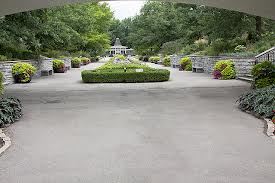 Hendrie Gardens RBG “Royal Botanical Gardens puts nature’s beauty on display, but it isn’t a park system. It teaches but it isn’t a school. It protects and preserves forest and marsh, but it isn’t a conservation authority. It collects and propagates botanical knowledge and plant life, but it is not a library, museum, or laboratory. It is all those things and more than their sum”.
Designated as a national historical site, RBG is revered worldwide for its extensive 400 acres of display gardens. What makes RBG unique is that it also protects and stewards over 2300 acres of environmentally sensitive lands and diverse ecosystems that connect the Niagara escarpment to Lake Ontario. In acknowledgement of this crucial environmental role, Royal Botanical Gardens was granted a provincial mandate in 1941 for the development of four areas of focus: Conservation, Education, Horticulture and Science. In the 70 years that followed, RBG has established a national and international reputation as a living laboratory for science, a connecting point for children in their early embrace of nature, a leader in sustainable gardening and the standard-bearer for ecological restoration and plant preservation.
In the face of devastating environmental threats worldwide, RBG is more relevant now than ever before. Its established and evolving environmental programs provide straightforward, workable solutions designed to maintain sustainable biodiversity in Canada, for the world.
 Thomas Baker McQuesten Thomas McQuesten
Thomas Baker McQuesten (June 30, 1882 – January 13, 1948) was born in Hespeler, Ontario (now Cambridge) and received his primary and secondary school education in Hamilton. Following high school, McQuesten attended the University of Toronto and continued his studies at Osgoode Hall, receiving his law degree in 1907. McQuesten served as an alderman on Hamilton City Council and later, a Liberal member of the Legislative Assembly of Ontario (representing Hamilton- Wentworth).
McQuesten, whose family had deep roots in Hamilton was a key player in infrastructure development across Ontario and is credited with bringing forward the Queen Elizabeth Way, Royal Botanical Gardens and many other projects. McQuesten was a tireless advocate for the development of parks and conservation areas. For instance, his advocacy for parks on Hamilton, Ontario City Council earned him an appointment to the permanent position on the Board of Park Management in 1922, where he remained until his death in 1948. In this position, he supported the construction of the Rock Garden and other landscaped areas on the Burlington Heights (Ontario), which became part of Royal Botanical Gardens in 1932. After his retirement from electoral politics, McQuesten resumed his interest in RBG and became an executive member of that organization, active there until just before he died.
Artwork Location
The artwork will be located in the Dalglish Family Courtyard. The courtyard serves as the entry point to the newly rejuvenated Rock Gardens at the Royal Botanical Gardens. The three-year, $20 million project provided the garden with major upgrades in infrastructure, accessibility and landscape design. This included improvements to the garden’s structural integrity, water and sewage systems, visitor accessibility, and architectural landscape. In addition, a new visitor centre was constructed to serve as a year round destination for business and private functions.
Just outside the visitor centre, the Dalglish Family Courtyard is an elegant space that serves as both a welcoming point for guests making their way outdoors and a venue for social occasions and gatherings. Alpine plants representing true rock garden vegetation grow from the beautiful stone walls, and gentle waterfalls creates a peaceful atmosphere.
The artwork will be sited in the eastern portion of the courtyard is the primary location for the artwork. Artists may propose an artwork in series or ancillary piece that makes use of Site B as a secondary location (optional).
 Locations for the sculpture in the Daiglish Family Courtyard. Artwork Design Parameters
The artwork must adhere to the following design parameters:
• The artwork must be an exterior, sculptural installation.
• The artwork should contain elements that are representative of Thomas Baker McQuesten. The artwork could be a formal commemorative sculpture or could contain elements that are more interpretive in nature in combination with figurative elements
• The artwork should express the passion and commitment of McQuesten to the natural environment and the Royal Botanical Gardens
• Fabricated using high quality, long-lasting materials that are highly resistant to theft, vandalism and weathering
• Must not pose a risk to public safety (i.e. no sharp points, does not allow climbing to restricted areas, no slip hazards, etc.)
• Does not incorporate light, video or sound elements
• Artwork does not restrict visitor’s movement within the courtyard or compromise accessibility standards
• Meets all Ontario building code standards (https://www.mah.gov.on.ca/Page7393.aspx);
• The selected artist will be required to submit drawings certified by a structural engineer licensed to operate in Ontario
Budget
The budget for this project is $140,000 CAD (maximum, exclusive of HST). This is the total amount available for all related expenses of this public art project including (but not limited to): artist fees, materials, site preparation, technical consultation, fabrication, installation, any required above or below-grade foundations, insurance, equipment, permit fees, and travel.
RBG grounds staff will be available to assist in site preparations, general labour and have a significant skillset and available equipment that may be used during installation. To ensure the budget is being maximized an installation consultation will occur with each short-listed artist.
 When the flowers and plants are in bloom the RBG is one of the most beautiful places on the planet. Eligibility
This competition is open to all professional Canadian artists. Artist collectives and/or artist-led teams are also encouraged to apply. The selected artist must be able to travel to Burlington, Ont. for a minimum of two visits: one technical consultation meeting and one visit to manage the installation of the artwork and to engage in public dialogue (i.e. artist talk / public unveiling event).
The selection panel is comprised of the following representatives:
- Camilla Dalglish, major gift donor
- John Best, author, Thomas Baker McQuesten: Public Works, Politics, and Imagination
- Tobi Bruce, Director, Collection & Exhibitions / Senior Curator, Art Gallery of Hamilton
- Jeremy Freiburger, Executive Director, Cobalt Connects
- Andrew Hunter, Fredrik S. Eaton Curator, Canadian Art, Art Gallery of Ontario
- Mark Runciman, CEO, Royal Botanical Gardens
- Maryella Leggat, resident & RBG supporter.
Estimated Project Timeline (2016-17)
December 2016 Expression of Interest document released
January 20, 2017 Deadline for Stage One: Expression of Interest
By January 31, 2017 Selection committee applications, selects short-listed artists
March 17, 2017 Short listed artists’ Concept Proposals due
By March 31, 2017 Steering committee reviews proposals and selects winning artist Selected artist enters into a contract with the Royal Botanical Gardens
September / October 2017 Artwork is installed
What’s the rush? If they are going to commemorate McQuesten -do it right.
By Pepper Parr
January 9th, 2017
BURLINGTON, ON
There is always a certain amount of rivalry – call it give and take – between Burlington and Hamilton. The relationship has changed from one where Burlington was basically a bedroom community attached to Hamilton to what is now more of a partnership between the two cities. The Bay Area Economic Summit was a very good example of what the two cities can achieve when they work together.
Burlington city manager James Ridge’s meeting with Hamilton bureaucrats over getting the LaSalle Park water lots into the hands of Burlington might fracture that relationship a little. We are likely to get outsmarted by Hamilton on that transaction. But I digress
With the federal government telling us how they are going to spend our tax dollars as we celebrate our 150th anniversary as a country – that’s what a Sesquicentennial is – all kinds of ideas are popping out of nowhere.
One of the federal ideas is to have a couple of chaps travelling across the country with a red leather chesterfield on which they are inviting people to sit on with them and tell stories about Canada. That one is almost as wacky as some of the Canada Council grants we hear about.
There is one grant application that doesn’t appear to involve very much in the way of tax dollars but might appeal to Burlington’s pride – even though the object of all the attention is located in Hamilton.
 These were the ships that fought the Battle of the Atlantic, the longest naval battle in history. Shown here is HMCS Haida, currently tied up in Hamilton. And that is the Tribal Class destroyer HMCS Haida that is tied up in Hamilton in a place that is not that easy to find. But the good ship Haida is there.
There is a petition sponsored by Project Naval Distinction that they would like you to sign to have the ship named as the “flagship” of the fleet.
This is our opportunity to recognize a Canadian icon of excellence, the last of its kind in the world.
The ‘fightingest ship’ Canada has ever produced, Her Majesty’s Canadian Ship (HMCS) HAIDA served during the Second World War, the Korean War and the Cold War, sinking more enemy tonnage than any other ship in Canadian history.
 When you get to the web site just enter E560 for the petition you want to sign and they will take you through the process. The sponsors of the petition want to see Haida given due recognition during the Canada150 celebrations.
Go to
petitions.parl.gc.ca
 While not known as a naval city – Burlington has always had a strong naval pride. A portion of the monument on the Naval Promenade at Spencer Smith Park. before February 22nd, 2017 and add your signature to petition E-560 to honour the incredible accomplishments of HMCS HAIDA. This is a simple and symbolic way that you, and those you share this petition with, can make the Canada150 celebrations even better.
This is one of the better Canada 150 projects – all they are asking for is your signature.
|
|





 Tom Muir is a resident of Aldershot who has been a persistent critic of decisions made by city council. He turns his attention to the current school board mess. He recently suggested to Burlington city council that “If you are so tired of and frustrated by, listening to the views of the people that elected you, then maybe you have been doing this job too long and should quit.
