By Gazette Staff By Gazette Staff
August 19th, 2025
BURLINGTON, ON
The Great Disconnect is a documentary that features Canadian voices, asking the questions:
“Can we be individualistic and communal?”
“Is it possible to overcome our modern culture of disconnectedness and rediscover how truly essential we are to one other?”

The film explores themes around how isolation and conversely connection are critical health issues.
 Join Community Development Halton (CDH) as we celebrate 41 years of connecting community as we offer a screening of The Great Disconnect, followed by a panel featuring local research, solutions and shared stories from CDH members about how we bridge disconnection to belonging in Halton. The panel guests include: Join Community Development Halton (CDH) as we celebrate 41 years of connecting community as we offer a screening of The Great Disconnect, followed by a panel featuring local research, solutions and shared stories from CDH members about how we bridge disconnection to belonging in Halton. The panel guests include:
· Elizabeth Wells from Our Kids Network
· Steven Barrow from CDH
· Hanadi Al-Masri from HMC Connections
· Michelle Sparling from Just be You
The event is free but registration is required. Click HERE to register
We hope to see you in September 9th. Doors open at 5:30pm with refreshments. The program begins at 6:00pm.

By Gazette Staff
August 16th, 2025
BURLINGTON, ON
Social media has given people an opportunity to say what they think on major community issues.
A Burlington resident who lives in a Lakeshore Road condo that over looks Spencer Smith Park posted a question on Facebook about funding the Sound of Music.
Here are some of the responses:
Candy Multamaki
Charge $5 per person for entry. Small enough to be affordable but enough to help with costs.
Dave Gionet
Try reaching out to streamers on X/Twitter. A lot of people on there don’t mind contributing to events they can stream with their proceeds. Try reaching out to schools for garbage pick up or minor volunteer work because students need to have so much community service hours put in. My parents did this for students when they were running a walk-a-thon in Hamilton for a bunch of years.
Samantha Maddison
For me it is about accessibility. It just isn’t feasible with a walker or wheelchair. I too would pay for more appealing line up with accessible ease. In this changing climate cooling areas and stations would be welcomed.
Kim Lalonde
Bring back street closings and street festivals, was just talking to a,retailer on Brant Street who did half in sales compared to last year. The street festival part of Sound of Music was the best.
Laura Wayne
I attended a symposium this year that discussed the future of music venues, large and small, in Toronto. Two of the key things that were noted by the presenters / experts are that too many people put their noses up at the thought of paying a cover fee to enter the venues when live music is being performed. As well, that alcohol sales are way down due to the cost to the consumer and cannabis now being legalized (and not for sale at the venue). I for one have no issue paying a reasonable cover charge when I know music I am interested in listening to is being performed. I do not have a solution to propose, but those are two of many issues that were discussed.
Kurt Sorensen
Partner with Rotary and merge with Ribfest, perhaps without the ribs and let the focus be local music with miscellaneous food options.
Mark Langlois
I was at the free kitchener Blues fest over the weekend. Looks like that event is thriving. Might be worth organizers to reach out to other successful events to see what they do differently.
Donna Dmd
It was better when it first started. Closing the streets & having various types of music in different areas.
Go local. Get back to basics. Not every band needs to be a head liner.
Get a good fundraiser. There are numerous businesses in Burlington.
Ditch the fence, that is suffocating & hard to get out.
Find a better park, with parking.
Keep it free – by donating at entrance with whatever one can afford. $1.00 / $2.00 etc…
Joseph Whiteman
Im on the charge bandwagon, wouldn’t go higher then 20.00. That’s what the biggest Canadian festival charged, the sars benefit cost. Also, When I was there this year. I was also sad seeing no street festival. Maybe that could come back as well. Music wise it hasn’t been too bad, but putting all music in one place with the two stages, with staggered times. This would cut some cost.
Alisha Mcmaster
Do what Oakville used to do. Charge a small fee for a weekend pass but allow the pass to give access to public transit to get down there as well. Anything on the side streets remain free but anyone wanting to go get in on the actual concerts have to pay.
Jimbo Jones
How about moving from Burlington to Hamilton
Top fan
Ted Bullock
What happened to Tim Hortons as a sponso
Susan Lord
It’s got to crowded. I used to enjoy it.
Rebecca Bowen
Absolutely start selling tickets/wristbands ($10 per person for a weekend of fun, will add up on your end). Oakville used to have the Waterfront festival. You purchase a button and with that came your entrance and free bus transportation all weekend. People will pay. I respect that you hold so high being a free festival, but free is in the past (unfortunately). SOM is Burlington. People will pay. Good luck!
Broad range of views . Are the Sound of Music people listening?
By Pepper Parr
August 14th, 2025
BURLINGTON, ON
First, there was the Mayor’s Statement on the Sound of Music (SoM: it was iconic (a much overused word) then there was mention of the legacy and lots of good feeling words.
Later on the same day – Dave Shepherd released a statement on how dire things were for the Sound of Music (SoM) and that if there wasn’t any sponsorship, the event didn’t have much in the way of a future.
The Mayor set out the kind of money the city was putting into the event – not all that much – especially when you take into account the different fees the SoM had to pay the city.
What didn’t get mentioned was the business plan the SoM was required to submit for 2026 event. That was due June 1st, 2025
Producing the business plan was one of the conditions attached to the $225,000 the city loaned SoM to get the 2025 event off the ground.
What we are seeing is a lot of running around like chickens with their heads cut off – precious little in the way of a solid document put together by people who understand marketing, understand the music business and know how to get all the relevant data onto a spreadsheet that they then analyze.
Related news story:
Mayors Statement
Sherherds’ plea
What is really needed
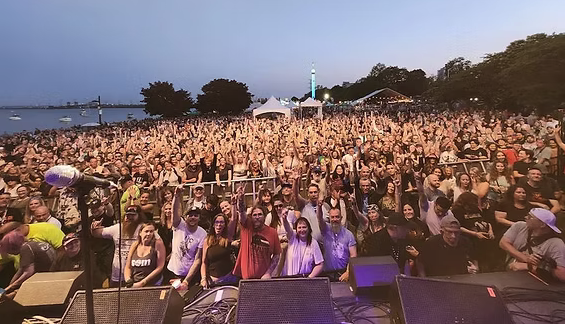
 How do you lose money with crowds like this?
By Pepper Parr
August 13th, 2025
BURLINGTON, ON
Do you get the impression that Sound of Music (SoM) is scrambling?
And can you smell the political interference? Out of the blue, the Mayor issues a statement expressing her complete support for the SoM. A day later there is a statement from SoM setting out the gravity of their financial condition.
 The audience is there. Should they be asked to pick up some of the cost? SoM is a business – it just isn’t being run as a business. While discussing a financial problem at City Council SoM chair Dave Sheppard responded: “I’d just like it to go away”.
On that occasion someone came forward and directed the Community Foundation to send funds to SoM. We don’t know how much that was nor who made the funds available. Everything the Community Foundation does is secret as it should be.
There is a serious problem. SoM continues to look for corporate sponsorship. That model has come to an end, and the people running SoM should have been aware of that.
One of the problems at SoM has been the turnover at the leadership level. Entertainment is a very complex business – it needs people with years of experience at the helm. Sheppard, through no fault on his part, found himself serving as chair
 These are the people who get things set up before the event begins Administratively the SoM has an incredible team of people who make the wheels go around when the event has to be set up.
There are a number of opportunities for the SoM to change the direction and the funding model. Find the help from within the community – it is there.
Burlington has about 15, maybe 20 marketing organizations that are world-class operations.
Sheppard wants to get some help in identifying just who they are and approach them for help. This is something former Mayor Rick Goldring could help out with. He knows these people and is no longer part of the political process in the city.
Pull ten or so of them together – set out the situation and look to them for advice. That means opening their books
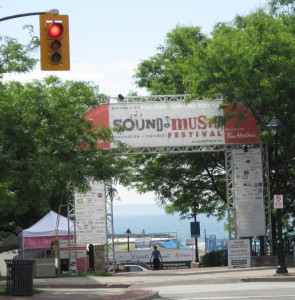
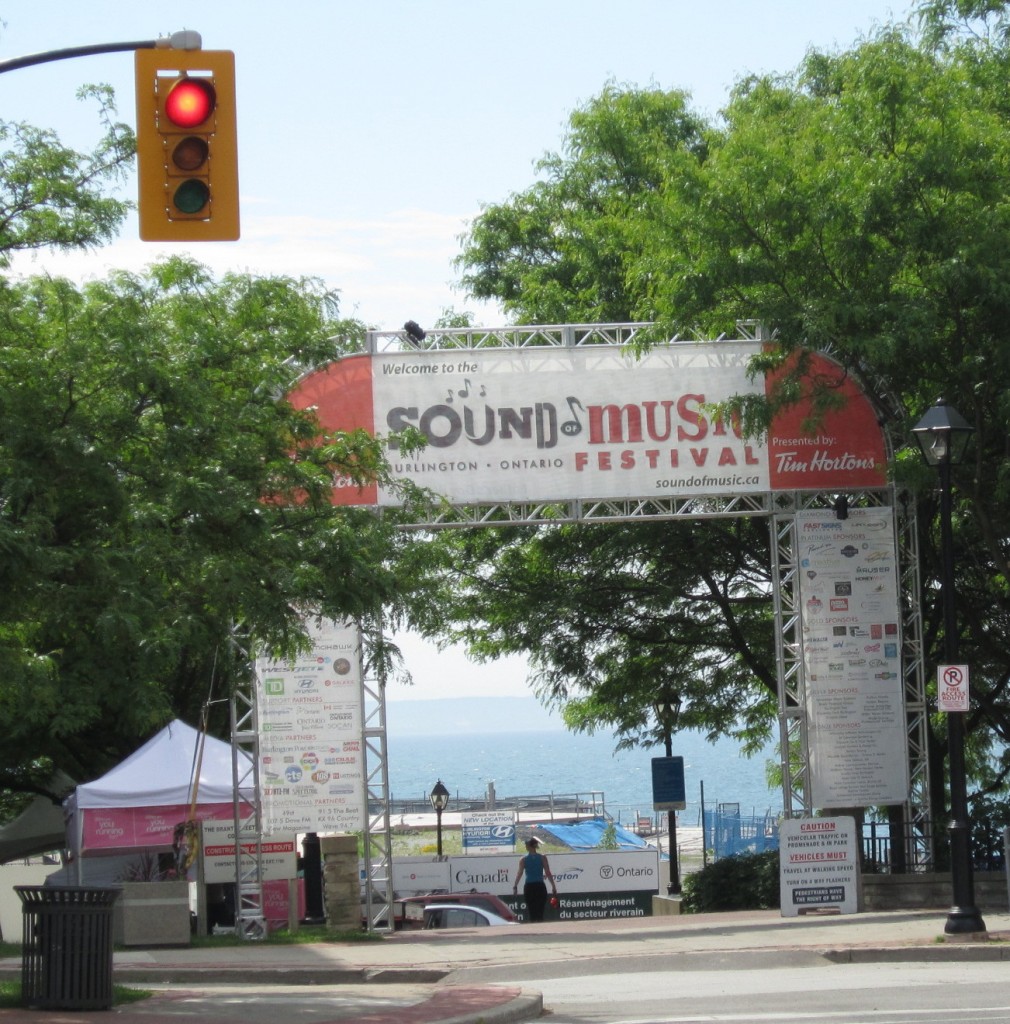
 A tired-looking sign, slightly shabby. The SoM has forgotten about its public profile. The graphics are old, tired-looking, and slightly shabby. They should have been upgraded five years ago.
 That graphic defies description. And the logo – what does it say to you? To me it looks like something put together by a ‘stoner’. Upgrade it.
Look progressive, tell the story about people who have gained the public notice they needed from the SoM stage.
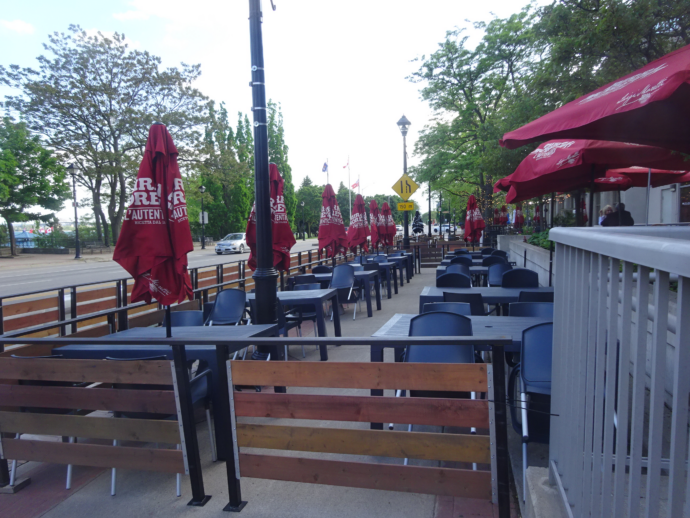
 This stretch of commercial activity is filled during the Sound of Music. Mention is made by the SoM people about the economic impact on the local economy. There is no doubt that the hospitality sector does very very good business during SoM week. Why isn’t that sector putting some of that additional revenue in the SoM coffers?
The city charges the SoM music for at least half a dozen services it provides. They pay for the use of Spencer Smith Park. It would be difficult to reduce the rate for SoM but the city could get creative. They managed to find a way to get funds to Burlington Green when they ran out of sponsorship and Trillium funding.
SoM has to have a conversation with the talent. Lowering just how much is paid to those who take the stage might be due. The public would be surprised as to just how much SoM pays out to the artistic talent. It is extensive.
There are more reasons to keep the SoM as an annual event than there are to let it become something Burlington used to be known for.
The Brant Inn came to an end because of poor management.
This doesn’t have to be the reason for bringing the Sound of Music to an end.
By Pepper Parr
August 13th, 2025
BURLINGTON, ON
After 45 years of music, memories, and community–building, the Burlington’s Sound of Music Festival is facing a crisis. As Canada’s largest free outdoor music festival, we have brought together more than 400,000 visitors annually, offered a stage to 50+ Canadian artists each year and contributed an estimated $25 million in economic impact to Burlington and the surrounding area. Now, with sharp declines in public arts funding and sponsorship, our future is now uncertain.
What was once a thriving example of free and accessible live music is now grappling with the hard truth: We can no longer sustain this festival without urgent financial support!
 Funding Cuts Are Undermining a Legacy Funding Cuts Are Undermining a Legacy
The federal Heritage Fund, which traditionally supported with $200,000 annually, now only offers grants up to $50,000. Other funding programs have been similarly reduced in material amounts. These losses, compounded by shrinking sponsorship dollars, have created a critical gap that threatens the very heart of the festival.
“We’ve done everything possible to run lean without sacrificing safety or the quality of the experience,” says the Festival’s Board of Directors Chair, Dave Shepherd. “We’ve trimmed costs – over $500k has been removed in the last 2 years, streamlined operations, and maximized efficiencies. But we are now at the edge—without new partners stepping in, we don’t know if we can keep going.” Shepherd goes on to add that “the festival is run and managed professionally, but the real magic happens with our dedicated volunteers who clock an impressive 6000 hours, over the festival weekend. We provide a great opportunity for summer youth employment each year as well, for some of the students in our community. “
A Proven Economic Engine and Cultural Beacon
A recent survey conducted with Burlington Economic Development and Tourism underscores what we’ve long known:
42% of attendees come from outside the city, with many staying 4+ nights, boosting revenue for hotels, restaurants, and retailers.
90% of out–of–town visitors plan to return to Burlington after attending
Over 40 local businesses were showcased as community partners
The festival provided contracts in over$ 500k in value to Southern Ontario based businesses
 Is everyone benefitting? This is more than a festival. It’s an economic and cultural anchor that helps define Burlington’s identity, attracts tourism, and promotes small business success across the city and region.
Call to Action for Community Champions – The time to act is now!
We’re calling on community leaders, philanthropists, corporate partners, and anyone who believes in the power of music and arts to help. We urgently need a major sponsor or group of sponsors to join us in protecting this treasured event and ensuring that future generations can continue to experience the joy, connection, and inclusivity that live music offers.
Why It Matters
In a time where connection and community are more important than ever, free and open access cultural experiences matter. The Sound of Music Festival is a safe space, a mental health booster, and a platform that breaks down barriers. It is one of the last of its kind—a rare event that remains completely free to attend, offering world–class performances to everyone, regardless of income or background. There is no barrier to entry!
This is more than a funding shortfall—it’s a community crossroads. Without immediate support, we risk losing a 45–year tradition that unites thousands in celebration every summer.
 A tired, well past its “best before” date sign. Close to shabby. Let’s Keep the Music Playing
If you are a business leader, a brand that values impact, or a citizen who wants to make a difference, we urge you to reach out. Sponsorship opportunities, legacy partnerships, and creative collaborations are all on the table.
Its time for change! Together, we can and must keep the music alive!
For more information or to schedule a conversation about sponsorship opportunities, please contact:
Brent Kinnaird – VP Festival Operations
Dave Shepherd – Chairperson, Board of Directors
Julie Cole – Vice Chairperson, Board of Directors
By Gazette Staff
August 12th, 2025
BURLINGTON, ON
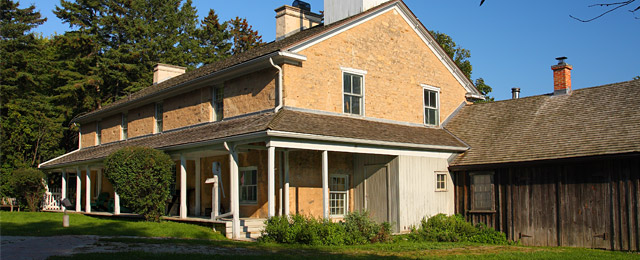
 Ireland House, one of the few early 18th-century homes still standing in the City. The folks at Ireland House invite you to step back in time and explore the grounds of Ireland House Museum during the Classic Cars & Carnival event!
Enjoy a nostalgic array of classic cars, try your hand at ring toss, and treat yourself to timeless treats like popcorn and cotton candy.
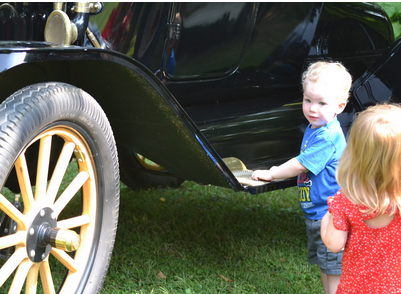
 His great-grandparents may have driven a vehicle like this. There will be family friendly entertainment and activities throughout the day, and the Burlington Teen Tour Boosters will be onsite with a barbecue. Guided tours of the historic house will be available for booking (regular tour rates apply).
Admission to the event is by donation, suggested donation of $5/person. All proceeds from the event support the development of our education programs and management of collections at Ireland House Museum.
Saturday, August 23 | 10:00am – 2:00 pm
Ireland House Museum
Ireland House is a historical house and property and the original homestead of the Ireland family. With guided tours, visitors step back in time to understand the life of early settlers.
By Pepper Parr
August 11th, 2025
BURLINGTON, ON
Does anybody know how many people attended the Sound of Music (SoM) last June?
Not a word from the SoM folks. Nothing from the city either
We now know a little bit more on what takes place on their financing.
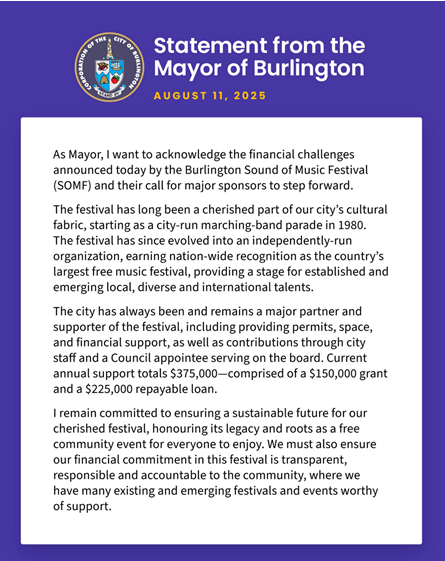
The Mayor issued the following earlier today.

 No idea why the Mayor issued the statement. No mention of whether the loan has been repaid or when repayment is due. There is a lot more than the above when it comes to what the SoM people bring in in terms of sponsorships and revenue and what it spends for the talent that appears on the stages.
The not-for-profit sector is not required to produce financial statements.
A large part of their operational costs are things they have to pay the city to provide – they also have to pay the Police service a considerable amount.
Dealing with artistic talent is not easy – SoM has not always had the kind of talent needed to mange artists.
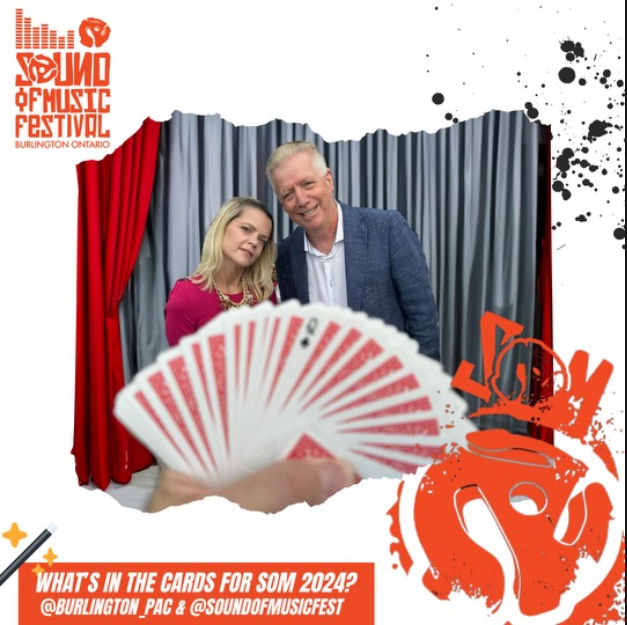
 The graphic said more than it was supposed to. Their relationship with Burlington Performing Arts held some promise; the Executive Director who got the two (BPAC and SoM) together had dep rooted experience she could draw on.
Her abrupt departure as Executive Director brought that to an end – nevertheless, BPAC still describes itself as the sponsor of SoM without defining just what that sponship entails.
The Performing Arts Chair is a former band player who has always been close to SoM. He has yet to make himself available for an interview.
No idea what possessed the Mayor to issue the statement.
By Mark Gillies
January 15, 2015
BURLINGTON, ON
Burlington is using the month of August to celebrate local history. Sometime ago the Gazette published a series of articles by Mark Gillies, a lifelong Burlingtonian. It is appropriate to re-publish the stories about the people who built this city. This is part two of the Spencer Smith story.
Spencer Smith got to Canada as part of the immigration of British children into Canada and Australia. The children were shipped from England by well meaning people but there were some horrific abuses and I believe it is necessary to expand the Spencer Smith story and learn more about how these boys who, without their consent became indentured servants. They were referred to as “Home Children”.
The poem Spencer Smith wrote, it was included in part 1, aches with the longings of a man who missed so much of a natural childhood.
 Home children on a dock in St. John NB – waiting for trains to take them east. The concept of Home Children started with honourable intentions; with good people trying to salvage young children from a parent-less home, or incredible poverty. Relocate them to a better life in Canada or Australia, that’s all they had to do. What’s the problem with that?
What made the idea work, was that farmers in Canada and Australia faced a severe labour shortage. They had recently immigrated themselves from Europe, cleared their fields, and grew their crops. Only problem was, who was going to do the harvesting, tend to the fields, feed the animals, and everything else that farmers do in this difficult labour intensive profession?
They didn’t have anybody to help. Governments were perplexed as well; those in Canada and Australia were more than happy to bring in immigrants to open up land and create farms. Sometimes they even gave them free land and supplies, but governments overlooked one part of the equation. Who is going work these large farms? They desperately needed a solution, and quickly.
 No doubt about it, everyone at the time believed this was a “WIN-WIN” situation. Spencer Smith’s story was a perfect example of one that seemed to have a happy ending. No doubt about it, everyone at the time believed this was a “WIN-WIN” situation. Spencer Smith’s story was a perfect example of one that seemed to have a happy ending.
Featherstone Martindale & Spencer Smith.
Spencer Smith’s sponsor was Featherstone Martindale from Caledonia. If you have ever been to Caledonia, it seems that about every third person you meet has the last name Martindale. They are a fantastic local family and they show up everywhere in Caledonia. Featherstone was born in 1848 in Haldimand County. Featherstone must not have been impressed by his first name, because he always went by the name Fred. He was a good honest man and a hardworking farmer who desperately needed help on his farm. Fred over the years became a father of 8 children and had married 3 times.
The Farmer’s Wife in Spencer’s Poem
In Spencer’s poem, he speaks of the farmer’s wife who influenced him. Spencer was referring to Eliza Mary Shult, who was Fred’s second wife. His first wife Eliza Jane Anderson died in 1881 after giving birth to a daughter named Ann. Fred married Eliza Mary Shult on January 8, 1883, and the new couple proceeded to have 7 children, the first born was Frederick who died in early 1884. Then another son named Featherstone was born in late 1884, and another 5 children were born between 1886 and 1895. In 2 quick years from 1883 to 1885 Eliza had married, and brought along her own small son named Wilfred McBride who was 5 years old from her previous marriage, when her first husband John McBride died from tuberculosis in 1879.
Spencer arrived on the farm May 21st, 1885 when Eliza Mary was just 28 years old. She was quite a busy young lady herself by the time he stepped down from the carriage. This young lady seems quite remarkable to me, since she still had some extra maternal time to still dote on young Spencer, something that helped shape his life.
 Eliza Mary Shult, the second wife of Featherstone Martindale had a huge influence on Spencer Smith, and he fondly recalls about her in his poem written in 1911. I’m sure old Fred would be quite crusty at times, and probably scared the lads half to death many more times, but Spencer’s poem has a softer edge to it, especially towards Eliza Mary. Eliza Mary died in 1895 from complications of the birth with her last child George Martindale. By this time, young Spencer had already left the Martindale farm. If Spencer actually stayed the full 3 years until he was 18, his servitude would come to an end in January 1888. After the death of Eliza Mary, Fred married a spinster named Margaret Anna Peart in 1907.
The Peart family in Caledonia, which is very large in number, just like the Martindale’s is somehow linked to the Peart family in Burlington, my guess is they are probably cousins. It’s only speculation, but the Jacob Peart farm in Burlington is on the land now occupied by Fortinos, Sears and Ikea, so maybe there was a connection for Spencer Smith to come to Burlington, especially if it was initiated through the Peart families in Caledonia and Burlington. The Peart farm was located directly across Plains Road from the Bell homestead. We’ll never know for sure, but we can at least think about it.
Spencer Smith was quite fortunate and did not face some of the severe hardships that other Home Children experienced. Far too many faced a certain hell of an existence.
The Truth about the British Home Children in Canada
Here’s what really happened to most of the British Home Children.
 This became an economic issue more than anything else. It was strictly a case of supply and demand. Most of these organizations were faced with a huge demand. They had great difficulty in meeting the demand by farmers and governments in Canada and Australia. It was stated at one time that there were 10 applications for every child. So what were they going to do? The answer was simple. Start rounding up any child who potentially was wayward and lived in the area that was to be scoured for recruits. Overly simplified, absolutely, but not by much. This became an economic issue more than anything else. It was strictly a case of supply and demand. Most of these organizations were faced with a huge demand. They had great difficulty in meeting the demand by farmers and governments in Canada and Australia. It was stated at one time that there were 10 applications for every child. So what were they going to do? The answer was simple. Start rounding up any child who potentially was wayward and lived in the area that was to be scoured for recruits. Overly simplified, absolutely, but not by much.
The fact remains, that the original concept was for orphaned children. The reality was that only 2% were orphans. The rest were children in the wrong place at the wrong time. It’s true that during these times some parents had great economic problems, perhaps they were unemployed or seriously ill, and they had no choice but to hand over their children to a workhouse, or some other care facility until they could get back on their feet and then bring their children home. The truth is, these organizations to help meet the demand, decided to ship them overseas without their parents’ consent. Most of these children had no idea what was happening to them. The parents did not know either. The children never realized that they would never see their family again.
 Dr. Thomas Barnardo was a very controversial character, and was responsible for exporting thousands and thousands of British children out of England and relocating them mainly in Australia and Canada. Here he is in 1905 leading the Founder’s Day Parade shortly before his death that same year. The largest organization was run under the management of its controversial founder Dr. Thomas Barnardo. He somehow convinced the Canadian and Australian Governments to take these children. Once that was established, then other organizations like the Shaftesbury Homes, the Salvation Army, churches, and others also jumped on the bandwagon. Probably, none of these add on organizations realized that down the road, this program was going to spiral way out of control, and thousands and thousands of small children were going to be totally exploited in this moneymaking scheme to supply cheap child labour to Canadian and Australian farmers. You can dress it up any way you want, citing testimonial cases that turned out good, reminding people that they were paid a small amount, some orphans were adopted by loving families, but in my opinion, the bare bones reality was: Canada, Australia and England were totally involved in a repulsive child slavery program.
Whatever happened to the other 32 boys who made the trip to Hamilton?
When I researched for information on the other 32 boys that made the trip to Canada with Spencer Smith, only about 2 boys continued to surface on available records. The Flamborough Historical Society has documented one of these Home Children. That boy went on to marriage, become a father and worked as a market garden farmer in Aldershot. He turned out okay.
Spencer Smith turned out okay. The others, they completely disappeared. We know some could have been adopted and had their surnames changed. As an outsider, it is basically impossible to track them. We already know that conditions for some children were so severe that they continually ran away from the farms they were working on, and many were beaten to a pulp when they were caught and returned. We know with documentation as proof that over two thirds of all the British Home children were beaten severely. We know that many of these children were not allowed to become part of the family that was caring for them.  They were forced to live in exclusion on the farmer’s property, and not interact with the farmer’s own children or have any friends of their own. They were not loved or nurtured in any way. We know that they were constantly tormented and bullied by other children at local schools, and even adults participated in this human degradation of these children. We know that many just eventually disappeared. Where you ask? They were forced to live in exclusion on the farmer’s property, and not interact with the farmer’s own children or have any friends of their own. They were not loved or nurtured in any way. We know that they were constantly tormented and bullied by other children at local schools, and even adults participated in this human degradation of these children. We know that many just eventually disappeared. Where you ask?
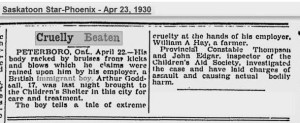
My guess is some were probably murdered when they were beaten so severely by the farmers, and when authorities came around they just claimed that they ran away. Some children because of horrific living conditions probably became so ill, that they died on the farm, and were quietly buried on the property so as not to draw any suspicion. Others may have committed suicide, and became nothing more than John or Jane Does stashed away in a local morgue, waiting for no one to identify them. Whatever the reason, they’re gone, and we don’t know have explanations. Have a look at this story that appeared in the Saskatoon Star-Phoenix newspaper on April 23, 1930 about a young British Home Child boy named Arthur Godsall who was savagely beaten on a farm in Campbellford by farmer William Albert Hay, age 37.
 Albert had just arrived from England with many other British Home children and they all disembarked at Halifax from the ship Albertic on March 17, 1930. Albert had just arrived from England with many other British Home children and they all disembarked at Halifax from the ship Albertic on March 17, 1930.
Albert made his way to the Hay’s farm in Campbellford, and less than a month after he arrived he endured this beating and was finally rescued. That’s just one tragic story, there were thousands of stories just like this. One boy was forced to live outside in the dog house with the farm dog. The farmer fed the dog table scraps, and if the dog was full and if by chance there was any dog food left over, it was for the boy to scavenge. Not to mention that this same farmer viciously beat the boy almost daily. Eventually, he was removed from the farm, and as far as I know this farmer did not face any charges. This is unbelievable, but true. This happened in Canada. If you do some basic internet research, you will find these stories and many more.
What’s really disturbing is just how low profile this tragic event in human history was, and just how little we know of it now. But, it is becoming more widely known, and just recently as victims have finally come forward. In Australia for example, the Australian Government were finally brought to their knees by a public outcry after the public learned the truth from these victims, and the government brought forth an apology for their involvement in this hair-brained scheme. Also, the British Government were totally embarrassed by previous governments’ involvement in this tragic situation also came forth with an apology offered by then Prime Minister Gordon Brown. And what about the Canadian Government?
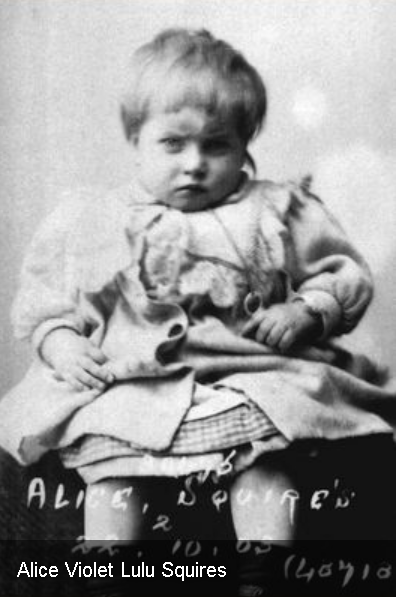
 Where do we stand? Sadly, and unfortunately, the Canadian Government has essentially taken the position that this isn’t really a big deal, and no apology is warranted or forthcoming, even though they backed and encouraged this form of child slavery and abuse under the guise of helping disadvantaged children. Personally, I think that Jason Kenney the Cabinet Minister responsible for these remarks was not that well informed on the situation when confronted with the apology question, and consequently brushed it off as unimportant. I encourage you to contact Burlington’s local Federal Member of Parliament, Mr. Mike Wallace, who is a very decent man, and please voice your concern. I would like to think that Mike can champion this cause and help us get this apology from the Canadian Government. It’s long overdue, and it’s the right thing to do. Where do we stand? Sadly, and unfortunately, the Canadian Government has essentially taken the position that this isn’t really a big deal, and no apology is warranted or forthcoming, even though they backed and encouraged this form of child slavery and abuse under the guise of helping disadvantaged children. Personally, I think that Jason Kenney the Cabinet Minister responsible for these remarks was not that well informed on the situation when confronted with the apology question, and consequently brushed it off as unimportant. I encourage you to contact Burlington’s local Federal Member of Parliament, Mr. Mike Wallace, who is a very decent man, and please voice your concern. I would like to think that Mike can champion this cause and help us get this apology from the Canadian Government. It’s long overdue, and it’s the right thing to do.
Here’s how to reach Mike Wallace, Member of Parliament: Burlington Mall Office, 777 Guelph Line, Suite 209, Burlington, Ont. L7R 3N2. T: 905-639-5757 or F: 905-639-6031
House of Commons, East Block, Suite: 115, Ottawa, Ontario, K1A 0A6
T: (613) 995-0881; F: (613) 995-1091 or email, mike.wallace@parl.gc.ca
There is an incredible website on the British Home Children. https://canadianbritishhomechildren.weebly.com/
It tells the whole story of the plight of these exploited children. It will break your heart to read and watch some of the videos made by former Home Children, these men and women who are now elderly, who have finally broken their silence to tell the real story of what happened to them. The website also has a form that can be signed. It is a petition to persuade the Canadian Government to offer an apology to these unfortunate people, many still alive in Canada, and still suffering mental anguish.
Add the website to your “Favourites”. It is quite large and takes a fair bit of time to go through it properly, so you will likely have to go back several times. The website also is constantly updated with more unbelievable stories about this shameful part of our Canadian past.
By Ray Rivers
August 10th, 2025
BURLINGTON, ON

This is a story of passion and valour; a story of small victory and great losses, and the story of civilians turned combatants in a time of need.
In 1812 over 200 American troops crossed the international border from Fort Detroit to invade Canada. A bridge in their path near Windsor Ontario was defended only by two British soldiers
– and this is their story.
Canada is not the only nation with a bullying neighbour. The history of Ukraine is a story of invasions and occupations spanning hundreds of years. Ukraine had over 16,000 bridges when the
war started and they became one of the best weapons of defence for the nation under attack.
When the Russians came it became the duty of all Ukrainian men and women to fight for the freedom of their nation. They were joined in this struggle by some of the millions of diaspora living
in other places around the globe, including Canada.
Their story is just another of the many that have characterized Ukraine’s struggle for survival from becoming another just Russia oblast – its 51st state.
Editor’s note: Ray Rivers is the Director ofd the play and also the author of the script. He plays a part as well.
Tickets:
By Mark Gillies
January 12, 2015
BURLINGTON, ON
Burlington is using the month of August to celebrate local history. Sometime ago the Gazette published a series of articles by Mark Gillies, a lifelong Burlingtonian. It is appropriate to re-publish the stories about the people who built this city. Today we retell the story about the man the lake side park is named after – Spencer Smith.
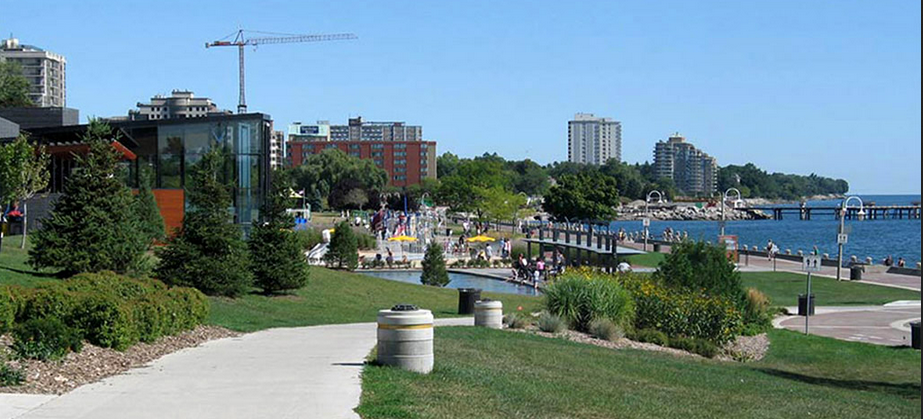
 Here is Spencer Smith Park as it looks today; a park enjoyed by thousands of residents annually, all thanks to the vision of a single man. . One of the most recognized names in Burlington is Spencer Smith. We have named Burlington’s most scenic park in his honour. Spencer Smith Park, located on the shores of Lake Ontario, is used for many events that attract thousands of visitors annually.
We know the park; we really don’t know who Spencer Smith was, and just what it was that made him so significant to Burlington?
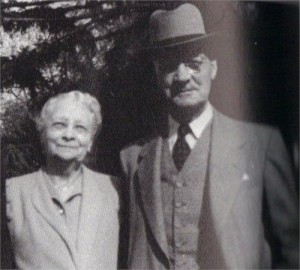
 Spencer and Edith Smith a happy couple who enjoyed living and working in Burlington. If you read last week’s column on Edith Hodge, one of Burlington’s earliest settlers, you would have discovered that Spencer Smith was Edith’s son-in-law. Spencer married Edith and William Bell’s youngest daughter Edith Bell.
The Spencer Smith Story
Just how did Spencer Smith end up in Burlington, where did he come from, and what did he accomplish that made his name a Burlington household word?
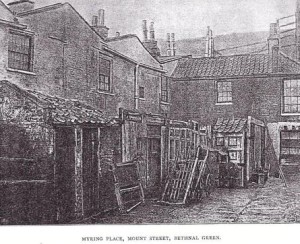
 Spencer Smith was born at 7 Mount Street. This illustration shows what housing looked like on Mount Street around the time of Spencer’s birth in 1870. Spencer George Smith was born on January 18, 1870 at 7 Mount Street in Bethnal Green, East London, England to George Spencer Smith 26, and Mary Ann Mears 24. Spencer was the youngest of three children. He had two older sisters, Mary Ann who was born in 1866 and Sarah born in 1868. Spencer’s father worked as a labourer at a local wharf on the Thames River. Mary Ann was also employed, and most likely worked at or near the wharf and was responsible for folding the sails for ships, or as it was referred to in 1870, she was a furl server. Their residence may have been a tri-plex, as two other families lived at the same address. Edward Dwyer, a bricklayer and his wife Isabella, a tailoress, and their 4 children; plus George Scales, a cooper, and his wife Sarah and their 3 children all lived at 7 Mount Street.
Life in Bethnal Green during the 19th Century
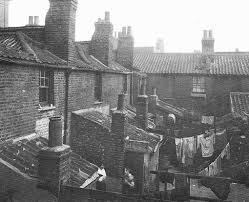
Bethnal Green was a very poor neighbourhood, often referred to as a slum area. It was rundown, disease ridden, rat infested, everyone was exposed to raw sewage, the neighbourhood had a gut wrenching bad smell to it, and it was full of sickness, drug addicts, prostitutes, and uncontrollable crime. Bethnal Green was not the best place to raise your family. Bethnal Green was not unlike many other urban communities in England at that time. 
The Industrial Revolution had driven many people from their agricultural backgrounds into the towns and cities looking for work. These areas quickly became overcrowded, and living conditions seriously declined. Times were very bad.
For reasons that we do not know something happened to the Smith family. They basically vanished from the census records for 1880 and everything afterwards.
Death records have not been located proving conclusively that Spencer’s parents or sisters died, or moved elsewhere. Some have claimed that Mary became a widow, and that she had no choice but to give up her children, but this is just hearsay. It could be true. The only person we conclusively know about is Spencer Smith.
For whatever reason, perhaps to escape an imminent transfer to the local workhouse, which was a hideous institution located just down the street at 103 Mount Street. It was a derelict building having been in existence for over 120 year. Perhaps Spencer was to be turned over to an orphanage, we just do not know, but life for Spencer definitely changed. Did you know that workhouses were often the last destination for families that could no longer support their children, and parents were forced to turn them over to the authorities? Even orphanages were overcrowded and poorly run. Many parents died from disease, starvation, alcoholism, murder, suicide, or work related injuries. They left their children destitute, and there was no other recourse, but for these little people to end up in any one of these deplorable institutions.
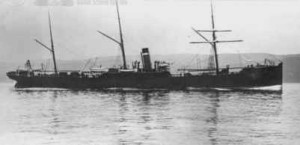
 Spencer Smith and 32 other boys were sent to Canada on the SS Corean in May of 1885. This is the actual ship that Spencer made the voyage across the Atlantic Ocean on. Spencer in 1885 at 15 years of age was forced to leave his home and friends, board a steam ship named the SS Corean, along with 32 other boys all about his same age, and set off for Canada. The ship arrived in Montreal on May 14, 1885, and the boys made their way to Hamilton. They travelled on the Grand Trunk Railway, stopping all along the way, including Burlington, and finally on to Hamilton. Who knows, maybe Spencer looked out of the train car window when the boys pulled into the Freeman train station, and thought to himself, “This looks like a nice place. Maybe one day I will live here. Where am I anyway?”
Spencer and the other boys were sent by the Shaftesbury Homes organization based out of London, England. This organization and many others were operating in England, taking on the responsibility of relocating disadvantaged youth to Canada, and also Australia. The largest organization was run by Dr. Thomas Barnardo. It has been written that Spencer Smith was a “Barnardo Boy”, but that information is incorrect. This was a common error made by most people when they referred to the “British Home Children” shipped to Canada. The Barnardo organization was much larger than the other British organizations, the name ended up as generic terminology and just about all were referred to as Barnardo children regardless of the organization that sent them over.
It was believed at this time some British children would have a better life if they were removed from their local environment in their overcrowded communities and sent to Canada and Australia to live and work on farms. The concept was developed mainly for orphans, but over time this evolved into destitute children becoming included as well.
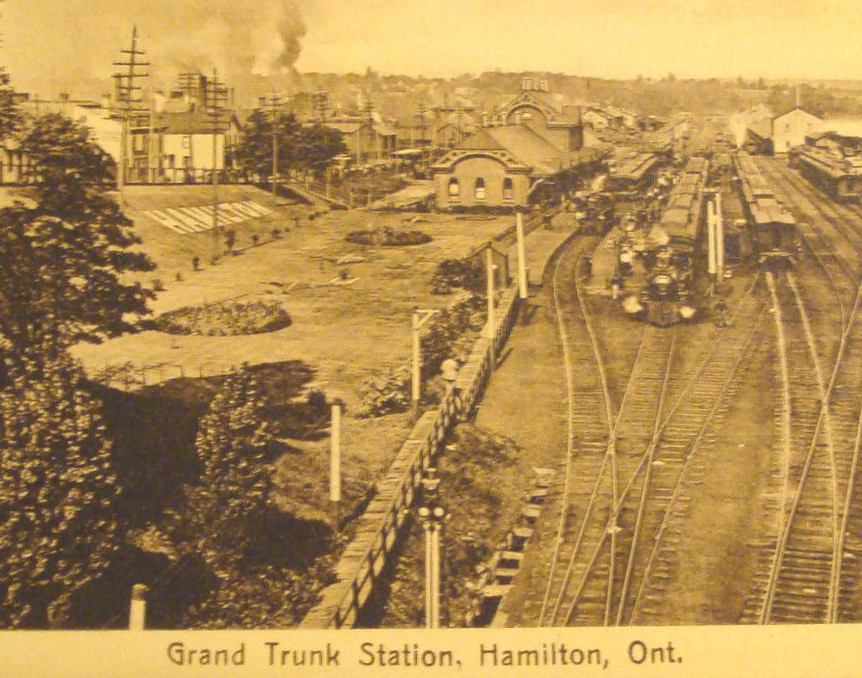
 When Spencer arrived by train destined for Hamilton, he disembarked at this Grand Trunk Railway Station located along the southern shores of Burlington Bay. When the Grand Trunk Railway train arrived in Hamilton, the Shaftesbury boys were sent to live temporarily at a location called a “Receiving Home”.
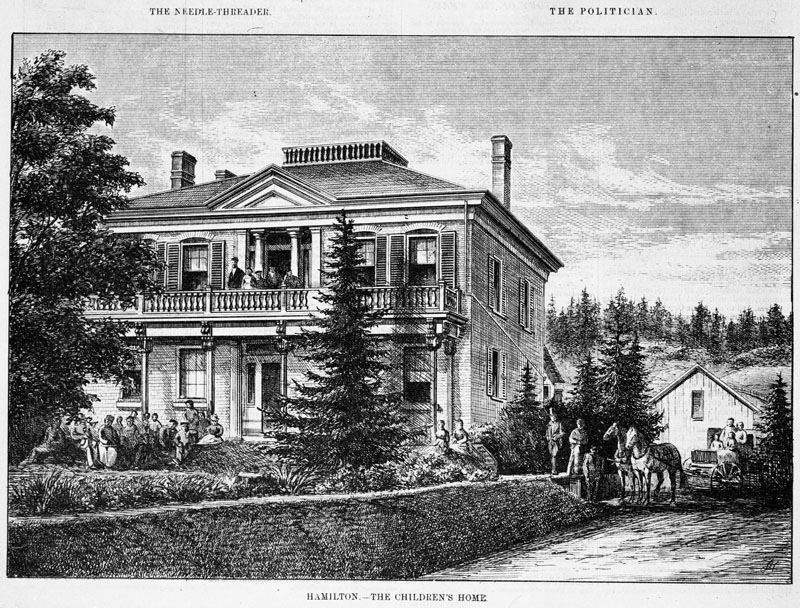
In Hamilton it was called, “The National Children’s Home & Orphanage” which opened in 1884. This home was located on Main Street, in the east end of Hamilton on the grounds of present day Gage Park.
 Spencer and the 32 other boys were sent to this “Receiving Home”. It was called the “National Children’s Home & Orphanage”, located on the grounds of present day Gage Park. When the boys arrived, farmers in the Niagara area who had sent in an application to be a sponsor for these children were notified that the children had made it to Hamilton, and they were now ready to be picked up and taken to their new home. Not all children were sponsored before they arrived, it depended on the circumstances that brought them to the “Receiving Home”. In some situations children had to wait for someone to come along and claim them. “The National Children’s Home & Orphanage” over time evolved into Canada’s Children’s Aid Society. Shaftesbury Homes in London, at a later date, became the cornerstone of the London Children’s Aid Society.
 Featherstone Martindale was the farmer from Caledonia who sponsored Spencer Smith taking him back to his farm to begin work as an indentured farm labourer. For Spencer Smith, a farmer named Featherstone Martindale from Caledonia was coming to pick up him and probably a couple more boys too. We know that other boys also went to Caledonia to work on the Martindale farm, but we do not know how many. Most likely it was no more than 2 more boys. They met, and all got to know each other a bit better, and eventually Featherstone, the other boys, and Spencer left “The National Children’s Home & Orphanage”.
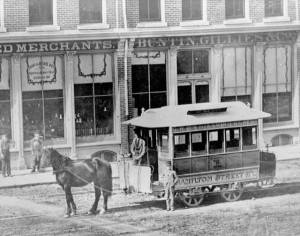
 Before the Hamilton Street Railway streetcars became electrified, they were horse drawn. Featherstone Martindale and Spencer Smith and the other boys made their way to the King Street train station on a streetcar just like this one, for the train trip to Caledonia. The group travelled west along King Street in Hamilton on a horse drawn Hamilton Street Railway streetcar to the King Street train station at Ferguson Avenue, embarked on to the train and made the trip to Caledonia. That day was Thursday, May 21, 1885. When they arrived at the Caledonia station, Featherstone, the other boys, and Spencer travelled again for 6 miles, this time in the Martindale’s fancy carriage and on out to the Martindale farm in rural Caledonia.
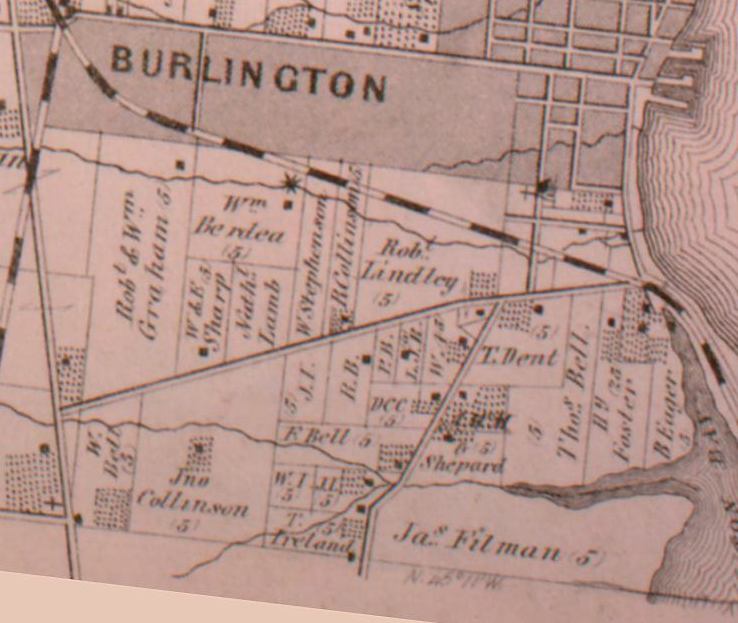
 The farms along Maple Avenue provided the country with some of the most fantastic fruit grown anywhere in the world. If you look closely on this map, you can see the Lindley farm where Spencer worked, and also in the lower left corner you can see the William Bell homestead where he worked following his employment with the Lindley family. Spencer Smith’s new Canadian life was about to get underway.
The usual arrangement was to keep a British child on the farm, as indentured servants until they became 18 years of age. These children were to be paid a small wage, fed, clothed, schooled and provide room and board. According to Spencer, he agreed to stay at the Martindale farm for one year. This could be true, or not. We’re not certain if Spencer stayed with the Martindale’s for up to 3 years, or if he went to another farm. We do know that Spencer in 1889 was working as a farm labourer on the Lindley farm in Burlington when he was 19 years old. The Lindley family operated a very successful orchard farm on Maple Avenue. It was located just north of Water Street, now called Lakeshore Road, and it ran north up to about the south side of Mapleview Mall.
The Lindley’s were smart farmers and during the Great Depression, just to stay in business, negotiated a deal with Dominion Stores and supplied the grocery store chain with produce, an agreement so good that it lasted for over 40 years. For many years, the Lindleys and other local farmers hauled their crops by wagon up to the Freeman Train Station, and loaded up the boxcars with their products for transport to markets across Ontario, Canada, England, and even South Africa. The Freeman Station (now under restoration on Fairview Street and in need of more private funding) was the focal point of Burlington’s emerging agricultural market. It was Burlington’s “Window to the World”.
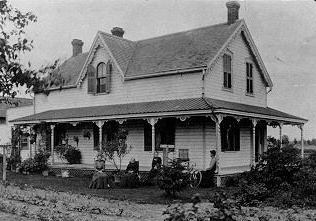
 Here’s the Bell Homestead where Spencer Smith worked and met his future wife, Edith Bell. The homestead is still here today, although it looks somewhat different. You could call it, “The Home of the Strawberry Social”. One day, Spencer Smith left the Lindley family farm and moved up Maple Avenue to the William & Edith Bell farm located at the southwest corner of Plains Road and Maple Avenue, and he began working as a farm labourer for the Bell family. It was here at the Bell homestead that Spencer Smith met Edith Bell, the youngest daughter of William and Edith Bell. Spencer courted the farmer’s daughter, and before you knew it, they were engaged and then the young couple married on May 9 1900.
At that time, Maple Avenue went north and more westerly emerging at the Union Burial Ground, the historic pioneer cemetery located in front of the Sears, Fortinos & Ikea stores. It has been reported that Spencer Smith went to work on a farm in Penetang. Again, this is hearsay, and not proven. It is possible, but if Spencer did work on a farm in that area, it would have most likely been after his servitude was completed at the Martindale farm, and before he began work on the Lindley farm by 1889, or Spencer may have left the Lindley farm, went to Penetang and returned to begin working with the Bell family. We’re not certain.
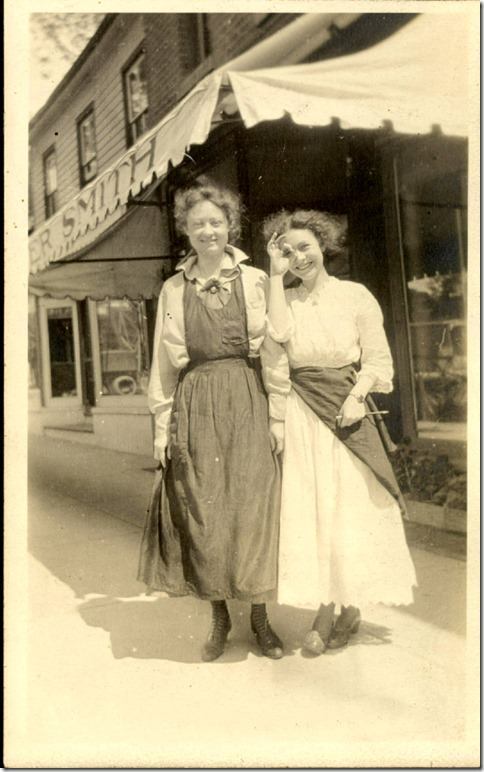
 These two young ladies are standing outside Spencer Smith’s green grocery store on Brant Street, just north of Pine Street. The young lass on the right just may be holding a candy stick that was given to her by Spencer Smith. This rare photograph taken around 1914 shows the last part of the name Spencer Smith on the awning’s edge. Many thanks to local genealogist Russell Hunsperger for digging up this picture from his family’s photo archives. Spencer eventually became a green grocer, and opened a store in Toronto, but this did not last long and the couple returned to Burlington, where Spencer opened another green grocer store. This time it was on Brant Street, just 4 doors north of Pine Street, on the east side.
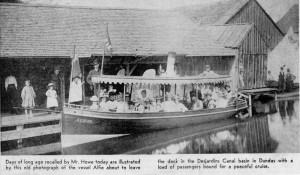
 Spencer Smith’s grocery store attracted pleasure boat shoppers just like these passengers on the boat “Alfie” which set out from a dock in Dundas. The store was very successful, and eventually Spencer and Edith became quite affluent. Spencer Smith was a clever marketing man. Whenever children came into his store, they were treated with candy. There were other grocery store competitors in town, but Spencer usually won the day over the other stores. When the children in the neighbourhood persuaded their parents to go shop at Mr. Smith’s store, the parents usually agreed, not quite realizing why the children were so insistent. The other grocers in town probably couldn’t figure out why Spencer Smith’s store continually had so many customers. Spencer and Edith Smith were very good at business, and skilled as retailing entrepreneurs.
In fact, the store was so popular, that passengers travelling on recreational pleasure boats from Hamilton, Dundas, Grimsby, Bronte, Oakville, and other local towns often docked at the wharf located at the foot of Brant Street, just to shop at Spencer Smith’s store. Today, we call this shopping at “Destination stores”.
Spencer was a member of the Burlington Horticultural Society for 36 years, from 1919 up until he died in 1955, where he served as the Society’s President from 1931 – 1936. Other well-known local names served as President when the Society was started for a second time in 1919. The first President was Rev. George W. Tebbs, Rector of St. Luke’s Anglican Church who served in 1919-1920. William Arthur Emory, was Spencer’s brother-in-law and he served in 1925-1926. Paul Fisher served in 1921.
The Fisher family owned the orchard farm where Burlington Mall is located. Fred Ghent served in 1922. Richard Jerome “RJ” Alton served in 1949. The first Burlington Horticultural Society actually started in 1889 by the local market gardeners as more of an agricultural group interested in how to better grow market garden products. The second Society focused more on the beautification of Burlington. It was this latter Society that had the Rose selected as Burlington’s official flower, and to this day, area residents compete for the annual Rose Awards in recognition for residents’ beautiful home gardens.
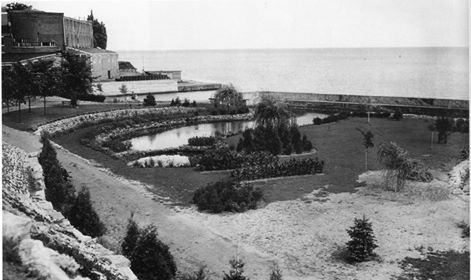
 The Lakeside Park was starting to look more like a park. Over the years it continued to develop into a beautiful scenic park. The canning plant can be seen in the upper left as well as the dock that was at the foot of Brant Street. In 1933, Spencer Smith as President embarked on an ambitious project to beautify the land at the foot of Brant Street in Lakeside Park. During the Great Depression the canning plant employees located next door to the park were on strike, and Spencer utilized the strikers to help clean up the new park. It has been reported that Spencer Smith hired these strikers, but more realistically these were probably just volunteers who were quite bored being on strike. There certainly wasn’t much money available at the time, and Spencer was always looking for free assistance, wherever and whenever he could find it. Spencer himself, devoted countless hours of volunteer labour at the park.
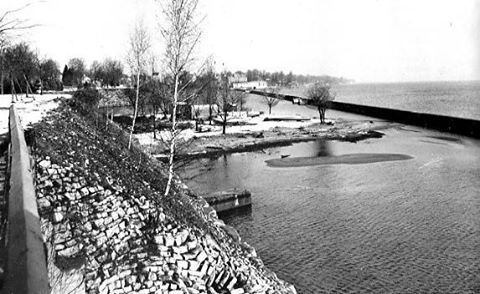
 The new Department of Recreation after 1950 decided to add more fill to the water and expand the size of the park. The breakwater is clearly in place. Harold McGrath owned a local trucking company, and Spencer even enticed Harold to drop off any excess loads of rock or topsoil at the park, also probably done at no cost. Spencer had a clear vision for this park, and he was bound and determined to make it happen. The spectacular willow trees growing in Spencer Smith Park are not there by accident. Dorothy Angus the town’s librarian and friend to Spencer, lived on Ontario Street and had willow trees growing on her property. Spencer carefully removed willow tree cuttings and transplanted them to the park. Today, we can see the results of this undertaking. The park was an ongoing project for many years, and in 1942, the Town of Burlington finally recognized Spencer Smith’s accomplishments and named the park “Spencer Park”.
In 1950, the town created a Department of Recreation, and this department took over the management of Spencer Park. One of the first projects undertaken by this new department, was to expand the park with more landfill at the eastern end.
When the Town of Burlington, under the leadership of Mayor Lloyd Berryman, was looking for their own unique Centennial project for 1967, a decision was made that Spencer Park would an ideal choice for an upgrade. The plan was to fill in the entire water area out to the breakwater, and over to the Brant Inn on the far western side, once all of the boats sheltered behind the breakwater were evicted. The Burlington Centennial Committee was created and received the go-ahead for the creation of the new park, and when the park was completed in 1967, they made one very serious error in judgment and attempted to recommend a completely different name for Spencer Park, which was abruptly objected to by The Burlington Horticultural Society and many other concerned local residents who were extremely upset that Burlington’s heritage was once again facing erosion, and quite possibly Spencer Smith’s hard work, commitment, and dedication to his park were about to be permanently removed. The Burlington Centennial Committee reluctantly realized their error, and eventually backed down giving way to a new name, mutually agreed to by everyone on both sides, it was to be called Spencer Smith Park, a name that still stands to this day.
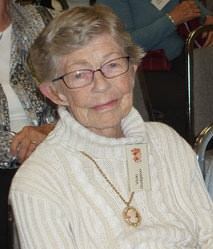
 The great grand niece of Spencer Smith was the former Victoria Emery, and after marriage we knew her as Vicki Gudgeon, a local historian and a past President of the Burlington Historical Society personally knew Spencer Smith very well. Spencer didn’t stop at his park. Many of the streetscape trees growing in downtown Burlington were planted by The Burlington Horticultural Society. Burlington didn’t become so scenic and beautiful by itself. Credit should go to those dedicated members of The Burlington Horticultural Society. The property next to Central School was a seedling centre, and the Society grew new plants there which were eventually transplanted throughout Burlington. Spencer Smith’s great grand niece, Vicki Emery Gudgeon, who served as President of the Burlington Historical Society in 1975 -1976 recalled in an interview on the life of Spencer Smith for The Hamilton Spectator in 1989, that all of the trees planted by Spencer Smith and the Horticultural Society on Brant Street were removed when street lights were installed. Vicki stated back then, “I don’t think it was a fair exchange,” I think we can all agree that street lights on a treeless road are not as beautiful as a tree lined road. Vicki had the pleasure to really know her great grand uncle and described him as, “a very kind gentle man, and a gentleman.” She went on to say, “he looked a bit like Charlie Chaplin, because he had the same kind of moustache.”
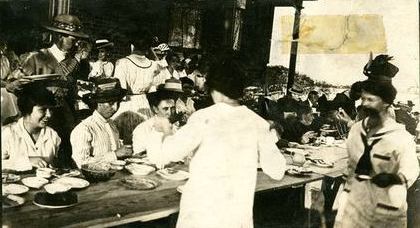
 The Strawberry Social was an event that Spencer Smith, his wife Edith, the Bell family, and just about everybody else in Burlington looked forward to every year in town. Here’s Spencer serving up some more treats at the historic Willowbank on King Road. Over the years that Spencer Smith lived in Burlington, things changed, sometimes unexpectantly. Even though Spencer and Edith never had children, they still devoted much of their time to the betterment of Burlington. For example, Spencer and Edith both loved the Strawberry Socials, an event developed by the Bell family, and participated wholeheartedly in making them a rousing annual success in Burlington.
In 1924, after a beautiful 24 year marriage, the blissful happy couple faced a very serious challenge. Edith was not well, and soon became extremely sick. Edith developed pancreatic cancer which eventually spread into her liver, and this lovely, petite, gentle lady died a painful and tragic death on March 21, 1924, in the prime of her life at 54 years of age. The shocked and devastated Spencer buried his beloved Edith in historic Greenwood Cemetery on March 24, 1924. Spencer’s world of new found joy and happiness had ended with pain, and he proceeded to mourn his loss alone, and live a life that seemed to have no purpose.
Spencer continued to operate his grocery store on Brant Street for two more years, he was just putting in time; Then he met a middle aged lady who would become his next wife. She was known as Lillie, but her birth name was Elizabeth Anna Smith. Lillie was born June 7, 1870 in Whitby, Ontario to Thomas Henry Smith and Sarah Smith, a pioneer farm family who lived in the Whitby area for many years. It is not known where and when Spencer met Lillie, but we do know that this was the first marriage for Spencer’s new wife, and it seems a little bit humourous to me that Lillie changed her maiden name from Smith to her new married name Smith. It’s not too often that couples wed each other with the same surname, but it happened here.
Lillie’s new home was to be at 40 Locust Street. I am not certain as to when Spencer purchased this home. We do believe that Spencer and Edith had lived over top of their Brant Street store for a few years.
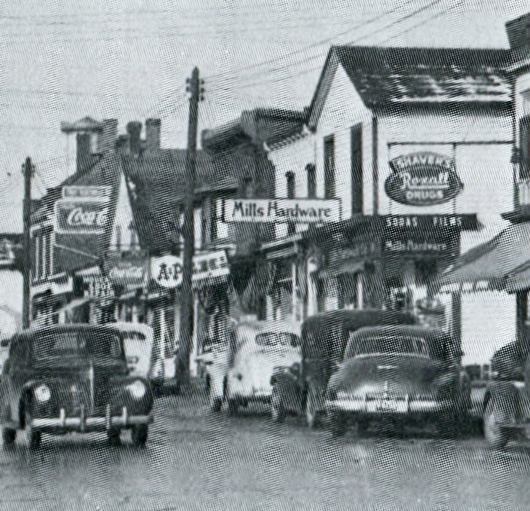
 This photograph shows the A & P store that replaced Spencer Smith’s store in the same location. The photograph was taken in 1947 before the A & P moved farther north up Brant Street later that same year. The “modern” looking car in the photo is a 1947 Buick. This vehicle establishes the year of the photograph. It has been reported that Spencer Smith retired from work in 1950 when he would have been 80 years of age. I disagree, but I could be wrong. Although, I do not know exactly when he retired, it was most likely when Spencer was around 65 – 70 years of age in 1935 to 1940. I say that because Spencer Smith sold his store to the A&P Food Store company. A&P came to Burlington around that time, and Spencer was ready to call it a day. A&P took over his location and stayed there until they relocated farther north to a new store on Brant Street which opened in 1947. There are no records that we can locate of Spencer working elsewhere after that time, but he did continue to volunteer his time.
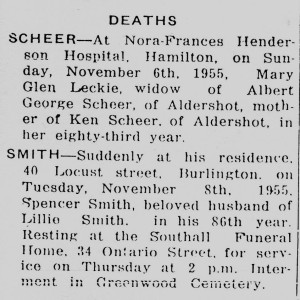
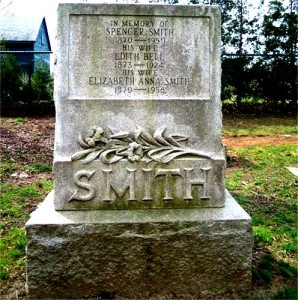
 Spencer Smith’s Death Notice appeared in the Burlington Gazette newspaper on November 9, 1955 on page 14, column 3. The town was deeply saddened to hear of the passing of one of Burlington’s greatest citizens.  Spencer Smith, his first wife Edith, and his second wife Lillie are buried in historic Greenwood Cemetery. On November 8, 1955 Spencer Smith peacefully passed away at his residence at 40 Locust Street. He was buried alongside his cherished wife Edith in historic Greenwood Cemetery. The following year in 1956, Lillie, Spencer’s second wife passed away at 85 years of age, and was interred with Spencer and Edith in Greenwood Cemetery.
The full life and times of Spencer Smith was now over, but not forgotten.
Spencer Smith left us with a poem that he composed in 1911. He called it “Reminiscences”. In poetic phrasing Spencer captures some of his memories that changed his life.
Reminiscences
‘Twas six and twenty years ago,
And perhaps a little bit more,
When I, a lad of fifteen years,
Lit on this fair Canadian Shore.
Fate led the way to Hamilton,
And there a man I met,
Who said a likely boy to do the chores
I certainly must get.
I don’t think I looked likely,
For the voyage had been rough,
And leaving home and friends behind,
I felt most mighty tough.
But the farmer thought I’d suit him,
If I’d try and do what’s fair;
So we came to an agreement,
And I hired for a year.
We boarded the train at King Street-
I’ll never forget that day;
It was in the spring of eighty-five,
On the twenty-first of May.
My thoughts were busy all the way,
On the new life I was now to begin;
To me the prospect seemed gloomy,
And my future loomed very dim.
We arrived at Caledonia,
And the farmer’s old bay mare
Soon took us down the river road
To the farm, six miles from there.
The buggy we rode in was classy,
The roads none I’d seen could compare-
We took so much on the wheels as we went
It’s a wonder there’s any there.
My boy courage rose as I entered the house,
And I saw the farmer’s wife.
I’ll never forget her as long as I live;
And bless her all my life.
I had my tea and went to bed,
And slept as sound as a trout.
And the first thing I heard in the morning
Was: “Come, boys, it’s time to get out.”
I put in that day in a hazy way;
For a lonesome boy was I,
And as I drove the cows to the fields
I heaved many a deep, deep sigh.
Each day was filled with surprises,
And, Oh, the mistakes I did make!
Were the things I broke put together
They’d be worth all the wages I’d take.
The farmer was often impatient;
And often discouraged was I,
But one thing that kept up my courage
Was the farmer’s good wife and her pie.
The cows and the horses, the sheep and the pigs,
Were ever a worry and care;
But since I have left them I think of them still,
And in my dreams fancy I’m there.
The lessons I learned on the farm are worth more
To me than mere dollars and cents;
And if I were privileged to start over again,
It’s life on the farm I’d commence.
The farmer’s wife has gone to her rest,
But her influence lives in me still:-
She helped lift the load along life’s rough road,
And save me a start up the hill.

Part two of the Spencer Smith story will be published later this week.
By Gazette Staff
August 10th, 2025
BURLINGTON, ON
This event closes at the end of August.
Given our relationship to water – without it we wouldn’t be here, this should give a perspective on water you may not have had.
Worth the time – AGB is a great place to spend a few hours in the hot, muggy weather we are experiencing.
Drawing from digital archives and physical postcards, Leila Fatemi explores the connection between photographic representation and props, which often symbolize societal status.
 Vessels that bend water In A Vessel to Bend Water, she critically engages with the historical representation of women from the SWANA (South West Asia and North Africa) region in photography, particularly in Orientalist imagery, by focusing on the vessel—a recurring motif that reinforces colonial ideologies and constrains women’s roles.
The vessel is often used as a metaphor for confinement, while also suggestive of ideas related to domestic labour, nourishment, and gathering. Photographic depictions of vessels underscore broader issues of gendered representation and systemic marginalization and, in the histories of women from SWANA regions that were, in the nineteenth century, problematically depicted in opposition to the West and in relation to European powers as “the Orient”—highlight how women’s bodies were defined and controlled through the lens of colonial power. A Vessel to Bend Water demonstrates how imagery of women holding, hoisting, carrying, and leaning on water vessels was frequently used to undermine women’s agency, subjecting them to imposed identities and societal expectations.
The project spans various mediums, including collage, textiles, cyanotypes, lenticular prints, ceramics, and photolithography on clay, reinterpreting and disrupting conventional forms of photographic representation. These interventions challenge the objectification of women by questioning the power dynamics and limitations imposed on their bodies. Through images drawn from Fatemi’s personal collection and the Getty Institute’s Ken and Jenny Jacobson Orientalist Photography Collection, the work engages in a dialogue with historical visual artifacts, emphasizing the need to deconstruct and reinterpret oppressive narratives. Using collage techniques like redaction, tearing, and erasure, Fatemi disrupts the preciousness of these images, forcing viewers to reconsider their implications.
 The project spans various mediums, including collage, textiles, cyanotypes, lenticular prints, ceramics, and photolithography on clay, reinterpreting and disrupting conventional forms of photographic representation. During a residency in the AGB clay studios from January to April 2025, Fatemi explored new methods of making and presenting her work for the exhibition. Working alongside the studio technicians and artist-educators, she further experimented with integrating printmaking techniques into her practice, merging photography with ceramics.
In addition to testing image manipulation, Fatemi began reimagining the idea of the vessel itself by pulling the form, as depicted in an archival image, and re-constructing it into a living object. Over the course of the exhibition, unfired clay vessels will slowly disintegrate under the weight of water, returning them to a raw state. Water vessels, once muted in photographers’ studios, now become active agents in their own story. By erasing the utility of the physical vessel, Fatemi underscores its futility in the original archives, breaking down what constitutes a photographic prop to erode the historical narrative.
The Art Gallery of Burlington is supported by the City of Burlington, Ontario Arts Council, and Ontario Trillium Foundation. The AGB’s learning programming has been sponsored by the Burlington Foundation and the incite Foundation for the Arts. The 50th Anniversary Exhibitions have been sponsored by the J.P. Bickell Foundation.
By Gazette Staff
August 10th, 2025
BURLINGTON, ON
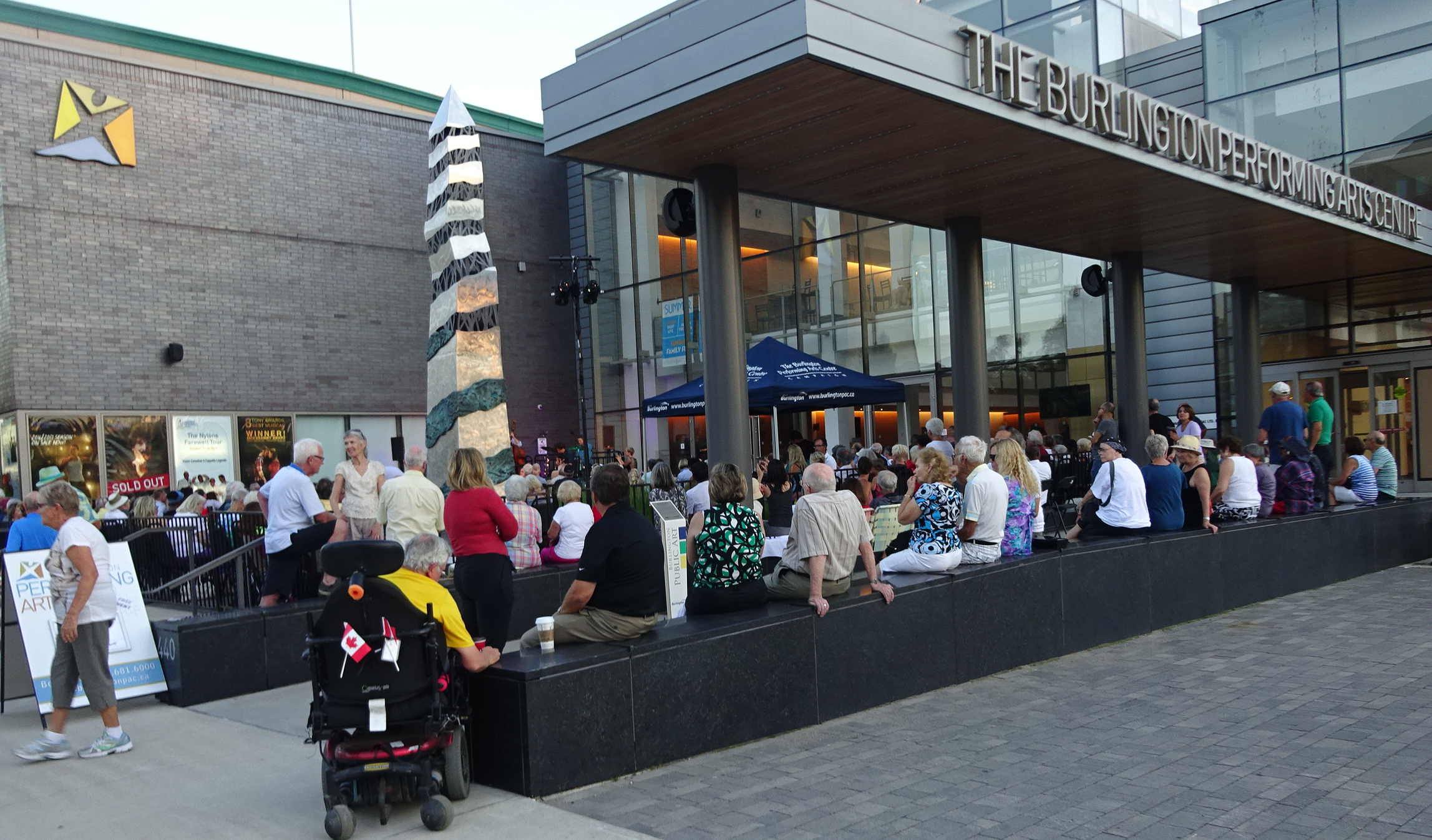
Today – Sunday is the final day for Jazz at the Plaza – the Performing Arts event that is free and takes place rain or shine.
Location: Right outside the Performing Arts Centre on Locust at Elgin. Bring a chair – seats are limited.
Cash bar – will keep you cool. If the weather decides not to cooperate, the event moves inside.
Three performances:

By Pepper Parr
August 9th, 2025
BURLINGTON, ON
Hot, humid weather, but Jazz on the Plaza is taking place this afternoon.

Jay Davis and Amanda Martinez entertained last night.
Today there are three performances: Alex Pangman at 2:00 Eliana Cuevas at 3:15 and Mark Lalama and Friends at 4:30.
There is a cash bar to keep you cool.

This is a free event.
By Gazette Staff
August 9th, 2025
BURLINGTON, ON
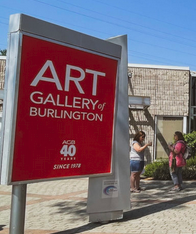
There are six Guilds at the Burlington Art Gallery.
They are the foundation on which the current gallery was built.
All Guilds Show
 There is an All Guilds Show running from August 23—September 9, 2025 in the Lee-Chin Family Gallery There is an All Guilds Show running from August 23—September 9, 2025 in the Lee-Chin Family Gallery
The All Guilds Show showcases the artists who make and learn at the AGB.
If you ever wondered if being part of a Guild might be for you – make a point of attending. You’ll find a lot of welcoming faces and people waiting to help you learn
This 50th Anniversary exhibition celebrates the invaluable contributions the Burlington guilds have made to their communities by nurturing creativity, preserving artistic traditions, and fostering lifelong learning.
By Gazette Staff
August 8th, 2025
BURLINGTON, ON
 What if the pooch lifts his leg at an inappropriate place? A heat warning has been issued by Environment and Climate Change Canada for August 9 2025.
Residents can stay cool at all designated Burlington Public Library branches during library open hours.
On extreme heat days, pets may come inside with their owners to cool off.
By Gazette Staff
August 8th, 2025
BURLINGTON, ON
The City of Burlington is building its newest community centre, the Robert Bateman Community Centre.
 Scheduled to open officially September 15th. This community centre will be a multi-purpose, community-focused facility that includes tenants such as Brock University, Burlington Public Library, Halton District School Board, Tech Place, and the City of Burlington.
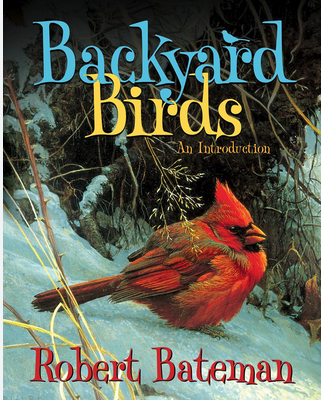
To recognize Robert Bateman’s distinguished career and connection to Burlington, the City of Burlington is seeking Expressions of Interest from professional artists or artist teams to create a community mural inspired by Mr. Bateman’s book Backyard Birds.
 Using Bateman’s wildlife paintings as a point of inspiration, the selected artist(s) will design a mural in their own artistic style. Using Bateman’s wildlife paintings as a point of inspiration, the selected artist(s) will design a mural in their own artistic style.
This Call for Artists is open to artists working in a variety of styles and mediums.
The intention is not to reproduce Mr. Bateman’s artwork style but to use Backyard Birds as a point of inspiration.
Deadline: Monday, September 8, 2025
Budget: $15,000 CAD (Design Only)
CLICK HERE for more detail and submission form
By Gazette Staff
August 7th, 2025
BURLINGTON, ON
At first glance, building a tower out of toothpicks or launching a balloon rocket might just seem like play, not reading. But STEAM (Science, Technology, Engineering, Art, and Math) and literacy go hand in hand. In fact, hands-on learning can strengthen some of the most essential literacy skills for growing readers.
What STEAM Teaches Beyond Science
STEAM starts with science, but it doesn’t end there! When kids engage in STEAM activities, they’re also:
 When kids engage in STEAM activities, they’re also: Building vocabulary – Kids learn new words like balance, gravity, dissolve, or predict in meaningful hands-on contexts.
Practicing sequencing – They follow multi-step instructions and describe what they did in order, using words like first, next, then, and last.
Improving comprehension – They connect what they read (in a story or instructions) to what they observe, build, or create.
Developing communication skills – They ask questions, explain ideas, and reflect on what happened. These are key parts of both science and storytelling.
 Check out these engaging picture books that explore Science, Technology, Engineering, Art, and Math (STEAM) in fun and accessible ways. Each title includes a simple activity idea you can try at home — perfect for sparking curiosity, creativity, and hands-on learning in young readers! bplearly Pairing STEAM with storybooks makes learning even more powerful. A story can spark curiosity, introduce a challenge, and help children connect big ideas to their everyday world. Stories help bring STEAM ideas to life, making them more relatable and easier to remember.
STEAM at Home
You don’t need fancy gadgets or expensive ingredients for STEAM learning at home. Everyday household objects can be the perfect tools for creative discovery. Try these easy ideas with what you have on hand:
- Plastic cups: Build towers, bridges, or try stacking challenges and sound experiments.
- Cardboard boxes or tubes: Make ramps, marble runs, or invent something new!
- Straws: Design and launch paper rockets or building structures and shapes.
- Toothpicks or spaghetti: Construct bridges or 3D shapes.
- Water bottles: Make a sensory bottle, lava lamp, or mini tornado in a bottle.
- Cereal or pasta: Count, sort, and make patterns.
- Buttons or bottle caps: Use them for measurement, pattern play, or crafts.
- Glass jars: Grow a seed, get a closer look at an insect, or make a musical instrument.
Explore, Discover, and Create with Us
Looking for more inspiration? Here are a few ideas from Children’s Librarian Kathleen:
- Try a story-inspired experiment – Read a book together and then encourage your child to come up with an experiment related to the story’s problem. Check out the booklist below for STEAM-filled picture books.
- Get outside with non-fiction – Pick out a non-fiction book about bugs, birds, flowers, or trees, and then head to your backyard or local park. Ask questions and investigate! Our always-available OverDrive/Libby ebooks are a great place to start.
- Join a library program – Explore hands-on fun at one of our upcoming STEAM programs for kids.
Looking for More Ideas?
Need a little inspiration? Our friendly librarians and programmers are always happy to help you make the most of your library. Come visit us—we’re always happy to see you.
By Gazette Staff
August 5th, 2025
BURLINGTON, ON
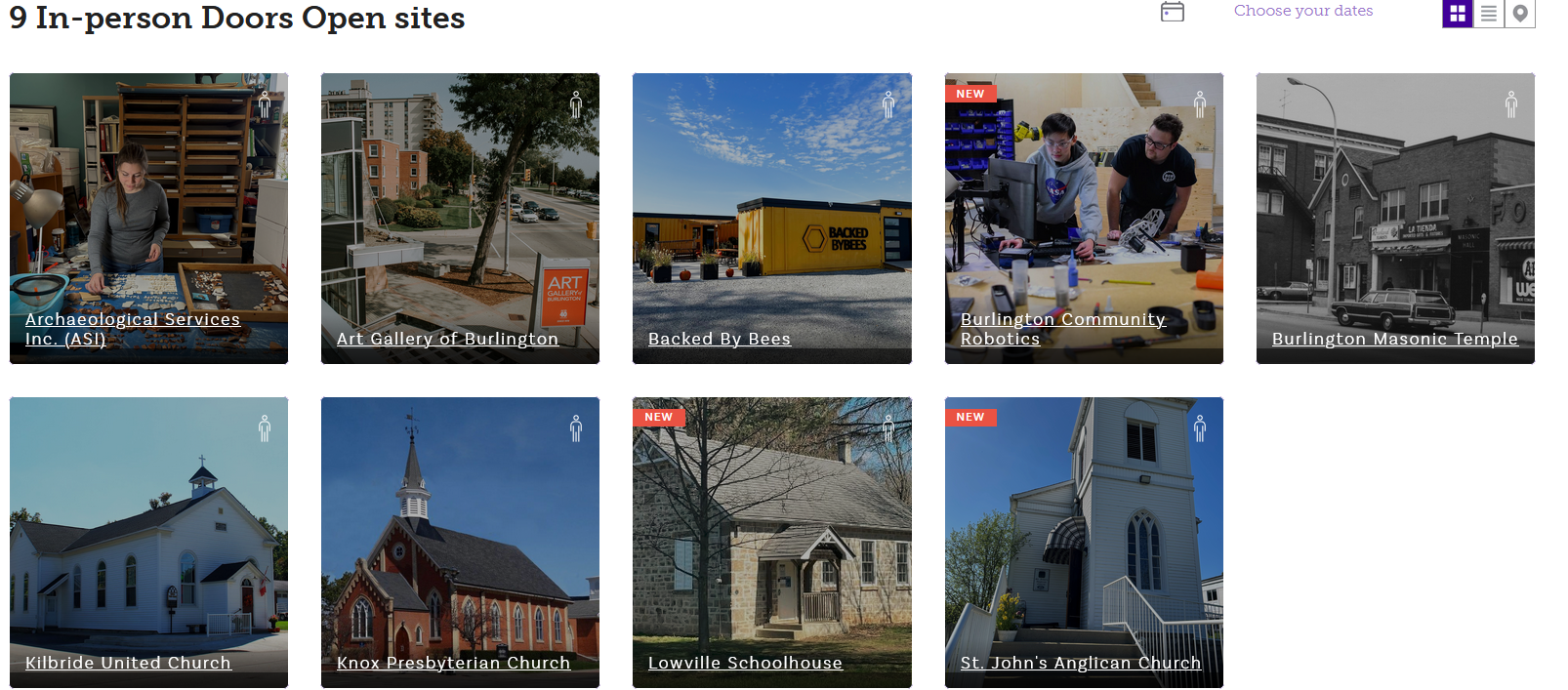
Discover the stories behind Burlington’s most unique spaces during Doors Open Burlington this Saturday from 10am to 2pm.
Visitors can go behind the scenes of local businesses and heritage sites, taking a look at the people and places that help shape our community.
All of the participating sites offer FREE admission and onsite activities. Plan your route using this Google Map.

By Pepper Parr
August 1st, 2025
BURLINGTON, ON
August has always been a nice month for the Performing Arts Centre.
Their now decade-old event improves year over year.
The show goes on rain or shine – if it rains the event is moved inside
The cash bar was a nice addition.
A Friday performance has been added and xxx
The lineup for the three-day event:


 It gets a little tight in terms of space
By Gazette Staff
August 1st, 2025
BURLINGTON, ON
Burlington isn’t exactly jumping this long weekend.
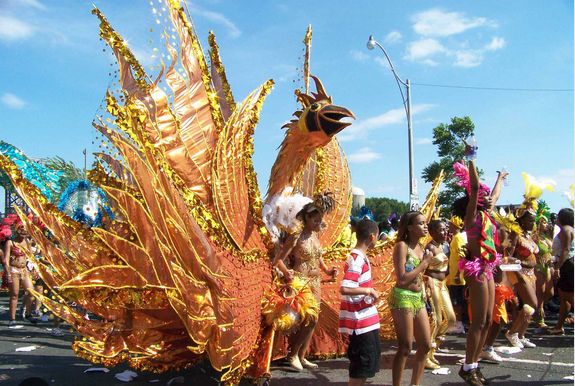
However, the Toronto Caribbean Carnival will be taking place in Toronto, bringing with it an array of vibrant festivities located just steps away from the Exhibition GO Station.
On August 2, GO Transit is increasing train service along Lakeshore West to help you get to and from the Grand Parade.
Lakeshore West:
- NEW 10:32 a.m., 12:02 p.m., 12:32 p.m., 2:02 p.m., and 2:38 p.m. train trips departing Union Station to Exhibition GO.
- NEW train trip departing 5:28 p.m. from Exhibition GO to Union Station.
 The colour and the extravagance is stunning. You’ll never regret watching the event. While most of the parade is free to watch, you can save 20% off with PRESTO Perks on ALL Caribbean Carnival ticketed events.
Customers can also take advantage of our $10 weekend day online passes that allow you to GO wherever you want, plus kids 12 and under can ride the GO for free! Riders can also transfer for free with One Fare between GO Transit and TTC.
This year will mark the 58th anniversary of the Caribbean Carnival, an annual celebration of Caribbean culture and traditions, with more than one million participants expected to attend this year. Learn more about taking GO Transit to this year’s Toronto Caribbean Carnival HERE.
|
|





 By Gazette Staff
 Join Community Development Halton (CDH) as we celebrate 41 years of connecting community as we offer a screening of The Great Disconnect, followed by a panel featuring local research, solutions and shared stories from CDH members about how we bridge disconnection to belonging in Halton. The panel guests include:
 By Gazette Staff






 By Pepper Parr
 By Pepper Parr


 By Pepper Parr
 Funding Cuts Are Undermining a Legacy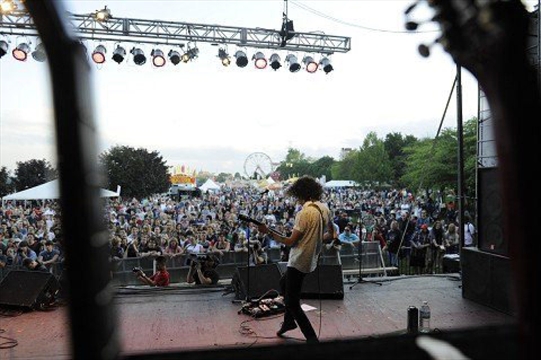



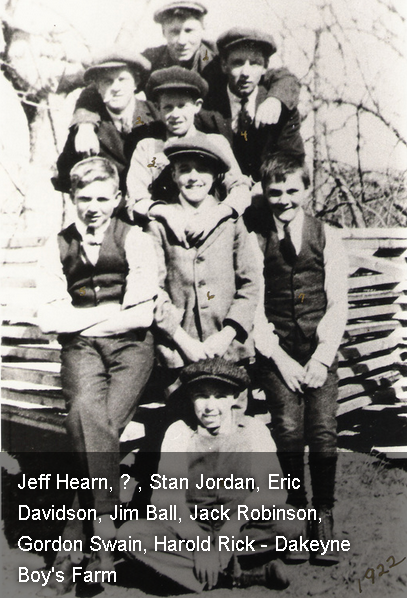 No doubt about it, everyone at the time believed this was a “WIN-WIN” situation. Spencer Smith’s story was a perfect example of one that seemed to have a happy ending.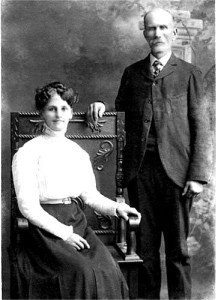
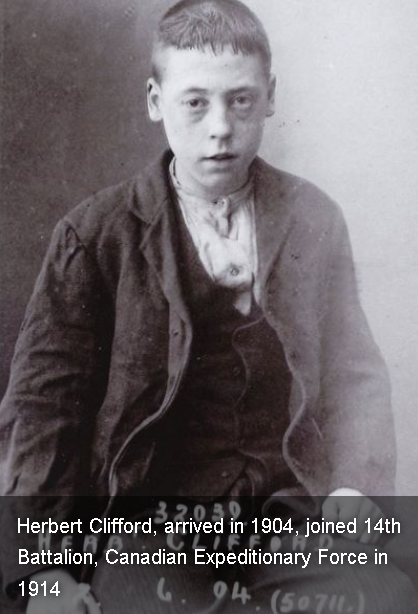 This became an economic issue more than anything else. It was strictly a case of supply and demand. Most of these organizations were faced with a huge demand. They had great difficulty in meeting the demand by farmers and governments in Canada and Australia. It was stated at one time that there were 10 applications for every child. So what were they going to do? The answer was simple. Start rounding up any child who potentially was wayward and lived in the area that was to be scoured for recruits. Overly simplified, absolutely, but not by much.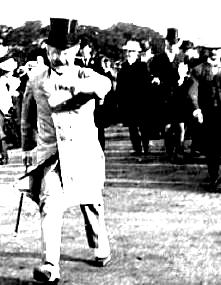
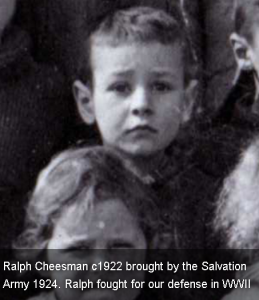 They were forced to live in exclusion on the farmer’s property, and not interact with the farmer’s own children or have any friends of their own. They were not loved or nurtured in any way. We know that they were constantly tormented and bullied by other children at local schools, and even adults participated in this human degradation of these children. We know that many just eventually disappeared. Where you ask?
 Albert had just arrived from England with many other British Home children and they all disembarked at Halifax from the ship Albertic on March 17, 1930.
 Where do we stand? Sadly, and unfortunately, the Canadian Government has essentially taken the position that this isn’t really a big deal, and no apology is warranted or forthcoming, even though they backed and encouraged this form of child slavery and abuse under the guise of helping disadvantaged children. Personally, I think that Jason Kenney the Cabinet Minister responsible for these remarks was not that well informed on the situation when confronted with the apology question, and consequently brushed it off as unimportant. I encourage you to contact Burlington’s local Federal Member of Parliament, Mr. Mike Wallace, who is a very decent man, and please voice your concern. I would like to think that Mike can champion this cause and help us get this apology from the Canadian Government. It’s long overdue, and it’s the right thing to do.
 By Gazette Staff





 There is an All Guilds Show running from August 23—September 9, 2025 in the Lee-Chin Family Gallery
 By Gazette Staff
 Using Bateman’s wildlife paintings as a point of inspiration, the selected artist(s) will design a mural in their own artistic style.
 By Gazette Staff