By Pepper Parr By Pepper Parr
June 17th, 2016
BURLINGTON, ON
They are going to try it again – and maybe this time produce more in the way of results.
The Hamilton and Burlington Chambers of commerce are holding their second Bay Area Economic Summit, to promote strategic cooperation between the two cities to advance their respective regional economic development, prosperity and quality of life.
Burlington should be grateful for letting Hamilton allow us to hitch our little wagon to the freight train they have pulling their economy.
 No reason why this shouldn’t be a relationship made in heaven – does it need an office dedicated to nurturing the relationship? While Hamilton city council seems to be waffling all over the planned LRT that gets loads of mention they do have a smoking economic agenda and is now the place to move to for all those Torontonians who were not able to convince their bank managers to go along with the size of the mortgage needed to buy a home in that city.
Hamilton is literally bristling with economic development.
Burlington outsourced its economic growth to an Economic Development corporation that said at its inception it needed time to gather meaningful data on which it could base their decisions.
Lots of data – but not very many decisions – they did put out an interesting graphic that WORDS.
 Art work used by the Burlington Economic Development Corporation. Did it manage to sell anything? The Economic Summit is taking place at Royal Botanical Gardens, half of which is in Hamilton and some in Burlington, on Tuesday June 21, 7:30 am-5:00 pm, followed by a leadership reception.
Premier Wynne will be speaking – she might want to avoid explaining why Burlington now has two Cabinet Ministers because she convinced old war horse Ted McMeekin that he could live life better by doing less.
The Liberals now own the political landscape in Burlington – but Hamilton is the city experience healthy economic growth.
Hamilton Mayor Fred Eisenberger and Burlington Mayor Rick Goldring, will play key roles in the proceedings – Eisenberg has the better jokes. There will be an update from the federal government on stimulus funding opportunities available to the Bay Area community – that will keep both Mayors paying close attention.
The media release spoke of building “on the momentum” of last year’s inaugural intercity summit; the recommendations were cited in a post-event discussion paper.
“This year, we’ll focus on significant opportunities of mutual interest ranging from regional transportation and growth management to big data, workforce development and environmental stewardship,” said Keanin Loomis, president and CEO, Hamilton Chamber of Commerce. “It’s all about responding to the needs of our stakeholders and building a bay area partnership required to strengthen teamwork, and attract talent and investment.”
The agenda, built around the tagline Leading Change in a Regional Age, will dive into three interrelated themes of interest to decision- and policy-makers on both sides of the bay and beyond:
The evolving role of the Bay Area in a growing regional and international economy
Strategies and tactics to position the Bay Area for long term success
Priority planning and actions to drive collaborative change
 Mayor Rick Goldring with Ontario Premier Kathleen Wynne at Burlington’s Rib Fest. She visits the city frequently but doesn’t sprinkle any pixie dust. In addition to morning and noon hour plenary sessions that provide a platform for key messages and announcements, the agenda will include 12 interactive breakouts on topics ranging from regional superclusters and transformations in healthcare to waterfront development and mixed use transit hubs, to name a few.
The summit will wrap up with the release of a communique crafted by event leaders that outlines a commitment to key actions moving forward.
The first summit set out some early steps for an organization that would continue the dialogue that began in 2015.
Feedback during and after BAES 2015 demonstrated great enthusiasm for the initiative and a desire to do it again in 2016. The boards, members and staff of the Hamilton and Burlington Chambers of Commerce are therefore committed to reconvene all stakeholders in June 2016 and to advance (in the interim and beyond) the shared agenda that has emerged from our efforts.
The most important commitments required at this time are from the Bay Area Subcommittee and the Cities of Burlington and Hamilton, including both Mayor’s Offices and Economic Development Departments. We are looking for involvement and investments at the same levels as 2015.
Rationale: The summit provides an existing high profile, multi-sector platform to advance informed thinking and action on the subject of Bay Area cooperation.
Achieve and Promote Early Successes: We will work with our partners to help advance signature Bay Area initiatives that are ripe for success, for example:
- Help secure formal provincial recognition of the Cootes to Escarpment EcoPark System as Ontario’s first “urban biosphere park”
- Help support the exchange of local best practices related to planning and intensification — a topic of growing importance to Hamilton and Burlington
- Help ensure the growth of “women in leadership” initiatives throughout the Bay Area
Rationale: Early successes in the advancement of the Bay Area will provide proof points and generate momentum moving forward.
Assign Dedicated Resources: If there is a desire to maintain the momentum and take advantage of the opportunities associated with further collaboration, we see the need to establish a part-time office dedicated to providing an interim organizational structure for intercity cooperation in the near and long term. Funding for the office would be provided by a consortium of stakeholders, including the City of Hamilton and City of Burlington.
Two immediate priorities for the office:
Form an intercity, multi-sector task force to investigate and report on proven partnership models that could be implemented locally to structure, fund, mobilize and sustain Bay Area cooperation over time. The task force would share its findings and recommendations at future summits.
Help local groups and organizations committed to Bay Area cooperation advance their shared initiatives — e.g., joint events, research, advocacy, planning, etc. A particular focus would be placed on helping achieve select “quick wins.”
Rationale: A dedicated office co-funded and supported by key Bay Area stakeholders would ensure that sufficient time and resources are applied to the important work of coordinating and driving the advancement of the Bay Area as a hub for economic development and quality of life.
This amounts to yet another office that will churn out reports and keep mid-level bureaucrats employed.
The Cootes to Escarpment EcoPark System isn’t going to create jobs that add to the wealth of the community – money will be transfered from one pocket of the bureaucracy to another.
Burlington has significant residential development underway – part of the drive to meet intensification targets that had already been met. The city is posting house price increases year over year in the 12% plus range – something that isn’t sustainable and makes the city too expensive a place for people who might find jobs in the city.
 Can the guy on the left negotiate a better deal than the guy on the right ? James Ridge, city manager for Burlington wants to convince Chris Murray, city manager for Hamilton to sell some water lots. What Burlington needs is a stronger employment base – that hasn’t been forthcoming despite a significant reset at the Economic Development Corporation.
There is one deal that could be closed at the summit – settling on a price for the water lots at LaSalle Park – any bets on who is going to get the better of that deal?
 To register or learn more, visit www.bayareasummit.ca or contact Whitney Eames at w.eames@hamiltonchamber.ca or 905-522-1151 x 100. To register or learn more, visit www.bayareasummit.ca or contact Whitney Eames at w.eames@hamiltonchamber.ca or 905-522-1151 x 100.

By Staff
June 16, 2016
BURLINGTON, ON
It is that time of year again – great music on the waterfront – a little mayhem with traffic. That’s what happens when tens of thousands of people arrive in town.
During the Sound of Music Festival, beginning Friday, June 17 at 3:30 p.m. to Sunday, June 19 at 6 p.m., Brant Street will be closed between Caroline Street and Lakeshore Road.
Routes 3 and 5
• Please go to the Bus Terminal on John Street or Brant Street north of Caroline.
Saturday, June 18
On Saturday, June 18, the Sound of Music parade will run from 10:30 a.m. to approximately 1 p.m. During these times, there will be no transit service on Brant Street between Fairview Street and Lakeshore Road.
Routes 3 and 5
• Please go north on Brant Street past Fairview Street or south on Brant to the Bus Terminal on John Street.
• There will be no bus service on Drury Lane south of Woodward Avenue or on Caroline Street.
Route 4
• Please go north on Drury Lane above Woodward Avenue or south to New Street.
• Please flag or wave the bus driver along New Street.
Delays are to be expected.
Burlington Transit runs a Festival shuttle service will run a continuous loop approximately every 15 minutes from the north side of the Burlington GO station to the Downtown Transit Terminal (430 John St.) as follows:
Saturday, June 11: Noon to midnight
Thursday, June 16: 6 p.m. to midnight
Friday, June 17: 6 p.m. to midnight
Saturday, June 18: noon to midnight
Sunday, June 19: noon to 8 p.m.
Cost for the shuttle: $3 round-trip
Children 5 and under are FREE
Please note: Drivers do NOT make change.
Extended Transit Service
Friday June 17, 2016:
3 North at 10:30 p.m. and LAST BUS at 11 p.m.
3 South to Burlington GO station at 11 p.m. and LAST BUS at 11:30 p.m.
10 East at 11 p.m. and LAST BUS at 11:30 p.m.
Saturday June 18, 2016:
3 North at 10:30 p.m., 11 p.m. and LAST BUS at 11:30 p.m.
3 South to Burlington GO station at 11 p.m. and LAST BUS at 11:30 p.m.
10 East at 11 p.m. and LAST BUS at 11:30 p.m.
By Pepper Parr
June 16, 2017
BURLINGTON, ON
They settled it pretty quickly. There wasn’t a lot of serious or significant debate.
There were a lot of questions to staff on details and trustee Oliver from Oakville wanted to ensure that there was some rigid monitoring to see just what registration in the French Immersion program was looking like as parents register for the 2018-190 school year.
The trustees went with the Staff recommendation for the implementation of a French Immersion program that will start with students in grade two and begin in the 2018-19 school year.
Between now and then the board has to scramble to find the resources they will need to make it happen.
 The trustees voted unanimously to accept the staff recommendation for the rolling out of the French Immersion program. No one knows yet what the unintended consequences of hat decision might be. The gamble – and it became very clear during the discussion that the choice is a gamble
Staff is hoping that enough parents will decide that French Immersion may not be for their child and have their child remain in the core English program.
Director of Education Stuart Miller said that the recommendation has to reduce the number of people who want to put their children in French Immersion by at least 7.5% – he added that he would like to see that number reduced by 20%.
Stuart added that if the uptake for French Immersion does not come down by at least 7.5% “we are in trouble”
The Board faced a situation that has a huge number of people opting for the French Immersion program and that is putting pressure on the board at two levels:
Finding enough qualified French teachers
And leaving them with English classes with as few as five students – and that isn’t sustainable.
The choice the board has made is to move French Immersion as a program that begins in grade two where all instruction will be in French during the first year and decrease in grades three and four to the point where French takes up 50 of the class time.
 Associate director of Education David Boag – he got to carry the ball and explain all the ramifications to the trustees. Looking for a solution to a two pronged problem was a 15 month process that started with Stuart Miller and got passed along to David Boag when Miller was appointed the Director of Education.
There were 14 different options before the committee that was struck to delve into the problem. The committee whittled the 14 down to four and later added two as the process went forward.
The choice as a compromise for what everyone described as a “complex issue”.
Staff put their recommendations before the Board June 1st and gave the trustees three inch binders filled with data. Public delegations were heard on June 13th, there were just ten of them which one trustee said was a sign that the public was basically on side with the staff recommendation.
Notable was the board’s decision not to webcast the public delegations. Recording those delegations would have given the public an opportunity to see the breadth of public thinking – an opportunity lost.
Miller told the trustees that the decision they made will allow viable programs in both languages, and result in very few, if any changes in boundaries.
Students who are currently in a French Immersion will be grandfathered.
The trustees seemed to want to have a system where there is a core French program that introduces students to the language along with a French Immersion program for parents who want a richer French language experience for their children.
Many people look upon French Immersion as an approach some parents to give their children a bit of a leg up in getting a quality education and ensuring that their children are in classes where the quality of the education they get meets the child’s ability.
Miller told the trustees that there are currently 22 schools in the system that have less than 15 students in grade 1.
 Busing students to schools where the class size is sustainable is no an issue the trustees want to even think about. Those small classes go forward year after year – which is something the board cannot afford. To get larger class sizes busing becomes an option – and for those trustees who are advocates, passionate advocates, of students going to school in their neighbourhoods this wasn’t something they wanted to even talk about.
In setting the tone for the meeting, Miller pointed out that French Immersion is an optional program – that had grown to the point where it was seriously de-stabilizing the board’s ability to deliver programs in what trustee Reynolds (Burlington) pointed out is an English language board of education
Miller said they could not have an optional program impede the core English program.
The staff recommendation was expected to resolve the problem – that recommendation had a lot of crossed fingers attached to it.
The Board just does not know what parents are going to choose – the one year delay will, they are hoping will give parents a chance to do some re-thinking.
There is however a very strong well organized lobby for French Immersion The CPF – Canadian Parents for French has chapters all over the country and receives significant funding from the federal government. Their objective is to have the educational system produce bilingual students.
David Boag, Associate Director of Education is very clear when he says the French Immersion programs the Halton board offers does not produce bilingual graduates.
 Director of Education Stuart Miller didn’t miss an opportunity to let the trustees know what he wanted in the way of a decision on the French Immersion question. They went along with him. A student can earn a Certificate of competency in French – but that is a long way from being bilingual.
It is an ongoing situation – one that the board has to manage logistically and at the same time work with parents on both sides of the divide that sees passions rise from time to time.
What the parents want is the very best for their children – realizing that every child is different and that all should have the same opportunity with the limited resources available.
This one isn’t over yet – the trustees bought some breathing time. Miller mentioned on a number of occasions that there might be some unintended consequences coming out of the decisions. He can almost bet the ranch on that observation becoming very real.
The trustees might manage to slip through the 2018 election because we probably won’t know the full impact of the decision by then.
By Pepper Parr
June 16th, 2016
BURLINGTON, ON
Burlington Transit reports: We have been having some issues with the software. It started last night and we have our vendor and IT people working on it. When we work out these issues it will work on all devices including phones,tablets and desk tops.
I have asked staff to update our web site and advise our customers that we are unfortunately experiencing some technical issues and be patient as we work through them.
Burlington Transit launches new mobile-friendly website with real-time data
Burlington Transit launched an improved, mobile-friendly website, which features real-time data for improved customer service.
It is all at www.burlingtontransit.ca
I wasn’t able to get the information I thought I was going to be able to get – like which busses I had to take to get from my building to a building somewhere else in the city.
 Transit is taking the available technology seriously. Making it really friendly right away would be nice. The transit people said: “This is a significant customer service milestone. In 2011, only 9.9 percent of our web traffic at BurlingtonTransit.ca was through a mobile device or tablet,” said Mike Spicer, director of Burlington Transit. “In the past year, our statistics show that over 53 per cent of our web visitors are using a mobile device, and we expect that number to grow even higher in the years to come.”
Percentages are always a bit mis-leading – there were no raw numbers given. But let’s give them a good mark for trying.
They key features of the new, mobile friendly website include:
• Trip Planner: Plan your trip online by entering an address, intersection, stop ID or searching by popular locations.
• Schedule Finder: View a route or stop-specific schedule online or print one to take with you.
• Next Bus: Get real-time departure information for any bus stop location online or by calling 905-639-0550 with the stop ID number. Users can also see a live map showing the exact location of their bus.
• Stop Finder: Find the best stop location to suit your needs. View a list of amenities available at each stop so you can plan your trip with comfort.
The next steps of the Smart Transit System project include launching a Burlington Transit Twitter account, an online subscription service and online Handi-Van trip booking.
In the very near future we will meet with the good people at Burlington Transit and get them to take us through the new system – once we understand it – we will explain it to you.
By Staff
June 15th, 2016
BURLINGTON, ON
Glastonbury Drive, from street number 2293 to 2353, will be closed from 7 a.m. to 5 p.m. on Thursday, June 16, 2016 for emergency storm sewer repair work.
By Pepper Parr
June 15th, 2016
BURLINGTON, ON
At this point she has the right to be referred to as “The Honourable” – but Mary Eleanor McMahon has yet to get her calling card updated – it will be Eleanor McMahon for some time to come.
She arrived at the tea party she had scheduled for her seniors – well before she was appointed to Cabinet where she will serve as the Minister for Sport, Art and Culture.
 The Honourable Mary Eleanor McMahon -Provincial Minister for Tourism, Culture and Sports.
McMahon’s Mother stood with her as she was sown in – she had tears running down her face said McMahon. “I was worried about tripping over something.”
The oath was taken with her Bible in her hand – A Catholic Bible McMahon reminded people.
“I met with my deputy minister” said McMahon – “she is going to be great. I will get my first full length briefing on Thursday and then it will be me hitting the Briefing binders.”
McMahon has a couple of projects that will impact Burlington directly – “not going to tell you what they are” she said and then inadvertently mentioned a big one – I agreed to respect her “that was supposed to be off the record” request. It isn’t in the bag yet – but McMahon is pulling hard for this one. The history buffs will like it.
As for the tea party – it was a quiet event.
Small crowd but all the right well wishers were there.
By Pepper Parr
June 15th, 2016
BURLINGTON, ON
Fifteen minute service during those hours when it count? That is in the planning stage
An additional GO station in Burlington – there are people who are out there scouting different properties.
Electrification of the GO system is also in the planning stages.
 Possible – probable? – location for a fourth GO station in Burlington. Walkers Line on the current StressCrete property Someone wants more of us to take the GO train – and for those poor soul who find themselves having to brave traffic on the QEW every day this must sound like some kind of an advertisement that you don’t think is really going to deliver on the promise.
But if the rumblings and the comments being made have any truth in them the GO people have begun to talk seriously on just where an additional GO station in Burlington might be located.
There was a lot of talk about an additional station be created at Cumberland and tying it into a grade separation at the same time.
The more recent talk seems to be on Walkers Line where Stress Crete is located,
Stresscrete is the company that makes light poles out of concrete. There is a large yard within their property that could be made into a GO station – far far too early to tell yet if that one will come to fruition.
 Upgrades to the south side parking and the entrance to the Burlington station have yet to be completed. There was a point at which even the Mayor couldn’t get a completion date out of the GO people. Given the rate at which the changes being made to the Burlington GO station that seem to be taking forever – there is no value in thinking about which station you would choose to use.
Whichever – expect whatever gets built to have all kind of electric charging stations to be part of the set up.
Change is coming in a big way.
By Pepper Parr
June 14th, 2106
BURLINGTON, ON
It was a quickie.
But a bit different in a couple of ways
At the regular meeting of city council – that lasted 28 minutes – Ward 2 Councillor Marianne Meed Ward called for six recorded votes – a record for her. The idea became popular and Councillor Craven, Councillor Sharman and the Mayor asked for recorded votes as well.
 It was almost as if they didn’t want you to know who they are. Terrible picture quality. The city of Burlington just isn’t going to move to a technology that records every vote on everything at both Council and Standing committee meetings.
 The Board of Education visuals are much much better. The Halton District School Board has put technology in place that allows the trustees to press a bottom and within seconds the vote result appears on a screen that can be seen on the web cast as well.
 The close ups of Councillors are not any better. The pink jacket tells you she is Councillor Lancaster. The guy with the bling tells you which one is the Mayor. The city is also a bit of a laggard when it comes to the quality of their web casts, Compare the visuals we have provided – the school board cameras capture the expressions on the faces of the trustees – the city cameras let us know that Councillor Lancaster is wearing a pink jacket.
The city can do better – they just don’t want to – so much for genuine public engagement.
Councillor Craven reported that the public space at the corner of Plans Road and Waterdown is now complete – it took the unfortunate and some thought illegal expropriation, of the former Murphy’s convenience store to make this happen – but that is the price of progress. Craven told council the Aldershot BIA contributed $65,000 to the creation of the small plaza
Aldershot is getting another small space for the public to sit and watch the cars go by at the intersection of Plains Road and Francis – that should be in place by September,
 Commercial services at grade – we have yet to see any form of office space development – the place where all those quality jobs are going to be located. so far – it is just a place for people to live – a place that has neither a decent supermarket or an LCBO store. That isn’t living folks! The report identifies Ruth Victor & Associates as both the Applicant and the person who is representing the applicant. Ruth Victor is the planner who speaks for the ADI Group most of the time. June 22nd – there is a public meeting on the plans for an eight storey structure at Cooke Blvd Road and Plains Road East which Councillor Craven explained as an additional step in the creation of the economic hub that is coming into being in the Aldershot community.
 The existing is the convention centre – the proposed is the six storey hotel. Construction should start soon. A decent watering hole for the east end. The report identifies Ruth Victor & Associates as both the Applicant and the person who is representing the applicant. Ruth Victor is the planner who speaks for the ADI Group most of the time.
A six storey hotel adjacent to the Burlington Convention centre was approved – in record time gushed Councillor Sharman
By Staff
June 14th, 2016
BURLINGTON, ON
It was Question Period in the House of Commons and Lisa Raitt wanted to make a point about pensions and what they did do to one’s wallet.
Mr. Speaker, next week the Minister of Finance is going to meet with his counterparts in the provinces and territories to sell them on his CPP scheme which would tax the average worker an extra $3,000 per year. This new payroll tax would kill 130,000 jobs in our country and it would permanently and significantly lower wages for our young people especially.
How does the Minister of Finance expect Canadian workers to save, start a family, or buy a home when he is increasing their taxes?
A few minutes later Raitt followed up with:
 Conservative MP Lisa Raitt asks a question during question period in the House of Commons on Parliament Hill in Ottawa. Photo courtesy THE CANADIAN PRESS/Sean Kilpatrick Mr. Speaker, Canadians are rightly concerned. The impact of a fourth CPP expansion is going to be on their wallets.
The Minister of Finance has stated that a CPP expansion would be putting too many eggs in one basket. He also said that increasing the CPP would practically take the private sector out of the pension business.
My question is again for the Minister of Finance. Will he just abandon this ill-conceived scheme because it would unfairly target Canadian workers?
Ms Raitt makes no mention of the pretty healthy pension benefit program Members of the House of Commons have given themselves – which comes out of the very same wallets she speaks of. Ms Raitt is the MP for Halton.
 The boundary for the riding of Halton includes much of northern – rural Burlington.
By Graham Fraser
June 14, 2106
BURLINGTON, ON
One of the things I like about this job, that pays me less than nothing, is the responses we get from readers. Elise Box wrote and chided me for what she felt was my giving space to just on side of the French language instruction argument that Halton school board trustees are wrestling with. “I thought since you were in the “pinching,” from the Globe and Mail, you might consider pinching an article that is actually researched based. Perhaps you could assist in sharing the whole picture to the public.” I wouldn’t refer to this as “research based”; it is an opinion from a man I know personally and have a lot of respect for – however it is just an opinion.
For years, I have been listening to the arguments of ill-informed critics of French immersion. The time has come to set the record straight.
Some critics use the percentage of Canadians who are bilingual to argue that French immersion has been a failure. However, percentages are misleading; with Canada welcoming 250,000 newcomers each year, some of whom speak neither official language, it’s not surprising that the percentage of bilingual Canadians has dropped, even though the actual number has increased by more than half a million over the past 10 years.
Others complain that French immersion belongs to a particular chapter of Canadian history. Contrary to what many critics claim, French immersion is not a product of the Trudeau years, but began in the mid-1960s in Quebec, before Pierre Elliott Trudeau was even elected to Parliament. Its goal was to help children acquire language proficiency through the use of French as a language of instruction.
The allegation that it is an elitist program that filters out the children with behavioural problems and special needs is also profoundly unfair. The fact is that when a child in immersion has any kind of learning or behavioural problem, the first response of some schools is to pressure the parents to take their child out of immersion, regardless of whether or not the learning problem has anything to do with the language of instruction. Yet there are studies that show that children with learning problems do just as well in immersion as they do in the English stream.
 Similarly, many schools and school boards actively discourage immigrant parents from enrolling their children in immersion, even though studies show that immigrant students – who often speak a third language at home – adapt smoothly to immersion. Some immersion programs, however, boast a high percentage of children of immigrants, as their parents recognize the value of being able to speak the country’s two official languages. Similarly, many schools and school boards actively discourage immigrant parents from enrolling their children in immersion, even though studies show that immigrant students – who often speak a third language at home – adapt smoothly to immersion. Some immersion programs, however, boast a high percentage of children of immigrants, as their parents recognize the value of being able to speak the country’s two official languages.
Moreover, critics often refer to the drop-out rate from immersion. This is partly due to students choosing other specialized programs that are not available in immersion, and partly due to other factors. Some 15 years ago, Edmonton Public Schools was concerned about the dropout rate from immersion. By bolstering support for the teachers, improving communication with parents and establishing comparative evaluations of students’ language skills, the dropout rate diminished dramatically. Edmonton Public Schools is now recognized as having one of the best immersion programs in the country.
Some of the disenchantment with immersion comes from unrealistic expectations. Immersion doesn’t – and isn’t intended to – produce graduates who speak French with the fluency of native speakers. What immersion does provide is an important building block on which graduates can develop their language skills. Language proficiency is both an intellectual and a physical activity; without practice, it diminishes dramatically. I hope that the 150th anniversary of Confederation will see an increase in the number of opportunities for students to spend time in an environment where the other official language is dominant.
One of the problems that the immersion system has faced for a number of years has been a shortage of teachers who fully master French. To address this issue, a government program could be useful in breaking down some of the barriers that prevent exchanges between teachers. It is still easier for a teacher in Quebec to have an exchange with a teacher in France than with a teacher in Ontario, and easier for a teacher in Ontario to exchange jobs with a teacher in Australia than with a teacher in Quebec. This, to put it mildly, makes no sense.
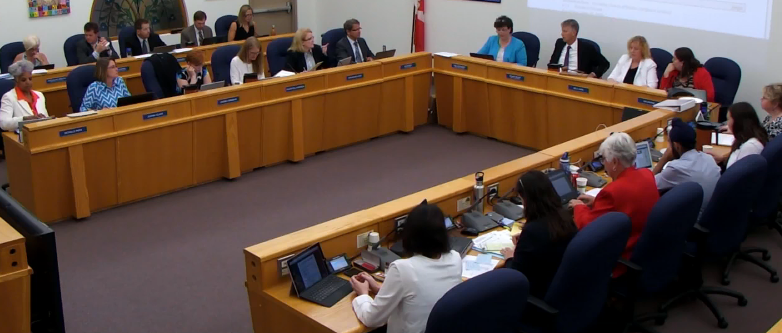
 Halton District School Board trustees. Senior staff sit in the second row and are on hand to answer questions and provide detail. The immersion experience can be life-changing. When Jennifer MacIntyre was a child in a small town in Cape Breton, she insisted on going into immersion, overcoming the reluctance of her unilingual parents. Her reason: she wanted to be able to work at Cape Breton’s National Historic Site, the Site Fortress of Louisbourg. The experience broadened her horizons. Now, several decades later, she is Canada’s ambassador to Switzerland. “Without French, nothing else would have been possible and my dreams would have been much smaller,” she told me recently.
Canadian parents – thousands of whom are themselves graduates of immersion – want their children to have the experience that French immersion offers. It has enriched the lives of millions of Canadians. It is unfortunate that an ideal of perfection is being used to criticize one of the most successful Canadian educational experiences available.
Graham Fraser is Canada’s commissioner of official languages.
By Pepper Parr
June 13th 2106
BURLINGTON, ON
Halton Board of Education trustees will this evening hear from citizen delegation on what they would like to see in the way of a French immersion program for the 2017-18 school year.
Staff have recommended:
Grade 2 Entry into French Immersion at both dual and single track schools with 100% intensity for the first year and reduced intensity after that as shown:
Gr 2 – 100% intensity
Gr 3 – 80% intensity
Gr 4 – 50% intensity
 David Boag, Associate Director of Education for Halton Board of Education – the man carrying the ball and gathering research for th trustees. “Delaying entry into immersion till Grade 2 and having kids learn French the whole day instead of half when they start. That way, officials hope, parents will think more seriously about whether to put their kids in the program. It’s a sensible idea that could help ease the bandwagon effect – gotta do it or my kid will lose out – that is overwhelming boards.
 Of the 57 Grade 1 kids at Tom Thomson Public School in Burlington, Ontario, 53 are in French immersion. The remaining four are in Ms. Amanda Heilesen’s split Grade 1 and 2 class. KEVIN VAN PAASSEN/for The Globe and Mail This is one of the few occasions when staff does not direct the elected trustees. Many meetings were held, lots of discussion and a three inch binder of research and the trustees were told – they were on their own.
Halton is trying to figure out how to meet the demand from parents along with the limitations on the school/classroom structure and the difficulty in finding the number of qualified French language teachers. Their problem isn’t helped by the price of housing in Burlington – that much touted Best mid-sized city in Canada isn’t going to do anything for us either.
What do the pundit think? There were two exceptionally good columns in the Globe and Mail recently from which we have pinched shamelessly.
Margaret Wente, a regular columnist at the Globe had this to say:
No wonder Canadian parents have gone crazy for French immersion. Who wouldn’t want to raise a bilingual kid? Across the country, demand is soaring through the roof. Schools are scrambling to cope. In some districts, 25 per cent of the primary-school kids are in French immersion. School officials say there would be far more if they could only find more teachers.
 Trustees Papin, Oliver and Grebenc Just one problem. Well, several, actually. For many parents, French immersion is a way to game the system. It filters out the kids with behavioural problems and special needs, along with the low achievers. In short, it’s a form of streaming. Most French-immersion students are from affluent, high-achieving families that work hard to give their children an edge. And who can blame them? It sure beats forking over $27,220 a year for the Toronto French School (and that’s for kindergarten).
Unfortunately, this selfish but entirely natural parental tendency is at total odds with the gospel of the Canadian school system, which strives to be equal and inclusive above all else. For schools, “streaming” is a dirty word. We are constantly assured that high-performing kids actually do better in classrooms that include all those other kids. And vice versa.
This tension between the school boards and the parents has created an impossible dilemma. Some schools’ English-language programs are being hollowed out. In dual-track schools, they now have a much bigger ratio of disadvantaged, behavioural, etc. kids than the French programs do. The schools are being accused of entrenching inequality. As one immersion advocate told Maclean’s, “If we’re going to offer this program, how can we justify it if we don’t give kids – from whatever background – the tools they need to succeed?”
Today, the idea of French immersion as a magic smart pill is virtually unquestioned.
Sadly, there’s not the slightest shred of evidence that French immersion has accomplished any of its lofty goals. After 40 years of ever-expanding immersion programs, the percentage of Canadians who can speak both official languages has dropped. At two of the Greater Toronto Area’s largest school boards, half of French-immersion students bail out by Grade 8. By the time they graduate high school, only 10 per cent achieve proficiency in French (which is not the same as fluency).
The reasons for this miserable success rate are no mystery. Their entire world outside the classroom immerses kids in English. They play in English. They live in English. Everybody they know speaks English. If you want them to be bilingual, you’d better take them to live in France or Quebec – or at least make sure you’re married to a French speaker.
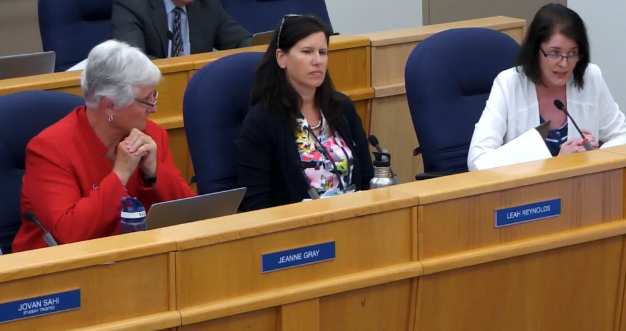
 Trustees Gray, Reynolds and Collard The downsides to French immersion, though seldom mentioned, are also real. Kids who struggle with English will also struggle with French – and who needs that?
Yet the dream lives on. As enrolment shrinks, school boards are desperate to keep parents happy so that they don’t defect from the public system. Like all-day kindergarten – which was also supposed to make kids smarter – French immersion turns out to be too good to be true. But too many people have too much invested in it to say so.
Marcus Gee who also writes a column had this to say:
French immersion is a wonderful thing in theory. Plunge kids into French in their early years, when their brains soak up language like a sponge, and they will emerge as confident French speakers. That will be good for them, making them more rounded people and giving them a shot at jobs where being bilingual is an advantage, and good for the country, helping bring the two solitudes of French and English together.
 Trustees Harrison, Harvey-Hope. Associate Director of Education David Boag is on the right. In practice, it hasn’t quite worked out that way, for several reasons. First, kids in immersion aren’t really immersed. The moment they are out the door and into the playground, they are speaking English, not French. In a city such as Toronto – or Edmonton or Vancouver or just about anywhere outside of Quebec – there just aren’t that many opportunities for most kids to use their French outside of school. Even in the classroom, few teachers can enforce a French-only rule at all times.
Second, it’s hard to find French-immersion teachers. The shortage is chronic. Schools scramble to fill immersion teaching posts and end up with a lot of teachers who can’t teach, can’t speak very good French or can’t do either.
Third, many students drop out of immersion as the years pass, some because they aren’t thriving in the French stream, others because they are going to specialty schools that don’t offer immersion. Even those who stay often don’t acquire good French. A surprising number do French for the whole 13 years, from senior kindergarten to Grade 12, and still can’t have more than a halting French conversation when they graduate.
That points to another problem with immersion: It has become a privileged island in the school system, populated disproportionately by kids from better-off families. It is the more educated, more involved parents who tend to choose immersion for their kids, hoping to give them an advantage within the hit-and-miss public system. Immersion classes tend to be whiter than the norm, with fewer students from immigrant families. In some schools, people come to view the English stream as second-rate, a place where poorer kids or kids who struggle in school end up. It’s the kind of division that a multicultural city that prizes equality wants to avoid.
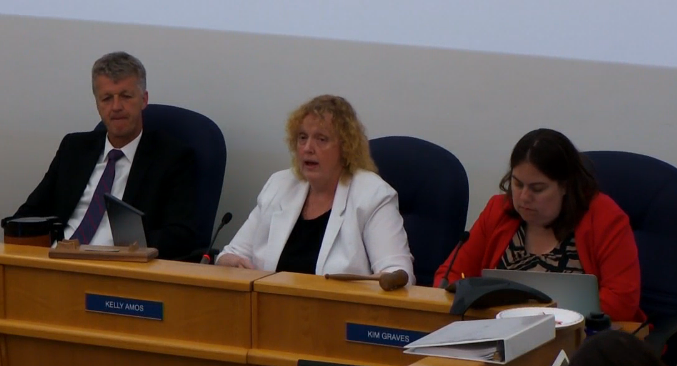
 Director of Education Stuart Miller, Chair Kelly Amos and Vice chair Kim Gervais You can’t blame parents for wanting the best for their children. You can’t blame school boards for wanting to accommodate them either. The goal of French immersion – to give more students command of the country’s other official language – is still a noble one. Knowing a second or third language, a commonplace for Europeans, is an obvious asset in the age of globalization (though Mandarin might be a smarter choice). All my kids say that, whatever the ups and downs of immersion, it gave them a good grounding in French and broadened their horizons.
But the whole program needs a good hard look. Enrolment in immersion is soaring. School boards are struggling to meet the demand. It’s a good time to examine whether it is working as it should.
Will the trustees from Burlington, Oakville, Milton and Halton Hills find a way to meet the mushrooming demands of the parents, the needs of those children who are not cut out for French Immersion and the and at the same time be able to see the bigger picture?
This is not what any of them expected when they ran for public office. They are going to be fully tested with this issue. Fortunately there are a number of wise women on the board. There are enough of them to make the right decision.
They will decide what they want to see done at a meeting on June 15th, after they have heard all the delegations.
By Staff
June 13th, 2016
BURLINGTON, ON
It is that time of year again folks – the Sound of Music sort of takes over the city and they bring in millions of dollars in business to the city – so we put up with the problems in getting around and get outdoors and enjoy the music.
Here is what happens street closure wise.
Road Closures for Sound of Music – June 17 to 19
The following road closures will be in place.
• Friday, June 17 from 3:30 p.m. to Sunday, June 19 at 6 p.m., Brant Street from Caroline Street to Lakeshore Road.
• Saturday, June 18, from 6 a.m. to 11 p.m.,John Street from Pine Street to Lakeshore Road.
Parade Closures
• Saturday, June 18 from 10:30 a.m. to 1 p.m., Caroline Street from Drury Lane to Locust Street, Elizabeth Street from Caroline Street to Pine Street and Drury Lane from Courtland to New Street.
Road closures will be managed under the supervision of the Halton Regional Police Service and emergency access will be maintained at all times.
By Pepper Parr
June 13th, 2106
BURLINGTON. ON
 Burlington MPP Eleanor McMahon – now a member of the provincial cabinet Mary Eleanor McMahon, has been appointed at the Minister of Tourism, Culture and Sport
Indira Naidoo-Harris has been appointed the Associate Minister of Finance (Ontario Retirement Pension Plan)
McMahon takes over a Ministry that was once held by former Mayor Cam Jackson when he was part of the provincial government. Better luck to McMahon with that portfolio.
Her Share the Road work gets her close to sports – her family day skating party suggests that she might want to spend some time outdoors.
 India Nadoo-Harris, MPP for Halon and now a member of the provincial cabinet Naidoo-Harris has a job as long as the provincial government has to go it along with their plans for a provincial retirement plan. Good management suggests the federal plan and the proposed provincial plan be merged.
McMahon and Naidoo-Harris are two very very different politicians. It will be interesting to see how they turn out.
Big change in the life of Mary Eleanor McMahon.
By Staff
June 13th, 2016
BURLINGTON, ON
Short Term Road Closure: Emerald Street on Tuesday, June 14, 2016 from 9 a.m. to 4 p.m.
Emerald Street will be closed on Tuesday, June 14 from 9 a.m. to 4 p.m. between Courtland Drive and Victoria Avenue for crane activity.
Signs and barricades will be up and no through traffic will be allowed.
Local traffic to residents in this area of Emerald Street will be maintained, as well as emergency access.
By Pepper Parr
June 13th, 2016
BURLINGTON, ON
 Indira Naidoo-Harris  Eleanor McMahon Indira Naidoo-Harris and Eleanor McMahon are appointed to the Cabinet of the Ontario provincial government
That gives the city two Cabinet members.
More to follow
By Pepper Parr
June 12th, 2106
BURLINGTON, ON
GLOBAL WARMING –
We hear about it every day.
There are still those who think it isn’t happening.
It is happening – the two pictures that follow make that clear enough for the most doubting.
This isn’t a theory – these are facts.
 Alaska’s Pedersen Glacier has retreated steadily over the past century, according to the U.S. Geological Survey. This photo, taken during the summer of 1917, shows a lagoon filled with icebergs. The bottom photo, dated August 2005, shows the same lagoon now filled with sediment, grasses and shrubs.  Alaska’s Pedersen Glacier has retreated steadily over the past century, according to the U.S. Geological Survey. This photo, dated August 2005, shows the same lagoon now filled with sediment, grasses and shrubs. The projections are dire: glaciers will continue to shrink, heat waves will be more frequent and the oceans will get warmer and more acidic. A large majority of environmental scientists warn that if global temperatures rise by more than 2 C above pre-industrial levels, the consequences will be severe and, in some cases, irreversible.
By the end of the century, the panel says, CO2 and greenhouse gas emissions must register near zero — a mighty feat that some observers say is simply not achievable.
What happens then?
Vince Fiorito, one of the most committed environmentalists we know once said to me: Pepper, don’t worry about the planet – it will survive. It is we human beings hat may not be able to survive on the plant we create because of our poor stewardship.
CBC has published an interactive WORD on their web site
CLICK HERE to get to it.
Every household in the city would be well served if they spent half an hour on this instead of watching a television show. At this point it is still our world – do we get to keep it and pass it along to our children and their grand children?
By Staff
June 10th, 2016
BURLINGTON, ON
On Thursday June 9th police in Milton and Halton Hills launched Project “Safety through Compliance” targeting dangerous commercial motor vehicles that operate within both towns.
 Assisted by officers from Peel Regional Police and Guelph Police, experienced traffic officers focussed their efforts on identifying vehicles that may present a safety hazard to road users. This targeted approach typically produces a high rate of inspection failures and this was true during this project. Assisted by officers from Peel Regional Police and Guelph Police, experienced traffic officers focussed their efforts on identifying vehicles that may present a safety hazard to road users. This targeted approach typically produces a high rate of inspection failures and this was true during this project.
On Thursday June 9th officers patrolled Georgetown and the surrounding areas. The inspection results were as follows:
34 Trucks inspected, 19 were taken out of service (56%), 109 charges were laid and two sets of plates were seized.
On Friday June 10th officers patrolled Milton and the surrounding areas. The inspection results were as follows:
21 Trucks inspected, 16 were taken out of service, 81 charges were laid and 1 set of plates were seized.
Halton Police recognize that heavy vehicle traffic is a concern to residents and we will continue to work hard to ensure our roads are as safe as possible.
To report individual driver behavior, residents can complete a Road Watch complaint form. CLICK HERE
By Pepper Parr
June 10th, 2106
BURLINGTON, ON
One of the pleasures of walking along Lakeshore Road is experiencing the breeze coming in off the lake, seeing the horizon stretch to the edge of the earth and from time to time see a ship heading for the canal and into Hamilton harbour or leaving the bay and heading for destinations unknown.
 A stroll along Lakeshore Road offers a view of the pier and the lake and the ships that steam in and out of Hamilton harbour. But what is that bit of screening on the right hand side? During the year there are various events that take place –Canada Day; the Rib Fest, Children’s Festival and the annual Sound of Music.
For those moving about the city and walking along Lakeshore road the music can be heard and one can, normally, look at the crowds and plan to drop in on what is for the most part a fee free event.
But things are changing with the Sound of Music – and there are now ticketed event. Sponsorships doesn’t appear to cover all the costs.
That’s business – the volunteers that make the Sound of Music happen each year have to manage the event as best they can.
 Long stretches of screening block the view of Spencer Smith Park and the lake. What are people doing behind that screening – and why is it place ? The park and the lake are public – totally public. But putting screen up so that people can’t see the lake because there is a ticketed event taking place? Where do they get permission to do that?
The view of the lake is public – who lets a screen go up.
There are fences to prevent entrance into ticketed events – that’s acceptable but a screen to block the view?
By Pepper Parr
June 10th, 2106
BURLINGTON, ON
What is it about a city that can have hundreds of people out planting trees but can’t manage to pass a bylaw that would prevent people from cutting down a tree on their property just because they didn’t like the tree anymore?
This weekend there will be a crew out on Colonial Court doing some tree planting
 More than 100 people turned out in the Beachway to plant trees. Last weekend there were was a small crowd planting trees in the Norton Park in Alton.
The week before that there were close to 100 people doing a GreenUp in the Beachway where thousands of seedlings are being planted as part of a multi-year program that will give some stability to the sandy soil that much of the park is made up of.
The Appleby Line tree planting activity runs from 10 – 2 on the 11th – gather at 103 Colonial Court – Burlington.
Mayor Goldring’s private tree bylaw initiative seems to have ground to a halt – there was some traction in the Roseland community a few years ago but it didn’t get much beyond a community committee level. In a Roseland Community Organization report Don Baxter said:
At the Community Services Committee of Council, in 2012 – yes 2012, a positive recommendation was approved to accelerate a study regarding the potential of a Tree Protection By-law on private property within Burlington.
Roseland Community Organization supported this recommendation, and made a presentation to Committee to that end. This action by RCO was brought about by a growing concern about the alarming rate at which mature trees are being brought down in our community. In a recent memo, one resident quipped, “We will soon need a by-law to ban loud sneezing or else another tree will come down in Roseland.”
At the Committee, there were a number of key issues that need to be carefully considered in the staff research, including:
Effectiveness – will the by-law stop unnecessary removal of trees? What has been effectiveness of such by-laws in other jurisdictions? Some of the presentations and concerns raised at Committee dwelled on this question – should we take away property rights for something that may not do the job? While no regulation can be totally effective for this kind of situation, can we at least introduce a “second sober thought” into the process before a century old tree is taken down?
Different Needs – will the by-law deal with the different situations that arise around trees, including:
– Where a developer clears a site of trees before proceeding to apply for development approvals, and thereby, avoiding tree protection through the site plan process?
– Where the home owner a large lot takes the trees down prior to making a land division application to ensure the preservation of trees does not become either a neighbourhood or a site plan issue
– Where the home-owner who, for no reason other than their personal preferences, decides to remove a significant tree
 These apple trees were cut down because the apartment building to the south and the church to the north didn’t like the way geese were attracted to the apples and were pooping on the roadway. Promises were made to plant different trees – nothing yet. Obviously there is no intent to stop all tree removal particularly where safety is an issue, but there should be a process where these issues are raised prior to the tree coming down – too often our wake up call is the early morning sound of chain saws, and by then, it is too late to do anything.
Liability – There were concerns that a Tree By-law may increase the liability of the City. Of course trees are a liability in that sense. The absolute safest route would be to take all trees down, but that is why we have risk management. The municipalities who already have tree by-laws have same insurance companies as Burlington, and they will advise the City on how to address this issue. The City already deals with risk management for trees on public property, so this new by-law could be an extension of that approach.
Budget – Implementation of a Tree By-law will generate costs but does this mean taxes will need to be increased? Perhaps, but the more managerial approach would be to decide if this is a needed service? what priority level does it have in relation to other services? and then, set a tax rate needed to generate the revenues required to deliver necessary services. Burlington is not on the edge of a fiscal cliff, and it has exercised sound fiscal management in the past.
Sustainability – While the focus of the Committee discussion was on the Tree By-law for private property, there were a staff review proposed on a broader range of tree issues. Much of the tree loss in Roseland is on public property for trees that are becoming hazards. The issues are ones of both maintenance and replacement procedures, and possible role for more community involvement.
The city was “studying the “feasibility” of a private tree bylaw. That was in 2012 – The study was one of the 40 recommendations included in the city’s revised Urban Forest Management Plan, approved by city council in 2012.
The plan recognized the many benefits trees provide to the community and their importance to current and future generations, according to a press release issued by the city.
 Residents in Alton turn out to plant 400 trees in Norton Park. “Burlington’s urban forest grows predominantly on private property” said Cathy Robertson, director of roads and parks maintenance in the release. “We realize that the residents and other stakeholders who own or manage land in the city have the greatest ability to influence our urban forest. However, we also realize that there is a broad range of opinions on this subject.”
The feasibility study will include a variety of engagement opportunities for affected stakeholders to actively participate in developing options and alternatives that provide a balance between the ability to use and enjoy private property, and the desire to protect trees.
The city did conduct a citywide telephone survey, along with a number of online surveys and a community workshop.
The idea has gotten nowhere and isn’t going to go anywhere until there is a change in the makeup of the current city council – the will to pass such a bylaw just isn’t there.
 Will streets in the Roseland community begin to look like this – with trees trimmed back to stumps for “public safety”? Meanwhile several thousand people spend their time planting new trees – the residents of Roseland must look at some of those towering trees in their community that have been around for close to 80 years and wonder if they are in any better shape than the two willows that were cut down in Spencer Smith Park earlier this week.
Much of the value of homes in Roseland is directly related to the canopy of trees. The picture set out below is of Belvenia – image that street without those trees? How much would their loss reduce property values.
 The value of the houses on this street is determined to a large degree by the tree canopy. So where do things stand now? There is a 184 page staff report gathering dust where these report go to die. The Executive summary read thusly:
This report has been prepared to provide a summary of the Private Tree Bylaw Feasibility Study. Based on council discussions at Development and Infrastructure Committee on May 27, 2013, recommendations have not been included. However, the report provides options for council’s consideration and advises which ones are supported by staff. Unless council approves one or more options at this meeting or provides direction for staff to take no further actions related to these options, it is staff’s intent to bring a supplemental report with recommendations for consideration at the next meeting of Development and Infrastructure Committee in September 2013.
By Staff
June 10th, 2016
BURLINGTON, ON
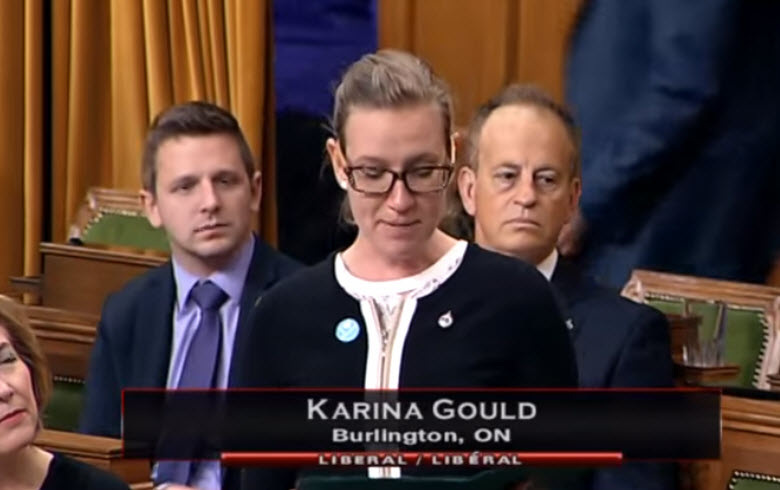
Karina Gould, Member of Parliament for Burlington and Parliamentary secretary to the Minister of International Development spoke in the House of Commons on the funds being dedicated to supporting our humanitarian work in Syria.
Daesh is the name now used to describe what has in the past been called ISIS, or Islamic State, IS or ISIL. This linguistic sea change is said to be intended to delegitimize the mock the organization. We appear to have an enemy that we cannot name.
Mr. Speaker:
I believe that I am not mistaken, as I start, by saying that all members in the House are outraged by the pervasive and unrelenting violence in the conflict in Syria and Iraq. Our government is outraged by the deliberate targeting of health facilities, as we have seen in Aleppo and in Kamounia camp, near the border with Turkey.
Canada deplores the deliberate targeting of civilians and the continued disregard for international humanitarian law. The continued cost in the lives of innocent men, women, and children from such attacks is unacceptable and further demonstrates the need for an urgent de-escalation of violence.
 Ruins in Aleppo, Syria. The appalling acts of violence perpetrated by Daesh have resulted in the deaths of thousands of people of all faiths in Iraq and in Syria. The atrocities and widespread abuses perpetrated by Daesh against religious and ethnic communities, including Yazidis, Christians, Shiites, and Sunnis, is an affront to human dignity and Canadian values of peaceful pluralism and respect for diversity.
Freedom of religion and belief and the ability to worship in peace and security is a universal human right. Human rights are universal, indivisible, interdependent, and interrelated and must be enjoyed by all people, without discrimination and without distinctions of any kind. Canada stands in solidarity with those facing oppression as a result of their religious beliefs.
I am outraged, and Canadians are outraged, by the use of rape and sexual violence as a weapon of war. Sexual violence as a specific tactic, as well as the enslavement of women and girls, is not unique to the conflicts in Iraq and Syria. However, its systematic employment by Daesh in Syria and Iraq needs to be recognized, and its perpetrators will ultimately need to be held to account.
We are equally outraged by acts of violence against individuals because of their sexual orientation or gender identity. In February, the UN commission of inquiry on Syria reported that Daesh continues to target sexual minorities for execution. The report contains shocking examples of Daesh’s intolerance and brutality. This includes a video that shows two men being thrown from a building. Why? It was because they had been accused of committing homosexual acts. Our government deplores this violence and any kind of discrimination or intolerance based on a person’s sexual orientation or gender identity.
 At least 30 people, including women and children, were killed when Kamounia camp in Idlib province, northwest Syria, was hit by either Syrian or Russian air strikes. Let me reiterate that our government strongly condemns the terrorist acts committed by Daesh, and we firmly support investigations into their crimes and the prosecution of perpetrators. However, while we respect the emotion behind this motion, and what fair-minded person would not, unfortunately, democratic governments cannot only be guided by emotion.
I understand that members opposite disagree with the approach we are following, namely to arrive at a legal determination and not simply a political or emotional one. Why are legal determinations important? It is so we do not risk acting in a manner that undermines our intent.
As part of our broader engagement in the Middle East region, Canada is taking substantial and concrete actions that contribute to preventing and halting war crimes, and possibly genocide, by Daesh.
Our participation in the international coalition, our provision of humanitarian, development, and security and stabilization assistance, and our diplomatic engagement all support the protection of vulnerable populations.
To this effect, on February 8, the Prime Minister, the Minister of National Defence, the Minister of Foreign Affairs, and the Minister of International Development and La Francophonie shared Canada’s commitment to deliver a multi-faceted response to the crises in Syria and Iraq and their impact on the surrounding region. This commitment includes $1.1 billion in much-needed humanitarian and development assistance over three years.
From this funding, $840 million will help provide much-needed humanitarian assistance, such as food, urgent health services, water, shelter, education, and protection, including from sexual violence, for the most vulnerable people affected by conflicts in the Middle East.
On April 13, the Minister of International Development and La Francophonie took the first step in delivering on this commitment by announcing $100 million in humanitarian assistance funding to support the responses to the conflicts in Iraq and Syria.
 One wave and choppy waters and most of the people in this raft would drown – they nevertheless take the risk to flee their war torn countries. This announcement included $31.8 million to UNICEF to match the generous donations of Canadians to charitable organizations responding to the crisis.
This funding will increase education opportunities, provide child protection services in Syria and Jordan, and support immunization efforts for children in Syria, responding to critical needs and building the resilience of conflict-affected communities.
The funding announced is also supporting our humanitarian partners to provide emergency physical and functional rehabilitation services to people injured by the violence in Syria and Iraq, psycho-social support to people traumatized by violence, and clean water, food, shelter, and primary health care to people who have fled the violence in Syria.
In addition, this government is supporting the provision of confidential medical assistance, case management, and referral services to survivors of sexual and gender-based violence.
Canada’s humanitarian partners work in some of the most dangerous and challenging environments. Every day, humanitarian staff, many of them Canadians, put their lives on the line to make sure that vulnerable civilians affected by conflict around the world, including in Syria and Iraq, get the assistance they need. The price they continue to pay for their dedication to their mission is tragic. Since the conflict began in Syria, over 87 humanitarian personnel have been killed.
One need not travel far from the House of Commons to appreciate the dedication of Canada’s humanitarian community.
Given the inherent challenges in delivering humanitarian assistance, Canada’s long-standing practice is that Canadian humanitarian funding is provided to experienced humanitarian partners to meet the life-saving needs of civilians caught in the middle of conflict.
 Thousands of refugees wait to cross the border from Serbia to Tovarnik in Croatia as they fled Syria With decades of experience, our humanitarian partners have developed practices and processes to ensure the integrity of the assistance they deliver. Canada’s humanitarian partners adhere to the principle of humanity, meaning that all victims of conflict or civilians affected by conflict deserve protection and assistance, no matter where they are found.
In order to fulfill this goal, our partners also adhere to the principles of impartiality, neutrality, and independence so that they can work wherever those in need are located. This is an essential point. The ability of humanitarian workers to have access to people in need is predicated on their actions being neutral. This means providing assistance with no military or political objective, only the objective of saving lives and alleviating suffering.
In many contexts, the safety and security of aid workers depends on their ability to demonstrate that they have no other motive than providing assistance to those in need. Humanitarian principles remain the foundation of this trust, and we must be careful to protect their integrity.
Canada is committed to promoting and enhancing respect for humanitarian principles, international humanitarian law, and the protection of civilians.
We must uphold the spirit and the letter of the law, improve compliance, and hold violators to account. For this reason, our humanitarian partners and the Government of Canada are extremely careful that humanitarian assistance is provided in full respect of humanitarian principles and in accordance with the Geneva Conventions.
Karina Gould at the World Humanitarian Summit, in Istanbul, Turkey. Last month, I participated in the World Humanitarian Summit, in Istanbul, Turkey. I represented Canada at an event entitled “A Call to Action for Addressing Gender-Based Violence in Emergencies”, because we continue to be concerned about the fact that there is an increased incidence of sexual and gender-based violence during a humanitarian crisis. Women and girls, in particular, continue to face increased protection risks, such as sexual violence, trafficking, and child, early, and forced marriage during crises.
I wish to reiterate this government’s commitment to helping the most vulnerable and this government’s commitment to do so in a manner consistent with humanitarian principles.
I understand that members opposite disagree with the approach we are following, namely that we be guided by principles, principles that have served Canada for decades, under governments of all stripes, and not by emotion or politics.
 Karina Gould, Burlington MP, speaking in the House of Commons We all abhor what Daesh is doing. We all want it to stop and to hold the perpetrators to account. To do this, we must work with our allies through the international legal process. To not do so both elevates the structure of Daesh to something it is not, a government, and risks having Canada condemn it in a manner not consistent with how our country approaches addressing such acts. This is the appropriate process, and we are following in line with our allies and the international bodies responsible in that assessment.
This government stands with the United Nations and its international partners in calling for a judicial investigation and an end to impunity for the perpetrators of serious international crimes.
|
|





 By Pepper Parr



 To register or learn more, visit www.bayareasummit.ca or contact Whitney Eames at w.eames@hamiltonchamber.ca or 905-522-1151 x 100.










 Similarly, many schools and school boards actively discourage immigrant parents from enrolling their children in immersion, even though studies show that immigrant students – who often speak a third language at home – adapt smoothly to immersion. Some immersion programs, however, boast a high percentage of children of immigrants, as their parents recognize the value of being able to speak the country’s two official languages.









 Assisted by officers from Peel Regional Police and Guelph Police, experienced traffic officers focussed their efforts on identifying vehicles that may present a safety hazard to road users. This targeted approach typically produces a high rate of inspection failures and this was true during this project.