 By Pepper Parr By Pepper Parr
August 13th, 2021
BURLINGTON, ON
Burlington and development have for the past five years been in one of those awkward relationships.
The city wants development, the developers want to build – the problem has been what kind of development and where.
It became a menage a trois when the province said that we had to grow – big time. More housing for more people with not much in the way of space for the traditional single family house with a nice back yard that made Burlington what it is today.
Those that live in the southern part of the city didn’t want to see dozens of high rise towers taking over.
The developers wanted their buildings to be in the downtown core where the pricey condos were being built.
The argument got intense from about 2015 to the 2018 election when the issue was the boundary for the Urban Growth Centre.
Set out below is the boundary that was in place when the current city council was elected.
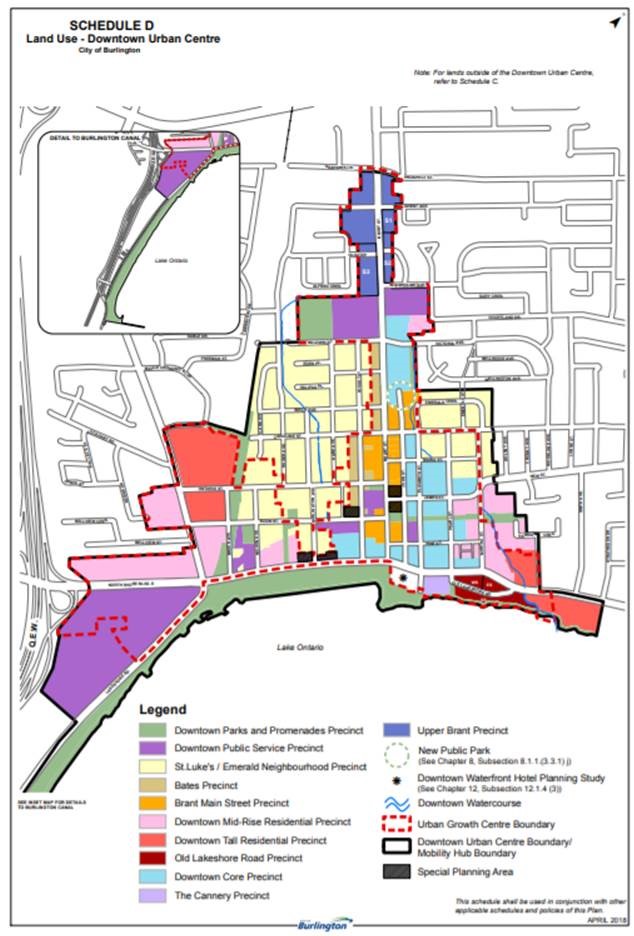 The Urban Growth Boundary that is in the Official Plan that is in force now went through a number of changes. The colours define the different precincts the city is divided into. A precinct is an area that has zoning and development rules unique to that area. Marianne Meed Ward convinced people that she could get hat boundary changed and while the fight isn’t over yet – there are new Urban Growth Centre boundaries in place and once the Official Plan gets completely approved – it is currently in the hands of the Ministry of Housing and Municipal Affairs – where it is expected to be approved – all it has to do is get through the appeals process – there are 40 some odd organizations appealing – it becomes the law of the land.
Meed Ward was adamant from day 1 – the boundary has to be changed.
This is what the Urban Growth Centre boundary is going to look like.
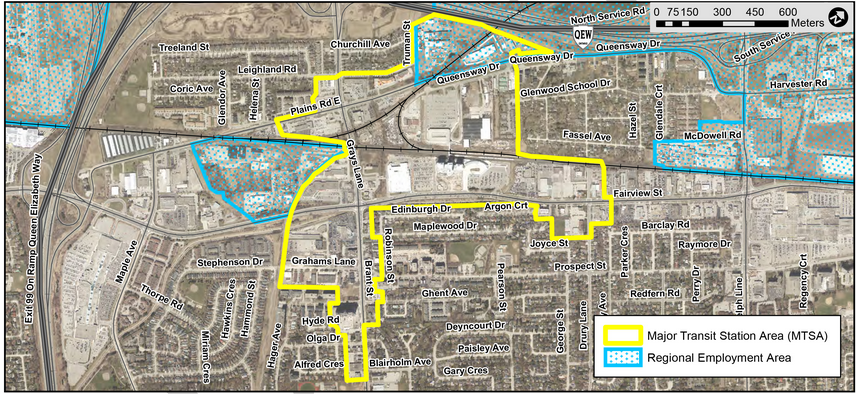 Boundaries for the Urban Growth Centre that are part of the approved but not in force Official Plan. Now slide back up and look at what was in place before a new city council set out to make a change
A huge difference – and the credit for much of it belongs to the Mayor. She was thee one who pushed and pushed and did her best not to budge an inch.
It was no small feat.
Meed Ward did not do this alone – what she did was lead the five newcomers to council, who for the most part were on her side when they were first elected, and then supported what she was setting out to do.
The Gazette has a number of differences with how this first term Mayor has handled and portrayed herself; Lord Acton had it right when he said: “Power tends to corrupt, and absolute power corrupts absolutely.” Time will tell if Marianne Meed Ward can catch herself before she falls. None of this should take away from what she did in getting that Urban Growth Boundary moved north,
Salt with Pepper is the musings, reflections and opinions of the publisher of the Burlington Gazette, an online newspaper that was formed in 2010 and is a member of the National Newsmedia Council.

By Pepper Parr
August 12th, 2021
BURLINGTON, ON
The definition appeared in a media release from the city’s communications department.
I had never seen something like this before.
2SLGBTQIA+ (TwoSpirit, Lesbian, Gay, Bisexual, Transgender, Queer, Intersex, Asexual)
This expansion of the acronym to refer to the community has gone too far.
 The symbols are important -let’s not demean them with acronyms that lead to ridicule. The fight to get the Pride community the respect it deserves has been long and hard; it has taken decades to get to the point where the community is recognized and not shunned, dismissed, shamed and hurt.
The political leadership has once again gotten over-enthusiastic and in the process hurt the people she chooses to speak for.
The Pride Community can speak for itself.
Gazette readers are commenting – some examples.
 Brave step – smart move. One in every ward in the fullness of time. Agreed (name withheld). “I do not have the time of day for this passive aggressive approach orchestrated by the mayor. She created the survey (not staff). Now there are 2 rainbow crosswalks in Ward 2 and not one of them is in front of city hall. She will hide behind the survey results but we all know what her goal was.”
Another reader wrote: “I was surprised to see the latest permutation of inclusivity symbols in this article (2SLGB….+). While I am fully in favour of demonstrations of support for people struggling to find their identity, there is a danger of going to extremes to include more and more subsets until everyone finds their own personal home. And let’s not forget there is another axis of identity being explored these days based on race, heritage, language and age. At some point our whole view of our society becomes a jumble of alphanumeric compartments that render it meaningless, while activists in each group clamor for special attention. Thus we become divided, not united.”
 What the Halton Regional Police Service did was dignified and appropriate. Let’s continue to raise the Pride flag and when we see instances of discrimination personally do everything we can to put a stop to it.
Support the Pride Community the way you would like your community to be supported.
Why the city communications department went to the lengths it did is both surprising and disappointing.
Salt with Pepper is the musings, reflections and opinions of the publisher of the Burlington Gazette, an online newspaper that was formed in 2010 and is a member of the National Newsmedia Council.
By Pepper Parr
August 12th, 2021
BURLINGTON, ON
We ran a piece yesterday announcing the Green Party candidate whose people suggested that an election call might come as early as next week.
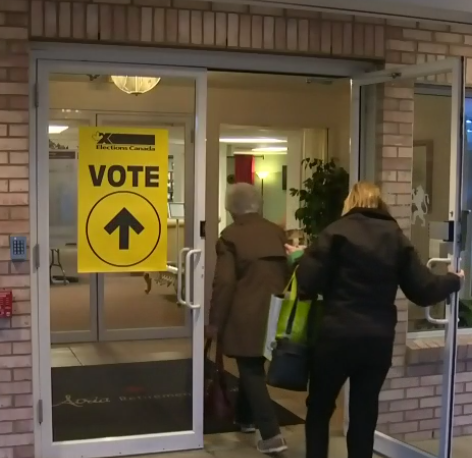 The next election isn’t due until sometime in 2023. The next election isn’t due until sometime in 2023.
There is no valid reason to call an election at this time. The country is doing just fine with the current minority Liberal government.
The Conservative Opposition cannot get itself elected; the federal New Democrats couldn’t from a government in the very unlikely event that they did get elected.
The federal Green Party may not be a political party if they continue with the internal squabbles.
The only reason for an election is the Prime Minister wanting a majority government.
 David Peterson called an unnecessary election in 1990 because he thought he would win. Ran a terrible campaign and lost. David Peterson tried that stunt in 1990 and it cost him the government he had.
 Governor General Mary Simon Canada has a new Governor General – what little we have seen of Mary Simon suggests she might suggest that the Prime Minister go back to his office and think about it should he decide to pay her a visit asking that she dissolve parliament.
When the Liberal Caucus meets (virtually) are there Members of Parliament with the courage to tell the Prime Minister that an election now is a mistake.
Given the polls we are seeing there is no certainty that the Liberals could win a majority.
Ending up with another minority would be reason enough for Justin Trudeau to offer his resignation.
Salt with Pepper is the musings, reflections and opinions of the publisher of the Burlington Gazette, an online newspaper that was formed in 2010 and is a member of the National Newsmedia Council.
 Max Bowder: Local Journalism Initiative Reporter Max Bowder: Local Journalism Initiative Reporter
August 12th, 2021
BURLINGTON, ON
Burlington is a city full of young families which means I am always surrounded by selfless people willing to help each other in their time of need.
Many Burlington businesses are in a time of need, especially the hospitality sector. Others are glad to be back at work with an economy that is opening up and shifting away from the risk of having to shut down – again. Some don’t see another huge spike in Covid cases.
 Value Village is back to where it was before the pandemic hit the city. “We have been reopened since June 17… we are now back to business as usual,” said Value Village manager Beau Kowanetz.
In an attempt to help small businesses, the business Burlington Economic Development Team has supported business with website development and access to grants.
Clothing stores needed to adapt to online purchasing because all trade shows were shut down.
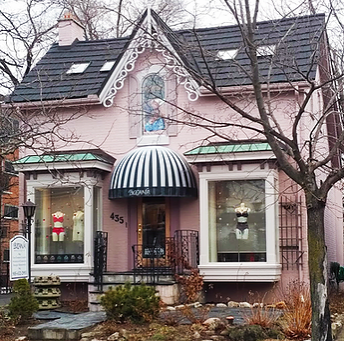 Carol Boyko, owner of the Bocana Boutique is putting in 16 hour days and learning to use the internet to advertise. “We’re doing virtual zoom meetings to look at new clothing collections … that’s an issue on its own because you cannot feel and touch the merchandise,” said Bocana Boutique owner Carol Boyko.
Boyko has had to put in 16 hour days in order to keep her business alive while learning all about online advertising.
Though difficult as it was her resolve is better than ever and although she is praying and is optimistic about not going into lockdown again, she has contingency plans ready for if businesses are forced to close. .
The reason I think Burlington has done so well is because the people of this city have a great, rare universally shared mentality that I have not seen since visiting Argentina where I worked for a short period of time.
People in this city do not look for someone to blame for the problems; something that is easily done in societies that are divided by opinions. Burlingtonians don’t think of problems that have to be changed by someone but rather people in this city analyze the issue, ask what needs to be done to get through it and diligently and patiently surmount the issue without panic turning instead to hard work.
Being in Burlington means being in a place that is peaceful but also where my responsibilities are not too far away. Burlington is a city that lets me enjoy the seclusion of the country and wilderness but also where I can become more active in my community, find stable work and conveniently attend college.
Burlington as I see it is a city that has maintained its spirit, optimism and its joys; it shows the same spirits of the people who looks past excuses and focus on solutions.
When Covid hit Burlington the people were disappointed that our lives had come to a stop but they were not surprised; they watched the news and knew it was only a matter of time – unlike so many in the United States who rejected reality or looked for someone to blame.
 The Burlington Food Bank provides food for families that have been financially damaged by the pandemic. Citizens donate to keep the operation going.healthy I see Burlington as a city of people who give care to its family and support to those who need it and are doing everything that needs to be done to end the pandemic soon.
Burlington residents have found themselves coping quite well with the pandemic – they feel they have it better than most.
“I think we’ve been doing very well, said parent Amy Cohen.
“Parents are looking forward to in-class learning for their children in the fall and with a keen sense of returning to normalcy.
“Parents enjoy taking their children out to Orchard Community Park and allowing kids to play at the water parks and not wearing masks but still keeping socially distanced and limited people on playground at a time.
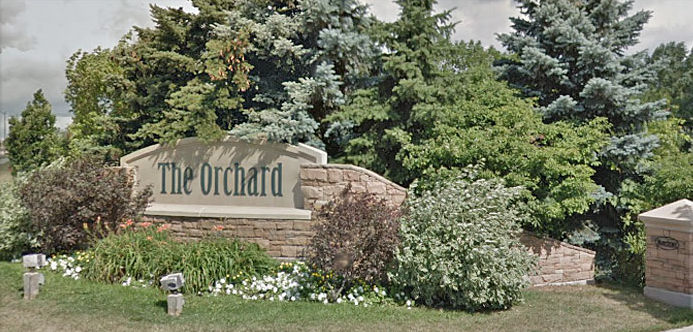 The Orchard as a community has pulled together to get families through a problem they never expected to have to deal with. With people coming out to be vaccinated in large numbers and the city slowly but surely opening up, residents are seeing the end in sight believing the pandemic to be over soon.
With the majority of residents vaccinated and plans to have their children vaccinated as soon as Covid19 vaccines are approved for younger ages.
“I think [the schools] are doing the best they can, given the amount of notice they have been given,” Cohen continued.
 Max Bowder is a second year journalism student at Sheridan College. He is part of a team with the Gazette on the Local Journalism Initiative funded by the federal government. Before enrolling at Sheridan Max volunteered in a community in Argentina where he worked with young people. He is a Burlington resident who helps out on the family farm in Milton. Max Bowder is a second year journalism student at Sheridan College. He is part of a team with the Gazette on the Local Journalism Initiative funded by the federal government. Before enrolling at Sheridan Max volunteered in a community in Argentina where he worked with young people. He is a Burlington resident who helps out on the family farm in Milton.
 By Ray Rivers By Ray Rivers
August 11th, 2021
BURLINGTON, ON
OPINION
It’s been sixty years since the New Democratic Party was formed. Surely that must make them the old democratic party by now. In all that time they only once become the second party in Parliament. And that was only after their charismatic leader, Jack Layton, had catered to the separatists, promising to ignore a Supreme Court ruling and let Quebec separate on a 51% sovereignty vote.
The NDP’s socialist roots go back to Saskatchewan premier Tommy Douglas, who introduced Canada’s first universal medical care system. Douglas’ party merged with the Canadian Labour Conference in 1961 to become the NDP which also made them a labour movement, at least for unionized workers.
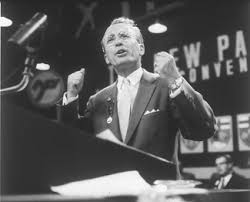 NDP’s socialist roots go back to Saskatchewan premier Tommy Douglas, who introduced Canada’s first universal medical care system. More recently the NDP has tried to become the other green party, despite the potential conflicts between environmental conservation goals and jobs in the resource and energy sectors. And after a half century of marriage between labour and the socialists other cracks have developed. Some labour leaders have become frustrated being tied to a a party which was unlikely to ever become government, and so shifted their support to the Liberals.
The party faced a major crisis in the 60s and 70s when a determined group of members, called the Waffle, sought a more aggressive policy shift towards socialism and economic nationalism in Canada. Fearing a loss of the Quebec NDP wing, they also called for greater accommodation for Quebec’s sovereignty demands. The Waffle was booted out of the party. Still some of its ideas found their way into Liberal government policy at the time, such as the Foreign Investment Review Agency (FIRA).
A little over a decade later the Mulroney government replaced FIRA with the more welcoming Investment Canada. The folly of that move became particularly clear last year when this country was struggling to find COVID vaccines. Toronto based Connaught Labs, which had been a world leader in the development and manufacture of vaccines was gone, it’s technical know-how exported and its trained research staff relocated elsewhere.
 Much of what the Manifesto called for has taken place – except for the elimination of fossil fuels The Leap Manifesto presented another milestone issue for the party. In 2015 about 60 representatives from Canada’s Indigenous rights, social, environmental, faith-based and labour movements came together over two days to identify 15 policy actions for the future. Though the initiative was non-partisan, it had been driven by social and climate activists Avi Lewis and Naomi Klein, both with deep roots in the NDP.
LEAP was so well conceived and written that, within a couple weeks of its creation, over 25,000 Canadians had endorsed it. Yet, during the 2015 federal election NDP leader Mulcair shunned the initiative, thinking it was too radical, even as his party was endorsing LEAP riding by riding. Today almost all of the LEAP demands have been adopted, at least in principle, by the current Liberal government and some are even accepted by the Conservatives.
 He was a powerful leader of the Opposition – but did not have the vision the country wanted and lost an election he thought he had in the bag. THE CANADIAN PRESS/Fred Chartrand Tom Mulcair had been an effective opposition leader but his lack of vision set the party back from the break-though which early polling in the 2015 election had promised. Jagmeet Singh, who replaced him, is an articulate politician but has not been able to bring the party back from its third place, though his class baiting has won him some support.
Singh’s problem is that the Liberals have learned to overtake the NDP on some key progressive policies. For example, when Singh promised an NDP government would ban single use plastics by 2022, Trudeau announced he would start the process in 2021. It is hard to determine how much the NDP does in fact influence government policy, though the Liberals mostly have to rely on the NDP to keep them in office.
Even should the Green Party collapse within itself, as it appears to be doing, the NDP are unlikely to supplant the Liberals, at least so long as Mr. Trudeau avoids something like another sponsorship scandal. And while Trudeau’s image and likability may have become tarnished over his last five years in office, as happens to all politicians, Canadians do not seem in a hurry to replace him in these scary times we are living through.
The LEAP project, now retired, can claim credit for stimulating debate and placing so many of its priorities into action. It was ultimately endorsed by the NDP and its ridings, despite the concern of the Alberta contingent over the language on fossil fuels. Today the NDP is looking south of the border for its inspiration, and is trying to develop a Canadian Green New Deal.
 Jagmeet Singh chose to prop up the minority Liberals; there wasn’t much else he could do. Whatever else Mr. Singh has accomplished by propping up the minority Liberals over the last couple years, he has failed to get Mr. Trudeau to move forward on some key socially progressive priorities, like universal pharmacare, a basic annual income and proportional electoral representation. Unless his party improves its position in the upcoming federal election, his leadership may well be at issue.
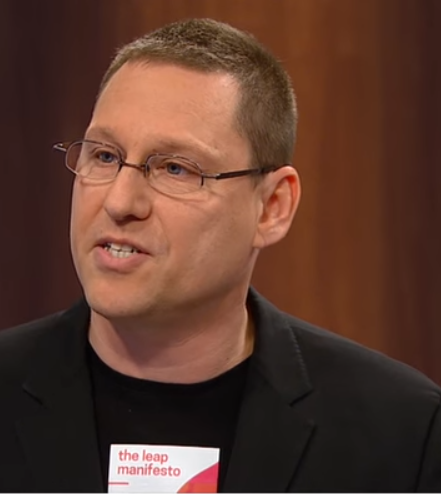 A strong mind, an incredible political pedigree and now a willingness to run for public office. Avi Lewis, one of the instigators of the LEAP project, has thrown his hat into the ring to run for the NDP in the upcoming election. Lewis hails from a political heritage, including his father Stephen and grandfather David, which rivals that of Justin Trudeau. If Lewis wins his seat nobody should be surprised to see him advance to leadership in the NDP and to challenge Trudeau for the top job in the country. Maybe the party could even change its name, dropping the amateurish sounding ‘New” given how long it has been around.
There was a time when Pierre Trudeau and Ed Broadband mulled a political merger between the parties. But that idea was anathema to the western NDP movers and shakers at the time and nothing came of it. So unfortunately for both parties in Canada’s first-past-the-post electoral system, a vote for the NDP will end up being another vote on the left which the Liberals won’t get. And that makes it just like a vote for the opposition Tories.
 Ray Rivers, a Gazette Contributing Editor, writes regularly applying his more than 25 years as a federal bureaucrat to his thinking. Rivers was once a candidate for provincial office in Burlington. He was the founder of the Burlington citizen committee on sustainability at a time when climate warming was a hotly debated subject. Ray has a post graduate degree in economics that he earned at the University of Ottawa. Tweet @rayzrivers Ray Rivers, a Gazette Contributing Editor, writes regularly applying his more than 25 years as a federal bureaucrat to his thinking. Rivers was once a candidate for provincial office in Burlington. He was the founder of the Burlington citizen committee on sustainability at a time when climate warming was a hotly debated subject. Ray has a post graduate degree in economics that he earned at the University of Ottawa. Tweet @rayzrivers
Background links:
NDP –
Leap – More Leap – Unions – NDP Constitution –
Jagmeet Singh – Waffle – Avi Lewis –
By Ray Rivers
August 9th, 2021
BURLINGTON, ON
OPINION
If he hadn’t been politically assassinated by his own caucus, Patrick Brown might have become the 26th premier of Ontario and perhaps formed it’s first truly Progressive Conservative government since Bill Davis.
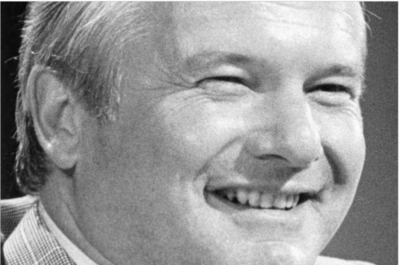 Bill Davis: A moderate conservative in his time and what the province needs in these troubling times. Davis, referred to himself as bland. He was a moderate conservative from all accounts. He seemed more comfortable with colleagues like Brian Mulroney, Jean Chretien, Pierre Trudeau, John Tory and Bob Rae, than right wingers from his own party like Mike Harris or Doug Ford, for example.
Davis was a careful master of compromise between progress and conservation. He understood that when it comes to policy, it’s more important to do what in the public interest than to defend your ideology. And he clearly believed when it came to delivering his messages that bland beat bragging and bravado hands down.
Davis will always be the education premier to me, even though he was education minister proper only during my formative years of schooling. But he was far more than the person who modernized and expanded the provincial education system. To those who remember him, he was considered one of Canada’s best loved provincial premiers, vying for that spot with Alberta’s Peter Lougheed.
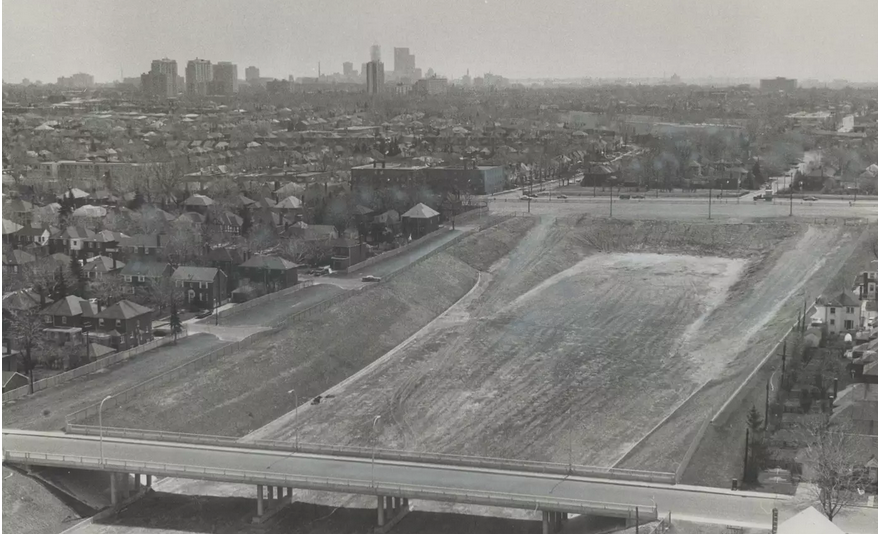 The Davis decision to kill the construction of the Spadina Expressway into the downtown core of Toronto was a brilliant political stroke. Davis also expanded health care, implemented regional government, initiated GO service, killed the Spadina Expressway, and made the Ontario civil service bilingual. Moreover Davis played a key role in repatriating Canada’s constitution while doing more than his part keeping the country together during those early years of living with Quebec’s separatist government.
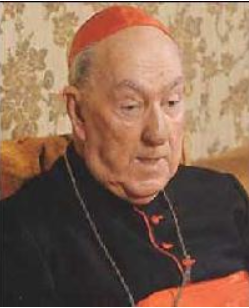 Cardinal Gerald Emmett Carter and Bill Davis met often. The Cardinal and the Premier, according to provincial myth decided to extend catholic schools into high school over cognac and good cigars. Trying to please all people usually means that you displease some. Davis’ decision to enable full secondary schooling by the Catholic church upset more people than it satisfied, and his successor lost the next election because of that error in judgement. His rationalization of Ontario’s municipalities led to an unprecedented level of urban sprawl which today is choking Ontario’s roads.
Building coal-fired electrical power plants was a mistake that took several decades and a change of government to correct. And in all his 13 years in office Davis never managed to balance his budget, even during relative boom times, averaging $2 billion in dept annually as the net debt to GDP grew from 2% to 15.2% during his tenure.
But Davis’ leadership style is what perhaps made him such a respected, if not loved, premier. There was no ‘we ‘or ‘they’ in his world, and he imparted a positive vibe of optimism to us all. He showed that it is possible to govern progressively, to meet the needs of an evolving society even when you are a conservative. And for that alone we should all take a moment to remember him.
Ray Rivers, a Gazette Contributing Editor, writes regularly applying his more than 25 years as a federal bureaucrat to his thinking. Rivers was once a candidate for provincial office in Burlington. He was the founder of the Burlington citizen committee on sustainability at a time when climate warming was a hotly debated subject. Ray has a post graduate degree in economics that he earned at the University of Ottawa. Tweet @rayzrivers
Background links:
Remembering Davis – Bill Davis Big Blue –
–
 By Mark Gillies By Mark Gillies
January 18, 2015
BURLINGTON, ON
Burlington is using the month of August to celebrate local history. Sometime ago the Gazette published a series of articles by Mark Gillies, a lifelong Burlingtonian. It is appropriate to re-publish the stories about the people who built this city.
A Burlington History Maker, Like No Other
His name was Lee Joseph Smith, another outstanding citizen of Burlington, and just like Spencer Smith, this individual also made a huge impact on why so many of us choose to live here. What did this man do? As in so many cases with Burlington’s history makers, they have not been properly recognized.
 Chief Lee Joseph Smith, (1885 – 1973). Was this man Canada’s greatest Police Chief ever? Most residents will not know his name, or at best, barely remember who Lee Smith was, but by the time you finish reading this four part feature, you will better understand this man’s contributions to the safety and protection of our local society. This is for you Lee. This is your story.
Farm Boy joins The Northwest Mounted Police
Lee was born July 26, 1885 in London, Ontario, but spent most of his boyhood years growing up on the family’s market garden farm in Saltfleet Township, which is the Stoney Creek area of Wentworth County. When Lee was 21 years of age, in 1906, he made a decision that was about to change his life, and not knowing it at the time, this same decision would eventually affect the residents of Burlington, even to this day.
 Here is a typical Northwest Mounted Police officer in full dress uniform around 1911. Lee would have worn a “Mountie” uniform exactly like this one, and then climb onto his horse and head out on patrol. His decision was to serve the public in law enforcement. Lee joined the Northwest Mounted Police, where they promptly sent him out west, where Lee patrolled on horseback throughout the wild desolate prairie lands of Alberta, only 1 year into becoming a province.
Later, Lee transferred to the Brandon, Manitoba detachment as a result of his outstanding service, having been promoted to detective. When Police Commissioner Aylesworth Bowen Perry introduced annual training classes, Lee was selected as one of his first instructors. No doubt about it, Lee Smith was a good as it gets; a rising star who undoubtedly was destined to one day become a future Commissioner of the Royal Canadian Mounted Police. Officer Smith while out west had some skirmishes and even took a few bullets, fired upon by local rowdies, but the young man survived, and continued to serve faithfully, and grow as a highly respected police officer.
Boy meets Girl
While posted to the Brandon detachment, Lee met his future wife to be. Her name was Alma Edith Mackenzie a lovely young lady from Woodstock, New Brunswick. Alma was a student studying at the Brandon Baptist College. When Alma was 21 years old, she and Lee tied the knot in Brandon on September 27, 1911. The newly wedded couple lived and worked in Brandon until 1914, when personal tragedy struck back home in Ontario.
Lee, after serving with the Mounties for eight rugged years, felt it best if he resigned, and return to his home area of Hamilton with his bride Alma, after receiving the tragic news his younger sister Annie Katherine, at the age of 26, had died on May 17, 1914, from tuberculosis. Annie had painfully suffered for several years with the dreaded disease. The family was grief stricken. Lee, a compassionate man, felt he had completely let his family down with his long absence from home, and racked with guilt, now wanted to be closer to his family, especially at this very difficult and sad time. Home for good, Lee needed to find work as soon as possible. Then he heard about a possible opening as a constable in Burlington.
Lee Smith finds employment in Burlington as a Night Constable
Lee was hired as a replacement night constable a few weeks after his sister’s death in the spring of 1914. Burlington, at that time, had a population of around 2,000 people during World War 1. Most of the young men from town and the surrounding farms had already gone off to war. If you think about it, if about half the population were children, and ½ of the adults were female, this only leaves 500 adult men in town. Burlington did its part, and we sent 300 over to Europe. Only 200 elderly men remained behind. Who was going to keep us safe? The Town Council had recently gone through a series of unsuccessful attempts to hire other men who did not work out to be the kind of Burlington police officer they wanted patrolling the streets after dark.
Lee Smith’s interview was impressive, and Lee was selected to be their new man of law and order. Lee continued to be exceptional at police work putting his Northwest Mounted Police training to good use. Sometime in 1916 Burlington’s first Chief Constable, Charles Tufgar, 36, who lived on Ontario Street, unexpectedly resigned. Lee Smith, without any hesitation by Town Council was promoted to Burlington’s Chief Constable. Town Council wanted to make sure their “all-star officer” didn’t one day suddenly resign, with ambitions to move up the ladder with another police department. As it was, Lee was not about to leave. The Chief strongly believed in loyalty to the Mayor, the Town Council, and the residents of Burlington he served. The truth was Lee and Alma loved Burlington.
The new Chief delivers his first report to Town Council
It was the duty of the Police Chief to provide the Town Council with an annual update of the activities and concerns of the Police Department during the first week of January. In the Chief’s first report in 1917, he acknowledged the resignation of Chief Charles Tufgar, and he also informed the town’s Council they were without the services of a night constable.
The Chief reported that in 1916 there were 475 cases that went to Court. During that same year, the Chief had found 43 doors were unlocked, and advised those residents to have them secured. The Chief reported that Burlington had 5 fires, and 24 accidents were attended. There were two cases of aggravated assault, 76 overnight lodgers, three house break ins, two charges of abusive language, 14 thefts, four common assaults, 12 disorderly conducts, 11 vagrancy charges, 1 trespassing charge, two stolen horses, 49 warnings issued for small offences, 161 local complaints received and investigated, three charges of residents not having a proper license, five charges of riding a bicycle on the sidewalk, three charges of property damage, 3 cruelty to animal charges, one charge for not having sleigh bells, 286 aliens were registered, seven charges laid for being an alien enemy, 14 charges for drunkenness and breach of the OTA, and seven charges laid for breach of the Motor Vehicle Act.
There were 11 arrests outside of points. The Chief also reported that 29 children had not attended school and the parents had been contacted. A total of $1206.20 in fines was collected. Visitations to the two pool rooms and the moving picture theatre were deemed satisfactory and managed properly. The Chief was referring to Burlington’s new Crystal Theatre located on Brant Street, opposite Ontario Street.
The following year in June 1918, the Crystal Theatre featured the two classic blockbuster silent films, “Birth of a Nation” and “Intolerance”, complete with an in-house orchestra. The Chief concluded by saying, “I highly appreciate the valuable assistance given me by Mayor and Council, also that of the Special Constables and other Town officials during the year.” No doubt about it, the Chief had a very busy year in 1916.
The Chief expands his Police Department & hires more officers
When Lee Smith became Chief Constable, he was responsible for additional duties other than police work. It was also Lee’s job to do all the janitorial duties, such as washing windows, sweeping the floor, cleaning washrooms, and to do minor repairs around the municipal office. Lee was receiving $17.80 each week, and that was after his raise, when he was promoted to Chief. This was thought to be good pay back then.
One day, the Town Council under the leadership of Mayor Maxwell Smith, himself a man of great vision, innovation and entrepreneurship, decided that Lee could use some help as the town tried to modernize, so later that year in 1916 Town Council presented Lee with a telephone for his office, something long overdue, since telephones had been in use since their invention around 1877, almost 40 years earlier.
That wasn’t all that changed for the better. The following year in 1917, affable Bert Dunham was hired as a special constable, and it was decided Bert was to work every other Sunday for $2.00 a day. Bert and his wife Ida who had seven young children were living in a very small house at the corner of Pine and Elizabeth Street; and for the Dunham family, this new source of money was greatly welcomed. Lee knew that Bert needed the extra money and this was his way of helping out when he hired Bert for the job.
One thing about Lee J Smith, he really knew people. Bert was grateful for the work, and he wasn’t going to let the compassionate Chief down. Now, Lee was no longer on call seven days a week, but still came pretty close to around the clock duty. Lee not only worked days, but he also worked nights, and it was decided another constable was needed for the still vacant night shift.
Allan Mitchell, a Scottish born family man who was about 50 years old, also could use another job, after hitting some tough times, and like Bert, Allan could use the extra money to augment his irregular income. The Chief puzzled over how Allan would labour during the day with his various odd jobs, and then still work all night. Regardless of how Allan was going to make it work, he was hired as a night constable by Chief Smith, and this brought about some more badly needed relief for this completely overworked Police Chief.
 Here is a very dapper Adolphus Smith sporting a fashionable bowler hat, with his wife Susan and daughter Annie around 1918 at their home 2091 Maria Street, near the corner of Martha Street. Doll, as he was known, was the older brother of Chief Smith, and Burlington’s first motorcycle officer. A Police motorcycle, automobile accidents & possible nepotism
The Burlington Police Department grew to 4 officers in late 1919 when Chief Smith hired his older brother Adolphus as a new Burlington police officer. Adolphus was better known by everyone as “Doll”. During World War 1, fighting against Germany, Adolphus was probably not the best name to be known by, so Doll thought this shortened version of his name worked better. Doll Smith, a woodworker by trade was working at a munitions plant in Hamilton during World War 1.
 This accident occurred on the Lakeshore when the driver was heading towards Bronte. The impact was severe enough to snap the power line pole. When the war ended, Doll who was married, with a young daughter to raise, was soon to face unemployment and began looking for work. As it turned out, Chief Smith, a man with uncanny vision, had been thinking of a way to patrol the Lakeshore Road area. This road was becoming busier all the time, now that automobiles were becoming more prevalent, and wouldn’t you just know it, automobile accidents were starting to happen, a new phenomenon for the department. The population had increased to close to 2700 people. The population was getting close to a 50% increase over wartime numbers in town. Chief Smith, with virtually no real budget to work with managed to locate a free motorcycle for his department.
The Chief discovered that British World War 1 surplus motorcycles under the Imperial Gift plan, a program set up for all Members of the British Commonwealth to receive some of Britain’s military surplus, on a ruling established by the British Parliament on June 4, 1919 was put into effect. Chief Smith was elated and quickly sent in his application for one slightly used battle scarred motorcycle. When the machine arrived later that year, Constable Smith was assigned as Burlington’s first motorcycle officer.
 Chief Smith secured a war surplus motorcycle similar to this 1918 Matchless, and assigned his brother to patrol the busy Lakeshore Road, the main thoroughfare for automobiles, trucks, carriages, wagons, bicyclists and pedestrians between Toronto and Hamilton from 1919 to 1930. Doll patrolled the Lakeshore Road all the way to Toronto and back. Either Doll was hooked on riding a motorcycle, or he thought Burlington was far bigger than it actually was; whatever the reason, this is what Doll did for a few years. Doll left the department in the late 1920s to ride for the Ontario Highway Patrol, and in 1930 he moved over to the Ontario Provincial Police, when they hired 70 constables to begin their own motorcycle division. Doll was one of the OPP’s first motorcycle officers hired, and remained an OPP motorcycle officer patrolling Highways 8 and 20, right through to the Niagara area, until his retirement in 1950.
What about the nepotism? It wasn’t to be a problem. Not many people in that day could even drive an automobile, and far less could operate a motorcycle. Adolphus Smith already new how to ride, or so he claimed. Doll just happened to be in the right place at the right time. Adolphus Smith passed away in 1975 at 92 years of age.
The Ontario Temperance Act
Just when Lee Smith received his promotion to Chief, Ontario went bone dry in 1916. The Ontario Temperance Act (OTA) was enacted and this new law, designed with good intentions, prohibited alcohol sales. The OTA was in force until the Act was repealed in 1927. Needless to say, the Chief and his three officers were kept busy trying to enforce this unpopular law. Quite possibly, Chief Tufgar may have been provoked into his resignation over opposition to this legislation. The Temperance Act was that controversial.
The story of Burlington’s most famous Chief of Police was told in for parts. The Gazette is re-publishing parts 1 and 4. Links to parts 2 and 3 are linked below.
Part 2
Part 3
By Pepper Parr
August 4th, 2021
BURLINGTON, ON
Food Bank Executive Director Robin Bailey put the situation in plain black and while.
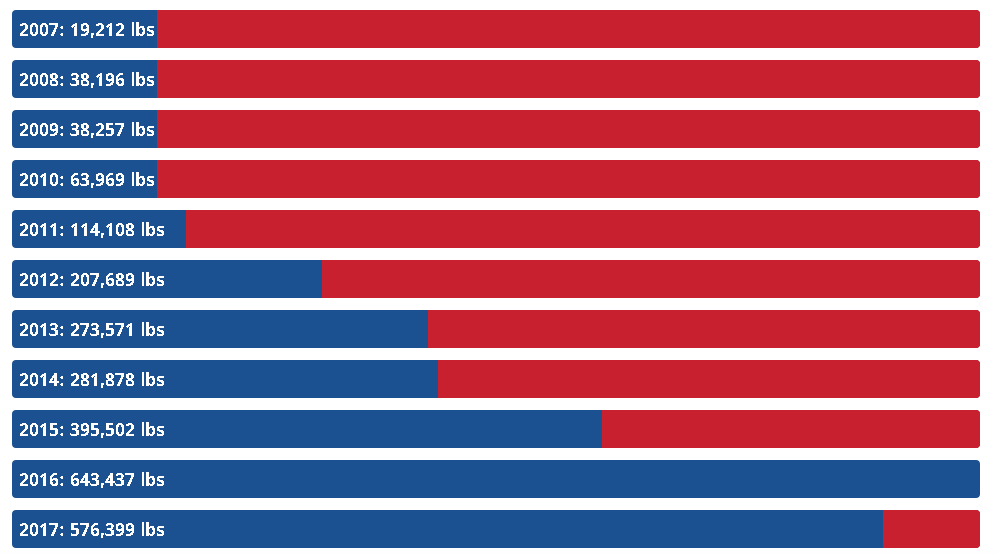 An incredible record of performance The damage the pandemic has done to the annual Gift of Giving Back food raising event is going to have a negative impact on what the food banks are able to do.
In the past, Jean Longfield and her team have done a superb job of rousing the team spirits of young people involved in sports and using that energy to produce tonnes of food that kept the food banks running quite well.
When Longfield came up with the idea in 2007 it just grew and grew – to the point where she was able to pass the idea along to other communities.
 Jean Longfield talking to a television reporter about the success of the Gift of Giving Back program. John Tate is in the background. This year, there will be a food drive – it won’t use the traditional Gift of Giving Back – instead they will work under the banner of xxx and work with Burlington Centre to create a location people can take food to and have it picked up from the cars parked in the lot.
It won’t be the same – the buzz that always existed around the Giving Back event was exciting; seeing student after student come into the high school gymnasium with cartons of food that other people would need was a sterling example of our young people learning to care for others.
For Jean Longfield this must be an anxious period of time. She put everything into making the program better year after year.
To be stopped in your tracks by a pandemic is understandable – but that doesn’t lessen the disappointment.
By Mark Gillies
February 2, 2015
BURLINGTON, ON
Burlington is using the month of August to celebrate local history. Sometime ago the Gazette published a series of articles by Mark Gillies, a lifelong Burlingtonian. It is appropriate to re-publish the stories about the people who built this city.
Would you like to know who I think was one of Burlington’s great business leaders of the early 20th century? Many great people who lived here before us, sacrificed much to help shape Burlington; in order for us to benefit from our beautiful surroundings today. As a local society, we have in far too many cases, turned our backs on these great citizens of Burlington. This is a real shame, and it doesn’t have to be this way.
As in my previous articles, most of the people I write about will be names that you do not recognize, and are now reading for the first time. These outstanding citizens of Burlington accomplished much locally, but have never been properly recognized. One such person is Henry “Harry” Lorimer.
Harry Lorimer moves up the ladder with The Grand Trunk Railway
Harry was born on the family farm in Norfolk County, February 8, 1861. By 1891, Harry left the family business and pursued a career with the Grand Trunk Railway in Norfolk County. Harry’s first job was a telegraph operator, then he became a Railway Agent assigned to a station in Norfolk County, where he perfected his skills, before receiving a promotion that was about to relocate Harry and his family to a more fast paced location, the Burlington Junction Station in Freeman.
 Harry Lorimer was the Burlington Junction Station Master in 1906 when it opened after fire destroyed the previous station in 1904. By 1897, Harry, his wife Seba, and daughter Gertrude were living in Freeman, and Harry was working as the Grand Trunk Railway Agent. It was very prestigious to be assigned as a Railway Agent to a Junction station. There was so much activity all of the time. Burlington Junction had double track lines running from Montreal right through to Chicago. Trains were travelling both ways. Then, the Grand Trunk Railway had another track running from the Niagara Region, across the Beach, through town, and up to Freeman where it crossed over the double tracks, continuing up to Georgetown, and then up to Allandale.
Burlington Junction also had freight warehouses, which were always busy with boxcars being loaded or unloaded. The responsibility and stress levels were extremely high for Harry Lorimer. The complicated schedules and logistics were unbelievable. Harry was lucky to have a telephone, some needed high tech assistance. The Station Master’s number was easy to remember. Who could forget “2”? Harry was the only Station Master for two different Freeman Stations. One burnt to the ground in 1904, and was replaced by another GTR station in 1906.
 After a fire destroyed the original Great Western Railway train station in 1883, this second station was built by the Grand Trunk Railway, which also succumbed to a fire and was destroyed in 1904. Harry Lorimer was Station Master for both railway stations.  This is the historic 1906 Grand Trunk Railway Station photographed just after it had been built. The GTR identified the station as “Burlington Junction”. Our historic station was one of the busiest Junction stations in all of Canada. Now, thanks to the financial generosity of local citizens and businesses, this 109 year old historic building, owned by the City of Burlington, is in the process of restoration and has been permanently relocated to Fairview Street, west of Brant Street. The city owned 1906 historic station is now under restoration in a new location on Fairview Street, solely at the expense of private citizens and local businesses, who have come forward to save the station from demolition, as recommended by The City of Burlington. The City of Burlington at one time was to receive close to $1,000,000 in stimulus money to finance the relocation and restoration, but Burlington City Council, several years ago, were unsuccessful in agreement on a new suitable location. Subsequently the City of Burlington lost access to all of this stimulus money. Then, their solution to solve the problem on what to do with this magnificent old building, was a decision to have our heritage rich Freeman Station demolished, despite this being one of Burlington’s most historic buildings, and a huge part of Burlington’s colourful heritage. The citizens of Burlington were outraged at their thinking. Some on City Council still continued to fight to save our beloved Freeman Station and have been officially recognized for their outstanding efforts by the citizen organization, Friends of Freeman Station.
The Station Master was a highly respected citizen
The Station Master or Railway Agent in any town with a railway station was always a very influential and prominent citizen in their community. Railway Agents were very well respected, much like the clergy, police officers, doctors or lawyers. One of the reasons for this high level of respect was due to the fact that new families moving to Canada from Europe, arrived on the scene, and knew no one, often standing on the railway platform, suitcases in hand, and not knowing what to do, or where to go. The first person they saw and who offered to help them was the local Railway Agent. From meeting their first friend in Canada, new arrivals, one day, responded in kind. Often times, throughout Canada, the town’s highly respected Railway Agent also became the local Reeve or Mayor.
In 1901, Harry and his family were well entrenched into Burlington’s local community. Some of their good friends and neighbours were John Thomas Tuck and his family, plus the Ghent family, two very prominent local families. We’re all familiar with John T Tuck School on Spruce Avenue, and we all know where Ghent Avenue is located in Burlington. These two families have been recognized locally, but not so for Harry Lorimer.
 James S. Allen was the proprietor of Allen’s Hardware at the time it was sold to Harry Lorimer and Gordon Colton in 1912. James S. Allen was the nephew of George Allen, the previous owner, who then moved on to build prestigious homes in the core area of Burlington. James S. Allen, later became the Mayor of Burlington from 1925-1928. Harry Lorimer changes careers and Burlington wins again
In 1912, Harry, who was just 51 years old, made a career change. He became a hardware merchant and bought into an established business with his son-in-law, Gordon Colton. Together, they bought the hardware store, Allen’s Hardware, from James S. Allen, who at one time served as Mayor from 1925-1928. James Allen had previously purchased the business from his uncle George Allen in 1901. George had become Burlington’s most prominent home builder at the time, and was responsible for the building of many of Burlington’s historic homes in the downtown core, which was referred to as the Wellington Park area. The former Allen’s Hardware, was now called Colton & Lorimer Hardware store, and was located at the northeast corner of Brant Street and Pine Street. Their retail neighbour 2 doors north, was Spencer Smith’s green grocery store. I wrote about the remarkable Spencer Smith and his accomplishments in my article on January 12th. The hardware store, from the same location, operated as a thriving business well into the 1970s when it was owned by Keith Dale from Aldershot, and Keith operated it as Dale’s Hardware. Keith Dale purchased the store from the Mills family who had operated it as Mills Hardware, after they purchased it from Harry Lorimer.
 The Allen’s Hardware name was removed and the Colton & Lorimer name was added to the outside of the building in 1912. The historic building was located at the northeast corner of Pine & Brant Streets. This historic building met a fate all too familiar in Burlington, and was demolished. The retailing skills of Harry and Gordon were outstanding, as they both realized Burlington was growing quickly. Harry and Gordon understood that they needed to supply all of the local market gardeners with proper farm supplies, implements, and chemicals, plus they were also aware that new housing starts, and new building construction would provide incremental retail sales. To have everything in stock for both farmers and homeowners, and at the same time was a massive retailing nightmare. Big “Box stores” were not in Burlington yet, close to 100 years into the future, but Harry and Gordon knew exactly what would sell and what to stock in their store. Burlington was their market, and their shrewd retailing skills made Harry and Gordon very successful businessmen.
The Colton & Lorimer Hardware store was extremely successful, undoubtedly the most successful retail location on Brant Street, and most residents in Burlington shopped there. If you were lucky enough to have a telephone in Burlington, you could call Colton & Lorimer. Their number was “9”. If Colton & Lorimer didn’t have what you wanted, then you really didn’t need it. Colton & Lorimer had fine-tuned hardware retailing to a science.
 Harry Lorimer proved to be a superior retailer, and as a result the Lorimer’s attained substantial affluence. Along with the purchase of a custom made house, built by Burlington’s most prominent builder, George Allen; Harry & Seba also acquired a luxurious automobile and were driven about town by Bob, their chauffeur. With hard work, comes the spoils, Burlington’s on a roll
Harry and Seba finally decided to purchase a new home. They also decided to buy an automobile, and hire a chauffeur to drive them around. The hardware business was doing that well. The beautiful home they chose was built by Burlington’s most prominent home builder George Allen. Many of George Allen’s beautiful homes have now been designated as historical. The Lorimer residence was built in 1914 on a lot to the north of George Allen’s own historic house at 1391 Ontario Street. George Allen did not disappoint the Lorimer family. Their new home was stunning. The historic Lorimer family is at 504 Burlington Avenue, and the house just had its 100th birthday.
 George Allen built this beautiful home for the Lorimer family, and they moved here in 1914. The house at one time was recognized as historical, but in 2013 it was removed from the Registry by the City of Burlington for alleged lack of historical significance. City of Burlington insults Harry Lorimer’s legacy 50 years later
This beautiful home was lived in by the prominent Lorimer family for 50 years, from 1914 until 1964, and at one time was recognized as historical and added to the Municipal Register of Cultural Heritage Resources, then was officially removed from the Register in 2013 for what was said the be a lack of historical, architectural, or contextual value. (I know what you’re thinking, I’m not making this up, it really happened). The City of Burlington defends its heritage reasoning found on their website as follows:
What is Heritage Conservation?
“Heritage conservation involves identifying, protecting and promoting the elements that our society values. Heritage conservation has traditionally been associated with protecting the physical or built environment (buildings, structures, landscapes, facts etc.). More recently, the term has also come to be associated with safeguarding the non-physical associations between people and a place (associations linked to use, meanings and cultural or spiritual values).”Taken from Parks Canada Standards and Guidelines for the Conservation of Historic Places in Canada
Why is Conservation Planning Important?
The conservation of built heritage is an integral part of the land use planning process at the City of Burlington. It entails planning for the identification, protection and promotion of the heritage resources that our community values. Burlington’s heritage is a living legacy that helps us understand our past, provides us context for the present and influences our future.
Why Conserve our Heritage?
The conservation of cultural and heritage properties is vital to a community’s overall cultural and economic development and it can enrich our lives, inspire us and create a sense of community that can sustain generations. The Heritage planning process in Burlington is overseen by staff in consultation with the Heritage Burlington Committee.
The Passing of Harry Lorimer and his Family
Harry lived to be 99 years old, and passed away peacefully in 1960. His beloved wife Seba died 10 years earlier at 85 years of age in 1950. Gertrude, their daughter died at 76 years of age in 1964, and her husband Gordon tragically died at 31 years of age in 1918 as a result of the great influenza epidemic. They are all buried together as family, in Aldershot’s historic Greenwood Cemetery. All residents of Burlington owe a huge debt of gratitude to the Lorimer and Colton families. These two dynamic families were true genuine pillars of the community and did far more than their fair share in helping to build, shape and drive Burlington’s economic engine so efficiently into the 20th century
Plan to Attend Heritage Days
On Saturday, February 7th at Burlington Central Library, Heritage Days will be in full swing with many wonderful displays of Burlington’s local heritage featured for the public to view. Plan to take the children or grandchildren. It’s free to everyone. There will also be several guest speakers throughout the event. Heritage Days will be from 10:00 AM to 3:30 PM. One display you will not want to miss, will be the Burlington Junction Train Station 1:24 scale model. This beautiful model was handcrafted by Burlington resident, Mr. Bob Chambers. Thanks to Bob’s talents, you will get to see what life was like in 1906 when the historic train station opened, and Harry Lorimer was its first Station Master.
 Councillors Marianne Meed Ward and Blair Lancaster, both heritage preservation advocates were recognized by the citizen group “Friends of Freeman Station” for their perseverance and leadership in convincing the others on City Council that the Freeman Station was worth saving.  Mayor Rick Goldring was recognized by “Friends of Freeman Station” for his personal involvement in helping to save the Freeman Station from demolition, as recommended by the City of Burlington. Mayor Goldring received a Lifetime Membership to Friends of Freeman Station from Brian Aasgaard, President of Friends of Freeman Station. The Friends of Freeman Station will be there to answer all of your questions. Please plan to donate generously to help these exceptional volunteers complete the restoration of this magnificent historical building, something the City of Burlington could not accomplish. Without private financial support, this Burlington Junction restoration cannot be completed. There is no local, provincial, or federal government funding.
My next article on February 9th will be on the Burlington Junction Station, or as it is so often called, the Freeman Station. Find out why I believe Burlington Junction Station is Burlington’s most historical building, and why we need to make sure this part of our local heritage is preserved for future generations.
Related article:
What the Freeman Station really meant to the growth of the city; it was the key link in the transition of the city
By Mark Gillies
Originally published January 5, 2015
BURLINGTON, ON
Burlington is using the month of August to celebrate local history. Sometime ago the Gazette published a series of articles by Mark Gillies, a lifelong Burlingtonian. It is appropriate to re-publish the stories about the people who built this city. The pictures are fascinating.
I chose Edith Hodge for my first venture into writing about Burlington’s fascinating historical roots.
 Edith Hodge, 1829 – 1925, a true local pioneer. Most Burlington residents have never heard of Edith Hodge, but by the end of this article, you will become much more familiar with this wonderful lady, and just how she has positively impacted Burlington. Edith is the perfect example of how life changed for many people of this era, who for whatever reason, left their homeland, and ventured into the New World as a pioneer, rooted themselves to their new environment, and provided future generations with the foundations of progress for a new society.
Edith Hodge came to Burlington in 1843 when she was only 14 years old, on a sailing ship that set sail from England and arrived in Montreal, Quebec. The voyage across the Atlantic Ocean lasted 7 long weeks. What’s unique about this voyage was Edith actually recalled her travel experiences and had them documented when she was in her 95th year in 1923, when she related the story to Marion North Blodgett (1891 – 1966).
There are not many first hand recorded recollections of life on these ships from immigrants sailing from Europe and settling in the New World. To have such information available from one of Burlington’s earliest residences is indeed quite rare and should be cherished for its historical content.
 Edith, her mother & father, brothers and sisters were born and raised in Weymouth, England. This illustration shows how the village of Weymouth looked around the time the Hodge family decided to leave and relocate in Upper Canada.  Martha Bartlett was Edith Hodge’s mother. Martha and her daughters made all of the preparations for the long and dangerous voyage across the Atlantic Ocean, then upon arrival in Montreal after a 7 week voyage made their way to Hamilton. Edith was born in Weymouth, England in 1829. With her mother Martha (1794 -1881), and 3 sisters Susan (1821- 1915), Mary (1825 -1899), & Emma (1834 – 1895) they travelled by themselves on this incredible journey. Edith’s father William Hodge (1790 – 1870), and her 3 brothers William (1827 -1899), James (1828 – 1897) & John (1837 – 1891) had already travelled the treacherous Atlantic Ocean much earlier, in order to set up a home, find a job, send money back home, and do everything necessary to bring the rest of the family over to a more comfortable lifestyle. It was not uncommon for families to split up like this, in order to better establish themselves in their new homeland.
Edith recalls the sailing ship had 3 masts, and had bricks as ballast. Ships on their return voyage to Europe were basically void of passengers, but were changed into freight ships loaded with lumber and grain, usually wheat, destined for the European market.
 Historic Burlington Junction Station in 1906. As a matter of local interest, the historic 1906 Freeman Grand Trunk Railway Station now under restoration on Fairview Street has ship’s ballast as decorative stone work on the outside of the building. These are called “Whinstones”, which were quarried in the Midlands area of Scotland. To raise funds for the restoration work, 1,000 Whinstones can be sponsored with a tax deductible receipt for $100.00 each. To find out about sponsoring a Whinstone, just go to the Friends of Freeman Station website www.freemanstation.ca
Travelling by ship in 1843 was not anything like a cruise ship of today. It was not “All Inclusive”. The whole trip was extremely uncomfortable and very dangerous. Sickness and death were rampant. The ships were often called “Coffin Ships”. Burials at sea were an almost daily event. If you arrived alive, it was miraculous.
To travel, passengers had to bring their own food. Edith recalls the preparations that she and her mother and sisters made for the voyage. “We lived near a baker who supplied loaves of bread, which we cut and toasted before starting; also Mother cooked hams and prepared preserved fruits.” This information is quite insightful, as most of us have absolutely no knowledge of how these new settlers sustained themselves on a trip like this which lasted about 2 months.
 This illustration and the one to the right, show some of the horrific living conditions endured by passengers aboard a sailing ship travelling across the Atlantic Ocean, often in perilous weather.  Another family from Weymouth, England were the Judds. They became the travelling companions of the Hodge family, and shared a compartment on the ship below deck. There was a low partition between the 2 families, and bunk beds for both. Edith recalls being mischievous on the long trip. “They used to call me down for everything.” Edith tells of the 2 families reading aloud to each other, often praying and singing. Another family from Weymouth, England were the Judds. They became the travelling companions of the Hodge family, and shared a compartment on the ship below deck. There was a low partition between the 2 families, and bunk beds for both. Edith recalls being mischievous on the long trip. “They used to call me down for everything.” Edith tells of the 2 families reading aloud to each other, often praying and singing.
During a huge Atlantic storm, when water was lashing over the bulwarks, passengers had to be fastened down below deck. The fierceness of the ocean tossed passengers violently on the ship. One of Edith’s sisters became so ill, that she removed her restraints and ventured onto the deck during this fierce storm. This was probably not the best of decisions, since sailing in oceanic storms can be very dangerous.
It was common to exchange food amongst passengers. The captain had fresh meat tied to the mast and sometimes would give the Hodge and Judd families some. The Hodge family had brought salted meat, and this was a welcomed change.
The Hodge and Judd families were very religious and took exception to some passengers playing cards. Edith said, “We didn’t have anything to do with them.”
 Aaron Dunham Emory was the man who loaned the money to the Hodge family which allowed them to purchase their farm in present day Burlington. According to Edith Hodge, Aaron Emory was “a real decent chap”. When the ship arrived in Montreal, the passengers had to stay in quarantine for 4 days, and once they cleared inspection, they were allowed to proceed. The Hodge family then travelled on a small boat which was pulled by a team of horses along the shoreline whenever they encountered rapids on the St. Lawrence River. Finally, this small boat made its way to Hamilton, and the Hodge women reunited with the Hodge men. William Hodge had already rented a home with a big garden. He began work as a gunsmith. The Hodge family stayed at this home for a short time, just long enough to figure out how to buy their own property. William and Edith then borrowed enough funds from Aaron Dunham Emory (1808 – 1892), to buy some farmland.
The Hodge’s had to remove tree stumps with oxen hitched to chains that were wrapped around the stumps. Edith stated, “You’d think it was a mountain coming up when the stumps gave way.” The cost to remove all of the tree stumps was $300.00, which was a huge amount of money in those days. The first crop planted was blackberries. The Hodge farm also had 2 cows. The family raised money by selling butter and blackberries at the Hamilton Farmer’s Market, which was used to pay off the interest on Aaron Emory’s loan. Edith recalled, “It was a great thing when we could pay off the borrowed money.” She called, Mr. Emory, “a real decent old chap”.
So how does Edith Hodge become more familiar to the rest of us in Burlington?
 William Bell married Edith Hodge around 1850 and they proceeded to have 10 children . They lived a very good life at their homestead in Burlington. Around 1848, Edith met a man named William Bell (1826 – 1895) who she fancied very much, and the couple married around 1850. William Bell was born in England, and made his way to present day Burlington as a young man, and he then became a local farmer. His father Robert Bell and two of his brothers were shoemakers in Hamilton, and William was not interested in pursuing that career. Together, William & Edith Bell had 10 children. They are: James (1851 – 1935), Frederick (1853 – 1939), Elizabeth (1855 – 1936), William (1856 – 1942), Martha (1857 – 1932), John (1861 – 1947), Mary (1863 – 1962), Rhoda (1866 – 1957), Edith (1868 – 1871) & Edith (1873 – 1924).
William & Edith built the Bell homestead, which is still standing in Burlington. Thankfully, it has not been demolished, as so many properties of local historical relevance have been.
 This photo shows the original Bell homestead photographed about 100 years ago. It is still in existence. This is the home of Canada’s “Strawberry Social”. What’s extremely important about the Bell homestead, is that William Bell introduced strawberries as a commercial agricultural product to Canada. Previously, people would usually have strawberries growing in a small container, maybe located on their verandah, and as people went by, they would pick one or two to eat.
 The Bell homestead is now called Bellview House. Today it is a conference centre. Look for the house when you exit the Ikea & Fortinos parking lot. When you turn left on Plains Road heading towards Brant Street, just look right as soon as you turn. It was William Bell, who had the vision of much more, and realized that this product could be grown in the fields, especially along Maple Avenue where the sandy soil was perfect for strawberry production, and then harvested, sold locally and also shipped to distant markets. William and Edith Bell were agricultural entrepreneurs who realized you could make a lot of money, just by growing strawberries.
 Here’s the “Strawberry Social” in full swing in 1916. The three ladies in front (L-R) are Mary, Martha and Rhoda Bell, three daughters of Edith Hodge. If you look closely at the photograph you can see a young dashing Spencer Smith in the background. The Bell family also were instrumental in using the “Strawberry Social”, as a very clever marketing tool to increase the sale of their strawberries. It became very fashionable to eat strawberries in Burlington, and around the country, thanks to William & Edith Bell.
Some of the Bell children married into many early local pioneer families. James, the eldest son married Jennie Fonger, (David Fonger was one of Aldershot’s first residents), Elizabeth, the eldest daughter married William Arthur Emery, (the Emery/Emory family are United Empire Loyalists), William married Frances Alton, (the Alton name is well recognized in Burlington), and Edith, the youngest child married Spencer Smith, a name known by everyone in Burlington.
 Another daughter of Edith Hodge was Elizabeth Bell. Elizabeth married William Arthur Emery, a successful market gardener in Aldershot.  William Arthur Emery who married Elizabeth Bell was the son of Aaron Dunham Emory. Aaron Dunham Emory was born in New Jersey and came to the area as a United Empire Loyalist.  Marion North Blodgett was the lady responsible for documenting the recollections in 1923 of Edith Hodge and her experiences travelling across the Atlantic Ocean in 1843. This was not an easy task as Edith Hodge died of senility shortly thereafter. Today we know this as dementia.  Ethel Victoria Emery is the daughter of Victor and Marion Emery. Today, we know her better as Vicki Gudgeon, a local historian and past President of the Burlington Historical Society. Elizabeth Bell and William Arthur Emery had 5 children. One son was Victor Harold Emery (1883 – 1966). Victor married Marion North Blodgett. One of their daughters is Ethel Victoria Emery. Many will better recognize this lady as Vicki Gudgeon, a former past President of The Burlington Historical Society, and a noted local historian.
Who knew?
My next article will be on Monday January 12, 2015. It will be on Spencer Smith, the son-in-law of Elizabeth Hodge. We all recognize the man who has his name attached to Spencer Smith Park, a park used and enjoyed by thousands of residents, but very few of us know anything about this very special man. Spencer Smith had an extraordinary life. Find out next week.
Mark Gillies is a lifelong resident of Burlington, grew up in Aldershot and developed as a local historian, researcher, master genealogist and writer who has a passionate interest and extensive knowledge of the many early pioneer families. Mark will write a regular column Who Knew?, about colourful local history introducing Burlingtonians to the people that made this city what it is today.
By Pepper Parr
July 30th, 2021
BURLINGTON, ON
OPINION
Politics can be a cruel mistress.
A number of months ago Andrea Grebenc thought she had grown to the point where she decided she would like to try something bigger in the world of politics.
She was chair of the Halton District School Board. The Burlington Provincial Liberal Association was going to have to nominate a candidate soon and Grebenc thought she could do that job.
The process to the actual nomination of a candidate for the Liberals was messy – sloppy is perhaps a better word.
 Ward 2 Councillor Lisa Kearns was coy about seeking the Liberal nomination. She announced; shortly afterwards Andrea Grebenc announced she was also running for the nomination. Kearns withdrew. The Liberals invited ward 2 Councillor Lisa Kearns to seek the nomination. After a month or so of saying maybe yes – maybe no publicly, she finally came out and said she would seek the nomination.
A few days later Grebenc announced her intention to see the nomination.
Within 48 hours Kearns withdrew.
By that time there was a third candidate seeking the nomination.
Mariam Manaa announced she would seek the nomination. Ms Manaa, a young Muslim woman had been recruiting new members for the Burlington Provincial Liberal Party since January.
Grebenc chose to wait until May 27th to file her papers. The Provincial Liberals set June 6 as the date for the nomination meeting.
 Andrea Grebenc, chair of the Halton District School Board – lost the nomination contest. Grebenc explained to the Gazette at the time that she was working regularly with Jane McKenna, the MPP for Burlington and felt that it would be rather awkward to be working with McKenna and at the same time preparing to run against her.
Thus the wait until May 27th.
With just 10 days to sign up new members there wasn’t much of a chance to overcome the new membership lead that Ms Manaa had.
“I can tell you that the Manaa supporters were very loyal. I called many of them – they weren’t budging.”
Ms Manaa is the Liberal candidate – she won fair and square – the problem was that the rules didn’t allow those who had been Liberal supporters with Party experience to make a choice.
Anybody could become an instant Liberal. All you had to do was live in the city and be able to prove it.
The process turned out to be a race to see who could recruit new members – Manaa recruited more than anyone else and won.
The nomination process was unfair to both Grebenc and Manaa – they were limited to a 10 minute speech with nothing in the way of debate between the two women.
 Mariam Manaa – Liberal candidate . Manaa has some very credible experience in the community. Her work for the Member of Parliament was much appreciated by the Minister and the community that she was able to help.
We were indeed in the middle of a pandemic and there were stiff restrictions. But not so many that a debate could not have taken place and streamed live.
Neither candidate was given a chance to show their stuff.
The blame for this rests in the hands of the Burlington Provincial Liberal party executive. They failed the party; they failed the candidates, and they failed the people of Burlington.
Hopefully Ms Manaa will create an election team and keep her distance from the Burlington Provincial Liberal Association – they have proven to be incompetent.
Salt with Pepper is the musings, reflections and opinions of the publisher of the Burlington Gazette, an online newspaper that was formed in 2010 and is a member of the National Newsmedia Council.
“I’ve always been fond of dogs, and they are the one animal that knows the proper treatment to give to poles (polls).” (Former PM – John Diefenbaker)
By Ray Rivers
July 29, 2021
BURLINGTON, ON
OPINION
We are expecting a federal election call anytime soon. Most Canadians think we don’t need one yet. But the Liberals are stuck in a minority situation and beholden to the other centre-left or left-of-centre parties to bring their agenda forward. So with the polls moving in their favour they will do what political parties do.
 The opposition parties are complaining that it has only been two years since the last election and we’re still not out of the pandemic. But the real issue is that they don’t like what the polls are telling them. After all this would not be the first election during COVID. If we can believe the polls, an election today would mean that the ruling Liberals would improve their seat position and possibly even garner a majority. The opposition parties are complaining that it has only been two years since the last election and we’re still not out of the pandemic. But the real issue is that they don’t like what the polls are telling them. After all this would not be the first election during COVID. If we can believe the polls, an election today would mean that the ruling Liberals would improve their seat position and possibly even garner a majority.
The Greens are still polling around their traditional 5%, which means they may not do as poorly as they should this time. After all, the party has shown that it can’t even manage itself, let alone the nation.
Greens have always been a fringe party. Their raison d’être has been protection of the environment and mitigating climate change, which today, to their credit, is one of the most important priorities for Canadians. Still, Elizabeth May, try as she did, never got anyone to take their social and economic policies seriously.
 Annamie Paul, current leader of the Green Party In fact, when new leader, Annamie Paul, decided to venture into middle eastern politics, even with a seemingly balanced position, all hell broke loose. The party ended up losing a third of its elected members to the Liberals, falling back to only two seats. As a result, Paul came within a hair of being turfed out as leader and her Green Party membership revoked. An arbitration process saved her skin, though that in itself is now the subject of even more discord.
The Greens need to shake their collective heads. They are supposed to be a party which preaches social harmony, tolerance and understanding. Yet racism, mud slinging, conspiracy and cronyism are in the makings of this internal war. The party executive has even held back funding Paul’s personal election campaign, in what can only be described as a desperate attempt to get rid of her.
Paul is hoping that the existing executive will be replaced at the upcoming party convention, which may end up coinciding with the federal election. But who knows? And with party executive at war with their leader, why would anyone vote for these folks? Unless Paul can pull a rabbit out of a hat they are another political entity on a road to extinction.
Though it’s not certain, the Greens may at least hope to hang onto Elizabeth May’s traditional B.C. riding. Beyond that, no one should be betting on them. Their future is not likely bright. Besides, the NDP and Liberals have already stolen most Green policies, making the Greens more of a postscript rather than a viable electoral option.
From the perspective of the Conservative Party the Greens are, in fact, a political ally. They and the NDP represent votes which, thanks to our first past the post electoral system (FPP), won’t otherwise go to the Liberals. It is little wonder then that the Conservatives have always rejected changing the electoral system.
But a proportional electoral system, as is commonplace in most democracies (94), might even enable the Greens to become a part of a governing coalition, as they have in other countries. So it was unsurprising that some Green voters supported Mr. Trudeau and voted Liberal when he first promised electoral reform in his first election campaign.
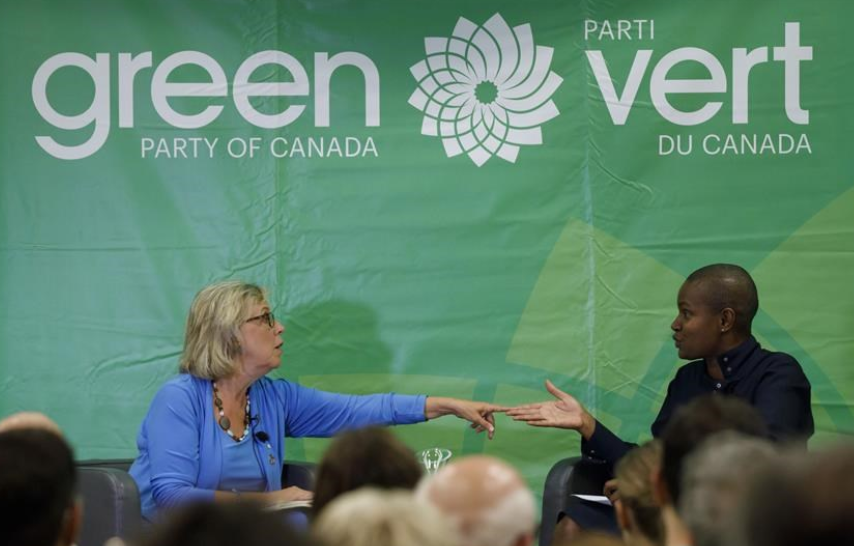 Elizabeth May and Annamie Paul. May was the leader of the Green Party – she was replaced by Annamie Paul. At best, the Green Party of Canada, which was formed back in 1983, is unlikely to win enough seats to form even a minority government in the foreseeable future, even if Canada changes its electoral system. And, given the internal strife the Green Party is now experiencing, no one would be surprised to see it go the way of Social Credit, Natural Levitation, the Communists and Marxists, the Reform Party, and very likely the People’s party.
The Liberals, to their credit, have seen the writing on the wall, borrowed environmental policies mostly scripted by the Greens, and is undertaking the most massive restructuring of the Canadian economy and society in our lifetimes, in order for this country to become a global leader in carbon freedom. For that the Green Party needs to be recognized for their prescience and forbearance, anyway.
 Annaimie Paul has been remarkably self-restrained and controlled through all that is going on, including personal attacks. She deserves better. As for Paul, who has been remarkably self-restrained and controlled through all that is going on, including personal attacks, she deserves better. One can only hope there is a future for her to bring her qualities and strengths to work in some other way, or with some other political party, for the benefit of us all. But if her party membership really has a point about her leadership failings, perhaps there is some other kind of career opportunity waiting for her.
Next time we’ll take a look at the federal NDP.
Ray Rivers, a Gazette Contributing Editor, writes regularly applying his more than 25 years as a federal bureaucrat to his thinking. Rivers was once a candidate for provincial office in Burlington. He was the founder of the Burlington citizen committee on sustainability at a time when climate warming was a hotly debated subject. Ray has a post graduate degree in economics that he earned at the University of Ottawa. Tweet @rayzrivers
Background links:
Election Polls – Green Party – Climate Change Polls –
Paul – Green’s Dispute – More Discord –
By Ray Rivers
July 24th, 2021
BURLINGTON, ON
OPINION
“Despite being the epicentre of the COVID pandemic in Ontario, for-profit nursing homes, from a business point of view, did incredibly well over the past 15 months. The Ford government indemnified them against liability from lawsuits, paid them out at full capacity no matter how many residents they had, and even offered them subsidies for other lost revenues.
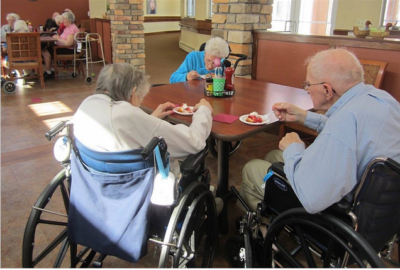 The profitability of the long term care sector is astonishing. In fact, many of the investment-backed, corporate players in the nursing home industry will emerge from COVID-19 in better shape than they entered it, thanks in large part to the province’s aggressive and generous plan to refurbish old homes and build new ones.” (Toronto Star July 2021)
The authors of this in-depth report (link below) concluded that throughout Ontario’s COVID crisis, premier Doug Ford simply followed the advice of the last person he had met with, and those were all too often corporate lobbyists or his friends in the development sector. Apparently when it comes to COVID Ford has one rule for the lobbyists and another for all the rest of ‘his people’.
 Construction hours have been extended at the request of the developers. Why for example, was construction allowed to continue pretty much business-as-usual when so many other businesses with lower COVID transmission rates were forced to shutter? Construction is known to have one of the highest transmission rates of all industries, and yet, curiously, residential construction was declared an essential service.
Meanwhile, in an attempt to appear to be acting tough on public health measures, recreational golf and tennis, which had no previous record of COVID transmission, were banned. Small non-grocery business owners, with a tiny public footprint, were outraged that their big box competition at Walmart and Costco could continue to operate while they had to close.
And despite being among the hottest spots for viral transmission in the province, meat packing, the Post Office and Amazon, were allowed to continue unabated. In the end it took the local medical officers of health, not the province, to shut them down.
The way Mr. Ford has tailored his priorities helps explain why it has taken Ontario so long to get our COVID infection rates down. This policy of allowing high risk activities to continue while curtailing safer options is not just unfair, it’s also negligent.
 The opening up of the hospitality sector too soon brought about a third wave from which we are just emerging. “….since Ontario first declared a state of emergency in March of 2020 the government has made decisions that align with the interests of lobbyists — many of whom have close ties to the premier, his party or both — and the businesses they represent. Those decisions have often favoured certain sectors over others and have, at key moments in the pandemic, gone against public health advice, delaying or fracturing lockdowns. Those decisions have often favoured certain sectors over others and have, at key moments in the pandemic, gone against public health advice, delaying or fracturing lockdowns.?” (Toronto Star July 2021)
If only a lobbyist for vaccine passports or mandatory vaccination for health care workers could make their way over the premier’s office?
Background links
Star Report – Construction Sector – Building Trades – Retaining and Big Box –
 By Rob Golfi By Rob Golfi
July 20, 2021
BURLINGTON, ON
The pandemic era housing market has continued to climb to an all-time high over the past two years with the average selling price of $688,208 recorded this May, according to WOWA. The intense demand of homes during the pandemic has made prices skyrocket, creating a seller’s market. While the market activity was up 103.6% year-over-year, The Canadian Real Estate Association has noted a decline in national home sales by 7.4% on a month-over-month basis in May.
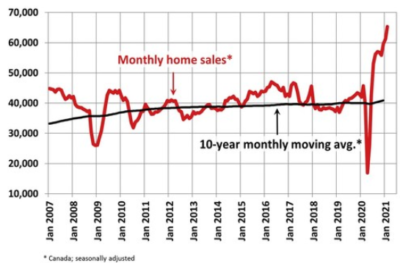 Data – Canadian Real Estate Association With the high demand of homes and a shortage of properties, frantic bidding wars on low valued homes have become out of control. In March 2021, the peak of the pandemic market, out of 1304 homes sold 1116 sold at asking price or higher and in April 2021 sales were up 245% since April 2020. However, sale prices were down 11% in June with the inventory available at the end of the month dropping to 0.8% which was lower than May. I have noticed that seller expectations are being impacted from how things were in previous months” resulting in pandemic tunnel vision which is preventing people from being able to sell their homes.
Unfortunately, sellers are getting caught up in the previous numbers of the market or hear about a neighbour who sold their house for X amount of money a few months ago, and believe their house is worth the same or more. Many agents in the area are having trouble coaching and supporting both buyers and sellers. Although the market isn’t retreating to a stable level, it isn’t continuing to rise to the previous caliber of March and April. As a result many are realizing weeks later that they botched a great offer and regret becoming overly confident and unsatisfied with the offers they declined. It is difficult for sellers to understand that we are now in an adjustment phase of the market”. Ultimately, sellers need to disregard previous numbers from the peak of the market and realize that it is beginning to settle down.
All things considered, the market earlier this year is a great memory for those who sold, and for buyers it will catch up in 12 months and you will see your equity begin to flourish. However, in this moment it is crucial for sellers to comprehend the shift the market is taking to successfully sell their home, and refrain from being fixated on numbers that are no longer applicable.
 Rob Golfi is the founder of RE/MAX Escarpment Golfi Realty Inc. A Real Estate Brokerage operating in Hamilton, Halton, Brantford, and Niagara. The firm has over 200 years of combined experience with more than 1000 five-star reviews on Google, Facebook, and Zillow. The Golfi Team is rated the 7th best RE/MAX team worldwide. The have being en in the top 100 Real Estate Teams for RE/MAX Canada since 2003. Rob Golfi is the founder of RE/MAX Escarpment Golfi Realty Inc. A Real Estate Brokerage operating in Hamilton, Halton, Brantford, and Niagara. The firm has over 200 years of combined experience with more than 1000 five-star reviews on Google, Facebook, and Zillow. The Golfi Team is rated the 7th best RE/MAX team worldwide. The have being en in the top 100 Real Estate Teams for RE/MAX Canada since 2003.
By Ray Rivers
July 19th, 2021
BURLINGTON, ON
The roller coaster ride with COVID has slowed down once again in this province. Our infection numbers have declined substantially since we peaked at over 4000 cases back a few months ago. Clearly the ‘stay-at-home’ and other public health restrictions have helped, though it’s the vaccinations that have really made the difference. And our governments deserve credit, the feds for securing vaccine supply and the province and local health authorities for rolling out the vaccinations.
Yet Ontario’s infection rate is still hovering in the triple digits and only about half of the adult population is vaccinated . But, the Premier is boasting about getting back to normal soon, much as he did last year. But chances are better than even that he is wrong again.
Normal is a long way off. Over the last few days the provincial infection numbers have either settled onto a plateau, or started inching back in the wrong direction. And Ontario’s new medical officer of health is now predicting another increase in infections come September, just as we saw last year.
If we look at the British and Americans. We see how they had mostly opened up their economies when their vaccination levels were similar to those in Ontario. But the results have been disastrous. COVID cases have soared over 90% across the UK such that their infection numbers are now back to those of last January, when they were in the grip of the Alpha (UK) variant and hardly anyone had been vaccinated.
 British Prime Minister Boris Johnson is prepared to life all controls for the UK: covid19 infections are expected to rise while the PM goes into self isolation. Medical officials in the UK have characterized Boris Johnson’s COVID policy of ‘living with the virus’ as just creating a breeding ground for new viral variants. In the US, the Delta variant has become the prime enemy of the people, with cases doubling every couple weeks and with increases in infections rising in every state. Authorities are laying the blame on the fall off in vaccination rates.
The virus and Delta variant may be the enemy, but those refusing the jab are its enablers. Just as in Canada, the virus in the UK and America is being spread primarily by the unvaccinated. So why aren’t more people rolling up their sleeves? US president Biden accuses social media of killing Americans by spreading anti-vaccine disinformation.
In France, when vaccinations started slowing down and COVID cases started rising, President Macron made vaccination mandatory for all health care workers. And then he made vaccine passports mandatory for access to congregate places, like bars and sporting events. That was a powerful incentive and a million people signed up almost immediately to get the shot in the arm.
Only two provinces in Canada are even considering issuing vaccine passports and regulating their usage. And Ontario isn’t one of them, despite calls from the mayor of Toronto and the business community to do just that. Premier Ford, while saying everyone should get the jab, keeps muttering about a split society, whatever that means. And also he refuses to mandate vaccines for health care workers.
 Quebec chooses to use QR codes as vaccination passports. It can’t be a constitutional rights or a privacy issue. After all, this is the same premier who instructed provincial police to block people moving across the provincial borders and to conduct random checks of vehicles and ticket those not travelling to a workplace. He is the guy who ordered COVID-safe golf and outdoor recreational tennis facilities and children’s playgrounds, shuttered under threat of thousands of dollars in fines.
The truth is that this pandemic will not be over until everyone, who is able to, gets fully vaccinated. It’s how we eliminated smallpox and for a time, measles. It’s either that or we social distance it into oblivion as New Zealand has done successfully so far. And it is likely too late for that.
With an election coming up next year, one would think Mr. Ford would want to ensure that Ontario’s economy is opened up as quickly and safely as possible – not another false start. Getting everyone vaccinated is the best bet for that to be possible.
 After the turbulent series of confusing and often counter-productive provincial policies over the last year and a half, this might demonstrate that Mr. Ford is actually capable of learning on the job and responding to the public will. Otherwise it’s deja vu. After the turbulent series of confusing and often counter-productive provincial policies over the last year and a half, this might demonstrate that Mr. Ford is actually capable of learning on the job and responding to the public will. Otherwise it’s deja vu.
Background links:
Step Three and COVID – French Experience –
The Next Wave – Ford Opposes – Ontario Medical –
Mandatory Vaccinations – England Threat to the World –
By Pepper Parr
July 14th, 2021
BURLINGTON, ON
They waved to the cameras once the motion to adjourn was passed – and with that the seven members of Council were off for the summer.
They return to a thick schedule of meetings September 6th.
Some have set out pretty hectic schedules for themselves; others are taking a break.
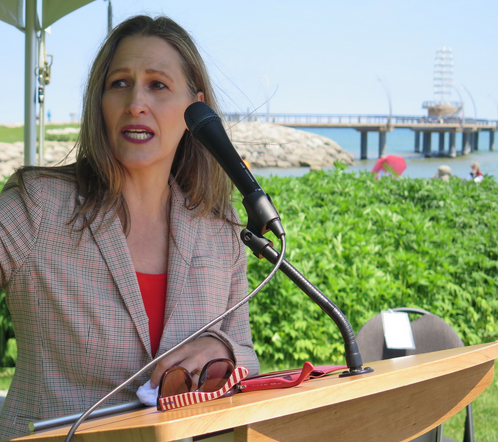 Mayor Marianne Meed Ward Nothing specific from the Mayor – she will network with her tribe and shore up the weak spots.
 Ward 4 Councillor Shawna Stolte Ward 4 Councillor Stolte is going to hold Pop Up meetings in parks throughout her ward. We lost count at seven locations. They will take place on Wednesdays from 5:00 to 7:00 pm.
Bentivegna plans on something a little more subdued – he will be meeting with small groups of five or six in back yards to listen and to ensure that they know he will be running again.
 Ward 6 Councillor Angelo Bentivegna Bentivegna is very effective in working a crowd; he plunges right in and makes friendly. He isn’t as available for media – basically he doesn’t respond; he used to – early in his first campaign he posed for pictures and talked about his plans as a city councillor. When he didn’t like what we had to say – he stopped talking.
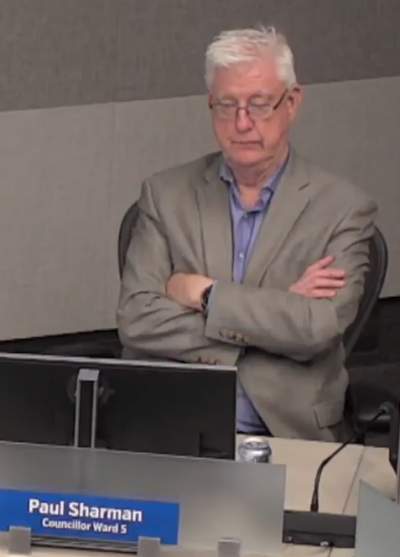 Ward 5 Councillor Paul Sharman Councillor Sharman is going to focus on his Orchard Park community – it might have to be virtual. He has an annual Appleby Line event that might make it out of the Covid19 social distancing limitations.
Ward 1 Councillor Kelvin Galbraith will be taking part in a couple of community events. The Rolling Horse Tour d’Aldershot is on his calendar. Summer is cottage time for the Galbraith household.
Every member of Council will begin, or have already begun, looking at their election prospects.
 Ward 2 Councillor Lisa Kearns Ward 2 Councillor Lisa Kearns will be doing some Zoom broadcasting. A usually reliable source told the Gazette that Kearns told him she would not be running for the Council seat even if she lost the attempt to gain the Liberal nomination for a seat in the Legislature.
We all know how that event went – she dropped out the day another candidate threw her hat into the ring.
Kearns can be mercurial at times. Will she live up to the statement she is reported to have made?
The long break gives the people elected to represent the interests of the tax payers time to think about what they have managed to get done and what they want to do with the time left in this term of office.
The achievements have been significant – they set a different direction in terms of the development that is taking place and will take place.
They have also come to learn more about the strengths and weaknesses are of their fellow council members and what they can achieve personally.
Some rude awakenings for several.
For those that decide to run again – most of them will – but they aren’t all going to retain their seats.
The Mayor will run again – she loves the job and, truth be told, there is no one out there who can beat her at this point in time.
Also true – she was the best choice the city had for Mayor in 2018
The budget could trip her up – there are too many changes coming on the expense side. Insurance premiums are going to sky rocket for the municipal sector – and there isn’t much councils can do.
Spending on small items will add up –a reported $100,000 for Rainbow Crosswalks comes under the Mayor’s “want to have”. She used to talk in terms of must have and nice to have.
There are two members of Council with Mayoralty aspirations – both realize this is not their time – 2026 might be.
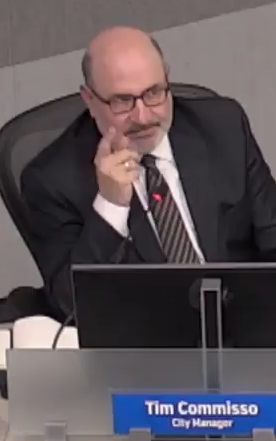 City Manager Tim Commisso City Manager Tim Commisso has done a fine job of rejigging the way the administration is to operate and put some very qualified people in place. He has a number of top level positions that will see retirements – Legal and Finance might not change while the pandemic has to be dealt with but once things are secure they will want to live different lives.
Will Commisso renew his contract? Probably not – but his work isn’t done yet.
However, his replacement gets better every day. And a majority of Council thinks she great. Awesome was the word used by several.
Salt with Pepper is the musings, reflections and opinions of the publisher of the Burlington Gazette, an online newspaper that was formed in 2010 and is a member of the National Newsmedia Council.
By Pepper Parr
July 13th, 2021
BURLINGTON, ON
City Council meets at 1:00 pm this afternoon for their last meeting until September.
The agenda for that month is loaded.
There have been very few delegations since the first lockdown in March of 2020 – those that did take place left little impression on those listening.
During the period of time the city was in a State of Emergency with its affairs guided by an Emergency Control Group they met whenever it had to –seldom less than twice a week. The City is still in a State of Emergency, which is where the city manager thinks it should remain for as long as possible.
Provincial funding goes to those who are in a State of Emergency.
Last week Council went through an impressive schedule of Standing Committee meetings that were both controversial on some levels and solid governance on others.
The Mayor’s ill-advised tweet about support she got from some of her colleagues but not others was petty politics at its worst – while the comment from Councillor Sharman on the decision by Human Resources to do away with annual performance reports was excellent governance.
Councillor Sharman was not amused. We will let you know when the annual performance reviews are put back in. Sharman will beaver away at this – expect him to prevail.
Will we see that decision as a Staff Direction? That might be expecting a little too much.
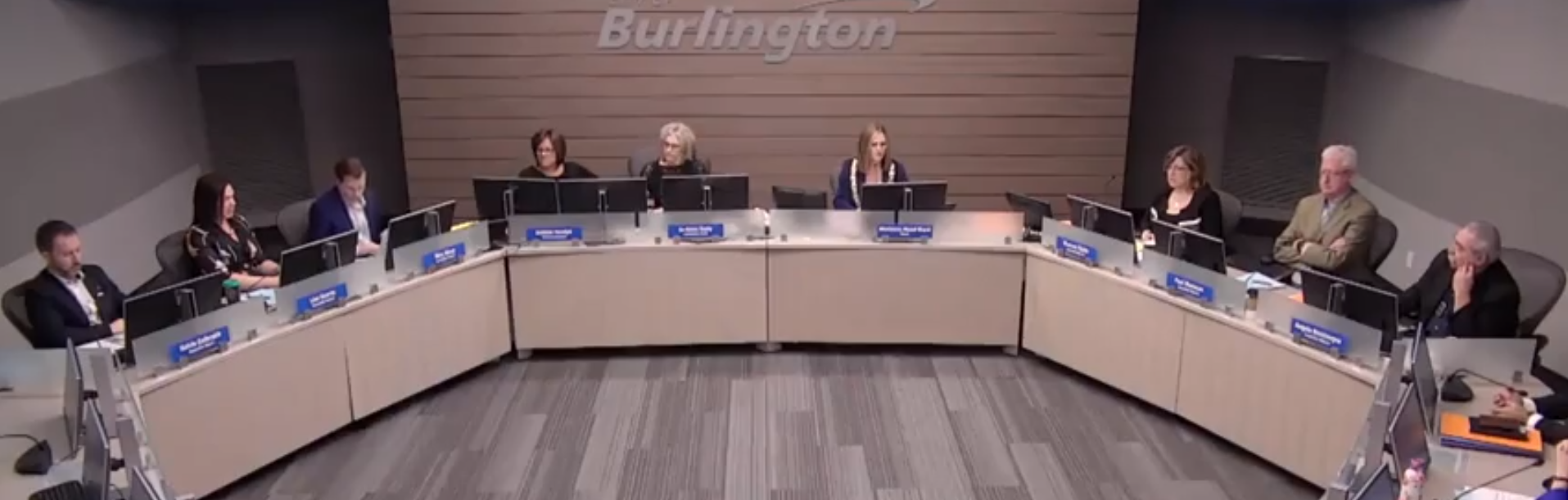 We used to get this: City Council meeting – before COVID The meeting today will be swift – there is next to nothing on the Agenda page in terms of documents that are going to be approved.
 Now we get this. All the Council members were present – they don’t always all appear on the screen at the same time The City Manager’s work plan – all the things he is going to get done, was not available to media during the Standing Committee meeting.
Some of the narrative in the City Manager’s report was available but the specifics, what was going to get done and when, was not available and the city communications adviser we dealt with said it would not be available.
Public participation was a feature of the Goldring council – there were opportunities to speak – even though they didn’t listen all that well.
This Council is using the pandemic, and the phrase “an abundance of caution” as a reason to keep the public away – and at this point they have succeeded. We no longer hear from Gary Scobie, Jim Young or Blair Smith to name just a few.
During the last Standing Committee last week we did see some rumbling on the part of Councillor Stolte about finding a way to involve living, breathing members of the public.
Stolte got jerked around but her point was made. The City Clerk did set out his concerns – there were a lot of them, few with much in the way of merit.
Council will wish us all a fun summer and be away from their posts until September. Some will begin thinking about their re-election plans. Two of the seven are at risk with a third in for a surprise once his constituents get roused.
Salt with Pepper is the musings, reflections and opinions of the publisher of the Burlington Gazette, an online newspaper that was formed in 2010 and is a member of the National Newsmedia Council.
By Pepper Parr
July 9th, 2021
BURLINGTON, ON
The Standing Committee on Environment, Infrastructure and Community Services met earlier this week and almost swooned as they listened to Stephen Paquette talk about why the Ryerson school and the park adjacent to it should be renamed.
The Councillors and the two school board trustees who took part as delegations were like high school students listening to a rock star.
 Stephen Paquette. Paquette on the other hand was sensible and balanced.
Sure he took a strong position on the getting rid of the Ryerson name but he said he could live with statues of Sir John remaining providing there was a plaque beside the statue putting the man’s role in context.
Unfortunately many are not as sensible and balanced as Paquette.
He taught the Councillors some important lessons; one being the way we choose to elevate some people and create a statue and put it in a public place without a full understanding of the person. He seemed to be saying the statues were more adulation than realistic accounting of the person.
The fear I have is that we will rename the park and the school and then move on to something else forgetting what the real issue is – first making amends for the harm we created and then giving the Indigenous people what they deserve. Decent housing and water they can drink.
A number of years ago Gord Downie stood on a stage and implored the Prime Minister who was in the audience to take care of the Indigenous people. And how much has been done for those people since that time?
I look to Paquette being the person who keeps our feet to the flame and helps us get to the point where the members of the First Nation are true equals.
I was impressed with the man – he is an Elder serving as a staff consultant with the Halton District School Board. He is an excellent spokesperson for his people.
Joseph Boyden, wrote a book: The Orenda. It is a hard book to read on the relationship between the Jesuits who came to Canada to civilize the “savages”. There was painful cruelty on both sides. Boyden created significant controversy writing on Indigenous people. Boyden is primarily of Irish and Scottish ancestry. A number of Indigenous writers and researchers came forward to publicly state Boyden did not have the right to speak on behalf of any Indigenous community because he was not a First Nations citizen and ultimately not Indigenous.
We are going to be dogged with controversy on the question of how we atone for some time. Hopefully the plight of the Indigenous people gets improved while we squabble.
Salt with Pepper is the musings, reflections and opinions of the publisher of the Burlington Gazette, an online newspaper that was formed in 2010 and is a member of the National Newsmedia Council.
“Exxon worked alongside Chevron, Shell, BP and smaller oil firms to shift attention away from the growing climate crisis. They funded the industry’s trade body, API, as it drew up a multimillion-dollar plan to ensure that “climate change becomes a non- issue” through disinformation. The plan said “victory will be achieved” when “recognition of uncertainties become part of the ‘conventional wisdom’”.
(Chris McGreal – The Guardian 30 Jun 2021)
By Ray Rivers
July 8th, 2021
BURLINGTON, ON
Over 700 people in B.C. alone have died so far this summer from the heat dome that sits over much of that province. How could any rational person now dispute the link to global warming? The rising temperature resulted in over 200 forest fires in what was to have been Canada’s biggest renewable carbon reserve. Instead, the nation’s forests have now become another source of carbon emissions.
 Street level view of a burned out Lytton, BC It is estimated that over a billion marine animals have perished in the fires and heat, and we have no idea about the land animals we’ve lost as well. And it’s not just Canada. New Zealand has just recorded it’s hottest winter ever. Siberia is on track for a repeat of last year’s hottest year ever. And even Antarctica has recorded 18 degrees last February, the temperature I keep my house thermostat in the winter.
If there are still climate deniers, or those who doubt that human activity is responsible for the rapid change in the planet’s weather patterns, they should truly be ashamed of themselves. It’s been over a century since scientists first suggested that all the CO2 being emitted would eventually warm up the planet.
In the 1970’s computerization enabled climate modelling which predicted pretty much what we are seeing today. In fact climate scientists now worry that, if anything, they have been too conservative, have underestimated the speed of global warming.
Then there are the other scientists, the ones employed by the fossil fuel industries who knew what was coming as far back as the 1950’s. But neither their boys in the upstairs board rooms nor the political leaders we’d elected to protect us seemed to get the memo. The message was blunt. If we don’t change we’re all likely headed for a doomsday scenario like we’ve never known.
But profits were good and the oil fossil fuel lobby was powerful politically, so their solution was to muddy the waters, create enough uncertainty so that nobody could be sure. The answer was to deny global warming and, when climate change became inevitable, deny that humans were responsible.
 Government did their best to sabotage global efforts at reducing carbon emissions. It is one thing to unknowingly endanger humanity, but quite another to do so deliberately, falsifying data, outright lying and deceiving the public, as the oil executives did during the nineties and 2000’s. They and the GW Bush government did their best to sabotage global efforts at reducing carbon emissions, and perverted the serious discussion of climate change.
Bush almost immediately after being elected in 2000 pulled the USA out of the binding Kyoto emissions agreement. And he and the energy lobby then proceeded to do their best to sabotage the international climate change deliberations.
Canada did sign onto Kyoto, and we might have met our first committed emission reduction, thanks to Ontario closing its coal power plants. But Stephen Harper, who had been unsupportive of Ontario’s Liberal government’s climate initiative, had done little else to reduce Canada’s growing carbon footprint. And no sooner had he won his parliamentary majority than he pulled Canada out of the agreement.
When considering the unethical approach of the fossil fuel sector to their business, it is not difficult to look at another industry which profited from misery caused by its poison. Big tobacco had long been lying about the debilitating health effects of the product it had been pushing, and had deliberately misled the consuming public on its health effects. Several court actions in the USA eventually persuaded the industry to pay up just under $250 billion for the endless suffering it had caused to so many.
 Ronald Reagan, a future president of the United States promoting the use of tobacco. Almost everyone smoked — until we learned how dangerous it was. There was legal action also in Canada, and hundreds of billions of dollars were delivered in assigned settlements, $300 billion for Ontario alone. However, big tobacco cried bankruptcy and premiers Legault and Ford, last year, conducted secret negotiations with the companies. And it now appears that, in a bizarre turn of events, big tobacco might be let off the hook providing they make an effort to get their customers to stop using their products.
There have been a rising number of legal actions in the USA against the oil companies and Big Tobacco is the model they are using since it fits the pattern so well. But nobody should expect any kind of accountability among the political leaders, who like Stephen Harper wasted ten years, or Pierre Trudeau who helped get the oil sands project started back in the seventies.
And there is his son Justin who promised back in his first election to end public subsidies for the fossil industry and has yet failed to do so, and in fact is building a couple of new pipelines to serve the oil and gas industry. Subsidies are the other side of a carbon tax – they effectively lower the price of fuel production and thus serve to promote its greater use. Canada has been named as the G7 nation which most subsidizes its oil and gas sector.
 Mr. O’Toole changed his messaging on the carbon tax Mr. Trudeau has been outspoken on confronting global warming and that has helped him in the polls, particularly when the opposition party denies the reality of climate change. That might just be the loud voice of Alberta and Saskatchewan struggling with the last gasps of their dying oil industry sector. And it was a message we all got more from Mr. Harper and Mr. Scheer than the more moderate Mr. O’Toole. At least Mr. O’Toole changed his messaging on the carbon tax after the court legality ruling, finally acquiescing, albeit with an unworkable tax model.
There are still many otherwise intelligent people who will tell you that they now believe that climate change is happening, but doubt that humans are mostly responsible. If nothing else a big fat court ruling may help the misguided find themselves. And realizing the mess we are creating and leaving it to future generations to start acting responsibly to reduce their carbon foot print.
Ray Rivers, a Gazette Contributing Editor, writes regularly applying his more than 25 years as a federal bureaucrat to his thinking. Rivers was once a candidate for provincial office in Burlington. He was the founder of the Burlington citizen committee on sustainability at a time when climate warming was a hotly debated subject. Ray has a post graduate degree in economics that he earned at the University of Ottawa. Tweet @rayzrivers
Background links:
Humans Caused – Ford Knew – Heat Dome – New Zealand –
Trudeau – Climate Scientists – Antarctica – Billion Marine Animals –
US Tobacco – Canadian Tobacco – Oil Company Deceit – “Air Pollution Deaths” –
By Pepper Parr
July 2nd, 2021
BURLINGTON, ON
What do people mean when they say “that is a defining characteristic”?
What defines Burlington? Is it the geography – the lake and the Escarpment?
At this time in our history what is it that defines Canada?
I want to suggest that the way Canadians respond to the news of yet another place where the bodies of children have been buried and what we as a people are going to do about it is what will define this country for decades.
 There are several hundred grave sites like this in Canada In this country people expect the leadership to make the big decisions. We have given the power we have to the leaders hoping that they will do the right thing for us.
The tragedy brought about by the creation of the Residential Schools is now in front of us with all the ugliness that neglect heaps on us when we treat one group of people as worth less than the rest of us.
Some 150,000 children were trucked off to Residential Schools with no consent from the parents. People just came and took them.
Those children who did eventually return to their communities years later, were deeply scarred emotionally, some physically abused, and left unable to cope with daily living.
We are learning now that many thousands did not return but were placed in shallow graves that were unmarked.
The Aboriginal community knew about those graves but no one wanted to listen to a “bunch of Indians”.
Now we all know and decisions have to be made about what we are going to do about it.
The Aboriginal community is pressing the Pope to come to Canada and apologize for the harm that was done and to make restitution as well or at least to live up to the financial contribution all of the religious organizations who operated the Residential Schools agreed to provide.
The federal government has agreed to provide the millions that will be needed to search the grounds of every Residential School to learn if and how many children are laying in shallow graves.
 This just isn’t enough. How long will the public place pairs of shoes on steps of buildings as a show of support?
Is this just a fad that will pass soon?
The weekly release of yet another grave site will keep this on the public radar for the Aboriginal community who knows they have an issue that has legs.
 Gord Downie did what few of us could so – screamed that the Aboriginal people mattered. How many remember what Gord Downie had to say to the Prime Minister who was in the audience for that heart rending performance when he asked Justin Trudeau to keep the promise? That’s been the problem, we Canadians have never kept the promise – we instead jerked them around again and again.
Are we finally at the point where that basic, human fundamental right for water that can be swallowed might be theirs the way it is ours? Or are we stuck at the placing of shoes in public places to show our support.
There is an opportunity to show the world what we have done. We have this opportunity to determine how we are defined.
My question to each person reading this is – how do you want to be defined?
|
|