By Staff By Staff
Photography by Oliver Hannak
April 4, 2014
BURLINGTON, ON.
Things didn’t get off to a great start for the Burlington Vipers – the team Brandon Wagner, Burlington’s Paralympian, plays on – but he will be back at it on Saturday taking part in the three day National Championship tournament at the Haber Recreational Centre. The Burlington Vipers lost their first two games
 The 2014 Canadian Wheelchair Basketball League (CWBL) National Championship takes place April 4-6, 2014 in Burlington and are sanctioned by Wheelchair Basketball Canada. The 2014 Canadian Wheelchair Basketball League (CWBL) National Championship takes place April 4-6, 2014 in Burlington and are sanctioned by Wheelchair Basketball Canada.
The event is being hosted by the Burlington Vipers in conjunction with the City of Burlington. These Championships are the first national event to take place at the Centre which was built for just this kind of thing.
The place has eight courts where teams can play at the same time. The building, brand new, is squeaky clean with large plasma screen throughout the building.
Wheelchair basketball players do not have to be disabled – something I didn’t know. When any player falls over in their chair – and with the way these men and women go at it – there are a lot of tumbles, they have to get up by themselves. Men and women do play on the same team.
Every player is ranked, which is a number assigned to a player based on their level of physical functionality. It is basically a measure of their body trunk capability. The players are ranked by professionals who have experience with disabled people.
There are five players on the court at any one time – and the total value of the players cannot be more than 15 points. So a team that has some high ranking – a player is ranked between 1-5 and can be a 3.5 for example.
 If there are two players who have exceptional body trunk capability and they have ranks of 4.5 – nine of the 15 points available to the coach are taken up. If there are two players who have exceptional body trunk capability and they have ranks of 4.5 – nine of the 15 points available to the coach are taken up.
Off to a corner of the court two people sit at a table keeping a count of the points on the floor. They know the ranking of each player and are adding up their rank values every time a new player rolls onto the court.
A players ranking can charge but that doesn’t happen very often.
The tournament runs Saturday and Sunday. The schedule can be reached by clicking on the link.
Brandon Wagner is back on the court Saturday afternoon.
Background links:
Haber Recreational Centre deal put in place.

By Staff
April 4, 2014
BURLINGTON, ON.
It’s hard to keep up with the different colours used by the corporate community and community organizations to signify interest in what they are doing. I think it all started with that American pop song: “Tie a yellow ribbon round the old oak tree” to celebrate the return of a person who wasn’t at all sure he would be welcome.
I thought that pink was taken by the CIBC bank people and their Run for the Cure to raise funds for cancer treatment but pink is also being used to recognize International Day of Pink
 Set in the east end of the city on New Street the Nelson Youth Centre has been serving youth since the 1980’s Each year on the second Wednesday of April, millions of people wear pink to remember that positive actions make a difference. On Wednesday April 9th, RBC will make a donation to the Nelson Youth Centre in Burlington to support their efforts to eliminate bullying and discrimination.
Nelson Youth Centre is an accredited Children’s Mental Health Centre that offers treatment programs for at-risk youth in Halton. Reconnecting Youth is a community based program focused on helping youth develop effective social/emotional skills, coping strategies and effective learning skills to transition into adulthood and become successful and independent. The program works with youth, families, schools and the community and provides mental treatment and support for youth between the ages of 14-17 who are experiencing moderate to severe mental health issues which significantly impacts their ability to cope.
Day of Pink is an international day against bullying and discrimination supported by RBC. Last year, more than 16,000 RBC employees wore pink to show support for this great cause; this year the bank is encouraging employees to wear pink and in Halton South we are also making a donation to the Nelson Youth Centre in Burlington.
The Nelson Youth Centre has a program called Reconnecting Youth that provides individual and group counseling for youth struggling with self-esteem, social/emotional issues and poor peer relationship issues.
Next week we will take a look at the people and programs at Nelson.
By Staff
April 4, 2014
BURLINGTON, ON.
While some think it isn’t yet a safe bet that there will be no more snow – if there is any it won’t stick around very long – which was enough motivation for the Friends of Freeman Station to begin checking their tool boxes and getting out their work books to troop over to the current location of what everyone calls the Freeman Station.
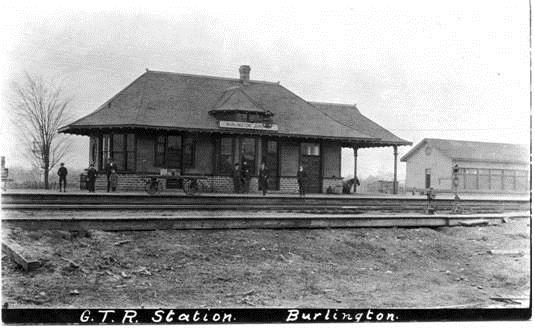 It was a different Burlington at a much different time when it was not yet a town and the reason for being was to grow produce and ship it out from this station. Now we want to preserve the place. In 1856, the Great Western Railway completed the rail line. The first train station of the Great Western Railway line was built around 1854 near Brant Street close to where Plains Road is now located. The line itself, which ran between Hamilton and Toronto was completed in 1856.
The local area at the time was called Wellington Square.
In 1869, the Great Western Railway started to list the train station as “Wellington Square”, in their railway timetable schedules. A short time later, the station name “Wellington Square” was changed to “Burlington”, when the area became known as Burlington.
In 1877 on February 14th, the Hamilton & Northwestern Railway line opened from Hamilton to Burlington and on up to Georgetown. This created a junction between the GWR and H&NW railways, and it was at “Burlington”. The designation for the train station changed to “Burlington Junction”.
In 1882, the Great Western Railway and the Grand Trunk Railway amalgamated and the train station at “Burlington Junction” was of a Great Western Railway building style, and now it was part of the Grand Trunk Railway who used different styles for their train stations.
 The train station was a focal point for the city – train travel was how most people for to Burlington. In 1883, the “Burlington Junction” station was completely destroyed by a devastating fire. The station was rebuilt in 1888, and the Grand Trunk Railway continued to use the GWR design. There is an old photograph from this period that shows the station with signage that shows the station with the name “Burlington”.
In 1904, this second station also burned to the ground. It was not that uncommon to have fires at train stations. The locomotives were spewing embers as they entered into the station area, and on windy days, those burning embers often landed on the stations somewhere.
In 1906, the Grand Trunk Railway built a new station using their own classic design, which was known as “Type B2a”. This is the historic station design we are fortunate to have in Burlington, and now it will be preserved and renovated. As a side note, all three stations were built at the same location.
During the time that the stations were active, the signage changed three times. The names ‘Burlington Junction”, “Burlington”, & “Burlington West” were all in use. “Burlington West” was used for a very short time in the mid-1980s as Go Train Service was introduced and the new Fairview Street Station opened. For a brief time, both the Go station & the “Burlington West” station were in operation at the same time. The “Burlington West” sign was there only to distinguish between the two stops until the beautiful old train station was finally closed around 1988 by the Canadian National Railway.
 Burlington grew produce; pears, peppers and apples were some of what got shipped from the Burlington station. So why was it ever called “Freeman Station”? Contrary to popular belief, it was not named after the Freeman family who settled the area over 200 years ago. The station was located in the Village of Freeman, which was the area of Brant Street and Plains Road. The Freeman family has lived in and around the Village of Freeman for all of those years. The Village of Freeman was a thriving community with several factories, including a canning company and a basket making company, and a fair number of nearby houses. The Village of Freeman even had its own Post Office and a postal stamp designation up to 1952, when amalgamation finally brought the Village of Freeman together with the Town of Burlington. The name evolved from everyday usage by the local residents who affectionately called their train station, “Freeman Station”.
With this kind of local history one would have thought city council would have been all over themselves to save the place. The city couldn’t find a place to put it and the leadership to save the structure didn’t show up until the place was being offered for sale as kindling. The city just wanted to get rid of it.
 On the move – the station got moved a number of times – is there yet another move in its future? That is when Councillors Marianne Meed Ward and Blair Lancaster got together and pleaded with their colleagues to just give them some time and they would find a way to save the structure.
The Friends of Freeman Station was formed; the found a way to acquire charitable status and then they found a home for the building – that turned out to be yards away from where the station had been resting – standing on blocks beside the Fairview Fire Station.
The move took place before the winter set in. The building is still sitting on blocks and two large yellow steel beams. A foundation will be put in and then the structure lowered onto what will be its home while the restoration work gets done.
  With the warm weather about to arrive the renovators and refurbishes want to get at it. And that is going to cost – quite a bit – at least $300,000 With the warm weather about to arrive the renovators and refurbishes want to get at it. And that is going to cost – quite a bit – at least $300,000
They can’t sell tickets – yet, but the FoF board has decided they can sell naming rights and they have come up with an ambitious approach to sell naming rights for everything but the toilet that we assume the place is going to have.
Try these on for size:
1. The Station Master’s Office, $15,000
2. The Waiting Room, $12,500
3. The Portico, $10,000
4. The Baggage Room, $7,500
5. The Lower Level, $5,000
6. The Les Armstrong Main Entranceway, $2,500
7. The Lower Level Entranceway, $2,000
8. The Crew Room, $1,000
9. The Windows (14), $2,000 each
10. The Jane Irwin Oval Window, $2,000
11. The Interior/Exterior Main Level Doors (5), $2,000 each
12. Interior Furniture, Lights & Displays (20), $500 each
And that’s just the inside of the structure. Outside you can slap your name on:
1. The Burlington Junction Freeman Station Park, $60,000
2. The Train Platform, $10,000
3. The Parking Area, $5,000
4. The Original Baggage Cart, $2,500
5. The Landscaping, $2,000
6. Exterior Platform Accessories, (20.5) $1,000 each
7. Original 1000 whinstones, $100 each
The fund raisers come up with a total of $305,500
There are two sponsorship opportunities that need comment. The Les Armstrong Main Entranceway, $2,500 and the Jane Irwin Oval Window, $2,000. I’d up the price for those to $5000 each; Irwin and Armstrong were the two strongest advocates for saving the station –Les was the forming president of the Friends of Freeman and Jane the vice president – both are no longer with us.
 The signing of the Joint Venture agreement between the Friends of Freeman Station and the city – with the Friends raising most of the money. The hope is that the FoF board will exercise some discretion and not have the station looking like one of those NASCAR drivers with clothing that is a collection of corporate. Dignified and under-stated please.
Background links:
The station was saved.
Freeman station being prepped for a move.
 By Pepper Parr By Pepper Parr
April 3, 2014
BURLINGTON, ON.
Well that wasn’t very nice.
We did an upgrade to some of the plug-ins we use to make this a manageable web site – and the plug-ins plugged everything up.
We were working on the upgrades until the wee hours this morning – published several stories and then called it a day believing that our early morning readers would see their newspaper at the end of their keyboard the way they do each day.
It was late – I was tired so I left the testing to right after that first cup of coffee.
WOW! – what a surprise. Zippo, nada, nothing other than a message:
Apache Server at www.burlingtongazette.ca Port 80 message.
Phone calls to the support team, calls to the people who keep the tubes to the internet operating hour after hour – what’s going on?
It took the first half of the day to figure out where the problem was and then the rest of the day to fix it. So much for the plans I had in place to lunch with my top columnist Ray Rivers and his wife who was in town.
There are a clutch of news stories that will now get loaded. Nothing much happened in town except that there is to be a photo op on Friday. Mayor and some staff are going to fill some pot holes. And oh yet – the pot hole application is now fully functional – so you can report every pot hole you find to someone at city hall – they will acknowledge the report, place the pot hole on a map so you can see that city hall is on the job – and then you can see when they have fixed the pot hole.
Who ever said the city wasn’t putting your tax dollars to good use.
Background links:
Pothole widget on city web site.
 By Staff By Staff
April 2, 2014
BURLINGTON, ON.
Tracy MacCharles, Minister of Consumer Services and Consumer Protection Initiatives got herself out in front of a microphone earlier today and passed on what she thought was good news – and good news it was – assuming what she said is true, true, true.
 The Minister of Consumer Services and Consumer Protection Initiatives told us how we were going to be protected from cell phone contract abuse – from the offices of a cell phone provider. Which is a nice way of saying the prices aren’t coming down but you will know just how high – try sky high – those prices are going to be when you sign up.
That the Minister delivered her comment at the offices of Wind Mobil gives you a sense of who has the clout; had she been out on a street corner with people who had their phones next to their ears and talked to them about what works and doesn’t work – this might have been a different story.
So for now we have to go with what the Minister said in that controlled environment the politicians like.
Eight out of every 10 Ontario families have a wireless services agreement but most of us don’t really understand the contracts we sign: the terms and conditions, what’s included in the agreed upon monthly fee, and what will cost extra.
Thus the new Wireless Services Agreements Act now in effect, brings long-awaited improvements to the marketplace. Ontario consumers can now expect clearer, easier-to-understand information, and fewer surprises when they enter into, or amend, cell phone and wireless services contracts.
Requiring plain language contracts;
Requiring that contracts clearly outline which services come with the basic fee, and which would result in extra charges;
Requiring that providers get a customer’s explicit consent before amending, renewing or extending a fixed-term contract;
Enforcing a cap on cancellation fees, making it less expensive for consumers to walk away from contracts; and
Allowing a consumer to cancel a contract at no cost after two years.
 What can consumers do if they think their contract was not properly made — or they feel they are paying for services they didn’t contract for? Under our new law, providers who do not comply with the rules must give consumers who cancel their contracts a full refund for up to a year of service. What can consumers do if they think their contract was not properly made — or they feel they are paying for services they didn’t contract for? Under our new law, providers who do not comply with the rules must give consumers who cancel their contracts a full refund for up to a year of service.
 If a provider charges for services after a contract is improperly amended, a consumer is entitled to get that money back. If a provider charges for services after a contract is improperly amended, a consumer is entitled to get that money back.
The act also addresses advertising by wireless services providers. Providers must now show the minimum monthly costs in ads – if they are advertising any costs – and the most prominent price must be the all-inclusive price.
Keeping up with all these rules and the services being provided to protect us can be daunting. The government has launched a new program (yes, another one) called Consumer Protection Ontario; an awareness program that will link together all of the consumer protection activities of the Ontario government with a common identifier.
Provincially mandated administrative authorities – such as the Real Estate Council of Ontario, the Electrical Safety Authority, and Technical Standards and Safety Authority, will help the people of Ontario know where they can turn to get information about their consumer concerns.
The Stronger Protection for Ontario Consumers Act gave provides more effective rules to help people who have to deal with door-to-door transactions, dealing with debt settlement companies, or in real estate transactions.
The province is going to modernize Ontario’s Condominium Act, so that the 1.3 million people in this province who live in a condo will have up-to-date legislation that reflects the reality of condo life today – including proper qualifications for managers and increased consumer protection for owners.
They are also continuing to explore home inspector qualification to increase the level of confidence people have when they buy a home – they need to be sure that their pre-purchase inspection has been done by someone with appropriate credentials.
 Protection from tow truck drivers – now that is something useful. Do you get the sense that we have a government working hard to convince us that they are out there doing everything they can to protect us – which many of us wanted them to do when they were thinking through how to get out of those gas plants they decided not to complete – that was a $1 billion ouch.
By Pepper Parr
April 2, 2014
BURLINGTON, ON.
Steve Kempf has a very steep learning curve ahead of him but he seems determined to get himself a seat at city hall – and doesn’t seem too concerned about which ward he actually represents.
 Steve Kempf’s decision to buy this property at Indian Point and then seek a severance taught him more than he wanted to know about city hall. A resident of Ward 1, he lives at Indian Point where he created a ruckus when he went for a severance in 2011 that a lot of people didn’t like.
Kempf says had had the support of the planners at city hall – and that the Conservation Authority called him to advise him that the 200 foot water front lot looking over the bay could be severed. So sever it he did.
Steve Kempf is a little on the abrupt side. During the Indian Point character study he was pretty noisy and wonders why the city wasted $100,000 doing a study that has done nothing for the community. Kempf says he knew the ward Councillor wanted the study done and that there were a small percentage of people who didn’t want any change. The community knew that once a single severance was granted more would follow and that, many, thought that would be the end of the community.
Kempf clearly believes in change – and if you look at the house next to the two properties he bought – you get an understanding as to what he sees in the way growth and change. The structure to the east of his new house is rundown and badly in need of an upgrade – certainly past its best before date.
Buildings get old, they need renewal; plumbing and electrical services need to be upgraded – and, Kempf maintains, you need to make changes to the outside of the building – sometimes the whole building.
So – why ward 4 when he lives in ward 1? He thought of running in ward 1 “but there is already at least one good candidate and a very strong incumbent.” He looked at ward 6 as well, believing that Blair Lancaster could be beaten, but he had no affinity with that ward. Kempf wonders if he is going to end of running against Jack Dennison, who has yet to declare and tells an interesting story of the evening he was at the Golf and Country Club sitting at a table in the dining room and was there by himself – except for Jack Dennison. “I really wanted to go over and ask him if he was going to run, but I didn’t” said Kempf.
 Candidate Kempf knows he has a steep learning curve ahead of him. He will be taking a lot of notes in the next seven months. What does Steve Kempf know about how city hall works? When it comes to how council works – he doesn’t know very much and faces a very steep learning curve but points out that all the others who were new to council had to learn. He quickly adds that he can tell you a lot about the way the departments work: Way too much red tape and it takes forever to get a permit.
Kempf who was a fireman in Mississauga for 28 years will tell you that in that city two things were exceptionally well done. The building department worked and the Mayor did her job. “If you had a problem in Mississauga you called Hazel – and the problem was looked into” said Kempf. “You may not have agreed with the answers Mayor Hazel McCallion gave you but at least you knew she had looked at your problem.
Kempf maintains he had a problem with Burlington Hydro and called the Mayor’s office. “I never heard back from him”, said Kempf.
 Kempf, born in the west end of Toronto, spent some time with his family in Owen Sound and will tell you that he “has some history with the city”. He bought a property on Indian Road and sought a severance – his was the first anyone had asked for since 1929 – so you know that ruffled some feathers. Kempf, born in the west end of Toronto, spent some time with his family in Owen Sound and will tell you that he “has some history with the city”. He bought a property on Indian Road and sought a severance – his was the first anyone had asked for since 1929 – so you know that ruffled some feathers.
Kempf has lived in Milton, Mt Nemo and Roseland. He has built a number of homes – five he thinks. He found that Burlington, from his point of view was a mess in terms of getting anything through city hall.
When Kempf finished high school in Owen Sound he moved to Toronto and got a job in a factory as a labourer. He saw an opportunity to get a job as a fire fighter – went for it and spent 28 years fighting fires and retired as a Captain.
Like many firefighters his schedule left him with time to build home and to run an electronics importing business on the side.
 Kempf saw Mississauga as a very well managed city and the fire department a place where staff was encouraged to bring forward ideas; :there was a reward system where we would get a day off if an idea was accepted. We had input and felt the operation was something we not only worked at – but something we contributed to as well.” Kempf saw Mississauga as a very well managed city and the fire department a place where staff was encouraged to bring forward ideas; :there was a reward system where we would get a day off if an idea was accepted. We had input and felt the operation was something we not only worked at – but something we contributed to as well.”
Married in 1980, Burlington became home because that’s where his wife’s parents lived. They lived in Millcroft and Campbellville as well for a period of time.
Steve Kempf isn’t a Rotarian, doesn’t serve on any committees – he builds. The opportunity to buy the two properties on Indian Road came up in 2010.
Kempf doesn’t like government sticking their nose in his business. He understands that government is needed but he doesn’t think they should be doing studies like the Indian Point Neighbourhood Character study. He believes that market forces will bring about needed changes.
The lack of a post-secondary education shows when it comes to complex financial matters. The running of a city is complex and understanding how the budget is created is not easily absorbed by high school graduates.
Kempf is a put up or shut up kind of guy who understands the city needs to bring in more business to town and can’t understand “why we don’t have good people out there selling the city.” He is the kind of guy who just wants to get it done.
 Bridgewater site is the kind of thing Kemp likes to see happening. He isn’t a build for the sake of building but he is a build for growth kind of guy. He likes the Race Around the Bay even though it impeded his ability to get out of Indian Point for a bit but he isn’t a fan of the Chilly Half Marathon that closes Lakeshore Road.
Loves the Performing Arts Centre – would just love to see them doing more.
Regional government – has a lot to learn at that level.
Knew nothing about the squabble over selling city waterfront land to private ownership.
Big on multicultural issues.
Would like to see taxes tied to the cost of living.
Thinks the waterfront is under used.
Wants to see a lot more economic development.
 Notebook under his arm, pier in the background ward 4 candidate Steve Kempf would like to see the city getting more use out of the waterfront. Kempf felt that the Habitat for humanity project in Aldershot should be required to compensate people who have to give up some of their privacy when a development impacts them negatively.
At first look – Kempf is untested. He has time on his hands and has personal issues with the way city hall handles people who want to build. It would be interesting to watch him in a debate with John Sweeney and Alexandra Kubrick – and possibly Jack Dennison. Is there another candidate out there?
The candidate for the ward 4 seat expects to have a web site up soon. This business of getting elected is new Steve Kempf – he is going to have an interesting seven months – let’s see how he does.
 By Staff By Staff
April 2, 2014
BURLINGTON, ON.
A provincial government agency, Technical Standards and Safety Authority (TSSA) successfully prosecuted a Burlington refrigeration operator for working with a forged Operating Engineer certificate.
Jeff Bennett of Burlington, Ontario was fined $4,000, plus the mandatory 25% victim surcharge, for a total penalty of $5000, for violating safety regulations under the Technical Standards and Safety Act, 2000 (the Act), by the Ontario Court of Justice in Burlington.
Following an investigation by TSSA, it was determined that Mr. Bennett worked at Wave Twin Rinks located at 1175 Northside Road in Burlington without holding a certificate as a Refrigeration Operator B Class or a Fourth Class Operating Engineer. Mr. Bennett had misled both management and the Chief Operator, pretending to have completed his exams and passing off a forged certificate, purporting to be a Refrigerator Operator Class B.
Mr. Bennett pled guilty to knowingly providing, using and displaying a false certificate of qualification
“This is a serious violation of Ontario’s public safety rules,” said Mike Adams, Director of TSSA’s Boilers and Pressure Vessels, and Operating Engineers Safety Program. “Mr. Bennett flouted critical safety rules, put himself and his colleagues at needless risk, and sullied the good name of power engineers.”
In Ontario, operating engineers must possess valid TSSA certification, which ensures all operators are properly trained and familiar with Ontario’s safety rules. If in doubt of an operator’s certification, contact TSSA toll-free at 1- 877-682-8772.
The Technical Standards and Safety Authority (TSSA) is Ontario’s public safety regulator mandated by the Government of Ontario to enforce provincial safety regulations and enhance public safety. Throughout Ontario, TSSA regulates the safety of amusement devices, boilers and pressure vessels, elevating devices, fuels, operating engineers, ski lifts, and upholstered and stuffed articles. Its range of safety services include public education and consumer information, certification, licensing and registration, engineering design review, inspections, investigations, safety management consultation, and enforcement and prosecution activities. The organization’s vision is to be a valued advocate and recognized authority in public safety.
 By Ray Rivers By Ray Rivers
April 2, 2014
BURLINGTON, ON.
It is a messy business – the election in Quebec. The Parti Québécois (PQ) is a separatist party, bent on splitting up Canada, but ever since RenéLévesque founded the PQ it has been a pro-labour socialist party as well. So you can imagine the jaws dropping at the press conference where leader Pauline Marois introduced her star candidate, former Quebecor newspaper oligarch, Pierre Karl Péladeau. PKP, as he is known, was a sworn enemy of trade unions everywhere, from the press/printing rooms to the ink drying between the pages of the newspapers in his media empire.
Marois called the election less than two years into her minority government because the polls were in her favour. And she needed a majority government to run her party’s third (and presumably last) referendum on sovereignty. Strategically she would want to do that while Stephen Harper is still PM, given his low standing among Quebecers of all stripes – so before the 2015 election to be safe. That she has been organizing the next referendum is the worst-kept secret in Canada.
As PKP took the podium, there was this rush of wind as Quebec’s union leaders, always a backbone of the party, headed for the door and into the waiting arms of the opposition Liberals. Then to add insult to injury, PKP, the neophyte politician, blurted out that he wanted to make Quebec an independent country. It didn’t take long for the polls to register this comment and Marois to find herself a Shakespearian tragic heroine, watching her dreams of a much coveted majority government dissipate in a whiff of smoke, as non-separatist PQ supporters went shopping for another party.
Some people just don’t know when to quit, and Marois was one of those, picking up the separatist theme, speculating on how an independent Quebec would use the Canadian dollar and be invited to sit on the board of the Bank of Canada. Eventually she realized she’d gone too far and slipped the muzzle over the too-enthusiastic PKP and herself.
The truth is that most Quebecers are weary of all this referenda nonsense. Independence referenda are the flavour of the year it seems – Scotland, Venice and Ukrainian Crimea, of course. But it takes a lot of energy and emotion to get your interest up for something that has failed the last two times they tried it – and that the polls show would fail again. And if not lucky the third time, does this make it conclusive – Quebec is in Canada to stay? That prospect must be as discomforting to hardened separatists as it would be pleasing to the ears of federalists.
And then there is the economic reality. Quebec’s economy is not a happy place. They have the lowest per capita income in the country, save that of the three maritime provinces. On top of that Quebec is carrying the highest debt-to-GDP ratio of any of the provinces, about half of its annual GDP. And the province is the most dependent ‘have-not’in receipt of federal equalization payments to help subsidize its government services, receiving almost half of the entire federal equalization budget of sixteen billion dollars a year.
In the first leaders’debate Marois finally got it. Newly minted Liberal leader Phillippe Couillard hammered her on her hidden agenda, scoring big points and good poll numbers. So Marois relented and almost promised there would be no referendum coming from a PQ government should they get elected, just a white paper on the province’s future in Canada.
With that out of the way, the two leaders went after each other on ethics and corruption. Couillard has some questionable business linkages, and there was that Montreal corruption scandal, which made Montrealers almost wish they had Rob Ford as mayor – but not quite. And then we find out that Marois’s partner has been accused of influence peddling, bringing the corruption issue to a draw – one as bad as the other.
As the campaign draws to a close, the Premier realizes that her big project, her highly divisive (some would say racist) “Charter of Values” hardly saw any air in the debates – and like it or not nobody wanted to discuss it. Nor is anyone taking her seriously when a desperate Marois complains about students from other provinces registering as voters in an effort to steal the election.
Of the other parties, the Coalition Avenir Québec (CAQ), appears to have lost its lustre, as third parties often do in Quebec politics, and its voters will likely go back to the Liberals. And the upstart Québec Solidaire, the extreme separatist and green/socialist party, may become the new home for hard core Quebec nationalists further weakening the PQ.
The candidates head to the polls this coming Monday and nothing is certain at this point. But somebody will win and it might well be with a majority. Interestingly there have only been two minority governments in Quebec since confederation. The tone of this election campaign reflects the times we live in; heated by the divisive issue of separatism; clouded by the efforts to restrict freedom of expression and; stained by the ever-present corruption.
A third of all Quebecers never wanted to be in Canada. A third are content to be part of the great Canadian experiment. And the remaining third are willing to be swayed by the most persuasive and seductive of national and provincial leaders. Pauline Marois called this election in order to finish the process that Lévesque had started almost a half century ago.
If she fails to win a majority, Marois may will have to wait to another day for that big prize. On the other hand, if the 65 year old tireless war horse loses this election to the Liberals, that job will be left to another PQ leader on another, even more distant, day. And we can all get on with our normal lives.
Background links:
Marois Corruption Link
CAQ
Preparing for the Referendum
Historical Elections
PKP
Election Predictions
Integrity
Equalization Payments
PKP Union Buster
 By Staff By Staff
April 1, 2014
BURLINGTON, ON.
Some people will get taken in by this. If they bank with the Royal Bank of Canada they might click on that link – and that could well be the beginning of a process that moves your money from your bank account to someone else’s bank account.
 What’s the give away here? Look at the address of the sender: rcbroyal – if it were legal it should have read rbcroyal. Also the srvcustom r – spelling error. Most important – a Canadian bank would never, ever send you a notice like this. If you are at all active on the internet – and it’s hard not to be – you need to be vigilant. There are literally tens of thousands of people pumping out phony messages that are intended to steal your money from you.
At a quick glance they look genuine and they catch your attention.
This latest one, purported to come from the Royal Bank is pretty easy to spot as phony but you do have to look beyond the bank logo which is in the message to give you comfort that it is your bank talking to you.
Just pay attention – and you should be OK. Unfortunately, if money does get removed from your account – it will not be easy to get it back.
Background links:
They will go to almost any length to fool you.
 By Staff By Staff
April 1, 2014
BURLINGTON, ON.
Starting today, right now actually you have to butt out in any city park. Burlington passed a bylaw in November of 2013 , to ban smoking in city parks and recreation facilities. Exceptions to the bylaw include LaSalle Park Pavilion; Discovery Landing; Paletta Mansion; and Tyandaga Golf Course. Smoking at these locations will be allowed in designated areas.
 A leisurely smoke in a park – comes to an end in Burlington today. Those locations generate revenue for the city.
It will be interesting to see how this works during RibFest.
 Weed rules are bending – expect to smell this at the Sound of Music. The Sound of Music will be different – at that event a different kind of smoking takes place and it looks as if the weed will become fully legal at some point.
The city says its parks will become smoke-free, joining a province-wide movement to create healthier outdoor spaces. . “Like our neighbouring municipalities, we wish to provide a place where people can enjoy their recreation time without the health hazards associated with smoking.”; except for those exceptions – hypocrisy rules!
Hamilton and Oakville put in place smoke-free parks and recreation bylaws in the summer of 2012. According to the Play, Live, Be Tobacco-Free website, 121 Ontario municipalities have adopted an outdoor smoke-free bylaw or policy.
Enforcement in Burlington will be self-regulated and self-enforcing, as it is in many municipalities.
We’d like to hear how that works out; I don’t think I’m going to tell some bruiser of a biker to but out at RibFest and apparently there isn’t going to be a bylaw enforcement officer roaming around to do any enforcement.
|
|