By Staff By Staff
February 11th, 2025
BURLINGTON, ON
An alert Burlington resident advised us this morning that the City of Burlington will no longer use the Alert Burlington program, effective immediately.
There is no further action needed on your end, and all personal information will be erased.
Moving forward, emergency alerts for life-threatening incidents will be issued through the national Alert Ready system.
 We were ready in 1812 – are we ready now? Learn more at www.alertready.ca. Residents looking to stay informed during an emergency should visit www.burlington.ca/subscribe to subscribe to newsfeeds, calendars, and webpages for the latest information on the City’s emergency response.
 If you are in immediate danger, please call 9-1-1. Do not respond to this email. This email is not monitored. If you are in immediate danger, please call 9-1-1. Do not respond to this email. This email is not monitored.
Our reader wonders if the President of the United States would see this as an opportunity to invade the country in the dark of night without our even knowing it.
Could this be the war of 1812 all over again? Could the Burlington Heights be scaled again and allow them to capture Hamilton at the same time.
These are perilous times – or at least that is the opinion of one city resident.

By Staff
February 11th, 2025
BURLINGTON, PN
City of Burlington administrative services will be closed for Family Day, on Monday, Feb. 17. A summary of closures is listed below.
| City Service |
Holiday Closure Information |
| Animal Services |
The Animal Shelter at 2424 Industrial St. will be closed to appointments on Monday, Feb. 17. To report an animal control related emergency on a holiday, please call 905-335-7777. |
| Burlington Transit |
Burlington Transit will operate on a Sunday schedule on Monday, Feb. 17. The Downtown Transit Terminal, at 430 John St., and Specialized Dispatch will be closed.
Online services
|
| City Hall
|
Service Burlington and the Building, Renovating and Licensing counter on the main floor of City Hall at 426 Brant St., will be closed on Monday, Feb. 17.
Many service payments are available online at burlington.ca/onlineservices. If your request is urgent, call 905-335-7777 to connect with the City’s live answering service.
For online development services, MyFiles can be used by residents who have applied for Pre-Building Approval. Check the status of Pre-Building Approval applications at burlington.ca/MyFiles. |
| Halton Court Services – Provincial Offences Office
|
Court administration counter services at 4085 Palladium Way will be closed on Monday Feb. 17.
Except for the Family Day closure, telephone payments are available at 905-637-1274, from 8:30 a.m. to 4:30 p.m., Monday to Friday. All in-person services are available from 8:30 a.m. to 4:30 p.m. Monday to Friday. Many services are also available by email at burlingtoncourt@burlington.ca or online at Halton Court Services. Payment of Provincial Offences fines is available 24/7 at paytickets.ca. |
| Parking |
Free parking is available downtown, on the street, in municipal lots and in the parking garage (414 Locust St) after 6 p.m. and on holidays, including Monday, Feb. 17.
On Sundays, free parking is available downtown, on the street, in municipal lots,. and in the parking garage (414 Locust St.).
On Saturdays, pay parking downtown is required in high-demand parking lots (Lots 1, 4 and 5) and all on-street metered parking spaces. A three-hour maximum is in effect for all on-street spaces. Free parking is available in the remaining municipal lots and the parking garage (414 Locust St.).
NOTE:
- The Waterfront parking lots (east and west at 1286 Lakeshore Rd.) do not provide free parking on holidays.
- Parking exemptions are required to park overnight on city streets and for longer than five hours. If you have family and friends staying with you that require street parking, please visit burlington.ca/parkingexemptions to register for a parking exemption. Please note: parking exemptions are not valid during declared snow events, to assist with snow removal.
|
| Recreation Programs and Facilities |
Drop-in recreation activities
Indoor pools, including Aldershot (50 Fairwood Pl W), Angela Coughlan (2425 Upper Middle Rd.), Centennial (5151 New St.), and Tansley Woods (1996 Itabashi Way) are open on Family Day Monday, Feb. 17 for swimming. Tansley Woods Community Centre also offers a drop-in family fitness, family gaming, and craft time on Family Day.Drop-in swimming, skating and other recreation program times vary for the long weekend. For all schedules, visit burlington.ca/dropinandplay.Cogeco Skating at Burlington Rotary Centennial Pond
The outdoor rink at 1340 Lakeshore Rd. will be open daily from 10 a.m. to 10 p.m., weather and ice conditions permitting. Residents are encouraged to call the ice conditions hotline at 905-335-7738, ext. 8587 before leaving to make sure the pond is open. The free skate lending program at the Burlington Rotary Centennial Pond is available Monday to Thursday, 5 to 9 p.m., Friday 5 to 10 p.m., and 10 a.m. to 10 p.m. for Saturday, Sunday, and holiday Monday. For more information, visit burlington.ca/pond.Cogeco Neighbourhood Rinks
The outdoor skating season is here. Find a Cogeco Neighbourhood Rink in your neighbourhood at burlington.ca/neighbourhoodrinks. There are seven locations to choose from.
Outdoor Fun
Head outside and play in our parks with trails, disc golf at Tyandaga Golf Course (1265 Tyandaga Park Dr.), tobogganing and more. Explore all the options at burlington.ca/outdoorplay.Play Equipment Lending Library
If you need some indoor or outdoor play equipment, try the Play Equipment Lending Library. It’s free of charge! Equipment pickup and return is at Haber Community Centre (3040 Tim Dobbie Dr.). To reserve and borrow, visit burlington.ca/playlending. Customer Service
Recreation, Community and Culture customer service is available to assist you over the holiday weekend:
- In person at recreation facility counters during program times (Feb. 15, 16 and 17)
- By email at liveandplay@burlington.ca (Feb. 15 and 16)
- By phone at 905-335-7738 (Feb. 15 and 16)
- Phone and email service are closed on Feb. 17
|
| Roads, Parks and Forestry |
The administrative office will be closed on Monday, Feb. 17. Essential services, including winter control, will be provided as required. |
Burlington is a city where people, nature and business thrive. Sign up to learn more about Burlington at burlington.ca/subscribe and follow @CityBurlington on social media.
By Julieta Belen Correa
February 10th, 2025
BURLINGTON, ON
Canada is home to some of the most diverse bucket-list destinations on the planet — it has some of the best ski slopes, thousands of kilometres of untouched nature, and multiple hubs of commerce and entertainment of international renown. This, coupled with its expansive tourism push in recent years, means that Canada relies on an adaptable and modern aviation industry.
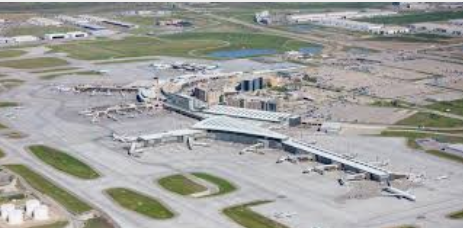
Luckily for tourists and Canadians alike, the nation hosts North America’s busiest and most technologically advanced airports, perfect for handling the influx of tourism expected over the next ten years. Take a look at the top ten busiest airports in Canada.
10. Kelowna International Airport (YLW)
You can fly into Kelowna, a critical gateway to British Columbia’s Okanagan region, to explore some of Canada’s best wineries, lake regions, and the breathtaking scenery of Osoyoos. The airport serves around 2,000,000 passengers a year and offers destinations nationwide and routes all the way down to sunny Mexico.
 Billy Bishop, named after a Canadian war hero is an airport minutes from downtown Toronto 9. Billy Bishop Toronto City Airport (YTZ)
Toronto’s second-largest airport, situated on the Toronto Islands, is named after one of Canada’s most iconic fighter pilots. This airport caters to just over 2,000,000 passengers a year and makes a great alternative to the massive Toronto Pearson International Airport, especially if you’re looking for either domestic or short-haul flights. You can expect shorter security queues and faster processing times so that you can make every minute count of your vacation or work trip.
 If your destination as a tourist is Halifax International – you will want to visit Peggy’s Cove. 8. Halifax Stanfield International Airport (YHZ)
Coming in at 8th place on the list is Halifax Stanfield. The airport serves the Halifax region, mainland Nova Scotia, and other areas in the Maritime provinces. As Canada’s easternmost international airport, it is a vital connection for rural communities and also provides hundreds of jobs for the region’s tourism sector. The airport generated a massive C$4.2 billion for the Nova Scotia economy in 2023 alone, and with a rise of over 20%, it’s expected to continue to grow in the coming years.
The airport is also home to numerous Fixed-Based Operators (FBOs), private companies that provide essential aviation services like fuel, parking, maintenance, and passenger amenities.
7. Winnipeg James Armstrong Richardson International Airport (YWG)
Winnipeg James Armstrong Richardson International Airport, located in the Winnipeg Capital Region, handled just over 4 million passengers last year. YWG is crucial for connecting small communities living in difficult conditions with regularly scheduled flights to Northern Manitoba, Northwestern Ontario, and Nunavut.
6. Ottawa/Macdonald–Cartier International Airport (YOW)
As the airport serving Canada’s capital city, Ottawa International is a home base for Canadian North and a major hub for Porter Airlines, which is investing $65 million into the airport infrastructure over the coming years. The airport serves the National Capital Region with over 4 million passengers annually — a 36.9% increase on the previous year, the highest such growth among Canada’s busiest airports.
The airport’s modern terminal, extended in 2008, features artwork reflecting the region’s history and culture, creating a uniquely Canadian welcome for first-time visitors to the country.
5. Edmonton International Airport (YEG)
Climbing into the top 5 busiest airports in Canada sees a marked jump in passenger numbers, with a massive 7.4 million passengers flying in and out of Edmonton International Airport. The airport caters to residents and visitors to the Edmonton Metro Region, some three hours north of Calgary.
The airport itself is so busy due to the lack of other major cities in the region, making it the only major airport for those travelling from Alberta and Saskatchewan.
 Calgary International 4. Calgary International Airport (YYC)
Calgary International Airport, also known as “the gateway to the Rockies,” serves a whopping 18.5 million passengers a year. One reason for YYC’s huge numbers is its proximity to Banff and Canada’s impressive range of ski destinations.
YYC is home to two terminals — one domestic and one international — and serves as the main hub for Canadian airline WestJet. The airport offers world-class accessibility with modern parking systems, easy-to-use car rental services, and the reliable Calgary Transit System, which offers routes across the region.
3. Montréal–Trudeau International Airport (YUL)
Serving the Greater Montreal area, Montréal–Trudeau International Airport is a bustling hub that managed over 21 million passengers in 2023. This large operation is the region’s primary link between Canada’s French-speaking population and the rest of the world.
YUL’s strategic location makes it perfect for transatlantic flights, with popular routes to Paris, London, and Frankfurt. This dynamic location, combined with a modern general aviation terminal, makes it an ideal airport for those looking to charter a private plane to Europe and beyond. Domestic travellers also benefit from frequent flights to Toronto, Vancouver, and Halifax.
 Vancouver International 2. Vancouver International Airport (YVR)
Vancouver International Airport, nestled on Sea Island in Richmond, British Columbia, is the busiest airport in Western Canada. Welcoming almost 25 million passengers in 2023, the airport is the ultimate gateway to the region’s surrounding mountains, lakes, and the icy North Pacific. YVR is consistently ranked as one of the best airports in North America and was most recently named as the number-one airport on the continent in 2024.
Vancouver International is also the nation’s best link to Asia, with frequent flights to Tokyo, Hong Kong, and Seoul. Its location also makes it a popular stopover for flights to Australia and New Zealand.
1. Toronto Pearson International Airport (YYZ)
With almost double the capacity of number two on the list, Toronto has been Canada’s busiest airport for decades. It’s the primary hub for Air Canada and the second busiest arrivals hub for international travellers to North America. Serving the Greater Toronto Area, Pearson handled an impressive 44.8 million passengers in 2023, making it the pride of Canada’s already-impressive aviation industry.
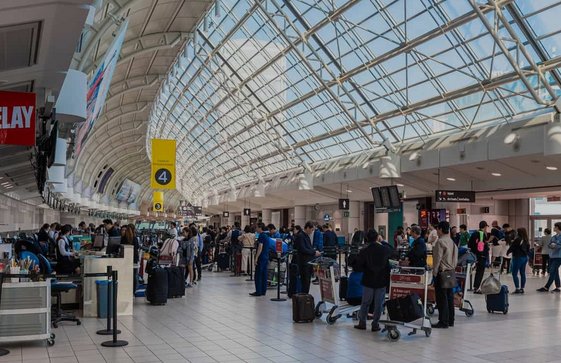
 Pearson International Located just outside Toronto in Mississauga, Pearson offers direct flights to destinations on every continent. With its cutting-edge amenities, including world-class dining and shopping, Toronto Pearson sets the standard for Canadian airports when it comes to sheer size and availability.
Canada, Connected
With some of the most forward-thinking, accessible, and downright massive airports in North America, Canada continues to impress year-on-year with its dazzling array of airports. Vancouver continues to offer the best service in North America, Toronto Pearson connects you to the world with ease, and Calgary, Halifax, and Winnipeg airports continue to provide a vital lifeline to some of the continent’
By Lyall Gillies
February 10th, 2025
BURLINGTON, ON
As more people are recently choosing internet platforms for leisure and enjoyment, Burlington’s entertainment scene has changed dramatically. Daily life now mainly revolves around digital entertainment, which includes movie streaming, video game playing, virtual event participation, and online casino exploration. With advancing technologies and a better internet connection, there is a change in the leisure activity choices of the citizens of Burlington.
Top Digital Entertainment Trends in Burlington
Here are some of the most vital online entertainment trends of the city with the rise of Bitcoin casinos and the growing attraction of e-sports.
Online gaming and cryptocasinos growth
Players can compete with each other. Online gaming has been one of the major developments in the field of entertainment in Burlington. In particular, the most pervasive activities to spend time with friends or simply unwind include:
- Multi-player video games.
- Mobile apps.
- Online casino platforms.
- Digital games.
Since the emergence of online gaming, numerous developments have been recorded. One of these is the introduction of crypto casinos. From intensive research, it is claimed that these casinos are characterized by safety and reliability. Moreover, players tend to enjoy incredible security, swiftness, and anonymity when it comes to serious financial transactions. So if you are an ardent online casino player who seeks the top crypto gambling platforms that can guarantee several jawbreaking features, you may want to visit https://cryptocasinos-ca.ca/.
Streaming services dominate digital entertainment
Households in Burlington have made a shift towards streaming services as the on-demand nature has made them the default choice for entertainment. With all manner of movies, TV shows, and original content, the menus offered by companies like Netflix, Disney+, and Amazon Prime just keep on getting bigger and better. Niche streaming sites handling sports, documentaries, and independent films are also gaining traction. More importantly, Burlington locals who would choose online access to NHL, NBA, and international sports leagues over paying subscription to traditional cable have found great popularity with live sports streaming. Besides, local artists and content creators use platforms like YouTube and Twitch to grow larger audiences, which makes this a very lively digital entertainment ecosystem.
Virtual events and online socialization
 The whole family can take pat in an online game Virtual events have been a great tool in altering the very nature of concerts, comedy shows, and cultural gatherings for the people of Burlington. With the transition into digital performances, people can enjoy live events now from the comfort of home while interacting with others through either the chat or video feature. Virtual reality meetups and interactive chat rooms are becoming the norm in online social spaces, especially on Discord and Clubhouse.
E-sports and competitive online gaming
The popularity of competitive gaming and e-sports is rapidly rising, drawing in gamers and viewers alike. Burlington’s gamer community is tuning in to world tournaments featuring blockbuster titles such as Fortnite, League of Legends, and Call of Duty. Local gaming communities and e-sports leagues give beginners a chance to practice and improve. Online competitive gaming is part of mainstream entertainment options; streaming platforms such as Twitch and YouTube Gaming now show live coverage of major e-sporting events.
Digital casinos and the future of online gambling
Online gambling in Canada just keeps rolling, and Burlingtonians show increased interest in the digital form of casino. While the classics in online casinos aren’t going to lose their popularity, blockchain integration into them and new cryptocurrency exchange options are gradually changing the face of gaming. Cryptocasinos offer an extra layer of security, faster payout options, and a level of anonymity not offered by traditional online gambling. With Canadian law constantly changing regarding online gaming, Burlington players increasingly look toward sites that bring them innovation and reward-laden experiences in gaming.
Evolution of online shopping and entertainment subscriptions
E-commerce and digital entertainment go together as Burlington seeks convenience and personalized experiences in entertainment. Equally common are subscription-based services for video games like Xbox Game and PlayStation Plus as well as, music including Spotify and Apple Music. With those boundaries blurred between retail and entertainment, especially on the likes of Instagram and TikTok Live Shopping, offering consumers an opportunity to interact with influencers and brand ambassadors.
The future of online entertainment in Burlington
 Online entertainment in Burlington is only going to diversify further with the steps in technology. It’s going to continue offering inhabitants of the city more and more alternatives, considering that virtual reality and blockchain-based gaming will rise, alongside the tailoring of streaming services. Websites like CryptoCasinos-CA are shaping the future of digital entertainment with innovative and secure ways to enjoy online gaming, including gaming, streaming, virtual events, and interactive social platforms. Thus, the digital entertainment landscape in Burlington takes new shapes to respond to the desires of a tech-savvy audience. Online entertainment in Burlington is only going to diversify further with the steps in technology. It’s going to continue offering inhabitants of the city more and more alternatives, considering that virtual reality and blockchain-based gaming will rise, alongside the tailoring of streaming services. Websites like CryptoCasinos-CA are shaping the future of digital entertainment with innovative and secure ways to enjoy online gaming, including gaming, streaming, virtual events, and interactive social platforms. Thus, the digital entertainment landscape in Burlington takes new shapes to respond to the desires of a tech-savvy audience.
By Ezra Klein
February 2, 2025
BURLINGTON, ON
Look closely at the first two weeks of Donald Trump’s second term and you’ll see something very different than what he wants you to see.
If you want to understand the first few weeks of the second Trump administration, you should listen to what Steve Bannon told PBS’s “Frontline” in 2019:
Steve Bannon: The opposition party is the media. And the media can only, because they’re dumb and they’re lazy, they can only focus on one thing at a time. …
All we have to do is flood the zone. Every day we hit them with three things. They’ll bite on one, and we’ll get all of our stuff done. Bang, bang, bang. These guys will never — will never be able to recover. But we’ve got to start with muzzle velocity. So it’s got to start, and it’s got to hammer, and it’s got to —
Michael Kirk: What was the word?
Bannon: Muzzle velocity.
 Donald Trump’s first two weeks in the White House have followed Bannon’s strategy like a script. Muzzle velocity. Bannon’s insight here is real. Focus is the fundamental substance of democracy. It is particularly the substance of opposition. People largely learn of what the government is doing through the media — be it mainstream media or social media. If you overwhelm the media — if you give it too many places it needs to look, all at once, if you keep it moving from one thing to the next — no coherent opposition can emerge. It is hard to even think coherently.
Donald Trump’s first two weeks in the White House have followed Bannon’s strategy like a script. The flood is the point. The overwhelm is the point. The message wasn’t in any one executive order or announcement. It was in the cumulative effect of all of them. The sense that this is Trump’s country now. This is his government now. It follows his will. It does what he wants. If Trump tells the state to stop spending money, the money stops. If he says that birthright citizenship is over, it’s over.
Or so he wants you to think. In Trump’s first term, we were told: Don’t normalize him. In his second, the task is different: Don’t believe him.
Trump knows the power of marketing. If you make people believe something is true, you make it likelier that it becomes true. Trump clawed his way back to great wealth by playing a fearsome billionaire on TV; he remade himself as a winner by refusing to admit he had ever lost. The American presidency is a limited office. But Trump has never wanted to be president, at least not as defined in Article II of the U.S. Constitution. He has always wanted to be King. His plan this time is to first play King on TV. If we believe he is already king, we will be likelier to let him govern as a king.
Don’t believe him. Trump has real powers — but they are the powers of the presidency. The pardon power is vast and unrestricted, and so he could pardon the Jan. 6 rioters. Federal security protection is under the discretion of the executive branch, and so he could remove it from Anthony Fauci and Mike Pompeo and John Bolton and Mark Milley and even Brian Hook, a largely unknown former State Department official under threat from Iran who donated time to Trump’s transition team.
It was an act of astonishing cruelty and callousness from a man who nearly died by an assassin’s bullet — as much as anything ever has been, this, to me, was an X-ray of the smallness of Trump’s soul — but it was an act that was within his power.
But the president cannot rewrite the Constitution. Within days, the birthright citizenship order was frozen by a judge — a Reagan appointee — who told Trump’s lawyers, “I have difficulty understanding how a member of the bar would state unequivocally that this is a constitutional order. It just boggles my mind.” A judge froze the spending freeze before it was even scheduled to go into effect, and shortly thereafter, the Trump administration rescinded the order, in part to avoid the court case.
 Stephen Kevin Bannon served in the US Navy as an Officer, then worked with Goldman Sachs as an Investment banker In 2016, Bannon became the chief executive officer of Trump’s 2016 presidential campaign[18][19] and was appointed chief strategist and senior counselor to the president following Trump’s election. He left the position eight months later and rejoined Breitbart. In January 2018, after his criticism of Trump’s children was reported in Michael Wolff’s book Fire and Fury, he was disavowed by Trump and subsequently left Breitbart. What Bannon wanted — what the Trump administration wants — is to keep everything moving fast. Muzzle velocity, remember. If you’re always consumed by the next outrage, you can’t look closely at the last one. The impression of Trump’s power remains; the fact that he keeps stepping on rakes is missed. The projection of strength obscures the reality of weakness. Don’t believe him.
You could see this a few ways: Is Trump playing a part, making a bet or triggering a crisis? Those are the options. I am not certain he knows the answer. Trump has always been an improviser. But if you take it as calculated, here is the calculation: Perhaps this Supreme Court, stocked with his appointees, gives him powers no peacetime president has ever possessed. Perhaps all of this becomes legal now that he has asserted its legality. It is not impossible to imagine that bet paying off.
But Trump’s odds are bad. So what if the bet fails and his arrogations of power are soundly rejected by the courts? Then comes the question of constitutional crisis: Does he ignore the court’s ruling? To do that would be to attempt a coup. I wonder if they have the stomach for it. The withdrawal of the Office of Management and Budget’s order to freeze spending suggests they don’t. Bravado aside, Trump’s political capital is thin. Both in his first and second terms, he has entered office with approval ratings below that of any president in the modern era. Gallup has Trump’s approval rating at 47 percent — about 10 points beneath Joe Biden’s in January 2021.
There is a reason Trump is doing all of this through executive orders rather than submitting these same directives as legislation to pass through Congress. A more powerful executive could persuade Congress to eliminate the spending he opposes or reform the civil service to give himself the powers of hiring and firing that he seeks. To write these changes into legislation would make them more durable and allow him to argue their merits in a more strategic way. Even if Trump’s aim is to bring the civil service to heel — to rid it of his opponents and turn it to his own ends — he would be better off arguing that he is simply trying to bring the high-performance management culture of Silicon Valley to the federal government. You never want a power grab to look like a power grab.
But Republicans have a three-seat edge in the House and a 53-seat majority in the Senate. Trump has done nothing to reach out to Democrats. If Trump tried to pass this agenda as legislation, it would most likely fail in the House, and it would certainly die before the filibuster in the Senate. And that would make Trump look weak. Trump does not want to look weak. He remembers John McCain humiliating him in his first term by casting the deciding vote against Obamacare repeal.
That is the tension at the heart of Trump’s whole strategy: Trump is acting like a king because he is too weak to govern like a president. He is trying to substitute perception for reality. He is hoping that perception then becomes reality. That can only happen if we believe him.
 President Donald Trump displaying an Executive Order he had signed. The behaviour of a school child showing his parents his home work. The flurry of activity is meant to suggest the existence of a plan. The Trump team wants it known that they’re ready this time. They will control events rather than be controlled by them. The closer you look, the less true that seems. They are scrambling and flailing already. They are leaking against one another already. We’ve learned, already, that the O.M.B. directive was drafted, reportedly, without the input or oversight of key Trump officials — “it didn’t go through the proper approval process,” an administration official told The Washington Post. For this to be the process and product of a signature initiative in the second week of a president’s second term is embarrassing.
But it’s not just the O.M.B. directive. The Trump administration is waging an immediate war on the bureaucracy, trying to replace the “deep state” it believes hampered it in the first term. A big part of this project seems to have been outsourced to Elon Musk, who is bringing the tactics he used at Twitter to the federal government. He has longtime aides at the Office of Personnel Management, and the email sent to nearly all federal employees even reused the subject line of the email he sent to Twitter employees: “Fork in the Road.” Musk wants you to know it was him.
The email offers millions of civil servants a backdoor buyout: Agree to resign and in theory, at least, you can collect your paycheck and benefits until the end of September without doing any work. The Department of Government Efficiency account on X described it this way: “Take the vacation you always wanted, or just watch movies and chill, while receiving your full government pay and benefits.” The Washington Post reported that the email “blindsided” many in the Trump administration who would normally have consulted on a notice like that.
I suspect Musk thinks of the federal workforce as a huge mass of woke ideologues. But most federal workers have very little to do with politics. About 16 percent of the federal work force is in health care. These are, for instance, nurses and doctors who work for the Veterans Affairs department. How many of them does Musk want to lose? What plans does the V.A. have for attracting and training their replacements? How quickly can he do it?
 Any damage done to the American Social Security Administration will hurt vulnerable people almost instantly. The Social Security Administration has more than 59,000 employees. Does Musk know which ones are essential to operations and unusually difficult to replace? One likely outcome of this scheme is that a lot of talented people who work in nonpolitical jobs and could make more elsewhere take the lengthy vacation and leave government services in tatters.
Twitter worked poorly after Musk’s takeover, with more frequent outages and bugs, but its outages are not a national scandal. When V.A. health care degrades, it is. To have sprung this attack on the civil service so loudly and publicly and brazenly is to be assured of the blame if anything goes wrong.
What Trump wants you to see in all this activity is command. What is really in all this activity is chaos. They do not have some secret reservoir of focus and attention the rest of us do not. They have convinced themselves that speed and force is a strategy unto itself — that it is, in a sense, a replacement for a real strategy. Don’t believe them.
I had a conversation a couple of months ago with someone who knows how the federal government works about as well as anyone alive. I asked him what would worry him most if he saw Trump doing it. What he told me is that he would worry most if Trump went slowly. If he began his term by doing things that made him more popular and made his opposition weaker and more confused. If he tried to build strength for the midterms while slowly expanding his powers and chipping away at the deep state where it was weakest.
But he didn’t. And so the opposition to Trump, which seemed so listless after the election, is beginning to rouse itself.
There is a subreddit for federal employees where one of the top posts reads: “This non ‘buyout’ really seems to have backfired. I’ll be honest, before that email went out, I was looking for any way to get out of this fresh hell. But now I am fired up to make these goons as frustrated as possible.” As I write this, it’s been upvoted more than 39,000 times and civil servant after civil servant is echoing the initial sentiment.
In Iowa this week, Democrats flipped a State Senate seat in a district that Trump won easily in 2024. The attempted spending freeze gave Democrats their voice back, as they zeroed in on the popular programs Trump had imperiled. Trump isn’t building support; he’s losing it. Trump isn’t fracturing his opposition; he’s uniting it.
This is the weakness of the strategy that Bannon proposed and Trump is following. It is a strategy that forces you into overreach. To keep the zone flooded, you have to keep acting, keep moving, keep creating new cycles of outrage or fear. You overwhelm yourself. And there’s only so much you can do through executive orders. Soon enough, you have to go beyond what you can actually do. And when you do that, you either trigger a constitutional crisis or you reveal your own weakness.
Trump may not see his own fork in the road coming. He may believe he has the power he is claiming. That would be a mistake on his part — a self-deception that could doom his presidency. But the real threat is if he persuades the rest of us to believe he has power he does not have.
The first two weeks of Trump’s presidency have not shown his strength. He is trying to overwhelm you. He is trying to keep you off-balance. He is trying to persuade you of something that isn’t true. Don’t believe him.
 Ezra Klein is an American liberal political commentator and journalist. He is currently a New York Times columnist and the host of The Ezra Klein Show podcast. He is a co-founder of Vox and formerly was the website’s editor-at-large. Ezra Klein is an American liberal political commentator and journalist. He is currently a New York Times columnist and the host of The Ezra Klein Show podcast. He is a co-founder of Vox and formerly was the website’s editor-at-large.
By Staff
February 10th, 2025
BURLINGTON, ON
We got this one wrong. The item wasn’t debated which meant there wasn’t an opportunity to learn what council members thought of letting people vote online during both the advance poll and on election day
The next municipal election will be held on October 26, 2026. Municipal and school board elections are held every four years and are administered by the City Clerk as the Returning Officer
The Municipal Elections Act, 1996 permits municipalities to utilize alternative voting methods and vote-counting equipment for its municipal elections. To authorize alternative voting methods and the use of optical scan tabulators, Council must pass a by-law by May 1, 2026. Notice of contract extension must be provided by March 31, 2025.
Council was asked to:
Approve the use of optical scan vote tabulators for in-person voting throughout advance polls and on election day, and that internet voting be authorized for advance voting in the 2026 Municipal election.
Key findings.
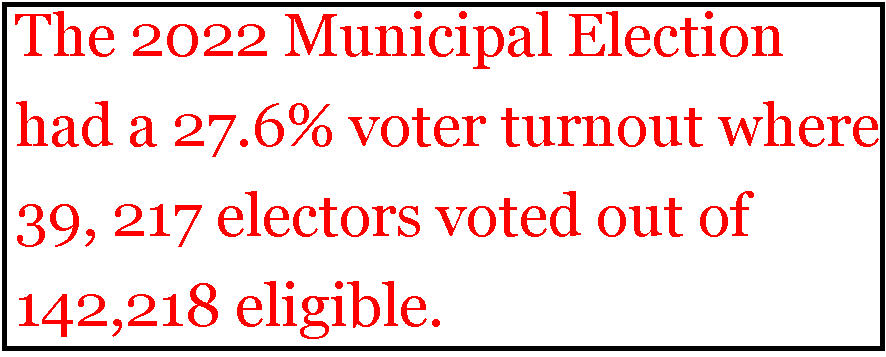
The 2022 Municipal Election had a 27.6% voter turnout where 39, 217 electors voted out of 142,218 eligible.
 These are not numbers the city should be proud of nor are they numbers council embers should see as a respectable mandate. 14,980 electors voted online, up by 12.5% from 13,123 in 2018.
In the 2022 municipal election, internet voting was available for 10 days from October 11th to Oct 20th.
64% of the post-election survey respondents indicated they voted online, and of those, 96% found the process to be easy and convenient.
In December 2021, the contract was awarded to Voatz Inc., for internet voting services along with Election Systems & Software (ES&S) for optical scan tabulators. Voatz provided a secure and accessible system for casting and reconciling votes.
Benefits:
Internet voting is convenient, helps reduce barriers and increases accessibility of the process, eliminates spoiled ballots, and provides an accurate ballot count. Coupled with the use of optical scan vote tabulators at in-person voting locations on Election Day, it allows for quick and accurate results.
The post-election survey conducted in 2022 provided insight into the voter experience. Survey responses and additional information on the 2022 election is available in the CL-07-23 2022 post-election report. Survey results indicated strong support for the use of online voting for future municipal elections in Burlington.
 Was this a COVID Council? The voter turnout was in the 27% range. The City was still in the post-COVID period when things were not normal. For the 2026 municipal election, staff will once again work closely with the Communications team to develop a comprehensive communications and engagement plan for the election focusing on the availability, accessibility, and security of online voting. The election team will also create online voting guides for electors to further improve the online voter experience and to assist in the process, with the goal of encouraging more voters to utilize this method of voting.
Staff recommend using internet voting as an advance voting option as it provides a secure and accessible way for electors to cast their ballot from anywhere and at any time during the 10- day internet voting period. It is the approach used successfully in 2022 and voters in Burlington are familiar with the process.
Although expanding internet voting to election day may provide more convenience, the risks outweigh the benefits. Any voting slowdowns or system timeouts may require the Clerk to utilize emergency powers to extend voting hours delaying election results. Supporting two different voting methods (online and at a polling station) will require significantly more staff to support the voting processes and could significantly impact the voting experience both at the polls and online. Anyone not registered to vote, would still be required to go to a voting location to be added to the voter’s list on election day where they could vote right there and then. For access and convenience, Burlington employs the “vote anywhere in your ward” system, meaning that electors do not have to go to an assigned voting location, but can vote at any of the voting locations in their ward.
The cost of the 2022 alternative voting methods was $194,541. Costs for the 2026 municipal election are expected to include inflationary increases and any change orders to the statement of work with the vendors. The source of funding for the election is the reserve fund with an annual contribution of $160,000.
This item wasn’t debated. It was placed on the Agenda as a Consent item which meant it would not be debated unless a Council member asked to have the item removed from the Consent agenda.
For those readers who commented – you might want to rethink what you submitted.
By Pepper Parr
February 10th, 2025
BURLINGTON, ON
They are calling it “the Great Man Theory” as what is behind all the noise coming out of the mouth of the President of the United States and his apparent desire to make Canada the 51st state.
 Fulton County Mug shot of Donald Trump taken when he was arrested. Trump is said to believe that he is a great leader and can remake America – expand its boundaries to include the provinces and territories. He still has huge support within the United States – the reckoning that Americans will eventually face when it becomes clear that Donald Trump is not going to solve the very real problems the average American faces.
Canadians, to date, haven’t been all that upset over this challenge to our sovereignty. We accept that the American are different and they are free to be whatever they choose to be.
Can you imagine a Canada with the health system the Americans have; can you imagine Canada having people walking down streets with a weapon in a holster on their hip?
Canada doesn’t have the rampant level of racism that pollutes a lot of what American’s do. We created and value the social safety net we have in place. We have two languages that are part of what we are as a country.
It is becoming clearer that Donald Trump is going to do whatever he can to make Canada part of what is now the United States if we continue to be asleep at the switch
In an interview aboard Air Force One Trump continued to threaten a country that has long been one of the U.S.‘s closest allies. He claimed that Canada is “not viable as a country” without U.S. trade, and warned that the founding NATO member can no longer depend on the U.S. for military protection.
There is a timidity to Canadians – time to thicken our skin and stand firm. Our response to whatever Trump announces today has to make it clear that Canadians see his plans to be an affront against our sovereignty.
The Prime Minister who is out of the country, somewhere in Europe, discussing Alternative Intelligence, needs to be on a plane and in the country leading the response to whatever Trump announces.
Salt with Pepper is an opinion column reflecting the observations and musings of the publisher of the Gazette, an on-line newspaper that is in its 12 th year as a news source in Burlington and is a member of the National Newsmedia Council.
By Pepper Parr
February 10th, 2025
BURLINGTON, ON
 2017 fire that destroyed most of the buildings The Paletta International site just off Appleby Line that was destroyed by fire in December 6th, 2017 is beginning to be re-animated.
The company has conditional site plan approval. The company is currently working through the various conditions one of which is obtaining Committee of Adjustment approval.
When completed the site and bring new employment and economic opportunity to the city.
Building designs are still a work in progress however there is a site plan.
Along with plans to eventually construct a new Alinea headquarters building, there will be approximately 300,000 square feet of new leasable light industrial / employment space in three new buildings.2017
Everything on the 18.5-acre property will be demolished and replaced with modern employment and office buildings. Given the uncertainty of timing to this point, no tenants for the light industrial / employment space have been sought yet; that will come in due course. “We are already getting calls from companies expressing interest in being part of this exciting redevelopment,” said a company spokesperson.
The 2018 fire meant there were going to be many changes in what the company would do and the business they were going to be in.
The death of Pasquale “Pat” Paletta, in 2019 brought about changes in the leadership and management style.
 The late Pat Paletta with his four sons. One huge change for the company was the creation of Alinea which didn’t include all four of Pat Paletta’s sons. Angelo Paletta went in his own direction while the other three brothers formed Alinea that is now focused on plans for the Bronte Meadows site and the 1200 King Road property
“While there may be a few minor tweaks to this plan in relation to the future Alinea headquarters building, there is a general sense of what’s being planned.
Property that was acquired by the Paletta family in Burlington was first used to pasture cattle; the company grew to become the largest beef processing operation in Eastern Canada; it was later sold to Canada Packers.
 The structure shown in orange will be the head office for Alinea. The other three structures will be developed when market conditions are right. The company added poultry processing (Tender Choices) to its operations.
 Both business lines were eventually sold and the focus was shifted to property development. Both business lines were eventually sold and the focus was shifted to property development.
Alinea is working out of what is left after the fire. “All existing buildings on the property will be demolished once Demolition Permits are obtained later this year. Specific demolition and construction timelines have yet to be determined, but we do know that for practical purposes development will need to be phased over several years.
Exciting days for the company
By Pepper Parr
February 9th, 2025
BURLINGTON, ON
UPDATED February 10th
Among the Directions the Mayor issued to staff on the matter of possible tariffs the Mayor included:
Staff to undertake research and provide advice to the head of Council on potential responses to the tariff threats, including attendance at Mayor’s Tariff Task Force meetings as required in a research and advisory capacity.
No mention is made of just who is on this Task Force and what its immediate objectives are.
 It looks like tariffs are real again. The tariffs that President Trump had put on hold for 30 days – that didn’t last. Before heading off to the Super Bowl Game in New Orleans Trump announced that he would announce 25% steel and aluminum tariffs Monday; with more import duties coming.
This President has made monkeys out of the American media. He keeps flooding the media with announcement- which they take and run with. While media is chasing announcements the President gets on with what matters to him.
He needs his Cabinet in place and it appears he will do everything he can take get them there.
This is a completely different President – the rules do not matter to him. David Frum, a respected news analyst, has described Donald Trump as a predator who uses every tool and new outlet to get his message out.
He has taken away the security clearance former President Biden had; he has removed senior people from the FBI; he has removed Inspectors, the people who are in place to ensure a federal agency is doing the job it is supposed to do to protect the public interest. The President is required to advise Congress if he wants to do this. Trump doesn’t pay attention to rules.
 Time to look for better customers  All the while confusing everyone as to just what he plans to do. All the while confusing everyone as to just what he plans to do.
This is the guy Doug Ford wanted to vote for – 1000% said Ford. Remember that 18 days from now when you cast your ballot for member of the provincial Legislature.
Canada has a lot of very strong options. Cut off the power they buy from Canada that keeps the lights on in New York City; stop selling them the oil they need.
Wear velvet gloves but make sure the Americans know that they need us as much as we need them. The threat of doing things like this is all that is needed – time to see the Canadian government showing that they have options – and in the meantime look for better customers.
The Mayor has yet to announce who the members of the Task Force will be.
By Matt Harvey
February 9th, 2025
BURLINGTON, ON
The threat of tariffs has the people of Burlington feeling unsure about what could happen.
I asked 26 people outside two of the Fortinos supermarkets about what they thought about the possibility of tariffs and how it would affect their households; there were different sentiments about the looming threat.
Continue reading Burlingtonians have views on the possible imposition of tariffs – many didn’t know quite what to say
By Staff
February 9th, 2025
BURLINGTON, ON
What a day for a horse and sleigh!
A great Canadian winter.
 That umbrella gets used in the summertime – today it adds a splash of colour to the green of the fir trees dressed with a white covering. Winter! The kids will be out on the slopes with whatever they can get their hands on to slide down to the bottom, climb back up, and do it all over again.
Will it be sloppy when it melts – probably?
 The path to the lane that leads to the road will have to be cleared at some point.
By Staff
February 8th, 2025
BURLINGTON, ON
Coldest Night of the Year! Feb 22, 4-7pm
For Eagles Neat, a registered charitable organization that helps adults, youth and children care for their mental health and learn new tools for healthy relationships, is located on the border of Hamilton and Burlington, Coldest Night of the Year (CNOY) is their biggest fundraiser.

Continue reading February 22nd – is the Coldest Night of the Year a time to
By Nate Erskine Smith
February 8th, 2025
BURLINGTON, ON
 Nate Erskine Smith While the House of Comments isn’t meeting, the Prime Minister appears to be at his desk on occasion. Minister of Housing Nate Erskine Smith has made it very clear what he wants to do in the time that he has left:
Drive down the costs of home building, double down on our commitment to community housing, end homelessness, and treat housing as a home first and an investment second.
“I’ve been busy making transit and housing-related announcements across Ontario these last few weeks, and we’re set to travel across the country going forward. As a result, I’m a little behind on writing and sharing ideas.
Continue reading How Minister of Housing, Nate Erskine Smith is addressing Canada’s housing crisis
By Staff
February 8th, 2025
BURLINGTON, ON
We have a 311 service, we have a 911 service and now there is a 211 service.
 The Halton Hamilton United Way (HHUW) was a founding partner of 211 service in Canada, providing funding and support for the program, and advocating to make its services available to all communities across Canada. The Halton Hamilton United Way (HHUW) was a founding partner of 211 service in Canada, providing funding and support for the program, and advocating to make its services available to all communities across Canada.
211 is the largest national database of community services and government programs in Canada. It plays a critical role in helping people navigate available local resources.
The service 211 connects people in Halton and Hamilton to essential social services, including housing support, mental health resources, and food security, through a free, 24/7 confidential service available in over 150 languages.
Continue reading Do you know what the 211 service is?
By Staff
February 7th, 2025
BURLINGTON, ON
After meeting with the nation’s provincial leaders and the prime minister on Jan. 15, Ontario Premier Doug Ford said that it was time to put Canada first, even ahead of provincial interests, in dealing with tariff threats from American President Donald Trump. By Jan. 29 the province had begun an election campaign, after Ford announced an early call in order to garner a stronger mandate over the next four years.
 Premier Doug Ford: Has he taken a political risk that he might regret? New data from the non-profit Angus Reid Institute finds residents not sold on the timing or motivation of the election. Four-in-five Ontario residents (78%) – and in fact three-in-five who currently say they’ll support Ford’s party – say that this election call was made to serve Ford’s interest and not those of the province. Seven-in-10 (68%) characterize the election as “unnecessary”.
Continue reading Four-in-five Ontario residents say this election call was made to serve Ford’s interest
By Staff
February 6th.2-25
BURLINGTON, ON
After careful consideration, the Burlington Teen Tour Band will not be travelling to Myrtle Beach to perform in the Myrtle Beach St. Patrick’s Day Parade.

By Staff
February 6th, 2026
BURLINGTON, ON
Today, Mayor Meed Ward issued a Mayoral Direction focused on supporting Canadian businesses, workers, and the broader Burlington community, aligning with provincial and federal efforts to bolster national economic resilience.
The Mayoral Direction issues the following directions to staff:
Continue reading Mayor Meed Ward: We have to Stand Up for Canadian Businesses and Burlington’s Future
By Staff
February 6th, 2025
BURLINGTON, ON
Stretched to the limit: hospital union will be lining up gurneys outside Joseph Brant Hospital in Burlington at 1:00 pm today to draw attention to the healthcare crisis
The province is in the midst of a provincial election that is to take place on February 27th.
Every self-interest group is struggling to get its story out while the political parties get close to reckless on how they would spend public money.
The hospital unions are raising concerns about access to care due to growing deficits across the hospital sector. Based on latest data, hospitals in Ontario faced a cumulative shortfall of $800 million in the first half of 2024-25.
 Joseph Brant Hospital operated at 94.2% capacity, well above the 85 per cent recommended maximum bed occupancy level. At Joseph Brant Hospital the shortfall was $1.8 million. The union warns that cutbacks are already happening at numerous hospitals, including Burlington, as they buckle under the weight of growing patient volumes and insufficient funding; pointing out that per-person hospital funding in Ontario is the lowest in Canada and that we have the fewest beds and hospital staff to population.
In the first half of 2024-25, Joseph Brant Hospital operated at 94.2% capacity, well above the 85 per cent recommended maximum bed occupancy level. According to analysis by OCHU-CUPE, Joseph Brant must add 32 beds to achieve safe occupancy levels.
Michael Hurley, president of CUPE’s Ontario Council of Hospital Unions (OCHU-CUPE) says it is not surprising to witness a record increase in hospital overcrowding. About 2,000 patients every day receive care on stretchers in unconventional spaces such as hallways and storage closets, an increase of 125 per cent since June 2018 when Ford got elected on the promise to end hallway health care.
Hurley says hospital overcrowding compromises patient and staff safety, causing delays in admitting patients, higher risk of nosocomial infections, and heavier workloads. Moreover, it robs patients of dignity as they are treated out in hallways without privacy.“There were 250,000 people on wait lists for surgeries last year,” Hurley says. “2,000 are on stretchers today, begging for a bed. Palliative patients die at home without painkillers. As a province, we must do so much better for our citizens.”“The next government must implement real solutions”
The union recommends the following solutions to address the healthcare crisis:
 Hospital union will take empty gurneys out onto Lakeshore Road to demonstrate how bad things are at the Joseph Brant Hospital. Improve hospital capacity to match the needs of an aging and growing population, by adding staffed hospital beds.
Address the staffing crisis by improving compensation and working conditions, and providing incentives such as free tuition to students in nursing and PSW programs
End private sector delivery of acute, long-term care and community health services
Ban agency nurses to reduce staffing costs, and invest that money in improving compensation and working conditions for in-house workers
Improving staffing in LTC to meet the 4-hours of daily care benchmark and expand capacity to reduce waitlists
End contracting out of services across health care, and run LTC and home care on a public, not-for-profit basis
Expand the use of nurse practitioners to lead primary care clinics.
Fast Facts:
- 1,860 people on stretchers in hospital hallways, up from 826 in June 2018 when the Premier promised to end hallway medicine.
- 2.5 million citizens without a family doctor
- Palliative homecare patients dying without painkillers and medical supplies
- 250,000 people waiting for surgeries
- Nearly 50,000 people waiting for long-term care
- Constant ER closures in small towns.
By Pepper Parr
February 6th, 2025
BURLINGTON, ON
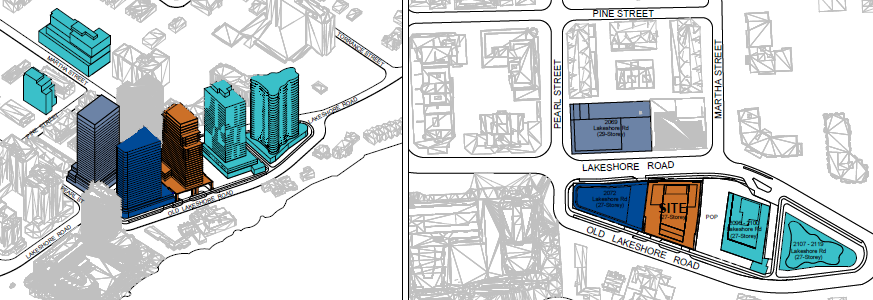
The properties bounded by James, Martha Lake Shore Road, and Pearle provide a snapshot of what is taking place in the downtown core.
In the picture below there is the Mattamy development on the corner of James and Martha. In the background, on the left is the ADI Nautique, and to the right the Beausejour. and to the right the Beausejour.
South of the ADI and Beausoleil developments, in the football space between Lakeshore Road and Old Lakeshore, thereat are four skyscraper-level developments that are in various stages of development.
 Every square foot of the property inside the football has a development plan that is somewhere between the Planning Department, the OLT, and maybe even a building permit. The people who live north of Upper Middle Road have, for the most part, little in the way of understanding how the city is changing – downtown for them is Sound of Music, Ribfest and events that get them out to Spencer Smith Park which is now past capacity.
The small stretch of Martha, on the east side of the street just south of where James turns into New Street there is a patch of land that will see buildings that are in the six to eight-storey range.
Interesting how development has changed the downtown core and the Save the Waterfront group that Marianne Meed Ward used to get herself elected to Council in 2010 has managed to save the waterfront – if you can see it.
 The sales sign on the Nautique doesn’t represent the reality that most people deal with when looking at condo space. The sales sign on the Nautique doesn’t represent the reality that most people deal with when looking at condo space.
In the beginning – when Rick Goldring was Mayor the then Waterfront Advisory Committee invited former Mayor David Crombie out to talk to the group. At the time Crombie urged the community to invite architects to come up with some ideas on what could be done with the football properties. At that time no one had begun to consolidate the 18+ lots.
That idea didn’t find any traction – what you see rising out of the five-level underground garages is what Burlington is going to look like well into the next century.
Pity
By TOM PARKIN
February 5th, 2025
BURLINGTON, ON
Many school principals say lack of available teachers is a daily problem and many have had to tell a special needs student they can’t come to school.
In 2024, 46 percent of Ontario elementary school principals and 39 percent of secondary school principals had a shortage of teachers every week, according to a recent survey of over 1,000 Ontario school principals.
And it’s a daily problem at 24 percent of elementary schools and 35 percent of secondary schools, principals say.
Ontario universities are graduating about half the number of teachers as a decade ago, and the low number of available teachers is making it hard to ensure classrooms are staffed, principals report.

Teachers not available when principals needs to fill gaps
Starting in September 2015 the Ontario Liberal government expanded the teacher training program to two years from one year and cut admissions by half.
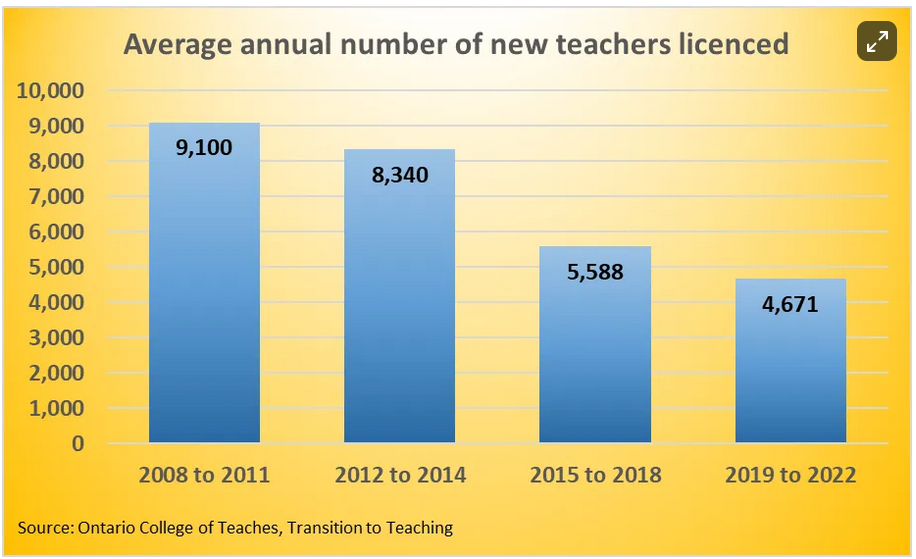
Between 2008 and 2011, before the change, there were 9,100 newly licensed teachers in an average year, according to the Transitions to Teaching report from the Ontario College of Teachers. That’s dropped to just 4,671 on average between 2019 and 2022.
The result has been a teacher shortage. In 2014, 34 percent of newly-licenced teachers were not full-time employed as a teacher in their first year. That number has dropped to just four percent in 2022, leaving principals in many areas unable to find teachers and fill gaps.
The annual report of principals shows that 42 percent of elementary principals and 46 percent of secondary school principals had a shortage of educational assistants every day.
Principals telling special needs students to not come to school
In 2018, 58 percent of elementary principals and 48 percent of secondary school principals had to tell special needs students to not come to school for the day. In 2024 it was 63 percent and 58 percent, respectively.
In 54 percent of cases, the principal told the special needs student to not come to school because necessary support was not available.
In Ontario, 16 percent of elementary and 28 percent of secondary students are supposed to receive some form of special education support, a proportion that has remained relatively steady over the last decade
Majority of schools in northern Ontario have no access to a school psychologist
In 2017, principals reported that 13 percent of elementary schools and 16 percent of secondary schools had no access to a school psychologist, either in-school or on-call. In 2024, that number has increased to 24 percent and 29 percent, respectively.
And the problem of no access to school psychologists is heavily geographically weighted.
Principals reported that only seven percent of schools in the Greater Toronto Area didn’t have access to a school psychologist. But there was no access for 20 percent of schools in southwest Ontario, 30 percent in eastern, 36 percent in central, and 59 percent in northern Ontario schools.
|
|





 By Staff
 If you are in immediate danger, please call 9-1-1. Do not respond to this email. This email is not monitored.