By Pepper Parr By Pepper Parr
November 7th, 2025
BURLINGTON, ON
There is an arms length organization with the abbreviation BED.
That got upgraded to BEDT.
What was the Burlington Economic Development Corporation became the Burlington Economic Development and Tourism Corporation.
They began to get on with doing what they were created to do.
In their Annual report for 2024 they reported:
 Annual report released in July of this year. Burlington Economic Development and Tourism is proud to announce the release of its 2024 Annual Report, capturing a transformative year of strategic integration, expanded programming, and record-breaking impact across sectors. Representing the first annual report following the amalgamation of Burlington Economic Development and Tourism Burlington, it reflects a strengthened, more coordinated approach to growing Burlington’s economy and elevating the visitor experience.
In 2024, the organization supported over 800 businesses, helped attract more than 300 new jobs, and recorded $524 million in visitor spending—a 26% increase over 2023.
But the wheels came off.
In the Executive Summary of the Rubicon report, prepared by a consulting company, the recommendation was to dissolve BEDT and bring the economic development and tourism functions into the City’s corporate structure, adding that the relationship between the City and BEDT is broken and leaving the current model in place risks further erosion of trust, wasted resources, and lost economic opportunities.
It’s quite a story. Council will be meeting in a Special session on Monday to determine what they should do.
The Gazette will provide a detailed outline on what happened at Council on Tuesday. It was not a pretty picture
Whatever they do – it will be expensive.

By Ray Rivers
November 6th, 2025
BURLINGTON, ON
This may have been the most over-hyped budget ever. The consensus among many economists is it is neither as transformational nor as generational as the PM and his finance minister had billed it.
When an economy starts to go downhill as Canada’s has, it is government’s role to prime the pump. Stephan Harper did exactly that during the 2008 economic downturn with Mr. Poilievre in his caucus. And that is exactly what this budget does. The question many economists are asking is whether there is even enough priming given the challenges we face – whether Mr. Carney is being too cautious.
 We are just not ready for serious import substitution. Mr. Carney must feel it is too early for Canada to fully reciprocate by countering all of Trump’s tariffs. One factor is that Trump’s so-called emergency tariffs (his first ones tied to fentanyl and migration) are before the US Supreme Court. Were those tariffs to be ruled unconstitutional, the entire tariff apple-cart might be in play. Plus there might even be some compensation for us on the table. But don’t get your hopes up given the voting record of this highly partisan MAGA Supreme Court.
Second, all trade negotiations have been placed on hold ever since Ontario’s dysfunctional premier interfered in US domestic politics by playing those Reagan ads on US media. B.C. cancelled its planned ads on lumber trading once it saw the damage that Ford had done. And even the PM’s apology for the interference from one of his Team Canada premiers, has not brought Trump back to the table.
And third, we are just not ready for serious import substitution. It’s only been a few months since the tariffs landed. As an example, we are still importing US made beer cans despite the fact that the aluminum comes from Canada. So applying a tariff on US beer cans would just serve to raise the cost of beer – thus adding to inflationary pressure.
Fear of Inflation was the primary reason the Conservative opposition is claiming for voting against the budget. Somehow, Poilievre would be OK with $42 billion but not a $78 billion deficit. And somehow, the fear of recession and joblessness is of lesser importance than inflation. But then the Conservatives have almost never supported a federal Liberal budget over all the years.
 Poilievre has reverted to being Mr. Negativity again – using the same old negative attack dog antics. Besides, Poilievre has reverted to being Mr. Negativity again – using the same old negative attack dog antics which worked so well at eviscerating the previous Trudeau government. It’s little wonder that at least one MP has tired of this negativity and narrow-minded leadership and crossed the floor to join the Liberal camp.
Writing a budget in times like these is a balancing act. Maintaining the social safety net is critical to removing financial insecurity for Canadian consumers, since consumption is the antidote to recession. So pharmacare, dental care and child care are still in play despite the government shaving back the overall costs of its programs.
 Do Canadians want Carney to shift how he has tried to work with Trump? Canada is experiencing an economic crisis but most importantly there is also a crisis of confidence – in ourselves and our ability to rebuild a stand-alone Canada. Critics had warned at the time about entering into the kind of trade deal Mulroney had negotiated – warned about the inevitability of the outcomes we are seeing today. Still, we are fortunate that the USMCA has allowed us to avoid the full impact of Trump’s tariffs even if only until Trump finally squashes it next year.
I had been expecting more from this budget. It would have been good to see even more tax incentives and direct investment, particularly for small and medium business. Carney should have reactivated the digital services tax – money for nothing, a no brainer – which he cancelled in the naive and failed hope of expediting trade negotiations. And if Carney was really serious about new private sector investment why hasn’t he dropped the GST on Canadian made goods?
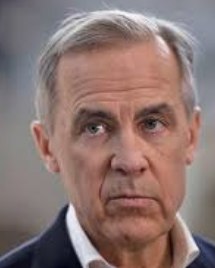
 Ray Rivers, a Gazette Contributing Editor, writes regularly applying his more than 25 years as a federal bureaucrat to his thinking. Rivers was once a candidate for provincial office in Burlington. He was the founder of the Burlington citizen committee on sustainability at a time when climate warming was a hotly debated subject. Ray has a post graduate degree in economics that he earned at the University of Ottawa. Tweet @rayzrivers Ray Rivers, a Gazette Contributing Editor, writes regularly applying his more than 25 years as a federal bureaucrat to his thinking. Rivers was once a candidate for provincial office in Burlington. He was the founder of the Burlington citizen committee on sustainability at a time when climate warming was a hotly debated subject. Ray has a post graduate degree in economics that he earned at the University of Ottawa. Tweet @rayzrivers
Background links:
First Budget – Not Good Enough –
By Gazette Staff
November 6th, 2025
BURLINGTON, ON
The Santa Claus parade is returning to downtown Burlington Sunday, Dec. 7, from 2-4 p.m.
The parade will feature floats, community groups, costumed characters, the Burlington Teen Tour Band, Junior Redcoats and other marching bands. As always, Santa will be the grand finale of the parade.
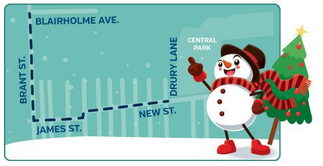
 Back again. Families will sit on the curbs along New Street to watch the parade. Lots of floats and the Teen Tour Band. The parade will start at 2 p.m. at the corner of Drury Lane and New Street and will make its way downtown along New Street. The parade then travels north on Brant Street and finishes at St. John the Baptist Church on Brant Street at Blairholm Avenue.

Roads will close at varying times along the route and will re-open shortly after the final float has moved through and a clean-up has been completed. For the most updated information including the full parade route, visit Burlington.ca/Parade.
Residents living in the parade area are encouraged to plan ahead as there will be detours and delays.
Children are encouraged to bring letters for Santa, which will be collected by letter carriers from Canada Post along the parade route or dropped in area mailboxes. The Burlington Oldtimers Hockey Club will be collecting non-perishable food and monetary donations.
By Gazette Staff
November 6th, 2025
BURLINGTON, ON
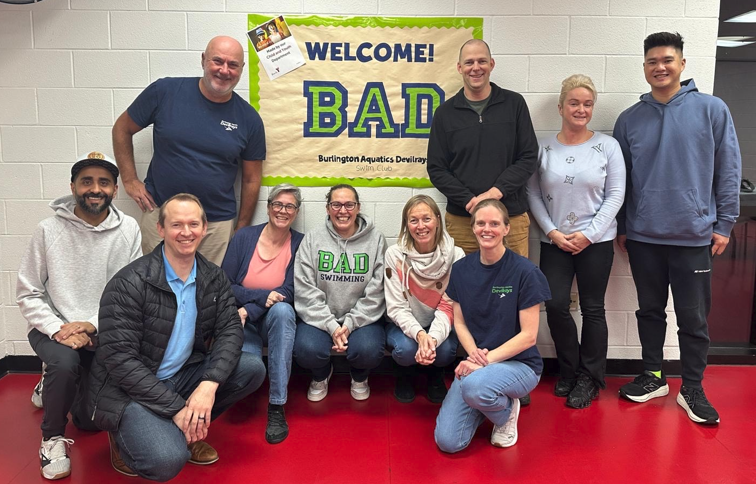
 This is what a swimming team is about. The Burlington Aquatic Devilrays (BAD) officially formalized their new executive Tuesday night, following a special meeting of the club on October 23, 2025, where 8 members were elected to the board. 1 additional member was appointed to the board at last night’s executive board meeting to round out the team.
The new board consists of:
- President – Karl Meissner-Roloff
- Executive Vice President – Zohair Khan
- Secretary – Karen Markowsky
- Vice President, Operations – Derek Streefkerk
- Vice President, Internal Affairs – Izabela Dombrovsky
- Vice President, Communications – Heather Drewett
- Vice President, External Affairs – Geraldine Guenot
- Treasurer – Anderson Chow
- Registrar – Aimee Hilson
- Head coach (ex-officio) – Sergei Soloukhin
 L to R (bottom row) – Zohair Kahn, Karl Meissner-Roloff, Heather Drewett, Geraldine Guenot, Karen Markowsky, Aimee Hilson, L to R (top row) – Sergei Soloukhin, Derek Streefkerk, Izabella Dombrovsky, Anderson Chow.
This event marks a new chapter for the Burlington Aquatic Devilrays (BAD), with our newly elected board is eager to build on the club’s strong foundation and drive future growth.
BAD will continue to be a vibrant and thriving swim club. With pool time at the Ron Edwards YMCA and city facilities, their athletes are training diligently every day.
The club recently hosted their annual Fall Invitational Swim Meet on November 1st and 2nd; it drew strong participation from BAD members and visiting clubs alike. The event was a tremendous success, made possible by the enthusiasm of our swimmers and the tireless efforts of our volunteers.
Recovering from the process that limited the amount of pool time is an ongoing process. Champions know how to win.
By Pepper Parr
November 5th, 2025
BURLINGTON, ON
Don’t say you didn’t know – admit that you have let it happen.
 The following from the December issue of The Atlantic, an American magazine that began publishing in 1857. The following from the December issue of The Atlantic, an American magazine that began publishing in 1857.
The social-media era is over. What’s coming will be much worse.
Mark Zuckerberg, founder of Facebook, in this same spirit, has began to suggest the idea that AI chatbots could fill in some of the socialization that people are missing.
 The social-media era is over. What’s coming will be much worse. Facebook, Instagram, Snapchat, X, Reddit—all have aggressively put AI chatbots in front of users. On a podcast, Zuckerberg said that AI probably won’t “replace in-person connections or real-life connections”—at least not right away. Yet he also spoke of the potential for AI therapists and girlfriends to be embodied in virtual space; of Meta’s desire—he couldn’t seem to help himself from saying—to produce “always-on videochat” with an AI that looks, gestures, smiles, and sounds like a real person.
Meta is working to make that desire a reality. And it is hardly leading the charge: Many companies are doing the same, and many people already use AI for companionship, sexual gratification, mental-health care.
What Zuckerberg described—what is now unfolding—is the beginning of a new digital era, more actively anti-social than the last.
Generative AI will automate a large number of jobs, removing people from the workplace. But it will almost certainly sap humanity from the social sphere as well.
Over years of use—and product upgrades—many of us may simply slip into relationships with bots that we first used as helpers or entertainment, just as we were lulled into submission by algorithmic feeds and the glow of the smartphone screen. This seems likely to change our society at least as much as the social-media era has.
It gets through to you from a monitor or a cell phone screen – stop letting it in.
By Gazette Staff
November 5th, 2025
BURLINGTON, ON
Every young person has to see the Nutcracker at least once – preferably when they are very young and again as an adult.
The Nutcracker is a Canadian Tradition that is coming back to the Performing Arts.
Running on the Main Stage Tuesday, November 25th and Wednesday,November 27th – 7:30pm

Created by acclaimed choreographer Bengt Jörgen to Tchaikovsky’s well-loved score, this classic is a favourite that adds magic to the holidays. Born from a collaboration with Kleinburg’s world-renowned McMichael Canadian Art Collection, this iteration of The Nutcracker brings out the magic of the great white north. Iconic 20th-century landscapes make up the stunning 30-foot backdrops, including Franklin Carmichael’s Church and Houses at Bisset.
Audiences will be taken on Klara’s familiar, magical dream journey, but this time, she arrives in Canada and experiences winter landscapes filled with snowflakes, lumberjacks, Mounties, and creatures of the woods!
Don’t miss this delightful classic with a Canadian twist!
Tickets: HERE
By Gazette Staff
November 5th, 2025
BURLINGTON, ON
Have you noticed the chill that is sometimes in the morning weather?
 When winter rolls in your pipes go to battle with the cold – and without the right prep, they rarely win. When winter rolls in your pipes go to battle with the cold – and without the right prep, they rarely win.
Frozen and burst pipes are among the most common – and expensive – cold-weather emergencies. One small crack can leak hundreds of litres of water in a single day, causing thousands of dollars in damage to walls, floors and furniture.
During the winter many homeowners deal with preventable damage from frozen or burst pipes. Taking simple steps during the fall months can save homeowners from a worst-case scenario.
Prevention now can mean the difference between a cozy winter and a costly flood. Here are a few tips to get your plumbing winter-ready:
 Insulate exposed pipes – Pipes in unheated areas like basements, crawl spaces, attics and garages are most vulnerable to freezing. Wrapping them in foam insultation or applying electric heating tape can prevent ice from forming inside. Insulate exposed pipes – Pipes in unheated areas like basements, crawl spaces, attics and garages are most vulnerable to freezing. Wrapping them in foam insultation or applying electric heating tape can prevent ice from forming inside.
Disconnect and drain outdoor water lines – Remove garden hoses from outdoor faucets, shut off the interior valve supplying the line and drain any remaining water. Leaving hoses connected allows water to back up into pipes and freeze, which can lead to cracks and burst fittings inside your home.Seal up cold drafts – Cold air entering through cracks, vents or gaps near plumbing can quickly lower pipe temperatures. Use caulking or insulation to seal openings around your pipes where they enter walls or floors – especially along exterior walls and foundations.
Know where your main shut-off valve is located – In the event of a burst pipe, shutting off the water immediately can prevent extensive flooding and property damage. Make sure all household members know how to locate and operate the main shut-off valve before an emergency occurs.
 Don’t forget outdoor drains and sump pumps – Clear debris from gutters, downspouts and sump pump discharge lines so melting snow and ice can drain properly. Clogged drains can lead to backups and basement flooding once the thaw begins. Don’t forget outdoor drains and sump pumps – Clear debris from gutters, downspouts and sump pump discharge lines so melting snow and ice can drain properly. Clogged drains can lead to backups and basement flooding once the thaw begins.
It only takes one night of extreme cold for an unprepared home to be impacted. A bit of prevention goes a long way toward keeping your winter stress-free.
By Pepper Parr
November 5th, 2025
BURLINGTON, ON
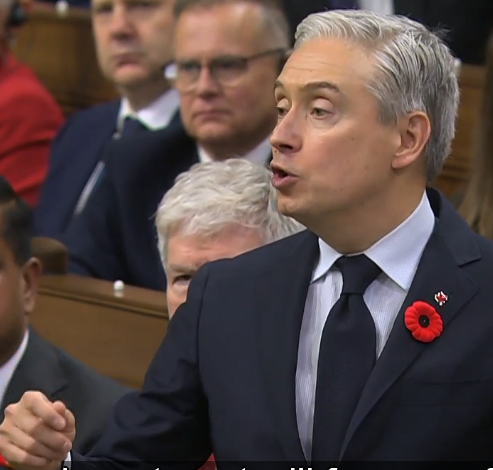
Minister of Finance François-Philippe Champagne stood for close to an hour accepting wave after wave of applause from the Members of the House of Commons.
He had them on their feet at least 25 times – probably more – it was difficult to count.
 The Members of the House of Commons were on their feet, applauding many times during the one-hour event. Minister of Finance François-Philippe Champagne addressing the House of Commons What many do not realize is that the Members of the House would not have seen the budget until the Minister began speaking.
 Clerk delivering a copy to Members of the House. At that point, Clerks moved from desk to desk, handing each Member a copy of the Budget
Champagne was on his feet to assure Canadians that the government had a firm grip on dealing with the strains on the economy and just who Canadians are going to be trading with in the future.
 Champagne: “I made the shoes I am wearing.” A Canadian tradition is for the Minister of Finance to acquire a new pair of shoes. Champagne went one better than previous Minister’s of Finance. He flew to Saint-Tite, Quebec, (on a government jet) to a shoe manufacturing company makes footwear, and took part in making the pair of shoes he wore in the House.
The cost of the trip was never mentioned.
Champagne did say that the company made boots for the RCMP adding that the Members were surely jealous that they didn’t have such a nice pair of shoes.
During his speech, Champagne said the government was basically rebuilding Confederation to keep Canada Strong.
The budget will be given First reading today – and then the debate begins. Can a minority government (The liberals are two seats short of a majority) get its budget passed without the calling of a federal election if the budget does not have the confidence of the House of Commons?
By Gazette Staff
November 5th, 2025
BURLINGTON, ON
The Burlington Community Foundation (BCF) announced the launch of a community campaign with the formation of a Housing Support Fund The goal is to raise $50,000 for two local housing initiatives and create a long-term investment in housing support for the Burlington community.
 The campaign, which will run from Nov. 5 to Dec. 31, has two giving goals: The campaign, which will run from Nov. 5 to Dec. 31, has two giving goals:
1) Provide $25,000 each to housing initiatives from charitable organizations Wesley and Shifra Homes and
2) Establish a permanent Housing Support Fund at BCF that provides grants to charitable organizations annually. The Housing Support Fund has received a generous opening lead donation of $25,000 from Burlington residents and BCF fundholders Doug and Maryella Leggat.
 Megan Tregunno, CEO of the Burlington Community Foundation. “Housing is a complex issue, and there’s an urgent and growing need for housing assistance in Burlington,” said Megan Tregunno, CEO of the Burlington Community Foundation. “Our Housing Support Fund is a response to that.”
“Last year, Halton’s shelter system operated at 40% over capacity. Housing affordability was also identified as top issue in Burlington in the recent BCF Vital Signs research report. We know that through the generosity of collective action, we will be able to make a meaningful impact to help our neighbours in need.”
The fund will support Wesley’s Emergency Supportive Housing program in Burlington, which serves Halton residents and is the only emergency shelter for unhoused families and single women facing homelessness in the region.
“We are grateful for the support of the Burlington Community Foundation and the generosity of community members who understand the urgent and complex requirements around providing emergency housing support,” said Kristyn Bruce, Senior Director, Housing and Outreach Services at Wesley. “Unfortunately, the need continues to grow. One way these funds will help Wesley is to add bunk beds to rooms at our shelter so that we can keep larger families together during an already traumatic time.”
Shifra Homes is Halton’s only maternity residence. Mothers and babies are supported with wraparound services through pregnancy and the transition to independent living. The organization operates without funding from any level of government and is supported through the generosity of community members.
“Each year, the number of mothers and babies needing our support increases and it is through community generosity and partnership that we are able to meet those needs,” said Nancy Romic, executive director of Shifra Homes. “These funds will help us provide housing, mental health, and nutritional support, as well as contribute to the continued support of mothers and babies as they move on from Shifra to their own residences.”
Through the Housing Support Fund, community members can make a bigger impact, working together. Donations to the fund can be made through personal and holiday giving, employee campaigns, local fundraisers, and in honour of loved ones.
Businesses, community groups and individuals are welcome to contact the Foundation for more information on how they can support the fund at Info@BurlingtonFoundation.org or 905-639-0744.
HOW TO DONATE:
Online at
- Through Gifts of Securities (there is no capital gains tax on charitable securities gifts)
- Through a donor advised fund
- Credit card donation by phone – 905-639-0744 1
- By cheque payable to: Burlington Community Please contact BCF to arrange pick up or drop off due to mail disruptions.
ABOUT BURLINGTON COMMUNITY FOUNDATION
Established in 1999, the Burlington Community Foundation is this city’s trusted philanthropic partner, and one of more than 200 community foundations across Canada. We manage charitable gifts from donors whose generosity allows us to create permanent, income-earning funds. Funds are then distributed as grants for charitable or educational purposes. To date, the Burlington Community Foundation has invested $12.7 million in people, projects, and non-profit organizations that strengthen Burlington and communities throughout Canada.
 ABOUT WESLEY: Wesley is a long-standing local non-profit, offering support for people experiencing poverty, homelessness, and barriers in the community. We provide programs and services to meet diverse community needs in Hamilton, Halton and Brantford. As a multi-service organization, we offer Children, Youth & Family Services, Housing & Homelessness Services and Newcomer, Employment & Community Services. Wesley’s services are possible through a broad base of funding support from government, business, foundations, groups and individuals. ABOUT WESLEY: Wesley is a long-standing local non-profit, offering support for people experiencing poverty, homelessness, and barriers in the community. We provide programs and services to meet diverse community needs in Hamilton, Halton and Brantford. As a multi-service organization, we offer Children, Youth & Family Services, Housing & Homelessness Services and Newcomer, Employment & Community Services. Wesley’s services are possible through a broad base of funding support from government, business, foundations, groups and individuals.
 ABOUT SHIFRA HOMES: Shifra Homes is Halton’s only maternity residence. Mothers and babies are supported through pregnancy and the transition to independent living. The organization operates without funding from any level of government and is supported through the generosity of community members. In 2024, Shifra opened an additional residence, increasing its capacity to support 17 mothers and babies. ABOUT SHIFRA HOMES: Shifra Homes is Halton’s only maternity residence. Mothers and babies are supported through pregnancy and the transition to independent living. The organization operates without funding from any level of government and is supported through the generosity of community members. In 2024, Shifra opened an additional residence, increasing its capacity to support 17 mothers and babies.
By Gazette Staff
November 4th, 2025
BURLINGTON, ON
The following is the delegation that the Golden Horseshoe Aquatic Club made to City Council on Monday.
“Good afternoon, Mayor, Members of Council and city staff. My name is Cody Bradt. I’m honored to serve as the chief operating officer and Associate Head Coach of the Golden Horseshoe Aquatic Club (GHAC). It’s a privilege to stand before you again this afternoon and share the incredible progress our club has made and this community has made since we last met.
“I’m thrilled to tell you that competitive swimming in Burlington is busy, vibrant, diverse and inclusive. We are off to a booming start, even with the delays caused by the legal matter that followed the RFP process.
“Despite those setbacks, programs have launched with extraordinary momentum. Today, we have over 250 Burlington youth aged five to 18 swimming in city owned facilities from introductory levels all the way to high performance. We also have 179 Burlington residents registered as officials, volunteering their time to support our sport and ensure fair competition in our first month of operation in City of Burlington, owned facilities. again, demand was so high that we had to request additional lifeguards at every single one of our practice hours.
“And today, more than half of our practices have wait lists. That is a good problem to have. Burlington families are eager to participate, to belong, to be part of something positive, inclusive and athlete centered. And here’s a statistic that I’m especially proud of in this 2025 2026 season, we have had zero transfers out of our age group programs, not one. That level of retention and satisfaction is almost unheard of in competitive swimming or sports in general. It shows the trust our families have in our coaches and the excitement our athletes feel about being a part of G hack.
 Cody Bradt “Now I know the question of critical aquatic infrastructure is one we’ll have to tackle another day, and we remain committed to being a constructive part of that conversation. But these numbers clearly show the demand and enthusiasm for swimming here in Burlington. Since I last stood before you, our coaching staff have continued to lead and represent Burlington in the Golden Horseshoe with excellence. They’ve completed more training, earned provincial recognition and presented at Ontario’s largest swim conference. I want to highlight one coach in particular, Colleen Ben, a Burlington resident and longtime member of the Burlington swimming community. She was recognized by Sim Ontario as a world class coach for guiding an athlete to a top 15 world ranking. She also presented on the main stage about effective coach leadership, showing that Burlington’s coaches are leaders far beyond our local pools. I too had the opportunity to present and serve on a panel at that same conference, sharing insights on inclusivity, collaboration and athlete centered development from my experience coaching team Ontario at the Canada Summer Games. These are not just Burlington stories. These are our stories, and they demonstrate the caliber of excellence that exists right here, in this community and has for well over a decade.
“I’d like to address the process that brought us all here. We followed the stipulated RFP process, the same process we respected in prior years. It was open, transparent and thorough. When we were unsuccessful in 2020 we respected that outcome and moved forward. We were successful this time in the youth bid. We are proud and excited to begin what came after, however, it was painful and unnecessary. Without revisiting every detail, because I can’t. I want council to know that we were asked by the city to give up some of the rights we had earned through the RFP process, rights awarded through a fair process, in order to reduce the tension within the community. That was not an easy task, but we agreed, because we believed unity was more important than division.
“Let me also remind council that we were again unsuccessful proponents of a swimming RFP. We did not win the adult bid. We participated in good faith. The city made its decision, and just as before, we accepted that result without question, because that is what it means to respect a fair, transparent process. I asked council to review the Bellamy report following the Toronto inquiry, which established the recognition recognized best practices for public procurement.
“With this foundation, procurement decisions should be based solely on the merits of the submission and keep political influence out. Let me remind Council of a quota shared with you months ago, one published in 2020, regarding this very RFP process, procurement and purchasing decisions are best made on value for service and not political influence. Those words were true then, and they remain true today. I do want to take a moment to recognize city staff, everyone we interacted with, from procurement to leadership to aquatics, each individual we engaged with was professional, responsive and understanding. We know they were doing their jobs, following the direction they were given. We appreciate their diligence throughout this process. We followed the process then, and we continue to follow it now.
“I also want to address the misinformation that has circulated in the media and online. There have been false claims made about our organization, claims that are simply untrue. The Golden Horseshoe Aquatic Club has been a part of this community for over 15 years. We have run Burlington we have run programs in Burlington facilities long before the first RFP ever took place. In fact, there are old contracts still on file with the city, predating far before 2020, showing our long-standing partnership. We didn’t suddenly arrive in Burlington. We have been serving this community faithfully for more than a decade and a half. Unfortunately, some media commentary has painted a misleading picture, one suggesting we’re outsiders. This is not only untrue. It’s unfair to the athletes, families, staff and your constituents that call Burlington home, as we all know, Burlington, Hamilton and surrounding communities are deeply interconnected. We share census, data, infrastructure, recreation and workforce. Businesses based in one municipality often serve families across many. A perfect example of this, the Burlington Gazette, one of the news outlets most active in covering this story, is actually based in Hamilton, just off of John Street South.”
(The Gazette once had an office in Hamilton; that was closed in 2021.)
“This is just a reflection of how our region truly works. We are not defined by postal codes, but by service commitment and community. Our club operates in that same spirit, proudly serving Burlington and Golden Horseshoe families contributing to the broader sporting fabric of the GTHA.
 “Finally, I need to address one last matter, the Golden Horseshoe Aquatic Club itself became the subject of a formal complaint filed with Swim Ontario by a member of this community questioning our right to operate and offer programs within Burlington. While I am not at liberty to release those reasons without the express permission of Swim Ontario, we were completely vindicated, and our right to offer services in this community was validated. Swim Ontario, the governing body for the sport and its dispute resolution office, determined that the Golden Horseshoe Aquatic Club has every right to operate here in Burlington, and that our work is in full compliance with all provincial standards, regulations and requirements. This decision reaffirmed what we have known all along, that our organization has acted in good faith within all proper frameworks and always with the best interests of Burlington athletes and families at heart that process, though difficult, brought closure and it validated the trust that hundreds of Burlington families have already placed in us. “Finally, I need to address one last matter, the Golden Horseshoe Aquatic Club itself became the subject of a formal complaint filed with Swim Ontario by a member of this community questioning our right to operate and offer programs within Burlington. While I am not at liberty to release those reasons without the express permission of Swim Ontario, we were completely vindicated, and our right to offer services in this community was validated. Swim Ontario, the governing body for the sport and its dispute resolution office, determined that the Golden Horseshoe Aquatic Club has every right to operate here in Burlington, and that our work is in full compliance with all provincial standards, regulations and requirements. This decision reaffirmed what we have known all along, that our organization has acted in good faith within all proper frameworks and always with the best interests of Burlington athletes and families at heart that process, though difficult, brought closure and it validated the trust that hundreds of Burlington families have already placed in us.
“We are proud to continue building a positive, inclusive and thriving swimming community here in Burlington and across the Golden Horseshoe as council now considers this RFP process and if it needs to be referred to the audit committee for review.
 Cody Bradt addressing Council earlier this year. “I ask you to consider this: was the process unfair, or was the unsuccessful bidder simply louder? This time, the city is not responsible for the viability of any corporation other than its own. To date, the city has spent 10s of 1000s of dollars in staff and time resources on this topic, one that serves fewer than 1500 constituents. We, too have spent 1000s of dollars of our own resources as a direct result of Council’s involvement in matters tied to the legal proceedings.
“It is time for us to move forward, to find closure on this topic and to focus on what truly matters – that Burlington youth have places to swim, grow and thrive. There is space for everyone. Let me remind you that we voluntarily gave up pool time that we had rightfully won so that our competitor could continue offering similar programming as requested by the city. We did this in good faith, in the spirit of cooperation and with the hope of putting this matter behind us once and for all. Within our organization, competitive swimming is not only alive, it’s thriving. We are ready to move forward together with respect, collaboration and with our focus where it belongs, on the athletes and families and the constituents we all serve. Thank you for your time.”
Collaborating with GHAC proved very difficult for the Gazette. We reached out on several occasions – never got a response. When we did get a response, it was from their legal counsel asking if we were interested in doing an interview. We were, until we learned that it was to take place in the lawyers offices inHamilton and that the lawyer would be attending.
We took a pass on that opportunity, but did say we would meet with GHAC people at their pool at McMaster University anytime.
They took a pass on that opportunity.
Relayed news story:
BAD puts its case before City Council
By Gazette Staff
November 4th, 2025
BURLINGTON, ON
This holiday season, United Way Halton & Hamilton is inviting community members to make a meaningful difference through its annual Holiday Helping Hand program. The initiative brings people together to brighten the holidays for local families, seniors, and individuals who are struggling to make ends meet.
 Now open for registration, the program offers multiple ways to give back, whether through donations, teamwork, or volunteering, making it easy for anyone to spread kindness and joy this season. Now open for registration, the program offers multiple ways to give back, whether through donations, teamwork, or volunteering, making it easy for anyone to spread kindness and joy this season.
Participants can:
Adopt a Family – Sponsor a local family and provide gifts and grocery cards so they can enjoy a warm and dignified holiday celebration together.
Host a Gift Drive – Rally your friends, coworkers, or community group to collect toys, stocking stuffers, or gift cards for families and individuals who might otherwise go without.
Build Kits – Assemble themed kits such as Baby Supply Kits, Household Basics Kits, or Period Promise Kits to meet urgent community needs.
Volunteer – Sign up for hands-on opportunities with local agencies to directly support those who need it most.
Registration is open until Friday, December 5, 2025, with donation drop-offs taking place at United Way Halton & Hamilton’s Community Donation Warehouse in Burlington on December 8 and 9 from 9 a.m. to 6 p.m.
“The holidays can be especially difficult for families facing financial strain,” said Brad Park, President and CEO, United Way Halton & Hamilton. “Holiday Helping Hand gives people a meaningful way to connect with their community and make a lasting impact.
Every gift, kit, or volunteer hour helps ensure that everyone across Halton and Hamilton can experience the joy and dignity of the season.”
Participants often describe the program as one of the most rewarding parts of their year, a reminder of the power of community and compassion. Many workplaces use it as a team-building opportunity, while families take part to teach children about empathy and gratitude.
All gifts and donations collected through Holiday Helping Hand stay local, supporting United Way funded agencies and programs that provide essential items and support services during the holidays and throughout the year.
Those interested in getting involved can learn more and register at https://uwhh.ca/events/hhh/.
By Juan Beas
November 4th, 2025
BURLINGTON, ON
Over the years, digital connectivity has become a way to help transform users’ experiences and lives while providing them with knowledge of different communities. It is only limited by infrastructure and geography, as many of these regions across Canada are now using multiple digital platforms that provide users with various game options alongside movies and music. In comparison, there is also internet access given to the members alongside northern residents that are slowly discovering a whole different world of gaming where everything is at members’ fingertips, ranging from virtual events to streaming platforms to low wagering casino platforms and many other digital entertainment options.
 Whitehorse, a northern Canadian community, now has good internet speed – they have always had Northern Lights. . The Growth of Connectivity in Remote Regions
For decades, there have been various barriers to digital entertainment among individuals based in northern Canada, and they were limited to a certain internet speed. At the same time, there was also a sparse population, which offered members a challenging terrain option and made it much more difficult to provide faster internet connectivity.
Apart from the multiple advancements that have been made in the industry, the satellite internet also provides users with multiple broadband initiatives given by the government, and that was only done to bridge the gap. There is also much more enhanced connectivity for the users, allowing the residents to stream and engage in various things, such as online education.
There is also a newfound reliability option for the members that has opened a new door and is providing members with multiple different entertainment options that include both online casinos and digital gaming options.
The Appeal of Digital Entertainment in the North
For the northern residents of the country, digital platforms are not just offering fun but also inclusion. Multiple services are given to these users that are bridging these gaps and creating peace among the people. Streaming services are also there for users to provide them with global media, offering them a community and further engagement.
Casual and social gaming have gained significant popularity. Mobile-friendly, puzzle-focused games, and online casino choices offer easily accessible fun for those seeking brief, captivating experiences after a long day at work or during chilly winter nights. At the same time, there has also been an increase in low wagering casino platforms, making the digital gaming platforms much more appealing for the players and offering them much more value in all financial aspects.
Why Low Wagering Casinos Are Gaining Popularity
 These platforms also offer multiple promotions and bonuses with significantly less playthrough requirements. How did the concept of low wagering casinos come back into charge since they are slowly helping Canadian players to take part in different areas, offering them financial mindfulness and affordability? While these platforms also offer multiple promotions and bonuses with significantly less playthrough requirements, the players would not have to spend much. They could still gamble on their favourite game.
A lot of the northern players are unaware of these concepts and the different online casino sites; hence, it provides them with an approach that is much more comfortable and offers them the option of digital gaming. It also reduces the risk of exploring games like roulette, slots, and blackjack while giving them significant financial pressure.
While there is also a balance between safety and accessibility, which has been maintained among the low wagering casinos, which are also deemed a natural fit for the users of the communities, as it provides them with much more fun.
 Beyond Casinos: A Broader Digital Lifestyle Beyond Casinos: A Broader Digital Lifestyle
As digital entertainment increases its fold in the north, apart from gaming, multiple things have come into the mix, such as online workshops, virtual concerts and various streaming platforms which provide both members such a lifeline. At the same time, many different artists and organizations offer users multiple platforms that can help to reach a much bigger audience for the members.
By Gazette Staff
November 4th, 2025
BURLINGTON, ON
Tickets are going quickly!
 Join the Folks at Ireland House for their traditional Christmas event and celebrate the holidays during “A Night at Ireland House.” Join the Folks at Ireland House for their traditional Christmas event and celebrate the holidays during “A Night at Ireland House.”
 One of the very few farmhouses left in Burlington. An experience worth the time. Guests will spend the evening sampling traditional Victorian foods served from the hearth and woodstove while touring the historic house. There will also be the opportunity to sip local wine and craft beer along the way while listening to carolers and roasting chestnuts on an open fire.
There are two time slots available to book, 6pm & 7:30pm. Tickets are $57/person ($54/members) and must be purchased in advance, tax is included in the price. Please dress for the weather as a portion of your experience will take place outdoors.
Ticket includes wine and beer sampling, food sampling, and a tour of the historic home. This is a 19+ event.
By Pepper Parr
November 4th, 2025
BURLINGTON, ON
There are at least two and a possible third person running for City Council in 2026
Yesterday we reported that a tip from a usually reliable source had Lawson Hunter running for Ward 2.
That was not correct and we have apologized to Lawson Hunter for our error.
Brad Harness, publisher of the Burlington Independent is pulling together information and building a team that includes former members of what was once known as BRAG and is now operating at Focus Burlington.
The information that made its way to the Gazette reads:
 In 2018 Brad Harness was working to organize a new provincial party, hoping to field candidates in 36 ridings for the 2018 Ontario general election. The Consensus Ontario party he said would function differently from the Liberals, Progressive Conservatives, the New Democrats and even the Green Party. They would instead identify priorities that voters want their provincial government to tackle. “It’s bottom-up representation.” said Harness Hi Eric & Steven,
This is a wonderful job you have done here. I like data, and I insist on public consultation – and councillors representing their constituents’ priorities.
I do hope city council reads this, takes it at face value (as helpful input from residents) rather than ignoring it.
This report will be very useful as I build my Ward 2 campaign and team. It certainly echoes what I have already heard from many people. Let’s meet in the next fortnight to discuss this report in detail.
Also, I want to give this space somehow (it is long) in the Independent so our readers can listen to their neighbours concerns. Often people are shy to speak out until they see others doing so.
Question: Eric, is there a way to do a similar survey focus on Burlington’s publicly-funded schools (English & French, Public & Catholic) to see what people are thinking?
By Gazette Staff
November 4th, 2025
BURLINGTON, ON
From our Queen’s Park source:
 Add a beer and you’ve got a party TAILGATE TIME — The proposal: “To expand the definition of ‘tailgate event’ to include cultural and community events.
This would enable organizers to host events, such as an art exhibit in a public park, where attendees 19 years of age or older could purchase alcohol and/or bring their own alcohol for consumption.”
Deadline for public feedback: November 11. Click HERE to get the details on commenting.
By Pepper Parr
November 4th, 2025
BURLINGTON, ON
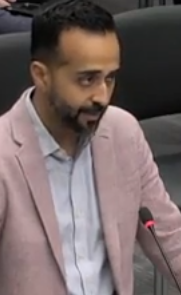
Zohar Kan was speaking to a Motion that would have the City Auditor review the process that determined which swimming clubs would be given time at city swimming pools. The club pay the city for the use of the space.
“My name is Zohar Khan. I’m here as a swim parent, a volunteer for the growth in aquatic Devil Rays, and someone who cares deeply about our young swimmers and about the fair, transparent and about fair, transparent city processes.
“I appear today fully aware that under the Minutes of Settlement that the Burlington Aquatic Devilrays sign with the city, we are prohibited from speaking publicly about the RFP process or pool allocation.
 I’m speaking carefully about facts that are already in the public domain. “I’m not here to breach that. I’m speaking carefully about facts that are already in the public domain. To support this motion for an independent audit, I would be remiss and frankly negligent to stay silent when this committee is considering an audit of the very process that has affected public confidence in how Burlington governs community access to its facilities, while I respect confidentiality where required accountability should not be subject to a confidentiality clause, I also ask that my remarks not be used against the club or volunteers.
“My intent here is to be constructive, to help improve the process so no community organization finds itself here again.
“So how did we get here? In March of this year, the Burlington Aquatic Devilrays submitted a proposal for the city’s five year youth competitive swim program contract.
“The Burlington Aquatic Devilrays (BAD) has trained Burlington youth for decades, delivered excellence and complied with every term of the prior agreement. In 2020 the city’s RFP required bidders to submit a proof of nonprofit incorporation. The wording was clear and easily satisfied and BAD complied.
“In 2025 that clause was changed to require a current and valid certificate of incorporation as a nonprofit or not for profit organization. This phrase does not exist in Ontario law. A certificate of incorporation is issued once at the birth of an organization. It never expires. The only document that can be considered currently is the Certificate of Status, which is what BAD submitted. It is like requesting a birth certificate to understand if a person is alive and well. Nevertheless, BAD was disqualified for failing to submit a document that cannot be obtained.
“When the club questioned this, the city cited sections of the not-for-profit corporations act to explain what a certificate is, without acknowledging that the RFP itself introduced a non-existent requirement. That is not fairness, that is bureaucracy collapsing in on itself. At the same time, the Burlington residency requirement was communicated publicly as if it was a hard pre-award requirement, while BAD was excluded over an impossible paperwork standard.
“The winning Club was recognized for agreeing to meet an 85% Burlington resident threshold by the end of September 2025, months after the RFP deadline. It is important to note that had our proposal been reviewed and not disqualified on the technicality, BAD’s submission already included residency data for the past five years.
“Meeting this requirement in September, the city further shifted the goal post to define the 85% as swimmers swimming at Burlington pools, as opposed to 85% of your swimmers, which further affected us at this point because we had lost city hours BAD had to contract time at the YMCA, a private pool, just to keep our kids swimming.
 My comments here today are simply about fairness. “I do want to express my appreciation the marginal hours ultimately made available to our club kept many kids afloat, literally. City worked under pressure, and we recognize that effort. My comments here today are simply about fairness, about ensuring that Burlington’s process is clear, even-handed and trusted rules that feel unclear or uneven, erode confidence no matter who wins. For youth programs where hundreds of children’s training hours depend on continuity, the city applies zero tolerance to one bidder while allowing flexibility for another one. question the road, a non disparagement clause, limited discussion. This is the very definition of an uneven process, and exactly what this audit must address.
“Your motion rightly directs the city auditor to examine whether the definitions and requirements used in this RSP were consistent with the city’s procurement By law. This is critical, because section 270 of the Municipal Act requires municipal procurements to be clear, fair and transparent. Behind these policies are real Burlington families, children who lost training lanes overnight, parents now driving to Oakville, Hamilton and Milton, volunteer coaches and board members who spent the summer seeking basic clarity from the city they’ve partnered with for decades, for our families, the impact has been catastrophic.
“The long-term damage to a grassroots, volunteered, powered program is real, and it will take time to repair. This isn’t about lawyers and clauses. It’s about community. This is why this motion matters. The three outcomes listed in the motion, if answered clearly and publicly, will restore trust. That will give staff, clubs and families a shared playbook.
“Moving forward, this motion is about ensuring Burlington’s processes live up to Burlington’s values of clarity, fairness and honesty. When a city issues an RFP with ambiguous language, relies on technicalities and then communicates in ways that do not match the documents, public faith is eroded.
“You have an opportunity this afternoon to begin repairing that confidence. Please, let this audit bring the facts to the surface so that every swimmer, every parent and every resident can once again believe that Burlington plays by its own rules, openly, fairly and in good faith.”
The Golden Horseshoe Aquatic Club also delegated. Their delegation will be the subject of a separate article.
Related news story:
GHAC addresses Council
By Pepper Parr
November 4th, 2025
BURLINGTON, ON
This article has been edited for length and clarity.
The first delegator during a meeting that was full of surprises was Lawson Hunter who has been a resident of Burlington for over 30 years.
 Lawson Hunter “ I’m here to speak about what I perceive as sadly lacking and underfunded in the proposed 2026 budget. In 2019 this Council declared a climate emergency. You also made a promise to the residents of Burlington that the city would be net carbon neutral by 2050 . I am of an age where I most likely will not see 2050. I’m here to advocate on behalf of future generations, who I hope will not look back and ask, what were they thinking? Why did they not do more?
“I’m sure you’re immediately thinking about the list, EV chargers, free transit, geothermal heating at Skyway, solar panels on fire station five, LEED design of City View Park, transition of city fleet to electrification and integrated mobility plan, green building standards, protected bike lanes, etc.
“Even this budget document on page 12 highlights that what was done in 2025 the city is investing over $12 million and between 2015 and 2025 the city has invested $90 million in storm water management infrastructure. The City repeats its past accomplishments as new adventures in consultants, plans or staff reports, things that have barely taken place or aspirations that have little hope of being accomplished are presented as bold new initiatives, when in fact they are run of the mill.
“Must do items that keep the lights on the streets busy and are performative displays that lead to empty promises and systemic under achievements.
“I’m here to ask, what are you going to do in 2026 in this proposed budget?”
Lawson Hunter closed his delegation with: “In conclusion, I feel that I’ve made myself perfectly clear and will not take any questions. Thank you.”
By Ron Nikelson
November 4th, 2025
BURLINGTON, ON
Online gaming and sports entertainment company, Rush Street Interactive (RSI), has recently reported its most successful quarterly performance in Ontario in almost two years. RSI is the owner of BetRivers, a leading online casino and sportsbook that operates in multiple regulated markets across the US, Canada, and Latin America.
 RSI’s commitment to its online casino-focused model has led to a 24% revenue growth in Ontario after quarter 3. This is the best revenue the company has been able to generate since late 2023, and comes as a welcome relief for RSI after a significantly slow sports season. RSI’s commitment to its online casino-focused model has led to a 24% revenue growth in Ontario after quarter 3. This is the best revenue the company has been able to generate since late 2023, and comes as a welcome relief for RSI after a significantly slow sports season.
Online casinos, like those operated by RSI, have become exceedingly popular in Canada. Not only do they make the world of online gambling and sports betting infinitely more accessible than their traditional counterparts, but they are also known for their impressive game libraries and enticing bonuses. Some even enable gamblers to wager and withdraw funds in cryptocurrency, which allows for tightened security as well as faster and cheaper transactions (source:https://99bitcoins.com/online-casinos-in-canada/)
All of this allows gamblers to enjoy everything they love most about a traditional casino from the comfort of their own home. This is extremely helpful for those who are unable to regularly attend brick-and-mortar institutions due to accessibility issues, geographical restrictions, or time constraints. With all of this in mind, it makes sense why the online casino scene is booming, and RSI has certainly made the right decision to capitalize on that.
 In Quarter three, the RSI secured a record revenue of $227.9 million USD or $388.6 million CAD. This is up an impressive 20% when compared to the same time last year. It also marks the tenth year in a row of sequential growth for RSI. Adjusted earnings before interest, taxes, depreciation, and amortization (EBITDA) went up 54% to $36 million USD ($50 million CAD). This then caused their net income to reach $14.8 million USD ($20.7 million CAD). Representing a significant increase from the $3.2 million USD ($4.5 million CAD) they hit last year. In Quarter three, the RSI secured a record revenue of $227.9 million USD or $388.6 million CAD. This is up an impressive 20% when compared to the same time last year. It also marks the tenth year in a row of sequential growth for RSI. Adjusted earnings before interest, taxes, depreciation, and amortization (EBITDA) went up 54% to $36 million USD ($50 million CAD). This then caused their net income to reach $14.8 million USD ($20.7 million CAD). Representing a significant increase from the $3.2 million USD ($4.5 million CAD) they hit last year.
RSI objectively made the right decision to focus on online casino gaming in Ontario. This province’s regulated market regularly sees more than $7 billion a month in wagers on online casino platforms. When we examine online casino revenue more generally, we see a similar year-on-year climb experienced by RSI. The total revenue was up 34% when compared to last year, and the total number of active monthly users reached 225,000, which is also a 34% increase. This represents the fastest quarterly growth of Ontario online casino users in more than four years.
RSI’s success isn’t limited to Ontario either; the company saw strong growth in Michigan (up 48%), New Jersey (up 37%), and Pennsylvania (up 15%). It also dominates in Delaware as the only iCasino operator with state approval. On top of this, it also operates a pooled online poker network across four US states.
 The company saw strong growth in Michigan (up 48%). All of this led RSI to raise its full-year revenue guidance to $1.11 billion USD or $1.55 billion CAD. This represents a 20% increase when compared to last year. Additionally, it was able to raise its EBITDA to $150 million USD or $210 million CAD, which represents an impressive 62% increase year-on-year.
By Sadie Smith
November 4th, 2025
BURLINGTON, ON
Canada’s online casino industry is evolving with strong growth expectations over the next five years. Convenience, choice and regulated offerings are helping the digital entertainment space become a leading option nationwide.
Across Canada, adults are enjoying online entertainment that sits well with their lifestyles. Easy access on mobile devices and having trustworthy licensed operators, has made online casino gaming a popular way to relax. The market outlook reflects this surge in interest, with an expected steady expansion driven by player-friendly experiences.
Bonuses and Promotions Piquing Player Interest
 Sign-up offers and promotional rewards make the early experiences worthwhile. Canadian players appreciate a warm welcome, especially when trying a new platform. Sign-up offers and promotional rewards make the early experiences worthwhile, opening the door to more variety and enjoyment, even before the play begins.
There is also a strong appeal in extra value, whether through free spins, event bonuses, or deposit match deal from licensed casino in Canada, which serves as an incentive that adds value to entertainment and helps you explore more of the games you enjoy.
Offers remain one of the top motivators for choosing where to play. In a competitive market, promotions can certainly set operators apart while giving you, the player, more flexibility in how to enjoy your leisure time. It’s a win-win approach that keeps the industry lively and player engagement high.
Convenience Shaping Gaming Habits
Canadian lifestyles are certainly increasingly mobile-first. People browse, shop and socialize through their smartphones and gaming fits naturally into that digital routine. The ability to log in from anywhere makes online casinos quite convenient.
Players can relax during a break, unwind in the evening or enjoy entertainment between other activities. Easy-to-understand app layouts and responsive mobile browser designs make sure that you enjoy smooth and intuitive play without any technical difficulty.
This convenience enables fun in short bursts or longer sessions, creating entertainment that adapts to real life rather than the other way around. As long as a secure connection and a moment of free time exist, enjoyment is certainly only a few taps away.
Mobile access also supports accessibility across Canada’s large landscape. Even those outside major cities can enjoy the same entertainment as those who are in busy urban areas. What you get is a gaming culture that feels inclusive, convenient and ready for the future.
Regulated Markets Foster Trust
Regulation has been a major driver of growth in Canada’s online casino scene. Licensed operators provide transparent safeguards and responsible gaming features that help players feel comfortable and confident. Knowing platforms must meet strict regulation standards ensures a build of trust, which improves the overall experience.
This structured approach fits well with Canada’s values for digital safety and fair entertainment. It gives players reassurance that they can focus on enjoyment while the technology they are using quietly ensures secure transactions and data protection.
Statistical insights reflect how impactful this framework is becoming. According to a 2025 Statista report, revenue is expected to show an annual growth rate (CAGR 2025–2030) of 2.82%, resulting in a projected market volume of US$17.92bn by 2030. This growth showcases how players are becoming more confident in the online space and the effectiveness of clear regulatory rules for casino operators.
 Trust builds strong communities. Trust builds strong communities and Canada continues to be a leader in making online gaming a safe and positive recreational choice.
Demand Growth with Game Variety
From bold visual slots to stylish table gameplay like roulette, blackjack and baccarat, Canadian players like having a choice. Popular themes like sports, adventure, pop culture and mystery deliver fresh excitement each time you log on.
Game developers are continuing to put out new releases with interactive stories and exciting bonus mechanics. There are hundreds of options and so players can tailor their entertainment to what they like best.
This evolving variety keeps every session interesting. Even long-term players frequently discover new favourites that match their personal tastes. A constantly expanding selection keeps the market energized and encourages players to explore new entertainment styles throughout the year.
Cultural Shifts and Long-Term Growth
Across Canada, digital entertainment has become a core part of lifestyle and relaxation. Streaming services, mobile gaming and virtual social interaction have shaped modern habits and online casinos fit naturally into that environment.
Players appreciate entertainment that feels inviting, comfortable and flexible and online casinos, with their experiences, meet those expectations by providing personal enjoyment without the need to travel or schedule time outside the home. It’s entertainment that seamlessly fits into whatever a day brings.
This accessibility, combined with growing digital literacy, means the audience continues to rise. As confidence in regulated platforms increases, more players discover the pleasure of on-demand entertainment that mixes anticipation with excitement.
The industry’s positive outlook reflects these cultural changes. Canada’s digital future supports fun that travels with its audience, wherever they are and whenever they choose to engage with it.
Canada’s Thriving Online Casino Scene
 A welcoming and engaging experience that millions of players enjoy. Canada’s online casino market is positioned for steady growth in the coming years, supported by mobile accessibility, trusted regulation, exciting bonuses and dynamic game selection. These elements create a welcoming and engaging experience that millions of players will enjoy.
The projected US$17.92 billion market volume by 2030 shows how strongly Canadians have embraced digital entertainment. Online casino gaming in Canada isn’t just growing; it’s thriving by evolving alongside the lifestyles and expectations of the people who love it.
By Gazette Staff
November 3rd, 2025
BURLINGTON, ON
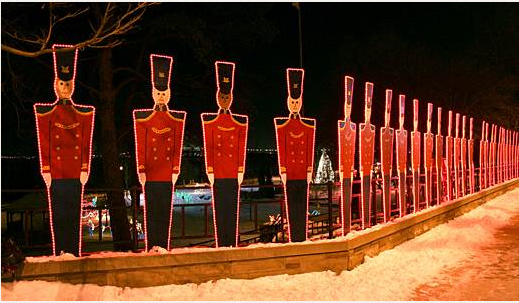
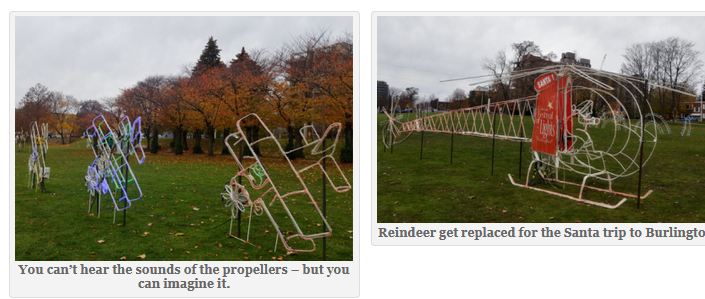
Festival of Lights returns to Spencer Smith Park from Nov. 28, 2025 to Jan. 8, 2026, transforming the waterfront into a glowing winter walkway with illuminated displays along the lake.
 The Red Coats have guarded the waterfront every Holiday Season for decades This will be the 30th anniversary of the event.
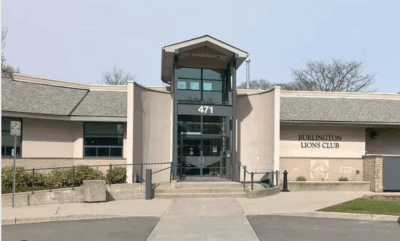
New this milestone year, the Burlington Lions Club Hall (471 Pearl St.) will host a slate of indoor community events steps from the park.
“For three decades, the Festival of Lights has brought neighbours together on our waterfront,” said John Fanjoy, President, Burlington Lions Club. “Marking 30 years with accessible, family-friendly programming at the Lions Hall means more ways for everyone to warm up, connect and celebrate between strolls through the park.”
 Hundreds of families take their children on a walk around the dozens of light sculptures that were assembled by teams of volunteers. 
Indoor events at Burlington Lions Club Hall (short walk from the park)
Burlington Lions Club – short walk from Spencer Smith Park Jingle Market + Holiday Gift Wrapping — Sat., Dec. 6, 10 a.m.–6 p.m. Browse local makers, sip something warm, and let us handle the bows. Free admission and complimentary gift wrapping on-site (donations to the Burlington Lions Club appreciated).
Parade Day Pop-Up — Sun., Dec. 7, noon–6 p.m. – Make parade day your winter highlight: free photos with Santa (12:30–1:45 p.m.), Meet the Grinch (12–3 p.m.), and watch live ice carving (3–6 p.m.). Plus cocoa, crafts, games, and festive photo ops just steps from the route.
Holly Jolly Tea — Seniors’ Holiday Social — Sat., Dec. 20, 11 a.m.–2 p.m. – Slow the season down with a cozy, accessible seated tea. Seasonal treats, warm conversation, and a welcoming space. $15 tickets.
Holiday Hoedown — Sat., Dec. 20, 7–10 p.m. Boots or sneakers—your call. Learn easy line-dance steps, laugh a lot, and two-step into the holidays. $15 at the door.
Jingle Beats Silent Disco (Christmas Hits) — Sun., Dec. 21, 6–10 p.m.- Dance under the lights with glowing headsets with classic Christmas jams. IG-worthy fun for all. $10 tickets.
Full event details, schedules and any registration or ticket information: burlingtonfestivaloflights.com/events
Plan your visit & accessibility
The waterfront pathway is accessible; Lions Hall offers indoor seating and washrooms. Parking is available near the Hall and in Downtown Burlington. Transit access via Burlington Transit and the Lakeshore/GO corridor. Visitor info: burlingtonfestivaloflights.com
The Festival of Lights is community-powered. To volunteer, visit burlingtonfestivaloflights.com/volunteer To explore partnerships, visit burlingtonfestivaloflights.com/sponsor
About the Burlington Festival of Lights
The Burlington Festival of Lights is an annual, volunteer-powered celebration that lights up Spencer Smith Park with illuminated displays and seasonal programming from late November to early January. Now celebrating 30 years, the event draws residents and visitors to Burlington’s waterfront to experience the magic of winter along the lake.
|
|





 By Pepper Parr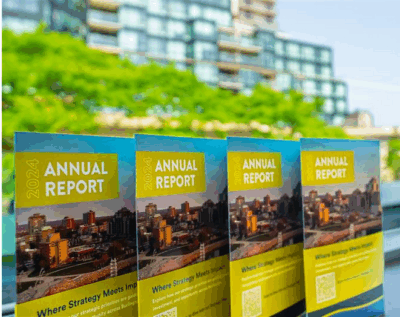

 By Ray Rivers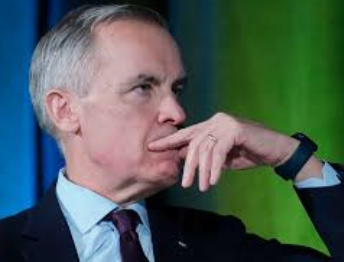

 Ray Rivers, a Gazette Contributing Editor, writes regularly applying his more than 25 years as a federal bureaucrat to his thinking. Rivers was once a candidate for provincial office in Burlington. He was the founder of the Burlington citizen committee on sustainability at a time when climate warming was a hotly debated subject. Ray has a post graduate degree in economics that he earned at the University of Ottawa. Tweet @rayzrivers
 By Gazette Staff

 By Pepper Parr
 The following from the December issue of The Atlantic, an American magazine that began publishing in 1857.
 By Gazette Staff
 When winter rolls in your pipes go to battle with the cold – and without the right prep, they rarely win.
 Insulate exposed pipes – Pipes in unheated areas like basements, crawl spaces, attics and garages are most vulnerable to freezing. Wrapping them in foam insultation or applying electric heating tape can prevent ice from forming inside.
 Don’t forget outdoor drains and sump pumps – Clear debris from gutters, downspouts and sump pump discharge lines so melting snow and ice can drain properly. Clogged drains can lead to backups and basement flooding once the thaw begins.


 By Gazette Staff
 The campaign, which will run from Nov. 5 to Dec. 31, has two giving goals:
 ABOUT WESLEY: Wesley is a long-standing local non-profit, offering support for people experiencing poverty, homelessness, and barriers in the community. We provide programs and services to meet diverse community needs in Hamilton, Halton and Brantford. As a multi-service organization, we offer Children, Youth & Family Services, Housing & Homelessness Services and Newcomer, Employment & Community Services. Wesley’s services are possible through a broad base of funding support from government, business, foundations, groups and individuals.
 ABOUT SHIFRA HOMES: Shifra Homes is Halton’s only maternity residence. Mothers and babies are supported through pregnancy and the transition to independent living. The organization operates without funding from any level of government and is supported through the generosity of community members. In 2024, Shifra opened an additional residence, increasing its capacity to support 17 mothers and babies.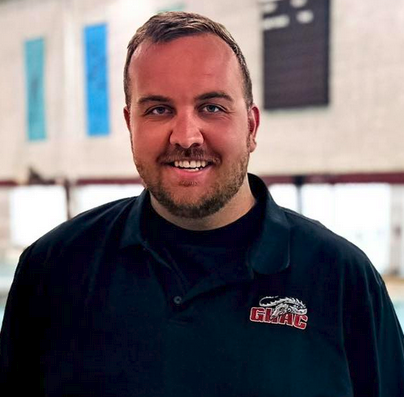
 “Finally, I need to address one last matter, the Golden Horseshoe Aquatic Club itself became the subject of a formal complaint filed with Swim Ontario by a member of this community questioning our right to operate and offer programs within Burlington. While I am not at liberty to release those reasons without the express permission of Swim Ontario, we were completely vindicated, and our right to offer services in this community was validated. Swim Ontario, the governing body for the sport and its dispute resolution office, determined that the Golden Horseshoe Aquatic Club has every right to operate here in Burlington, and that our work is in full compliance with all provincial standards, regulations and requirements. This decision reaffirmed what we have known all along, that our organization has acted in good faith within all proper frameworks and always with the best interests of Burlington athletes and families at heart that process, though difficult, brought closure and it validated the trust that hundreds of Burlington families have already placed in us.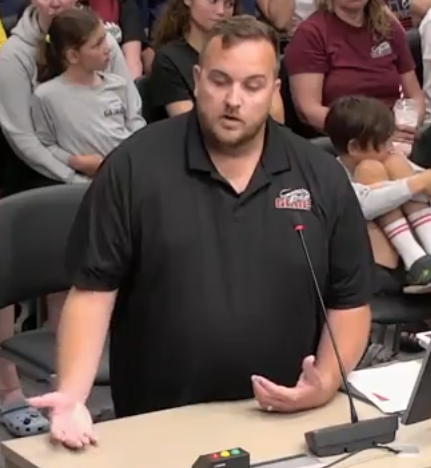
 Now open for registration, the program offers multiple ways to give back, whether through donations, teamwork, or volunteering, making it easy for anyone to spread kindness and joy this season.
 Participants often describe the program as one of the most rewarding parts of their year, a reminder of the power of community and compassion. Many workplaces use it as a team-building opportunity, while families take part to teach children about empathy and gratitude.
 By Juan Beas

 Beyond Casinos: A Broader Digital Lifestyle
 By Gazette Staff
 Join the Folks at Ireland House for their traditional Christmas event and celebrate the holidays during “A Night at Ireland House.”
 By Pepper Parr


 RSI’s commitment to its online casino-focused model has led to a 24% revenue growth in Ontario after quarter 3. This is the best revenue the company has been able to generate since late 2023, and comes as a welcome relief for RSI after a significantly slow sports season.
 In Quarter three, the RSI secured a record revenue of $227.9 million USD or $388.6 million CAD. This is up an impressive 20% when compared to the same time last year. It also marks the tenth year in a row of sequential growth for RSI. Adjusted earnings before interest, taxes, depreciation, and amortization (EBITDA) went up 54% to $36 million USD ($50 million CAD). This then caused their net income to reach $14.8 million USD ($20.7 million CAD). Representing a significant increase from the $3.2 million USD ($4.5 million CAD) they hit last year.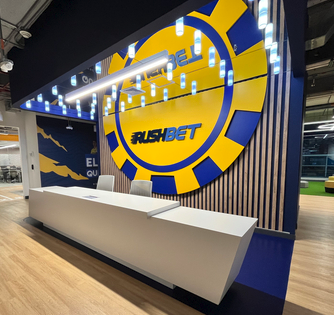
 By Sadie Smith


 By Gazette Staff