By Pepper Parr By Pepper Parr
November 1, 2016
BURLINGTON, ON
Teachers do a lot more than teach.
They are one of the sets of eyes that watch our children as they grow from that shy little girl who steps cautiously into a classroom with her Mom on that first day of school to seeing the change taking [;ace in a boy because the family he is part of is falling apart.
That teacher is the one who realizes when a student is ready for a bigger idea and knows just which book should be given to the child.
They see the student who comes to school in the winter weather with just a heavy sweater – there is no winter coat.
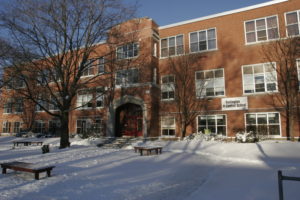
 She notes that the snow is deep and that boy is wearing just running shoes – there are no winter boots. She notes that the snow is deep and that boy is wearing just running shoes – there are no winter boots.
And she notes as well that on pizza days there are a couple of kids who don’t show up because they don’t have the money to pay for their pizza.
There is a group – the Halton Learning Foundation that is in place to provide some of the money needed to fill these gaps.
There are other organizations, Food4kids is one, that provides food for those that are going to go home to a house where there may not be a real square meal on the table.
Later this month the Learning Foundation will be holding their Benefit Bash. The event isn’t one of the fancier, splashy events where people get to wear that dress.
It isn’t a major event on the social calendar – but it is an important event. It raises some of the money that gets used to pay for some of the needs that students have that their parents can’t handle.
The business of taking care of these situations is always slim resources chasing growing needs.
On the 16th school day of this school year the request for funds was double what it had been the previous year at the same time. The social helpers in this city can see serious problems coming their way.
The Benefit Bash takes place November 10th at the Burlington Convention Centre.
This might be one of those places you could send a donation along to.
They will be announcing their No Student Left Behind campaign at the Benefit Bash – this is something we are looking forward to telling you a lot more about.

By Pepper Parr
November 1, 2016
BURLINGTON, ON
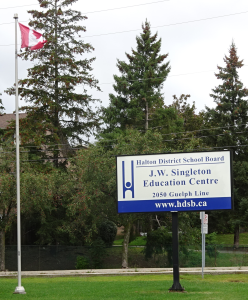
It is going to be a busy month for the bureaucrats at the J. M. Singleton Education Centre.
 The school board will be making presentations to parents at every high school in the city to explain what the Program Accommodation Review (PAR) is all about and what the Program Accommodation Review Committee (PARC) will be doing between December 1st and May of next year – when the school board expects to make a decision on which, if any, high schools are going to be closed. The school board will be making presentations to parents at every high school in the city to explain what the Program Accommodation Review (PAR) is all about and what the Program Accommodation Review Committee (PARC) will be doing between December 1st and May of next year – when the school board expects to make a decision on which, if any, high schools are going to be closed.
The dates for the events at each high school are set out below.
Tuesday, November 1, 2016 Robert Bateman HS 6:00 pm – 7:00 pm
Tuesday, November 1, 2016 Nelson HS 7:30 pm – 8:00 pm
Thursday, November 3, 2016 Aldershot HS 6:00 pm – 7:00 pm
Thursday, November 3, 2016 Burlington Central HS 7:30 pm – 8:00 pm
Monday, November 14, 2016 Lester B. Pearson HS 6:00 pm – 7:00 pm
Monday, November 14, 2016 M.M. Robinson HS 7:30 pm – 8:00 pm
Tuesday, November 15, 2016 Dr. Frank J. Hayden SS 6:00 pm – 7:00 pm
The meetings are going to be brisk and to the point – and there will not, we are advised be a Q&A session during the meeting.
The Gazette will cover some of these meetings are report back on what takes place.
By Staff
October 29th, 2016
BURLINGTON, ON
There is time during each day that Member of Parliament get to say something about their community.
Last week Karina Gould rose in the House to tell her 338 colleagues about a remarkable young man named Griffin Gervais. Gould said:
Madam Speaker, on October 15, I had the opportunity to celebrate one young boy’s determination in revitalizing an important space in his community.
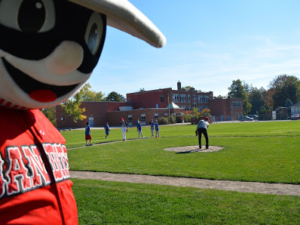
 Griffin Gervais with his parents Eleven-year-old Griffin Gervais was disappointed that his baseball diamond at Lakeshore Public School was in rough shape and not scheduled for an update. Rather than just accept the fact, Griffin decided he would lead the effort to repair the diamond.
Starting last January, Griffin with the help of his family, classmates, his community, and the city of Burlington’s neighbourhood community matching fund, raised a total of $12,000. Today, with two updated benches, new chain-link fencing, and a freshly mowed field, the Lakeshore Public School baseball diamond now looks better than ever.
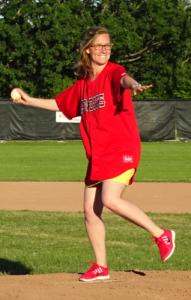
 A smartly laid out baseball diamond behind Lakeshore Public school. Griffin’s story is one that is truly inspiring and shows that individuals can make a impact on their community if they set their mind to it. I thank Griffin for all of his hard work. I was proud to attend the grand opening and to see him throw the first pitch on the field.
 Burlington MP Karina Gould throwing the opening pitch at a Burlington Bandits baseball game. Gould by the way is no slouch on the baseball diamond either. She got it right across the plate – which is more than can be said when the Mayor was asked to throw that opening pitch.
By Pepper Parr
October 28, 2016
BURLINGTON, ON
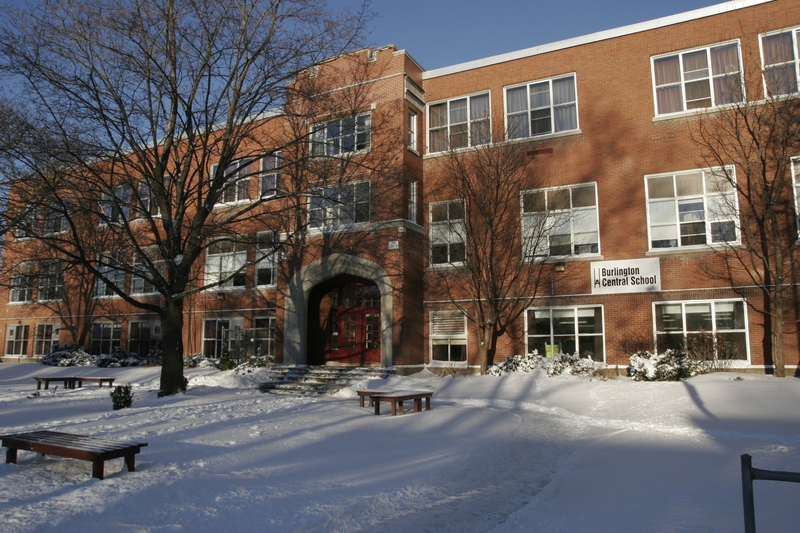
Burlington parents with students in Central high and Lester B. Pearson high school are scrambling. The Halton District School Board (HDSB) put a series of recommendations before the trustees earlier this month that could result in the closing of the two high schools.
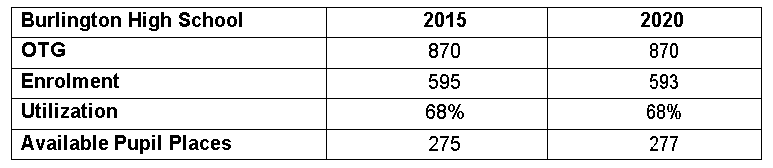
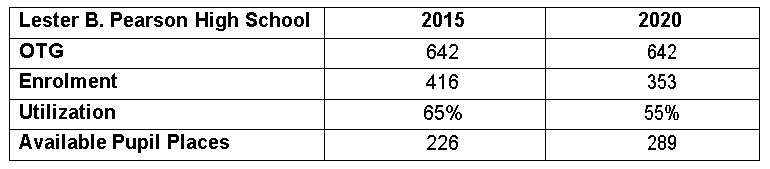
The Board of education is driven by provincial funding rules that require them to do a Program Accommodation Review (PAR) if the percentage of the seats available in a school that are being used falls below 65%
Central high and Pearson are at that level.
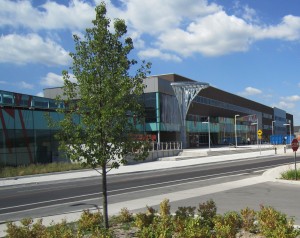
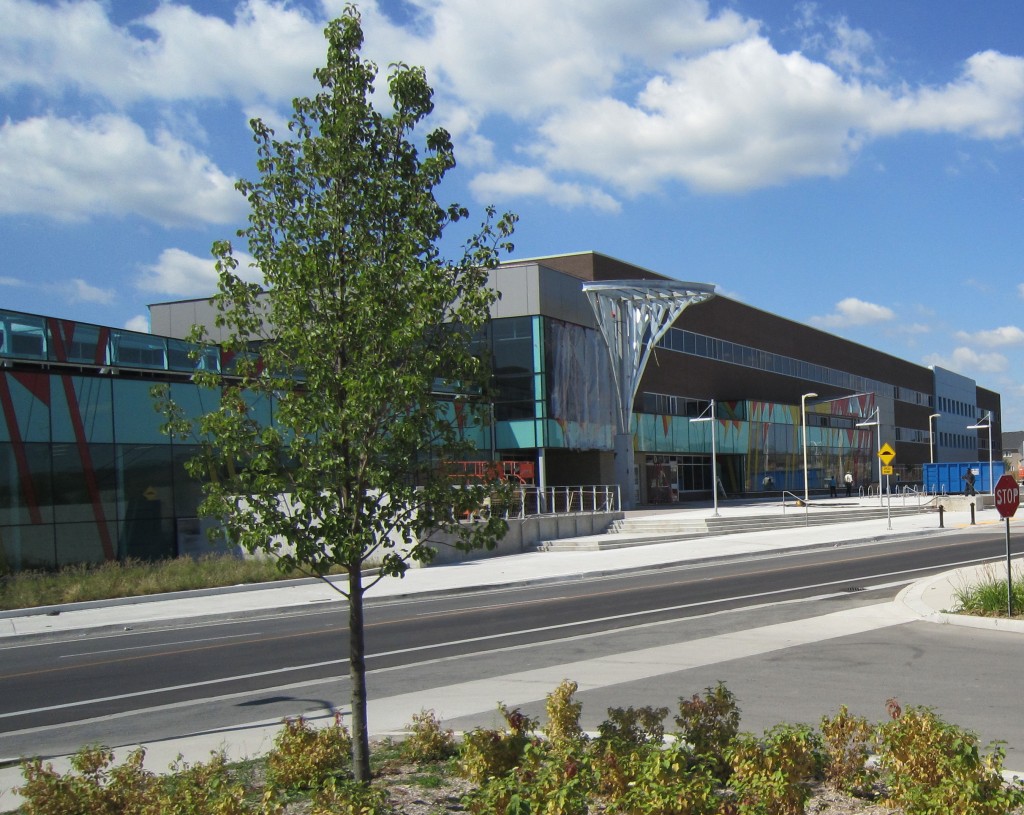
 Hayden High school, Burlington’s newest built as part of a complex that includes a Recreational Centre and a public library with a skate park across the street is at 115% capacity and already has portables in the parking lot. The Board situation is complicated in that the three year old Hayden high school is at 115% capacity.
Director of Education Stuart Miller explained to the trustees that the city has one and a half too many high schools – and that they are south of the QEW where the student population is falling.
The process of closing a school requires that a Program Accommodation Review Committee (PARC) be formed and that the trustees listen to what that committee recommends before making a decision.
The PARC process is to be completed by May of 2017. That is a tight timeline.
There are people in the academic world who think the province is forcing the school boards to do this the wrong way – and that opting for larger school rather than smaller school is bad pedagogy.
Schools play a central role in their communities. They are essential to economic development and they make communities more attractive to new- comers. Businesses are more likely to move to communities with schools, and families will not move to communities without schools. When a community loses its school, it loses its viability.
Extensive research over the last decade shows that small schools make excellent learning environments for students, and that, despite economies of scale, they are often cost effective because of their higher graduation rates.
Creative and proactive strategies must be developed now to recognise the value of small schools and to ensure their viability and that of their communities.
Bill Irwin of Huron University College and Mark Seasons at the University of Waterloo school of Planning argue that the push to close school doors seems to be an economic exercise, overlooking educational and community needs. Irwin is a professor of Economics and Management and Organizational Studies at Huron.
Together they have launched a website: env-blogs.uwaterloo.ca/schoolclosures/ offering a research-based platform to guide discussion about school closures.
“We believe,” the website states, “that the theory and best practices of both urban planning and public participation are good foundations from which to ameliorate the school closure process, and ultimately lead to a more effective and equitable outcome for those involved.”
The website is one of the outcomes of a 2013-14 Social Sciences and Humanities Research Council (SSHRC) Insight Development Grant.
“We’re looking at the whole issue surrounding school closures, in terms of several touchstones – as a public policy issue, and how policy is developed and delivered; as a public participation issue and the relationship between institutions and communities; and the implications of closures in terms of impacts on financial, social and human capital,” Irwin explained.
There are a number of factors driving this school closing trend.
• The last of the baby-boom generation’s children (who have created an enrollment swell since the 1970s) are now completing their secondary education.
• Ontario’s secondary school curriculum was reduced from five years to four years resulting in the loss of a whole grade of students.
• With the growing industrialization of agriculture, the loss of Ontario’s family farms has added to the exodus from rural areas.
 Terry Ruff, a former Central his school principal explained to parents how a possible closure was avoided when he was principal in 2000. “The research into the subject of school closures is grounded in developing and implementing a better decision making process with regards to accommodation review. To complement this, the researchers are concentrating on three areas of focus; public participation, urban planning, and the accommodation review process itself. We believe that the theory and best practices of both urban planning and public participation are good foundations from which to ameliorate the school closure process, and ultimately lead to a more effective and equitable outcome for those involved.
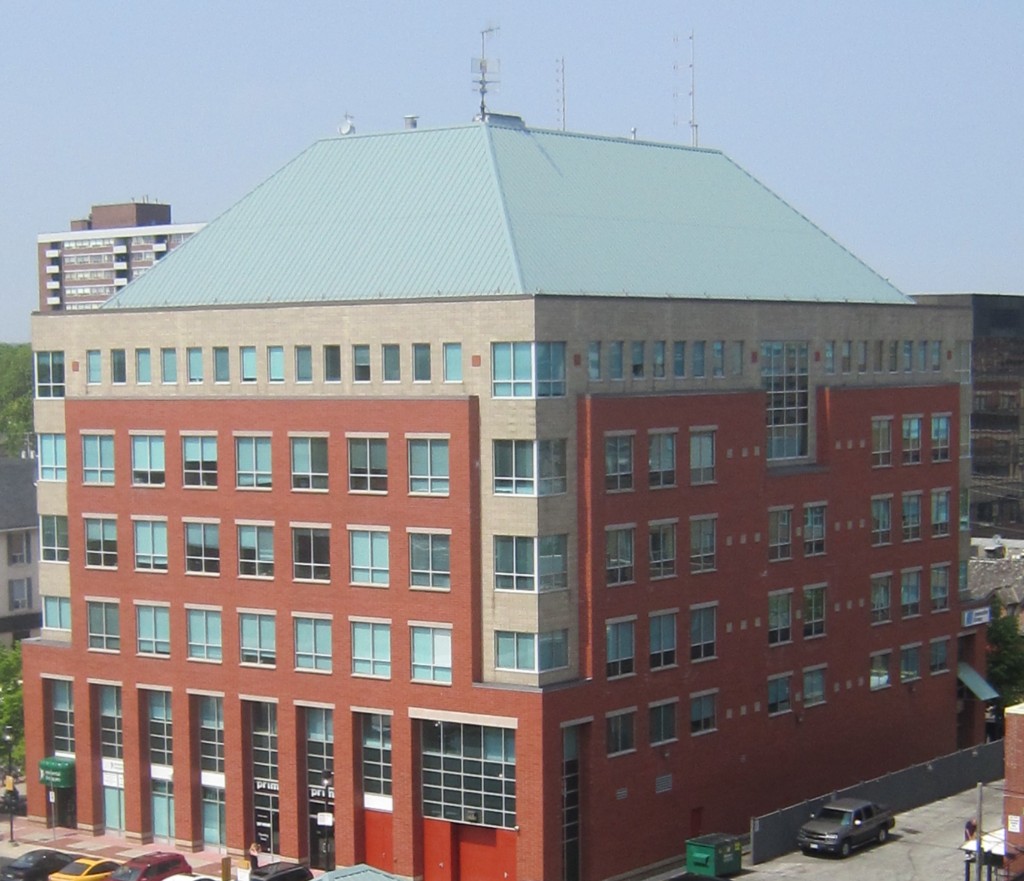
 The Simms building, directly across the street from city hall is a number of city departments – Legal and Human Resources. Might they take up some of the spare space at Central ? “One of the key components to realizing this objective is the ability to achieve an increased awareness of this issue, and to encourage an informed discussion between government officials, policy makers, school board administrators, and civic leaders alike. To support this, the researchers have provided material that they believe will enable a wide range of stakeholders to become better informed about the various guiding aspects of accommodation review and school closures.”
A major problem the closing of a school stumbles upon is that planning is a municipal function – and in Burlington the Board of Education and city hall tend not to work very closely together; the two don’t have an organizational structure they can meet on as equals.
The last time there was an educational issue that involved the city was when the Charles Beaudoin School wanted to add more portables – but in order to do so they had to get permits from the city.
The parents at the school didn’t want more in the way of portables so they pressured the city not to give the Board of Education what they said they needed.
The school board eventually got permission to install additional portables – just not as many as they needed.
“There is documentation that will enable others to become better informed about some of the more subtle elements and underlying causations that have led school closures to become such a highly contentious and polarizing experience.
 The parents at Central high are well organized – Pearson is trying to catch up. “School closure decision making process have been framed by policy makers in Ontario, through the accommodation review process (ARCs) (2006), as exercised in public participation. Critics of ARCs have decried the process being more of a subterfuge than a genuine attempt of joint institutional-community review. At its core, the research is a quest to better understand the relationship between institutions of education, in Ontario represented by the provincial Ministry of Education and local school boards, and the community.
“Furthering this understanding will require addressing the question: How do people view the concrete and practical application of school closure policy in their community? Critics of the current ARC process in Ontario have stated that the provincial government appears to ne be making use of school boards to regulate the citizenry to their own end, applying the version of the Foucauldain (a form of discourse analysis, focusing on power relationships in society as expressed through language and practices) notion of governmentality.
“The questions are: How does the community view the consequences of school closings, especially as the closing occur in local settings? How does (or do) the end results of school closings reflect what community members’ desire? or the process of review?
“The research starts with the premise that ‘true public participation’ in any policy decision rests not only with the institution listening to the community; the institution needs also to consciously include the community insights into the final outcome. Therefore institutional context and motive plays a pivotal role in determining a group or individual’s capacity to make informed choices, and then transform those choices into desired actions and outcomes. Capturing that institutional context and motivation as it relates to public participation, actual and perceived, is a major focus of the research.”
Bill Irwin explains: “When I started my research – my thesis (in 2012) was on school closures – no one else had looked at this issue since the policy had come forward in 2005,” he continued, adding if the province was closing smaller community schools as a fiscal savings measure, there was no tracking of those savings. More importantly, there was no review of community costs.
“How does a closure impact students as learners? We don’t know if this is impacting students’ ability to learn or their marks. This happens in young people’s lives at the same time they’re going through emotional, physical changes. There are so many unanswered questions in this,” Irwin continued.
“The Ministry of Municipal Affairs and Housing is spending resources on rebuilding houses, while the Ministry of Education is supporting closures of community schools. We want to rebuild our inner cities, yet we want to shut down schools in their communities,” Irwin said.
“We’re taking schools from poor neighbourhoods and putting them in affluent neighbourhoods. It’s a reverse Robin Hood situation.”
“What’s more, current policies surrounding school closures ignore previous research that shows smaller schools have a great impact within their communities.
“In the 1960s, 70s and 80s, robust research literature was done on the benefits of small schools as learning environments, as having long term benefits to students. That literature has been totally ignored in this whole process,” Irwin said.
“All of us realize there will be a provincial election this year. This should be part of the discussion. How we treat our schools has a tremendous impact long-term on the social fabric of our communities,” Irwin said.
• The number of small elementary schools with full-time principals has dropped by 15%, twice the rate of the drop in all elementary schools in the province.
• The number of small elementary schools with a teacher-librarian (full- or part-time) has declined by 53% compared to a 30% decline in all elementary schools.
• Just 20% of small elementary schools have access to a physical educa- tion teacher, compared to 51% of larger elementary schools.*
• Only 25% of small elementary schools have access to specialist music teachers, compared to 61% of larger elementary schools.
• All larger secondary schools have libraries that are open full-time, but 21% of small secondary schools had libraries open only part-time.
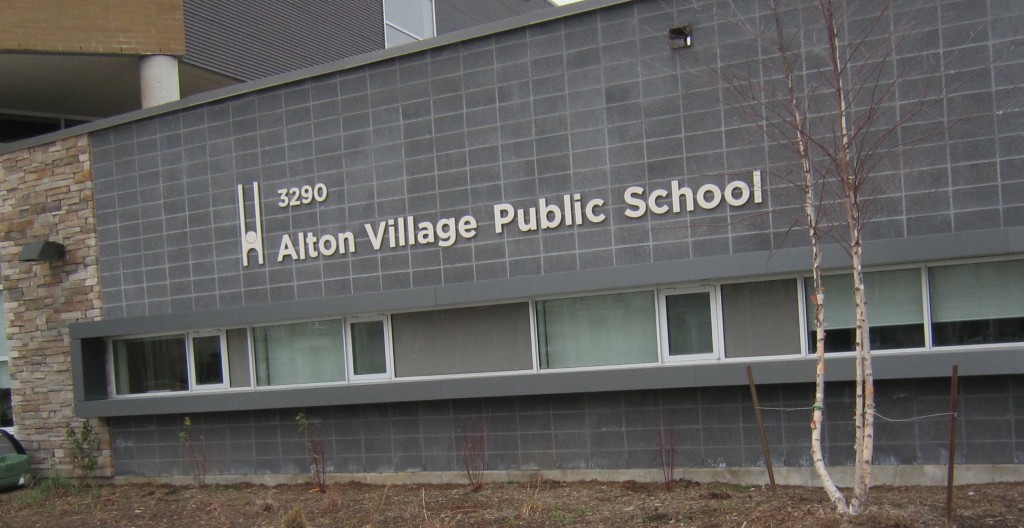
 The Alton public school is scheduled to have a second floor added – the school hasn’t been open three years. Three quarters of Ontario’s small elementary schools and 83% of small high schools report that their schools are used by the community after school hours for everything from sporting events to ratepayers’ meetings.
Ontario’s drive to build larger schools is solely a response to an education funding formula geared to larger schools – it is an economic decision rather than a pedagogical one.
The HDSB recently approved taking on commercial enterprises that could use some of the space; meetings were held but nothing has come of this kind of opportunity so far.
The city of Burlington has been renting space in the Sims Building directly across from city hall for years. There is a consultant’s report in a filing cabinet gathering dust that sets out what the city is going to need in terms of office space and what is currently has – that report has not been released to the public yet.
After years of stopgap solutions, it is time to reverse the trend and recognize that closing a school is not simply an educational issue, it has major social and demographic repercussions as well.
The researchers declare that “we must recognize the reality of declining enrollment in Ontario, and come up with new and proactive solutions to maintain the viability of small schools and communities. It is time to develop creative ways to keep the school buildings vital and expand their role as the hub of their communities. We can take cues from other places: English small schools are inviting postal sub-stations to occupy a part of their buildings; Newfoundland has community schools that have on-site social service agencies, community radio stations, and seniors’ programs. It is possible to modify school buildings slightly so that they can function as community centres as well, and, if provided with adequate funding, day care centres enhance schools and act as a draw for young parents.”
 Expect to see a lot more evening with rooms packed with parents as the |Board of Education begins a series of meeting to explain the PAR process. There will not be a Q&A session at any of these meetings. Somewhere in the research there is mention of adjusting transportation guidelines and funding to ensure that no student spends more than 1½ hours per day on the school bus. That amount of time suggests students in Burlington are being prepped for commutes on the QEW,
The battle in front of the parents right now is the very real threat to two of the city’s high schools – there might be a higher level discussion these parents can put in front of the trustees and that is – what size of schools do we want and can we slow things down a bit and take the time needed to get this right the first time.
This article draws heavily on the work of Bill Irwin at Huron University College and Mark Seasons at the University of Waterloo.
Pretty sure this is a first for high school students – a letter from the Director of Education explaining the possibility that their high school might close. Interesting decision.
October 27, 2016
Open letter to all Burlington high school students
Dear Students,
As you have no doubt heard, the Board of Trustees of the Halton District School Board voted last week to begin a process to look at student accommodation issues in our Burlington high schools. The process is called a Program Accommodation Review or PAR. I am writing to explain a bit about this process, but more importantly, to let you know that your input will be important in this process.
 Why do we need a “PAR” process? Why do we need a “PAR” process?
The Halton District School Board has initiated the Program Accommodation Review because we have schools with declining enrollment. As the Director of Education, I have a responsibility to provide excellent programs and environments for learning. I need to ensure all secondary school students in our Board have access to the best possible education we can deliver.
According to the Board’s Program Accommodation Review policy, the Director’s Preliminary Report must include a staff recommended option. This recommendation is not a final decision, but a starting point for consultation in this PAR. Staff has recommended Option 19 which proposes various boundary and program changes across Burlington secondary schools, as well as the closure of Lester B. Pearson High School and Burlington Central High School.
The PAR process will begin in November with information sessions held at each Burlington high school. You are welcome to attend these sessions and learn more about this process and help you formulate your own opinions. These evening meetings are on November 1, 3, 14 and 15. Refer to the HDSB website at www.hdsb.ca for more details. If you are unable to attend, the presentation will be posted on the Board’s website.
On November 21 at 7 p.m., Board staff will join me in hosting a live online question and answer session. Log on at www.hdsb.ca . Your questions are most welcome.
The Board of Trustees will make their decision in May 2017; however the earliest date that any changes could take place is September 2018.
As high school students your opinion is valued. The decisions made by the PAR committee will profoundly impact your school experience and those who follow you. In the New Year, the PAR committee will gather feedback from Burlington high school students. We want to hear your voice!
As a parent and educator I understand many of you are deeply loyal to your school, your teachers, and the school traditions that have developed over many years.
 However, as the Director of Education, I need to ensure all Burlington high school students have equitable access to programs that allow them to explore and enhance their true potential. The PAR process will look at this issue and investigate various options to address the challenge that many Burlington high school students are experiencing. However, as the Director of Education, I need to ensure all Burlington high school students have equitable access to programs that allow them to explore and enhance their true potential. The PAR process will look at this issue and investigate various options to address the challenge that many Burlington high school students are experiencing.
I encourage you to stay informed and engaged in the PAR process. We will keep you informed through ongoing information posted on our website at www.hdsb.ca
We will provide more details about how you can share your input in the New Year.
Sincerely,
Stuart Miller, Director of Education, Halton District School Board
By Staff
October 26, 2016
BURLINGTON, ON
Do you remember the day you first went to school? It was certainly a different time – we live in a different world.
To start with there are no longer rows of desks.
The Halton District School Board wants to make that transition as smooth as possible. In November and December, future students and their parents/guardians are invited to attend one of five Kindergarten Open Houses to learn more about starting school.
 The years in school will probably be longer than the time they spend in any one job. Drop by any one of the following open houses between 6:30 to 7:30 pm.
Georgetown:
Thursday, Nov. 3 – Ethel Gardiner Public School (14365 Danby Road)
Burlington:
Thursday, Nov. 10 – Bruce T. Lindley Public School (2510 Cavendish Dr.)
Milton:
Thursday, Nov. 17 – Tiger Jeet Singh Public School (650 Yates Dr)
Acton:
Tuesday, Nov. 22 – Robert Little Public School (41 School Ln)
Oakville:
Thursday, Dec. 1 – West Oak Public School (2071 Fourth Line)
At the Open House, students and parents will:
• Explore a Kindergarten classroom
• Learn about play-based learning
• Pick up information and resource material in a free backpack
• Access information about community agencies and resources in Halton
• Get information about before and after school care
• Connect with special education staff to discuss any developmental concerns
Children born in 2013 can start Kindergarten in September 2017.
Registration for Kindergarten begins in January 2017 and takes place at the school your child will attend.
View our video to see what you will learn about the Board’s Kindergarten program.
By Pepper Parr
October 25th, 2016
BURLINGTON, ON
Should the Halton District School Board trustees decide that the Lester B. Pearson High School should be closed and its students asked to attend M.M. Robinson instead that would bring to an end a school that was created for the community more than forty years ago when the idea of a community school was considered important.
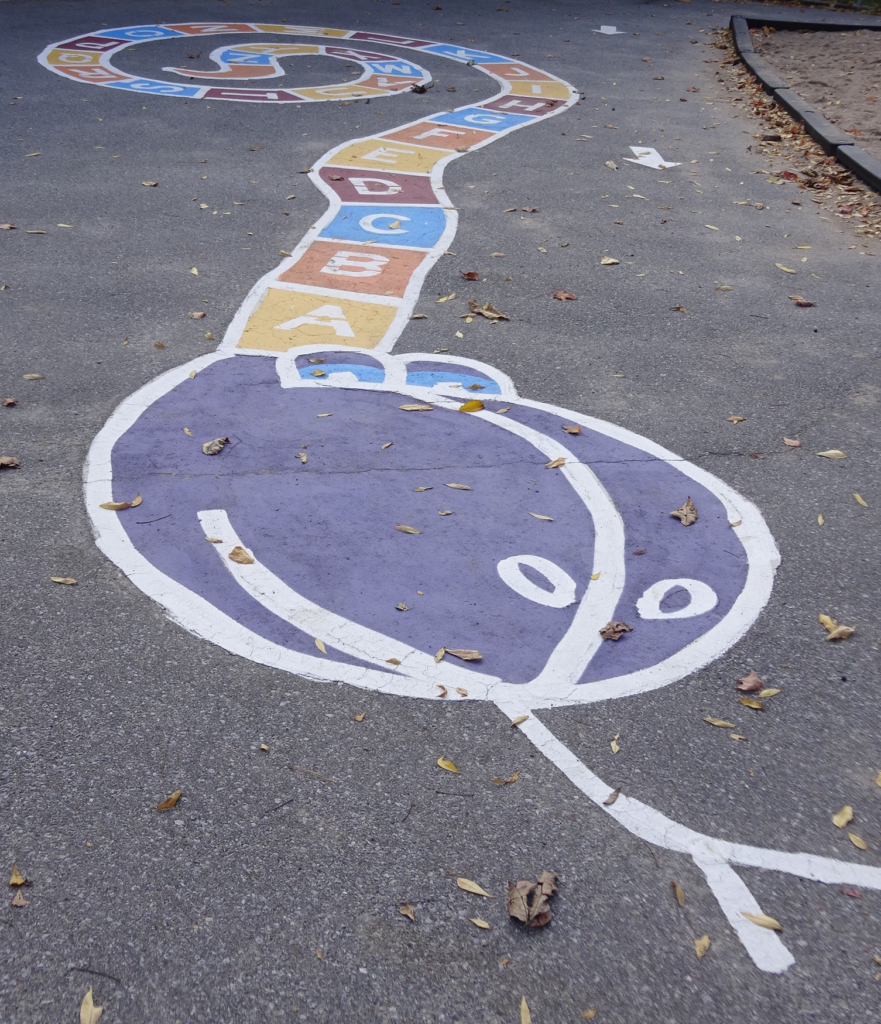
 Great way to get an idea as to just what the alphabet is for the nursery set. The Pearson school was made even more unique when a Co-op nursery program was included. That nursery now provides classes for close to 100 children.
There are morning and afternoon sessions in a setting that will be very very hard to replicate.
Fiona Wielhouwer, with a certificate that is the equivalent to the Canadian Early Childhood Education that she earned in the United Kingdom, is the supervisor who reports to a nine parent volunteer board. That board may have a very serious and perhaps daunting task ahead of them.
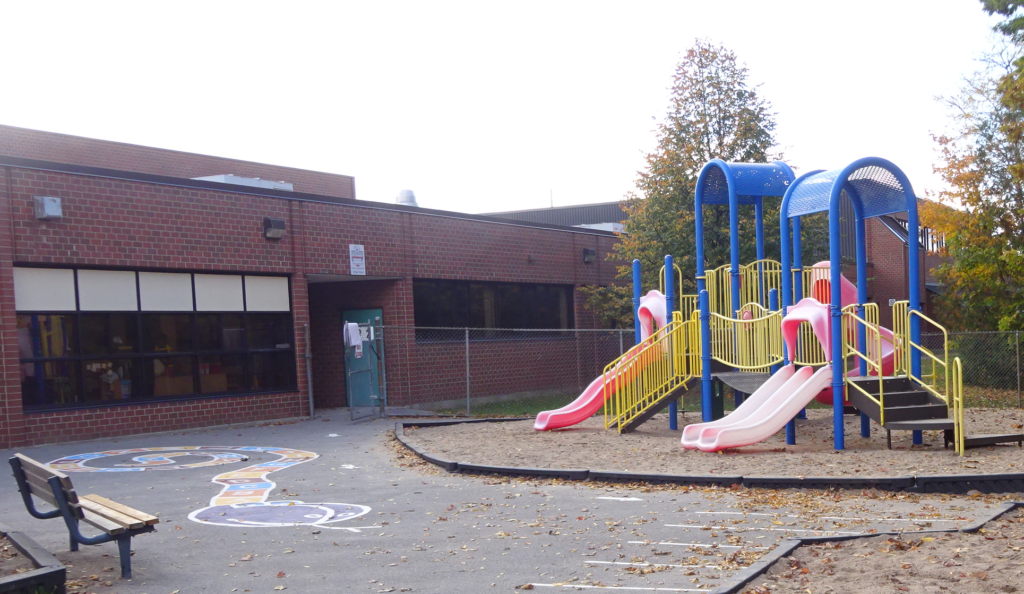
 Tucked in at the very back of the high school the nursery has a seperate entrance and a secure well outfitted playground. The nursery co-op was planned as part of a school that would serve the wider community. A school the size of Pearson would normally have two gymnasiums – Pearson has three. The intention right from the beginning was to make the space available to everyone in the community.
The nursery serves as a student placement location for those who think they might want to work in the childhood care field. It is also affiliated with both Sheridan and Mohawk colleges where Early Childhood courses are given.
Fiona Wielhouwer explains that the nursery uses an enquiry based approach to the care they give the children. “We aren’t a drop and run location – we work with the parents and prepare the children for the JK and SK classes they will move on to – during their time with us the children get used to the idea of being away from Mommy for short periods of time and they learn to mix with other children.
The nursery interacts with the high school but administratively it is a separate organization. We do get help from the IT people in the high school and when we need something from the shop people they work with us.
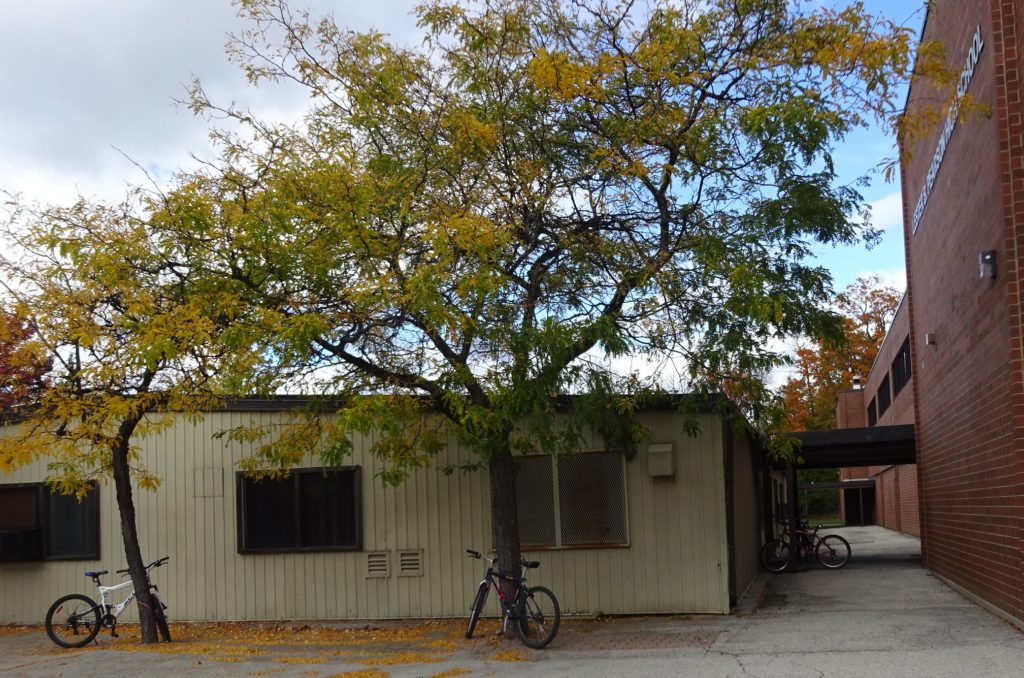
 Portables that were once necessary are now empty – a sign of the enrollment decline. As a community school it works. Pearson was never intended as a large high school. When enrollment exceeded the capacity a bunch of portables were stuck at the front of the school – they are now empty.
When the school was created it was intended as a “lab” school – a place where different ideas would be tested. The co-op nursery in a school has worked out very well. Some of that original thinking seems to have been forgotten and now it is a matter of numbers.
There are now parents who have their children in the nursery – there was a time when they were in the nursery and then attended the high school.
The city is said to have invested some money in the school when it was built and the belief is that the Region supports the nursery financially.
There was a time when there were community clubs in the school – the place was a real community hub – that too seems to have been given up on.
 Current Director of Education for the HDSB, Stuart Miller was once the vice principal at Pearson. The school is now set out as the preferred option of the board staff for closing – the current Director of Education Stuart Miller was once the Vice principal at the school and he knows what kind of a school it is – however, his job requires him to initiate the process of determining if a school should be closed when it falls below 65% of its capacity utilization.
It is now up to the trustees to determine of the school should close – and it is up to the parents to inform the trustees as to what they want.
For the children – this week is all about pumpkins – especially the ghost pumkins.
By Pepper Parr
October 25th, 2016
BURLINGTON, ON
There is an Ontario Arts Council workshop where valuable guidance on applying to the OAC’s Visual Artists grants program for individual artists is available. They can answer any questions you may have about applying for funding.
 Taking place at Hamilton Artists Inc., 155 James Street North, Hamilton, Ontario. Attendance is free but registration in advance is requested by Wednesday November 2 at 5:00pm. Taking place at Hamilton Artists Inc., 155 James Street North, Hamilton, Ontario. Attendance is free but registration in advance is requested by Wednesday November 2 at 5:00pm.
It is being put on by the Hamilton Arts Council Visual Arts Committee – no reason why someone from Burlington can’t attend.
There is also the November 22 deadline of the Visual Artists: Emerging program is one of the few OAC programs selected as a pilot for a new online grant application system. This session will highlight some of the changes artists will see online, and provide some information on further Visual Arts program updates coming up in 2017.
To learn more about these upcoming changes, visit https://www.arts.on.ca/Page6375.aspx
Attendance is free but registration in advance is requested by Wednesday November 2 at 5:00pm.
By Pepper Parr
October 25, 2016
BURLINGTON, ON
There is a team of four people, Dania Thurman, Michael Kukhta, Lynn Crosby and David Sykes, who rely heavily on parents from Central High School that are putting together the argument for keeping Central High open.
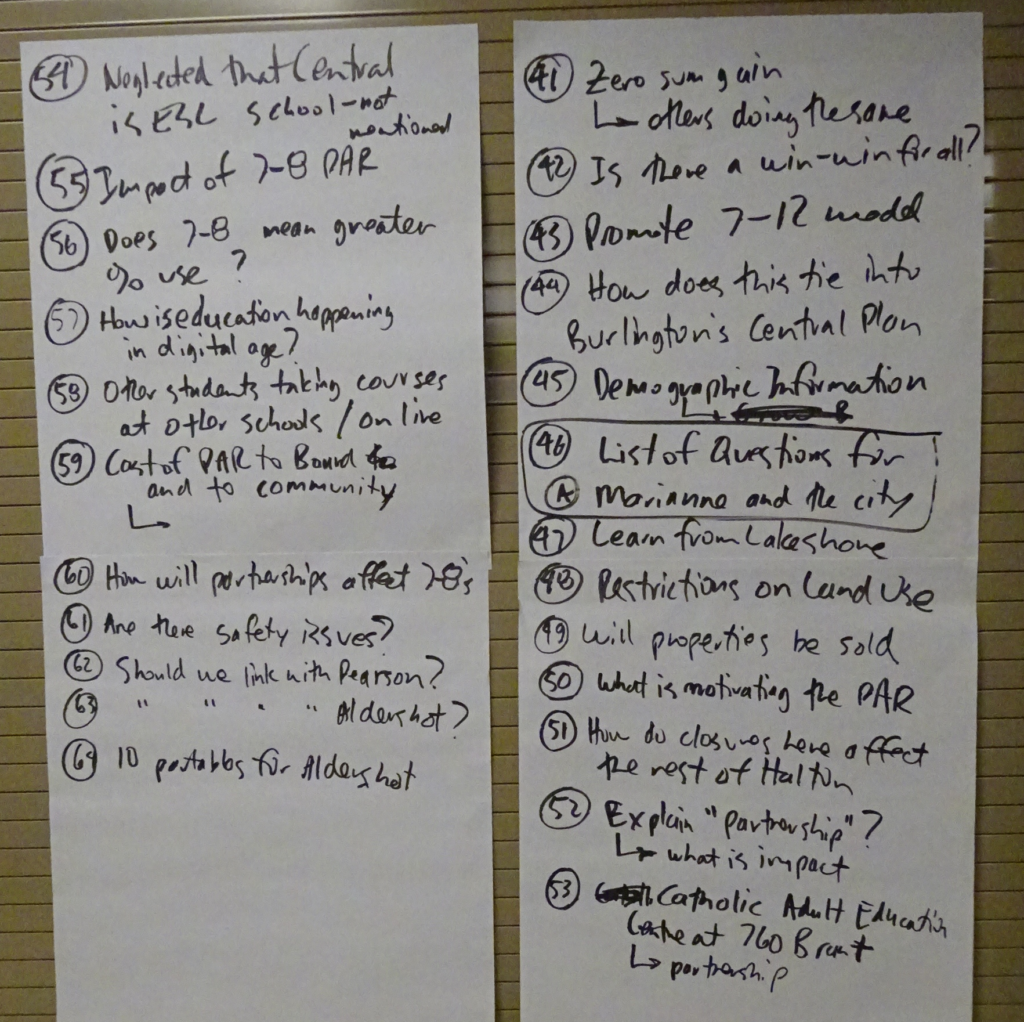
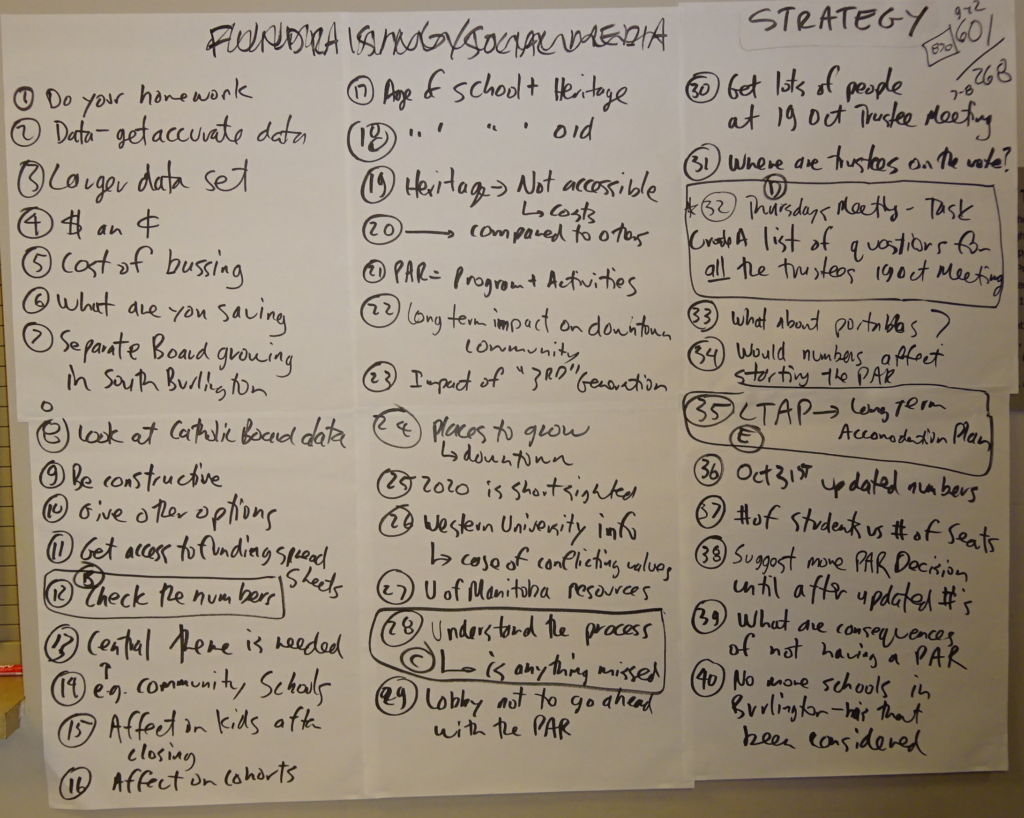
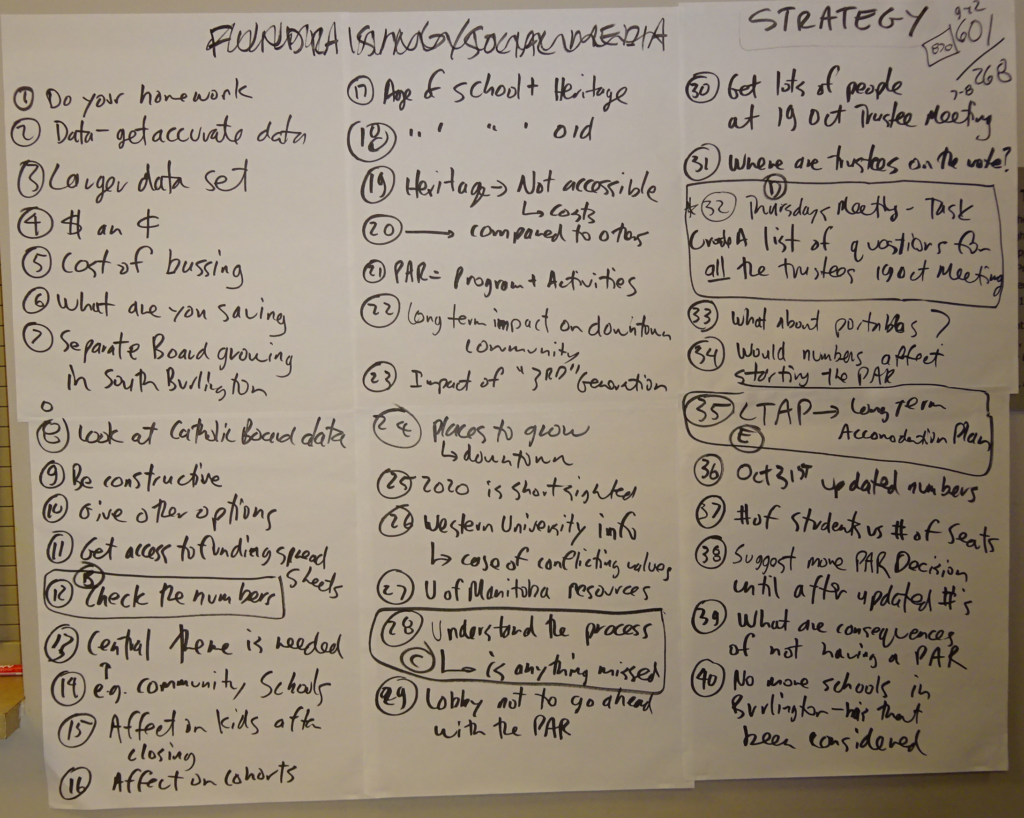
 At a Central high school parents meting they identified some of the issues that needed to be researched. At their most recent strategy – planning meeting, they wrote out a list of topics they need to research to make their case for keeping the high school open.
The topics have been assigned to different attendees at the meeting who volunteered to look at them. The leadership team believes there are many more “out there” who can also help out with the research and who might have additional topics that need to be researched.
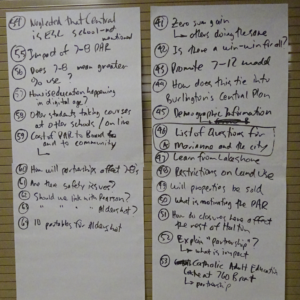
Set out below are the topics they have identified. They expect that as the research work progresses some will naturally merge with others. If anyone has any information, articles or research on one of these topics (or any other) to share with the group as a whole, send it along to them at: info@centralstrong.ca If you would like to add your name to one of the topics and be connected with the person doing it please email them so introductions can be made.
What will they do with this research? They want to ensure that their trustees on the PAR Committee have it, so they can present it and use it at the committee meetings and use it in letters to the committee during the public input sessions.
People can use any of this research to present at the 5-minute “public delegation” sessions to the trustees that are scheduled for April 18, 2017 and any other meetings where delegations are allowed. Their objective is to convince trustees that closing Central is not the best option.
 The trustees will make the final decision next May. Parents are going to have to work with their trustees and convince them of the merits of the arguments they put forward. “It is important that Trustees receive letters on any of these topics or other factors you feel will make an impact. Simply explaining your own personal thoughts on why Central is so important to you and your family is also very important, ” suggested the team leaders.
The Program Accommodation Review (PAR) process begins officially on December 1 with an orientation session that will take place in each high school.
Tuesday, November 1, 2016 Robert Bateman HS 6:00 pm – 7:00 pm
Tuesday, November 1, 2016 Nelson HS 7:30 pm – 8:00 pm
Thursday, November 3, 2016 Aldershot HS 6:00 pm – 7:00 pm
Thursday, November 3, 2016 Burlington Central HS 7:30 pm – 8:00 pm
Monday, November 14, 2016 Lester B. Pearson HS 6:00 pm – 7:00 pm
Monday, November 14, 2016 M.M. Robinson HS 7:30 pm – 8:00 pm
Tuesday, November 15, 2016 Dr. Frank J. Hayden SS 6:00 pm – 7:00 pm
These is just orientation sessions – there will be no Q&A. Just the facts as the HDSB sees it all.
The first public meeting is on December 8.
The PAR Committee (with two representatives) will work through January, February and March.
A second public meeting will be held on March 2.
The Director will then prepare a report with all of the compiled feedback.
April 18 will be another public delegation night.
The BCHS parent group wants to see a big turnout of supporters at all of the public sessions. The final report will be presented to the Board of Trustees on May 3 and they will vote on it on May 17.
The BCHS goal is to show the Board why their recommended option is the wrong one.
Here are the topics the BCHS parents are going to research. The list may expand and some of the topics may merge.
 Some of the issues to be looked into that came out of a BCHS parent meeting. – Accessibility issues – Cheryl
– Partnerships – Shawna
– School Profiles (SIPs) – Maureen – this is a vital one and Maureen will likely need group input with this
– Transportation/bussing – Kevin
– Benefits of small schools – Heather
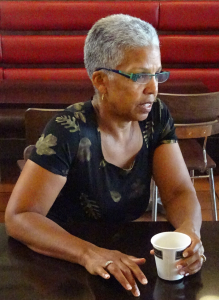
– City Strategic plan – Marianne
– Urban Growth Centre – Marianne
– Data collection/missing data/incorrect data – Mike Matich
– History of BCHS – Deborah and Lynn
– Market Share of Students – Deborah and Lynn
– Impact on 7/8 Students – Theresa and Dania
– Number of Seats Available vs. used – data – Stacey
– Socioeconomic Impact – Dania and Paul
– Alternate Options – Emil
– Fundraising/Alumni Support (compared to other schools) – Theresa and Laura
– The Process – Josie, Allison
– Appeal Process – Mike, Allison
– Ministry Funding Formula – Josie, Lynn and Deborah
– Special Programs at BCHS – Courtney and Karen
– Projected Numbers/Data – Andrew
– Costs/Capital – Phil and Todd
– Challenging Board Assumptions – Josie (other research on other topics will feed into this)
Other topics that should be considered as recommended by Terry Ruf and others include:
– Catholic Board PAR/LTAP interaction
– Strengths of Grade 7-12 schools
– Advantages of unified cohorts coming from feeder schools
There were 19 options identified. The Board staff chose to go forward with Option 19 however the PARC is free to use any other option or a mix of several options. The options were possibilities as the board staff saw things.
Option 13 makes a statement about unified cohorts, acknowledging this advantage, yet Option 19 will see split cohorts coming out of Central Public and Tom Thompson (depending what happens to the 7/8) as well as FI students from Pineland
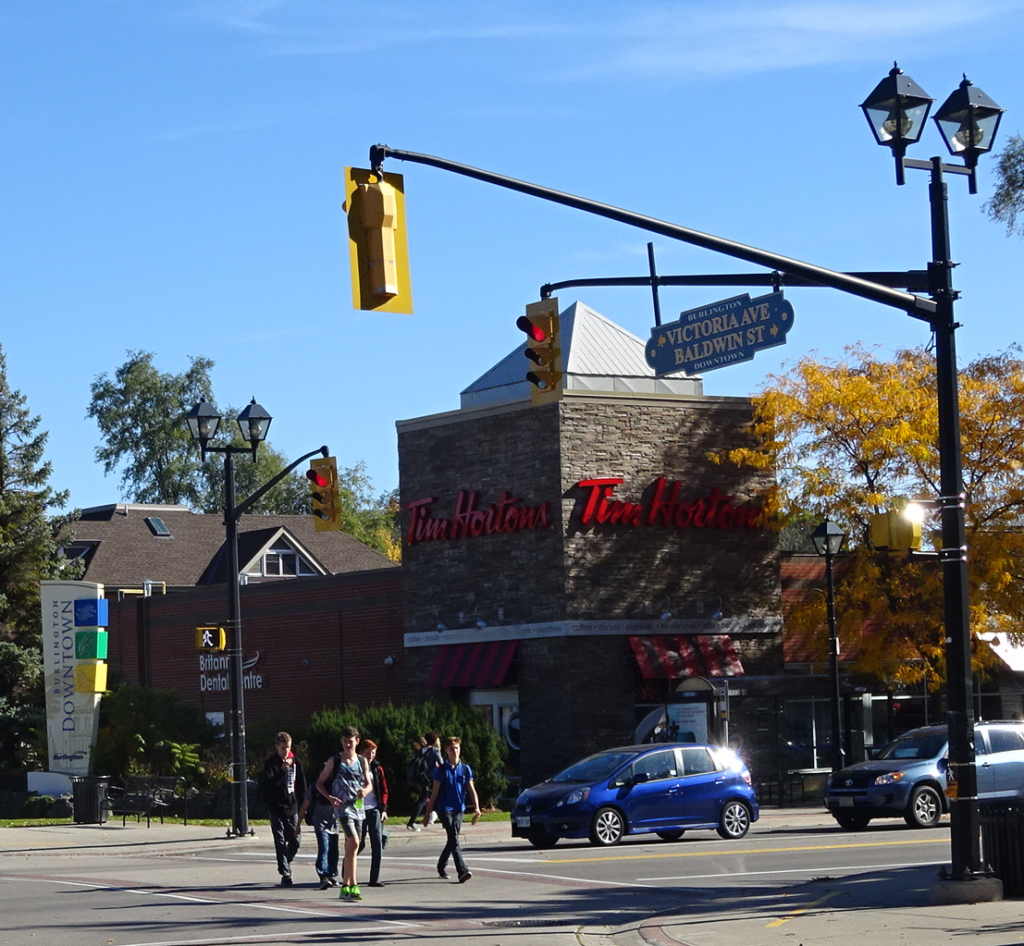
 A Tim Hortons is considered part of a “complete community” Should the high school actually close – the revenue stream at this Tim Hortons is going to take a big hit. – Community School culture – Terry Ruf sees this in Central but is not sure all the high schools has what Central has. Central is suffering from some tunnel vision on this one. Pearson has a culture every bit as rich as Central.
– Central does have a unique configuration its Jk to graduation is unique. Does it limit the horizons of a student who does every day of their public school education in one location?
There is a lot of work to be done – and the parents at Central are well into it.
 The parents at Pearson have begun their work – they do have some catching up to do and they do have a very unique situation to deal with: – The Co-op nursery that has been part of that school for more than 40 years which the Gazette will report on. The parents at Pearson have begun their work – they do have some catching up to do and they do have a very unique situation to deal with: – The Co-op nursery that has been part of that school for more than 40 years which the Gazette will report on.
By Pepper Parr
October 24, 2016
BURLINGTON, ON
The meetings to explain the Program Accommodation Review to patents will take place on the dates and at the high schools set out below.
Date School Time
Tuesday, November 1, 2016 Robert Bateman HS 6:00 pm – 7:00 pm
Tuesday, November 1, 2016 Nelson HS 7:30 pm – 8:00 pm
Thursday, November 3, 2016 Aldershot HS 6:00 pm – 7:00 pm
Thursday, November 3, 2016 Burlington Central HS 7:30 pm – 8:00 pm
Monday, November 14, 2016 Lester B. Pearson HS 6:00 pm – 7:00 pm
Monday, November 14, 2016 M.M. Robinson HS 7:30 pm – 8:00 pm
Tuesday, November 15, 2016 Dr. Frank J. Hayden SS 6:00 pm – 7:00 pm
 There is a lot of work to be done on the part of parents. Central High school parents set out the tasks as they saw them. Once parents have an understanding of the process the Program Accommodation Review Committee (PARC) gets set up.
The members of the PARC (there will be just the one committee) will be:
A Trustee as an ad hoc member, and Superintendent, both from an area not under study;
From each affected school:
the school Principal or designate (resource only)
two parents/guardians from each school, one of whom will be nominated by the School Council Chair; the other will be selected by the Superintendent(s) through the submission by parents of an expression of interest.
The Superintendent will review all parent representation and endeavor to ensure that all affected geographic areas and programs are represented.
A municipal Councillor will be invited to the committee once the committee is formed.
This is not going to be a small committee”
1 trustee
1 Superintendent
14 parents
7 principals
1 municipal Councillor
Our count is 24 people.
Timeline for the complete process:
PAR Initiated
October 19, 2016 (Done)
J.W. Singleton Education Centre
2050 Guelph Line
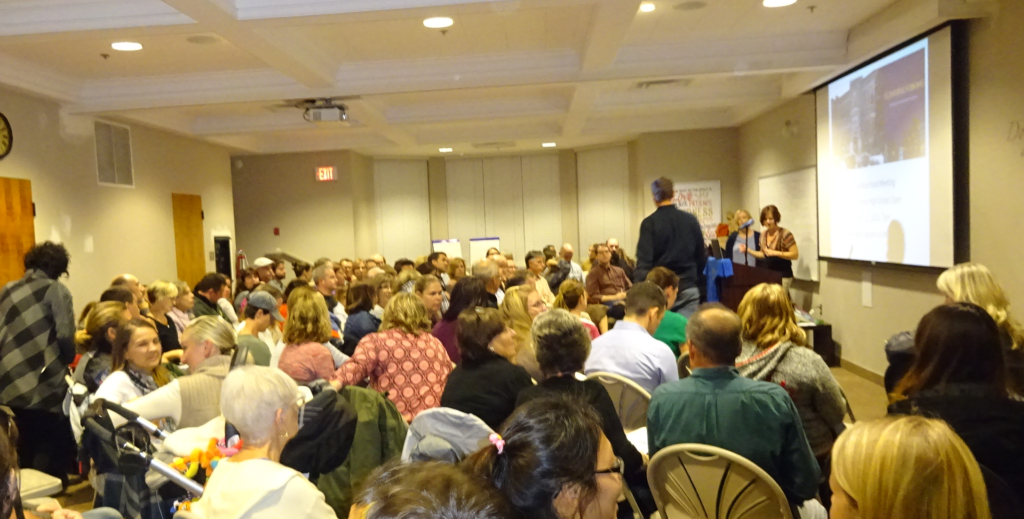
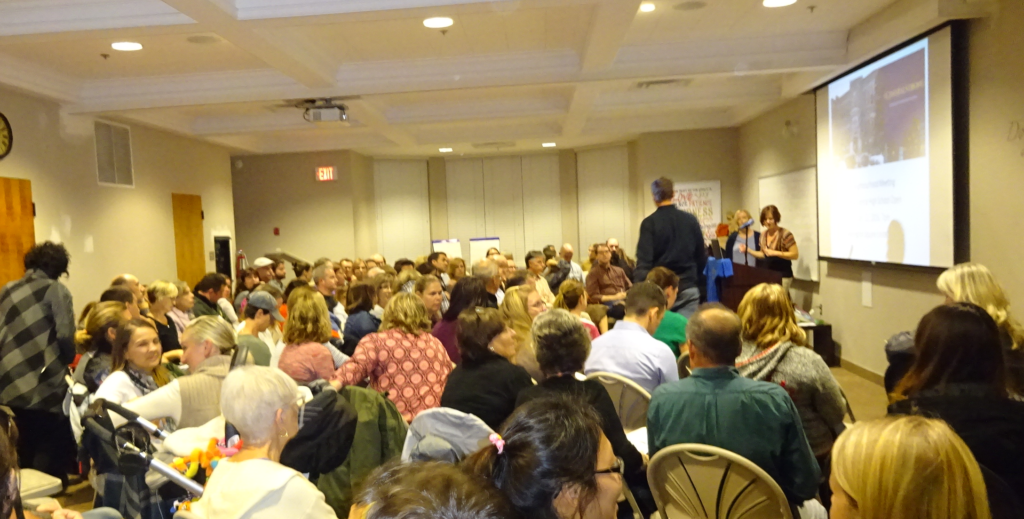
Expect to see rooms full of parents for the next number of months. This was the first parents meeting for Central High school parents. Formation and orientation of Program and Accommodation Review Committee (PARC)
December 1, 2016
TBD
Public Meeting #1
December 8, 2016
TBD
PARC Working Meeting #1
January 26, 2017
TBD
PARC Working Meeting #2
February 2, 2017
TBD
PARC Working Meeting #3
February 9, 2017
TBD
Public Meeting #2
March 2, 2017
TBD
PARC Working Meeting #4
March 23, 2017
TBD
Director’s Report to Committee of the Whole
March 29, 2017
J.W. Singleton Education Centre
2050 Guelph Line
Public Delegation Night
April 18, 2017
J.W. Singleton Education Centre
2050 Guelph Line
Presentation of Report to Board of Trustees for Decision
May 17, 2017
J.W. Singleton Education Centre
2050 Guelph Line
There is a lot of work to be done – and a considerable amount of disruption throughout the high school system in Burlington.
What the parents need to understand is that it is the trustees they elect who will make a final decision not the bureaucrats. Work with your elected officials.
By Pepper Parr
October 22, 2016
BURLINGTON, ON
The following is not something you are likely to see coming out of Burlington’s city council.
 Halton District School Board trustees. The Halton District School Board passed the following:
With the unanimous approval of Motion M16-0121 on June 15, 2016, the Halton District School Board authorized the posting of the Board’s Trustee Code of Conduct Policy on the Board’s website for public input, for a period of no less than 25 days.
Any feedback received was to return to the Board at the second meeting in September 2016.
RECOMMENDATION:
Be it resolved that Halton District School Board approve the “Trustee Code of Conduct
” policy, as revised, and appended to Report 16127.
Burlington’s city council has been avoiding the creation of and agreement on a Code of Conduct for the members of Council – not the sign of a healthy organization.
 Burlington’s city council One has to wonder why such a state exists.
The task was left with the City Manager to get something worked out. Don’t hold your breath waiting for that to happen.
This council does not want a Code of Conduct and the city manager isn’t going to work all that hard to bring anything to the table.
By Pepper Parr
October 21, 2016
BURLINGTON, ON
For the parents at Lester B. Pearson high school the thought of their school closing is a tough one.
Many parents wanted their children to attend a small school and moved into the neighbourhood for just that reason.
Some talk about actually moving out of the community or “we will send our kids to St. John”, which is the local Catholic school.
Another parents, who asked not to be identified said she did not want her kids “going to the pharmacy”, which was code for a school with a drug problem.
 Trustee Richelle Papin During the Board of Education discussion about Lester B. Pearson (LBP) trustee Richelle Papin talked about the Nursery Program in the school that has been in place for more than forty years that has become a model and a training ground for students from Mohawk who expect to work in the child care field.
The Halton District School Board is acutely aware that they face a serious situation where, as Director of Education Stuart Miller put it – “Students will begin voting with their feet and we will lose even more students”.
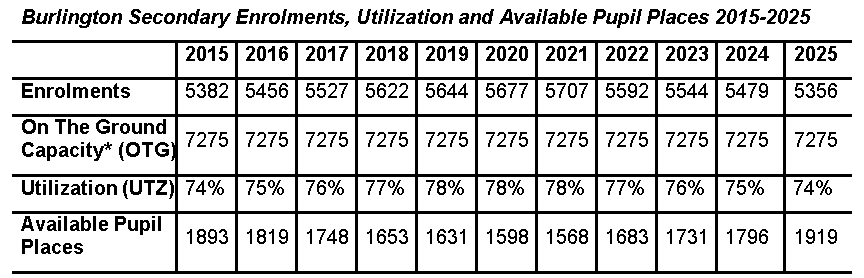
All the feelings and concerns don’t change the facts – Burlington has too much high school capacity. There are 1800 high school student seats that the Board can’t fill.
Yes, there is some intensification taking place but condominiums are being built and they tend not to house families with several children. Add to that – the population growth has been north of the QEW and the high school capacity is south of the QEW.
The Board of Education staff set out 19 possible options – and recommended what is referred to as option 19 – which proposes that:
• Close Lester B. Pearson HS, and redirect students to M.M. Robinson HS
• Close Burlington Central HS and redirect students to Aldershot HS and Nelson HS
• Change Dr. Frank J. Hayden SS boundary and programming.
 Hayden High school, Burlington’s newest already has portable classrooms and spotty WiFi service as well. This recommendation is not a final decision of the Board of Trustees, but a starting point for consultation.
Stuart Miller, Director of Education said: “I want to stress that the recommended option is the starting point for the Program Accommodation Review (PAR) process.” “With feedback from the public, and the research and work of the PAR committee, a different solution could arise as a result of this process.”
Initial information sessions will be held to provide communities with further information about the PAR process and rationale for why the Board is undertaking a PAR for Burlington secondary schools. These sessions will be ‘information only’. There will be no question and answer opportunity at these initial sessions.
There is a massive amount of data and detail the public will need to think through the alternatives.
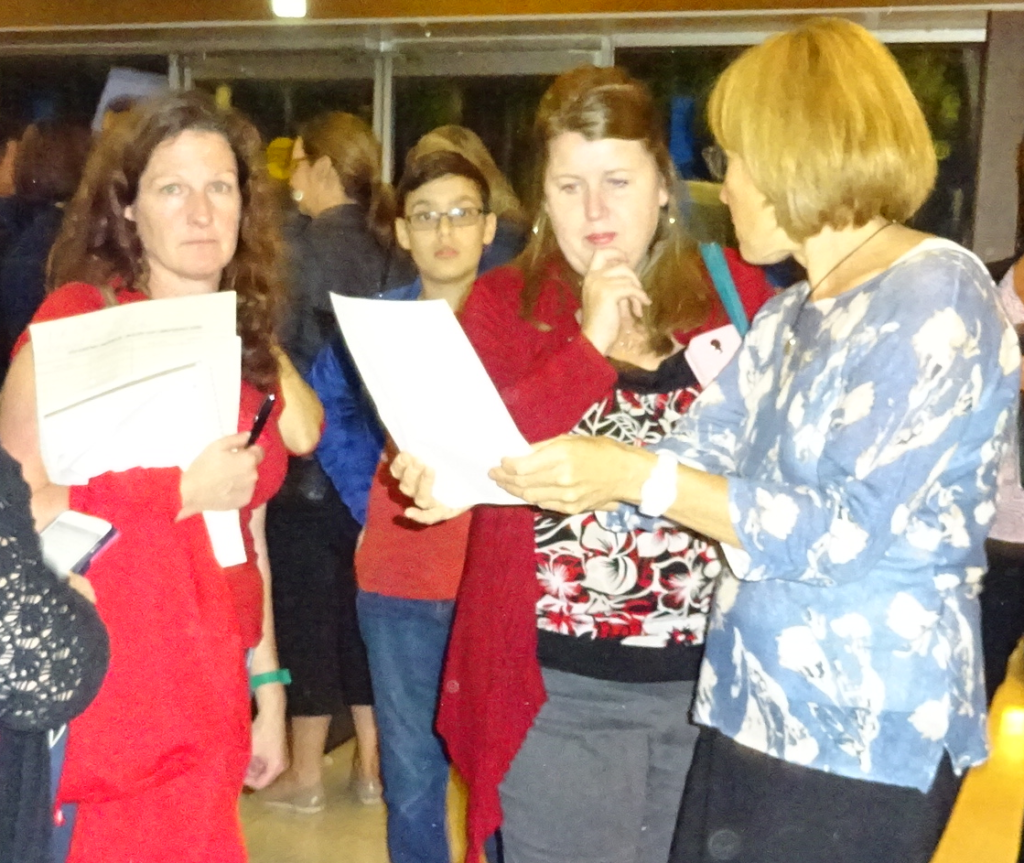
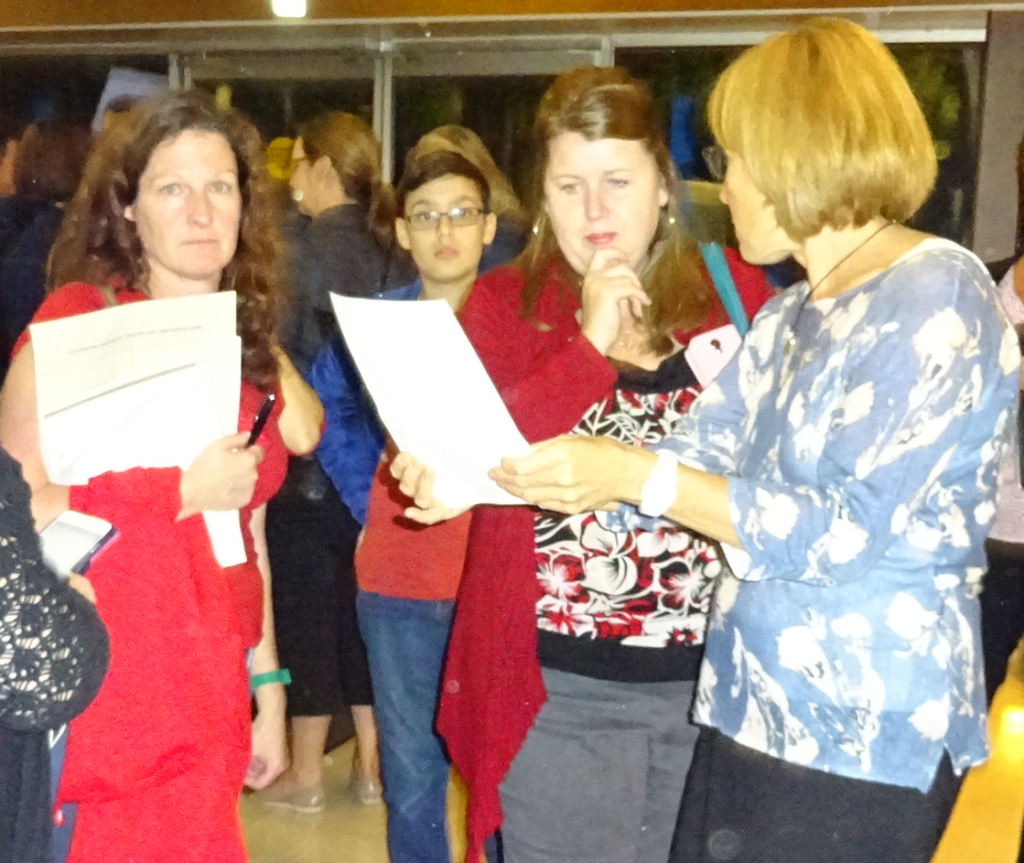
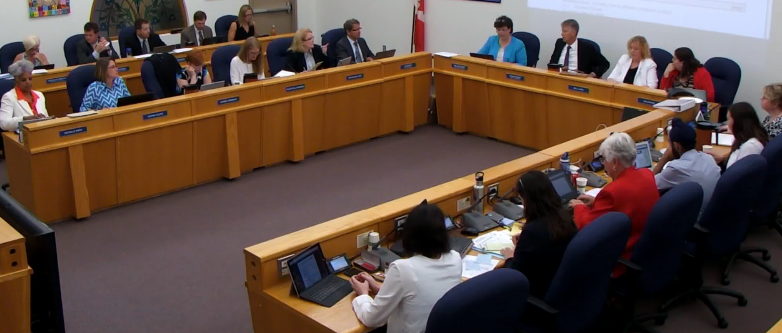
 Parents looking over the agenda for a Board of Education meeting. Parents are now in the process of setting up what will be called PARC (Program Accommodation Review Committees) that will work through everything and give the Board of Trustees their recommendations.
It is the Board of Trustees that will make the final decision – however, whatever decision they make has to comply with provincial government guidelines and the cold hard fact is that – there are too many spaces south of the QEW and not enough north of the QEW.
The Hayden High school that hasn’t been open for three years already has portables set up – and worse – the WiFI service is “spotty”.
 The people you elected as trustees are going to have to work with parents groups to come up with solutions that satisfy as many people as possible. It is going to be a busy year for everyone. The really positive upside is that the parents who have surfaced and are facing the challenge are a bright, energetic bunch of people –they are going to come forward with a solution.
It is the parents that are going to make the difference.
By Pepper Parr
October 20th, 2016
BURLINGTON, ON
There will be a Program Accommodation Review (PAC) – and it is going to keep the parents hoping.
Board of Education trustees voted last night 10 – 1 to form Program Accommodation Review Committees.
The possible closure of both Burlington Central High school and Lester B. Pearson high school are now distinct possibilities.
There is a tremendous amount of work to get done and the learning curve is going to be very steep for the parents.
A Program Accommodation Review is something a board of education has to do when the enrollment in a school falls below 65%.
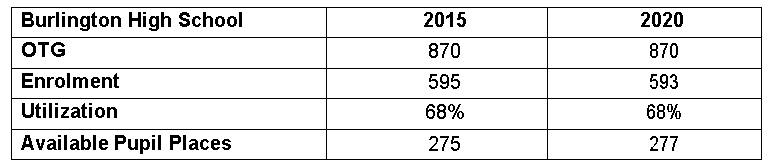
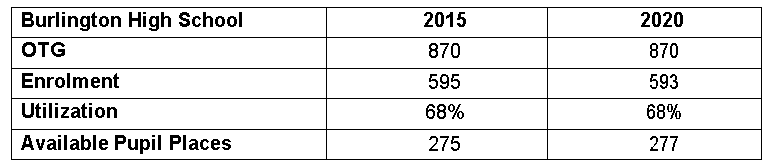
 Central High school could handle an additional 275 students – but they just don’t live in the community.  Lester B. Pearson is a small school to start with and enrollment is projected to decline. The recommendation the Board put on the table was to look at closing both Lester B. Pearson and Burlington Central High school.
Central High is a large school with a very strong connection to their community – they hit the ground running and have made strong arguments for not even holding a Program Accommodation review at this time.
The trustees didn’t see it that way and voted to take the next step which is to form a Program Accommodation Review Committee (PARC). (Note the school board people love acronyms – get used to them.)
The task now is to create the PARC’s. Burlington Central is well prepared for this next step.
Lester B. Pearson (LBP), a much smaller high school and it doesn’t have the depth as a community school that Central has. We will return to the LBP situation.
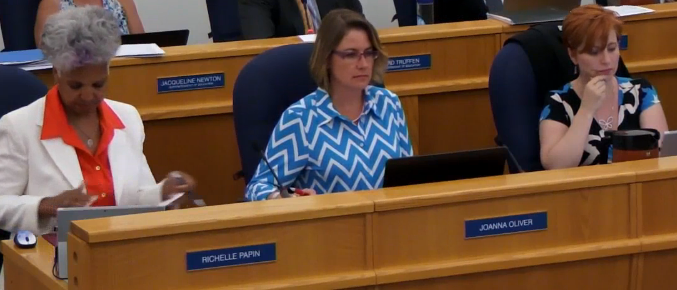
 Trustees Papin, Oliver and Grebenc The Board of Trustees is responsible for deciding the most appropriate pupil accommodation arrangements for the delivery of its elementary and secondary programs. Decisions that are made by the Board of Trustees are in the context of carrying out its primary responsibilities of fostering student achievement and well-being, and ensuring effective stewardship of school board resources. The Board of Trustees may consider undertaking pupil accommodation reviews that may lead to school consolidations and closures in order to address declining and shifting student enrollment.
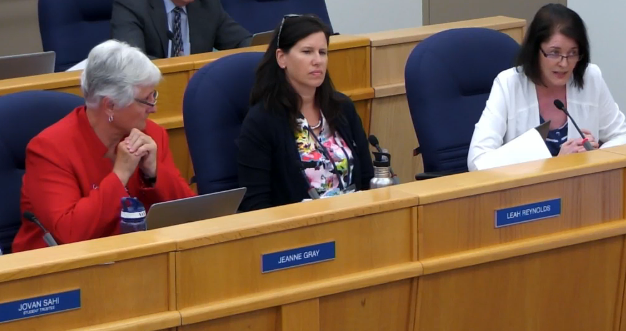
 Trustees Sams, Reynolds and Collard. The PARC process has been revised and this is the first time the Halton Board has had to work under the new rules which shorten the amount of time to go through that process.
Here are the steps that are going to be taken:
● Director’s Preliminary Report to the Board of Trustees; DONE
● Preparation of the School Information Profile(s); these are ready to now be turned over to the PARC that is to be formed.
Each high school will have its own PARC
● Board of Trustee’s approval to undertake a Program and Accommodation review process; They did that on October 19th.
● Communication with all stakeholders about the process, opportunities for involvement, and identifying outcomes; The Board staff are going to have their work cut out for them on this level.
● Establishing the Program and Accommodation Review Committee; The jockeying for the spaces on this committee is going to be interesting to watch.
● Consultation with Local Municipal Governments/Community Partners;
● Public Meetings;
● Final Staff Report, including a Community Consultation section;
● Public Delegations to the Board of Trustees;
● Decision by the Board of Trustees; and,
● Implementation and Transition Planning.
A PARC will be formed following the consideration by the Board of Trustees of the Director’s Preliminary Report.
Parents getting the agenda explained to them by the Board o Education communications manager. The PARC will consist of the following persons:
A Trustee as an ad hoc member, and Superintendent, both from an area not under study;
From each affected school:
the school Principal or designate (resource only)
two parents/guardians from each school, one of whom will be nominated by the School Council Chair; the other will be selected by the Superintendent(s) through the submission by parents of an expression of interest. The Superintendent will review all parent representations and endeavor to ensure that all affected geographic areas and programs are represented.
All Trustees are invited to attend PARC working meetings to observe the proceedings.
 Dania Thurman on the left – one of the more active parents at Central High school. The PARC is to be created within five business days of the motion to form the PARC was passed – which happened yesterday. Things begin to move very quickly at this point – and it is going to be difficult for the parents at Lester B. Pearson to keep up.
Once the PARC is constituted, it will invite a municipal Councillor or delegate to join the Committee. The Committee will be deemed to be properly constituted whether or not all of the listed members are willing and able to participate.
 Matthew DiSouza – a Lester B. Pearson student The Board will invite PARC members from the school(s) under review to an orientation session that will describe the mandate, roles and responsibilities, and procedures of the PARC.
That is what the community is going to immerse themselves in – the people selected for the PARC is important – getting the right people is important.
How did we get to this point? Well enrollment numbers were the first indicator that a change was needed. Burlington has seven high schools, Oakville has six. And Oakville has a larger high school population than Burlington.
Director of Education Stuart Miller explained that the preferred size of a high school is 1200 students. He added using that number Burlington has one and a half too many high schools.
That is the lens the board of education bureaucrat use – they have to look at the numbers – the province requires that they do just that.
However, it is the parents that are at the top of the food chain. It is their money that pays for everything and it is the education of their children that is at issue.
It is now up to the parents to come up with the ideas that will resolve the problem on the table.
 Director of Education Stuart Miller getting a briefing. Miller said a number of times that the option put on the table is rarely if ever the option that gets chosen. Which is fine but in order to be able to come up with the best option parents need to ensure that they do not lose control of the process.
By Pepper Parr
October 20th, 2016
BURLINGTON, ON
It is just under a month away but registration for this event is going to fill up very quickly – you will want to register now if you’d like to attend.
This struck the Gazette as one of the more interesting ways to promote the history of the city – and if anything is history in Burlington it is the Freeman Station.
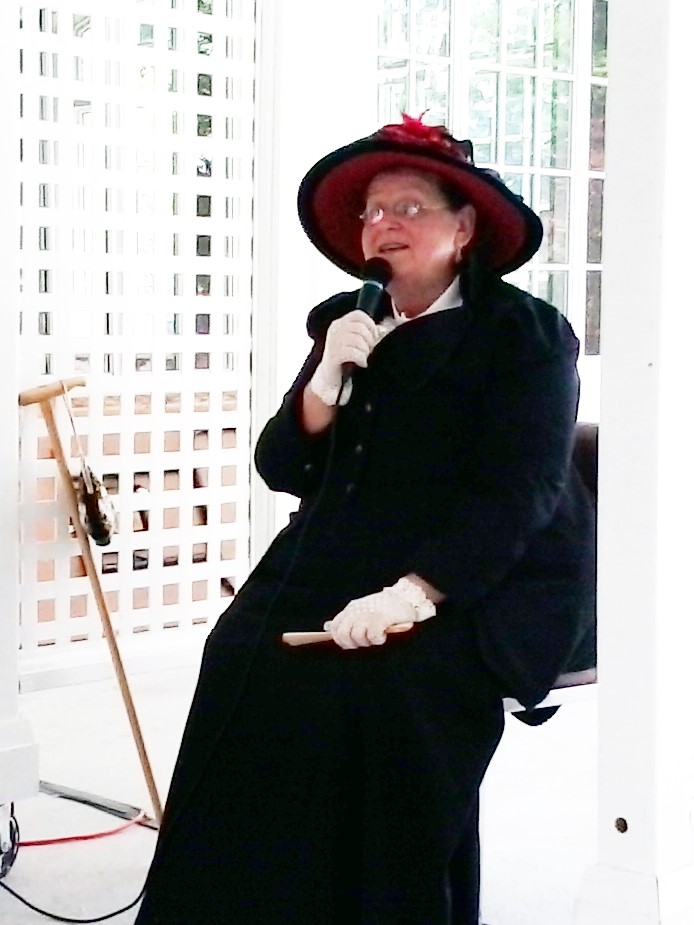
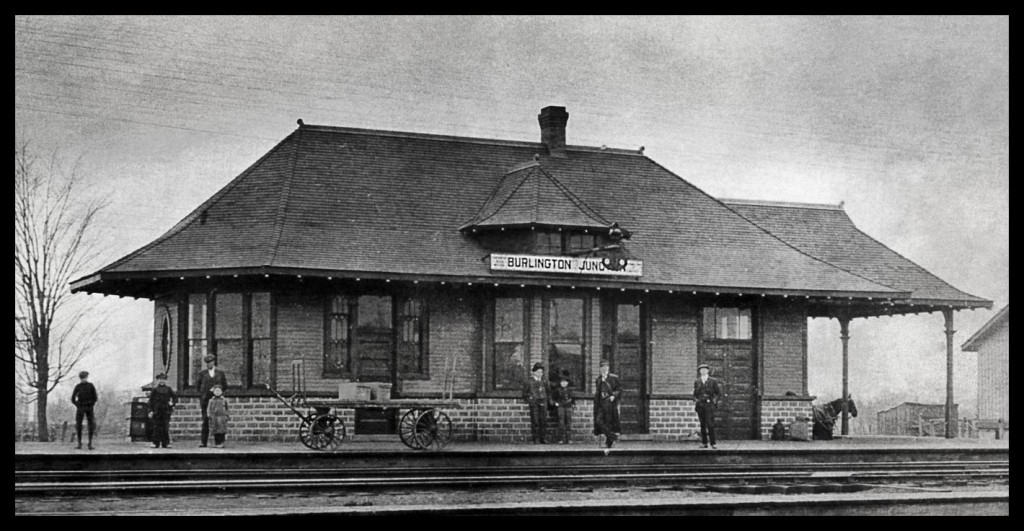
 Pauline Grondin – the year is 1920 and she is at the Burlington Junction station in Freeman. On Saturday, November 19th, well-known professional storyteller Pauline Grondin will again work her magic as she relates, first-person, her story of life around Freeman Station.
The year is 1920, and the Burlington Junction Station in Freeman is a vibrant hub of community comings and goings.
Pauline will bring history to life for us as she relates what’s happening around the village. (A bit of gossip here and there?)
 Waiting for the train. The Friends of Freeman Station invite you to join them at the Burlington Seniors’ Centre for “Breakfast at the Bistro,” beginning at 8:30 AM for a delicious meal followed by Pauline’s enchanting presentation.
Reservations are required, seating is limited, breakfast is only $ 6.18 per person, tax included, it’s all for a great cause, and a good time will be had by all. Nostalgia guaranteed, tears optional.
Book early! Registration is required. Limited seating, and typically sells out well in advance.
To register, log onto: https://secure.burlington.ca/recexpress/Activities/ActivitiesAdvSearch.asp
and enter the code “345506” in the TTR Barcode Search field to pull up Breakfast at the Bistro – Pauline Grondin – 345506
By Pepper Parr
October 18th, 2016
BURLINGTON, ON
You knew before the meeting was over that this was a group of parents who were going to think through the situation they faced very thoroughly and present a case for keeping the community school.
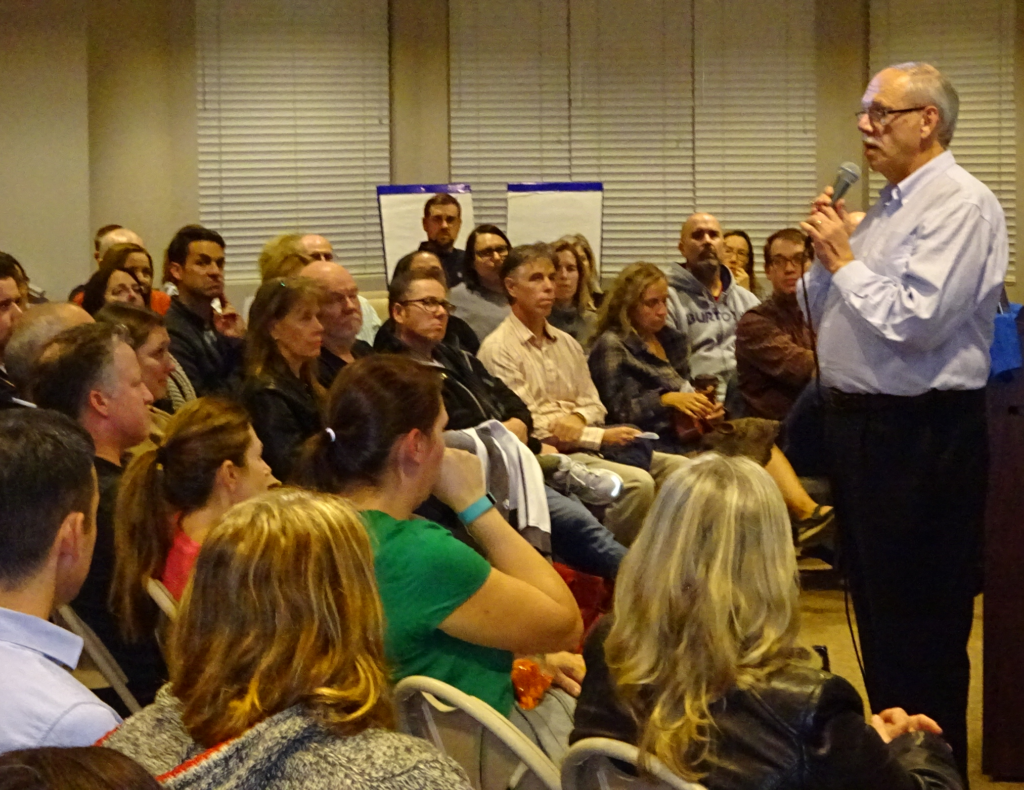
They packed the room. There were well over 80 people (some set the number at close to 100) packed into a room at Wellington Square United Church to figure out what they wanted to do about the Halton District school Board decision to hold a PAR.
A PAR is a Program Accommodation Review which is a look that the board has to take when the amount of available space in a school falls below 65%
A PAR – to address enrollment, empty/overfull space and programs offered – is needed for Burlington secondary schools claim the parent group – but the conditions needed to hold a PAR are not yet in place.
In its report Board of Education staff found a number of school that were below or very very close to that 65% number and they produced a report that set out 19 option. The options were related to various schools in Burlington.
There are just too many empty seats at Central High.  The utilization percentages are good – bu the sea available are in the wrong schools.  The parents group covered everything – and then some. The parents did their homework – the looked at the facts and they came to the conclusion that while there might be a need for a PAR – this was not the time to proceed.
The Board for its part produced an exhaustive report – we are talking inches thick here and it takes time to go through the details and then measure them against what the parents know and experience.
The letter was signed off on by Michael Kukhta and Dania Thurman who were speaking on behalf of the Burlington Central Strong Community Group).
Michael had run for school board trustee before Dania is new to the game but keep an eye on this woman. She is a force to be reckoned with.
In a letter to the school board trustees this group of parents from Burlington central high school said:
At the Halton District Board of Education (HDSB) Board of Trustees meeting on 19 October 2016, you will be deciding on a motion to approve beginning the Program Accommodation Review (PAR) process.
In this letter, we will outline why we urge you delay the start of the process by tabling the motion until numerous issues are addressed. This request is made in order to ensure the integrity of the PAR process and to ensure that accurate and productive recommendations can be made to the Board of Trustees at the conclusion of the PAR process.
It appears to be clear that a PAR is needed, but also clear that the conditions to start it now, 19 October 2016, have not been met. It is crucial that many issues in the Halton District School Board’s (the “Board”) PAR process and Director’s Preliminary Report on the PAR (#16132) be clarified and clearly understood before proceeding with the PAR process. There are also many concerns with data and the Board’s new and untried PAR process that should be addressed.
Summary of Concerns:
1) A PAR is needed, but conditions to initiate the PAR at tomorrow’s (October 19th) meeting have not been met;
2) The Board’s new and untested PAR process has critical errors and confounding steps;
3) Significant segments of data are incomplete, missing or inaccurate;
4) The nineteen (19) Alternate solutions offered do not consistently compare conditions and issues creating unfair and confusing conclusions and inferences.
Very compelling details, supporting data and information about each of these Concerns are detailed below in Appendices. (They are voluminous and will be set out in detail on the web site when it is fully operational.
The Gazette will publish that data later in the week.
Our volunteer and dedicated community group has worked very hard to pull this letter and information together in a short time frame. There are, no doubt, challenges and questions with the conclusions we have made; however, we have only had a week to look at this.
Nevertheless, we have discovered and documented many issues that will jeopardize the PAR until they are understood and corrected. We look forward to continue working together with you and the board to be as informative, objective and accurate in providing productive discussion, analysis and recommendations to assist you in making the best decisions possible.
Decisions to close schools and realign boundaries will have long-lasting and profound effects on the community. Let’s get it right. Mistakes could be costly and cause delays in implementation. The Board’s process is fast: 5-7 months from approval and launch to recommendation to and ultimately approval by the Board of Trustees.
There is insufficient time once the process starts, to research, fix and present new data to the PAR Committee. A delay in the process will allow the constituencies affected – indeed, the students and entire community of Burlington – to catch up with the process and truly feel engaged and respected as valued stakeholders.
 From the right Burlington trustees Amy Collard and Leah Reynolds – two of the four. We urge you to table the approval of the PAR process until all of the issues and concerns are clearly articulated, the data and information understood and the process robust and transparent.
Will the trustees listen? The four from Burlington can be expected to do so. But there are 11 trustees and they all get a vote on this.
It will be an interesting Board of Education meeting this evening.
By Pepper Parr
October 14th, 2016
BURLINGTON, ON
Not quite sure how to take this announcement from our provincial government – let’s see what you think.
GO train schedules are going to be displayed on highway signs telling commuters when the next train is leaving and how much time you have to get there.
Ontario is introducing a year-long pilot that will use electronic highway signs to show drivers nearby transit information and promote alternative travel options, to help manage congestion and get people where they’re going sooner.
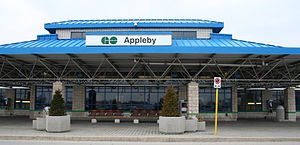
 The province appears prepared to go to ridiculous lengths to get you to use the GO trains On October 17, a sign will be installed on the QEW near Appleby GO station displaying information about upcoming GO train trips departing from that station. The information will factor in the time it takes to drive there, park and catch the next available train. By the end of the year, the pilot will expand to Bronte and Oakville GO stations.
Let me see if I understand this. I am in my car on the QEW, heading east for an appointment or maybe driving to the Rogers Stadium to watch a baseball game. And the sign on the highway is supposed to convince me to hang a right and head for the GO station and take the train instead. Did I get that right?
The media release doesn’t say how much the province is spending on this initiative – nor do they make any mention about how they will measure the success of the idea.
This one has the look and feel of the road diet we put New Street on.
Where do these ideas come from?
Is there something in the water we drink?
Maybe I misunderstood the purpose of this project.
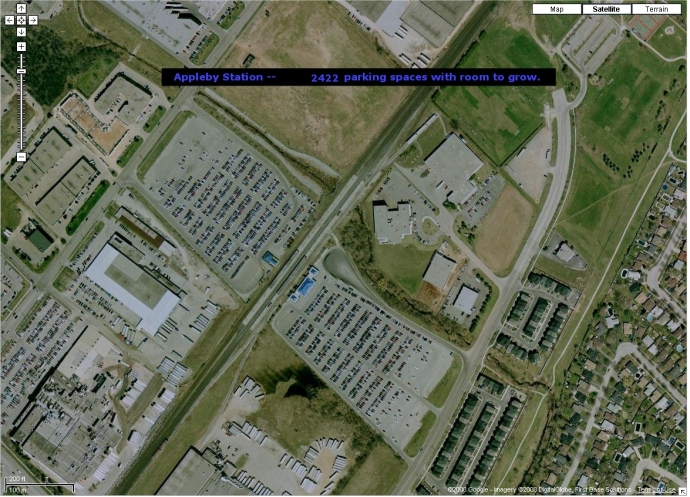
 While there may be close to 3000 parking spots – finding an empty one can b a challenge at times. Reminding me that the GO train is a very good alternative, perhaps even better than driving to get me to the stadium to watch the ball game – and if you know anything about parking prices in Toronto – it is a better alternative.
Telling me that this is a better alternative while I am already in the car. I don’t know about me changing my mind just like that.
The media release did tell me that the Appleby GO station has 2,964 parking spaces. As part of the pilot, technologies will be evaluated that determine real-time parking availability at GO stations. This information could also be displayed on the signs.
The two Jane’s going after the Progressive Conservative nomination to be the candidate for that party are going to have a field day with this one.
Jane McKenna and Jane Micheal have announced they are going after the nomination.
By Staff
October 13, 2106
BURLINGTON, ON
To a considerable degree the group of parents working to ensure that the Burlington Central High school is kept open are working on the fly. They are nimble, quick to spot the changes that have to be made and, if you ever wanted to see what collaboration is all about – sit in on a couple of their meetings.
If there were any egos to be seen – they got checked at the door.
Most are young professionals who are way past the getting signatures on a petition. These people understand policy and they focused on strategy right from the beginning – they are focused and determined. The smarter people at the school board will want to pay attention to these people – they are the ones that will be coming up with the solutions.
The Facebook set up they are using has been changed – the NEW Facebook address is set out below.
https://www.facebook.com/centralstrongBCHS/?notif_t=page_fan¬if_id=1476309799742119
The introduction to the Facebook page says it “was created by the committee of parents/residents and alumni (replaces the Group that was started) to keep the downtown core community informed on the HDSB’s proposal to close Central High School in 2018. The Board of Trustees’ final vote would be in May 2017, and the recommendation to close schools may change based on public input. It is important for us to share info and keep you informed of important meeting dates where you can provide ideas and feedback.”
While the Gazette can report on much of what the group does – their Facebook page will probably be the core source for information on an hour to hour basis. Bookmark it.
By Pepper Parr
October 13, 2016
BURLINGTON, ON
It was interesting, exciting and exhilarating to watch some 60+ parents, several with children in tow and babies in carriages talk about how they will go about ensuring that those children have a high school to go to. The Parent Council at the high school did a superb job of both organizing and pulling together information. A quick look at the sheets of notes highlights how thorough they are going to be.
The trustee for the ward was doing what she is supposed to do – advocate for her constituents. The ward Councillor did her job as well. Her “I am here for you” was what the room needed to here.
If one can assume that all four trustees are on side for keeping Burlington Central High open – that gets 4 of the 11 votes. What about the two more that will be needed to ensure that the proposal to close BCHS is not approved by the trustees?
As an aside it looks like the parents with students going to Lester B. Pearson are comfortable with the decision to merge that school with M.M. Robinson.
 The potential to become one of the best high schools in the province rests in the hands of the Parent Council. The people taking part in the first BCHS community meeting were active, engaged and offered some superb comments.
This is their school – and this may be the opportunity for the community to not only oppose the closing of the school but put together ideas and proposals that would make the place one of the best in the province in terms of where students go for their education.
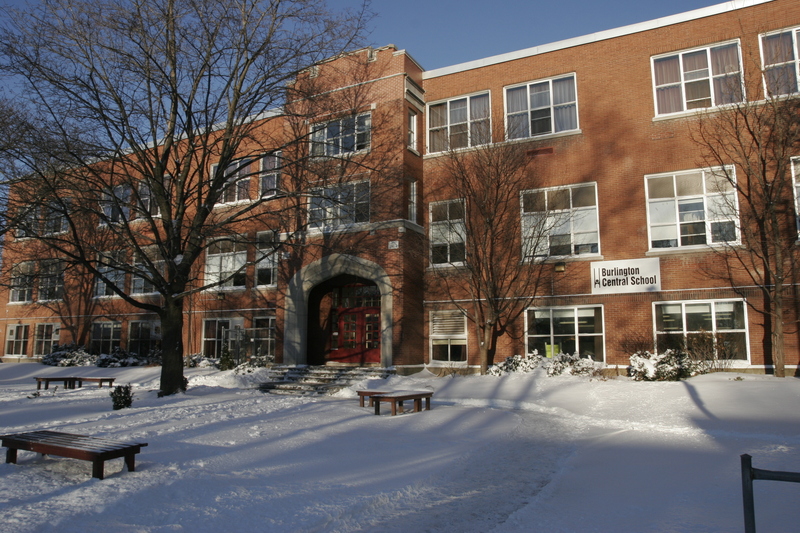
The structure has a sense of style and solidity to it. It is in the downtown core.
It does need a makeover which if done properly will make the school the one many students will want to attend.
It is already unique with its K to graduation set up. It has a very significant number of bursaries and scholarship available to students.
 These are the people that can make their school into whatever they want it to be. It has a parent population that in 1975 raised $100,000 to, we are told, refurbish the auditorium. Those were 1975 dollars.
This is a group of people who should not limit themselves to the just keeping the school open.
Dare to be Daniel’s and show your Board of Education that you have a vision for your community school.
Salt with Pepper is an opinion column publish from time to time
By Pepper Parr
October 12th, 2106
BURLINGTON, ON
The Halton District school Board recently decided that they needed to look at the number of high schools it would operate in the city of Burlington.
The review becomes necessary when the number of students in the school falls below a specific number – 65% of the schools capacity.
The school board staff set out a list of 19 options; the 19th was the one chosen for a review. The decision to do a review is made by the trustees.
Parents packed a meting Room at Wellington Square United Church – they will be doing that frequently in the next nine months. Last night more than 60 parents met at the wellington Square United Church in a room that was packed and decided what they wanted to do about any possible closure of the Burlington Central High school.
They got an overview of what happened in 200 when Terry Ruff was the newly appointed principal at the high school learned that he might have to close the school. Ruff, a Burlington native, was also a Central high school graduate. They managed to beat back the idea of closing the school then – the community faces that same issue 16 years later.
These parents are not going to go quietly into the night. The meeting was to begin the process o getting themselves organized. They set up four committees:
Executive/Organizing committee: set agendas/meetings; includes Team leaders
Strategy Team
Logistics team: volunteer intake & assignment; coordinate topic Teams
Fundraising/Communications Team (social media, GOFundMe)
The following four people from the high school parent council are:
Michael Kukhta – Neighbourhood Meeting Facilitator/ BCHS Council Chair
Lynn Crosby – Neighbourhood Meeting C0-Facilitator/ BCHS Council Secretary
Dania Thurman – Neighbourhood Meeting Facilitator/ BCHS Council Vice-Chair
David Sykes – Neighbourhood Meeting Facilitator/ BCHS Council Treasurer
Where are they at and what are they up against?
Dropping enrolment and other factors trigger a proposal for a Program & Accommodation Review (PAR) for all Burlington secondary schools.
The HDSB Director of Education gets staff to write a report to which is given to the elected Trustees recommending that a PAR be undertaken. Of the 19 options in the report staff recommended using Option #19 as starting point for discussions.
 Burlington central High school was seen as being very close to the point where there are not enough students to justify keeping it open – parents think the numbers the board is using might be suspect. Option #19 recommends closing Burlington Central High School, and Pearson High School.
Close BCHS; students west of Brant St redirected to Aldershot HS; students east of Brant St redirected to Nelson HS
Close Pearson HS; students redirected to MM Robinson HS, including those in Late French Immersion program
French Immersion eliminated from Dr Frank Hayden SS: FI students north of Upper Middle Rd redirected to MM Robinson HS
New FI program started at Robert Bateman HS: FI students south of Upper Middle Rd attending Hayden SS redirected to Bateman HS; FI students east of Appleby Ln attending Nelson HS redirected to Bateman HS
English program students south of Upper Middle Rd attending Hayden SS redirected to Bateman HS
The parents at Central high school, with very strong support from their municipal councillor Marianne Meed Ward are opposed to closing their high school.
The trustees were given the report on October 5th. On October 19th the trustees vote on whether to undertake a PAR. Assuming they do, a PAR Committee (PARC) Established on December 1st.
That committee will include:
Trustee from outside Burlington
Superintendent from outside Burlington
Principal or designate from each affected high school
Two parents/guardians from each affected high school
Once PARC is formed, municipal councillor or delegate is invited
HDSB staff are available as resources from specific HDSB departments including (not limited to): School Programs, Special Education, Human Resources, and Planning.
The goal the Central high school parents have set out for themselves is to participate fully in the Program & Accommodation Review, including HDSB Trustee meetings (Oct. 19 – vote on PAR; April 18 – public delegation meeting, May 3, May 17 – decision date) and public meetings (Dec. 8; March 2). Final report ready: March 29, 2017
 Boiling all this down to the five key points is going to take a lot of work – the parents appeared to be up to the task if their first meeting is any indicator. Throughout the process they intend to make their case that Central high school should be kept open. They will be collecting their own data and evidence and first-hand knowledge and stories
To build their case they are assigning different topics to research/write/present.
The parents are very concerned about Walkability – their want their children to be able to walk to school. They are firm in their belief that much of the data the school board is using comes from outdated statistics; faulty enrolment projections, and a misunderstanding of downtown growth.
They point to the problem in Alton where a band new high school was opened two years ago and is overenrolled due to multiple families living in the same household. The board staff weren’t aware that multiple families were living in the one house.
The parents are suggesting that the data doesn’t always reflect reality on the ground.
The impact on the feeder schools: Lakeshore, Tom Thompson, Central elementary is a concern.
The audience was told that schools cannot be closed in what are defined as Urban Growth Centres in the Provincial Places to Grow plan,
The audience was told that the staff report is thorough and that the focus of the report is on programs for students; heritage is on the list but it didn’t have much in the way of priority.
 Former Burlington central High school principal Terry Rugg explained to parents what had to be done in 2000 when the board o education wanted to close the high school. The parents seemed to be focused on “community” and the role schools play in the creation of community. Central is the only school in the Region that is a K to graduation school – the parents don’t want to lose that feature of their community.
Because it is an older school there are a lot of scholarships and bursaries attached to the school – what would happen to those were the high school to close?
Admittedly, the school could use some upgrading – it is an old school and it needs some help – bu it certainly doesn’t need to disappear.
In 1975 $100,000 was raised by the community to upgrade parts of the school.
Data available to the parents’ points out that household income for the Central high school catchment area is the lowest in Burlington – how are those low income families going to handle the cost of transportation to Nelson or Aldershot?
They point out that the report doesn’t offer anything in the way of a solution on what will happen to the grade 7 and 8 students should the high school be closed.
This is going to be a very active story and one that is critical to what kind of a downtown core community the city is going to have – these parents are not going to sit still and lose their high school.
There will be a web site with all the data and reports. The Gazette will let you know when it is up.
There is a Facebook page with 1500+ people looking in.
Can the parents convince the Board of Education to keep the school open? The committee has collected $1750 of the 42500 target they gave – these funds will be used to print lawn signs and pay the rental fees for the space they use for their meetings.
What the parents are going to have to watch very carefully is how the Board of Education chooses to interact with them. Tread carefully was the advice given to the meeting.
Central High school is critical to the kind of downtown community the city has – there is a seperate high school a stones throw away.
What doesn’t exist is a committee where the city and the board of Education meet to thresh out issues. Truth be told – the two organizations don’t get along all that well and tend not to cooperate very well.
By Pepper Parr
October 10th, 2016
BURLINGTON, ON
As we move into the Thanksgiving weekend teachers in the Region use one of their Professional development days which closes the schools for four days.
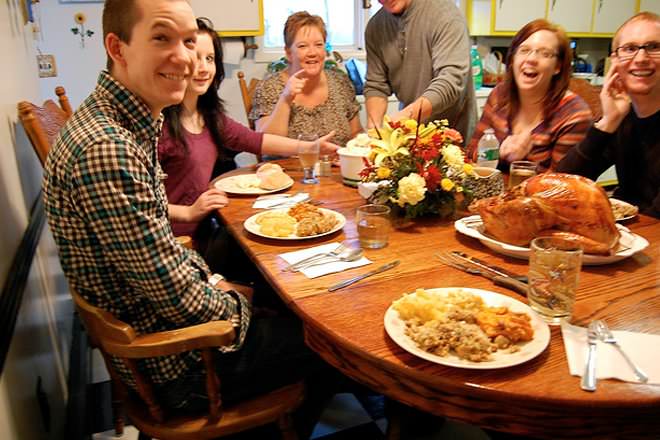
Most of us will sit at tables filled with platters of food and enjoy time with our families.
It is weekends like this that keep the volunteers at Food4kids busy – they pack food for kids that go home to a fridge that is pretty empty – no turkey on their plates.
Gayle Kabbash reports that 329 healthy food packages were given to children in Halton and 758 in Hamilton this week. “Our numbers will increase as we are higher at this time of year than last year.”
 Food in a bag. Food4kids is just one organization that helps students in need – there are a lot more of them than most people are prepared to admit.
Sheri Armstrong, with the Learning Foundation reported that just 16 days into the school year there were 80 request for aid; compared with the 40 at the same time last year.
The Halton Learning Foundation (HLF) partners with individuals, corporations and community foundations to eliminate financial barriers to education for public school students in Acton, Burlington, Georgetown, Milton and Oakville.
They provide assistance through emergency funds for students-in-need, post-secondary scholarships, and engagement funds that help schools purchase tools and resources to engage students in learning.
With public support, HLF helps ensure that every student of the Halton District School Board has the chance to fit in at school, to have the same experiences as their peers, to be engaged in learning, and to explore possibilities for the future.
The Learning Foundation has provided Eliminating Barriers funds to virtually every school in communities across Halton. The majority of Burlington schools (95 per cent) have received Eliminating Barriers funds to help students in the last two years.
 Thanksgiving – food on the table. The odds are that there is more than one students in the life of your children who are in need of the basics like food or clothing or who are unable to participate in the class trip or other school activities.
We have much to be Thankful for today – hopefully we will find a way to help those that don’t have quite enough.
Halton Learning Foundation –
https://www.haltonlearningfoundation.ca/eliminating-barriers/
Food4kids –
https://www.food4kids.ca/
|
|




 By Pepper Parr
 She notes that the snow is deep and that boy is wearing just running shoes – there are no winter boots.


 The school board will be making presentations to parents at every high school in the city to explain what the Program Accommodation Review (PAR) is all about and what the Program Accommodation Review Committee (PARC) will be doing between December 1st and May of next year – when the school board expects to make a decision on which, if any, high schools are going to be closed.


 Why do we need a “PAR” process?
 However, as the Director of Education, I need to ensure all Burlington high school students have equitable access to programs that allow them to explore and enhance their true potential. The PAR process will look at this issue and investigate various options to address the challenge that many Burlington high school students are experiencing.



 Taking place at Hamilton Artists Inc., 155 James Street North, Hamilton, Ontario. Attendance is free but registration in advance is requested by Wednesday November 2 at 5:00pm.
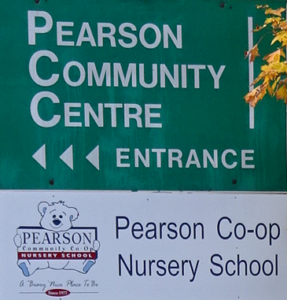 The parents at Pearson have begun their work – they do have some catching up to do and they do have a very unique situation to deal with: – The Co-op nursery that has been part of that school for more than 40 years which the Gazette will report on.