 By Staff By Staff
October 8th, 2016
BURLINGTON, ON
The Gazette asked Halton District school Board trustee Richelle Papin, ward 4, if she had made any plans to respond to the decision the board has made regarding the possible closing of the Lester B. Pearson high school?
Papin’s response:
 Halton District School Board trustee Richelle Papin. Trustees should not be responding to the recommended option the report acknowledged regarding the possible closing of the Lester B Pearson High School. I’m not sure if the question can be answered right now. The director has presented a report regarding bringing forward a Program and Accommodation Review for Secondary Schools in Burlington. Part of the report, Ministry, requirement, is that the report must include a recommended option.
This is only one option which could very likely change after the PARC is completed.
Due to low enrollment, underutilization in a number of Burlington secondary schools and the possibility of inequity in education for some secondary students, the director is recommending that the Halton District School Board undertake a Program and Accommodation Review (PAR).
If the Board of Trustees approve the report, the Program and Accommodation Committee will begin the PAR. At this point, I need only respond to whether I agree that the report should be approved or not approved to begin the process. The trustees as a group will do that when we vote on Wednesday, October 19, 2016.
The Gazette asked if Papin planned on organizing a public meeting. Her response:
 Trustee Papin has not yet made any comment on what she thinks should happen to Lester B. B> Pearson high school nor has she commented on the views of parents in her ward. These may follow when she returns to Burlington from a short Thanksgiving vacation. The four Burlington trustees are planning a Super Council meeting for Monday, October 24, 2016 at the JWS office, Board Room for 7 pm to 8:15 pm. We will be meeting with the Director, some Superintendents, Principals and Secondary School representatives. The public is welcome.
Papin was out of the country limiting communication.
Parents in the downtown core concerned about the possible loss of Central High school have organized a meeting at Wellington Square United Church for Tuesday evening – October 11th at 7 pm.


 By Pepper Parr By Pepper Parr
October 4th, 2016
BURLINGTON, ON
Burlington does not take to change all that well.
A change in the configuration of traffic lanes on New Street has everyone up in arms – both those wanting the change and those opposed to a change.
The Halton District School Board has told the public, via the release of the agenda for the October 5th regular board meeting, that two of the city’s high school “could” be closed effective June 2018.
Burlington has seven high schools:
Aldershot High School,
Burlington Central High School,
Dr. Frank J. Hayden Secondary School,
Lester B. Pearson High School,
Nelson High School,
M.M. Robinson High School and
Robert Bateman High School
A recommendation to close two of the seven Burlington Central High school and the Lester B. Pearson high School, has left the community thunderstruck.
 Central High – the school in th downtown core is where the biggest battle to remain will take place. The ward alderman has already come out against closing the school – fortunately the school board trustee might give the decision more thought and wait until there is more in the way of public feed back. Feathers flew, school board trustees were inundated with phone calls and emails. One can expect all kinds of misinformation to get in the way of what the board is being asked to approve.
 The spunk and school pride at Lester B. Pearson may not transfer to M.M. Robinson where most of the students will transfer to in the 2019 school year. Some things to keep in mind: Staff prepare reports, they work within the provincial guidelines and have a collection of acronyms that that can’t be used in a Scrabble game. The staff report goes to the trustees – those men and women you elected two years ago – they are going to make the decision on your behalf.
There is a well-developed process for community input – use it before you lose it.
The proposed time line, assuming the trustees, go along with the staff recommendation is as follows:
If the Program and Accommodation Review proceeds as scheduled the following is a proposed timeline for the implementation staff recommended (they are considering 19 different options)
Completion of a PAR with a Final Decision in 8 – 9 months
Capital Priorities Application and Funding takes 3 – 6 months
Transition Planning takes 1 year
Pre-Construction and Construction (project dependent) 1-3 years
School Closing June 2018
Now to those acronyms – try to remember them – the process doesn’t make much sense without some understanding of what the Gazette has come to call “board speak”
PAR – Program and Accommodation Review
As outlined in the Board PAR policies, the Director must prepare a Preliminary Report which identifies a school or group of schools that may be considered for a Program and Accommodation Review. In order for a PAR to be initiated, one of five conditions must be met. The conditions are as follows:
1. The school or a group of schools has/have experienced or will experience declining enrolment where On-The-Ground Capacity (OTG) utilization rate is below 65%;
2. Reorganization involving the school or group of schools could enhance program delivery and learning opportunities;
3. Under normal staffing allocation practices, it would be necessary to assign three or more grades to one class in one or more schools;
4. The current physical condition of the schools negatively impacts the optimum operation of the building(s) and program delivery;
5. In respect of one or more of the schools under consideration there are safety, accessibility and/or environmental concerns associated with the building of the school site or its locality.
LTAP – Long Term Accommodation Plan is something done by all school boards annually. The plan is adopted by the Board of Trustees. The document provides enrollment projections for the upcoming ten years for all schools in Halton.
PARC Program and Accommodation Review Committee is an advisory group that acts as an official conduit for information shared between the Board of Trustees and their communities. The PARC will meet, review information, provide feedback from the community, and suggest options.
Each PARC consists of a Trustee and Superintendent from an area outside of Burlington; Principal or designate, two parents/guardians
Utilization rate – the percentage of the capacity that is being used.
 The table set out above shows enrollment estimates for the next ten years, the capacity of all the high schools in the city; the percentage of that capacity that is being utilized and the amount of space that is available. These numbers are for all the high schools – a breakdown of the numbers for each school is set out below. Staff are recommending that two high schools be closed in June of 2018:
Lester B. Pearson be closed and the current student population be sent to M.M. Robinson which is 1.6 km away.
 The Utilization rate is just too low to justify keep the school open. Lester B. Pearson High School, Grades 9-12, located north of the QEW between Guelph Line and Walker’s Line. The school offers English and Late French Immersion programming. It is the only school in Halton to have Late French Immersion. Late French Immersion begins in Grade 7 at Sir E. MacMillan Public School. Growth from infill developments are included in projections. The utilization is 65% and it is expected to decline. There currently is an excess of 220 spaces in the facility. Enrollments in Grades 9-11 English are expected to be less than100 students per grade. The board staff may have failed to recognize the changes taking place between Guelph Line and Walkers Line – east and west and between Upper Middle and Mainway – north south. Real Estate agents will quickly tell you that multiple families are living in a single detached house with basements being converted into a bedroom for four and six children. Many of these families are from the Middle East and culturally they are comfortable with a large family in the house – this is the way they choose to live because it is the only way they can afford houses in that community.  The Burlington Central facility houses elementary and secondary school classes (Grades 7-12) and is located within the downtown core. Combined with adjacent Central PS (K – Grade 6), this facility forms a part of a K-12 campus. This school offers English and French Immersion programming. Enrolments are projected to be stable. Growth from infill developments are included. The high school’s utilization is expected to remain stable at 68% capacity. In 2015, there were 376 available pupil places in the facility. Burlington Central is the only facility without an elevator/stairlift. The sports field lands are not owned by the Halton District School Board. Staff is recommending that Burlington Central HS be closed effective June 2018. All secondary students, west of Brant St., will be redirected to Aldershot HS and secondary students east of Brant St to be redirected to Nelson HS.
This recommendation does not include the redirection of Grade 7 and 8 students from the Burlington Central Elementary PS.
In the event that the decision is made to close this high school, there is a potential that a Program and Accommodation Review may be required for the elementary schools that currently feed into Burlington Central PS for Grades 7 and 8.
The enrollment, utilization ans space available in the other five schools is as follows:
 Located within the Aldershot community in southwest Burlington, the Aldershot facility houses elementary (Grades 7-8) and secondary classes (Grades 9-12). It is the only Grade 7-12 school available west of QEW/407 ETR. This school offers English and French Immersion programming. Enrolments are projected to decline beyond 2020. In 2015, there were 327 available pupil places in the facility. Growth from infill developments and North Aldershot Planning Area developments are included in the projections. The high school’s utilization is currently 78% and is expected to increase to 83%, by 2019. It is projected there will be close to 100 English secondary students per grade (excluding Grade 12). Aldershot High School
 Nelson High School, Grades 9-12, is located south of the QEW between Walker’s Line and Appleby Line. This school offers English, French Immersion, and Secondary Gifted Placement. Enrolments are expected to increase over the next ten years. Growth from infill developments are included in the projections. Nelson HS utilization rates are expected to remain above 80%. Nelson HS has the second highest high school utilization in Burlington. There is an excess of 343 available places at this school in 2015. There is support for a Nelson Stadium Revitalization project between the community, Board and Burlington staff. Nelson High School
 M.M. Robinson High School, Grades 9-12 is located north of the QEW between Guelph Line and 407 ETR. The school offers English, French Immersion and SC-SPED programming. It is one of two schools to offer SC-SPED programming in Burlington. The SC-SPED program was added to the school in 2013. Growth from infill developments are included in the projections. The utilization is below 55% and is expected to decline. There is currently an excess of 617 spaces in this facility. M.M. Robinson High School
 Robert Bateman HS Robert Bateman High School, Grades 9-12, is located south of the QEW between Appleby Line and Burloak Drive. A small area known as Samuel Curtis Estate in Oakville is directed to this school. The school offers English programming, International Baccalaureate programming (IB) and a variety of Self Contained-Special Education (SC-SPED) programs. Robert Bateman High School is the only school in Burlington to offer the IB program. This program attracts students from senior elementary schools in the Burlington area. This high school is one of two schools to offer SC-SPED classes and as such, this school has specialized facilities to accommodate the programs. Growth from infill development is included in the projections. Utilization is below 65% and is expected to decline. There currently is an excess of 500 spaces in the facility. The combined English program and IB program is expected to be under 100 students per grade (excluding Grade 12), by 2022. Hayden is already over-utilized and there are three new developments that are going to feed into the school – the third is the development at Dundas and Walkers Line.  Dr. Frank J. Hayden Secondary School, Grades 9-12, is Burlington’s newest high school located in Alton Village, north of Dundas St. It opened in 2013 and offers English and French Immersion programming. Enrolments are expected to increase. It is the only high school in Burlington that is currently above total capacity (2016) and is expected to continue to grow until 2021. Growth from new development west of Guelph Line and north of Dundas Street, and infill development is included in the projections. Current utilization is 118%. A major development application has been submitted after projections have been created for the 2015-2016 LTAP in the Evergreen Community, located north of Dundas St., and west of Tremaine Line. This area has not been assigned to a specific school. The development consists of 907 residential units. The City of Burlington is in the midst of creating a secondary plan. It is anticipated that there will be approximately 50 secondary students from this area. The closest high school to this development is Dr. Frank J. Hayden SS. Using the space that is available in a school if there aren’t enough bums to put in the seats.
The province recently gave the school boards permission to rent out some of their space to community organizations.
The Community Planning and Partnership Guidelines directs Boards to identify potential partnership opportunities and to share such opportunities with government agencies and parties that expressed interest for such opportunities.
In response, the Halton District School Board adopted the new Community Planning and Partnership Policy on October 21, 2015. The first annual Community Planning and Partnership meeting was held on June 22, 2016, in Burlington.
Approximately eight organizations had representatives at this meeting. There have been three follow up meetings and preliminary inquiries with interested partners since June 2016. At this time, there has been expressed interest in potential partnerships, but no specific details related to a partnership within a Burlington secondary school.
So that opportunity isn’t going to save either of the two high schools.
What is possible with both is re configuring them into affordable housing which is a Regional responsibility. However, surely the Region could pick up the telephone and call the school board and ask: ‘What do you think of the idea of selling the buildings to a developer we can convince to take on such a project.’
Have a chat with the four major developers who want some additional height and density and suggest a proposal to turn a high school into affordable housing units might elicit a favourable response to more height and density.
None of the developers in this city are interested in including affordable units in their buildings – they are marketing a lifestyle that doesn’t include people who can’t afford a unit that is going for something north of $400,000
Closing one high school in a community the size of Burlington would be a big deal – suggesting that two be closed at the same time is a bigger piece of meat than th school board can chew through in the time frame they have given themselves.
These decisions are Burlington decisions – but there are school board trustees from Oakville, Milton and Halton Hills – what impact will their votes have on a Burlington situation?
Interesting times ahead – stay tuned.
 By Pepper Parr By Pepper Parr
October 4th, 2016
BURLINGTON, ON
I’d heard about it; drove by the place hundreds of times, knew what it was but had never had a chance to actually go into the place.
It was the Union Burial grounds on Plains Road established in 1848 by ten pioneer families who were members of the Methodist Union.
 A brick wall, first built around 1882 to enclose the Union Burial grounds, now needs both renovation and repair The chief architectural feature is the fine brick wall surrounding the 138-by 104-foot burying ground. The wall was built around 1882 by brick mason Jabez Bent. There are also fine wrought iron gates at the front and side. The memorial markers commemorate some of the earliest pioneers in this area.
The site was originally farm land owned by Asahel Davis, a Methodist, a community who wanted burying grounds separate from those established by the Anglican Church at St Luke’s and St John’s. Religious differences were a big deal in those days.
 The Ghent’s were prominent farmers in Burlington. Both Thomas and hos wife Elizabeth rest in the Union Burial grounds. The families holding plots in the Union cemetery were major contributors to the early growth, prosperity, and well-being of Nelson and the Village of Wellington Square which are parts of what we know as Burlington today.
The Baxter’s, the Crosby’s, the Cummins’s, the Davis’s, the Fisher’s, the Gage’s, the Galloway’s, the Ghent’s, the Kerns’s and the Pearl’s – the families whose names identify many of our strrets created their own cemetery.
It is quite run down these days. The families moved on and there aren’t that many descendants of its founders around to continue to manage and maintain this historic burial place.
The brick wall is, sadly, in need of restoration. The wrought iron gates and original name plaque also date from 1888. The grave markers are invaluable historic records and also merit preservation. This cemetery feels especially unique given it’s setting of urban development.
“The families who created this cemetery came to Canada during the American Revolution. They were British and chose to remain part of the British Empire in North America. The Americans were in the process of creating their own country, there were just 13 colonial states at the time, who didn’t want the British imposing taxes on them. Out of the struggle between the Thirteen Colonies and their mother country emerged two nations: the United States and what would later became Canada.
 The smaller markers recognize members of the family – several for children that died at a very young age. “Those that left the colonies became known as The United Empire Loyalists who wanted to remain faithful to the Crown and wished to continue living in the New World. Therefore, they left their homes to settle eventually in what remained of British North America.
For many years after those people would put the letters UE after their names – United Empire. Many of the markers in the Union Burial ground have those letters on the stones.
“The Loyalists came from every class and walk of life. Some depended on the Crown for their livelihood and status and had considerable wealth and property. Many were farmers and craftsmen. There were clerks and clergymen, lawyers and labourers, solders and slaves, Native Americans, college graduates, and people who could not write their own names. Recent immigrants from Europe also tended to support the Crown.
“They had little in common but their opposition to the revolution. Their reasons for becoming Loyalists were as varied as their backgrounds. Some had strong ties with Britain: others had simply supported what turned out to be the losing side. Local incidents, fear of change, self-interest, political principles, emotional bonds – one or any combination of these influenced their decision to remain loyal to the Crown. The common thread that linked these diverse groups was a distrust of too much democracy which they believed resulted in mob rule and an accompanying breakdown of law and order. The Reverend Mather Byles mused, “Which is better – to be ruled by one tyrant three thousand miles away or by three thousand tyrants one mile away?” Loyalists believed that the British connection guaranteed them a more secure and prosperous life than republicanism would.
“Historians estimate that ten to fifteen per cent of the population of the Thirteen Colonies – some 250,000 people opposed the revolution; some passively, others by speaking out, spying, or fighting against the rebels. Approximately 70,000 Loyalists fled the Thirteen Colonies with roughly 50,000 settling in British North America.
“Of less practical value than land and supplies, but of more lasting significance to the Loyalists and their descendants, was the government’s recognition of the stand that they had taken. Realizing the importance of some type of consideration, on November 9, 1789, Lord Dorchester, the governor of Quebec, declared “that it was his Wish to put the mark of Honour upon the Families who had adhered to the Unity of the Empire…” As a result of Dorchester’s statement, the printed militia rolls carried the notation: U.E., alluding to their great principle The Unity of the Empire.
“Those initials “U.E.” are rarely seen today, but the influence of the Loyalists on the evolution of Canada remains. Their ties with Britain and their antipathy to the United States provided the strength needed to keep Canada independent and distinct in North America.
“In the two centuries since the Loyalists’ arrival, the myths and realities of their heritage have intertwined to have a powerful influence on how we, as Canadians, see ourselves. Truly, the arrival of the United Empire Loyalists not only changed the course of Canadian history by prompting the British government to establish the provinces of New Brunswick and Ontario, but it also gave them special characteristics which can be seen today. Perhaps the most striking of these is the motto on the Ontario coat of arms: Ut incepit Fidelis sic permanet that is, “Loyal she began, Loyal she remains.”
One of the people telling the story of the Union Burial grounds on Saturday was Stephen Davis, a surveyor who works for the Region; his descendants are buried on the grounds.
“We restored the rear wall and we will re-build the west wall. Trees planted too close to the wall grew and pushed over the brick work. It is a lot of work and we don’t have that much time – we are busy raising our family’s and some of the families buried here have moved on” said Davis.
Davis is working on some ideas on how young people can develop an interest in their ancestry and take part in the rehabilitation of a significant part of Burlington’s history.
Related articleL:
Large portion of this report came from a document written by Ann Mackenzie M.A.
 By Staff By Staff
October 4th, 2016
BURLINGTON, ON
Anishinaabe speaker, educator, and musician Eddy Robinson brings a wealth of knowledge and personal experience to the national conversation about Indigenous communities in Canada. He will be speaking at the Crawford Lake Conservation Area on Saturday, October 15, 2016 from 3:30 to 5:30 p.m.
Increasing media coverage of the challenges faced by Indigenous communities in Canada leaves many of us with questions about how such disparity can exist in our own country. Eddy will use his remarkable gift as a storyteller and teacher to bring this workshop to life and make the issues engaging for workshop participants.
 Crawford Lake, it is a meromictic lake meaning that it does not receive the same atmospheric disturbances as other bodies of water, so the water remains calm almost all the time. And this makes for some great photos and clear water to take a look at fish and other interesting features. A boardwalk surrounds the lake, so it is quite accessible to almost everyone. Come early for this remarkable workshop and you can explore the 15th century reconstructed Iroquoian Village and rare meromictic lake located onsite. Explore the past and then learn about our collective present, so we can make a more inclusive future.
“Through stories and song, Eddy works towards a day when the power of knowledge, inclusiveness and sharing of First Nations cultures helps our nation and all its’ people become connected and stronger.”
Tickets for the October 15 workshop at Crawford Lake are $25 per person (plus HST), you can purchase tickets online through the event listing at www.conservationhalton.ca/events.
Eddy Robinson, Indigenous Speaker, Artist, Musician & Activist was born to the Missanabie Cree First Nation, but born and raised in Toronto. Eddy didn’t enjoy an easy childhood as an Anishinaabe youth in the big city. His father, a Residential School survivor, left the family when he was just three years old and he subsequently endured years of abuse from an alcoholic parent. It was during these early years that he was first exposed to a heritage that he now credits with saving his life.
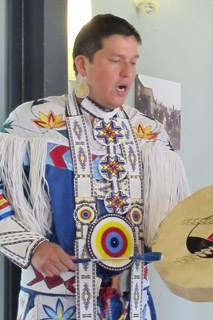 Eddy Robinson, Indigenous Speaker, Artist, Musician & Activist was born to the Missanabie Cree First Nation. Eventually ending up in the care of his grandparents, Eddy found himself on the same path of violence and addiction that dominated his childhood. He credits a Catholic priest at the Native Peoples Parish in Toronto for first encouraging him to seek out his roots. He pointed Robinson to a traditional Anishinaabe Vision Quest/Fasting ceremony that would begin his journey towards sobriety.
The power of the Dewegun (Drum) has opened the door to other aspects of his culture. A member of the Canadian Council of Aboriginal Business (CCAB) Eddy established his First Nations owned and operated business Morningstar River in 2007 to address the societal need for Indigenous education and displays of authentic culture. Eddy is a noted Anishinaabe artist, musician, activist and educator, and is a member of the National Speakers Bureau.
Crawford Lake is located at the corner of Guelph Line and Conservation Road (formerly Steeles Avenue) 15 km north of the QEW, and 5 km south of the 401 in Milton. The pristine waters of Crawford Lake have drawn people to its shores for hundreds of years. The rare lake, with surrounding boardwalk, is nestled in lush forests atop the stunning Niagara Escarpment where visitors can watch soaring turkey vultures glide through the Nassagaweya Canyon.
You can step back in time and explore the 15th century Iroquoian Village that has been reconstructed on its original site at Crawford Lake. The spirits still sing in the longhouses where tools, animal hides and the smell of smoke let you experience the rich history of Ontario’s First Peoples. Crawford Lake’s Customer Service staff can be reached by telephone at 905-854-0234, ext. 221, or by e-mail, crawlake@hrca.on.ca.
By Pepper Parr
October 4th, 2016
BURLINGTON, ON
There was a time when everyone walked to school – you met up with friends at the end of your street and you walked as a small group with your friends and learned what real gossip was all about.
 Bikes parked at the Beaudoin school. This doesn’t happen every day. When that practice came to an end – and why it came to an end is something the Gazette would invite some comment on.
Why do we insist in doing everything for our children? Are the streets of Burlington not safe?
The media release sent out by the school board uses the phrase “the need for safe places to walk”. Which streets to which schools in Burlington are unsafe?
“International Walk to School Day, October 5, began as a simple idea – children and parents, school and local officials walking to school together on a designated day. It is an energizing event, reminding everyone of the health benefits of regular daily activity, and the need for safe places to walk.”
“Suzanne Burwell, the Board’s Environmental Sustainability Coordinator says “Being active on the trip to school has a measurable effect on concentration levels”. She added that “Incorporating activity into morning routines is beneficial to the whole family, so if walking all the way isn’t feasible, consider connecting with other families to take turns walking with students, having students walk in groups or park legally a few blocks from the school, walk the rest, and start your day stress free.”
Do you get the sense that is a serious, significant commitment to convincing parents not to drive the kids to school?
I didn’t.
By Pepper Parr
September 27, 2016
BURLINGTON, ON
So – you’ve been in business for a reasonable period of time and you now need to expand your reach into your market. Or you are climbing the corporate ladder and you want to grow your personal network.
Keith Hoey, president of the Burlington Chamber of Commerce told an audience of new members that people buy things from people they know” and added – “so get to know people – network, that is what the Chamber of Commerce can help you do.”
 If you had a question: Keith Hooey had an answer for you. All part of his regular new member orientation sessions. You know that networking is the key to it all – but where do you go to begin creating that all important personal network? Ask that question of Hooey, and he will whip out an application form faster than you can pull out a business card.
Hoey is passionate about the work he does. He is unrelenting and is also a very funny guy.
Last week, the Gazette sat in on an orientation session for new Chamber of Commerce members – there were about 35 people gathered at the Burlington Golf and Country Club.
 As interesting as Keith Hooey, president of the Chamber of Commerce was – there was business to be done. Hoey wasn’t selling memberships – the people in the room were already members – what Hooey was doing was explaining just how good a deal they had gotten themselves into.
The benefits were impressive – Hoey almost made it sound as if you could end up making money on a Chamber of Commerce membership. The 3.5% discount on gas purchases will certainly get you started on the savings side.
If you are a small business operator there is the opportunity to sign your staff up to a health benefits plan. The opportunities to meet people are abundant. There is he Before 9 crowd and the Business After 5 crowd that were described by Hooey as the best networking opportunities in the city.
The selling features that Hoey focused on were the Chamber’s three prime purposes: Networking, Education and Advocacy. The organization has over 1,000 corporate members, ran 103 events last year and has eight committees advocating on behalf of their membership.
How effective is the Burlington Chamber of Commerce in advocating or its members? Hoey gives on sterling example. There was a time when Burlington was short 22 doctors which was hurting companies that wanted to attract talent to the city. A committee was put together and after a period of time – these things do take time – a program was put in place that attracted doctors to the city – Burlington is now just two doctors short of what it should have the size of its population.
Hoey had one word of caution for the new members he was orienting – “I hope you joined because you are interested”. An uninterested member was a person Hooey would chat up and give them reasons to become interested.
One critical comment: Hoey will tell people to “get out there and make money”. One doesn’t hear him say – and “give back to your community”. Other than that he does a great job.
He gave the new members all the time they needed and answered all the questions they asked – and kept looking at the clock – checking the time.
Hoey was leaving for a Chamber trip to India – a part of the world he had not been to before. And he had yet to pack for his afternoon flight.
 By Staff By Staff
September 23, 2106
BURLINGTON, ON
The 7th annual Culture Days weekend kicks off next Friday, September 30 and runs through Saturday, October 1st and Sunday, October 2nd. Burlington is getting more involved than ever by making arts and culture accessible to the community.
This year’s Culture Days will feature many different types of artists, activities and events, including Doors Open Burlington us for the 5th year in a row.
Here is a breakdown of some of the events taking place:
Art Gallery of Burlington,
Burlington Libraries,
Burlington Performing Arts Centre,
Burlington Student Theatre,
Burlington Teen Tour Band,
On October 1st, Civic Square is transformed into Art in the Square, an event that runs from 2 to 5 p.m. Artists and artisans will showcase their artwork in a marketplace and provide interactive activities for the community. The event will feature live music and dance performances and provide the opportunity to be a part of the audience, explore various art techniques and try something new.
Doors Open Burlington
 The 7th annual Doors Open Burlington takes place on Saturday, Oct. 1, 2016 from 10 a.m. to 4 p.m. It is an occasion to see your city from a different perspective and celebrate the cultural importance of the sites throughout the community. The event will highlight important buildings, organizations and landmarks that make Burlington a culturally vibrant place to live, work and visit. Admission is free! The 7th annual Doors Open Burlington takes place on Saturday, Oct. 1, 2016 from 10 a.m. to 4 p.m. It is an occasion to see your city from a different perspective and celebrate the cultural importance of the sites throughout the community. The event will highlight important buildings, organizations and landmarks that make Burlington a culturally vibrant place to live, work and visit. Admission is free!
 The city is a collection of doors – next weekend you get a chance to open many of them and take a peek inside. The Burlington Cycling Committee will lead a bicycle tour of the Burlington sites for the Doors Open event. Meet at City Hall, Civic Square at 10 a.m. and begin our journey to explore the sites. All ages are welcome and we will keep a leisurely pace using all available bike paths and bike lanes. There will be an opportunity to stop and visit each site. We estimate the cycle tour will take about two hours.
The looming question about this event is – will they drive along New Street and take advantage of those new bike lanes – and will that traffic count in the data the city is collecting.
Registration is required at the start of the tour.
Visit www.burlington.ca/culturedays to plan your weekend.
By Staff
September 22, 2016
BURLINGTON, ON
It will be the photo op of photo ops.
 Tips the scales at 200,000 lbs – and they want to pull it at least 50 – by hand. A team of people trying to move an Airbus A300 – 50 feet across the tarmac at the John C. Munro Hamilton International Airport.
The occasion is the official kick off of the Burlington and Greater Hamilton United Way fall fund raising drive.
The Gazette plans on being there to see if this can actually be done.
 Former, now retired Burlington General Manager Kim Phillips giving it her best as she works with other staff on a United Way fund raising drive. In past United Way drives we have seen staff at city hall tug away on a rope to move a heavy duty truck
The theme for 2016-17 is: Help us change 164,000 lives. In the past the United Way has created a fund raising target and found that they were losing sight of the real reason for being – people.
They have helped 164,000 people change their lives by being there to help when help was needed.
The United Way serves as a safety net – with that organization in place dozen of agencies through the two communities would not have the funds to give the help that is needed
 Shelves in a food bank – not exactly a supermarket is it. That help covers the gamut from providing lunches for children on the weekend when there just isn’t a meal for them.
It includes financially supporting organizations that are on the ground, in the field delivering the support for the disadvantaged, the infirm – those down on their luck – often through no fault of their own.
Plane pulls are one way of getting some attention.
The Plane pull takes place on Saturday at the airport – make a day of it and takes the kids to the Canadian Warplane Heritage Museum.
 By Staff By Staff
September 21, 2016
BURLINGTON, ON
The province released the results from the Ontario Education Quality and Accountability Office (EQAO) which show Halton District School Board students continue to perform above the provincial average, with significant gains experienced in Grade 3 Reading and Grade 6 Writing levels.
These results were based on assessments completed in the 2015-2016 school year for primary and junior students in Reading, Writing and Mathematics.
The results in 2015-16 are being compared to results in 2013-14, as EQAO was not administered in public school boards last year.
 These scores are nothing to shout about – surely this isn’t the best our teachers can do? In Grade 3:
• Reading: Results show a three-percentage point gain in Reading from 76% to 79% of students achieving at or above the provincial standard, while the provincial average was 72%.
• Writing: 78% of students attained the provincial standard, a decrease from 81%. The provincial average was 74%, decreasing from 78%.
• Math: Overall, provincial results declined from the previous EQAO assessment. In Halton, 70% of students – compared to 74% – exceeded the provincial standard. The provincial average was 63%, a four-percentage point drop. The decrease in Halton and Ontario was the same.
In Grade 6:
• Reading: Results remained at 85% of all students achieving at or above the provincial standard, while the provincial average was 81%. The past five years have seen growth of 6% overall in Junior Reading.
• Writing: Results showed an increase to 85% from 82% of all students achieving at or above the provincial standard, while the provincial average was 80%. The past five years have seen an increase of 8% overall in Junior Writing.
 We hope no one sees the reading and writing scores as acceptable – 90+ should be the goal that is reached. Math is terrible – expect the province to create a task force to up those numbers. Expect the Halon District school Board to move faster than the province. • Math: Results decreased by five percentage points to 56% of students achieving at or above the provincial standard. The province saw a decrease of four percentage points in Grade 6 Mathematics with 50% of students achieving at or above the provincial standard.
While the Board is pleased with the overall EQAO results, having achieved higher than the provincial results in all six categories of the primary and junior assessments, HDSB recognizes the need to improve particularly in the area of math.
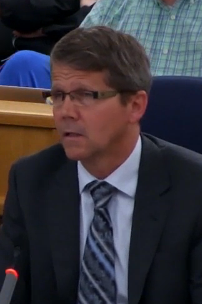 David Boag, Associate Director of Education “The Board continues to focus on its robust early literacy plan in all schools and is proudly making continuous gains in Grade 3 Reading,” said David Boag, Associate Director of Education for the Halton District School Board. “The Board’s Junior Reading and Writing scores improved as well, with the highest results ever in Grade 6 Writing.”
Junior Math results continue to decline for the Halton District School Board as well as for the province. While Halton continues to achieve above the provincial average in this category, the Board recognizes Junior Mathematics is an important area of focus.
“To improve math results, the province announced a revised math strategy this past spring. Halton is revising its Math Plan to reflect that strategy by developing goals to close the student achievement gap,” Boag said.
By Staff
September 21, 2016
BURLINGTON, ON
Grade 9 month doing fine ‘’’
The province might be having problems with the mathematics scores for grade 6 students but the Halton District School Board is pleased with the scores for the grade 9 math.
Today the Education Quality and Accountability Office (EQAO) released results showing Halton District School Board students well outperforming the province in Grade 9 Academic and Applied Mathematics, and on the Grade 10 Ontario Secondary School Literacy Test (OSSLT). Secondary students must write the Ontario Secondary School Literacy Test (OSSLT) as a requirement of graduation.
 There is clearly a lot of work to be done on the Applied side. For Grade 9 Math, there are different assessments for students in the academic and applied courses. On the Grade 9 Academic Math assessment, 90% of students achieved the provincial standard, unchanged from the previous year’s result. The provincial average decreased by two percentage points to 83% of students achieving the provincial standard. In total, there were 3,302 students enrolled in the Academic Math course in 2015-2016.
For the 655 HDSB students in the Applied Math course, 55% attained the provincial standard in 2015-2016, a one percentage point increase from the previous year. The provincial average decreased by two percentage points from 47% to 45% from the previous year.
 Literacy results are strong – are we seeing much in the way of creative writing at the high school level? The Ontario Secondary School Literacy Test (OSSLT) results for 2015-2016 were also released today. The Halton District School Board’s success rate for students writing the test for the first time remained unchanged at 88%, while the provincial average was 81%, a drop of one percentage point from last year. The overall results for the OSSLT in Halton continue to demonstrate remarkable consistency.
This year, the OSSLT participation rate was 97% and the success rate was 88%. Both of these Halton results are above the provincial average, showing Halton students continue to demonstrate strong literacy skills.
 By Pepper Parr By Pepper Parr
September 19th, 2016
BURLINGTON, ON
An interesting idea cropped up during our interview with Tim Cestnick, the newest member of the Burlington Foundation, which most of you will remember as the former Burlington community Foundation.
New members of any board need to take a little time to settle in and get a sense as to how the board has run in the past. Tim Cestnick and Tim Hogarth go back some time – both are polished senior executive types that know how to think through problems and take a strategic look at what the objective is. And both are now board members of the Foundation. Hogarth has been on the board for a period of time.
 The Foundation recently went through a re-branding and is well into the roll out of their Mental Health Awareness work they have been doing the past two years. They have a major speaker. Michael Landsberg, in town in October. The Foundation recently went through a re-branding and is well into the roll out of their Mental Health Awareness work they have been doing the past two years. They have a major speaker. Michael Landsberg, in town in October.
The number of Endowments they manage grows steadily as does the assets under administration – $10.7 million now.
The organization is readying itself for its Annual Gala that is being chaired by Rick Burgess this year. The event will be held at the Performing Arts centre on October 22nd.
  The Gala is a major fund raising event that covers the operational costs of the Foundation. The Gala is a major fund raising event that covers the operational costs of the Foundation.
Every organization that relies on the public needs to constantly refresh itself and while a brand change perhaps perks things up a little, the meat is in the ideas they come forward with. And this is where Cestnick’s thoughts on just what philanthropy is all about are very relevant.
The vast majority of the people out there would say that people with a lot of money can become philanthropists – Cestnick doesn’t see it that way. He thinks we can tech people at the high school level to think in terms of being philanthropists.
“Why can’t a high school student can’t set aside a small sum each year and make that their philanthropic donation – something that would be built on each year?
We have United Way for that might be a response – and it is a good one.
If one looks at the annual Terry Fox run that takes place in Burlington every year you get a sense of how a public will take to an idea; how they will respond to something that changed the way they see the world.
 Others are already involving their youth in philanthropic ventures. Philanthropy allows that kind of thing. The United Way seeks funds to provide services. The Burlington Foundation came to the realization that we need to look at Mental Health differently and bring it in out of the cold where it wasn’t talked about – we just felt sorry for those who were experiencing bad mental health.
The Foundation now has a program in place that has people talking about mental health and what has to change in the way we deal with this now growing social problem. That hasn’t been the kind of work that organizations like the United Way are doing. This is not to take anything away from what the United Way does – we could not survived as a caring society if we did not have the United Way in place.
 Tim Cestnick newest Burlington Foundation Board member. Tim Cestnick talks in terms of people needing to “feel” it when they are donating money. You give something up, you do without something you enjoy when you choose to make a philanthropic donation.
If I understood Tim Cestnick correctly he is interested in introducing people to the idea that there is something biblical about philanthropy and I got the impression it was something he might try to get on the Foundation agenda.
It will be interesting to see if this goes anywhere – it should.
Related article:
Cestnick appointed to Burlington Foundation board.
 By Pepper Parr By Pepper Parr
September 19, 2016
BURLINGTON, ON
It went well, it went very well.
The MoonGlade event put on by No Vacancy in partnership with the Art Gallery of Burlington was a huge improvement over the event last year. Shows what a curated event can be.
When Denis Longchamps, Chief Curator, added his skill set to No Vacancy’s organizational talents the city ended up with an event that can only grow. We are all winners with this one.
 The tunnel portion of Kune Hua’s installation It is an event Burlingtonians are going to have to grow into. Among the 17 “installations” pieces the one put on by Kune Hua was by far the most popular. While it wasn’t “art” per se, it certainly attracted a lot of people.
There was a line up outside the installation even though most people didn’t know what it was until they got inside and had a conversation with Kune who talked to everyone who passed through.
 Part of the Kune Hua installation consisted of a number of tents set up – people went in and just talked to the person inside. About what? We didn’t ask – hundreds lined up. It was described by one arts professional as something that was more philosophical than installation art – but it appealed to people.
Kune was on a high when the event came to a close; he sent a thank you out to all those involved and said: “What an incredible night! 🌸🌝 Feeling so much love 💗 and the light ✨ was certainly bright tonight. The LOVE garden was in full bloom and hundreds of people picked up the fragrance. Thank you so so much to everyone who helped make this happen from creating it, supporting it and experiencing it! It truly was a magical night.”
Jim Riley was given the space he needed for his visual installation.
One person who attended said the Art Gallery had probably never seen this many people in the place at one time before.
An added bonus for the people who went to take part in MoonGlade was the “stitched art” exhibit that was on at the same time. Unfortunately many, if not most people didn’t realize that the work was unique and one of the best shows of stitching, which is an offshoot of quilting, that will be seen in this province.
Kelly Bruton of Newfoundland had an excellent installation that called for some interaction to be fully appreciated.
 Shevon Madden’s installation. Shevnon Madden’s installation of a wire sculpture of a horse head with all the musculature of the neck clearly delineated was quite stunning. Her visual and vocal commentary made a telling point on how we train animals.
Longchamps wanted a much more hands on approach and art that was both interactive and made a social comment. For the most part he got much of what he wanted.
What was missing was public interaction.
 The Deconstruction table – created by Kelly Bruton Kelly Bruton had difficulty getting people to spend any time at either her destruct or reconstruct tables. The object was cut up T-shirts into strips of cloth and use the strips to make rugs.
 The reconstruction table. What we noticed was that people flitted from one installation to another and didn’t quite know what to do when they got there.
The exception was the Kune Hua installation. No one was able to say quit why it worked – just that it did. And that can be said for everything about MoonGlade.
 It was mediation and music – which is what many wanted. The Beer Garden went well; the Food Trucks met the need and the music was just fine.
Look for this event to be repeated next year. Kune Hua hasn’t a clue as to what he will do for a repeat. He has a full year to think that through.
By Staff
September 15, 2016
BURLINGTON, ON
Hearing that – Starting today, the shingles vaccine will be available across the province for people 65 to 70 years of age might get little more than a shrug from most people.
For those who have experienced shingles it is no laughing matter.
 Shingles is a very painful condition – it isn’t limited to people over 65. “Shingles is a painful illness caused by the chickenpox virus that can reactivate without warning later in life. The shingles vaccine lowers the risk of getting shingles significantly and reduces the chance of complications from this disease for people without medical contraindications.
The government is investing $68 million over three years in order to publicly fund the vaccine, which will reduce the likelihood of Ontario seniors developing the painful infection, and reduce visits to emergency rooms and hospitals.
Shingles, also known as herpes zoster, affects more than 42,000 people every year in Ontario and can cause complications such as loss of vision and debilitating nerve pain. Studies show that the vaccine is highly effective when seniors are vaccinated between the ages of 65 – 70, and this new program aligns with scientific and expert recommendations from Canada’s National Advisory Committee on Immunization and Ontario’s Provincial Infectious Diseases Advisory Committee on Immunization.
Those who are eligible for the shingles vaccine should contact their primary care doctor or nurse practitioner to receive the vaccination.
Approximately 850,000 seniors between the ages of 65 and 70 years are expected to be eligible to receive the publicly funded shingles vaccine.
 By Pepper Parr By Pepper Parr
September 15, 2106
BURLINGTON, ON
How would you describe getting the kids to drink water and give up sugar-sweetened beverages?
Some would call that a “challenge” which is exactly what city staff and Community Development Halton are going to try to do at the Healthy Kids Community Challenge that will take place Tuesday, September 27 from 11 a.m. to 2 p.m. at Mountainside Recreation Centre.
Residents are invited to a community workshop to share ideas on how to encourage children and families to drink water as a healthy alternative to sugar-sweetened beverages.
 Mayor Goldring was on hand for the launch of the Healthy Initiatives program. He didn’t try the hoola hoop but he did draw in chalk on the sidewalk. “Having a city that is healthy and green is one of the four key objectives in Burlington’s 25 year strategic plan,” said Mayor Rick Goldring. “We want to help motivate kids to drink water when they are thirsty and make choices that will lead to good health.”
Ideas generated from the community brainstorming event will be used to support the second theme of the Healthy Kids Community Challenge, Water Does Wonders.
Burlington is one of 45 communities selected to take part in the Province of Ontario’s Healthy Kids Community Challenge program, created to support healthy and active lifestyles in children zero to 12 years old.
The Ministry of Health and Long-Term Care will launch a new theme related to physical activity or healthy eating about every nine months and Healthy Kids Community Challenge Burlington will work together with local organizations to develop programs, policies and initiatives that promote and enable healthy behaviours.
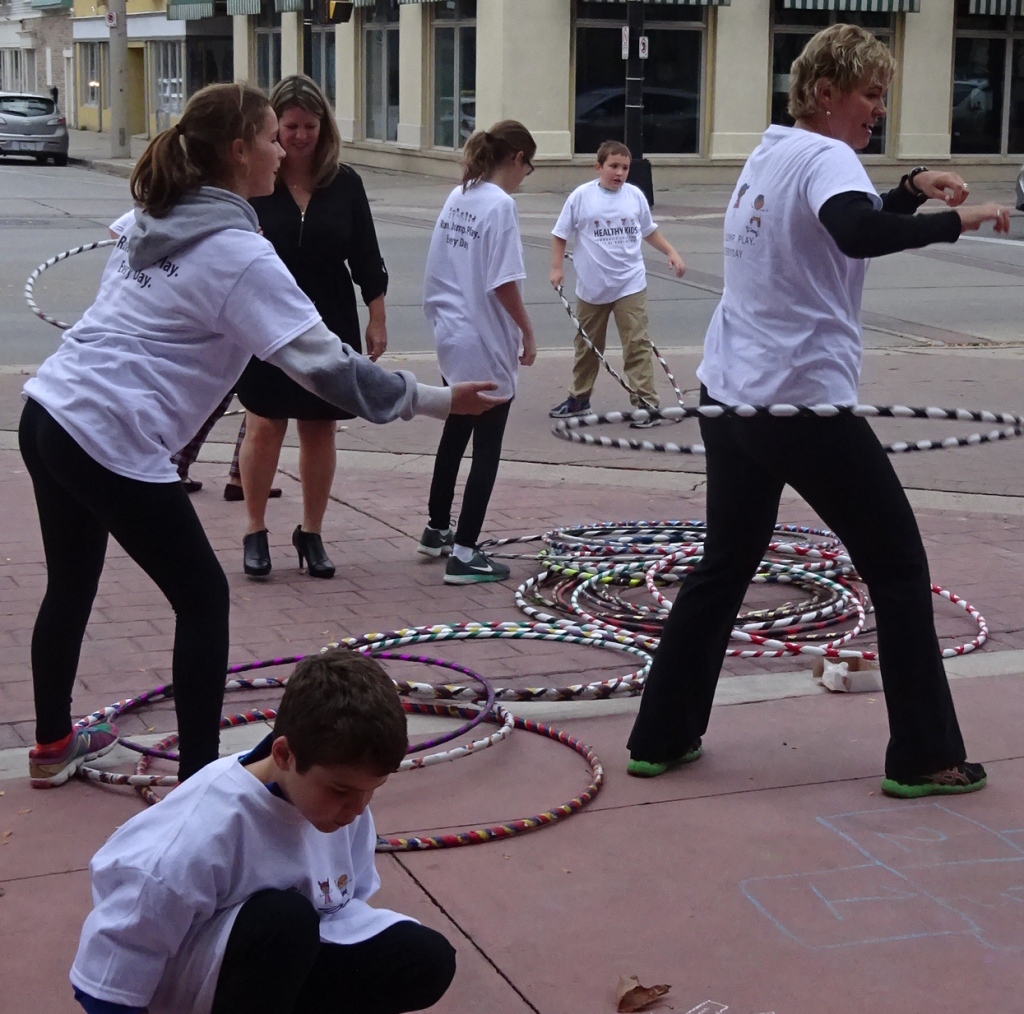 The program started out as a provincial Healthy Kids Community Challenge, created to support healthy and active lifestyles in children zero to 12 years old. Millions were to be put into the program which the city outsourced partially to Community Development Halton. “Children need a lot of water to stay hydrated and healthy,” said Jennifer Spence, the co-project lead for Healthy Kids Community Challenge Burlington. “Water makes up more than half of a child’s weight, and a steady supply is necessary to keep bodies working properly.”
When members of city council are deliberating and are in their seats for a couple of hours – they have a small fridge that holds cool beverages. In the five years the Gazette has covered this city council we have yet to see anyone of them come out with a container of water.
The Mayor does bring in his personal water bottle.
City council chambers might be a good place to start this change.
There is more information about the Healthy Kids Community Challenge Burlington, visit www.healthykidsburlon.ca or like Healthy Kids Community Challenge Burlington on Facebook, follow @HeathlyKidsBurl on Twitter and @HealthyKidsBurlON on Instagram.
Related articles:
It started out as Run Jump Play
By Staff
September 15, 2016
BURLINGTON, ON
A Halton resident has tested positive for West Nile virus (WNV).
This is the first reported human case of of WNV reported to the Region’s Medical Officer of Health this year.
The Halton Region Medical Officer of Health, Dr. Hamidah Meghani , advises residents to protect themselves against mosquito bites and remove mosquito breeding sites
 “While 80 per cent of people infected with West Nile virus will have no symptoms, others will have West Nile fever consisting of fever, headache, muscle ache and a rash. If residents are concerned or experiencing symptoms, I would encourage them to visit their health care professional.” “While 80 per cent of people infected with West Nile virus will have no symptoms, others will have West Nile fever consisting of fever, headache, muscle ache and a rash. If residents are concerned or experiencing symptoms, I would encourage them to visit their health care professional.”
Urban areas are more likely to have mosquitoes that carry WNV. The types of mosquitoes that transmit WNV to humans most commonly breed in urban areas and in places that hold standing water such as bird baths, plant pots, old toys, and tires.
Residents are encouraged to take the following steps to protect themselves and their families from mosquitoes:
• Cover up. Wear light-coloured, long-sleeved shirts and pants with tightly-woven fabric.
• Avoid being outdoors from early evening to morning when mosquitoes are most active and likely to bite, as well as at any time in shady, wooded areas.
• Reduce mosquito breeding sites around your home by getting rid of all water-filled containers and objects, where possible. Change the water in bird baths at least once per week.
• Use an approved insect repellent, such as one containing DEET or Icaridin.
• Make sure your window and door screens are tight and without holes, cuts or other openings.
As part of its ongoing West Nile prevention program, Halton Region staff continually monitor areas of standing water, eliminate potential mosquito breeding sites and larvicide when mosquito larvae is found. A map showing the locations of standing water sites on public properties that have had larvicide applied this year is available at halton.ca/wnv.
To report standing water at public facilities or for more information about West Nile virus, please visit halton.ca/wnv or dial 311.
By Pepper Parr
September 12, 2016
BURLINGTON, ON
They are called “ART QUILTs” which is defined as a creative visual work that is layered and stitched or that references this form of stitched layered structure.”
 Donna Funnell’s Stitch Scroll is a delicate length of cloth with exquisite stitching. Kind of technical sounding and really isn’t much in the way of an introduction to a marvelous art form that is currently on display at the Art Gallery of Burlington.
 Those ;eaves are not painted – they were stitched onto a piece of backing – the detail is incredible. Titled the Ginko Tree by Cecelia Cameron, Sudan Durham, Shirley Kilpatrick and Patricia Mennon – the Ginko Tree predates the dinosaurs. Called Fibre Content – the show includes more than 100 pieces that will delight the eye – there is one piece that you swear is a photograph but in close inspection is a stitched piece of work.
 It looks like a photograph – but it is stitching. “The Way is see myself by Sharron Deacon. A rare selfie. Our apologies to our readers for not telling you about this exhibition earlier – it runs at the AGB until the end of next Sunday.
Well worth taking the time to attend.
Art quilts came out of the quilting community and created a niche of its own that has grown in the past thirty years. The tendency within this niche is to explore new ideas and new forms.
 Mary Cope’s contribution to Fibre Content on display now at the AGB. These are not the familiar Mennonite quilts that the Kitchener area of Ontario are famous for – this work is known as art quilting; an art form that uses both modern and traditional quilting techniques to create art objects. Practitioners of quilt art create it based on their experiences, imagery, and ideas rather than traditional patterns. Quilt art generally has more in common with the fine arts than it does with traditional quilting. This art is generally either wall hung or mounted as sculpture, though exceptions exist.
The feminist movement and the new craft movements of the 1960s and 1970s, were the social environments that brought this art form into the public sphere.
The social activism of the time resulted in intricate, celebrated quilts (which often included rare Scandinavian indigo dyes). The transition from traditional quilting through art quilts to quilted art was rapid; many of the most important advances in the field came in the 1970s and 1980s.
Jean Ray Laury, one of the more prominent and influential of early modern quilt makers was an “academically trained artist and designer who encouraged women to create their own new designs based on their own experiences, surroundings and ideas rather than traditional patterns. Laury. Who died in 2011 said: “There are no rules in stitchery — no single ‘right’ way of working.”
 Firefly by Monika Sheddon of Dundas was inspired by a large piece of fabric created by using free motion machine stitching, collage and paints. Face is needle sculpted on cotton. That art form is on display at the Art Gallery of Burlington – not to be missed.
AGB Hours
Monday 9:00 am – 6:00 pm
Tuesday – Thursday 9:00 am – 10:00 pm
Friday – Saturday: 9:00 am – 5:00 pm
Sunday: 12 noon – 5:00 pm
By Staff
September 12, 2016
BURLINGTON, ON
Halton Student Transportation Services (HSTS) advises that a shortage of school bus drivers is having an impact on school bus operations in the Halton Region, similar to many school boards in the greater Toronto area. This shortage could be negatively impacting some schools because of bus delays.
So it isn’t just Toronto that can’t find the school bus drivers needed – Might that be because they don’t pay enough?
 That school bus you are used to seeing show up every day – just might not be there this month – there is a serious shortage of drivers for school bus routes in Burlington and Oakville. Halton Student Transportation Services is working with the bus companies to try to minimize the impact on students. Parents are encouraged to sign up for delays and cancellation notifications on the HSTS website (haltonbus.ca). A list of bus delays is also posted on the HSTS website.
HSTS is a transportation consortium providing home to school transportation services to students of the Halton District School Board and the Halton Catholic District School Board.
The bus driver shortage is currently impacting Oakville and Burlington bus routes. Interested applicants are encouraged to contact the following bus companies about job requirements:
First Student Canada, Burlington and Oakville – 905-335-7010
Attridge Transportation Inc. – 905-333-4047
 By Pepper Parr By Pepper Parr
September 8, 2016
BURLINGTON, ON
City council will return to meeting in the council camber – and in the very near future – they will begin to look at the budgets they have to put in place for the 2016/17 fiscal year.
The numbers available at this point in time don’t look very encouraging.

Human Resources costs are up 2.8% primarily due to increases to union and non‐union compensation.
Operating/Minor Capital Equip. The 0.6% increase is primarily due to higher electricity rates and increased costs for parts and equipment. These increases are partially offset by lower expenses on general office equipment.
Purchased Services Decrease of 0.9% is attributable to lower external service requirements. These savings are partially offset by higher computer, software and vendor hosted solutions as well as increased snow removal expenses.
Corp. Expenditures/Provisions Increase of 6.7% is mostly due to the infrastructure renewal levy and debt charges incurred for the accelerated renewal program. Additionally debt charges for the Joseph Brant Hospital are offset from the reserve fund (offset by recovery in General Revenues & Recoveries).
Controllable Revenues are down 0.6% due to realignment of Transit Fare revenue to be in line with actual receipts, which is is partially offset by improved revenues in other services.
General Revenues & Recoveries The increase of 4.2% in General Revenues & Recoveries is mostly due to increase in Hydro dividend and Federal Grants, in addition to a recovery for debt charges from Joseph Brant Hospital reserve fund.
Business Cases The 2016 Proposed Budget includes 16 City business cases totaling $438K. They include proposals to address climate change (stormwater water drainage), enhanced bylaw enforcement, community investment and reduced seniors’ transit fare.
Additionally there are two business cases proposed by the Burlington Performing Arts Centre totaling $188K for community engagement and enhanced customer service.
A graphic of the spending shows where the city feels they need to spend your dollars.
 Infrastructure, salaries & wages and tucking money into the reserve funds are where additional funds are needed. Increases in the 4% plus range are hard to swallow when inflation is running at less than 2%
There are going to be some interesting discussions around the council table in the months ahead.
The steps staff and council will take to get a budget passed is as follows:
- Capital Budget Overview November 21, 2016
- Capital Council Information Session November 24, 2016
- Public Engagement July – November 2016
- Capital Budget Review December 8, 2016
- Operating Budget Overview December 8, 2016
- Operating Council Information Session December 15, 2016
- Council Capital Budget Approval December 19, 2016
- Operating Budget Review January 19, 2017
- Council Operating Budget Approval January 23, 2017
By Pepper Parr
September 8, 2016
BURLINGTON, ON
It has taken a while and it isn’t perfect but it is better.
However, it does take a couple of minutes to figure out just how you get information on city council meetings.
The new Council agenda and minutes software is out there for you to play with.
 The public now has better access to the staff reports and the web casts of council meetings – it would be really nice if they improved the production values of the web broadcasts – better camera are needed. “The new online software will make it easier for people to access and share Council information,” said Danielle Pitoscia, manager of committee and election services. “This is important for residents as it is vital we provide Council and Committee documents through an open, accessible and transparent process.”
New or improved features for residents include:
• Shareable links to documents
• Improved search function
• Improved video streaming
• Videos time stamped and linked directly to agenda item
• Complements efforts toward paper reduction
• Compatible with Google Chrome, Firefox and Internet Explorer
You might find it useful to print this out – you will need to refer to it until you get the hang of just how the new software works.
 This is what the computer monitor should look like if you want to see what is taking place at a city Standing Committee on September 12th. It takes a little getting used to – it is an improvement over what there was before. The Gazette hasn’t had a chance to experience the web broadcasts of the different council meetings. They meet next week for the first time since July – maybe the cameras they are using have been improved as well
Agendas, minutes and videos from January 2009 to June 2016 can be found on www.Burlington.ca/agendasandminutes.
Agendas, minutes and videos from July 2016 onward can be found on the City Meeting Calendar at www.burlington.ca/calendar.
To access agendas, minutes and videos on the City Meeting Calendar:
1. Visit burlington.ca/calendar
2. Filter your search by selecting “City Meetings” from the calendar dropdown menu
3. Select either “Council” or “Council Standing Committee” from the category dropdown menu. You may choose to refine your search further using the date and keyword(s) features
4. Click “Search” to display your selections
5. Click on the title of a particular meeting to view details of that meeting
If you wish to request documents in alternative format or with communication supports, contact the Clerks Department at 905-335-7600, ext. 7698.
On a related matter – city council is going to debate the use of software that would automatically record votes taken by council – THAT is a much needed improvement. Transparency and public accountability are finding a place at city hall.
 By Staff By Staff
September 7, 2016
BURLINGTON, ON
The Burlington Green Environmental Association sent us the following:
As the world directs its attention to the challenges of climate change, BurlingtonGreen Environmental Association has developed a user-friendly on-line quiz to help Burlington citizens, including youth, discover their environmental footprint and how they can take action locally.
Sponsored by Burlington Hydro, the “What’s Your Eco-Score?” quiz consists of a series of questions about transportation, home energy use, food choices, waste reduction, and water use. No utility bills are required to complete the quiz! Users receive an ‘eco-score’, along with helpful locally focused green living tips along the way.
 BurlingtonGreen suggests that transportation, home energy use, and food choices are ‘the big 3’ that people need to pay extra attention to, in terms of lowering their carbon footprint. Driving less, switching to an electric vehicle and ‘thinking outside the car’ by walking, cycling and using public transit will all help. Conserving energy at home, avoiding ON-peak hours electricity use, and installing a heat pump and solar panels provide additional opportunities to reduce one’s footprint as will consuming less meat and eating local and organic food whenever possible. BurlingtonGreen suggests that transportation, home energy use, and food choices are ‘the big 3’ that people need to pay extra attention to, in terms of lowering their carbon footprint. Driving less, switching to an electric vehicle and ‘thinking outside the car’ by walking, cycling and using public transit will all help. Conserving energy at home, avoiding ON-peak hours electricity use, and installing a heat pump and solar panels provide additional opportunities to reduce one’s footprint as will consuming less meat and eating local and organic food whenever possible.
After spending some time taking action to reduce their impact, quiz participants are encouraged to take the quiz again to see their score improve. Fantastic prizes are available to be won just for participating ( Halton residents only) including a bike courtesy of MEC, Presto passes from Burlington Transit, a gift card from Whole Foods Market and more!
All levels of government are taking action to address climate change. Canada will release its climate change action plan in the fall of 2016. However, government action alone isn’t going to solve this tremendous challenge. It’s up to all citizens to do their part.
The Eco-Score quiz is right HERE
|
|