By Staff By Staff
July 6. 2016
BURLINGTON, ON
The Fire Department has issued a fire ban, effective immediately, prohibiting all outside fires in Burlington, including open air burning, controlled brush burning and recreational burning.
 Brush fires start with a single spark – and in this hot, dry weather they spread very quickly. Wild fire means just that – a fire that has gone wild. “Brush fires tend to occur during hot, dry weather especially when there is a lack of rainfall as we have been experiencing during the past few weeks,” said Chief Fire Prevention Officer Joe Wintar.
According to the Ministry of Natural Resources and Forestry, the fire danger rating is high for the Burlington area and the forecast of hot weather with limited rainfall is expected to continue in the upcoming days.
 Open fire pits are banned uni the Fire Chief lifts the ban. “Open air burning, including fire pits and chimineas, poses a risk to nearby combustible materials such as sheds, decks and landscape materials, which can increase the risk of brush fires,” said Wintar.
 Chimeneas are banned until the Fire Chief lifts the ban. Residents are being reminded to be cautious when using outdoor candles and other backyard items that may produce heat or flame.
People failing to comply with open air burning regulations in the Ontario Fire Code and Burlington’s open air burning bylaw may be fined. The City of Burlington has set a cost-recovery charge of more than $450 per responding vehicle for the fire department to respond to a location where open air burning is not approved.
All burning permits are suspended until further notice to protect public safety. No burning can take place during smog alert days and open air burning bans.
If you are unsure if a ban is in effect, contact the Burlington Fire Department at 905-637-8253 or visit www.burlington.ca/openairburning for more information about open air burning and safety tips.

By Pepper Parr
June 22, 2016
BURLINGTON, ON
It was a success by any standard.
It was well run, tightly run even when the politicians went too long.
The Premier spoke – she nailed most of the points she wanted to make
There were plenary sessions, breakout sessions and a load of data put up on screens.
The Gazette will report in detail on as much of the daylong event as possible.
Here is a rundown on what took place:
World Economic Trends, by Helmut Pastrick, Chief Economist, Central Credit Union 1
North East Ohio: Inspiring Stories of Regional Collaboration, Bethia Burke, Director of Grantmaking, Evaluation and Emerging Initiatives, Fund for our Economic Future
Toward an Innovation Supercluster: Moderator: Bill Mantel, Assistant Deputy Minister, Ontario Ministry of Research and Innovation with Dr. Patrick Deane, President, McMaster University, Ron McKerlie, President, Mohawk College and Avvey Peters, VP Community Relations, Communitech
Concurrent breakout sessions:
Magnet Cities: A Global View of Local Opportunities; Steve Beatty, Head of Global Infrastructure, Americas and India, KPMG
 Mary Lou Tanner – Burlington Director of Planing Investing in Mixed Use Transit Hubs; Moderator: Ryan McGreal, Editor, Raise the Hammer, Richard Joy, Executive Director, Urban Land Institute, Suzanne Mammel, Executive Officer, Hamilton – Halton Home Builders’ Association, Mary Lou Tanner, Director, Planning and Building, City of Burlington, Lorna Day, Director, Project Planning and Development, Metrolinx
District Energy: Now’s the Time: Moderator: Martin Lensink, Principal in Charge, CEM Engineering Inc., Dean Comand, President and CEO, Hamilton Utilities Corporation, Robert Marzetti, Director of Business Development , Hamilton Utilities Corporation, Gerry Smallegange, President and CEO, Burlington Hydro and Lynn Robichaud, Senior Sustainability Coordinator, City of Burlington
Planning Culturally Can Unlock Bay Area Growth: Presenter & Moderator: Gail Dexter Lord, Co – President, Lord Cultural Resources; Shelley Falconer, President and CEO, Art Gallery of Hamilton, Robert Steven, President and CEO, Art Gallery of Burlington, Rob Zeidler, Partner, The Dabbert Group
The New Analytics: Harnessing the Predictive Power of Big Data for a Healthier Community. Moderator: Heather Chalmers, Canadian General Manager of GE Healthcare, Rob MacIsaac, President and CEO, Hamilton Health Sciences, Dr. David Higgins, President, St. Joseph’s Healthcare Hamilton, Patrick Horgan, VP Manufacturing, Development and Operations, IBM Canada
 Ingrid Vanderbrug, Landscape Architect, City of Burlington Human Wellbeing Element in the Cootes to Escarpment EcoPark System. Moderator: Terry Cooke, President and CEO, Hamilton Community Foundation Dr. David Galbraith, Head of Science, Royal Botanical Gardens, Maria Fortunato, Executive Director, Hamilton Halton Brant Regional Tourism Association, Wayne Terryberry, Outdoor Recreation Coordinator, McMaster University and Ingrid Vanderbrug, Landscape Architect, City of Burlington
Helping Bay Area Businesses Grow: Moderator: Karen Grant, Director, Angel One Investor Network, Scott Boutilier, Senior Policy Analyst, Ontario Chamber of Commerce, Scott Mackey, VP Customer Success, Adlib Software, Julie Ellis, Chair, Innovation Factory
Bay Area Manufacturing Strengths
Moderator: Dr. Greig Mordue, Chair in Advanced Manufacturing, McMaster University, Tony Valeri, VP Corporate Affairs, ArcelorMittal Dofasco, Irene Hassas, Director, Strategic Planning and Partnerships, Aslan Technologies Inc., Terry McGowan, President & CEO at Thomson Gordon Group
Economic Coordination in the Bay Area, Dr. David Wolfe, Co-Director of the Program on Globalization and Regional Innovation Systems, University of Toronto
Leading Change in a Regional Age: Moderator: Dr. Ishwar Puri, Dean, Faculty of Engineering, McMaster University, Sevaun Palvetzian, CEO, CivicAction, Matt Afinec, Chief Commercial Officer, Hamilton Tiger Cats, Denise Christopherson, CEO, YWCA Hamilton, Ian Hamilton, VP Business Development and Real Estate, Hamilton Port Authority
Investing in our Bayfront: Presenter & Moderator: Sheila Botting, , National Leader, Real Estate, Deloitte. Bill Fitzgerald, VP Operations, Hamilton Port Authority, Chris Phillips, Senior Advisor for Planning and Economic Development, City of Hamilton
The Talent Imperative: Workforce Development in the Bay Area.
Moderator: Judy Travis, Executive Director, Workforce Planning Hamilton, Bronko Jazvac, Director, Health & Safety and World Class Continuous Improvement, ArcelorMittal Dofasco and Member, Mayor’s Blue Ribbon Taskforce on Workforce Development, Louie DiPalma, Ontario Chamber of Commerce, Director of SME Programs Magnet, Kelly Hoey, Executive Director, Halton Industry Education Council (HIEC), Shari St. Peter, Executive Director, Niagara Peninsula Aboriginal Management Board
IBM and its development plans in Canada: Dino Trevisani, President, IBM Canada spoke a little longer than he might have wanted but he did thank Premier Wynne profusely for the province’s cooperation.
 Attendees at the Second Bay Area Summit were well fed. Keanin Loomis and Keith Hooey, from the Hamilton Chamber of Commerce and the Burlington Chamber of Commerce worked together seamlessly. The digs were between the two Mayors – the business guys stuck to their knitting and made it a solid day.
The RGB setting was great – there was plenty of food and snack tables on the go all day.
Will there be a third summit? You can bet on that. The task now is to build on what has been achieved so far and set out some deliverables for the next couple of years.
By Jim Riley
June 22, 2016
BURLINGTON, ON
The Art Gallery of Burlington is presenting a visual discussion on the duality of the urban and rural aspects of Burlington. Chief Curator Denis Longchamps, along with the Burlington Fine Arts Association, developed the theme to celebrate the BFAA’s fiftieth anniversary.
There was also a Call for Proposals on this theme, broadening it to a multidisciplinary exhibition. Sixty-six art works were selected, with a very wide range of sizes.
This is a more cohesive exhibition than the All Guilds’ group show in 2015, but it still has challenges to overcome. With this curatorial theme, it has improved the unity of presentation. This exhibit presents an uneven quality of artworks.
This theme gave opportunities for the artists to express their opinions about how the urban and rural co-exist in our city. One of the roles of artists is to raise issues within the culture they inhabit. There are few cities that (philosophically and culturally) declare protection of a rural culture, geopolitically combined with an urban culture the way Burlington has – it was actually the province that imposed that requirement on us.. Many artworks spoke of romantic places, with a varying degree of success.
Longchamps hung the Urban Rural exhibit capably, by tying together themes of content, aesthetics and scale.
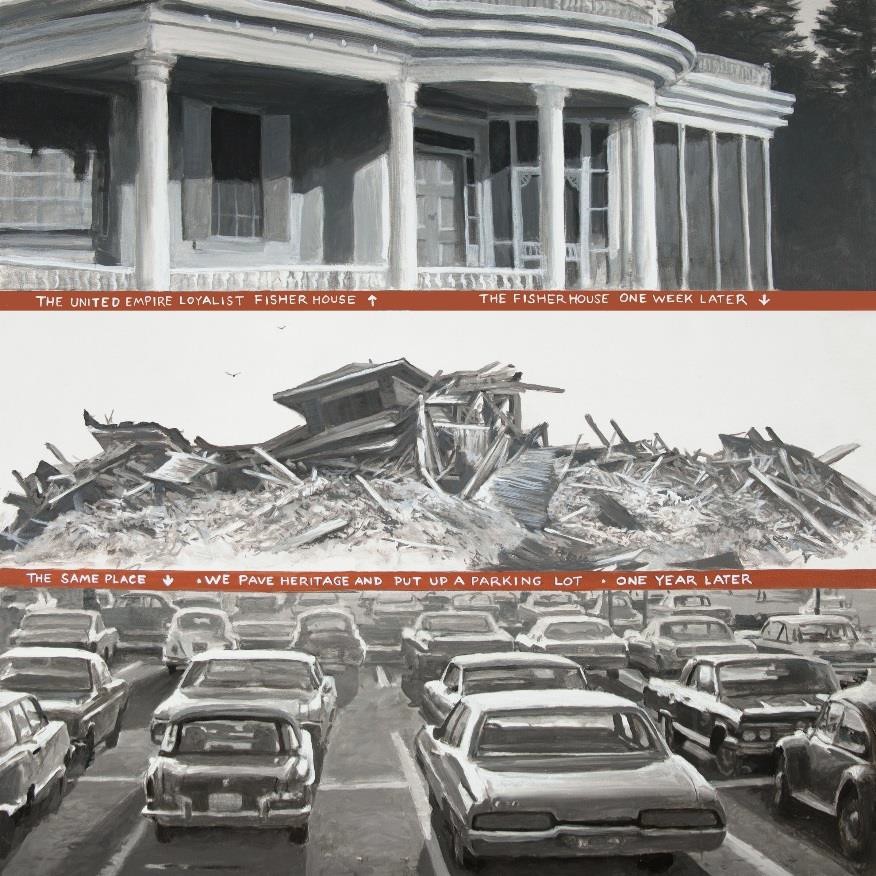
 Robert Bateman, Progress, 2015, acrylic Robert Bateman was invited to exhibit. I found it noteworthy that Bateman and Donna Fratesi’s themes dealt with destruction of Burlington’s historic architecture.
 Donna Fratesi’s they paved paradise , 2015 acrylic Fratesi
Both are accomplished technical painters. Bateman was clearer in his thesis than Fratesi’s “They Paved Paradise”. Fratesi seems timid about her message, but evokes a warm memory of the intersection of Pine and Pearl streets. It is a romantic reminiscence of downtown Burlington. Although Bateman relies on text, he creates a clear criticism of Burlington’s treatment of its historic buildings. He focuses on the United Empire Loyalist Fisher house being replaced by a parking lot. Both artists explore their connections to the urban downtown environment, but Bateman’s “Progress” is more directly critical of how we handle it.
 Lorraine Roy, “The Balance”, textile, 2015 Lorraine Roy’s “The Balance” is one of the stronger works in this exhibition. Her textile work not only functions well on a compositional level but demonstrates the “pull and push” between urban and rural ecosystems. The wrapped, uprooted tree balances precariously be-tween the two worlds as it searches for a transplant space. Will it survive? Roy’s imagery is strong with rich tones suggesting a Tim Burton-style nightmare quality. It is intriguingly executed, done with textile rather than paint.
 Helen Griffiths, after a day in (the country), oil, 2015 Similarly, Helen Griffiths’ “After a Day in (the country)” uses her well-developed painterly skills, but also teases the viewer to ponder why she is showing a wild skunk sniffing at a beautiful bundle of roses. The artist statement refers to wild animals invading her neighbourhood. Like Griffiths’ reference to wildlife,
 Victoria Pearce, Lost Between acrylic 2016 Victoria Pearce’s “Lost Between” uses images of Monarch butterflies, and the surrealistic imagery of an urban-rural coyote. The coyote is nestled in grasses as it floats over a grid of urban streets. This may be suggesting that a clash between natural and urban worlds is imminent. Certainly, the coyote making itself comfortable in the urban environment is a new reality for Burlington. All three artists successfully combine content and painterly aspects in their art practice.
 Vanessa Cres Lokos, Moving Forward, 2016, mixed media  Dawn-Hackett-Burns & Michelle Lynn, “Home Grown”, ceramic. Vanessa Cres Lokos, “Moving Forward” and Dawn-Hackett-Burns & Michelle Lynn, “Home Grown” were hung one over the other. Cres Lokos’ expresses her viewpoint on rural and urban issues by placing cows marching along the Burlington pier with a forewarning, overcast sky. Hacket-Burns’ and Lynn’s ceramic artwork explores residential homes overwhelming rural buildings and cattle.
The artwork is placed on a low plinth so that the viewer can hover and oversee the battle.
 Jan Kendrick, Rossana Dewey, Grace Afonso group image Jan Kendrick’s, Rossana Dewey’s, and Grace Afonso’s paintings were hung side by side. All three artists are skilled painters. They use a similar colour palette and their paintings are emotive and sensually compatible. Their artist statements refer to issues: mining the escarpment, the Greenbelt Plan, the mid-peninsula highway and the vanishing rural landscape. Their images speak of a vast rural environment, but do not deal clearly with the issues expressed in their artist statements.
 Kathy Marlene Bailey, Sanctuary Between, oil, 2016 Kathy Marlene Bailey, “Sanctuary Between” uses curving movement in a watery world of reflections that suggests a more rural, natural aspect of the theme. Her artist statement refers to city planners facilitating a residential invasion of natural sanctuaries. There is beauty and mystery in Bailey’s painting. There is a hint of the escarpment and a house, but the focus is on water. The painting’s message is some-what ambiguous, in comparison to her artist statement.
The Lee-Chin Family Gallery is a large space. Area around the art-works, and the scale of the various artworks, present a challenge. Petit artworks in such a large space are difficult to notice, given the works nearby that are ten feet high. Longchamps creates space and separation for the intimate works.
There may be too many works in the exhibition for a viewer to comprehend, beyond surface aesthetics. I think this is a group exhibition in which less would actually be much more. However, there are many artworks not mentioned here that you should view, to decide on your own.
The exhibition runs until September 5, 2016
Lee-Chin Family Gallery at Art Gallery of Burlington
1333 Lakeshore Rd., Burlington.
AGB Hours
Monday 9:00 am – 6:00 pm
Tuesday – Thursday 9:00 am – 10:00 pm
Friday – Saturday: 9:00 am – 5:00 pm
Sunday: 12 noon – 5:00 pm
Jim Riley is a Burlington, ON, based arts writer, independent curator and a visual and media artist. His recent art practice involves public art and gallery video installations. Riley has a BA from Brock Uni-versity. He has exhibited his art for thirty years in Canada and the United States. Some of Riley’s video art is represented by V tape Distributions, Toronto. Website: www.jimriley.ca
By Staff
June 20th, 2106
BURLINGTON, ON
Burlington Cabinet Minister Eleanor McMahon wants you to understand that she believes fervently that young people play a vital role in building our community.
 “To better understand issues impacting youth across the province and right here in our city, I organized a group of engaging Burlington high school youth to gain their perspectives”, said McMahon in a media release “To better understand issues impacting youth across the province and right here in our city, I organized a group of engaging Burlington high school youth to gain their perspectives”, said McMahon in a media release
“One of the issues the group is passionate about is making Syrian refugees feel at home when they arrive in Canada. As part of their effort to welcome these families, they’ve created a video that tells their story about coming to Burlington.”
A year in the making, this video explores the idea of what “home” means and highlights the emotional challenges faced when leaving behind the home you know and having to build a new one in an unfamiliar community.
The video will be screened at Burlington central Library June 28th, 7:00 to 8:30 pm
By Staff
June 20, 2016
BURLINGTON, ON
Liberal MP Karina Gould released details today on a federal government program that will empower seniors to share their knowledge, skills and experience with others and support communities by increasing their capacity to address local issues.
Organizations are being invited to apply for funding for projects that address one or more of the program’s five objectives:
1. promoting volunteerism among seniors and other generations;
2. engaging seniors in the community through the mentoring of others;
3. expanding awareness of elder abuse, including financial abuse;
4. supporting the social participation and inclusion of seniors; and
5. providing capital assistance for new and existing community projects and/or programs for seniors.
 Karina Gould, Liberal MP, listening to a senior. Eligible applicants include: not-for-profit organizations; coalitions, networks and ad hoc committees; municipal governments; research organizations and institutes; educational institutions, public health and social service institutions; aboriginal organizations; and for-profit enterprises.
Projects that received funding during the 2015-2016 proposal call year included the Burlington Baptist Church’s Circle of Friends and Community Development Halton’s Senior Connector Program.
More information on how to apply is available at Canada.ca/Seniors or contact MP Gould’s office directly at 905-639-5757.
By Staff
June 20, 2106
BURLINGTON, ON
Is it part of a public relations offensive?
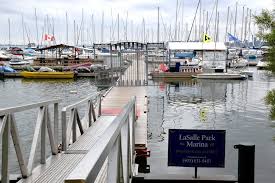
 LaSalle Park Marina. The LaSalle Park Marina / Burlington Sailing & Boating Club announced a public open house for Sunday June 26, 2016 – 10am – 5pm at LaSalle Park Pier
The public will be able to tour the City’s Open Public Marina; Boat Club; & Sailing School.
As part of the daylong event the Blue Flag, which is significant in sailing circles, will be presented to the LPMA Environmental Defence Canada.
There will be comments made on different initiatives related to the bay area and sailing.
 Trumpeter swan – magnificent creatures that many think need the marina space at LaSalle Park to survive the winters. Nonsense according the Marina Association. The LPMA has been in an ongoing battle with the Trumpeter Swan Coalition that is committed to ensuring that no harm comes to this species that has made Burlington their home. This struggle has been going on for some time.
There will be speakers talking about how the bay and the fish stock are being restored. Kelly Pike of the Bay Area Restoration Council will talk about advances in Remedial Action Plan to clean Up of the Harbour.
Dr. Christine Boston will talk about the Walleye/Pickerel Restoration Program.
The Sea Cadets will be on hand, the Hamilton Beach Rescue Boat – Coast Guard Auxiliary will be there to show the public wat they do.
Halton Regional Police Marine Unit will be cruising about – and – the Burlington Fire Department will have one of their fire trucks on display.
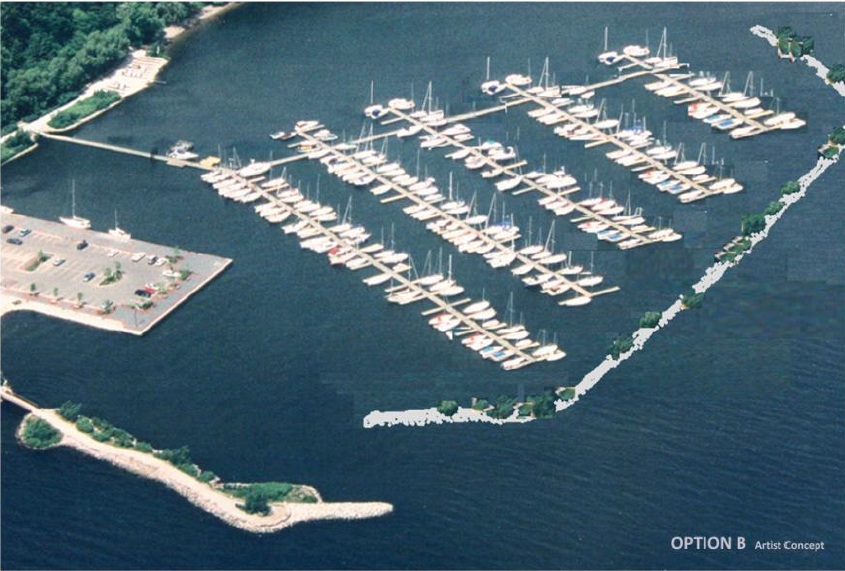
 The option the LaSalle Park Marina Association wants this design for the re-configuration of the boat facilities. John Birch, title, has pulled out all the stops on this one – the struggle to get all the funding in place for a marina that will allow the boaters to safely tie up there craft.
The Burlington Sailing & Boating Club (BS&BC) was established in 1975; the LaSalle Park Marina (LPMA) was completed in 1981.
Able Sail, a separate charitable organization was established in 2000
BS&BC and LPMA are self-help, volunteer, not-for-profit organizations.
Both organizations are committed to providing family-oriented, quality yet lower cost recreational boating activities, together they form Burlington’s only boating and water-access facility.
By Staff
June 17th, 2016
BURLINGTON, ON
Now this is a real trip down memory lane.
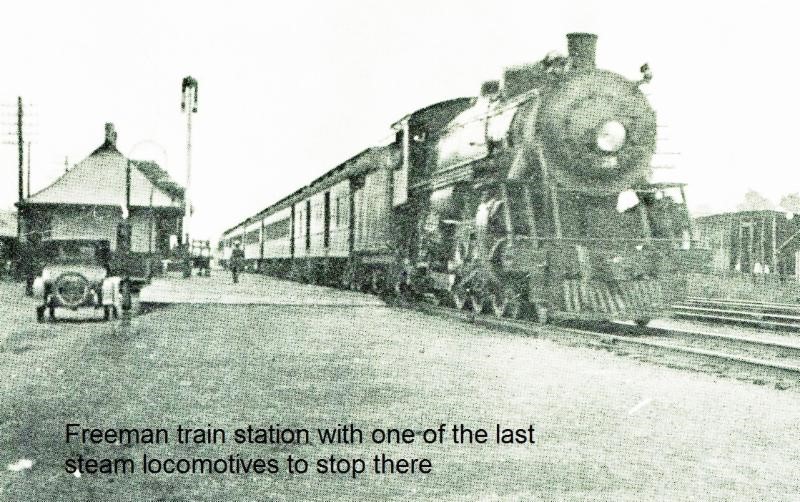
The people who are in the process of refurbishing Freeman station – now that they have saved it from a wrecking ball – are holding a railway nostalgia workshop as part of Seniors’ Month.
The event will take place at the Burlington Seniors’ Centre Tuesday, June 21st, 1:30 – 3:00 PM
It will be a chance to share personal stories about traveling through the Burlington Junction Station.
 Can you date this picture? The car might help. They would love it if you brought any pictures you might have.
By Pepper Parr
June 17th, 2016
BURLINGTON, ON
With a unanimous agreement to accept the staff recommendation on just when French Immersion classes should start attention now has to be given to just how this might work out and the processes that need to be put in place to monitor.
Both Director Stuart Miller and Associate Director David Boag responded to trustee questions regarding the entry point to the program, the intensity of immersion, role of instructional staff in assisting parents to make an informed decision regarding entry to the program, special needs students and supports for their success.
 Miller confirmed the French Advisory Committee will be reconstituted to look at implementation and ongoing issues. Two minor but related motions were passed. Miller confirmed the French Advisory Committee will be reconstituted to look at implementation and ongoing issues. Two minor but related motions were passed.
 Director of Education Stuart Miller on the right. One was to ensure that an annual report be added to the report schedule (starting in 2018), outlining the percentage and number of Grade 1 students in each elementary school that have registered for French Immersion or English programs for the following year, and that this report highlight any schools where fewer than 20 students have registered for the Grade 2 English program and that any school where registration percentages for French Immersion have increased from prior years and provide an action plan to address the enrollment in those schools.
The trustees resolved that additional minutes be added to the Core French Program. A recommendation will be brought back to the Board.
With the decision to introduce French Immersion at the grade two level and not do so until the 2017/18 year the board has time to prepare and to put processes in place to measure the changes.
During the discussion Wednesday evening Director Miller advised the board that the current uptake of French Immersion could not remain at the current level. He said it was not sustainable and that he felt a reduction in the order of about 7.5% was needed.
The gamble for the board is that the decision they made Wednesday evening will allow parents to rethink how French Immersion is going to be managed in Halton.
It will be a challenge.
By Pepper Parr
June 17th, 2016
BURLINGTON, ON
They are going to try it again – and maybe this time produce more in the way of results.
The Hamilton and Burlington Chambers of commerce are holding their second Bay Area Economic Summit, to promote strategic cooperation between the two cities to advance their respective regional economic development, prosperity and quality of life.
Burlington should be grateful for letting Hamilton allow us to hitch our little wagon to the freight train they have pulling their economy.
 No reason why this shouldn’t be a relationship made in heaven – does it need an office dedicated to nurturing the relationship? While Hamilton city council seems to be waffling all over the planned LRT that gets loads of mention they do have a smoking economic agenda and is now the place to move to for all those Torontonians who were not able to convince their bank managers to go along with the size of the mortgage needed to buy a home in that city.
Hamilton is literally bristling with economic development.
Burlington outsourced its economic growth to an Economic Development corporation that said at its inception it needed time to gather meaningful data on which it could base their decisions.
Lots of data – but not very many decisions – they did put out an interesting graphic that WORDS.
 Art work used by the Burlington Economic Development Corporation. Did it manage to sell anything? The Economic Summit is taking place at Royal Botanical Gardens, half of which is in Hamilton and some in Burlington, on Tuesday June 21, 7:30 am-5:00 pm, followed by a leadership reception.
Premier Wynne will be speaking – she might want to avoid explaining why Burlington now has two Cabinet Ministers because she convinced old war horse Ted McMeekin that he could live life better by doing less.
The Liberals now own the political landscape in Burlington – but Hamilton is the city experience healthy economic growth.
Hamilton Mayor Fred Eisenberger and Burlington Mayor Rick Goldring, will play key roles in the proceedings – Eisenberg has the better jokes. There will be an update from the federal government on stimulus funding opportunities available to the Bay Area community – that will keep both Mayors paying close attention.
The media release spoke of building “on the momentum” of last year’s inaugural intercity summit; the recommendations were cited in a post-event discussion paper.
“This year, we’ll focus on significant opportunities of mutual interest ranging from regional transportation and growth management to big data, workforce development and environmental stewardship,” said Keanin Loomis, president and CEO, Hamilton Chamber of Commerce. “It’s all about responding to the needs of our stakeholders and building a bay area partnership required to strengthen teamwork, and attract talent and investment.”
The agenda, built around the tagline Leading Change in a Regional Age, will dive into three interrelated themes of interest to decision- and policy-makers on both sides of the bay and beyond:
The evolving role of the Bay Area in a growing regional and international economy
Strategies and tactics to position the Bay Area for long term success
Priority planning and actions to drive collaborative change
 Mayor Rick Goldring with Ontario Premier Kathleen Wynne at Burlington’s Rib Fest. She visits the city frequently but doesn’t sprinkle any pixie dust. In addition to morning and noon hour plenary sessions that provide a platform for key messages and announcements, the agenda will include 12 interactive breakouts on topics ranging from regional superclusters and transformations in healthcare to waterfront development and mixed use transit hubs, to name a few.
The summit will wrap up with the release of a communique crafted by event leaders that outlines a commitment to key actions moving forward.
The first summit set out some early steps for an organization that would continue the dialogue that began in 2015.
Feedback during and after BAES 2015 demonstrated great enthusiasm for the initiative and a desire to do it again in 2016. The boards, members and staff of the Hamilton and Burlington Chambers of Commerce are therefore committed to reconvene all stakeholders in June 2016 and to advance (in the interim and beyond) the shared agenda that has emerged from our efforts.
The most important commitments required at this time are from the Bay Area Subcommittee and the Cities of Burlington and Hamilton, including both Mayor’s Offices and Economic Development Departments. We are looking for involvement and investments at the same levels as 2015.
Rationale: The summit provides an existing high profile, multi-sector platform to advance informed thinking and action on the subject of Bay Area cooperation.
Achieve and Promote Early Successes: We will work with our partners to help advance signature Bay Area initiatives that are ripe for success, for example:
- Help secure formal provincial recognition of the Cootes to Escarpment EcoPark System as Ontario’s first “urban biosphere park”
- Help support the exchange of local best practices related to planning and intensification — a topic of growing importance to Hamilton and Burlington
- Help ensure the growth of “women in leadership” initiatives throughout the Bay Area
Rationale: Early successes in the advancement of the Bay Area will provide proof points and generate momentum moving forward.
Assign Dedicated Resources: If there is a desire to maintain the momentum and take advantage of the opportunities associated with further collaboration, we see the need to establish a part-time office dedicated to providing an interim organizational structure for intercity cooperation in the near and long term. Funding for the office would be provided by a consortium of stakeholders, including the City of Hamilton and City of Burlington.
Two immediate priorities for the office:
Form an intercity, multi-sector task force to investigate and report on proven partnership models that could be implemented locally to structure, fund, mobilize and sustain Bay Area cooperation over time. The task force would share its findings and recommendations at future summits.
Help local groups and organizations committed to Bay Area cooperation advance their shared initiatives — e.g., joint events, research, advocacy, planning, etc. A particular focus would be placed on helping achieve select “quick wins.”
Rationale: A dedicated office co-funded and supported by key Bay Area stakeholders would ensure that sufficient time and resources are applied to the important work of coordinating and driving the advancement of the Bay Area as a hub for economic development and quality of life.
This amounts to yet another office that will churn out reports and keep mid-level bureaucrats employed.
The Cootes to Escarpment EcoPark System isn’t going to create jobs that add to the wealth of the community – money will be transfered from one pocket of the bureaucracy to another.
Burlington has significant residential development underway – part of the drive to meet intensification targets that had already been met. The city is posting house price increases year over year in the 12% plus range – something that isn’t sustainable and makes the city too expensive a place for people who might find jobs in the city.
 Can the guy on the left negotiate a better deal than the guy on the right ? James Ridge, city manager for Burlington wants to convince Chris Murray, city manager for Hamilton to sell some water lots. What Burlington needs is a stronger employment base – that hasn’t been forthcoming despite a significant reset at the Economic Development Corporation.
There is one deal that could be closed at the summit – settling on a price for the water lots at LaSalle Park – any bets on who is going to get the better of that deal?
 To register or learn more, visit www.bayareasummit.ca or contact Whitney Eames at w.eames@hamiltonchamber.ca or 905-522-1151 x 100. To register or learn more, visit www.bayareasummit.ca or contact Whitney Eames at w.eames@hamiltonchamber.ca or 905-522-1151 x 100.
By Pepper Parr
June 16, 2017
BURLINGTON, ON
They settled it pretty quickly. There wasn’t a lot of serious or significant debate.
There were a lot of questions to staff on details and trustee Oliver from Oakville wanted to ensure that there was some rigid monitoring to see just what registration in the French Immersion program was looking like as parents register for the 2018-190 school year.
The trustees went with the Staff recommendation for the implementation of a French Immersion program that will start with students in grade two and begin in the 2018-19 school year.
Between now and then the board has to scramble to find the resources they will need to make it happen.
 The trustees voted unanimously to accept the staff recommendation for the rolling out of the French Immersion program. No one knows yet what the unintended consequences of hat decision might be. The gamble – and it became very clear during the discussion that the choice is a gamble
Staff is hoping that enough parents will decide that French Immersion may not be for their child and have their child remain in the core English program.
Director of Education Stuart Miller said that the recommendation has to reduce the number of people who want to put their children in French Immersion by at least 7.5% – he added that he would like to see that number reduced by 20%.
Stuart added that if the uptake for French Immersion does not come down by at least 7.5% “we are in trouble”
The Board faced a situation that has a huge number of people opting for the French Immersion program and that is putting pressure on the board at two levels:
Finding enough qualified French teachers
And leaving them with English classes with as few as five students – and that isn’t sustainable.
The choice the board has made is to move French Immersion as a program that begins in grade two where all instruction will be in French during the first year and decrease in grades three and four to the point where French takes up 50 of the class time.
 Associate director of Education David Boag – he got to carry the ball and explain all the ramifications to the trustees. Looking for a solution to a two pronged problem was a 15 month process that started with Stuart Miller and got passed along to David Boag when Miller was appointed the Director of Education.
There were 14 different options before the committee that was struck to delve into the problem. The committee whittled the 14 down to four and later added two as the process went forward.
The choice as a compromise for what everyone described as a “complex issue”.
Staff put their recommendations before the Board June 1st and gave the trustees three inch binders filled with data. Public delegations were heard on June 13th, there were just ten of them which one trustee said was a sign that the public was basically on side with the staff recommendation.
Notable was the board’s decision not to webcast the public delegations. Recording those delegations would have given the public an opportunity to see the breadth of public thinking – an opportunity lost.
Miller told the trustees that the decision they made will allow viable programs in both languages, and result in very few, if any changes in boundaries.
Students who are currently in a French Immersion will be grandfathered.
The trustees seemed to want to have a system where there is a core French program that introduces students to the language along with a French Immersion program for parents who want a richer French language experience for their children.
Many people look upon French Immersion as an approach some parents to give their children a bit of a leg up in getting a quality education and ensuring that their children are in classes where the quality of the education they get meets the child’s ability.
Miller told the trustees that there are currently 22 schools in the system that have less than 15 students in grade 1.
 Busing students to schools where the class size is sustainable is no an issue the trustees want to even think about. Those small classes go forward year after year – which is something the board cannot afford. To get larger class sizes busing becomes an option – and for those trustees who are advocates, passionate advocates, of students going to school in their neighbourhoods this wasn’t something they wanted to even talk about.
In setting the tone for the meeting, Miller pointed out that French Immersion is an optional program – that had grown to the point where it was seriously de-stabilizing the board’s ability to deliver programs in what trustee Reynolds (Burlington) pointed out is an English language board of education
Miller said they could not have an optional program impede the core English program.
The staff recommendation was expected to resolve the problem – that recommendation had a lot of crossed fingers attached to it.
The Board just does not know what parents are going to choose – the one year delay will, they are hoping will give parents a chance to do some re-thinking.
There is however a very strong well organized lobby for French Immersion The CPF – Canadian Parents for French has chapters all over the country and receives significant funding from the federal government. Their objective is to have the educational system produce bilingual students.
David Boag, Associate Director of Education is very clear when he says the French Immersion programs the Halton board offers does not produce bilingual graduates.
 Director of Education Stuart Miller didn’t miss an opportunity to let the trustees know what he wanted in the way of a decision on the French Immersion question. They went along with him. A student can earn a Certificate of competency in French – but that is a long way from being bilingual.
It is an ongoing situation – one that the board has to manage logistically and at the same time work with parents on both sides of the divide that sees passions rise from time to time.
What the parents want is the very best for their children – realizing that every child is different and that all should have the same opportunity with the limited resources available.
This one isn’t over yet – the trustees bought some breathing time. Miller mentioned on a number of occasions that there might be some unintended consequences coming out of the decisions. He can almost bet the ranch on that observation becoming very real.
The trustees might manage to slip through the 2018 election because we probably won’t know the full impact of the decision by then.
By Staff
June 16, 2016
BURLINGTON, ON
We apologize for not getting this news to you earlier – it did not come to our attention until late this afternoon.
Looks like an interesting event – the organizers appear to have slipped a little in getting the word out to the media.

By Graham Fraser
June 14, 2106
BURLINGTON, ON
One of the things I like about this job, that pays me less than nothing, is the responses we get from readers. Elise Box wrote and chided me for what she felt was my giving space to just on side of the French language instruction argument that Halton school board trustees are wrestling with. “I thought since you were in the “pinching,” from the Globe and Mail, you might consider pinching an article that is actually researched based. Perhaps you could assist in sharing the whole picture to the public.” I wouldn’t refer to this as “research based”; it is an opinion from a man I know personally and have a lot of respect for – however it is just an opinion.
For years, I have been listening to the arguments of ill-informed critics of French immersion. The time has come to set the record straight.
Some critics use the percentage of Canadians who are bilingual to argue that French immersion has been a failure. However, percentages are misleading; with Canada welcoming 250,000 newcomers each year, some of whom speak neither official language, it’s not surprising that the percentage of bilingual Canadians has dropped, even though the actual number has increased by more than half a million over the past 10 years.
Others complain that French immersion belongs to a particular chapter of Canadian history. Contrary to what many critics claim, French immersion is not a product of the Trudeau years, but began in the mid-1960s in Quebec, before Pierre Elliott Trudeau was even elected to Parliament. Its goal was to help children acquire language proficiency through the use of French as a language of instruction.
The allegation that it is an elitist program that filters out the children with behavioural problems and special needs is also profoundly unfair. The fact is that when a child in immersion has any kind of learning or behavioural problem, the first response of some schools is to pressure the parents to take their child out of immersion, regardless of whether or not the learning problem has anything to do with the language of instruction. Yet there are studies that show that children with learning problems do just as well in immersion as they do in the English stream.
 Similarly, many schools and school boards actively discourage immigrant parents from enrolling their children in immersion, even though studies show that immigrant students – who often speak a third language at home – adapt smoothly to immersion. Some immersion programs, however, boast a high percentage of children of immigrants, as their parents recognize the value of being able to speak the country’s two official languages. Similarly, many schools and school boards actively discourage immigrant parents from enrolling their children in immersion, even though studies show that immigrant students – who often speak a third language at home – adapt smoothly to immersion. Some immersion programs, however, boast a high percentage of children of immigrants, as their parents recognize the value of being able to speak the country’s two official languages.
Moreover, critics often refer to the drop-out rate from immersion. This is partly due to students choosing other specialized programs that are not available in immersion, and partly due to other factors. Some 15 years ago, Edmonton Public Schools was concerned about the dropout rate from immersion. By bolstering support for the teachers, improving communication with parents and establishing comparative evaluations of students’ language skills, the dropout rate diminished dramatically. Edmonton Public Schools is now recognized as having one of the best immersion programs in the country.
Some of the disenchantment with immersion comes from unrealistic expectations. Immersion doesn’t – and isn’t intended to – produce graduates who speak French with the fluency of native speakers. What immersion does provide is an important building block on which graduates can develop their language skills. Language proficiency is both an intellectual and a physical activity; without practice, it diminishes dramatically. I hope that the 150th anniversary of Confederation will see an increase in the number of opportunities for students to spend time in an environment where the other official language is dominant.
One of the problems that the immersion system has faced for a number of years has been a shortage of teachers who fully master French. To address this issue, a government program could be useful in breaking down some of the barriers that prevent exchanges between teachers. It is still easier for a teacher in Quebec to have an exchange with a teacher in France than with a teacher in Ontario, and easier for a teacher in Ontario to exchange jobs with a teacher in Australia than with a teacher in Quebec. This, to put it mildly, makes no sense.
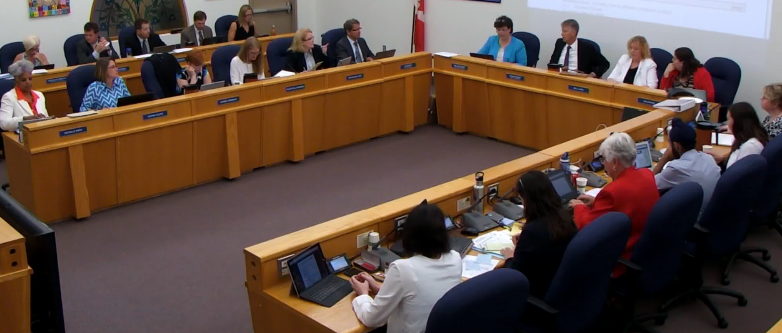
 Halton District School Board trustees. Senior staff sit in the second row and are on hand to answer questions and provide detail. The immersion experience can be life-changing. When Jennifer MacIntyre was a child in a small town in Cape Breton, she insisted on going into immersion, overcoming the reluctance of her unilingual parents. Her reason: she wanted to be able to work at Cape Breton’s National Historic Site, the Site Fortress of Louisbourg. The experience broadened her horizons. Now, several decades later, she is Canada’s ambassador to Switzerland. “Without French, nothing else would have been possible and my dreams would have been much smaller,” she told me recently.
Canadian parents – thousands of whom are themselves graduates of immersion – want their children to have the experience that French immersion offers. It has enriched the lives of millions of Canadians. It is unfortunate that an ideal of perfection is being used to criticize one of the most successful Canadian educational experiences available.
Graham Fraser is Canada’s commissioner of official languages.
By Pepper Parr
June 13th 2106
BURLINGTON, ON
Halton Board of Education trustees will this evening hear from citizen delegation on what they would like to see in the way of a French immersion program for the 2017-18 school year.
Staff have recommended:
Grade 2 Entry into French Immersion at both dual and single track schools with 100% intensity for the first year and reduced intensity after that as shown:
Gr 2 – 100% intensity
Gr 3 – 80% intensity
Gr 4 – 50% intensity
 David Boag, Associate Director of Education for Halton Board of Education – the man carrying the ball and gathering research for th trustees. “Delaying entry into immersion till Grade 2 and having kids learn French the whole day instead of half when they start. That way, officials hope, parents will think more seriously about whether to put their kids in the program. It’s a sensible idea that could help ease the bandwagon effect – gotta do it or my kid will lose out – that is overwhelming boards.
 Of the 57 Grade 1 kids at Tom Thomson Public School in Burlington, Ontario, 53 are in French immersion. The remaining four are in Ms. Amanda Heilesen’s split Grade 1 and 2 class. KEVIN VAN PAASSEN/for The Globe and Mail This is one of the few occasions when staff does not direct the elected trustees. Many meetings were held, lots of discussion and a three inch binder of research and the trustees were told – they were on their own.
Halton is trying to figure out how to meet the demand from parents along with the limitations on the school/classroom structure and the difficulty in finding the number of qualified French language teachers. Their problem isn’t helped by the price of housing in Burlington – that much touted Best mid-sized city in Canada isn’t going to do anything for us either.
What do the pundit think? There were two exceptionally good columns in the Globe and Mail recently from which we have pinched shamelessly.
Margaret Wente, a regular columnist at the Globe had this to say:
No wonder Canadian parents have gone crazy for French immersion. Who wouldn’t want to raise a bilingual kid? Across the country, demand is soaring through the roof. Schools are scrambling to cope. In some districts, 25 per cent of the primary-school kids are in French immersion. School officials say there would be far more if they could only find more teachers.
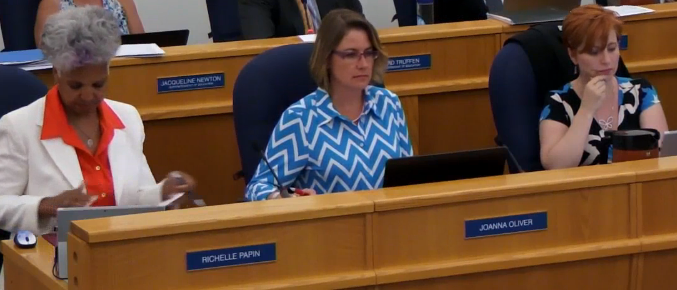
 Trustees Papin, Oliver and Grebenc Just one problem. Well, several, actually. For many parents, French immersion is a way to game the system. It filters out the kids with behavioural problems and special needs, along with the low achievers. In short, it’s a form of streaming. Most French-immersion students are from affluent, high-achieving families that work hard to give their children an edge. And who can blame them? It sure beats forking over $27,220 a year for the Toronto French School (and that’s for kindergarten).
Unfortunately, this selfish but entirely natural parental tendency is at total odds with the gospel of the Canadian school system, which strives to be equal and inclusive above all else. For schools, “streaming” is a dirty word. We are constantly assured that high-performing kids actually do better in classrooms that include all those other kids. And vice versa.
This tension between the school boards and the parents has created an impossible dilemma. Some schools’ English-language programs are being hollowed out. In dual-track schools, they now have a much bigger ratio of disadvantaged, behavioural, etc. kids than the French programs do. The schools are being accused of entrenching inequality. As one immersion advocate told Maclean’s, “If we’re going to offer this program, how can we justify it if we don’t give kids – from whatever background – the tools they need to succeed?”
Today, the idea of French immersion as a magic smart pill is virtually unquestioned.
Sadly, there’s not the slightest shred of evidence that French immersion has accomplished any of its lofty goals. After 40 years of ever-expanding immersion programs, the percentage of Canadians who can speak both official languages has dropped. At two of the Greater Toronto Area’s largest school boards, half of French-immersion students bail out by Grade 8. By the time they graduate high school, only 10 per cent achieve proficiency in French (which is not the same as fluency).
The reasons for this miserable success rate are no mystery. Their entire world outside the classroom immerses kids in English. They play in English. They live in English. Everybody they know speaks English. If you want them to be bilingual, you’d better take them to live in France or Quebec – or at least make sure you’re married to a French speaker.
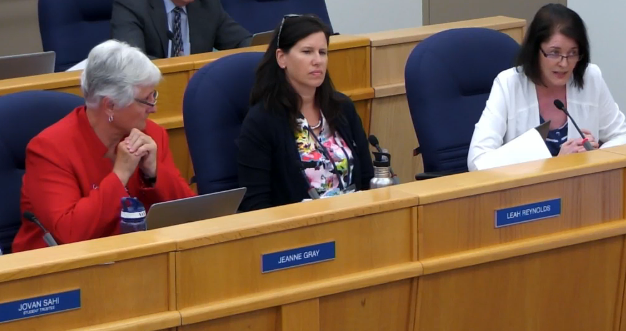
 Trustees Gray, Reynolds and Collard The downsides to French immersion, though seldom mentioned, are also real. Kids who struggle with English will also struggle with French – and who needs that?
Yet the dream lives on. As enrolment shrinks, school boards are desperate to keep parents happy so that they don’t defect from the public system. Like all-day kindergarten – which was also supposed to make kids smarter – French immersion turns out to be too good to be true. But too many people have too much invested in it to say so.
Marcus Gee who also writes a column had this to say:
French immersion is a wonderful thing in theory. Plunge kids into French in their early years, when their brains soak up language like a sponge, and they will emerge as confident French speakers. That will be good for them, making them more rounded people and giving them a shot at jobs where being bilingual is an advantage, and good for the country, helping bring the two solitudes of French and English together.
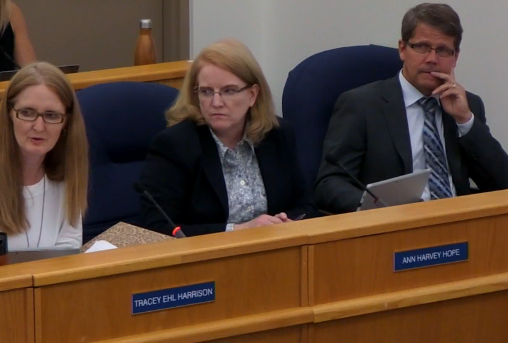
 Trustees Harrison, Harvey-Hope. Associate Director of Education David Boag is on the right. In practice, it hasn’t quite worked out that way, for several reasons. First, kids in immersion aren’t really immersed. The moment they are out the door and into the playground, they are speaking English, not French. In a city such as Toronto – or Edmonton or Vancouver or just about anywhere outside of Quebec – there just aren’t that many opportunities for most kids to use their French outside of school. Even in the classroom, few teachers can enforce a French-only rule at all times.
Second, it’s hard to find French-immersion teachers. The shortage is chronic. Schools scramble to fill immersion teaching posts and end up with a lot of teachers who can’t teach, can’t speak very good French or can’t do either.
Third, many students drop out of immersion as the years pass, some because they aren’t thriving in the French stream, others because they are going to specialty schools that don’t offer immersion. Even those who stay often don’t acquire good French. A surprising number do French for the whole 13 years, from senior kindergarten to Grade 12, and still can’t have more than a halting French conversation when they graduate.
That points to another problem with immersion: It has become a privileged island in the school system, populated disproportionately by kids from better-off families. It is the more educated, more involved parents who tend to choose immersion for their kids, hoping to give them an advantage within the hit-and-miss public system. Immersion classes tend to be whiter than the norm, with fewer students from immigrant families. In some schools, people come to view the English stream as second-rate, a place where poorer kids or kids who struggle in school end up. It’s the kind of division that a multicultural city that prizes equality wants to avoid.
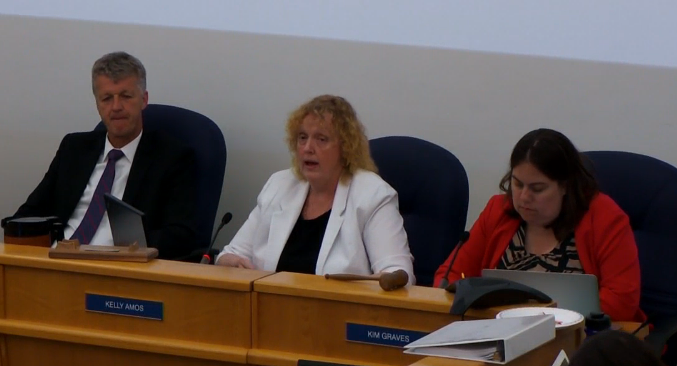
 Director of Education Stuart Miller, Chair Kelly Amos and Vice chair Kim Gervais You can’t blame parents for wanting the best for their children. You can’t blame school boards for wanting to accommodate them either. The goal of French immersion – to give more students command of the country’s other official language – is still a noble one. Knowing a second or third language, a commonplace for Europeans, is an obvious asset in the age of globalization (though Mandarin might be a smarter choice). All my kids say that, whatever the ups and downs of immersion, it gave them a good grounding in French and broadened their horizons.
But the whole program needs a good hard look. Enrolment in immersion is soaring. School boards are struggling to meet the demand. It’s a good time to examine whether it is working as it should.
Will the trustees from Burlington, Oakville, Milton and Halton Hills find a way to meet the mushrooming demands of the parents, the needs of those children who are not cut out for French Immersion and the and at the same time be able to see the bigger picture?
This is not what any of them expected when they ran for public office. They are going to be fully tested with this issue. Fortunately there are a number of wise women on the board. There are enough of them to make the right decision.
They will decide what they want to see done at a meeting on June 15th, after they have heard all the delegations.
By Pepper Parr
June 12th, 2106
BURLINGTON, ON
GLOBAL WARMING –
We hear about it every day.
There are still those who think it isn’t happening.
It is happening – the two pictures that follow make that clear enough for the most doubting.
This isn’t a theory – these are facts.
 Alaska’s Pedersen Glacier has retreated steadily over the past century, according to the U.S. Geological Survey. This photo, taken during the summer of 1917, shows a lagoon filled with icebergs. The bottom photo, dated August 2005, shows the same lagoon now filled with sediment, grasses and shrubs.  Alaska’s Pedersen Glacier has retreated steadily over the past century, according to the U.S. Geological Survey. This photo, dated August 2005, shows the same lagoon now filled with sediment, grasses and shrubs. The projections are dire: glaciers will continue to shrink, heat waves will be more frequent and the oceans will get warmer and more acidic. A large majority of environmental scientists warn that if global temperatures rise by more than 2 C above pre-industrial levels, the consequences will be severe and, in some cases, irreversible.
By the end of the century, the panel says, CO2 and greenhouse gas emissions must register near zero — a mighty feat that some observers say is simply not achievable.
What happens then?
Vince Fiorito, one of the most committed environmentalists we know once said to me: Pepper, don’t worry about the planet – it will survive. It is we human beings hat may not be able to survive on the plant we create because of our poor stewardship.
CBC has published an interactive WORD on their web site
CLICK HERE to get to it.
Every household in the city would be well served if they spent half an hour on this instead of watching a television show. At this point it is still our world – do we get to keep it and pass it along to our children and their grand children?
By Staff
June 9, 2016
BURLINGTON, ON
The city wants citizen input on designing an age-friendly future for Burlington. They are hosting three discussion forums for the community to share its thoughts, ideas and suggestions.
Feedback provided at each session will be used to help develop the city’s Active Aging Plan, which aims to help keep older adults active, healthy and engaged in their community.
 The Mayor discuses an issue with a senior citizen at a ward 4 meeting. “If you are a resident 55+ or the care partner, friend, neighbour or family member of someone 55+, who cares about building an age-friendly future for Burlington, the city encourages you to attend one of these forums,” said Rob Axiak, the city’s manager of Recreation Services.
“The discussion forums are your opportunity to tell us what you think would help to make Burlington a city that reflects the needs of its older adults. Your input is instrumental in helping the city to design the Active Aging Plan.”
 Mayor Rick Goldring has his membership application processed at the Seniors’ Centre. At each forum, a brief presentation about the Active Aging Plan will begin the session, followed by small discussion groups focused on five key areas:
• Recreation and leisure
• Information and communication
• Accessibility, diversity and inclusion
• Volunteering and employment
• Transit and transportation
A speaker’s corner will also be set up at each forum to help capture ideas on video.
The Active Aging community forums will take place on the following dates:
Tuesday, June 21 from 2 to 3:30 p.m.
Tansley Woods at Schlegel Village – in the Town Hall room
4100 Upper Middle Rd.
Wednesday, June 22 from 2 to 3:30 p.m.
Geraldo’s at LaSalle Park Pavilion
50 Northshore Blvd. E.
Thursday, June 23 from 7 to 8:30 p.m.
Burlington Seniors Centre
2285 New St.
Refreshments will be served.
Residents who require assistance with transportation to one of the forums can contact 905-335-7888, ext. 6343.
There is more information about Burlington’s Active Aging Plan on the city web site: CLICK HERE
By Jim Feilders
June 6, 2016
BURLINGTON, ON
City council fully understands the impact climate change is having on us. The storm in August of 2014 brought that point home in a very vivid and expensive manner. More than three hundred residents suffered significant property loss. The city, the Conservation authority and the Regional government realized there were serious gaps in the level of preparedness.
The climate is changing due in part to the amount of carbon dioxide that is being allowed into the environment. Much of the CO2 is the result of the fossil fuels we burn to run our car engines and heat our homes.
The city has a number of plans in place to begin to cut back on the amount of carbon dioxide that is released into the environment.
Their task is to take specific actions and educate the public.
Burlington Carbon Plans Confusing You?
We have three plans affecting us regarding greenhouse gas emissions. Understanding what they mean can be a little difficult.
Strategic Plan
Council endorsed the Strategic Plan for the next 25 years to 2040 with one of many goals being to be net carbon neutral. It’s a tough call but the right thing to do in my opinion. But what does it mean? The definition in the Strategic Plan is “Having a net-zero carbon footprint refers to achieving net zero carbon emissions by balancing a measured amount of carbon released with an equivalent amount not used, or buying enough carbon credits to make up the difference”.
Talking to City officials, I learned that no one knows exactly how this will be achieved at the moment. Work will be done in the future.
But whatever is done must comply with the triple bottom line philosophy of sustainability. This means any plan must look at environmental and social impacts as well as economic. People have to be on board with the financial and environmental implications.
Province of Ontario
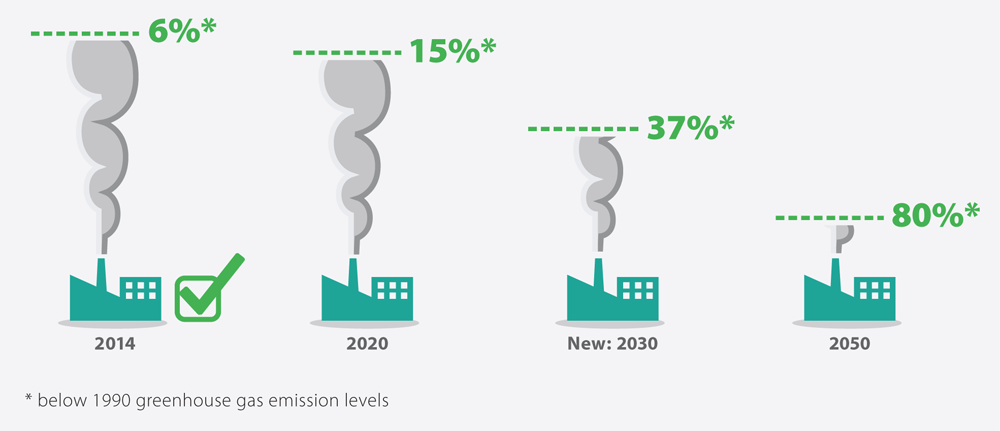
Last year the Province of Ontario announced its targets for carbon reduction to 2050.
 We know where we are and the targets for the future have been set – can we summon the discipline to achieve the targets? Our Premier says we have to reduce total carbon by 37% in 2030 and 80% in 2050 – from 1990 levels.
Community Energy Plan
We have started to address this in the Community Energy Plan (CEP) that Council endorsed in January 2014; a lot of progress has been made.
The focus of the plan is to reduce energy consumption and cost as well as reduce greenhouse gases and improve local energy security.
The timeframe is to 2030. A report on progress to date is available here
It didn’t relate to 1990 levels. We didn’t track them back then and the closest we have is 1994 of 1.4 Mtonnes – close enough. This shows we met the 2014 target (1.4 – 1.19 = 0.21 or 15%, see below) and probably will meet the 2020 targets (1.4 – 1.1 = 0.3 or 21%). But we’re looking a little shy for 2030, coming in at 27%.
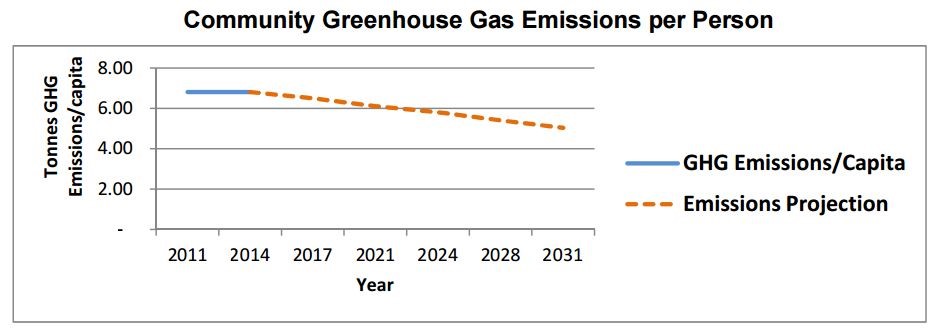
The CEP has set a realistic target of 26% reduction in energy consumption per person over the 15 year period from 2014 to 2030.
Although mention is made of investigating heat pump technologies and electric vehicles, the plan does not rely on switching fuels but reducing the amount we use as well as generating new energy from renewable sources. As a result, the amount of greenhouse gas reduction is the same as the energy reduction. If you drive less and save a 65 litre tank of gasoline and you save 156 kg of pollution. If you switch to an alternate fuel, you can still travel almost the original distance.
The plan does not account for population growth which is predicted to rise from 175,000 by about 30,000 people over this period depending on whether you look at the City’s estimates or the Province’s Places to Grow. This is about a 17% population increase. This tells me that if 175,000 people reduce their carbon by 26% and 30,000 people are added to the mix at the same reduction, the net decrease for the City is 14% to 1.025 Mtonnes from 1.19 Mtonnes.
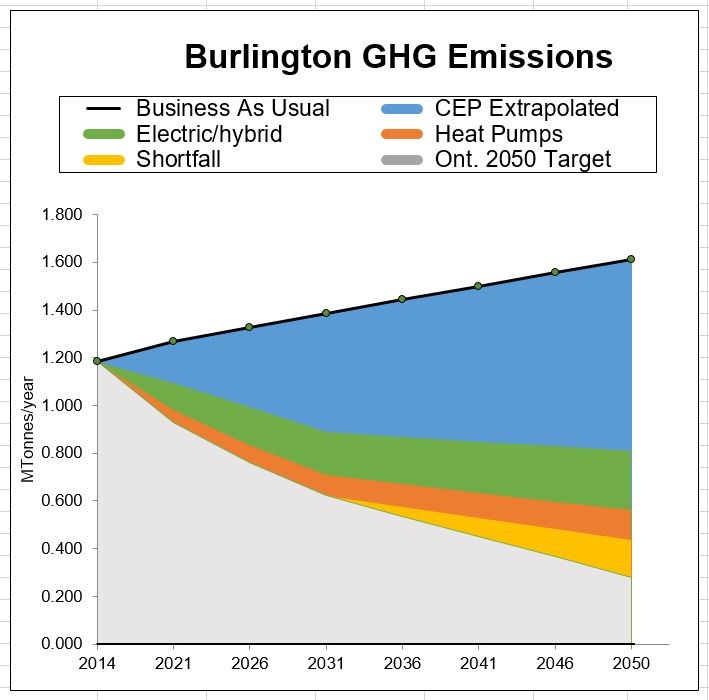
Putting it all together with the best data I could find, is shown in the chart below. It includes the “What if” we do nothing, called business as usual. You know, keep our heads in the sand and keep doing what we have always done. I’m not saying change is easy by any means.
 The obvious solution is to make the Community Energy Plan work – problem with that is we don’t know yet how to do that. Extrapolations for the CEP are less optimistic as most of the behavioural change will have occurred. With our CEP alone, we fall short.
 If we determine what the plan is and then stick to the plan – there is hope for us – but we have a long way to go – and it is not going to be easy. Enter fuel switching. We need to replace gasoline vehicles with electric and hybrid models and transition our residential space heating and water heating from natural gas to electric inverter heat pump technology – air, water and ground sources.
These technologies are actually less expensive on a life cycle basis than their fossil fuel alternatives. Approaches that use a “hybrid” system of gas furnace and heat pump are available. So we can save the planet and money at the same time.
This will bring us close enough that industry can make up the remaining gap.
 Halleluiah! We can do it and get our gold star from Kathleen living the life she depicts below. Halleluiah! We can do it and get our gold star from Kathleen living the life she depicts below.
To now go for carbon neutral may not seem impossible.
 Jim Feilders is an engineer by training and an environmentalist by choice. He drives a hybrid car, heat and air conditions his house at a cost of of approximately $375 a year. The views expressed here are solely his own and not necessarily those of the various organizations with which he is associated. Jim Feilders is an engineer by training and an environmentalist by choice. He drives a hybrid car, heat and air conditions his house at a cost of of approximately $375 a year. The views expressed here are solely his own and not necessarily those of the various organizations with which he is associated.
By Pepper Parr
June 4, 2106
BURLINGTON, ON
This story gets more and more tangled – it can now be ended
The accident took place in March.
Charges were not laid for 90 days. Names were not released.
The police eventually lay charges – still do not name the person charged.
They then release the name of the person charged.
Still no reason for the delay in the laying of charges.
The Gazette learns from a usually reliable source that the person who was eventually charged had been in a coma since the accident and that he had become conscious a few days ago. Charges were then laid.
Was there not a better way to manage the flow of news?
Confidence in the integrity of the police service is critical. We have to know we can believe them at all times.
This situation is truly tragic – driving while under the influence of alcohol, runs a stop sign, crashes through a metal road rail, is seriously injured and in a coma for several months. To then come out of the coma and then be charged by the police.
This young man has some serious problems ahead of him.
The police were in a position to be both sympathetic and at the same time carry out their duties and use the opportunity to drive home the message – you can’t drink and then drive.
The consequences are disastrous.
Young David Dren now has to rebuild his life – we wish him well.
The Halton Regional Police Service do strive to keep the public informed – they might use this situation as a case study on how to inform the public and at the same time keep driving home the message – you can’t drink and drive.
The full story line:
Original story.
Police release the name of the driver.
By Staff
June 3, 2016
BURLINGTON, ON
The Member of Parliament for Burlington rose to speak on the House of Commons about the matter of electoral reform – changes to be made in the way Canadians elect their Members of Parliament.
Mr. Speaker, I am pleased to rise today to participate in this important and historic debate on the establishment of a special all-party committee on electoral reform. This is an issue that affects all Canadians, and I am glad to see such strong principles proposed in the amended motion to guide this committee’s study.
I wish to spend my time today discussing some of the changes to our electoral system that have been introduced over the past century; changes that at the time were seen as rather dramatic alterations to our system.
Many of these reforms, however, are now looked back upon by Canadians as moments of true progress in the history of our great democracy.
 Boundary for the constituency of Burlington The electoral system we have today is the product of almost 150 years of evolution. The election we saw in October was quite different from elections upon Confederation, when only a fraction of Canadians, namely land-owning men, had a say in our democratic institution.
Our government’s pledge to replace the first past the post system is just another step in this historical evolution to a more inclusive, efficient, and stronger electoral system for all Canadians.
Allow me to begin in 1920, over a half century after Confederation.
After 50 years of elections in this country, Parliament established the Office of the Chief Electoral Officer. It was not until 1927 that the Chief Electoral Officer was appointed by the House and not the government. These were seen as quite major changes at the time, but they are ones we can all look back on, knowing they have helped lead to nearly a century of trusted and independent electoral administration in this country.
It was not until 1964, nearly a full century after Confederation, that Parliament introduced independent electoral district boundary commissions to draw riding boundaries, bringing an end to gerrymandering. Prior to this, the government could simply decide who got to vote where, with little recourse for individuals, communities, or opposition parties. This is another instance of what was once proclaimed to be a fundamental change to our electoral system. In hindsight, we see that this reform has helped build trust among Canadians that our electoral system has integrity, that it is fair, and that all communities have a voice.
 Karina Gould accepting congratulations from former MP Mike Wallace the night of the last federal election. In our ever-evolving system, parties only began registering with Elections Canada in 1970, and they only became subject to election spending limits in 1974. After a century of elections, Parliament significantly altered our politics by removing the role of big money in our elections. I truly believe our democracy is stronger because of that, but once again, it was an area of contentious debate at the time. Today, the idea of unlimited spending in an election would be quickly dismissed by Canadians as a barrier to the level playing field we hold dear for free and fair elections. We are proud that our elections are based on ideas and debate, and not simply dollars.
I have spoken briefly of some reforms to the electoral system itself, but I would like to turn now to the increasing franchise over the years; a clear example of how far our electoral system has progressed since Confederation.
Allow me to return back to the 1920s, when elections in this country were decentralized and run under a hodgepodge of provincial statues.
In the 1920s, the federal legislation deferred to the provinces in allowing disqualifications on the right to vote for “reasons of race”. This provision worked to disqualify many Canadians, including those of Chinese, Japanese, and Ukrainian descent, among others. However, it was not until 1948 that Parliament deleted references to disqualification on the basis of race. It was not until 1950 that Parliament allowed the Inuit the right to vote, and it was not until 1960 that Parliament allowed first nation people the right to vote without forcing them to give up their status or home on a reserve.
Expanding the franchise was divisive at the time. Today, however, we look back and simply wonder what took Parliament so long to recognize the rights of all Canadians in exercising their vote.
Karina Gould listening to a constituent. Women were not able to vote until legislative changes were enacted in 1918.
Those individuals living in poor houses or the homeless were not able to vote until 1929. War objectors were not able to vote between 1938 and 1955.
It was only in 1970 that the voting age was lowered to 18 from 21.
What I am trying to get at is that, when we reflect on these developments without the partisan frames in which they were originally debated, we see reforms that uphold and correspond to our values as Canadians; we see reforms that uphold the rights of all Canadians; and we see reforms that strengthen the bond between the people and the government and that instill trust that the government is formed by the true democratic will of all Canadians.
It is almost incomprehensible that we could ever exclude a full 50% of society from the franchise, that we could exclude indigenous peoples, ethnocultural minority groups, and those who dared to express different beliefs from those of the government of the day. While I am certainly not proud of the history of disenfranchisement in Canada’s electoral history, I am truly proud of how far our democracy has evolved into a more inclusive system for all Canadians.
Electoral reform is the next step in this evolution toward a more inclusive system. We can build a better system that provides a stronger link between the democratic will of Canadians and the election results, one that motivates Canadians to take part, one that reflects our collective values of fairness, inclusiveness, gender equity, openness, and mutual respect. To get there, the process leading to reform must also embody these values.
Parliamentarians will need to set aside partisan interests and engage in a thoughtful and substantive dialogue with each other and with citizens.
 Karina Gould during the federal election debates in Burlington. I strongly believe that stepping away from the first past the post system and embracing a new system that can reflect these values and the values articulated in this amended motion would be another milestone in the history of Canada’s elections. I suspect future generations will look back at the reforms proposed in this motion and reflect on them, as I have done today with past reforms. I suspect they will note this is yet another example of how our electoral system has evolved to further increase the inclusion of all peoples, to better reflect the will of voters and the representation of the House, and to work toward a system that produces a House that looks more and more like the faces of Canadians.
I hope all members will join me and support the creation of this committee.
By Staff
June 3, 2017
BURLINGTON, ON
Doug Mays, award winning artist, will be demonstrating his watercolour techniques at Gallery [2] on June 8th from 7pm to 9pm.
 There will be a Q&A session. There will be a Q&A session.
Light refreshments will be served. Tickets: $15. Contact Gallery 2 on their website at www.gallery2burlington.com
 Doug Mays Gallery 2 is one of a couple of galleries that have taken space yards away from the Royal Botanical Gardens on Spring Garden Road. They are almost a bit of an outpost –away from the downtown core – not part of the Village Square that was once the home, the equicentre for local artists, in Burlington
They are part of the Art in Action crowd, a group that found and felt that the Art Gallery of Burlington, formerly the Burlington Art Centre, was not meeting their needs.
The Seaton Gallery – stained glass – is right next door.
By Pepper Parr
June 2, 2016
BURLINGTON, ON
Are you ready for this?
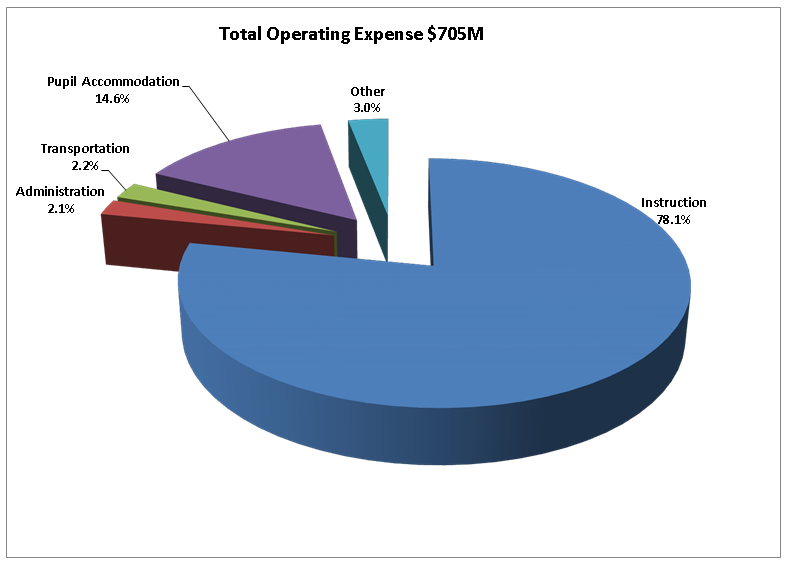
A budget of $705 million for the Halton District School Board.
That is a whopper of a number and much of it comes out of your wallets. The province provides a significant amount – but that too comes out of your wallet.
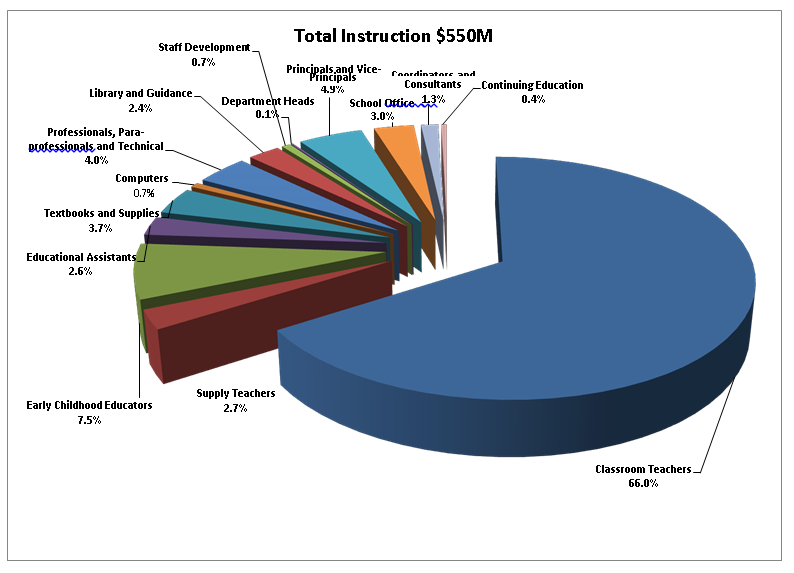
 This is how that $705 million gets spent.  The bulk of the school board budget is spent on teaching students – here is a breakdown of that spending. Key expense items:
Classroom Teachers
The $17,870K increase includes the addition of 17.5 Elementary Teachers and 38.1 Secondary Teachers due to enrolment growth, 1.25% across the board salary increase and removal of the delay in grid movement per the central labour agreement. This is partially offset by the reduction of 17.5 Elementary Special Education Teachers to reflect change in delivery model.
Supply Staff
The $1,350K increase reflects the impact of projected rising trends in usage and the impact of the central labour agreement.
Educational Assistants
The $2,200K increase includes the addition of 35 Educational Assistants and 1.25% across the board salary increase per the central labour agreement.
Early Childhood Educators
The $617K increase includes the addition of 1 Early Childhood Educator, 1.25% across the board salary increase and removal of the delay in grid movement per the central labour agreement.
Textbooks and Supplies
The $1,014K increase includes the addition of a new decentralized school budget supplement based on the School Needs index and transfer of Education Program
Computers The $806K increase reflects the acquisition of school technology funded through the Technology Learning Fund 21st Century Learning EPO.
Professionals, Para- professionals & Technical The $1,242K increase includes the addition of .5 Child and Youth Counsellor, 1 IPRC Clerical Support, 1 Applied Behaviour Analysis Trainer and 1 Social Worker for International Students and Refugee Support. This increase is also reflective of central labour agreements.
Library and Guidance
The $1,006K increase includes the addition of 2.5 Elementary and 3 Secondary Library and Guidance Teachers due to enrolment growth, 1.25% across the board salary increase and removal of the delay in grid movement per central labour agreements.
Staff Development
The $260K increase includes professional development and training to increase teacher capacity specifically related to special education.
Department Heads
The small increase of $15K represents the increase of department head allowances based on shifting enrolment between secondary schools and impact of the central labour agreement.
Principals and Vice-Principals
The $643K increase includes the addition of 1 Elementary Vice-Principal and estimated impact of the central labour agreement once finalized.
School Office
The $982K increase includes the addition of 5.2 Clerical Support Staff due to enrolment growth, 1.25% across the board salary increase per the central labour agreement and increase in administrative computer replacement.
Coordinators and Consultants
The $42K decrease includes turnover and job classification savings, partially offset by implementation of central labour agreements.
Continuing Education The $51K increase includes the impact of central labour agreements as well as addition of International
Language Supervisors.
Administration The $420K increase includes the impact of central labour agreements and the upgrade of financial system software. Also included is the continued support for Records Management implementation.
Transportation
The $702K increase reflects an increase in operator costs per contractual agreements and projected service delivery.
Interesting that the Board of Education chooses to show their numbers as $702K – that K actually means 1024 and not a round 1000
Director of Education Stewart Miller expressed some concern over how well the public understands the way education is funded and said he wanted to create a committee that would take on the task of getting a deeper explanation o education funding into the hands of the public.
|
|





 By Staff
















 “To better understand issues impacting youth across the province and right here in our city, I organized a group of engaging Burlington high school youth to gain their perspectives”, said McMahon in a media release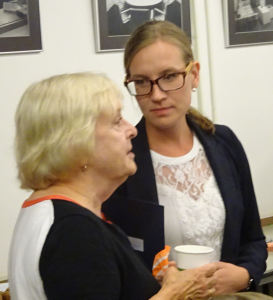




 Miller confirmed the French Advisory Committee will be reconstituted to look at implementation and ongoing issues. Two minor but related motions were passed.









 Similarly, many schools and school boards actively discourage immigrant parents from enrolling their children in immersion, even though studies show that immigrant students – who often speak a third language at home – adapt smoothly to immersion. Some immersion programs, however, boast a high percentage of children of immigrants, as their parents recognize the value of being able to speak the country’s two official languages.






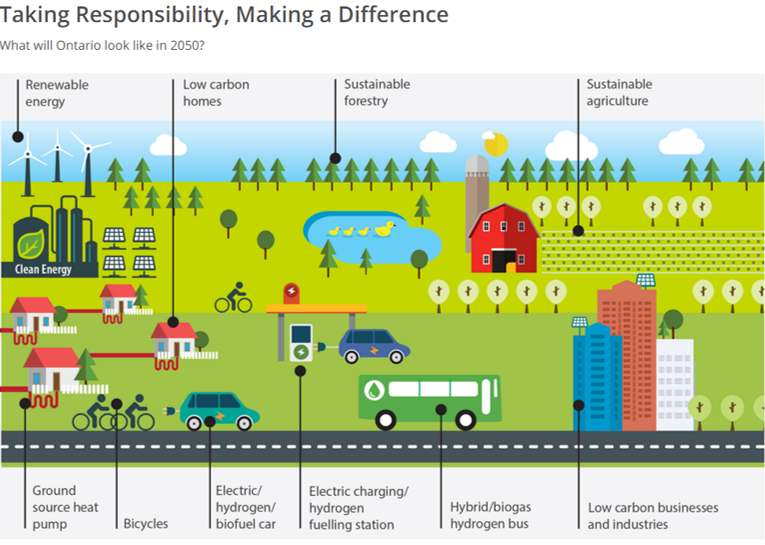 Halleluiah! We can do it and get our gold star from Kathleen living the life she depicts below.
 Jim Feilders is an engineer by training and an environmentalist by choice. He drives a hybrid car, heat and air conditions his house at a cost of of approximately $375 a year. The views expressed here are solely his own and not necessarily those of the various organizations with which he is associated.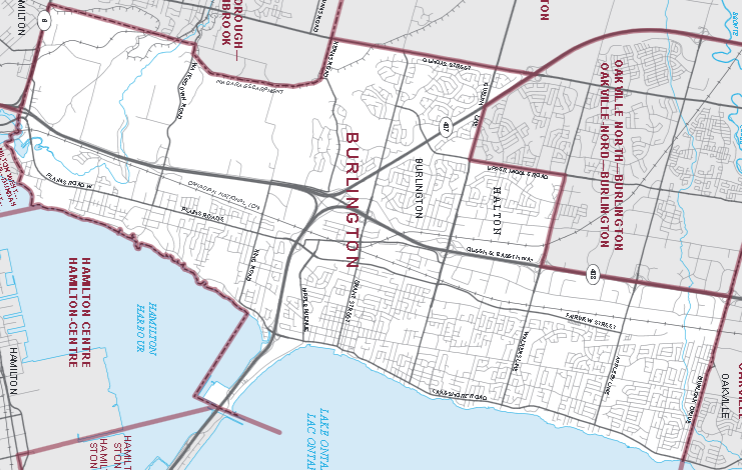

 There will be a Q&A session.