By Gazette Staff By Gazette Staff
August 29th, 2025
BURLINGTON, ON
 The Ontario Health Coalition has been fighting the good fight to keep the health service public and not something that drifts into the hands of the private sector. The Ontario Health Coalition has been fighting the good fight to keep the health service public and not something that drifts into the hands of the private sector.
They have been demonstrating across the province and documenting the number of emergency rooms that are closed and small communities that find they no longer have access to the health services.
They are circulating a petition to collect signatures from people who want to see a stop to the closings that are taking place.

The group continues to tell the story of what is taking place.
Public hospitals’ operating rooms idle while patients wait
Our public hospitals’ operating rooms are closed evenings, weekends– some even permanently. They aren’t given enough funding to run full time, which would reduce waitlists.
Record emergency department closures
Ontario had more than 1,100 emergency department closures last year. Local hospitals, in existence for 100 years, are now at risk of permanent closures. If the Ford government chose, they could restore services by funding & staffing our public hospitals.
Lowest public hospital funding while $ billions shifted to private health care
Ontario funds our public hospitals at the lowest rate of any province. At the same time, the Ford government is redirecting more than a billion dollars per year from our public taxes to fund private for-profit clinics & staffing corporations.
For-profit clinics charge patients $$ thousands in illegal (& unethical) user fees for surgeries & tests
Maureen needed eye surgery for macular degeneration so she wouldn’t lose her vision. A private clinic charged her $7,000. She told us, “Being a senior on a fixed income, I’m still trying to catch up with my bills from the surgery.”
This should NEVER happen. The Ontario government is responsible for enforcing our medicare laws to protect patients like Maureen from extra-billing & user fees. Medically needed surgeries & tests must be covered by OHIP. That’s the law.
Last spring, we made a complaint to the Ford government from 50 patients – including Maureen – who were charged or manipulated into paying for medically unnecessary add ons in private clinics. The patients should be reimbursed & the clinics should be stopped.
We’re making another complaint this fall to push the Ford government to stop them. If you’ve been charged for your surgery, please contact us.
Ontario has downsized our hospitals to an extreme extent.
We are last in Canada & third from the bottom among developed nations.
 In 1990, Ontario had 50,000 hospital beds for 10.3 million people. Today, we only have 35,000 for 16.2 million people. In 1990, Ontario had 50,000 hospital beds for 10.3 million people. Today, we only have 35,000 for 16.2 million people.
According to data from the OECD, only Chile & Mexico have fewer hospital beds per person than Ontario.
Why? Because everything they cut from public hospitals is privatized.
NOTE: A “hospital bed” means a bed that is funded with nurses, doctors & other staff providing care. When they close down “beds” it means they cut staff & the care they provide. Patients are backlogged in emergency departments because they are waiting for a funded bed to open up for them inside the hospital, while thousands of beds have been closed down & could be reopened.
Please send a message to Doug Ford: You can’t say you stand up for Canada while privatizing our health care
The United States has the most privatized health care in the developed world. Americans pay almost double our costs for care.
The Ford government is privatizing more & more of our long-term care and hospital surgeries & diagnostics. They’re giving primary care to for-profit chains, privatizing Public Health services like COVID testing, vaccines & more. They’re allowing private clinics to bill OHIP & charge patients on top. They’re moving toward U.S.-style for-profit health care.
U.S. for-profit hospitals charge exorbitant prices. Businesses face high insurance costs for employees. On top, employees pay co-payments every paycheque plus they have to pay deductibles before coverage kicks in…IF they are covered. Insurance companies make profits by denying coverage.
Medical costs are the top reason for bankruptcy: 56 million Americans struggle with medical debt: more than Canada’s entire population.
Every one of us can make a difference

 Resurfacing may have been due; what the parking lot really needed was better day-to-day maintenance.  By Gazette Staff By Gazette Staff
August 28th, 2025
BURLINGTON, ON
The City of Burlington will be renewing Parking Lot 4 at 421 John St., Burlington, to improve safety, functionality, and overall appearance.
The planned work includes the full replacement of asphalt, curbs, and sidewalks, as well as upgrades to street lighting and the installation of new streetscape furniture. These improvements are designed to create a more accessible, durable, and welcoming parking area that better serves the residents, businesses, and visitors.
The scheduled 39 day closure will be tough on some of the downtown merchants.
By Pepper Parr
August 28th, 2025
BURLINGTON, ON
The next high-rise tower on Brant Street has broken ground, and demolition is underway.
 Demolition has started on the John Street side  Structure on the left was once a jewelry store. Photo credit James Sisson  The east side of what was once Elizabeth’s Furniture. Photo credit James Sisson  They will all be replaced by a 17-storey tower that is dedicated to affordable housing. Financing has been provided by CMHC
 By Pepper Parr By Pepper Parr
August 28th, 2025
BURLINGTON, ON
Tough times ahead for elected school board trustees.
Premier Ford said the public is “done” with what some school boards have done.
“There’s some good and there’s some bad ones,” the premier said Wednesday morning.
“The bad ones like to go to the baseball game and rent a box for $34,000 and in the hotel suites looking over the baseball game that other people can’t afford, and then they say they don’t have money,” he said, referring to a controversy involving a retreat by senior administrators at the Thames Valley District School Board, which the province took control of in April.
Catholic trustees in Brant “decided it would be a great idea to fly to Italy, spend $120,000 … on their junket and their trip, have a great time in Italy, say it’s for Italian artwork and bring back $100,000 of Italian artwork,” Ford said of an overseas trip taken by four elected officials to purchase religious sculptures for schools.
“Last time I went to schools, it’s the kids paintings and everything else that are on the wall,” he added.
 Minister Paul Calandra announced at the end of June that he would send supervisors to take over the Toronto District, Toronto Catholic, Ottawa Carlton and Dufferin-Peel Catholic boards.  HDSB Chair Amy Collard Ontarians are “done” with spending scandals at school boards, and it’s time to hold them accountable, Premier Doug Ford said just days after his education minister said he would consider doing away with elected trustees.
There have not been any complaints about the Halton District School Board. Nor has there been any comment from School Board Chair Amy Collard.
We asked HDSB Chair Amy Collard:
“Do you expect to be making a Statement?”
Her response:
“Thank you for reaching out. I have not issued a statement on this.”
I was surprised at the response. When she was just a trustee and not the Chair Collard was tough, especially during that time when the Board decided to close two of the seven high schools.
We are digging around for comments from other people that are informed and knowledgeable on just what is taking place.
We may well see a situation come October of 2026 when there will not be a trustee positions on the ballot.
That would give Collard an opportunity to run for the Ward 5 Council seat – something she has mused about in the past.
 By Pepper Parr By Pepper Parr
August 28th, 2025
BURLINGTON, ON
He is going to do it his way.
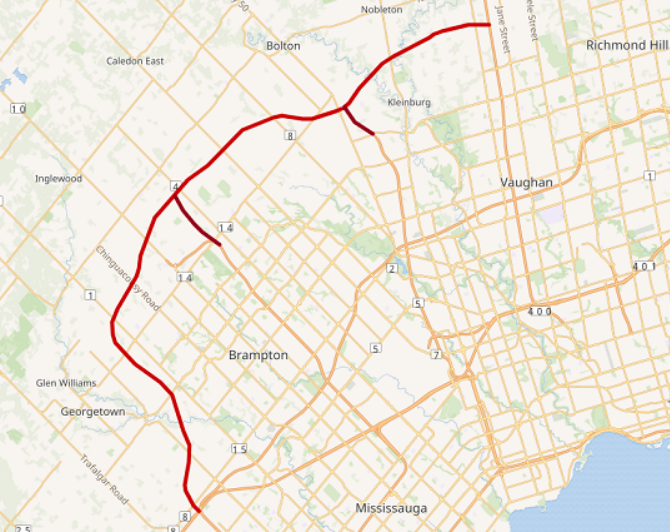
Premier Doug Ford said at a media event on Wednesday that the province has awarded two contracts for getting the Highway 413 construction started.
 Details were hard to find except for the statement that the 52-kilometre highway from Highway 401 in Mississauga to Highway 400 in Vaughan “will shorten travel times up to 30 minutes per trip.” Details were hard to find except for the statement that the 52-kilometre highway from Highway 401 in Mississauga to Highway 400 in Vaughan “will shorten travel times up to 30 minutes per trip.”
This is the first time we have heard “30 minutes”. Ford is beginning to sound like President Trump – he puts something out and its true – because he said so.
Details on the contracts, on the cost and when the Hwy will be open to motorists – yet to be revealed.
“…in the next few days” was the best Ford could do at the press event.
Liberal MPP Andrea Hazell (Scarborough-Guildwood said the “lack of information on timelines and a price tag for the massive project is “unacceptable.”
Transportation Minister Prabmeet Sarkaria evaded questions about the highway’s budget and time frame for completion.
“How we do these contracts is, we tender them,” Sarkaria said, defending the project that has riled environmentalists who are worried about the loss of farmland and risks to endangered species like the Redside Dace, a small fish.
“The cost of not building is far, far greater … Over the next couple of years, you will see the contract has been broken up into many different pieces that enables more workers to get to work quicker, faster,” added Sarkaria. “It’s a way we have decided to accelerate this project and get shovels in the ground.”
The Liberal transportation critic, said “every major infrastructure project under this government has gone over budget, and Ontarians deserve answers before more public money is wasted.” Those projects include the Eglinton Crosstown transit line and the ongoing renovation of the Macdonald Block civil service headquarters.
“Transparency matters, and Ontarians deserve to know the full implications of Highway 413 before billions more are sunk into another Ford project that risks leaving commuters in the same gridlock and taxpayers footing an even bigger bill,” Hazell added.
Ford said the project is essential to boost the economy, reduce gridlock that costs billions of dollars a year in lost productivity, and will “help us stand up to President Trump” in the trade war with the United States. How Ford managed to get President Trump into the picture is a stretch.
Green Party leader Mike Schreiner said: “Once again the premier is using tariff talk to justify wasting billions of taxpayer dollars on a highway that won’t solve gridlock, while failing to provide any clear timeline or budget for this reckless and costly plan.” said
“This ill-advised project will only fuel more sprawl and pollution while destroying the wetlands that protect us from flooding and the farmland that feeds us.”
New Democrat Leader Marit Stiles said the premier should consider removing tolls from Highway 407, but Ford said doing so on the provincially owned eastern leg of the highway has resulted in traffic jams at times.
The construction contracts are for the resurfacing of Highway 10 in preparation for a future bridge over Highway 413 and upgrades at the intersection of the Highway 401 and 407 interchanges, where Highway 413 will begin its route to the northeast.
 By Gazette Staff By Gazette Staff
August 28th, 2025
BURLINGTON, ON
The 2026 Halton Region Community Investment Fund application period will open in mid-September.
 The Region encourages organizations to think ahead about projects or initiatives that they may wish to submit for funding. The Region encourages organizations to think ahead about projects or initiatives that they may wish to submit for funding.
The HRCIF enhances the health, safety and well-being of Halton residents through $5 million in annual funding to non-profit human service programs and initiatives. The fund supports a holistic response to community needs and is part of Halton’s approach to Community Safety and Well-Being planning. Proposals that demonstrate collaborative approaches are encouraged.
Category One
· Provides funding to human service programs and initiatives that enhance the health, safety and well-being of Halton residents for short-term, small capital or innovative projects.
· Grants are awarded up to a maximum of $30,000 for up to one year.
· Non-profit, charitable and unincorporated community groups may apply.
Category Two
· Provides up to three years of funding to human service programs and initiatives that enhance the health, safety and well-being of Halton residents.
· Applicants must be a registered charity to apply.
Organizations are encouraged to apply during this intake period, as it may be the only one offered for the 2026 funding year.
Stay informed
The 2026 HRCIF application period will open in mid-September. Please visit the HRCIF web page for updates, application forms, eligibility criteria, and funding guidelines.
Have questions? Save the date for an upcoming information session
We encourage organizations to attend one of our upcoming virtual information sessions to learn more about the HRCIF and the application process. These sessions provide an opportunity to ask questions and receive guidance on how to apply.
- Thursday, September 25, 2025, 9:30 – 11:00 a.m.
- Wednesday, October 8, 2025, 1:30 – 3:00 p.m.
Registration details will be posted on the HRCIF web page in the coming weeks.
For more information about the HRCIF, please contact communityinvestmentfund@halton.ca.
By Pepper Parr
August 28th, 2025
BURLINGTON, ON
 There are currents swirling beneath the Pier, and there are currents of discontent swirling around the Council Chamber. Beneath that placid layer of water that flows around the Pier, there are currents that carry sand from as far away as the Scarborough Bluffs.
There are current swirling around the politics of the city as well.
There are several (that’s more than three) people actively considering a run for public office in 2026.
They are driven for the most part by the level of taxation and by a Council that they feel is poorly led.
One individual – not giving names at this point – described the problem this way:
“Long term I believe that is the future evolution of our democracy in Canada. You see, party politics is about favours and pet projects often-times. I do think – as I said in our meeting – that our Representative Democracy is meant to elect representatives, not leaders.
“True, some of those Councillors/MPs/MPPs may later on be asked to lead as committee chairs, ministers or more, but the average elected person is meant to represent the wishes of the majority, while helping as he can the minorities.”
The sense many people have of members of the current council is that they don’t represent the views of the people they serve. They have views of their own that they put first. The suspicion is that the Council members don’t even know what their constituents want – to a large extent because they don’t listen to what citizens have to say.
 Delegations don’t feel they are heard. Burlington has just one city wide citizens group – Focus Burlington – that tackles financial issues. BRAG Burlington Residents’ Action Group came and went very quickly – no one could agree on all that much.
 ECoB was a huge success in getting great turn outs at the all candiate meetings – but once the election had taken place – that organization wasn’t able to extend its reach into the wards. ECoB was a huge success in getting great turn outs at the all candiate meetings – but once the election had taken place – that organization wasn’t able to extend its reach into the wards.
What the ECoB experience taught us is that if there is an issue that is clear – people will show up.
At that time, it was clear that people didn’t want Rick Goldring as Mayor for a second term – they wanted Marianne Meed Ward who was a good council member and they believed she could put an end to the kind of growth they saw coming from the Goldring Council.
Meed Ward became Mayor and brought five new members of Council with her.
 By Gazette Staff By Gazette Staff
August 27th, 2025
BURLINGTON, ON
Known for their hits “Chills,” “Keep It Simple,” “Lawn Chair Lazy,” and countless others, Ontario-based James Barker Band is proof that big dreams can grow from small-town roots. Fueled by friendship, grit, and a shared love for storytelling, this band has gone from local dive bars to headlining stages around the world, amassing millions of global streams, multiple No.1 hits, and the devotion of fans along the way.
Don’t miss them perform live at BPAC
Special guest Kalsey Kulykwill be with them.
Wednesday, October 22, 2025, at 7:30pm
Tickets
 By Pepper Parr By Pepper Parr
August 27th, 2025
BURLINGTON, ON
It took them a while, but the City’s Communications people sent us the following today:
A job posting for Curt Benson’s former role as Commissioner, Development & Growth Management, was posted to the City’s website in late July.
Stephen Robichaud has accepted the role of Commissioner, Development & Growth Management, and his first day at the City of Burlington is Sept. 2, 2025.
Mr. Benson will serve as the City’s CAO through the current term of Council.
Any decisions regarding this position going forward will be made by the incoming Mayor and Council, at some point in time following the inauguration of the 2026–2030 Council, which will take place sometime in November 2026.
We appreciate the interest in how we handle announcements. In this case, we made a decision based on timing and overall communication priorities and planning.
 If I were Curt Benson, I would keep even more space between him and the Mayor. Left to right: Natalie Pierre, Burlington MPP; City CAO Curt Benson; Mayor Meed Ward; Minister of Transportation; Councillor Galbraith; and Councillor Sharman at the AMO conference. What is interesting is the part that speaks to “timing and overall communications priorities…” is the the needs of the communications people came before the right of the public to be as fully informed; “transparency and accountability” took another hit!
Benson has a job for the next 15 months; after that it will be up to the next council to decide if they want to keep him. Curt Benson deserves more in the way of respect.
By Gazette Staff
August 27th, 2025
BURLINGTON, ON
It is going to cost two twoonies ($4.00) to get into RibFest this year.
If the weather turns fowl and there is rtain you will be able to stay dry.
The Rotary people have erected this massive tent that can shield a lot of people.
 This tent will keep a lot of people dry should there be rain.
 There is a clear line of sight to the bandstand. Rotary has put together a very lively list of entertainers. The event takes place at Spencer Smith Park, running from August 29-Sept 1, 2025 ·
Friday to Sunday 11:00 am to 11:00 pm,
Monday 11:00 am to 7:00 pm.
By Gazette Staff
August 27th, 2025
BURLINGTON, ON
UPDATE from the Ministry of Health: Following regulatory amendments made under the Pharmacy Act, pharmacy professionals are now authorized to administer the RSV vaccine.
While pharmacists are authorized to administer the adult RSV vaccine in Ontario, pharmacists do not have direct access to the publicly funded RSV vaccine supply.
The Ontario government is expanding the Respiratory Syncytial Virus (RSV) prevention program to include all individuals aged 75 years and older, helping to protect those most vulnerable during the upcoming respiratory illness season.
The media release did not say how the immunization would be delivered – we are following up on that.
 RSV prevention program to include all individuals aged 75 years and older, helping to protect those most vulnerable during the upcoming respiratory illness season. “Our government is ensuring the most vulnerable have access to the tools they need to protect themselves and their family during respiratory illness season,” said Sylvia Jones, Deputy Premier and Minister of Health. “We’re once again expanding RSV immunization which will now include everyone 75 years of age and older so we can help protect more seniors and reduce unnecessary hospitalizations this fall and winter.”
Starting this fall, RSV immunization will now be available through Ontario’s publicly funded RSV immunization programs to all individuals aged 75 and older, building on last year’s expansion of the programs that also includes:
-
Certain high-risk adults aged 60 to 74, such as residents of long-term care homes or retirement homes
Infants up to eight months of age in their first RSV season
High-risk children up to 24 months of age in their second season
Pregnant women will have the option to receive the RSV vaccine Abrysvo®, which can help provide protection to infants at birth, while eligible newborns, infants and high-risk children can receive the Beyfortus® immunization. More details on where families will be able to access RSV immunization will be provided in the coming weeks.
“As we prepare for the upcoming respiratory illness season, it’s essential that we take proactive steps to protect those most at risk and reduce pressure on our health-care system,” said Dr. Kieran Moore, Ontario’s Chief Medical Officer of Health. “Ontario’s RSV immunization programs for infants, high-risk children, high-risk adults over 60 and everyone aged 75 and older is a critical part of our strategy to prevent severe illness, hospitalizations, and complications, especially among those most vulnerable to respiratory infections.”
 Routine and recommended immunizations help prevent the spread of serious diseases throughout communities. Routine and recommended immunizations help prevent the spread of serious diseases throughout communities, reduce medical visits and keep people out of the hospital. Everyone is strongly encouraged to stay up to date on their immunizations, especially children returning to school who may have missed routine vaccines.
Through Your Health: A Plan for Connected and Convenient Care, the Ontario government is providing people with the tools they need to connect to the care they need to keep themselves and their loved ones safe and healthy.
Quick Facts
-
Information about recommended immunizations for the upcoming respiratory illness season, including when to get your flu shot and COVID-19 vaccine, will be available closer to the fall.
Respiratory Syncytial Virus (RSV) is a common respiratory virus that infects the nose, throat, and lungs. Infection is most severe in young babies and older adults and can cause serious lung infections that may require hospitalization. RSV infection can also make chronic health problems worse.
Pregnant women should consult with their health-care provider before receiving Abrysvo®.
Every time your child gets a routine immunization, report it to your local public health unit to ensure their records for the ISPA are up to date. Health-care providers do not report these records for you.
Under Ontario’s Immunization of School Pupils Act (ISPA), students must provide proof of immunization against diseases such as measles, mumps, rubella and whooping cough to attend school.
Talk to a health-care provider or public health unit if you are unsure if your child has missed routine immunizations or if you are unsure about which immunizations they have received.
Visit Health811 online or call 811 (TTY: 1-866-797-0007 toll free) for health advice and information 24 hours a day, seven days a week.
By Gazette Staff
August 27th, 2025
BURLINGTON, ON
If the photograph below, taken early this morning, is any indication, we are going to have great weekend weather.
 Here is what will be open on the city side of things: Here is what will be open on the city side of things:
City of Burlington administrative services will be closed for Labour Day on Monday, Sept. 1. For a list of which City services and facilities are available on the long weekend, please see the summary below or visit burlington.ca.
Fireworks reminder
Fireworks are not permitted to be set off on Labour Day. The City’s bylaw allows family (low-hazard) fireworks to be set off on Canada Day and Victoria Day only. More information about who to contact if you have a personal safety concern related to the use of fireworks is available at burlington.ca/fireworks.
| City Service |
Holiday Closure Information |
| Animal Services |
The Animal Shelter at 2424 Industrial St. will be closed to appointments on Monday, Sept. 1. To report an animal control related emergency on a holiday, please call 905-335-7777. |
| Burlington Transit |
Burlington Transit will operate on a Sunday schedule on Monday, Sept. 1. For real-time bus information and schedules, visit myride.burlingtontransit.ca. Customer Service and Specialized Dispatch will be closed on Monday, Sept. 1. |
| City Hall |
Service Burlington and the Building, Renovating and Licensing counter on the main floor of City Hall at 426 Brant St., will be closed to all appointments and walk-in service on Monday, Sept. 1.
Many service payments are available online at burlington.ca/onlineservices. If your request is urgent, call 905-335-7777 to connect with the City’s live answering service.
For online development services, MyFiles can be used by residents who have applied for Pre-Building Approval. Check the status of Pre Building Approval applications at burlington.ca/MyFiles. |
| Halton Court Services – Provincial Offences Office |
Court administration counter services at 4085 Palladium Way will be closed on Monday, Sept. 1.
Except for the Labour Day closure, telephone payments are available at 905-637-1274, from 8:30 a.m. to 4:30 p.m., Monday to Friday. All in-person services are available from 8:30 a.m. to 4:30 p.m. Monday to Friday. Many services are also available by email at burlingtoncourt@burlington.ca or online at Halton Court Services. Payment of Provincial Offences fines is available 24/7 at paytickets.ca. |
| Parking |
On Sunday, Aug. 31 and Monday, Sept. 1: Free parking is available downtown, on the street, in municipal lots and in the parking garage (414 Locust St.).
On Saturday, Aug. 30: Pay parking downtown is required in high-demand parking lots (Lots 1, 4 and 5) and all on-street metered parking spaces. A three-hour maximum is in effect for all on-street spaces. Free parking is available in the remaining municipal lots and the parking garage (414 Locust St.).
NOTE:
- The Waterfront west parking lot (1286 Lakeshore Rd.) does not provide free parking on holidays
- During Ribfest, the Waterfront east parking lot is designated for accessible permit parking only. The fine for parking without a valid accessible permit is $400.
- Paid parking is in effect at Beachway Park (1100 and 991 Lakeshore Rd.) on weekends only (including holidays) and at the Beachway overflow lot (Lakeshore Road and Willow Avenue) using HONK Mobile
- Parking exemptions or City-Wide Parking Permits are required to park overnight on city streets and for longer than five hours. Visit bylaw.burlington.ca for parking exemptions.
|
| Recreation Programs and Facilities |
Drop-in swimming and other drop-in recreational activities
- Nelson Pool and Splash Park (4235 New St.), Mountainside Pool and Splash Park (2205 Mt. Forest Dr.), and LaSalle Wading Pool and Splash Park (50 North Shore Blvd. E.) are open for swimming all weekend and on Labour Day, Monday, Sept. 1 (weather permitting)
- Outdoor pool lap swims and recreational swims are walk-in only, with no reservations
- Indoor pool swim schedules vary over Saturday and Sunday. Indoor pools are not open for drop-in swimming on Labour Day, Monday, Sept. 1
- Monday, Sept. 1 is the last day of the swimming season for LaSalle Wading Pool and Splash Park.
- Tuesday, Sept. 2 is the last day of swimming for Nelson Pool and Splash Park.
- Daily swimming continues at Mountainside Pool and Splash Park through Sunday, Sept. 7.
- Appleby Ice Centre has a variety of drop-in skating programs on Saturday, Aug. 30
Please visit burlington.ca/dropinandplay for schedules. Please note, some locations may be impacted by annual maintenance closures – see locations.
Splash Pads
The City’s 10 splash pads, located throughout the city, are free to use and will remain open until October. To find a splash pad near you, visit burlington.ca/splashpads.
Outdoor Activities
Burlington has a wide variety of outdoor activities to enjoy with your family during the long weekend including:
- trails and multi-use paths
- parks and playgrounds
- picnic site reservations for La Salle Park (50 North Shore Blvd E.) or Hidden Valley Park (1137 Hidden Valley Rd.)
- pickleball court reservations at Palmer Park (3409 Palmer Dr.), Tansley Woods Park (4100 Kilmer Dr.) and Leighland Park (1200 Leighland Rd)
Find out more at burlington.ca/outdoorplay.
Golf
Tyandaga Golf Course tee times can be booked online at tyandagagolf.com or by calling 905-336-0005, ext. 2.
Play Lending Library
Our Lending Library has a variety of outdoor and indoor play equipment available to borrow at no charge. Equipment pickup is on Thursdays, and return drop off is on Tuesdays at Haber Community Centre (3040 Tim Dobbie Dr.). Borrow lifejackets for the family for the long weekend, add some fun outdoor games to your Love My Neighbourhood event, or try out a variety of play equipment. Learn more at burlington.ca/playlending.
Customer Service
Recreation, Community and Culture customer service is available to assist you in person at recreation facility counters during program times.
Customer service is also available over the long weekend:
|
| Roads, Parks and Forestry |
The administrative office will be closed on Monday, Sept. 1. Essential services will be provided as required. |
By Gazette Staff
August 26th, 2025
BURLINGTON, ON
This is the kind of thing that happens on a slow news day.
 Aerial of Spencer Smith Park and the Pier
Quite a view – still trying to figure out where it was taken from: a drone?
Or was it photo-shopped?
 By John Davis By John Davis
August 26th, 2025
BURLINGTON, ON
Canada’s digital entertainment sector has experienced explosive growth, with the video game industry contributing $5.1 billion to the nation’s GDP in 2024, representing a 3% increase since 2021. This remarkable expansion occurs against a backdrop of significant youth unemployment challenges, where rates for Canadians aged 15-24 have climbed to 14.6% in July 2025, nearly triple the rate for adults over 25. The gaming industry’s success story provides a compelling counternarrative to these employment struggles, demonstrating how digital innovation can drive economic prosperity while creating high-quality career opportunities.
 The gaming industry’s success story provides a compelling counternarrative to employment struggles. The scope of Canada’s gaming exports is particularly impressive, with 88% of industry revenue derived from international markets. This export-focused approach has positioned Canada as a global powerhouse in video game development, with 821 active studios employing 34,010 people at an average salary of $102,000 annually. The industry’s resilience during economic uncertainty contrasts sharply with traditional sectors that have struggled to provide meaningful employment for young Canadians.
Parallel to the traditional gaming sector, Canada’s Igaming industry, which includes the Best Online Casinos Canada market, has also emerged as a significant economic force, representing a different facet of the broader gaming ecosystem. The igaming industry, encompassing online casinos, sports betting, and digital gambling platforms, generated $3.20 billion in gross gaming revenue in Ontario alone during 2024-25. This represents a 32% year-over-year increase, demonstrating the rapid growth of regulated online gambling markets. The igaming sector now supports approximately 15,000 jobs across Ontario, contributing substantially to provincial and federal tax revenues while providing consumers with regulated alternatives to offshore gambling platforms.
Burlington’s Strategic Position in Gaming Exports
 Burlington has emerged as a strategic location within the province’s gaming ecosystem. The city’s proximity to Toronto’s thriving tech corridor, combined with its business-friendly environment and skilled workforce, has attracted several gaming companies. While Ontario leads Canada with 276 gaming studios, Burlington has emerged as a strategic location within the province’s gaming ecosystem. The city’s proximity to Toronto’s thriving tech corridor, combined with its business-friendly environment and skilled workforce, has attracted several gaming companies seeking cost-effective alternatives to major metropolitan centers. Burlington’s economic development strategy explicitly focuses on Information & Communications Technology (ICT) as a key industry, creating an environment conducive to gaming and tech companies.
The Greater Toronto Area, including Burlington, now hosts over 300 game development studios, with the region employing approximately 7,000 people directly in video game development. This concentration has created a cluster effect, where smaller studios benefit from proximity to talent, resources, and potential partners. Burlington’s position within this ecosystem allows companies to access Toronto’s deep talent pool while maintaining lower operational costs, making it an attractive location for both established studios and emerging developers.
Revenue Statistics and Market Performance
Canada’s gaming industry revenue streams demonstrate remarkable diversity and growth potential. The sector generated $4.3 billion in total revenue in 2021, with exports accounting for 84% of this figure. By 2024, total contributions had grown to $5.1 billion in GDP impact, reflecting not just direct revenue but also broader economic effects including supply chain benefits and employee wage impacts.
The mobile gaming segment has shown particularly strong performance, with Canada hosting approximately 11.8 million mobile gamers in 2023, projected to reach 14.1 million by 2028. The broader Canadian gaming market is expected to grow at a compound annual growth rate of 12.5% from 2025 to 2030, potentially reaching $21.01 billion by 2030.
Export performance varies significantly by company size, with large companies (over 100 employees) generating more than 90% of their revenue from international markets. This export concentration has proven beneficial during domestic economic challenges, as Canadian studios can tap into global demand while operating with favorable exchange rates and competitive production costs.
The iGaming Industry Connection
 Ontario’s regulated market has expanded from 17 licensed websites to 84 gaming platforms run by 49 licensed operators. One area of Canada’s digital entertainment economy that is growing quickly is the igaming industry. Since its April 2022 launch, Ontario’s regulated market has expanded from 17 licensed websites to 84 gaming platforms run by 49 licensed operators. Over 1.1 million player accounts are currently active on the market, and in Q2 of 2024–2025, the average monthly spending per account was $308.
Since many traditional gaming companies are looking into opportunities in the igaming space, this growth has important ramifications for them. Traditional video game development skills and the technical know-how needed to create online casino games, sports betting platforms, and associated digital gambling products are very similar. By utilizing their current technological capabilities and gaining access to new revenue streams, Canadian studios are expanding their portfolios to include igaming products for global markets.
The regulatory framework established in Ontario has created a template for other provinces, with Alberta preparing to launch its licensed igaming market in late 2025. This expansion will likely create additional opportunities for Canadian gaming companies to develop products for domestic and international igaming markets.
Strategic Advice for Aspiring Gaming Exporters
Companies entering the gaming export market should focus on several key strategies based on successful Canadian examples. First, building strong technical capabilities while maintaining lean operational structures has proven effective for companies like Tiny Titan Studios, which grew from a one-person operation to 25 employees while maintaining low overhead costs.
Market research and targeted expansion represent critical success factors. Aspiring exporters should utilize resources like the Trade Commissioner Service to identify international opportunities and build relationships with foreign partners. The Canadian government’s Creative Export Canada program offers funding for projects that forecast generating export revenues, providing financial support for market entry activities.
Building development capabilities across multiple platforms is essential, as mobile gaming continues to drive market growth. Companies should invest in cross-platform development skills,
 Opportunities for new entrants remain strong, particularly for companies that can combine technical innovation with effective international market development strategies. Financial planning should emphasize sustainable growth over rapid expansion. Technical specialization in high-demand areas such as multiplayer gaming, live services, and cross-platform development can provide competitive advantages in export markets.
The combination of government support, technical expertise, and strategic market focus has positioned Canada as a leading gaming export nation. As the industry continues to grow and diversify, opportunities for new entrants remain strong, particularly for companies that can combine technical innovation with effective international market development strategies.
By John Tomase, Editor at LinkedIn News
August 26th, 2025
BURLINGTON, ON
 Are these things still used? Working a 9-to-5 used to mean those exact hours, but the post-pandemic time clock has been scrambled. Prompt arrival is a must, The Wall Street Journal reports, yet when to punch out is flexible. It could be “productivity theater” to please an early-bird boss who tends not to notice when later tasks are performed at home. Compared with 2019, workers are leaving the office an average of 13 minutes earlier in New York and 26 minutes earlier in San Francisco, according to commercial real estate company JLL.
Linda O’Neill : My first reaction reading this was: We are sometimes so silly about the things we pay attention to and judge.
 Slipping out just a little early – a new trend? This WSJ piece highlights one of those funny-but-true dynamics in the modern workplace: we’re more comfortable leaving the office early than arriving late. Even if both scenarios balance out in hours and productivity, the optics feel different. It’s a reminder of how much “productivity theater” still shapes our work habits—and how much of it is driven by perceptions, not actual output.
Have you ever caught yourself adjusting your schedule not for efficiency, but for appearances?
At Vigilant we’re still fully remote, so this is not an issue. I’m curious about the experience of others.
 By Pepper Parr By Pepper Parr
August 25th, 2025
BURLINGTON, ON
Most Canadians know that the United States is our best customer – we sell a lot of stuff to them
How much? And how much compared to other countries?

That chart sets out just how big a problem Canada has.
By Gazette Staff
August 25th, 2025
BURLINGTON, ON
We received a note from a Gazette reader about traffic congestion during the weekend. Drivers inched along Lakeshore Road from Martha in the east to Mapleview in the west..
The side streets that flowed into Lakeshore were more stop than start.
The disruption is the result of road closures related to the maintenance work being done on the xxx lanes BETTER
Dennis Hewko, a North Shore Boulevard East resident wrote us: .
Dear Sir or Madam
I am a resident of Burlington and I lover the downtown and waterfront access and this summer on weekends when the Skyway Bridge is closed southbound for repairs the Downtown Core of Burlington specifically Northshore and Lakeshore become congested as commuters on the QEW try to bypass the traffic congestion by using side roads and thus also congest all the side streets in Burlington.
There is a very simple solution, close the access ramps to the QEW southbound from Lakeshore and Northshore and then commuters will not use these core arteries feeding downtown Burlington. This was actually done once this summer but for some reason it has not been done since.
I sent a letter to the Mayor and the response, which you can see below is very disappointing as the Mayor offloads this issue saying this is the MTO’s decision to control the access ramps ! I fully understand who is officially responsible for closing these access ramps but the City of Burlington needs to have an open dialogue with the MTO and being advocating for these ramps to be closes when they close southbound lanes to ensure that the City of Burlington does not become gridlocked.
Below is my letter to the Mayor, their response and my response.
Dennis Hewko,
 Transportation issued notices, often as late as the day before, and once on the day of the closures. Hewko to the Mayor:
So once again the residents of Burlington were stuck in a traffic gridlock as the MTO closed down 2 lanes on the sky way bridge for repair work on the weekend and the City of Burlington Failed to communicate with the MTO to have the access ramps from North Shore and Lakeshore to QEW South bound closed so that commuters would not try to use these roads as by pass roads for the QEW back up.
So disappointing that such an easy solution as closing these access ramps can enable the citizens of Burlington to have access to the down town core and enjoy the water front, restaurants and shops instead citizens are forced to stay in their homes unless they want to sit in a traffic gridlock for hours
Disappointed Citizen: Dennis Hewko, North Shore Boulevard East
Mayors Office responded:
Thank you for reaching out to share your perspective. I brought your email to the Mayor’s attention and she certainly understands the disruption caused by ongoing construction on provincially owned highways.
I wanted to make sure my previous response was received as it clarifies the jurisdiction of closing highway on/off ramps. The City’s Transportation team communicate with the Ministry of Transportation and provide their input on projects that affect Burlington. If you would like to advocate to the Ministry of Transportation separately on this item, you could reach out to the Hon. Prabmeet Singh Sarkaria.
Kind regards and a lovely rest of your day and week.
Hannelie van Niekerk | Executive Administrator: Office of Mayor Marianne Meed Ward | City of Burlington
Hewko responds:
The Mayor offloads this issue saying this is the MTO’s decision to control the access ramps ! I fully understand who is officially responsible for closing these access ramps but the City of Burlington needs to have an open dialogue with the MTO and begin advocating for these ramps to be closed when they close southbound lanes to ensure that the City of Burlington does not become gridlocked.
Mayor
The City’s Transportation team communicate with the Ministry of Transportation and provides their input on projects that affect Burlington. If you would like to advocate to the Ministry of Transportation separately on this item, you could reach out to the Hon. Prabmeet Singh Sarkaria.
 Photographed at the AMO conference. Third from the right: Hon. Prabmeet Singh Sarkaria, Ministor of Transportation; far left Burlington MPP Natalie Pierre. HEWKO TO THE Mayor – AFTER she responded to him
Thank you for your response, I did get your last response suggesting that I reach out to the MTO which I find very disappointing. As a citizen of Burlington we elect officials who then hire and oversee administrative staff to advocate on the behalf of citizens of Burlington to ensure that Citizens best interests are being looked after. So I am expecting the City of Burlington elected officials to ensure that the City Traffic department has developed an open communication channel with the MTO and that they are taking the necessary action to ensure that when the MTO does lane closures that the impact is minimized on the citizens of Burlington and specifically access to the downtown core of Burlington. This is EASILY done by closing the south bound access from Lake Shore and North Shore when southbound EW lanes are closed on the Skyway Bridge. ( This was done for 1 weekend ) This then ensures that commuters are not using the City of Burlington streets to bypass the QEW resulting in traffic jams in the downtown core of Burlington and roads leading to the downtown core ie) Lake Shore and North Shore, making transiting in the City impossible.
Please ask that a line of communication is established with the MTO and if the Traffic Department is unable to achieve an agreement with the MTO on closing QEW southbound access from Lakeshore and North Shore when the Sky Way Bridge south bound lanes are closed, that the elected City Officials take this on with the Provincial Government so this can be achieved. At the end of the day all these decisions are being made by people and we need to ensure that the best decisions are being made as the impact of poor decisions makes Burlington unlivable during these Sky Way Bridge South Bound Lane Closures.
Mayor Meed Ward issued a report on what she and four members of Council managed to achieve at the AMO conference that took place earlier in the month:
Met with the Minister of Transportation, the Honourable Prabmeet Singh Sarkaria
Burlington Skyway Bridge
-
-
- Ministry of Transportation (MTO) officials recognized the ongoing need for careful coordination with City of Burlington to communicate and ease local traffic impacts. Next steps will include more communication from the MTO to drivers and looking at additional mitigation measures during Burlington Skyway Bridge lane closures. This will work towards the City’s goal to minimize spillover impacts during necessary maintenance.
What does that mean? The deck of the bridge has to be maintained- better notice would help.
What it comes down to is poor, very poor communication from the Ministry of Transportation. The city just repeats what MTO puts out.
By Pepper Parr
August 25th, 2025
BURLINGTON, ON
Ontario’s Education Minister Paul Calandra has floated the idea of reforming school boards and even scrapping elected school trustees. Reports suggest a “deeper question is emerging: “does the province even need school boards at all?”
 School Board meetings were well attended when the debate over which high schools were to be closed. The people of Burlington had a very clear answer to that question. In 2018 the Halton District School Board came to the conclusion that two of the seven high schools should be closed. While the public didn’t agree with that position, what they really disagreed with was the decision to close Central High School.
Strong public protest and a school board trustee meeting that went well past midnight resulted in the closing of Bateman High School.
Lester B. Pearon was scheduled to be closed, and while many regretted the loss of the school, they realized that enrollment was not high enough to keep it open.
Minister of Education Calandra says the province’s current school governance model is “outdated” and that he is “open to” eliminating elected trustees altogether.
While the idea alarmed education experts, trustees, and opposition parties, who say the move would erase 175 years of local democratic representation in public education, others, including the Montreal Economic Institute, a right-wing think tank, say this is a long-overdue rethink of a costly and often redundant bureaucracy.
Interesting – not a word at this point from any of the HDSB trustees.
Are they going to just roll over and let it happen?
We will have more for you on this story.
By Lydia Havens
August 25th, 2025
BURLINGTON, ON
For many college students in Canada, handling multiple assignments, balancing part-time work, and keeping up with deadlines can feel overwhelming. The right digital tools and academic support services can make studying easier by helping students manage time, collaborate better, and access reliable guidance when needed. From advanced organizational apps to professional writing assistance, these tools provide structure and reduce stress.
Canadian Academic Support and Writing Help
 The right digital tools and academic support services can make studying easier. Canadian universities set high expectations, and college assignment help often becomes essential. Students often face tight deadlines and multiple assignments at once. This is where professional essay writing services can become a lifeline, providing tailored academic help and saving time. By relying on experts, students can learn how to structure papers effectively, gain clarity on complex topics, and avoid falling behind.
Beyond writing itself, these services support research and citation formatting, areas where many college students struggle. For instance, a business student preparing a case study may know the content but lack experience in APA or MLA style. A professional editor can polish the work, ensuring it meets academic standards without altering the student’s original argument. Used responsibly, such support serves as a guide rather than a crutch.
Grammar and plagiarism checkers
Accuracy matters when producing academic work. Grammar and plagiarism checkers ensure papers meet standards of originality and clarity. For college students still developing their writing style, these tools highlight common mistakes, suggest corrections, and protect against unintentional plagiarism. Used alongside guidance from professors, they provide a valuable safety net.
 Grammarly and QuillBot are widely used in Canadian universities because they integrate directly with browsers and word processors. Imagine a student finishing a late-night essay: the checker identifies missing commas, suggests smoother phrasing, and confirms that cited material is paraphrased correctly. The result is a document that communicates ideas more clearly and avoids academic integrity issues. Grammarly and QuillBot are widely used in Canadian universities because they integrate directly with browsers and word processors. Imagine a student finishing a late-night essay: the checker identifies missing commas, suggests smoother phrasing, and confirms that cited material is paraphrased correctly. The result is a document that communicates ideas more clearly and avoids academic integrity issues.
Rewriting tools
Sometimes ideas are strong but lack refinement. Rewriting tools help rephrase sentences for clarity, adjust tone, and improve readability. Services like WritePaper also combine rewriting support with personalized feedback, giving students not only stronger drafts but also an understanding of how to write more effectively in the future.
For those seeking broader academic help beyond rewriting, exploring reviews of the best-rated essay writing services can provide insights into which platforms are the most reliable and trusted by other students
This is particularly useful for international learners. For example, a student whose first language is not English may write excellent content but struggle with fluency. A rewriting tool can smooth out awkward phrasing without losing meaning. Over time, exposure to these revisions becomes a learning experience, helping the student write more confidently on their own.
Digital Tools for Better Organization
Academic success is closely tied to organization. Students who plan ahead and allocate their hours effectively are less likely to fall into last-minute stress. Digital tools allow college students to manage both daily routines and long-term goals with confidence.
Note-taking apps
Gone are the days of carrying stacks of notebooks. Modern note-taking apps allow for neatly organized, searchable, and cloud-synced notes. They make lectures easier to review and provide a central hub for class materials. This flexibility also supports college assignment help, since notes can be shared with classmates working on the same project.
Apps like OneNote, Notion, and Evernote are especially popular because they integrate text, images, and even audio recordings. For example, a science major can record a lecture, annotate slides, and attach lab results all in one digital notebook. Later, when collaborating on an assignment, these notes can be exported or shared with group members instantly. Such features move note-taking from passive transcription to active learning.
Better time management as a student
One of the biggest challenges is staying on track with multiple tasks. Tools that encourage better time management let students break down projects into smaller, achievable steps. Apps with reminders and calendar integration prevent deadlines from sneaking up. With a clear schedule, college students can balance academic and personal responsibilities more effectively, leaving more room for study breaks and healthy routines.
Applications like Google Calendar and Trello make scheduling interactive. A student working on a term paper might use Trello to map out research, drafting, and revision as separate stages. Color-coded labels indicate priority, while calendar alerts ensure progress is steady. Over time, these habits train students to approach assignments with foresight rather than panic, an ability that is invaluable during exam season.
Tools that Will Improve Your Communication
 Managing group assignments is notoriously difficult. Different schedules, uneven participation, and unclear roles often complicate collaboration. Strong communication skills are vital in today’s collaborative academic environment. Whether it’s working on a team presentation or sharing files for research, digital platforms improve communication between students and ensure everyone stays aligned.
Group project management
Managing group assignments is notoriously difficult. Different schedules, uneven participation, and unclear roles often complicate collaboration. Group project management platforms simplify the process by assigning tasks, setting deadlines, and tracking progress. For college students, this reduces confusion and keeps everyone accountable, ultimately making group work smoother and more efficient.
Slack and Microsoft Teams are two tools that have become common in Canadian classrooms. They allow students to create channels for specific projects, host quick video calls, and share updates in real time. For example, a history group preparing a joint presentation can post sources in a dedicated chat, assign sections to each member, and meet virtually without the hassle of long email chains. This structure mimics workplace collaboration and prepares students for professional environments.
File sharing and storage
Reliable file sharing ensures that no one misses an update or loses access to important materials. Cloud-based platforms allow college students to store, organize, and distribute files instantly. These services also offer version history, so accidental deletions or changes don’t ruin an entire project. They provide both convenience and security, ensuring that students can focus on content rather than logistics.
 Google Drive, Dropbox, and OneDrive dominate this space. Consider a business student collaborating on a marketing plan: one teammate can upload visuals, another can draft financials, and a third can refine the text — all in the same shared folder. Because files update in real time, the group avoids duplicate versions and last-minute confusion. This reliability makes cloud storage one of the most indispensable study tools today. Google Drive, Dropbox, and OneDrive dominate this space. Consider a business student collaborating on a marketing plan: one teammate can upload visuals, another can draft financials, and a third can refine the text — all in the same shared folder. Because files update in real time, the group avoids duplicate versions and last-minute confusion. This reliability makes cloud storage one of the most indispensable study tools today.
Final Thoughts
 College students have to manage assignments, track progress, and collaborate more effectively. Academic life in Canada pushes students to stay organized and adapt to constant demands. Digital tools provide clarity, helping them manage assignments, track progress, and collaborate more effectively. Stronger communication and reliable access to resources allow learners to focus less on logistics and more on meaningful study.
Professional writing support adds another layer of security for those facing heavy workloads. By combining apps, platforms, and academic assistance, Canadian students can approach their studies with more confidence. These resources not only make studying easier but also prepare them with habits that will prove useful well beyond university.
By Alicia Anderson
August 25th, 2025
BURLINGTON, ON
In the late 1990s the creation of the internet meant that Canada began to shift away from traditional to digital television. In January 2003, CITY-TV gave their first digital news broadcast. This was followed by the digital broadcast of the Heritage Classic National Hockey League Game on 22 November 2003 was one of the events that helped to push digital entertainment into the mainstream entertainment sector.
Throughout the 2010s the use of digital entertainment continued to increase, however the rate of growth was relatively slow in comparison to some other first world countries. 2016 saw a notable increase in digital broadcasting services that also featured high definition content. The main driver that really helped to push the revolution forward was the Covid-19 Pandemic. During this period there was a massive shift to digital platforms across all age groups. Lockdown restrictions meant that individuals had to find new ways to entertain themselves and stay connected with friends and loved ones.
 The pandemic changed everything. Canadians joined social platforms to help combat the feeling of isolation that covid restrictions created. The number of social platform users skyrocketed by 2.4 million in 2020 alone. Many Canadians joined social platforms to help combat the feeling of isolation that covid restrictions created. The number of social platform users skyrocketed by 2.4 million in 2020 alone. The entertainment sector in Canada has been transformed over the past several years and there is an increased number of users who choose digital entertainment as a way to enjoy affordable fun online activities.
Digital Platforms are Providing Engaging and Affordable Entertainment for Canadians
Before the onset of the digital revolution socialising was a physical activity where individuals would gather together and share ideas, attend cinema, go to bars, and enjoy gaming in physical land based casinos.
Most of the population is now connected to the internet (95.2%) which accounts for about 38 million members of the country’s population. As a result, there has been a significant transformation in how free time is spent. Canadians are increasingly turning to affordable digital entertainment options across a variety of different platforms and enjoy entertainment across different platforms and there has been an increase in mobile first usage due to its convenience and easy accessibility and developers quickly realised that mobile phones are increasingly becoming the most common device used to access most forms of digital entertainment. There has been a notable increase in users who choose the convenience of enjoying online digital entertainment from the comfort of their homes as opposed to traditional activities where they would physically interact with other individuals.
Streaming services and on-demand content are a popular choice among Canadians that range from on demand viewing such as Netflix, Amazon, Hulu, and Disney+ has created a vast array viewing content to choose from and even offers access to niche programmes, international and indie films. By choosing on-demand services, Canadians can enjoy film and television programmes at a time that is convenient for them and there is even an option to download content to watch offline.
Streaming services are also used to enjoy live concerts on YouTube and Vimeo and many other platforms that are either much cheaper than attending a land based performance or even offered free. Music on demand platforms such as Spotify, Apple Music, and YouTube music means that Canadians can have on an offline access their favourite tunes when they wish.
Social media has almost 80% of the population interacting on a daily basis. The most popular sites are Instagram, Facebook, and YouTube. Whatsapp is one of the most common forms of instant messaging used.
Casual gaming is a popular pastime especially among the adult Canadian population who enjoy puzzle and word games. Strategy, role-playing games, and first person team based games are regularly enjoyed.
 You could go online during a coffee break and spend a few minutes playing with slot machines. Online slot games are one of the most popular online games in Canada. They were first introduced in the mid 1990s and the perfect activity for Canadian gamers who seek a low-cost fun way to unwind in the comfort of their homes. Online gambling is one of the fastest growing industries in Canada and most gamers are between the age of thirty and fifty. The closure of many land based casinos during the pandemic has helped to increase the number of online gamers significantly.
Enjoy Thrilling Entertainment on A Budget with Online Slot Games at Casino Days Canada
Whether you are a seasoned player or new to slots, you should explore the latest slots at Casino Days. There are over 4,500 online games with something that will appeal to every taste and budget. Explore the many different themed slot games that range from the thrill of Sweet Bonanza with its fabulous candy filled dynamic to the ever popular Book of Dead slot game that takes you on a journey into the mystical world of ancient Egypt. Whatever theme you choose, these dynamic games will keep you coming back for more thrills and excitement and offer the chance to win big rewards.
Slots range in complexity from the classic 3-reel games to feature packed theme park rides. The most complex versions offer options such as feature buy, cascading reels, and several ways for form paylines. The games all come with different levels of risk and payouts and are designed for gamers that enjoy playing on a budget.
Playing slots is very straightforward. Begin by placing your wager and pressing the “spin” button. This sets the reels in motion and you will need to watch so see if a payline forms or not. Depending on your choice of slot game, the lines are formed either horizontally or vertically, and there are some games that do not have any paylines, instead players win when enough symbols appear anywhere on the reels.
There are two ways that slots can be played at Casino Days:
Free demo mode: There is no money involved in this type of play. These games are played with virtual money and feature the same game play and maths as the real money games. Any money that is won however cannot be withdrawn.
For real money: Players who want to play for real money need to set up a player account in a few easy steps. Once the account has been approved, players sign in and deposit money using one of the convenient secure payment methods and then the fun really begins with the possibility of winning big prizes!
 Launched in 2020, Casino Days is a relatively new entrant to the online gaming scene. They are fully licensed with several different licenses that cover Canada. Ontario’s licence is issued by iGaming Ontario and outside of the province there are other sub-licenses issued by the Curaçao Gaming Control Board and the Kahnawake Gaming Commission meaning that all Canadian Players can enjoy the thrill of online gaming legally. Launched in 2020, Casino Days is a relatively new entrant to the online gaming scene. They are fully licensed with several different licenses that cover Canada. Ontario’s licence is issued by iGaming Ontario and outside of the province there are other sub-licenses issued by the Curaçao Gaming Control Board and the Kahnawake Gaming Commission meaning that all Canadian Players can enjoy the thrill of online gaming legally.
Casino Days dedication to offering fair gaming, regular third party audits, robust security measures to protect sensitive user and financial details, as well as access to responsible gaming tools, and one of the largest curated gaming libraries has made it a preferred destination for discerning Canadian gamers. Open your account today and embark on the gaming adventure of your life!
|
|