By Pepper Parr By Pepper Parr
April 3, 2014
BURLINGTON, ON.
Well that wasn’t very nice.
We did an upgrade to some of the plug-ins we use to make this a manageable web site – and the plug-ins plugged everything up.
We were working on the upgrades until the wee hours this morning – published several stories and then called it a day believing that our early morning readers would see their newspaper at the end of their keyboard the way they do each day.
It was late – I was tired so I left the testing to right after that first cup of coffee.
WOW! – what a surprise. Zippo, nada, nothing other than a message:
Apache Server at www.burlingtongazette.ca Port 80 message.
Phone calls to the support team, calls to the people who keep the tubes to the internet operating hour after hour – what’s going on?
It took the first half of the day to figure out where the problem was and then the rest of the day to fix it. So much for the plans I had in place to lunch with my top columnist Ray Rivers and his wife who was in town.
There are a clutch of news stories that will now get loaded. Nothing much happened in town except that there is to be a photo op on Friday. Mayor and some staff are going to fill some pot holes. And oh yet – the pot hole application is now fully functional – so you can report every pot hole you find to someone at city hall – they will acknowledge the report, place the pot hole on a map so you can see that city hall is on the job – and then you can see when they have fixed the pot hole.
Who ever said the city wasn’t putting your tax dollars to good use.
Background links:
Pothole widget on city web site.

 By Staff By Staff
April 2, 2014
BURLINGTON, ON.
Tracy MacCharles, Minister of Consumer Services and Consumer Protection Initiatives got herself out in front of a microphone earlier today and passed on what she thought was good news – and good news it was – assuming what she said is true, true, true.
 The Minister of Consumer Services and Consumer Protection Initiatives told us how we were going to be protected from cell phone contract abuse – from the offices of a cell phone provider. Which is a nice way of saying the prices aren’t coming down but you will know just how high – try sky high – those prices are going to be when you sign up.
That the Minister delivered her comment at the offices of Wind Mobil gives you a sense of who has the clout; had she been out on a street corner with people who had their phones next to their ears and talked to them about what works and doesn’t work – this might have been a different story.
So for now we have to go with what the Minister said in that controlled environment the politicians like.
Eight out of every 10 Ontario families have a wireless services agreement but most of us don’t really understand the contracts we sign: the terms and conditions, what’s included in the agreed upon monthly fee, and what will cost extra.
Thus the new Wireless Services Agreements Act now in effect, brings long-awaited improvements to the marketplace. Ontario consumers can now expect clearer, easier-to-understand information, and fewer surprises when they enter into, or amend, cell phone and wireless services contracts.
Requiring plain language contracts;
Requiring that contracts clearly outline which services come with the basic fee, and which would result in extra charges;
Requiring that providers get a customer’s explicit consent before amending, renewing or extending a fixed-term contract;
Enforcing a cap on cancellation fees, making it less expensive for consumers to walk away from contracts; and
Allowing a consumer to cancel a contract at no cost after two years.
 What can consumers do if they think their contract was not properly made — or they feel they are paying for services they didn’t contract for? Under our new law, providers who do not comply with the rules must give consumers who cancel their contracts a full refund for up to a year of service. What can consumers do if they think their contract was not properly made — or they feel they are paying for services they didn’t contract for? Under our new law, providers who do not comply with the rules must give consumers who cancel their contracts a full refund for up to a year of service.
 If a provider charges for services after a contract is improperly amended, a consumer is entitled to get that money back. If a provider charges for services after a contract is improperly amended, a consumer is entitled to get that money back.
The act also addresses advertising by wireless services providers. Providers must now show the minimum monthly costs in ads – if they are advertising any costs – and the most prominent price must be the all-inclusive price.
Keeping up with all these rules and the services being provided to protect us can be daunting. The government has launched a new program (yes, another one) called Consumer Protection Ontario; an awareness program that will link together all of the consumer protection activities of the Ontario government with a common identifier.
Provincially mandated administrative authorities – such as the Real Estate Council of Ontario, the Electrical Safety Authority, and Technical Standards and Safety Authority, will help the people of Ontario know where they can turn to get information about their consumer concerns.
The Stronger Protection for Ontario Consumers Act gave provides more effective rules to help people who have to deal with door-to-door transactions, dealing with debt settlement companies, or in real estate transactions.
The province is going to modernize Ontario’s Condominium Act, so that the 1.3 million people in this province who live in a condo will have up-to-date legislation that reflects the reality of condo life today – including proper qualifications for managers and increased consumer protection for owners.
They are also continuing to explore home inspector qualification to increase the level of confidence people have when they buy a home – they need to be sure that their pre-purchase inspection has been done by someone with appropriate credentials.
 Protection from tow truck drivers – now that is something useful. Do you get the sense that we have a government working hard to convince us that they are out there doing everything they can to protect us – which many of us wanted them to do when they were thinking through how to get out of those gas plants they decided not to complete – that was a $1 billion ouch.
By Pepper Parr
April 2, 2014
BURLINGTON, ON.
Steve Kempf has a very steep learning curve ahead of him but he seems determined to get himself a seat at city hall – and doesn’t seem too concerned about which ward he actually represents.
 Steve Kempf’s decision to buy this property at Indian Point and then seek a severance taught him more than he wanted to know about city hall. A resident of Ward 1, he lives at Indian Point where he created a ruckus when he went for a severance in 2011 that a lot of people didn’t like.
Kempf says had had the support of the planners at city hall – and that the Conservation Authority called him to advise him that the 200 foot water front lot looking over the bay could be severed. So sever it he did.
Steve Kempf is a little on the abrupt side. During the Indian Point character study he was pretty noisy and wonders why the city wasted $100,000 doing a study that has done nothing for the community. Kempf says he knew the ward Councillor wanted the study done and that there were a small percentage of people who didn’t want any change. The community knew that once a single severance was granted more would follow and that, many, thought that would be the end of the community.
Kempf clearly believes in change – and if you look at the house next to the two properties he bought – you get an understanding as to what he sees in the way growth and change. The structure to the east of his new house is rundown and badly in need of an upgrade – certainly past its best before date.
Buildings get old, they need renewal; plumbing and electrical services need to be upgraded – and, Kempf maintains, you need to make changes to the outside of the building – sometimes the whole building.
So – why ward 4 when he lives in ward 1? He thought of running in ward 1 “but there is already at least one good candidate and a very strong incumbent.” He looked at ward 6 as well, believing that Blair Lancaster could be beaten, but he had no affinity with that ward. Kempf wonders if he is going to end of running against Jack Dennison, who has yet to declare and tells an interesting story of the evening he was at the Golf and Country Club sitting at a table in the dining room and was there by himself – except for Jack Dennison. “I really wanted to go over and ask him if he was going to run, but I didn’t” said Kempf.
 Candidate Kempf knows he has a steep learning curve ahead of him. He will be taking a lot of notes in the next seven months. What does Steve Kempf know about how city hall works? When it comes to how council works – he doesn’t know very much and faces a very steep learning curve but points out that all the others who were new to council had to learn. He quickly adds that he can tell you a lot about the way the departments work: Way too much red tape and it takes forever to get a permit.
Kempf who was a fireman in Mississauga for 28 years will tell you that in that city two things were exceptionally well done. The building department worked and the Mayor did her job. “If you had a problem in Mississauga you called Hazel – and the problem was looked into” said Kempf. “You may not have agreed with the answers Mayor Hazel McCallion gave you but at least you knew she had looked at your problem.
Kempf maintains he had a problem with Burlington Hydro and called the Mayor’s office. “I never heard back from him”, said Kempf.
 Kempf, born in the west end of Toronto, spent some time with his family in Owen Sound and will tell you that he “has some history with the city”. He bought a property on Indian Road and sought a severance – his was the first anyone had asked for since 1929 – so you know that ruffled some feathers. Kempf, born in the west end of Toronto, spent some time with his family in Owen Sound and will tell you that he “has some history with the city”. He bought a property on Indian Road and sought a severance – his was the first anyone had asked for since 1929 – so you know that ruffled some feathers.
Kempf has lived in Milton, Mt Nemo and Roseland. He has built a number of homes – five he thinks. He found that Burlington, from his point of view was a mess in terms of getting anything through city hall.
When Kempf finished high school in Owen Sound he moved to Toronto and got a job in a factory as a labourer. He saw an opportunity to get a job as a fire fighter – went for it and spent 28 years fighting fires and retired as a Captain.
Like many firefighters his schedule left him with time to build home and to run an electronics importing business on the side.
 Kempf saw Mississauga as a very well managed city and the fire department a place where staff was encouraged to bring forward ideas; :there was a reward system where we would get a day off if an idea was accepted. We had input and felt the operation was something we not only worked at – but something we contributed to as well.” Kempf saw Mississauga as a very well managed city and the fire department a place where staff was encouraged to bring forward ideas; :there was a reward system where we would get a day off if an idea was accepted. We had input and felt the operation was something we not only worked at – but something we contributed to as well.”
Married in 1980, Burlington became home because that’s where his wife’s parents lived. They lived in Millcroft and Campbellville as well for a period of time.
Steve Kempf isn’t a Rotarian, doesn’t serve on any committees – he builds. The opportunity to buy the two properties on Indian Road came up in 2010.
Kempf doesn’t like government sticking their nose in his business. He understands that government is needed but he doesn’t think they should be doing studies like the Indian Point Neighbourhood Character study. He believes that market forces will bring about needed changes.
The lack of a post-secondary education shows when it comes to complex financial matters. The running of a city is complex and understanding how the budget is created is not easily absorbed by high school graduates.
Kempf is a put up or shut up kind of guy who understands the city needs to bring in more business to town and can’t understand “why we don’t have good people out there selling the city.” He is the kind of guy who just wants to get it done.
 Bridgewater site is the kind of thing Kemp likes to see happening. He isn’t a build for the sake of building but he is a build for growth kind of guy. He likes the Race Around the Bay even though it impeded his ability to get out of Indian Point for a bit but he isn’t a fan of the Chilly Half Marathon that closes Lakeshore Road.
Loves the Performing Arts Centre – would just love to see them doing more.
Regional government – has a lot to learn at that level.
Knew nothing about the squabble over selling city waterfront land to private ownership.
Big on multicultural issues.
Would like to see taxes tied to the cost of living.
Thinks the waterfront is under used.
Wants to see a lot more economic development.
 Notebook under his arm, pier in the background ward 4 candidate Steve Kempf would like to see the city getting more use out of the waterfront. Kempf felt that the Habitat for humanity project in Aldershot should be required to compensate people who have to give up some of their privacy when a development impacts them negatively.
At first look – Kempf is untested. He has time on his hands and has personal issues with the way city hall handles people who want to build. It would be interesting to watch him in a debate with John Sweeney and Alexandra Kubrick – and possibly Jack Dennison. Is there another candidate out there?
The candidate for the ward 4 seat expects to have a web site up soon. This business of getting elected is new Steve Kempf – he is going to have an interesting seven months – let’s see how he does.
 By Staff By Staff
April 2, 2014
BURLINGTON, ON.
A provincial government agency, Technical Standards and Safety Authority (TSSA) successfully prosecuted a Burlington refrigeration operator for working with a forged Operating Engineer certificate.
Jeff Bennett of Burlington, Ontario was fined $4,000, plus the mandatory 25% victim surcharge, for a total penalty of $5000, for violating safety regulations under the Technical Standards and Safety Act, 2000 (the Act), by the Ontario Court of Justice in Burlington.
Following an investigation by TSSA, it was determined that Mr. Bennett worked at Wave Twin Rinks located at 1175 Northside Road in Burlington without holding a certificate as a Refrigeration Operator B Class or a Fourth Class Operating Engineer. Mr. Bennett had misled both management and the Chief Operator, pretending to have completed his exams and passing off a forged certificate, purporting to be a Refrigerator Operator Class B.
Mr. Bennett pled guilty to knowingly providing, using and displaying a false certificate of qualification
“This is a serious violation of Ontario’s public safety rules,” said Mike Adams, Director of TSSA’s Boilers and Pressure Vessels, and Operating Engineers Safety Program. “Mr. Bennett flouted critical safety rules, put himself and his colleagues at needless risk, and sullied the good name of power engineers.”
In Ontario, operating engineers must possess valid TSSA certification, which ensures all operators are properly trained and familiar with Ontario’s safety rules. If in doubt of an operator’s certification, contact TSSA toll-free at 1- 877-682-8772.
The Technical Standards and Safety Authority (TSSA) is Ontario’s public safety regulator mandated by the Government of Ontario to enforce provincial safety regulations and enhance public safety. Throughout Ontario, TSSA regulates the safety of amusement devices, boilers and pressure vessels, elevating devices, fuels, operating engineers, ski lifts, and upholstered and stuffed articles. Its range of safety services include public education and consumer information, certification, licensing and registration, engineering design review, inspections, investigations, safety management consultation, and enforcement and prosecution activities. The organization’s vision is to be a valued advocate and recognized authority in public safety.
 By Ray Rivers By Ray Rivers
April 2, 2014
BURLINGTON, ON.
It is a messy business – the election in Quebec. The Parti Québécois (PQ) is a separatist party, bent on splitting up Canada, but ever since RenéLévesque founded the PQ it has been a pro-labour socialist party as well. So you can imagine the jaws dropping at the press conference where leader Pauline Marois introduced her star candidate, former Quebecor newspaper oligarch, Pierre Karl Péladeau. PKP, as he is known, was a sworn enemy of trade unions everywhere, from the press/printing rooms to the ink drying between the pages of the newspapers in his media empire.
Marois called the election less than two years into her minority government because the polls were in her favour. And she needed a majority government to run her party’s third (and presumably last) referendum on sovereignty. Strategically she would want to do that while Stephen Harper is still PM, given his low standing among Quebecers of all stripes – so before the 2015 election to be safe. That she has been organizing the next referendum is the worst-kept secret in Canada.
As PKP took the podium, there was this rush of wind as Quebec’s union leaders, always a backbone of the party, headed for the door and into the waiting arms of the opposition Liberals. Then to add insult to injury, PKP, the neophyte politician, blurted out that he wanted to make Quebec an independent country. It didn’t take long for the polls to register this comment and Marois to find herself a Shakespearian tragic heroine, watching her dreams of a much coveted majority government dissipate in a whiff of smoke, as non-separatist PQ supporters went shopping for another party.
Some people just don’t know when to quit, and Marois was one of those, picking up the separatist theme, speculating on how an independent Quebec would use the Canadian dollar and be invited to sit on the board of the Bank of Canada. Eventually she realized she’d gone too far and slipped the muzzle over the too-enthusiastic PKP and herself.
The truth is that most Quebecers are weary of all this referenda nonsense. Independence referenda are the flavour of the year it seems – Scotland, Venice and Ukrainian Crimea, of course. But it takes a lot of energy and emotion to get your interest up for something that has failed the last two times they tried it – and that the polls show would fail again. And if not lucky the third time, does this make it conclusive – Quebec is in Canada to stay? That prospect must be as discomforting to hardened separatists as it would be pleasing to the ears of federalists.
And then there is the economic reality. Quebec’s economy is not a happy place. They have the lowest per capita income in the country, save that of the three maritime provinces. On top of that Quebec is carrying the highest debt-to-GDP ratio of any of the provinces, about half of its annual GDP. And the province is the most dependent ‘have-not’in receipt of federal equalization payments to help subsidize its government services, receiving almost half of the entire federal equalization budget of sixteen billion dollars a year.
In the first leaders’debate Marois finally got it. Newly minted Liberal leader Phillippe Couillard hammered her on her hidden agenda, scoring big points and good poll numbers. So Marois relented and almost promised there would be no referendum coming from a PQ government should they get elected, just a white paper on the province’s future in Canada.
With that out of the way, the two leaders went after each other on ethics and corruption. Couillard has some questionable business linkages, and there was that Montreal corruption scandal, which made Montrealers almost wish they had Rob Ford as mayor – but not quite. And then we find out that Marois’s partner has been accused of influence peddling, bringing the corruption issue to a draw – one as bad as the other.
As the campaign draws to a close, the Premier realizes that her big project, her highly divisive (some would say racist) “Charter of Values” hardly saw any air in the debates – and like it or not nobody wanted to discuss it. Nor is anyone taking her seriously when a desperate Marois complains about students from other provinces registering as voters in an effort to steal the election.
Of the other parties, the Coalition Avenir Québec (CAQ), appears to have lost its lustre, as third parties often do in Quebec politics, and its voters will likely go back to the Liberals. And the upstart Québec Solidaire, the extreme separatist and green/socialist party, may become the new home for hard core Quebec nationalists further weakening the PQ.
The candidates head to the polls this coming Monday and nothing is certain at this point. But somebody will win and it might well be with a majority. Interestingly there have only been two minority governments in Quebec since confederation. The tone of this election campaign reflects the times we live in; heated by the divisive issue of separatism; clouded by the efforts to restrict freedom of expression and; stained by the ever-present corruption.
A third of all Quebecers never wanted to be in Canada. A third are content to be part of the great Canadian experiment. And the remaining third are willing to be swayed by the most persuasive and seductive of national and provincial leaders. Pauline Marois called this election in order to finish the process that Lévesque had started almost a half century ago.
If she fails to win a majority, Marois may will have to wait to another day for that big prize. On the other hand, if the 65 year old tireless war horse loses this election to the Liberals, that job will be left to another PQ leader on another, even more distant, day. And we can all get on with our normal lives.
Background links:
Marois Corruption Link
CAQ
Preparing for the Referendum
Historical Elections
PKP
Election Predictions
Integrity
Equalization Payments
PKP Union Buster
 By Staff By Staff
April 1, 2014
BURLINGTON, ON.
Some people will get taken in by this. If they bank with the Royal Bank of Canada they might click on that link – and that could well be the beginning of a process that moves your money from your bank account to someone else’s bank account.
 What’s the give away here? Look at the address of the sender: rcbroyal – if it were legal it should have read rbcroyal. Also the srvcustom r – spelling error. Most important – a Canadian bank would never, ever send you a notice like this. If you are at all active on the internet – and it’s hard not to be – you need to be vigilant. There are literally tens of thousands of people pumping out phony messages that are intended to steal your money from you.
At a quick glance they look genuine and they catch your attention.
This latest one, purported to come from the Royal Bank is pretty easy to spot as phony but you do have to look beyond the bank logo which is in the message to give you comfort that it is your bank talking to you.
Just pay attention – and you should be OK. Unfortunately, if money does get removed from your account – it will not be easy to get it back.
Background links:
They will go to almost any length to fool you.
 By Staff By Staff
April 1, 2014
BURLINGTON, ON.
Starting today, right now actually you have to butt out in any city park. Burlington passed a bylaw in November of 2013 , to ban smoking in city parks and recreation facilities. Exceptions to the bylaw include LaSalle Park Pavilion; Discovery Landing; Paletta Mansion; and Tyandaga Golf Course. Smoking at these locations will be allowed in designated areas.
 A leisurely smoke in a park – comes to an end in Burlington today. Those locations generate revenue for the city.
It will be interesting to see how this works during RibFest.
 Weed rules are bending – expect to smell this at the Sound of Music. The Sound of Music will be different – at that event a different kind of smoking takes place and it looks as if the weed will become fully legal at some point.
The city says its parks will become smoke-free, joining a province-wide movement to create healthier outdoor spaces. . “Like our neighbouring municipalities, we wish to provide a place where people can enjoy their recreation time without the health hazards associated with smoking.”; except for those exceptions – hypocrisy rules!
Hamilton and Oakville put in place smoke-free parks and recreation bylaws in the summer of 2012. According to the Play, Live, Be Tobacco-Free website, 121 Ontario municipalities have adopted an outdoor smoke-free bylaw or policy.
Enforcement in Burlington will be self-regulated and self-enforcing, as it is in many municipalities.
We’d like to hear how that works out; I don’t think I’m going to tell some bruiser of a biker to but out at RibFest and apparently there isn’t going to be a bylaw enforcement officer roaming around to do any enforcement.
 By Staff By Staff
March 31, 2014
BURLINGTON, ON.
Burlington, Ont., March 31 2014 — The city and Halton Region will begin the final round of ice-storm debris and brush collection beginning March 31, 2014.
Early cleanup efforts in January included brush pick-ups, free debris drop-off depots at Lowville Park and Ella Foote Hall and a suspension of garbage bag limits during regular waste collection.
“The cleanup began almost immediately after the storm as we cleared fallen trees and branches and opened blocked roads,” says Cathy Robertson, Burlington’s director of roads and parks maintenance. “Now, as the weather eases, we can get at the debris that was stubbornly frozen in place.”
 Ice storm brush clean-up dates set. The spring cleanup is a two-part operation in the urban and rural areas of Burlington.
Urban Areas: Halton Region will provide expanded brush collection from March 31 through May 30, 2014. Bulk brush must be placed in one pile no larger than 10 feet long (3 m) by six feet (1.8 m) wide and be no more than four feet (1.2 m) high, with branches a maximum of three inches (7.5 cm) in diameter. It will be collected according to the regular waste collection schedule.
The city will collect larger brush once from all urban streets beginning on Monday, April 28, 2014. Residents are asked to place brush, stacked with cut ends piled together at the curb, by Sunday, April 27, 2014. Please keep branches and brush off roads and sidewalks.
The work will be completed by a combination of city staff and contractors. The urban area collection is expected to take up to four weeks, depending on the volume and size of material.
Rural Areas: The city will collect brush collection in all rural areas beginning on Monday, April 28, 2014. Residents in these areas are also asked to place brush, stacked with cut ends piled together, at the side of the road by Sunday, April 27, 2014. A second group of contractors will finish the rural and urban brush collection in May.
Residents and contractors can drop off storm-related brush debris and chipped material free of charge at the Halton Waste Management Site, 5400 Regional Rd. 25, Milton, until May 31, 2014.
 By Staff By Staff
March 31, 2014
BURLINGTON, ON.
If you were expecting a parcel to get to you by mail – we can now tell you why it didn’t arrive. The Halton Regional Police – 3 District Criminal Investigations Bureau teamed up with Canada Post Inspectors to conduct an investigation into thefts which occurred at the Canada Post Depot located at 1396 Guelph Line in the City of Burlington. The Thefts involved mail parcels which had not yet been delivered.
 Some of the property recovered by police look like Christmas gifts. Suspect released on promise to appear. As a result of the investigation, police have executed two search warrants and recovered stolen property with an approximate value of $8500.
Former Canada Post contract employee, Thomas Edmund DAVIS (32 yrs) of Burlington has been arrested and released on a Promise to Appear in Milton Court on April 16th 2014, charged with the following offences:
Break, enter & theft
Theft of mail
Theft under $5000
Possession of property obtained by crime
Anyone with information is asked to contact Detective Constable Mark Urie of the 3 District Criminal Investigations Bureau at 905 825-4747 ext 2338 or Canada Post Customer Service at 1-800-267-1177
 By Pepper Parr By Pepper Parr
March 31, 2014
BURLINGTON, ON.
There were myths to be dispelled and facts to be shared – and it would have been nice if there had been time to ask questions earlier in the evening. For some reason many civil servants feel they need to take their audiences through all the legislation that is out there to be dealt with – the people in the room at the Holy Lutheran Church on Lakeshore Road wanted to ask questions about the coyote problem Burlington is experiencing.
 Coyotes are territorial, weigh 40 lbs. if they are male and prowl at night. The audience learned that coyotes are very territorial. They tend to mate for life. They have the one gestation period each year – February. Their gestation period is 60 to 63 days and something between 20 to 50% of each litter survive.
Coyotes do not mate with dogs. They will mate with some wolves
 Pups stay with the parents until they know how to hunt – then they find a mate and leave the pack. Both parents raise the pups. Burlington has a population of what are known as eastern coyotes. They are not all that big: females are 30 to 35 lbs,; males 40 to 45 lbs. The Ontario Ministry of Natural resources has a number (21) of coyotes that have GPS collars and can be tracked with their located plotted on a map. The audience was shown a map of a pack that lives in the south Burlington area.
 Orange dots on the map indicates where a pack of coyotes was between March 7 and 14th in Burlington. Known as MISSO14 this pack is tracked by GPS collars. Coyotes sleep during the day and prowl at night looking for food. They have been known to take down sheep, goats and if there is a cow that is injured they will bring that down as well but for the most part they go after mice, they eat berries and will go after wild geese.
They look for corridors they can travel in; railway lines, hydro rights of way as well as the edge of the lake.
Coyotes will not attack – but they will chase. If confronted by a coyote make all kinds of noise and leave the area but do not turn your back on the animal and do not run.
Coyotes have been come habituated in urban communities. John Almond of the Ontario Ministry of Natural Resources told the audience that a fed coyote is a dead coyote – when fed they stop doing what they do naturally – hunt for their food.
 Coyotes have very acute hearing and can hear mice scurrying about beneath the snow. Coyote is preparing to pounce on a mouse. Coyotes look for places where they can sleep during the day and have a territory large enough for them to find the food they need. The live in packs, but once pups are taught to fend for themselves they leave the pack, find a mate and create their own pack. Territory is critical for them and they don’t welcome newcomers to an existing pack.
They have exceptionally acute hearing and know from sound where mice are beneath snow.
One of the biggest problems with coyotes in urban areas is people. We leave garbage out where they can get at it and some people actually leave food out for the animals.
 Coyotes howl to communicate to others in a pack. When coyotes howl – they are not telling the world they are about to kill something or have just killed something; their howling is a form of social vocalization.
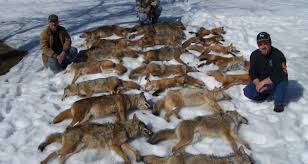 There was a time when government paid a bounty for coyotes trapped or shot. Coyotes have been with us for centuries. Governments used to pay a bounty to trappers in attempts to lessen the population. That didn’t work. disease and an inability to find the food they need is what controls the size of the coyote population. – there is a pack of them in south-east Burlington that has GPS collars the ministry uses to track them – they can take data from a satellite and know where that pack is at any given moment.
If you leave the coyotes alone, let them be the natural predators they are, don’t feed them – they won’t harm you. Because they are natural predators they see your cat as their lunch. Keep the cat inside at night.
 By Pepper Parr By Pepper Parr
March 31, 2014
BURLINGTON, ON.
We all know about insurance. We pay those premiums month after month convincing ourselves that we are “covered” and all too often when a catastrophe occurs we learn – the policy doesn’t cover that. It happens to households and it happens to the world of business as well – and when it happens in the construction industry – it can get messy.
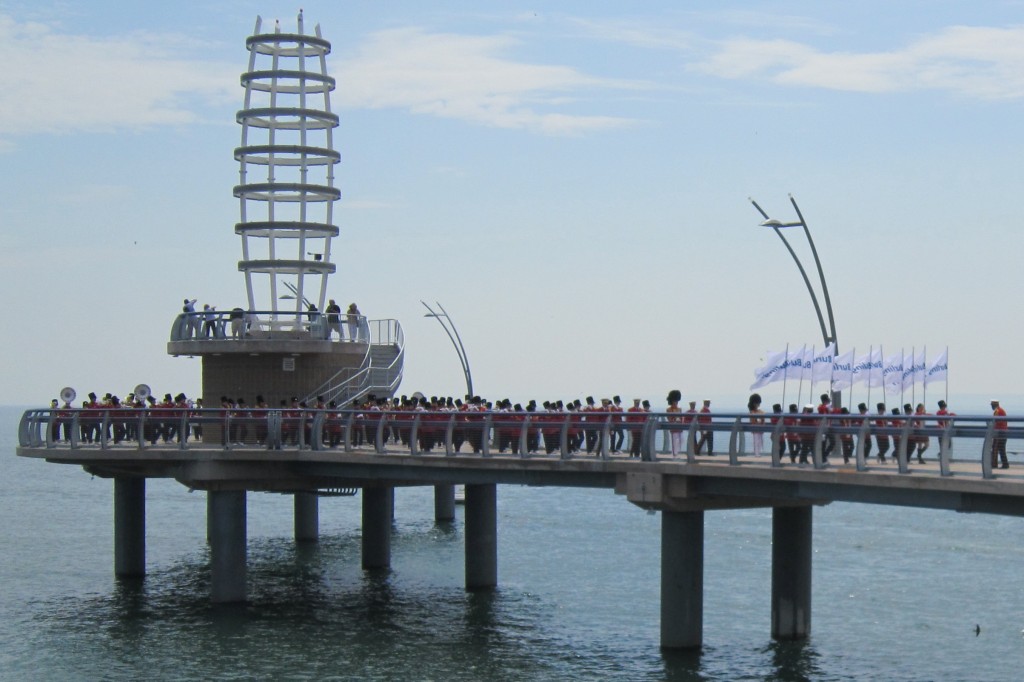 June 17th – 2013 – It will be seen as a great day in the history of the city. Despite a horrendous cost and new levels of mismanagement by people who are no longer with the city – the pier was a good idea. And if there was ever a messy construction project – look no further than The Pier at the foot of Brant Street. That situation is slowly working its way through the legal system. The next step is mediation – a process that is required before a case can be given a trial date.
Nancy Shea Nicol, the city solicitor has explained that at some point prior to any trial the Court will order that the parties engage in mediation to see if the issues can be resolved. Mediation does not make a determination of the legal rights of the parties; it is not binding and the mediator cannot impose a resolution on the parties. Mediation is a process where the people involved look for a way to see if they can agree on a settlement and avoid going to trial.
Mediation is a way to keep differences out of a court room. People involved in legal disputes – and in the pier situation there are five law suits – are required to at least attempt to mediate that dispute. It is useful to look at who is suing who:
Harm Schilthuis and Sons Limited (HSS) vs. City of Burlington
City of Burlington vs. Zurich Insurance Company (Bonding Company for HSS)
City of Burlington vs. HSS, EFCO, Aecom, Lombard, PV &V, Craneway (Insurance Claim)
City of Burlington vs. Aecom
HSS vs. Lombard, PV &V, City, Craneway (Insurance Claim)
What is instructive here is that HSS, the original contractor, is suing their insurance company and their insurance broker. You sue when you believe the service you bought was not delivered. HSS is also suing the city of Burlington – they believed they delivered and that the city has not paid for what was delivered.
The city is suing Zurich insurance – they are the company that provided the performance bond the contractor, HSS, was required to put in place.
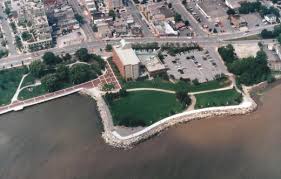 There was a time when the city didn’t have more than $14 million of taxpayers money sitting at the end of Brant Street. There are those who think it should have been left the way it was. The city called that performance bond, arguing that the contractor had not completed the job. The insurance company, Zurich, came back with a proposal to complete the pier – albeit at a higher cost – which the city didn’t like the look of and they declined the offer – pretty quickly it might be added – and went looking for a new contractor which they found, hired and paid. In June, 2013 the pier was officially opened.
 Steel beams that had been installed, found to be flawed were taken out – they sit in the construction yard at HSS The contract to build the pier was awarded in the summer of 2006. A new council was elected to office in October of 2006. Then there was the crane accident: August, 2008, during the first concrete pour, one of the main steel beams supporting the deck twisted. Two weeks later, a crane capsized onto the pier.
Fast forward to December 16, 2009, when HSS notified the city, in writing, that it was unwilling and unable to complete the pier construction contract. HSS then filed a construction lien against the city and issued a statement of claim in January 2010 – the gloves were off.
The city said at that time that it had a plan of action to complete the pier in a fiscally responsible manner and notified HSS’s bonding company, Zurich Insurance that HSS was in default. The city’s first recourse is to give the bonding company an opportunity to remedy HSS’s default and to follow the procedures as set out in the performance bond issued by the bonding company in favour of the city. Cam Jackson was still Mayor of Burlington at this time.
On June 18, 2010 HSS published a full-page advertisement in the Post to tell its story. The city issued a statement saying the “confidential, without prejudice discussions referred to by HSS,” in the advertisement, “contained significant new costs, which were not acceptable to taxpayers in the opinion of City Council, and additional conditions, which went against the advice of our legal counsel.”
The argument moved to a “he said”, “she said” stage where HSS said the company had not been paid by the city for invoices it had submitted and the city said it had already paid HSS $3.9 million of the total $6.5 million construction contract amounting to 60 per cent of the original contract.
 This Council didn’t create the pier problems – but they did manage to drop the ball on more than one occasion when there were opportunities to limit the financial damage. October 2010, a new city council gets elected; Cam Jackson is no longer the Mayor but the council still has three members, John Taylor, Jack Dennison and Rick Craven who were on council when the original contract was awarded.
In April 2011, the city received a proposal from Zurich Insurance Inc., the HSS bonding company, to settle the construction of the pier issues.
On May 11th, City Council, in a closed session was given an update on the proposal.
On May 24 city council decided not to consider the proposal. The public was never told what the proposal was or the reasons for rejecting it. We do know that the proposal did require the city to put more money into the construction of the pier but the public was never told how much more.
On September 26 council voted to hire Graham Infrastructure of Mississauga to complete the Brant Street Pier.
Graham Infrastructure’s bid was for a total contract price of $6,429,700, including full HST. Two optional items—a beach access ramp and additional concrete work for the waterfront promenade in Spencer Smith Park—were recommended for inclusion in the bid, bringing Graham Infrastructure’s contract price to $6,713,330.
The total project cost, including the nearly $5.98 million spent to date, would total $14.44 million.
 The city made the most of what will be seen as an historic occasion; the youth of today lay their hands on the pier plaque on opening day. On June 17th, 2013 the pier at the foot of Brant Street was officially opened.
But that is far from the end of the story. The pier ended up costing a lot more than anyone expected. The original contractor, HSS, has bills they sent the city before they left the construction site and which the city had approved for payment. But once the law suits were issued – everything was frozen. There were also invoices from the contractor that had been submitted but not yet approved. Those are still outstanding and the city is doing nothing about payment until the court case is settled.
These invoices, collectively are in excess of $1 million. HSS had bills to pay the trades that worked for them; they came perilously close to bankruptcy, which they believe many at city hall would have been quite happy to see happen. HSS has survived partly because the trades they have employed for more than 25 years stood by them and said they would wait for payment. When the court case is settled many believe HSS will be found to have been in compliance by walking off the job, their invoices will be paid, the tradesmen will get paid with interest that will come from the city of Burlington taxpayers.
The contractor, HSS is suing its insurance company and the broker who sold them the insurance policy. Lombard is believed to be the insurance carrier and PV&V Insurance, the broker who sold the policy to the contractor.
 There is nothing pretentious about the HSS operation. A general contractor with a solid reputation known for doing the extras.Henry S sits ay his desk working the numbers. Relationships are the foundation on which business people build trust. Henry Schilthuis, president of HSS, built relationships with his trades people who proved to be strong enough for them to wait for payment for the work they had done.
HSS is reported to have been dealing with PV&V for a considerable length of time and expected their insurance broker to defend their interests with the company carrying the insurance – in this case Lombard. Lombard apparently doesn’t think they have to pay on the policy claim HSS made. Messy.
While the contractor, HSS is unhappy with its broker and the insurance carrier – the city is unhappy as well and is going after the HSS the contractor, the contractors insurance company Lombard and the broker who sold the policy to the contractor PV&V and the project manager, AECOM.
This puts PV&V in a very awkward situation. They’ve got everyone coming after them, which doesn’t do much for credibility.
How does one mediate a mess like that? They look for a very skilled mediator – and the good ones are very much in demand. Finding one for this situation has been a challenge but it appears that a date for a mediation hearing has been set – June 19th, even though at least one of the parties is grumbling about the date chosen. Justice Fitzgerald, the judge handling this file has been pushing everyone on this.
In a document the city released before the mediation date of June 19th was set, the city said 17 days of examination for discovery had taken place which resulted in a considerable number of undertakings being given. An undertaking can be an obligation to find an answer to a question or produce further documents in response to questions.
Some undertakings were not agreed upon and required a court attendance for a determination as to whether or not the undertaking is valid. When one side doesn’t want to release information that is damaging to their case – it often requires a judge to tell them – give them the documents they are asking for.
Someone didn’t want to provide documents – our information is that it was the city that couldn’t find many of the documents and the project manager that seemed to require a lot of time to find documents.
The last time city solicitor Nancy Shea Nicol addressed council in open session she explained that there were another four to five days of examination for discovery and that up to that point more than 60,000 documents had been exchanged. At one point someone realized there was a collection of documents no one was fully aware of – it isn’t clear who it was who had the documents, the lawyers don’t talk about his stuff – they just send in their invoices and toil away.
The public has been asking for an accounting on those legal fees – they would like to know how much had been spent to date. The Post filed a Freedom of Information request asking how much had been spent on legal fees and was turned down by the city. The Post appealed that decision and the matter went to the Privacy Commissioner.
It didn’t take the city long to see the writing on the wall –they released the figures at a press conference on January 30th, – and said $1,349,952 had been spent to date.
 The city had argued that telling the public what they spent on legal fees would reveal some of their strategy. The figures are out and there doesn’t appear to be any harm done. I leave it to you to figure that one out. The city had argued that telling the public what they spent on legal fees would reveal some of their strategy. The figures are out and there doesn’t appear to be any harm done. I leave it to you to figure that one out.
The fear of course was that the public would be outraged and demand that the city quit the case. It is a very complex case – the real fear is that the city will settle during the mediation process, have a confidentiality clause put into the agreement and the public will never know just what the settlement amounted to and how much they had to pay out.
Did the contractor really screw up and will his insurance company have to pony up with a big cheque. Did the city provide the contractor with a plan for the pier that had major flaws leaving the original contractor with no option but to walk off the job?
Did the contractors insurance company come back with a proposal that would solve the technical construction problems and cost less than the city has spent so far on legal fees?
Why doesn’t city council walk their transparency talk and inform the public – the people who have to pay the bill when council gets it wrong.
The differences are both financial and technical. There were problems with the design of the pier and there are significant differences of opinion as to what an insurance policy covered and what it didn’t cover.
 Done – all the concrete is down – and the steel beams are holding it all in place. Now the railings get put in place. Earlier this week city manager Jeff Fielding advised council that he and city solicitor Nancy Shea Nicol had met with the lawyers representing the city and outlined the city’s position that was going to be put forward during the mediation sessions – which are not very long – hours rather than days.
The city will put forward its position and set out what they are prepared to settle for. It is not known yet precisely who will do the talking, the person representing the city has to have the authority to agree on a settlement figure. The lawyers representing the city will be in the room.
In the event that the mediation proves to be successful the city is going to have to tell its citizens that there is more money yet to be paid out. The contractor, HSS has a claim that many informed observers see as valid – money will move from city hall over to HSS.
How much money will move from AECOM, the project managers and the owners of TSH the company that designed the pier, to city hall is the question that matters most to this city council. If they can recover from AECOM more than they have to pay HSS – they will look like heroes. And in an election period that will matter.
The mess the city is in wasn’t created by this council – but there were several opportunities to settle the problems that the city took a pass on.
Councillors Taylor, Dennison, Craven and Goldring, led by former Mayor Cam Jackson, were part of the council that got the city into the contracts the city is now defending. The contracts weren’t the biggest part of the problem; it was the management of the contracts that have hurt Burlington taxpayers. When the full story is out – and it will come out – taxpayers will be livid.
Most of the people in the city’s engineering department that handled all the technical issues and the relationship with AECOM are no longer with the city. They have moved on to other municipalities.
 The idea for the pier came from a council led by former Mayor Rob MacIsaac, but he left town and went to Metrolinx, and then on to Mohawk College and has now settled as the president of Hamilton Health Services, the second largest health operation in the province with an annual salary of $542,000. With performance incentives that could rise to $650,000 excluding taxable benefits. The idea for the pier came from a council led by former Mayor Rob MacIsaac, but he left town and went to Metrolinx, and then on to Mohawk College and has now settled as the president of Hamilton Health Services, the second largest health operation in the province with an annual salary of $542,000. With performance incentives that could rise to $650,000 excluding taxable benefits.
That virtually doubles his 2012 salary ($275,515 plus $47,210 taxable benefits) as president of Mohawk College. That is quite a step form the approximately $50,000 MacIsaac earned as mayor of Burlington. MacIsaac has a five years contract. While at Mohawk he had seven weeks of paid vacation; he gets just six weeks paid vacation with the Hamilton Health Services organization.
Of those who were on council when all this happened, only Mayor Goldring has filed nomination papers for re-election. Taylor, Dennison and Craven have yet to formally file.
 By Staff By Staff
March 31, 2014
BURLINGTON, ON.
Each year the province requires municipalities to publish a list of all those who earn more than $100,00 annually. The data is presented as the salary paid and benefits given that are taxable.
Burlington civil servants were given a 1% salary increase in the 2014 budget.
Councillor Marianne Meed Ward brought a motion to Council that was approved asking the city manager to look into the free parking and free transit passes that are given city employees. Meed Ward is of the view that this benefit is taxable and should be treated as such.
The first figure shown after each name is the annual salary, the second is the taxable benefit.
ADCOCK ALAN Firefighter $102,172.28 $487.27
ALDHAM JUDY Field Services Supervisor $104,070.38 $2,225.26
ALLDRIDGE BRIAN Platoon Chief $124,140.31 $649.80
ANTONIOW PHIL Manager of Program Development, Budgets and Contracts $112,680.32 $622.77
AXIAK ROB Manager Facility Operations and Special Projects $105,876.99 $552.03
BAKOS MICHAEL Captain $108,247.81 $571.12
BARRY PHILIP Captain $108,610.77 $573.86
BAVOTA ANTHONY Fire Chief $157,572.65 $1,906.95
BAYLOR MARK Captain $110,816.79 $570.96
BAYNTON STEVE T. Captain $111,727.68 $586.64
BEATTY DAVID N. Fire Chief $105,836.89 $3,409.68
BEDINI CHRIS District Supervisor $105,298.61 $662.70
BENNETT RANDY Manager of Information Technology Infrastructure and Operations $117,305.77 $640.34
BENNITT JAMES District Supervisor $101,209.87 $764.12
BERDAN MICHAEL Transit Supervisor $103,954.97 $456.07
BIELSKI BIANCA Manager of Development Planning $131,198.38 $739.08
BIRCH CHARLES T. Captain $112,490.88 $585.12
BLACK JEFFREY Manager of Field Services $105,641.57 $3,398.73
BOYD LAURA Human Resource Manager $106,215.06 $590.76
BRILLON SYLVAIN Firefighter $100,870.86 $484.09
CAUGHLIN DEBORAH Manager of Council Services $104,747.58 $582.24
CHOLEWKA CHRIS Captain $107,542.24 $564.00
CLARK CARY Manager of Development and Environmental Engineering $109,618.58 $550.80
COULSON ANN MARIE Manager of Financial Planning and Taxation $133,138.56 $702.66
CRASS JOHN Manager of Traffic Services $106,854.96 $599.16
DI PIETRO ITALO Manager of Infrastructure and Data Management $118,340.36 $655.44
DONATI DERRICK Firefighter $101,799.93 $495.31
DOWD TIMOTHY Captain $117,192.97 $585.12
DUNCAN JOHN Transit Manager $120,963.15 $1,069.52
EALES MARK Captain $106,407.96 $559.95
EICHENBAUM TOOMAS Director of Engineering $165,413.29 $877.56
EVANS FRANCES Manager Halton Court Administration $104,071.88 $575.45
FIELDING JEFF City Manager $249,940.24 $8,898.60
FIORAVANTI LEANNE Solicitor $105,949.26 $510.32
FORD JOAN Director of Finance $153,457.30 $838.93
FRYER E. TODD Firefighter $101,929.55 $519.12
GLENN CHRISTOPHER Director of Parks and Recreation $132,997.91 $731.28
GLOBE DARREN Captain $107,508.37 $573.49
GOLDRING PATRICK Mayor $168,155.78 $2,511.56
GRISON GREGORY J. Captain $111,727.66 $585.74
HAMILTON SCOTT Manager Design and Construction $111,514.22 $618.78
HAMMER CHAD Firefighter $101,951.54 $493.89
HAMMOND BILL Fire Training Supervisor $107,840.61 $562.56
HART TIMOTHY Firefighter $103,027.20 $492.49
HAYES DENNIS M. Platoon Chief $127,478.73 $617.46
HEBNER PETER B. Captain $114,146.11 $585.12
HURLEY BLAKE Assistant City Solicitor $134,557.07 $644.83
JAMES MICHAEL Training Officer – Fire $102,489.52 $570.96
JONES SHEILA City Auditor $123,574.30 $664.26
JONES STEPHEN Captain $107,384.25 $550.83
JURK ROBERT Senior Project Leader $105,261.62 $581.57
KEANEY THOMAS Firefighter $100,775.57 $486.09
KELL DONNA Manager of Public Affairs $114,486.31 $630.35
KELLY JOHN Captain $110,246.84 $579.30
KIPPEN MARK Firefighter $100,628.48 $496.85
KOEVOETS MATT District Supervisor $106,906.64 $1,394.19
KRUSHELNICKI BRUCE Director Planning and Building $160,581.87 $891.60
KUBOTA ERIKA Assistant City Solicitor $134,346.99 $644.86
LAING BRUCE K. Captain $111,727.68 $585.12
LAPORTE N. JASON Captain $109,433.52 $571.25
LASELVA JOHN Supervisor Building Permits $103,581.39 $578.01
LONG MARK Captain $114,237.26 $591.85
MACDONALD GARY F. Captain $111,727.68 $585.12
MACKAY MICHAEL J. Captain $111,727.68 $587.71
MAGI ALLAN Executive Director of Corporate Strategic Initiatives $172,840.24 $967.56
MALE ROY E. Executive Director of Human Resources $182,946.28 $1,012.56
MARTIN CHRISTOPHER Captain $108,414.44 $553.46
MATHESON JAMIE Firefighter $100,671.68 $492.84
MCNAMARA MICHAEL J. Captain $112,644.56 $585.12
MERCANTI CINDY Manager of Recreation Services $113,175.87 $568.20
MINAJI ROSALIND Coordinator Development Review $100,370.93 $560.67
MONTEITH ROSS A. Deputy Fire Chief $136,019.93 $1,601.85
MORGAN ANGELA City Clerk $140,406.98 $753.15
MYERS PETER R. Captain $111,727.67 $593.09
NICELIU KENNETH Firefighter $104,681.45 $514.61
NICHOLSON J. ALAN Captain $111,727.68 $585.12
O’REILLY SANDRA Controller and Manager of Financial Services $113,228.22 $591.60
PEACHEY ROBERT Manager Parks and Open Space $111,558.40 $623.32
PHILLIPS KIMBERLEY General Manager $212,612.61 $8,730.36
POLIZIANI MATTHEW Captain $107,950.52 $557.81
REILLY PETER Captain $114,474.01 $589.90
ROBERTSON CATHARINE Director of Roads and Parks Maintenance $146,163.10 $1,304.38
SCHMIDT-SHOUKRI JASON Manager of Building Permit Services and Chief Building Official $135,620.24 $738.61
SHAHZAD ARIF Senior Environmental Engineer $100,995.97 $560.26
SHEA NICOL NANCY City Solicitor $168,958.55 $814.29
SHIELDS LISA Assistant City Solicitor $134,626.43 $638.32
SLACK CRAIG D. Platoon Chief $128,234.10 $649.80
SMITH CLINT Platoon Chief $127,352.17 $649.80
SMITH SIMON Firefighter $100,129.68 $498.05
SPICER MIKE Director of Transit $134,021.48 $708.84
STEIGINGA RON Manager of Realty Services $113,120.85 $618.84
STEVENS CRAIG Senior Project Manager $101,835.28 $570.98
STEWART SCOTT General Manager $217,635.03 $10,462.48
SWANCE JEFFREY W. Captain $111,727.67 $585.12
SWENOR CHRISTINE Director Information Technology Services $163,040.20 $861.42
TAGGART DAVID Manager Facility Assets $111,045.99 $610.32
THANDI JAZZ Manager Procurement Services $101,688.67 $561.61
VRAKELA STEVE Field Services Supervisor $101,325.60 $1,691.68
WEBER JEFF Deputy Fire Chief $139,961.19 $5,933.10
WHEATLEY RYAN Captain $110,407.44 $570.96
WIGNALL T. MARK Firefighter $102,867.06 $512.74
WINTAR JOSEPH Chief Fire Prevention Officer $110,934.32 $621.60
WOODS DOUGLAS S. Captain $112,106.48 $585.12
ZORBAS STEVE General Manager $167,678.00 $923.12
ZVANIGA BRUCE Director of Transportation Services $145,292.33 $775.86
 By Staff By Staff
March 31, 2014,
BURLINGTON, ON.
There has been another outbreak of measles that has the capacity to impact people in Burlington.
Persons who have visited any of the following locations may have been exposed to measles:
Saturday, March 22, 2014:
The Queen’s Head (pub), 400 Brant Street, Burlington, 10 p.m. to 2 a.m.
Sunday, March 23, 2014:
Milestones Restaurant, 1200 Brant Street, Burlington, 7 p.m. to midnight
Wednesday, March 25 – Friday, March 27, 2014:
Joseph Brant Hospital, 1230 North Shore Blvd., Burlington
March 25, 7 p.m. to March 26, 9:30 a.m.
March 26, 3:30 p.m. to midnight
March 27, 11:15 a.m. to 2 p.m.
The Halton Region Health Department is following up individually with patients and individuals accompanying them who may have been exposed at Joseph Brant Hospital.
“Measles is preventable through immunization with two doses of measles vaccine,” stated Dr. Monir Taha, Halton Region Associate Medical Officer of Health. “Persons who have measles need to isolate themselves while they are ill and for four full days after the rash first appears. Always call ahead before going to a health care setting.”
Measles starts with cough, runny nose, red, watery eyes, and fever, and after about four days a rash begins on the face and moves down the body. There may be white spots inside the mouth. Measles spreads easily to persons who are not immune. Infants under one year of age, pregnant women, and persons with weakened immune systems can get very ill with measles. Complications of measles can include middle ear infections, pneumonia, croup, and inflammation of the brain. Learn more at www.halton.ca/measles.
If you think you may have measles and need to see a doctor, you must call ahead to the doctor’s office, walk-in clinic, or emergency department. This will allow health care staff to give you a mask to wear when you arrive and take you straight to a room in which you can be isolated. In a doctor’s office you may be given the last appointment of the day.
For more information, dial 311 or call the Halton Region Health Department at 905-825-6000, toll-free 1-866-442-5866 or visit www.halton.ca.
 By Staff By Staff
March 29, 2104
BURLINGTON, ON.
The long, cold, snowy winter isn’t over yet – and we are going to pay for it for quite a while.
The Ontario Energy Board has approved a 40% hike in natural gas rates for Enbridge Gas Distribution customers that will take effect Tuesday, boosting the average residential customer’s annual bill by about $400 a year.
Enbridge filed its application for the increase March 12, interveners had until March 17, to get their comments in – the Energy Board handed down its decision March 29th to be effective April 1st. Name someone you know who can get a doctor’s appointment that quickly?
 You will look at that gas meter a little differently now – see it as a black sink hole. The hike is the result of Enbridge running out of its negotiated supply of gas for the winter and having to go to the open market for further supplies.
Enbridge Gas Distribution’s gas supply charge will increase from 12.68 cents per cubic metre to 17.60.
The changes would result in an overall increase of about $33 a month over the next year, according to Enbridge.
Of this $33 a month, about $20 per month relates to costs associated with this past cold winter.
The other $13 relates to the projected forecast natural gas price, both of which will be reviewed again in three months as part of the normal regulatory process.
“Our interim rates take effect on April 1, but customers won’t feel the full impact of the increase right away,” stated a release from Enbridge.
“Virtually all natural gas providers have increased their prices because of increased demand and increased gas prices over this unusually cold winter.”
 They do it because they can get away with it – and we are the fools for allowing it. Do these guys not plan for situations like this? In their media release they refer to the increase as an “interim rate” that takes place April fool’s. Does that mean when the supply stabilizes they will negotiate better contracts and drop the rates? Was having this happen on April Fool’s day a coincidence?
 By Pepper Parr By Pepper Parr
March 29, 2014
BURLINGTON, ON.
Premier Wynne is going to take part in Ted McMeekin’ s nomination event in Hamilton on Sunday. Ted is the member for Ancaster – Dundas – Flamborough – Westdale who has served as the stand in for Burlington when we need some help at Queen’s Park.
 Ted McMeekin, on the right, supports Karmel Sakran during the 2011 election. Sakran lost but McMeekin won and was returned to Cabinet when Wynne became Premier. McMeekin has solid Burlington roots and one of those whose political pedigree goes all the way back to the days when Bobby Kennedy was running for office in the United States and McMeekin was one of the political junkies that did some of the door to door work to get him elected.
When Burlington was beavering away at getting the funding for the re-development of the Joseph Brant Memorial Hospital – that’s what it was called then – McMeekin was the go to guy.
He wasn’t’ a Cabinet Minister then – Sophia Aggelonitus had that plum but she lost to a New Democrat in 2011. McMeekin however was always there for us.
Last week the MPP for Oakville, Kevin Flynn was made a Cabinet Minster and given the Labour portfolio which means Burlington is now bracketed by Cabinet ministers.
If you listen to the Burlington provincial Liberals they will tell you that Eleanor McMahon, the nominated candidate for the Liberals in the expected any day provincial election that she will become a member of Cabinet just as soon as she can get herself elected.
 Eleanor McMahon, Lineal candidate for Burlington in the next provincial election. Will that be a spring election? As accomplished as Eleanor McMahon is – and she has a very impressive resume (much better than Kevin Flynn’s) there is no way that Halton is going to have two MPP’s and with Ted McMeekin a stone’s throw away that would put a lot of Cabinet clout in our part of the world.
Not going to happen.
That will mean a bit of a change in the way the Eleanor McMahon does her door to door campaigning and morale will slip a bit once the reality of the Flynn appointment sets in.
The ironic part of all this is that it was the cancellation of a gas-fired energy plant in Oakville that is causing Premier Wynne so much grief. And that problem is not going to go away anywhere soon.
In September of 2009 the Ontario Power Authority accepted TransCanada’s bid to build a 900-megawatt natural gas-fired power generation plant in Oakville. Oct. 7, 2010 the Ontario government announced the cancellation of that power plant.
October 6, 2011 the Liberals under Premier Dalton McGuinty hold on to their seat in Oakville.
Oct. 8, 2013, Auditor General Bonnie Lysyk pegs cost of cancelling the Oakville gas plant at between $675 million and $815 million. Estimated total costs of cancelling both plants reaches the $1-billion mark.
Kathleen Wynne was a member of that government and sat at the Cabinet table – it is a stretch to say that she wasn’t fully aware. It will be a struggle for Wynne to continue to form the government. The budget that is scheduled for some time in the spring will tell the tale. If the Liberals can give the New Democrats what they will demand for their budget support, Kathleen Wynne will live another day and have time to re-build the close to decimated support the Liberal government once had.
Given enough time she has a chance – unless of course there is yet another scandal.
Meanwhile the Burlington Liberals press on with a good candidate in a tough situation.
 By Pepper Parr By Pepper Parr
March 27, 2014
BURLINGTON, ON.
They are sometimes called “issue” politicians; people who had an issue with city hall and fought back to make something happen and went on to serve their communities very well as city councillors.
These “issue” politicians tend to have had some experience with local groups where they were one of the hundreds that serve in the trenches making thee wheels go round.
 Angelo Bentivegna expects to be a force if he is elected to city council. His learning curve will be steep. Angela Bentivegna is an issue politician.
An immigrant to this country, he arrived in 1957 and lived in Montreal, in a less than tony part of town, where he started working at the age of 14 selling newspapers at a nickel a copy outside the old CN yards.
He got a job after that in a restaurant, completed high school, where he met the woman he married and has been married since 1978. The two of them attended McGill University at the Faculty of Education; they both wanted to be teachers.
Bentivegna has been fortunate enough to find mentors; people who saw his capacity and his energy and developed his skills in the operation and management of different kinds of restaurants. He managed restaurants, opened up new locations for the Victoria Station operation as well as Kelsey’s where he was the owner of a franchise.
 Angelo Bentivegna tends to look people in the eye and listen carefully. When Cara bought out all the Kelsey franchises – Angelo found himself with a decent cheque in his pocket and an opportunity to strike out on his own. “I always liked the idea of working for myself and this was the time in his life when he could do that.” He said.
The restaurant business was the one thing he knew very well; he knew everyone in that business, which he explains is “really a very small community.”
Angelo and his wife both graduated as teachers – she stayed in a classroom, he roamed North America for different restaurant organizations. Angelo and Diane lived through all of the recessions – he can name every one of them.
With a strong restaurant management background getting into retail selling products that were a part restaurant business was a natural – they opened their first shop in 1991 on Fairview –and have been in that same plaza location ever since.
Bentivegna learned to roll with the changes in the retail world. They started selling cooking utensils and as consumer demand shifted – they shifted. Today the Mrs. B’s Gift House focuses on gift packages and biscotti baked daily.
In TEAR Diane, Angelo’s wife, thought there was something wrong with a consistent itch she had in her chest. The Bentivegna’s were fortunate – early detection resulted in surgery that rid Diane of the disease. The family was grateful and wanted to do something for the community; they decided they would purchase a Digital Mammography Unit with Biopsy attachment for the Joseph Brant hospital – price $450,000 which didn’t seem to deter the family. They organized their event, sold tickets, found sponsors and thought things were going just fine when they ran into a brick wall at city hall.
 If Angelo Bentivegna is elected to city council he will either have to get up very very early to make the biscotti – or this city will just have to go without. Beauty and the Bistro, the name of the fund raising event, was set up so that every penny went to the fund to pay for the Digital Mammography Unit with Biopsy attachment – nothing, not a dime, was paid to anyone. Angelo scrounged support from everyone he knew and in the restaurant world – he knew everyone. Ten restaurants were lined up to serve small portions of food at a gala event where the tickets were priced at $50 – “We wanted every to be able to afford to attend”, said B
He got a party tent supplier to help out, “borrowed 1200 glasses, table cloths – you name it and Angelo B found someone to ask to donate what was needed.The event was to take place at the Leggat automobile showroom on Fairview. That location was not zoned to hold banquets, which B wasn’t aware of but didn’t see as a problem.
The Mercedes-Benz dealership on the North Service Road was used for two fund raising events so B didn’t think he had a problem. That changed when he started trying to get some help at city hall. Angelo couldn’t believe what he was hearing – why not?
He recalls one day when he asked city hall receptionist if the Mayor was in – he wasn’t. None of the councillors were in either but he did manage to get through to the administrative assistant for Councillor Craven and she said she would help.
City planner Bruce Krushelnicki learned of the problems and help Angelo work his way through the complex process of getting a change in the zoning for the Leggat site on Fairview.
It took an appearance before the Committee of Adjustment to get a minor variance and an appearance before city council to get a $420 fee waived. Angelo B got his permits and the city got a new bylaw that meant no one else would have to go through the same hoops ever again. Bylaw 2020-327 solves that problem
Angelo found getting information and clear direction at city hall confusing and frustrating – he didn’t think it was supposed to be that hard and around last Christmas began to think in terms of running for a seat on city council and working towards bringing about a change.
 People can expect to know just where Angelo Bentivegna will stand when there is an issue to be addressed. Angelo Bentivegna is certainly persistent. While he apparently didn’t understand the rules and there may have been a touch of impatience when he was at the counter at city hall he kept at it and finally found someone who would help and eventually got what he needed for his charitable event.
In an early draft of the platform Angelo Bentivegna is going to run on he says he is:
Passion, persistence, and productive, that’s who I am.
I listen…. We come up with a plan and we get to work.
I will have no excuses…and will admit when I need help.
I will commit 100% of my time as a full-time Councillor.
Expect this from me: One voice, one ward, our community, our great City….that is what I will embrace.
The challenges for ward 6 as Angelo Bentivegna sees them are:
The Airpark on Appleby Line. He doesn’t have any plans as to what should be done with the property once the various court appeals have been heard. He has begun to make inroads with the people who are directly impacted by the air park however B lives south of the 407/Dundas divide.
Many feel that it is time for someone who actually lives in the rural part of the city to sit on city council but B thinks he can overcome that problem by reaching out and being available to people. He is very critical of the practice Councillor Lancaster had of holding her ward events at the Air Park.
Transit is a stated issue but there are no policy outlines as to what he thinks the solutions are nor does he define the problem. The city’s aging population and the needs of our young families that need more programs for young children are subjects B wants to focus on – but nothing specific here either.
Ensure that we save the lakefront but no suggestions as to what should happen to the Beachway.
There isn’t a motherhood issue that Angelo B doesn’t touch on in his campaign outline. “We need to protect where we live, work, play and how we grow in the future”, is the clarion call.
Angelo Bentivegna has had his share of recognition for his community work. He was a finalist for the Business Excellence Award given by the Canadian Italian Business Professional Association. “I lost out to Angelo Paletta and I can live with that said Bentivegna
He was recognized by the Chamber of Commerce and awarded the Mayor’s Community Business Service Award in 2011
Add to that the:
Chamber of Commerce award winner of Best Retail/Wholesale Business. -2001
President’s Award for Burlington City Rep Hockey Club – 1991
President’s Club Award – Victoria Station Restaurants – 1979
President McGill University Student Faculty of Education-1976
His most recent community initiative is Chair of “Beauty and the Bistro”, a community wide, three-year fundraising initiative to purchase a Digital Mammography Unit with Biopsy attachment for Joseph Brant Hospital.
Angelo is a member and supporter of the “Gift of Giving Back” the largest community initiated food drive in Canada led by Jean Longfield one of the Directors of the Burlington City Rep Hockey Club.
Welcomed fans and guests during the OHL Memorial Cup 2011 twelve day event, managing and co-coordinating “Hockey House” activities from beginning to end at the Hershey Centre in Mississauga for the St. Mike’s Majors.
-Initial Charter Member of Lion’s Club Foundation for Guide Dogs in Oakville…’09
Burlington City Rep Hockey Club – Vice President… 94-present
Burlington Cougars Jr. A Hockey Club Executive 2001-2003
Burlington Tourism Supporter..08-present
Parent Council and later President of Notre Dame Catholic H.S. Parent Council 1991-2001
Created a WinterLude Fundraising Program for Notre Dame High School raising funds for computers and the library program 1991-2001.
Involved as Parent Liaison on Strategic Planning Committee with Halton Catholic District School Board 1991-2001.
Volunteer for the CIBC Run for The Cure Hamilton Burlington Chapter.
Angelo B appears to have touched all the bases – can he reach out far enough to touch the hearts of the people in ward 6. It should be an interesting race. There is an additional candidate running in ward 6, Jim Curran with a fourth candidate expected to declare early in April.
 By Pepper Parr By Pepper Parr
March 27, 2014
BURLINGTON, ON.
Someone suggested it might be called drive through charity and while that is an apt description – there is nothing passive about the way the 52 members of a group take out their cheque books to aid others – on the spot. No committee meetings – they just up and do it.
Last night the group, 100 Women Who Care, met at Tansley Woods and in under an hour and a half heard Adrienne Gosse explain what the Burlington Humane Society was doing with the $3800 they were given in January, listened to short, short presentations and passed on $5200.
The general flow of the meeting is: introductions; ask for nominations; randomly pick three names, listen to presentations by each of the nominees and then vote for the charity of choice for this meeting.
 Out came the cheque books – “what’s the date today” and as fast as that $5200 went to the Halton Women’s Place. Ballots are handed out – the chosen charity named and out came the cheque books. The Halton Women’s Place representative went home knowing they had $5200 more to work with.
There was no one talking minutes – they don’t have a secretary, there is no treasurer – they don’t handle the money – they are just the channel the cheques run through to get from the donor to the recipient.
They are called the 100 Women Who Care Burlington and it works.
The women who show up four times a year chit-chat the way women do and pay attention to what the speakers are saying.
 Adrianne Gosse, shelter manager at the Burlington Humane Society telling the 100 Women Who Care what her organization did with he funds they were given. Last night there was a presentation from the Burlington Big Brothers and Sisters, the Junior League and the Halton Women’s Shelter. Each presentation was less than ten minutes. Ballots were handed out, filled in, counted, the winner announced and the cheques written. Not every member manages to get to the group meeting. Those that don’t make it to the meeting get an email telling them who is being given funds and cheques are made out to that organization.
The drive by charity comment came from someone who remarked on how simple and direct it all is. Any member can fill in a nomination form on the spot, and assuming there is a person from the group nominated, they can speak and if the members present vote for that group they go home with the cheques in their purse.
Amazing – its just DONE!
 Meagan and Pat, two of the 100 Women Who Care, tidy up before going home. This is the second meeting the group has held – there are now 52 members. Once they reach their objective of 100 members – they will meet four times a year and raise $40,000 that gets put into the community service sector of the city.
No fuss, not a lot of noise. Just ordinary women meeting once a month, doing what they think is right because they are able to.
Do you want to join? Check out their Facebook page, send a message to Laurel Hubber and you’re in. She will tell you when the group meets – bring your cheque book.
Background links:
Support went to the dogs the first time.
 By Pepper Parr By Pepper Parr
March 27, 2014
BURLINGTON, ON.
The city will be taking its best minds and prettiest faces to Queen’s Park to tell our story and present our case for more support from the province.
Burlington is sort of like that bright child that doesn’t get into trouble, runs its operations well enough ad gets forgotten. Burlington doesn’t do drama or crisis. Everyone likes everyone Burlington – it is the greatest place to live – so what’s to worry?
There are problems – and the city wants the province to be more aware that we are here, have a great story to tell and when we have problems – we’d at least like Queen’s Park to be aware of them.
When the discussions were taking place about IKEA taking up residence on the North service Road between Guelph Line and Walkers Line city hall staff ran into all kinds of problems with the Ministry of Transportation over just when and how the QEW might get widened. We wanted to know what the MoT could do for us in the way of help with the interchanges on Walkers Line and staff found that there wasn’t a lot of help coming in.
Burlington realized it didn’t have a presence in the minds of the decision makers at Queen’s Park so we decided to put together a team of people who would GO train it to Toronto and meet with the provincial government
 If you haven’t asked to be part of this panel – don’t complain and say city hall doesn’t listen. As part of the preparation for that event city manager Jeff Fielding used his most recent communications tool – Insight Burlington – to ask his panel of more than 500 people what they thought the city should talk to the provincial government about.
There were six questions – four related to transportation and two related to employment.
The computer application that has been developed is kind of slick. The questions are set out on the left hand side of your computer monitor. On the right there is a row of boxes – one under the other with the words 1st choice, 2nd choice – right through to the 6th choice.
All you had to do was drag the question on the left to a place on the right – which was how you ranked the questions – showing which you thought was the most important to the least important.
The only thing missing was an opportunity to put in thoughts that were your own. There could have been a box to type in a comment or a question that could have been asked.
 There are times when city hall staff would like public opinion quickly. The Insight panel makes that possible. The members of the panel got an email yesterday afternoon and were asked to click on a link that took them to the survey. It took just two minutes to complete the survey. Sometime at the end of the day or early tomorrow Fielding will get a report from his team that will tell him what the community thought he should do.
It is quick, short and gives city administrators a very valid sample of what the community thinks.
The program that runs behind the questions gets an even distribution from each of the six wards, a balance of age, gender and income. All that data will have been collected earlier when the members of the panel were put into the system
Fielding would like a bigger panel and he wishes the members of council has been more diligent in promoting the idea. He believes that over time people will hear about the panel and want to become part of it.
 The beauty of this service is that the city is able to get opinions very quickly – and they don’t know who you are – they just know that you are of a certain age, which ward you live in, if you are a home owner or an apartment dweller. The will know if you drive a car or are a transit user or both. But they don’t know who YOU are. The beauty of this service is that the city is able to get opinions very quickly – and they don’t know who you are – they just know that you are of a certain age, which ward you live in, if you are a home owner or an apartment dweller. The will know if you drive a car or are a transit user or both. But they don’t know who YOU are.
If you would like to become part of the panel – log into the web site and answer the questions – remember – they don’t know who you are. The data collected is not kept at city hall. All they get are the results of the survey.
If you believe in a democracy and want to be of service to your community – became part of the panel. Some people have mentioned that they applied and were told they were on a waiting list. That would have been because there were too many people, say, of a certain age group which would skew the sample population.
While this is an extreme example: if 56% of the population is female but 80% of the people who applied were male – the results would not be reflective of the city. So some of those male applicants would get put on a waiting list and when the number of female applicants in the same age grouping increased they would be added to the survey panel.
What is vital is that the sample be reflective of the city’s population.
It will be interesting to hear what the city got back in the way of rankings to the six questions that were asked.
Background links:
City to create an opinion survey panel.
City recruiting panel members.
 By Staff By Staff
March 27, 2014
BURLINGTON, ON
On Wednesday March 26th shortly before 11:00 am, a citizen reported seeing a suspicious white truck and a male going door-to-door along Teal Drive in Burlington.
Police converged on the area and located a residence which had been broken into and a laptop was stolen. A search of the area failed to turn up the white truck or suspect however the stolen laptop was located and appears to have been discarded by the suspect on Tanager Avenue.
Several witnesses reported seeing the male running through numerous backyards and into the passenger seat of the white truck on Partridge Drive which then took off at a high rate of speed.
No description was obtained for the driver of the white truck however the suspect in the entry is described as a white male in his 20’s wearing a hat, navy blue and black puffy knee-length jacket, black pants and white running shoes.
Police are seeking assistance from area residents who may have information and/or surveillance cameras which might assist in identifying the suspect and/or the suspect vehicle and its’ driver.
Anyone with information is asked to contact Detective Constable Mark Urie of the 3 District Criminal Investigations Bureau, Residential Crime Team at 905 825-4747 ext 2338.
Alternatively, anyone with information on this or any other crime can anonymously call Crime Stoppers at 1 800 222-TIPS(8477), through the web at www.haltoncrimestoppers.com or by texting ‘Tip201’ with your message to 274637(crimes).
Burlington is clearly a city with citizens who notice suspicious behaviour and report it to the police quickly.
 By Ray Rivers By Ray Rivers
March 26, 2014
BURLINGTON, ON.
If it ain’t broke don’t fix it. Canada is held up as a model for how to run elections – we are recognized as having the best electoral system anywhere – and 85% of Canadians also thought our last federal election was perfectly fair. So why has the government introduced their so-called ‘Fair Elections Act’? And why is this Bill getting panned/dumped on by just about everybody, including a national newspaper and some 150 political scientists around the world?
 Raid on Conservative Party offices” Elections Canada wanted data. For one thing the process is flawed. Everyone knows that the PM has been engaging in a war with Elections Canada – ever since they nailed him on his party’s in-and-out funding scandal. Why would anyone expect him to be impartial? Shouldn’t something as important as changing our electoral process be managed by an independent body, rather than at the whim of one of the political parties? Why were there no consultations prior to introducing the Bill – not with the other political parties, not with the public and not even with Elections Canada, who might know a thing or two about elections?
Elections Canada’s mandate currently includes encouraging more people to vote. We understand that democracy works best when more citizens are involved. But this Bill would diminish that objective and further suppress voting by removing ‘vouching’, which was used without issue by thousands of voters in the last election. The government claims ‘vouching’is problematic, and there may be better ways to assist those without adequate ID to secure their right to the ballot box. But just excluding voters without adequate identification is throwing out the baby with the bath water. And, critics say the minister proposing this change is wrong – hasn’t done his homework.
 Not terrible numbers – but they should be higher – 70% across the country. Some nations, like Australia, legally require their citizens to vote; why would we want to do anything to suppress voting, to discourage people from exercising their franchise? If one wants to vote in Australia and isn’t carrying the right identification they can just swear an oath and declare their right to get a ballot. Further, shouldn’t we be finding more inclusive ways of voting, like internet voting to facilitate and enable more of our youth to participate in the democratic process? We do internet banking don’t we? Surely, we can manage the process of issuing secure ‘pin’numbers.
For a number of years Canada’s official political parties received direct public funding, the amount dependent on how well they had performed in the previous election. This reduced the influence of money, and the power of wealthy contributors, in shaping government policy. Germany, Sweden, Israel, Australia, Austria and Spain are among the growing number of countries with public funding, now representing over half of those with elected democracies. US presidential candidates may elect for public finding. And just to be clear, note that we subsidize political parties with the public purse anyway – through tax-deductible donations.
Mr. Harper, when leading his minority government, eliminated corporate and union funding and reduced the individual contribution limits to $1000, keeping his earlier election promise. And it was relatively easy for him since the Conservatives are more effective at attracting individual donations than the other parties. Then, after gaining his majority, he cancelled the public funding program to solidify his private funding advantage. And the new Bill would raise that individual donation limit by a whacking 50%. The Bill, for some bizarre reason the government has difficulty explaining, also exempts political parties from spending limits for fund-raising activities.
 The report had to be one of the most embarrassing for a democracy For something labelled Fair Elections Act, the Bill fails to improve fairness in any meaningful way, such as giving Elections Canada the power to investigate political parties and compel testimony of those suspected of committing transgressions. This limitation came to light with the Robocalls scandal, in which the Tories were also implicated. To make it even more difficult for irregularities to be uncovered and those guilty penalized, the Bill shifts that responsibility to a partisan minister (attorney general), and muzzles the politically impartial Elections Canada which reports to Parliament as a whole.
And wouldn’t something called Fair Elections deal with the unfairness of the first-past-the-post (FPP) system in our problematic multi-party environment – one that enables a PM winning less than 40% of the popular vote to rule the country at his/her pleasure for a full unfettered four years. New Zealand, Germany and a host of other nations use a proportional electoral system, where some of the MPs are chosen FPP and the others appointed by the relevant political parties based on their share of the popular vote. The results for these nations have been generally positive with less violent swings in public policy.
 The Green Party and NDP are big supporters of proportional representation. The Liberals are promoting a preferential system that would ensure future governments are elected by at least half the voters. Toronto city voters may use a similar system in this year’s mayoral election. Voters would rank candidates, and the second and third choices of the lowest scoring candidates would get added to the highest scoring candidates’tallies – until one has emerged with over 50% support. The Green Party and NDP are big supporters of proportional representation. The Liberals are promoting a preferential system that would ensure future governments are elected by at least half the voters. Toronto city voters may use a similar system in this year’s mayoral election. Voters would rank candidates, and the second and third choices of the lowest scoring candidates would get added to the highest scoring candidates’tallies – until one has emerged with over 50% support.
 It is about one person, one vote by an informed voter. In the end, democracy is about representing the public will. It is unfair to be subjected to the ideological whims of a political party, be it right or left-wing, which came to power with the support of less than half of the electors, let alone 38%. Fixing that irregularly would be a worthwhile endeavour. Otherwise, calling this Bill the ‘Fair Elections Act’is a huge misnomer. It is nothing more than a crude attempt to break and handicap what seems to be working just fine.
Background links:
Fair Elections Act Elections Canada Implications More Implications Ranked Voting Conservatives Muzzling
Elections Act Critics NDP Tour on Elections Act Kill This Bill Government Strikes Back Voter Fraud Real Problems
|
|