By Staff By Staff
BURLINGTON, ON March 13, 2012
There is an opportunity for you to meet with your peers and guess what the federal budget is going to do to you and listen to someone who really does understand “Information Bombardment and has some ideas and thoughts Rising Above the Digital Onslaught”
Dr. Nick Bontis, Author; Strategy and Management Guru; Director, Institute for Intellectual Capital Research Inc., argues that as we accelerate into the knowledge era, intellectual capital becomes the most important asset of an organization.
 Nick Bontis, author to speak at Economic Development luncheon. Nick Bontis, ranked among the Top 30 management gurus in the world, will be delivering a dynamic, high-energy presentation on knowledge management process and how to grow it to sustainable competitive advantage.
When and where: Thursday March 29, 2012, 11:30 a.m. – 1:30 p.m., Burlington Convention Centre.
Nick Bontis is a Canadian academic, professional speaker, author and management consultant. He specializes in intellectual capital, knowledge management and organizational learning. Bontis is Associate Professor of Strategic Management and Director of Undergraduate Programs at the DeGroote School of Business, McMaster University in Hamilton, Ontario, Canada. He is also the Director of the Institute for Intellectual Capital Research a management consulting firm and research think-tank that specializes in conducting human capital diagnostic assessments for corporate and government clients. He is also Associate Editor of the Journal of Intellectual Capital and Chief Knowledge Officer of Knexa Solutions – the world’s first knowledge exchange auction.[1][2][3]
In 1992, Bontis graduated with a Bachelor of Arts (Honors Business Administration) from Ivey Business School, University of Western Ontario. In 1999, he graduated with a Doctor of Philosophy (Business Administration) from Ivey. Bontis currently lives in Ancaster, Ontario with his wife Stacy, and their three children Charlie, Dino and Tia Maria.
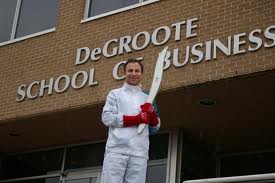 Bontis teaches graduate and post graduates students at the DeGroote School of Business at McMaster University. Bontis teaches business strategy to undergraduates, knowledge management to MBAs, and advanced statistics to doctoral students. He is also the coordinator of the first year introduction to business orientation course. In 2007, he was recognized as the first professor ever to win three outstanding teaching awards simultaneously: undergraduate instructor of the year, MBA instructor of the year, and McMaster University instructor of the year. He also received the faculty researcher of the year award for the business school.
Maclean’s has rated him as one of McMaster’s most popular professors for six years in a row.[4] In 2007, Bontis was one of 38 professors nominated for the 2008 Ontario’s Best Lecturer award.[5] In February 2008, TVO announced that he was among the top ten finalists.[6] In 2008, the OUSA (Ontario Undergraduate Student Alliance) recognized Dr. Nick Bontis as the top university professor in the province. The official award citation read “OUSA would like to recognize Dr. Nick Bontis for having made a significant contribution to teaching excellence and for facilitating a positive learning experience for Ontario students”.[7] In 2009, Bontis was awarded the 3M National Teaching Fellowship,[8] an exclusive honour only bestowed upon the top university professors in Canada.[9] He was also the OCUFA Teaching Award winner which is given to the top professors in Ontario.[10]
This is a Burlington Economic Development Corporation Mayor`s Imagince, Ignite, Innovate luncheon event. Tickets are $65.00 plus HST Table of 8: $520 plus HST Register through the BEDC web site:

 By Pepper Parr By Pepper Parr
BURLINGTON, ON March 13, 2012
There is a new broom at city hall. It`s behind the door of the new city manager`s office. He is quite capable of using it to clean things up.
 City Manager Jeff Fielding is bringing a different customer focus to city hall. As city manager`s go – Jeff Fielding was carved out of a different piece of wood. Not in office 60 days and he`s done or about to do two things this city hall staff has not seen before. He had some stationary printed up with the word “Thank You” printed on the outside and inside blank space for him to thank a staff member for something they`ve done. That’s going to come as a pleasant surprise to our civil servants at city hall.
Next on his list are somewhat different marching orders for what Jeff Fielding calls his ‘top 60’ – these are the men and woman that serve as the top level people at city hall.. General Managers, Directors, Executive Directors; that lot – the bosses.
Each of them is going to get a tap on the shoulder and Fielding is going to explain that during the month he wants them to get out on the street and meet with people. Drop in on store owners, restaurant managers maybe even apartment building managers and the guys at the gas stations who process your payment.
Not sure if Fielding is going to give these “top 60” tin cups with a few coins in the bottom they can rattle to indicate they would like a contribution or perhaps a mug filled with pencils they can sell. The point is, Fielding wants his people out on the street with their ears wide open able to listen to what people have to say. Should be an interesting exercise.
If some of those civil servants are going to call on home owners as well they might want to slide over to Glenwood School Drive and talk to Sara O`Hara about the way city hall works. O`Hara is a full time student pursuing an education degree. Her husband lost his job due to downsizing last month.
She explains: “Last night we found that our laundry room was backed up with sewage. We called a plumber and were told it would be an extra $100 to have someone come on a Sunday, so we didn’t use water all night and the plumber came first thing this morning. He told us his fee would be $450. Obviously we had no choice since our basement was flooded and with two young children we need water.
O`Hara went on to say: “The plumber put his snake through the drain and found out the blockage is on city property. He advised us to call the city.
“My husband” she continued “called 311. He was informed that if he had called the city first they would have sent a plumber and we would not have been charged. Since we called a private plumber, however, we are fully responsible for the bill. The city is willing to send a truck tomorrow morning to video the pipe to verify the blockage is on city property, but will not reimburse us even once they see this.”
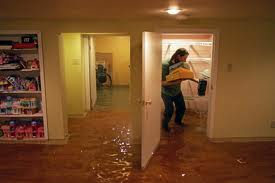 With the basement flooded Sara did what anyone would do - call a plumber. She could have called the city and they would have sent a plumber. How was O'Hara to know that? O’Hara says her “plumber told us the city of Hamilton fully reimburses for plumbing services where the issue is on city property, up to $600.”
“I just don’t understand”, said O’Hara ” how any resident would know to call the city in such a situation. And the city would have to pay their plumber just as much as we did the private one.”
Ms O`Hara did what a lot of people do – she called her Ward Councillor which in this instance happened to be Marianne Meed Ward – and wouldn’t you know it – Meed Ward was on Spring Break vacation and her trusty assistant was also away. O`Hara explained to Meed Ward in an email that: ” Our neighbourhood has had many issues with flooded properties in the past but nothing seems to be done. I know you probably can’t help us specifically but perhaps this issue can be solved in the future by at least making residents aware of their need to call the city when there is flooding, or to have the city look at sewer issues on our street.”
O’Hara added that: ” We had just re-done our basement in December and now our two month old carpet is garbage. We are going to have to make our first insurance claim ever. This is just a nightmare for our family.”
Meed Ward did pick up her email while on vacation and punted this one to her acting assistant with the comment: I am so sorry to hear about this. I have copied my acting assistant Sheri Wainman to look into this ASAP to see if there is an option through the city’s insurance or some other way to assist.”
Shortly after this story was originally posted – we got an email from Ms O’Hara. We will let her tell you what happened next.
Meed Ward’s assistant Sherri, contacted me about an hour after I sent the email to you. She directed me to Kelly-Jo Vautour, the Risk Management coordinator. Kelly hooked me up with the ex-gratia grant for public sewer back-ups and we are going to get $500 from the region. She and Sherri (Mead-Ward’s assistant) really jumped on this and were both sincerely sorry that we were dealing with the mess of the aftermath of the flood.
They were both fantastic. I even told Kelly that she restored my faith in the region. I did mention to her that it is not a well advertised grant, and if I had not pursued action with my councilor I would have simply been out the money. She agreed that something does need to be done to increase awareness.
Either way, we were reimbursed the cost for the plumber which is all I really wanted. We have to figure out now if we are going to go through insurance over the carpet or just skip that because of the deductible and potential increases in our policy.
The region is coming tomorrow to check out our pipes and figure out if further maintenance needs to be done to avoid future incidences like this. It has been a crazy day!!
 By Staff By Staff
BURLINGTON, ON March 13, 2012 Tansley United Church will be hosting an Electronics Drop off and Recycle Event on Saturday March 31st, 8:00 am to 2:00 pm.
 Tansley United Church, drop off point for electronics re-recyclables on March 31st Please drop off your old computers, printers, copiers, cell phones, fax machines, televisions, stereos, or speakers to the Tansley United Church parking lot located on Walker’s Line just north of Upper Middle Rd.
The Ontario Government has an initiative to divert 88,000 tons of electronic waste from the local landfill sites and Tansley United Church has agreed to help Burlington residents take on this challenge.
Please save your old electronics for our event and go out to your friends, relatives and neighbours and help us spread the word. The more people who are aware of this event, the more successful we will be.
For a detailed listing of what can be recycled and for more information about the program https://recycleyourelectronics.ca/Electronics/WhatWeRecycle.aspx
 By Pepper Parr By Pepper Parr
BURLINGTON, ON March 11, 2012 Jeremy Freiburger is the Founder of the Imperial Cotton Centre for Public Art that was very recently renamed CoBALT Connects and is responsible for overseeing the implementation of Burlington`s public art program. He is working away at the recently announced competition for the art work that will be placed on the exterior patio of the Burlington Performing Arts Centre.
With the new name Freiburger made one of his best connections ever by convincing the city of Burlington that he was the best person to develop the Cultural Master Plan which his group immediately renamed the Cultural Action Plan. The objective is to establish a pro-active and collaborative approach to cultural development in the city.
 Jeremy Freiburger will lead the search for a cultural identity and the development of a cultural action plan. A McMaster University graduate with a degree in Drama and Comparative Literature, which usually gets you a job driving a cab, Freiburger chose to dive even deeper into cultural studies and took classes at the American Music and Dramatic Academy. Added to that were numerous workshops in stage performance and direction, arts administration, grant writing, human resources and volunteer management, branding and marketing for the arts
As founder and Executive Director if ICCA Freiburger developed four facilities in Hamilton that are home to more than 100 creative workers and artists.
Freiburger is “not sure if it’s an advantage being trained in the theatre”, but has come to the realization that being creative and entrepreneurial were symbiotic. “For the better part of my life” he explains, “I’ve been exploring combinations of business and art as both an arts practitioner and administrator.”
The man who is going to guide the thinking that gets done to produce a Cultural Action plan for the city has “found himself gravitating towards scenarios that aim to answer the questions that go beyond the immediate need of the cultural industry (beyond the survival skills); and look more closely at those that are emerging and require resources and attention to flourish. These are also areas often mired in semantics, conflict, communication nightmares, as well as incredible opportunity, energy and reward. It’s at this point of friction and exploration that I find the most compelling work.”
Almost every project Freiburger has taken on provided him with an opportunity to learn the language of another industry, required entrepreneurial risk, partnerships and an open approach to project management. All skills and characteristics, that will be needed to complete the project, has to be in the hands of the Ministry funding the project, by the end of March 2013. As an aside, Burlington has a slew of events that are due to be completed during the first quarter of 2013: art unveiled in front of the Performing Arts Centre, the Pier officially opened and now a cultural action plan. And you know who is going to take credit for all this come the election in 2014 don’t you?
The project is an Ontario government Ministry of Tourism, Culture and Sport project funding 60% of the $100,000 contract and the city coming up with 40% that is a mixture of cash and in kind contributions.
Prior to taking on the oversight and management of the public art program for the city Freiburger managed the Imperial Cotton Centre for the Arts (ICCA which he founded in 2004 and is now called the CoBALT Connects.
Before founding the ICCA Freiburger did a basic needs analysis for Hamilton and Region Arts Council, which focused on the studio needs of local visual artists and the organization’s interest in starting a ‘collocation facility’. Despite the overwhelming need, availability of property and soft financial commitments from local funders, the organization decided not to pursue the initiative. He quit.
That failure to follow through and fund the arts was the final signal Freiburger needed to move on and become a full scale entrepreneur. Much of his entrepreneurial goal was based on the ability to “keep dreaming”. “After months of scanning the countless vacant properties in Hamilton’s downtown core, calling agents asking for tours and listing details, all the while having no clue what we were really planning to do with the information” Freiburger pressed on.
“While working in Oakville managing the Festival of Classics was a phenomenal position,” explains Freiburger, “I was still surrounded by fellow artists and friends in Hamilton who wanted to see the concept we presented come to fruition. With absolutely no resources (no money, no organization, no contacts of great influence) we continued our pursuit. It was discouraging but we were determined, a fair bit idealistic, and young enough to not think too much. Finally in the summer of 2003 our persistence paid off when we met the owners of the 270 Sherman complex. It was a spark moment for both parties. They had a massive property that needed animation and we had the energy and ideas to push it onto the community’s radar.”
Within days of meeting, Freiburger and his team were renovating space, hosting open houses and connecting the property with City officials, arts organizations and the general public. “All things we had no experience in – all things we had been collectively wanting for years together” said Freiburger.
 Freiburger signs the cheques and changes the light bulbs; part of being a cultural entrepreneur “This is the point at which I realized I was the entrepreneur and the others were just dreamers. The team dwindled quickly as the labour got harder. The team completely disappeared when it was time to talk contracts with the building owner and brownfield remediation with staff from Economic Development. It very quickly became clear that it would be me that would keep this idea alive.”
“I wasn’t paid a penny for the first two years of running the ICCA” states Freiburger. The work was tenuously balanced in evenings and weekends for the first year while he managed the theatre in Oakville, but eventually he gave notice there in order to make a serious commitment to the ICCA.
It was a grind and Freiburger found that after being featured in the Annual Report of the City of Hamilton Economic Development Department for three years, yet not having received a dime in financial support, he decided he needed a new relationship with the municipality. He tends to like heading into the lion’s den – so he intentionally chose not to set his sights on the Culture Department, but focused on Economic Development.
In 2005 Hamilton endorsed a clusters approach to economic development and ‘film and culture’ was one such cluster. Freiburger explains: “By 2007 the City had done plenty of work in the other clusters but very little in the one of most importance to me. So instead of waiting for them to get interested we invested $30,000 of our own money to conduct a basic industry impact study. The thought was that instead of coming cap-in-hand to the City, we would flip the relationship and approach them with investment opportunities and resources to help focus their efforts”.
With research partner Centre for Community Study and inroads at City Hall to gain key statistical information Freiburger embarked on studying the basic economics of the cultural sector. This immediately brought intense criticism from the arts and culture community. The ICCA and its partners developed the database of creative industry organizations and business, and authored the final report.
Since completing the study the information has been utilized by Hamilton to inform its economic strategy. Other organizations have used the data to justify and guide programming decisions, and it has become the foundation for the ICCA’s organizational plan. The dedication to an alternative relationship resulted in paid consulting contracts that far outweigh the costs of the original project, and has framed our relationship in a completely unique way with the municipality.
So, what is Freiburger going to do in Burlington? Well for starters he wants to see a community engagement process that has people “doing” things more than “talking” about things. “When we engage with the community we will have them doing things” – which is difficult to explain but for Freiburger “pushing the line” is a large part of the way he does business.
The project has to be completed by March 31st, 2013. Burlington picked up on an opportunity to have a project funded under the Ministry of Tourism, Culture and Sport`s Creative Community Prosperity Fund. The city got $61,550 to, as the Ministry put it “to build on the successes of the 10 year Cultural Strategy, Public Art Master Plan, Parks and Recreation Cultural Asset Plan, and earlier cultural mapping and economic impact studies. The city will update and enhance these tools to provide the municipality and cultural community with an integrated Cultural Plan.”
Freiburger, who will report to Director of Parks and Recreation, Chris Glenn, has broken the work into five sections: 1) the cultural producers, these are the people who “make” art; ; 2) the cultural industries, the people who support the cultural producers in a myriad of ways; 3) youth; 4) citizens and 5) education.
Kim Selman, Stephanie Seagram and people from Kitestring will be working with Freiburger on a close to daily basis.
By the end of it all Freiburger expects to be able to tell Burlington: “This is where we think you are going” and add to that where the city might best go in terms of developing its cultural industries.
Burlington’s city council recently turned down a budget request for $20,000 to cover the cost of a one year pilot project in Cultural Collaboration between the Heritage people and the Cultural crowd with the Royal Botanical Gardens folks thrown in for good measure. The presentation made to Council was a little disjointed and there was apparently some confusion as to who was to do what in terms of behind the scenes work. It looked as if that link wasn’t made and that the project didn’t even get talked about at the “pre-meetings” your Council holds before most of the public meetings.
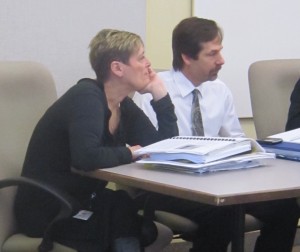 Director of Parks and Recreation Chris Glenn, on the right, will be the city's point man for the team developing Burlington's Cultural Action plan Barbara Teatero, Director Museums Burlington, didn’t manage to convince anyone on Council that the idea had legs and when Councillor Sharman asked them what would happen if they didn’t get the funds they were asking for – they didn’t have an answer. That brought a quick end to that request. Council got themselves off the hook by suggesting the idea was perhaps premature and should wait until the Cultural Master Plan delivered its findings.
We now know a lot more about Jeremy Freiburger, the man behind the task of helping Burlington figure itself out culturally. With a single public art collection – The Burlington Art Centre; a pitiful little museum; a part of a historical farm and a Performing Arts Centre that is in the start-up phase of proving itself plus a library that struggles to keep up with demand but nevertheless offers wide, varied and popular series of programs – Freiburger has his work cut out for him.
 By Pepper Parr By Pepper Parr
BURLINGTON, ON March 12, 2012 “I would like” said the city of Burlington, “a Master plan for the cultural industries in my city. Here is what I have, now what should I do to grow what I have.”
That basically is the question a Request for Proposals asked and what the CoBALT CONNECT contract is going to answer in the next twelve months. Here is how a conversation between the city and CoBALT CONNECT might have gone as the negotiated the contract.
Burlington has been engaged in creating a cultural policy since 1991. In that time the city managed to build a $40 million + Performing Arts Centre that we are so proud of we decided it needed to be adorned with some public art and we are spending an additional $100,000 on that.
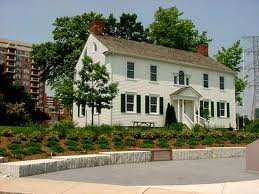 The Brant Museum is a combination of culture and heritage and is within what some describe as a "cultural district". Burlington believes in developing community capacity – not just municipal capacity, which is a collection of buildings. In Burlington, a number of leisure and recreation programs are delivered through partnerships with community hubs and we want to do the same thing with the delivery of cultural services.
The city has seen significant population growth, we are the largest city in the Region and are nestled in beside Hamilton which has much more urbanity than we have, although not quite as much civility, and they draw the younger people in our city and we want to create more draw for that demographic here.
As well, we are seeing much more diversity than we are used to, and we want to integrate the different cultures into the cultural fabric of the community
We think the development of our cultural plan process will break out into three phases. We bureaucrats like phases, they give us something to look forward to and we can usually get something into the budget to keep these phases alive.
Phase 1 from our point of view will begin with a review – we don’t want to re-invent the wheel now do we – but we do want to look at what other cities of a comparable size have done and at the same time get really adventurous and take a peek at what cities that are nowhere near what we are and see what they have done. One of the objectives is to bring all the members of the internal cross department team we will develop, up to speed and have us all working from the same base. We are desperate to make sure that we eliminate the silos – even though some of us are kind of comfortable with the things – if you know what I mean.
Phase 2 is when we think we should add a layer of community consultation and we would like this to be really robust. We want to see a very high quality, transparent and mutually beneficial relationship between the city and its cultural stakeholders by the end of this process.
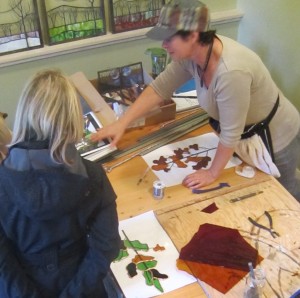 Stained glass artist Teresa Seaton is a force to be reckoned with in Burlington's cultural community. She will have a lot to say to the people developing a cultural plan for the city. This is where we want to involve the focus groups we will establish. You will have a focus group made up of the people who do culture; the playrights, the actors, the artists and even the buskers if there are any in Burlington. Then a focus group of the people who serve the cultural industries; the Chamber of Commerce, the Downtown Business Association.
We want to see a Youth focus group as well as a focus group from the education sector and then a focus panel from everyday citizens.
We want to hold two large scale collective engagement events plus a series of public consultation opportunities. We’d like to see this as wide open as possible and not just those cultural dilatants who feel they are the true holders of the cultural flame.
Throughout these processes we hope there will be an intense search for measureable data. Change that from hope to a ‘gotta’ – we need data to give us some idea what the heck we`re doing. The public knows we are spending their dollars when they see a road paved but it`s not quite as evident with the world of culture. So we need numbers that will support what we are doing.
Phase 3 is where the chickens should be coming home to roost. With community engagement coming out of our ears and everyone happy little campers, we want to be able to put our analysis, conclusions and recommendations in front of the public shaped as a Cultural Plan. And we want this to be boffo! This has to be a WOW! thing for the city. 2013 is going to be a great year for us and we don’t want any downers anywhere.
THE Pier will be opening, the art in front of the BPAC will be unveiled and our political masters will be in the final lap of their term of office and they all need to get credit for this plan. So make sure they are in on it from the get go. That won`t be hard – they will be using their elbows to get at the table. You watch and see – even Councillor Dennison will find a way to appear as a cultural buff.
Throughout this public engagement phase, the relationship between the city and the Cultural Action Plan committees will be tested, redefined and reshaped to reflect the needs of the larger community as we discover what they are.
The longer term hope is to introduce new, sustainable governance systems for planning and decision making regarding our cultural resources. We have made a terrible mess of planning and explaining our heritage to the city, we just don’t want to and can’t afford to make those mistakes again. Can you help us?
Here is what we bring to the table. We have a data base that has 356 organizations that have some link to culture – some of them might be slim links but we see culture as something that includes everything and anyone. For us that ranges from the Mayor playing the piano at an event and the local MPP tripping over a brook and forgetting the words when he did his Singing in the Rain impression of Gene Kelly. That event was given some legitimacy when our very own Jimmy Tapp gave us more than one chuckle.
Like bureaucrats around the world we break our work into phases and from 2006 to 2010 we focused on providing leadership for cultural development, building capacity and delivering clear benefits for the growing cultural community. Some of those benefits are not that easy to see – so we need to up the confidence level with our tax payers.
Our Heritage stuf is a bit of a mess right now but we are working on that. Your mission, now that you’ve accepted it, is:
To create a pro-active collaborative approach to cultural development.
Create a broad internal understanding of the cultural planning process and then give us some ideas on how to connect service delivery policies to our Strategic Direction..
When you do this we want there to be broad community engagement in the cultural planning process that includes cross sectional opportunities to move forward.
 Chris Glenn, Director Parks and Recreation for Burlington is the "report to" person on the development of a cultural plan. He is on the far right. Councillor Paul Sharman, a strong supporter of culture in Burlington will be following developments closely. Include in the report you are going to give us, a detailed cultural mapping process and an economic impact analysis which results in the identification of cultural and creative economic hubs and the evolving community needs and priorities. We want you to highlight the public and private opportunities and while you`re at it give us significant insight into the concept of a cultural district strategy. And help us find a way to make this meaningful to those folks in the Orchard and Alton parts of the city as well as those way up there in Kilbride.
Make sure you include a calculation of the economic impact of what culture can contribute to the economy of the city. We want you to identify the generation of a dollar value that culture can deliver to the city.
We want you to create a rich cultural electronic portal for ongoing reporting, analysis and promotion. You will know what that means.
Add to that a well-supported Cultural Plan to guide the city and its stake holders.
And because we think we are giving you a significant amount of money – something in the order of $100,000, we want you to hold at least 15 meetings with staff and various advisory groups; we want you to hold at least two public consultations; add to that at least three focus groups – one consisting of education people, one from the cultural industry and another from the cultural sector
You’re going to have to hold a Council workshop as well, that will include the internal stakeholders.
Then wrap the whole thing up with a launch event at which you deliver the report for the full stakeholder community.
That’s basically what the city asked for in a Request for Proposal and then based on a proposal submitted by CoBALT CONNECTIONS they awarded them a contract and said get a wiggle on, we need the report in just over a year.
The folks at CoBALT Connection are already digging into the task. Jeremy Freiburger, the man behind that organization is probably going to have to open up an office in Burlington to keep on top of it all. Gosh, we are seeing some economic spin off already.
[Facebook]
By Pepper Pa rr rr
BURLINGTON, ON March 10, 2010 It is on the move – again. This time to a better place where it will get the care and feeding it has deserved for such a long time.
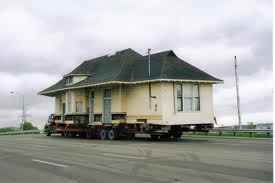 Is there another ride in store for the Freeman Station? Is it finally going to be given the home it deserves? Details are sparse but there is something afoot. Details are sparse but the committee that devoted itself to saving the Freeman Railway station from the wrecking ball appear to have pulled it off. Despite the city failing to find a decent home for the station even though they had more than enough money to move and refurbish the station it nevertheless failed to find a place they could located the building.
After a more than valiant effort by Councillors Marianne Meed Ward and Blair Lancaster they were given some time to see what they could do – and do they did.
 The sold prints, they held benefits and they scrounged for donations. They got themselves charitable status and they found someone who would take the building in, renovate it and have it ready for installation somewhere on the Beachway. The sold prints, they held benefits and they scrounged for donations. They got themselves charitable status and they found someone who would take the building in, renovate it and have it ready for installation somewhere on the Beachway.
There are more questions than answers at this point but it appears that the Save the Station committee found someone, who may be getting a tax receipt for the renovation work they are doing.
There were no dates or time lines available – just that the station would be moved and repaired and then located on the Beachway.
At some point this has to go to Council for approval which will not be before March 28th.
Conservation Halton will have something to say about putting anything on the actual Beachway, that is the land to the south of where the railway line used to run. Currently there is the Pump Station and and a small concession stand with washrooms that looks like it is need of an upgrade.
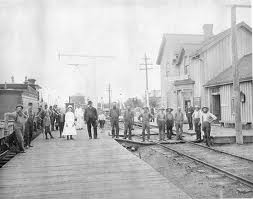 The station was the major route in and out of the city until the province developed a system of major highways. There are those in the community who want to preserve the railway station and there are those that blew the several chances we had to save some of our history. The Conservation Authority has been holding public meetings as it works its way towards what it feels should be a Master plan for the Beachway. That plan has to tackle the matter of the 28 + homes that exist north of the old railway line that is now a walking path.
The community that used to exist along the edge of the water is no more and the city has to decide if it wants people living in the area and if they decide yes – then what are they going to do in terms of sewage treatment facilities for those homes that are currently on septic tank systems. Declaring that the Freeman station is going to be located on the Beachway of course doesn’t mean it is actually going to get there.
Right now the group that has been fighting to save the freeman Station appears to have found someone to move it from beside the fire station on Plans Road and get it into a facility where it can be renovated.
There is obviously much more to this story than we have at this point in time. More details to follow.
 By Pepper Parr By Pepper Parr
BURLINGTON, ON March 10, 2012 There are things happening on the waterfront despite the close to disastrous state of the Waterfront Advisory Committee.
 Pump House was opened in 1910 and closed in 1936 then used as a private residence. Structure seems solid - could become a Beachway destination. Back when Burlington was a town there was a squat little brick building on the waterfront called the Pump Station that currently houses a`stuff ‘that the city doesn’t know where else to store. The Pump House was in continuous service from March 3, 1910 to February 1936, the year following the completion of the first filtration plant. It was converted into a private residence.
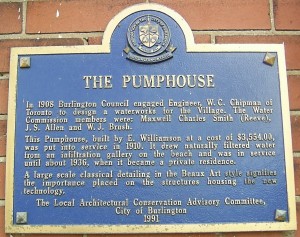 Just to the west of the Pump House there is a concession that sells French fries and ice cream. Jeff Martin heads up a subcommittee of the Waterfront Access and Advisory Committee that decided it wanted to do something and took on the task of turning the Pump House into a destination. Just to the west of the Pump House there is a concession that sells French fries and ice cream. Jeff Martin heads up a subcommittee of the Waterfront Access and Advisory Committee that decided it wanted to do something and took on the task of turning the Pump House into a destination.
The first step is to get inside the building and get a sense of what shape it`s in and what it will take to turn it into a place the public can use. The committee wants to entice someone with an entrepreneurial bent to take this on and turn it into a place that is open from at least May to Thanksgiving.
The building could be turned into a coffee shop, perhaps an art studio and a coffee shop. Licensed as well perhaps. The subcommittee is wide open to ideas and proposals – they just want to see something happening on the Beachway and hopefully get the Waterfront committee to the point where it can show it has actually managed to get done. Serious case of leadership vacuum on that committee.
Another subcommittee did excellent work on pointing out locations across the city where private property owners were blocking legitimate access to the waterfront. Les Armstrong and his team assembled a file and passed it along to city hall where it hasn’t moved all that much.
 In the picture above you can see the edge of the railway tracks that were removed. Jeff Martin’s group is determined to take the first step to bringing some life to the waterfront and making it a bit of a destination for more than those who like to get out for a walk. The place has potential and if the city is willing to work with someone who has restaurant/hospitality experience, we could see something akin to the Williams Coffee shop that exists in Hamilton on their waterfront.
Jeff Martin, along with a number of other Waterfront Advisory members were getting fed up with what wasn’t happening The full committee has spent most of its life (getting close to two years) spinning its wheels and getting deeper and deeper into the mud.
It`s terms of reference has a sunset clause in it; this one might not have much of a life left, which would be a pity because the waterfront needs some inspired leadership to channel the energy that is certainly evident on the committee.
However, as one way at city hall has pointed out:”They did re-elect the current chair so they have to live with that decision.”
 By Pepper Parr By Pepper Parr
BURLINGTON, ON March 9, 2012 After putting up a rather decent piece of public art in a place where no one gets to see it as they drive by, the city of Burlington is going to take a stab at getting it right this time. At a city budget meeting most members of council referred to the Orchids now on Upper Middle Road just east of Appleby Line, as a “lesson learned”.
There is a new group behind the public art process and the hope is they will bring their considerable expertise to this second time around“ for the city as far as public art is concerned.
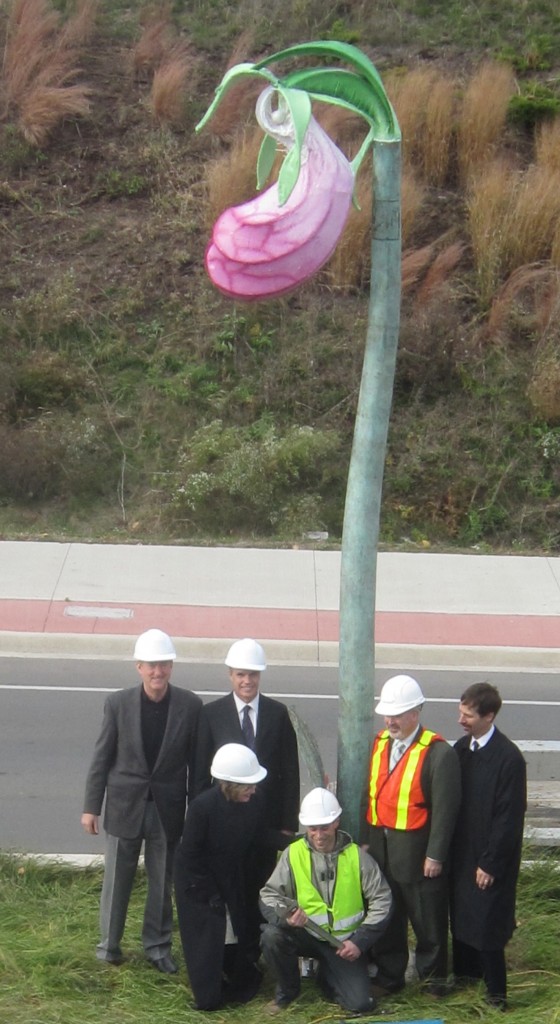 Not much of a public turnout for this unveiling. The city hired CoBALT CONNECTS, they used to be the Imperial Cotton Centre for Public Art, to oversee and administrate the selection of public art in the city. The city put a chunk of money into the art program budget and moved very quickly to announcing that the next location would be the exterior of the Performing Arts Centre. With the location issue of out the way, the community can now focus on who is chosen to do the art work.
All public art competitions will be evaluated by an independent jury of practicing arts professionals, community members and (when required) technical experts. If you would like more information about the jury process or would like to be considered for future jury positions contact publicart@burlington.ca
Professional artists are invited to submit Expressions of Interest to create a permanent public artwork for the exterior of Burlington Performing Arts Centre. This competition is open to all Canadian and International artists and artist-led teams. Click for a copy of the application form.
Because art is such a personal thing, and because so few people have the training or the experience to know good art when they see it, and because in a city the size of Burlington (any city for that matter) the more powerful people then to get their sticky fingers into the selection of anything that has to do with the “arts”, Burlington wisely chose a third party with the intriguing name CoBALT Connects to manage the process.
They recently put out a document requesting an Expression of Interest from the arts community. This is basically the first filter of names, but a rather rigorous one, that weeds out people who are not really qualified. `Qualified ‘has been a bit of a problem for Burlingtonians so to make it crystal clear for those who have a disposition to complain CoBALT sets out what they mean by an artist: A professional artist is an individual who has specialized skills and/or training in his/her artistic discipline (not necessarily in academic institutions), has a history of public presentation and is critically recognized as an artist.
That definition does shut out the wild and wooly abstract artists who have yet to be recognized but Burlington was never going to mount that level of art anyway. The definition CoBALT is working from sets a very acceptable standard. It means your uncle who has done some really wonderful work on tree trunks with his chain saw is not going to qualify.
There is a well-oiled communications network used by the artistic community to spread the word on where the opportunities are. With Expressions of Interest due April 13, that does though preclude any advertising in the “arts” publications. One assumes CoBALT knows how to get the word out to the artistic community. If they don`t like what they see in terms of Expressions of Interest they can, one assumes, delay and extend the time line.
The art work has to be responsive to the architecture of the building it is going to sit in front of and at the same time capture the sense of anticipation, movement and energy that is part of a live performance.
Whenever people talk about doing something in the downtown core the word vibrant gets slipped in. Saying we have a downtown core isn’t going to make the vibrancy just appear. It comes from the soul folks; it comes from the soul – ya gotta believe, you dig!
This piece of art is surrounded by don’t s. It can`t be something someone can climb up and it must not have any sharp points and it has to comply with the Ontario Building Code. The art work should complement the design aesthetic of the building – does that mean it has to be grey and bland like the brick work? The drawings submitted have to be certified by an engineer licensed to practice in Ontario.
The artist chosen will get a cheque for $95,000 CAD out of which he is going to have to pay for just about everything, including two trips to Burlington.
Stage 1 is the receiving of all the Expressions of Interest. The deadline is April 13th and there will be hundreds of expressions of interest. The selection committee will look at everything that comes in and ideally narrow it all down to three or four finalists using the following criteria:
Qualifications and professional experience of the artist.
Artistic merit of previous work.
Demonstrated ability to meet deadlines., budgets and success in executing projects of the scale outlined.
The artists responsiveness to the sit and approach to the project.
Meeting deadlines and a budget is code for “we don`t want another pier on our hands”.
The three to four that make the cut from Stage 1 will be asked to prepare a Concept Proposal that is to include an artists statement, preliminary drawings, draft budget and implantation plan. The finalists will have eight weeks to get this done and when submitted they will be paid an Honorarium of $1500 each. The proposals then go to the public for comment and feedback.
The selection committee will recommend the successful artist based on the merits of the Concept Proposal, technical feasibility and public feed back.
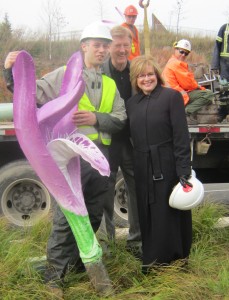 Burlington's intellectual cognoscenti pose with the artist at the installation of the orchids on Upper Middle Road. Unveiling a work of public art on the patio of the Burlington Performing Arts Centre will be a lot more dramatic than the miserable setting up of the orchids on Upper Middle Road on a chilly winter day. Not an artist in site other than the Irishman who created the orchids, a couple of civil servants and a clutch of politicians. Oh, and there were half a dozen mechanical types who had to drill new holes in the base of the orchids so the bolts put in place would fit. While the orchids would past muster under almost any public art standard, the administration and management of the that project was a lesson learned`.`
It is clear that the people in this city who makes the decisions didn’t take to our suggestion to move the orchids from Upper Middle to the steps of BPAC – an opportunity missed.
If all goes as planned the public art will be unveiled in front of the Burlington Performing Arts Centre in June of 2013. Wait a minute – June of 2013 – isn’t that the month we plan to officially open The Pier? Are we tempting fate here?
By Staff
BURLINGTON, ON March 8, 2012 King Road is getting all kinds of attention in terms of traffic restrictions. Phase 2 of the King Road Grade Separation Project will begin on March 12, 2012. This phase of the project involves the installation of round steel concrete-filled tubes to form an interlocking wall on the west side of King Road, south of the CN Rail crossing and north of the CN Rail, west of King Road.
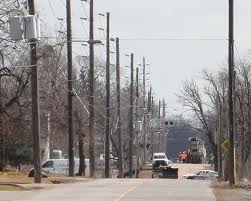 Grade separation work will limit access and traffic on King Road for six weeks. That means King Road will be closed for about six weeks beginning on March 12, 2012 from north of Enfield Road to 1135 King Rd. (IKEA Parcel Pick Up). Pedestrian access through the closure (across the CN Rail) will be maintained. Detours to Brant Street and Waterdown Road will be marked.
The construction work will consist of piles drilled into the ground; a steel sleeve put in place and then filled with concrete. This process is moderately noisy. Work will be done from 7 a.m. to 7 p.m. Monday to Friday.
It’s going to be a little on the messy side in that part of the city for the next while.
A grade separation is going in at the CN line on King Road. Expect construction to impede the flow of traffic while the city, CN and every public utility gets involved with what is a significant engineering task that will culminate during the Thanksgiving weekend. The project will also involve a widening of the bridge of the QEW.
 By Pepper Parr By Pepper Parr
BURLINGTON, ON March 8, 2012 It was Burlington people who brought to light just how many Jefferson salamanders there are in rural part of the city and it was the Harmer family that made the slimy little creature the centre piece for at least a part of the Joint Tribunal Hearings heard by an Ontario Municipal Board hearing that lasted more than a year.
And it is Burlington that is going to shut down parts of King Road so the ladies can cross the road and lay their eggs. If all these things are true – then why is there this big web site spread on the Regional web site.. Shouldn’t it be on the city of Burlington’s web site. Memo to the public affairs people at city hall – you were scooped.
 This is the section of the road being closed so that the Jefferson Salamander can trek across and lay its eggs. King Road is closed further to the south as well for grade separation work. King Road, between the base of the Niagara Escarpment and Mountain Brow Road, will be closed March 8 to March 29 to allow the endangered Jefferson salamander safe passage during its annual migration to lay eggs.
In Canada, the Jefferson salamander is found only in Southern Ontario, mainly along the Niagara Escarpment. Burlington is home to one of the few pockets of Jefferson salamanders in the province. In the past the city attempted a voluntary closure of a stretch of King Road to protect the species. In 2011, Conservation Halton conducted field research on the impact of vehicular traffic on the Jefferson salamander during breeding season. That research resulted in a full closure for the duration of the migration.
“We tried voluntary overnight closures as a temporary solution,” said Ward 1 Councillor Rick Craven. “But with such a small population, losing even a few of these endangered salamanders is too many. A three week closure is a small price to pay to preserve a species.”
According to Conservation Halton, a typical Jefferson salamander colony is small – with a population of no more than 100 – and confined to a specific area.
Local Jefferson salamanders spend the winter on one side of King Road, then cross the road to seek temporary ponds formed by spring run-off. “The annual migration takes place during dark, rainy periods in March, in exactly the type of weather where you probably won’t even see the salamander,” said Bruce Zvaniga, Burlington’s director of transportation. “The road closure is key to preserving the population.”
 The Jefferson salamander, native to the northern part of the city appears to have become a mascot for the Region. While Burlington does all it can to create an environment that the close to extinct critter can survive in, the Region is putting all their dollars into promoting the salamander.. The Regional Museum unveiled a new website featuring the Niagara Escarpment in Halton called Jeff’s Home.
The interactive, informative and easy-to-use experimental exhibition on the Escarpment in Halton is named after the Jefferson salamander, an Escarpment inhabitant. Made possible with the assistance of the Ministry of Tourism and Culture’s Museums and Technology Fund.
The site will serve as a teacher portal, offering access to environmental learning, heritage and escarpment facts and activities for students. It can also be used by the community at large, by a broader audience who may be thinking of visiting the Escarpment, as well as by those who are not able to visit in person, but who will now be able to enjoy a virtual experience.
Jeff, a Jefferson Salamander, serves as the site’s tour guide. Jeff was chosen as guide through the site’s Escarpment Discovery Hike, Educators’ Corner and information resources in The Escarpment in Halton pages because he is an indicator species. “If there’s trouble in our habitat, I give a warning,” said Jeff.
Visit the site at https://jeffshome.halton.ca
 By Pepper Parr By Pepper Parr
BURLINGTON, ON March 8, 2012 The first red light camera in Halton Region is up and running to remind drivers to stop at red lights. This is the first of 12 red light cameras the Region is planning to install over the next two years to help improve road safety.
 From left to right: Halton Chief of Police, Gary Crowell; Oakville Councillor Marc Grant; Oakville Mayor Rob Burton; Halton Regional Chair Gary Carr; and Oakville Councillors Tom Adams and Max Khan. Note that the only people smiling are the politicions. The police chief is going to have to enforce this law. “The fact that there’s at least one collision every week in Halton Region caused by a red light runner is not acceptable to us,” said Halton Regional Chair Gary Carr. “We want to save lives and make our roads a safer place to be. Running red lights is not only dangerous, it’s also illegal.”
To help improve road safety across Halton, Halton Region has worked with the Halton Regional Police Service on various road safety programs in the past addressing issues such as speeding and drinking and driving.
Red light cameras take photos of red light runners 24 hours a day, seven days a week, but only operate when a vehicle enters the intersection after the light has turned red.
Burlington is to get its Red Light camera March 19th when there will be a photo op at Brant and Dundas.
No mention was made in the press release on how much was spent on these red light runner detectors.
 By Staff By Staff
BURLINGTON, ON March 8, 2012 It was reported as stolen but it may have been more of a prank. A Boothman Avenue resident left a car idling in the drive way. That’s a no, no – Burlington has an anti-idling by-law.
 Sometime after 6:40 a.m. on March 6th, someone other than the owner of the car, a 2002 Hyundai, drove it out of the driveway and abandoned it later on Easterbrook Avenue. At that time of the morning I think we are looking at a commuter heading for work – he would have been late that morning. Sometime after 6:40 a.m. on March 6th, someone other than the owner of the car, a 2002 Hyundai, drove it out of the driveway and abandoned it later on Easterbrook Avenue. At that time of the morning I think we are looking at a commuter heading for work – he would have been late that morning.
The Hyundai Accent was not damaged. There is no suspect information as this time.
Anyone with information on this or any other crime is asked to call Crime Stoppers at 1 800 222-8477 (TIPS) or through the web at www.haltoncrimestoppers.com or by texting “Tip201” with your message to 274637 (crimes).
 Margaret Lindsay Holton, an award-winning writer and mid-career Golden Horseshoe artist found herself fascinated with a form of social media intended for the business crowd and reports on her experience for Our Burlington. Margaret Lindsay Holton, an award-winning writer and mid-career Golden Horseshoe artist found herself fascinated with a form of social media intended for the business crowd and reports on her experience for Our Burlington.
By Margaret Lindsay Holton
BURLINGTON, ON March 8, 2012 Chatter about ‘social media’ on the web is all pervasive these days. It is no longer enough to just have an email account. To be in the thick of things one must also have a Facebook and Twitter account. Generally, the latter two sites are for personal ‘interface’ with other like-minded types. However, in the business world, the pre-eminent ‘social media’ site, LinkedIN.com, is mandatory to stay within the business loop. Like it or not.
 If you weren't at this event - you missed the buzz. Burchill, the social media guru behind this "social media" gathering is in the upper left with notes in hand. Recently, I was doing my daily ‘check-in’ to that account, when I noticed that a few associates of mine had joined a group called ‘BusinessInBurlington’. Hmmm: what’s that?, I wondered, and within a few clicks of the mouse, I found out.
“The Business In Burlington open networking group started online in 2008 with a simple mandate – help connect, promote and support local Burlington businesses. If you’re a business in Burlington, do business in Burlington, or simply want to connect with local Burlington business owners and other entrepreneurs – THIS is the place to be!”
I was amazed at the size of the group, over 800 members. Wow. How come? Burlington, unlike Hamilton or Toronto, does not really have a unified City ‘identity’. Burlington is made up of six very diverse Wards spread out over a very large geographical area with a total population of only 170,000 +/-. For long-time residents, the City is better split into two distinct groups: those that live ‘above’ Dundas Street (formerly known as Highway 5), and those that live ‘below’. This divide is often expressed through contentious differences of opinion about the strategic growth of the City. It is built on fundamentally conflicting life values. Those above Dundas Street live in a predominately rural setting, while those ‘below’ live in suburban or urban clusters. Diverse, yes, unified, no.
So, WHO are these 800+ ‘like-minded’ business people of Burlington? And WHY do they feel the need to ‘join’ this group? (as I just did).
In answer, under the group discussion page, was a link for the third MeetUp on March 7th. There have only been two other MeetUps, in January and February of this year. Each had 60-70 attendees. As of March 7th at 3pm, 148 members have signed up. These are, by any standard, LARGE social events. People are coming together at a one physical location under the banner of ‘BusinessInBurlington’ without any specific agenda in mind. Again. Wow. How come?
The founder of Business in Burlington, (BiB), James Burchill, is naturally very enthusiastic about the response to his third event. In his own words, he is considered a “social media guru & an online marketing expert” (with 15,000 followers on Twitter to boot). He is also Founder/CEO of BusinessFusionMarketing, a Social Media Marketing (SMM) Advertising agency. I emailed and asked him WHY he thought there was such keen interest at this point in time for ‘Business in Burlington’? He first answered, “Good question!” He then promptly posted the same question on the LinkedIn ‘BiB’ discussion board. Over the next week, a few members responded with positive shout-outs for James, their inspiring BiB leader. But, more importantly, all comments exhibited a sense that ‘we be comrades in arms’.
Meanwhile, back at “BiB HQ”, James began offering a “video marketing” opportunity to some who intended to attend the next MeetUp event. A video booth, run by him, will record short introductions by participating members that will then be edited via his ad agency and posted on the BiB YouTube website with a URL linked back to member’s own websites. The strategy, according to James, is to maximize participants “SEO’d” exposure via YouTube, the “2nd most searched site on the net”. “Smart businesses”, he claims, “don’t have the time, the energy or the know-how to do proper video marketing on YouTube.”
“Businesses have no clue” James Burchill,Social Media guru. Further to this, James is now offering a special opportunity for those who want to “learn more about using video for email marketing”. Ask him about ‘Codename TF”.
All well and good comrades, but hey, WHAT ABOUT THE PARTY?There is no question that having an informal and free-admission ‘MeetUp’ at a familiar watering hole, the Beaver & Bulldog at 2020 Lakeshore Road, differs from more formal or conservative business gatherings that might be initiated by, say, The Chamber of Commerce or by the satellite McMaster University school site in Burlington. Talk about ‘dry’. And therein, to my mind, lies the key to this group’s apparent success.
 Some of the 100 + people who took part in a "MeetUp" Yes, business people from the broad business community are getting together. They are going to have a drink or two at the end of a long work day. They are also finally cashing in on their due diligence re: ‘on-line’ social media networking. Obsessively spinning in and out of e-mail, Twitter, Facebook and/or LinkedIn, can soon consume many hours of the work week. This ‘business’ browsing may keep us up-to-date on what our like-minded comrades are doing, but in terms of actual productivity, well, we all know how that works. When all is said and done, nothing replaces a good old fashioned chin-wag, or as James simply puts it, it’s “great to connect in person”. Ergo, and eureka, let’s rendezvous at the local pub! (By the way, another trending ‘social media’ site, Foursquare.com, has also figured this Old Truth out.)
Cynics could well dismiss this ‘BiB’ LinkedIn ‘MeetUp’ as just a hybrid ‘pick up’ or a veiled excuse for a ‘cocktail party’ circa 2012. However, Jennifer Aaker, Professor at the Stanford Graduate School of Business, has a different take. She believes that the role and impact of ‘brand marketing’ has changed so dramatically over the past few years, that brands, especially those gaining traction now, are those who act as “party hosts” aggressively overcoming the ever-increasing public “trust deficit”.
Additional thoughts on the public “trust deficit” can be found here and here.
Recognizing that we are becoming ‘cyborg-ized’ may also explain an increasing need for REAL human contact. Plugging into the internet is now an integral everyday extension of both our professional and personal lives. So, yes, how refreshing it is to just unplug for a bit, and get-together for some good old fashioned gossip.
To my mind, aside from the business hype, past and present, I think those who attend these ‘BiB’ MeetUps are genuinely interested in ‘down home’ socializing in a way not fashionable in well over a decade or two. In that sense, it really IS a local ‘cocktail party’ where rapid socializing, catching up, flirting, sizing up and business chats WILL happen over a drink or two within a very brief period of time. No strings attached.
James Burchill, as facilitator extraordinaire, has done Burlington a great service by manifesting this basic human need. ‘Let’s talk. Let’s have a drink. Let’s get to know each other a little bit better. Hey, what’s up with you anyway these days? What’s the BUZZ?’ As a community synergizer, he has effectively gotten people off their computers (and iGadgets), and put them in a convivial social atmosphere to ‘mingle’.
All of it – socializing in this friendly and informal way – encourages greater civic involvement, deepens an individual sense of belonging, and tangentially, nurtures a heightened civic responsibility by all those already actively invested in the success of this community. And, that, dear peeps, is GOOD for developing – and strengthening – a truly unified ‘identity’ for a rapidly evolving Burlington.
Turns out, it really is good business to ‘Know thy Neighbour’. Who knows. Maybe square-dancing will make a come-back soon too.
Business in Burlington (BiB) meets on the 1st Wednesday of every month from 5-7pm currently at 2020 Lakeshore Road, Burlington, inside theBeaver & Bulldog pub. There’s plenty of parking, on-site and on the street
© Margaret Lindsay Holton, 2012. Margaret Lindsay Holton, an award-winning writer & mid-career Golden Horseshoe artist, was born ‘above’ Dundas Street (aka Highway 5), and now resides ‘below’ it. The photography is © M.L.Holton 2012 / https://canadadaPHOTOGRAPHY.blogspot.com
 By Pepper Parr By Pepper Parr
BURLINGTON, ON March 7, 2012 There is going to be a fare increase – think in terms of it being an additional 25 cents added to the current $3.00 cash fare. There will be discounts for monthly passes.
The Budget Committee stewed for some time over what to do with transit. Ridership is only now getting back to the levels it was in the 80’s. The transit people are reviewing a report from a group of consultants and working on a Transit Master Plan.
The truth for Burlington is that no one wants to take the bus except for the people that don’t own a car because they can’t afford one or are no longer able to drive. Ten percent of the Burlington population is said to be living below the poverty line
The key metric for everything to do with transit in Burlington is called the R/C ratio; which is the ratio of revenue to cost. On many routes it is terrible and consistently draws the comment that “I saw a bus go by and it was empty” which gets the response “if you get on the bus it won’t be as empty” from transit staff.
Transit has a budget of more than $8, 647,000 each year.
At the last budget meeting there were two recommendations for fare increases. Councillor Taylor wanted it raised to $3.25 effective September 1st which he calculated would bring in $89,251 in new revenue. Why wait till September was Councillor Dennison’s response – he wanted the 25 cent increase to be effective May 1 – which would add $170,063 to the revenue side of the budget. Neither amount does very much for a budget that is over $8 million.
 They are looking at the same piece of paper but they are certainly not on the same page. Councillor Sharman and Director of Transit Donna Sheppard separated by key differences: he doesn't take the bus, she doesn't drive one.. Council members kept comparing Burlington’s prices to Oakville and Toronto – the cash fare in Toronto gets one a heck of a lot more value than Burlington is ever going to be able to offer. It is ingenuous to suggest that a Burlington cash fare should be anywhere near what Toronto charges.
The debate went back and forth with some council members talking about the cost of the system to the city and others talking about the need for the city to provide a service. None of the council members actually use the bus service; they don’t have to. It is the public that has to use the service that isn’t being heard by the majority of this Council. Meed Ward brings an understanding, sympathy and empathy for the problem.
Transit got mentioned in the Strategic Plan because the city had to mention it; it wasn’t put in the document because the city council members or staff saw it as a burning issue.
The budget committee kind of threw their hands up in the air and passed the whole thing back to staff saying – ‘here you guys figure it out’, which staff will certainly do. The comment in the budget agenda document provided by Dennison went as follows:
Achieve an annual RC ratio system wide of not less than 45% by September 1, 2012 with a 5% ridership increase in the projection; and further, that staff and the consultant review the six routes that have RC ratios of 30% and under and come back with reviews that include buses for peak only; dial a ride for off peak. All remaining routes are to be reviewed for opportunities for efficiency improvement and further, only improvements that can be implemented by June 2012. In addition, staff to produce the utilization route maps for individual routes that do not show overlaps of routes on any page.
How’s THAT for a set of marching orders? Absolutely none of it is do-able in the time frames given. Transit staff struggle maintaining a transit system in a city that really doesn’t want public transit but knows it has to provide such a service. Somewhere between the early 1980’s and today something changed. Ridership was much higher, the bus terminal was a bustling place and public transit was not seen as something poor people use.
Whether it was the urban sprawl, cheap gas and a lifestyle that had people driving everywhere; malls that you drove to and a transit schedule that seemed to meet the needs of the community – all hard to tell. What Burlington does know is that it has a transit system that is costing too much and not delivering all that much in the way of value for what is being spent.
 Plans to develop the parking lots either side of the John Street bus terminal and a consultants recommendation to get into marketing as much as moving people around suggest big changes for the service. Is city Council going to pick up the tab? The most recent consultant’s report suggests that Burlington is going to have to morph from a service that moves boxes with wheels on it up and down streets to an organization that tailors the transit service to the needs of specific markets and in the process become as much a marketing driven organization as an operator of vehicles.
It’s do-able. It has been done elsewhere with significant results. What seems to be missing in Burlington and at the Council table is the role transit plays in the life of a community. It is not a source of profit. It is a public service delivered by public servants in place to meet the needs, the real needs of the community.
That direction, put together by Dennison and sent back to staff, sounds like a cost cutting exercise handed out by an MBA graduate who has forgotten that the immediate and long term needs of the community are the issue.
Some social imagination will help. Now that the task has been handed back to staff we will get to see what kind of a twist the city manager puts on the way he interprets his role.
Doug Brown, who has more documentation on transit services than anyone else in the city, has a vision for the service he thinks the city needs. Does it square with reality?
 By Pepper Parr By Pepper Parr
BURLINGTON, ON March 6, 2012 When your city Council began the process of putting together the budget for the 2012 fiscal year they instructed staff to come back with a document that would result in a tax increase of between 2.5% and 3.50% The draft budget called for a tax increase of 3.44%.
During the past month Council and staff have been going through a process that has resulted in a committee level budget approval calling for a tax increase of 3.29% over the tax increase for 2011 – that one was less than 1%.
 Budget committee meetings were chaired by Councillor Craven who did a superb job of keeping Council members focus and moving through the agenda quickly and efficiently. What does all this mean to you? You will be adding $16.96 to your tax bill for every $100,000 of current value assessment attached to your home. If your house is assessed at $300,000 your tax bill will have an additional $50.88 cents on it
Mayor Goldring said during his election campaign that he would work to hold the increases during his term of office to not more than 10% during the four year period. During the budget discussions Rick Craven, chair of the budget committee, pointed out the 10% was a political statement and not council policy. With a .9% increase in 2011 and a proposed increase of 3.29 % in 2012, the Mayor will be at 4.19 half way through his mandate.
In 2011 Councillor Sharman wanted to see a 0% tax increase – that demand really shook up Council. The lowest demand we got this year was a 2.99% increase from Councillor Dennison. The 3.29% increase agreed to at Committee will only go higher when it gets to Council for final ratification.
The final figure will get determined at the March 19th Council meeting and the tax bills will go out late in April.
Watching a city craft their budget is a fascinating part of the democratic process. In Burlington it began with the Mayor stating that he would be happy with a tax increase that was somewhere between 2% and 3.5% and city Council sent staff a direction instructing them to pour over every department’s expenses and work towards a figure that fell within that range. Getting to where we are with this budget has been an interesting and at times exasperating process.
Once staff had been given their basic instructions they beavered away over the books. In Burlington, the Capital Budget gets done first – that’s the document that sets out the spending that has to be done over an 10 year time frame and set out what has to be allocated each year. Building a bridge, constructing an underpass, replacing a building. The replacement of the Drury Lane Bridge is an example of a capital expense.
With longer term need set out, Council then buckled down to figure out what they need to get through the next 12 months. In Burlington 90% of the revenue raised through the tax levy is spent on salaries and benefits – so this gets a very close look.
Last year the management of the FTE (Full time employees) was such a mess that Council put a cap on what the city manager could hire. Councillor Rick Craven felt this instruction seriously hobbled the city managers ability to run the city. But hiring had gotten so seriously out of hand the previous two years that Council put the hobble in place. Whenever there is going to be a new hire, the department looking for a new person will have to make a sound business case. Lifting the staffing cap was, in the eyes of Budget Committee chair Rick Craven, the biggest and most important decision made by the committee.
Council had a fine little spat last week when Councillor Taylor said he was opposed to going into closed session to discuss what the staff salary increase would be and if Council did that he was going to leave the Council Chamber and hold a press conference in the atrium.
When Meed Ward was first elected it looked as if she was going to champion a move away from these closed sessions but her desire for higher office proved to be stronger than her journalism degree and for the most part she has been silent when it comes to closed sessions.
Staff had settled on a general salary increase in excess of 2% when they knew that the region had settled on 2%.
Meed Ward did attempt to have the free parking city hall staff get taken away; that didn’t fly and her attempt to have it phased out over three years didn’t get the support of her fellow Councillors either.
Same thing happened to her attempt to have $100,000 removed from the city manager’s Staff Training budget.
Jack Dennison moved back into city hall – that’s going to cost you an additional $15,000. Up until very recently, actually close to the time when council members got moved to the 7th floor, where the accommodation was a lot nicer than the digs they had in offices that were windowless for some council members and their staff were stuck in a basement. Prior to the move to the 7th floor Dennison did most his work out of his health club and didn’t need a full time assistant.
During the part of the process that had Council members digging into very specific spending items Councillor Dennison managed to carve out an additional $600,000 for his Shave and Pave approach to saving the city a bundle and getting our roads to where most taxpayers think they should be.
The city instructed each of the local boards, the Library, the Burlington Art Centre to keep expense increases to not more than 2%, which made it all a little tough for groups like the Sound of Music Festival who came in rather late in the game and asked for an increase that passed the 50% level. He was rebuffed but expect the SOM people to be at Council to try again.
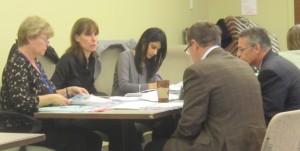 Mayor Goldring hunkers down with staff from the treasury department delving into the specifics behind a particular recommendation in the Capital Budget. In order to allow Councillors to get some sense of what cuts at different department levels would mean, the financial ninjas in the treasury department produced a spread sheet application that would allow Council members to cut an amount or add amounts and see instantly what the tax implications would be. It was a sort of high tech executive toy they could play with at home at night. When the little electronic memory sticks with the application were handed out Council members stood up and waved the things around like flags. Councillors Meed Ward and Taylor were like children at a birthday party who had just been given a loot bag.
 Director of Engineering Tom Eichenbaum looks over a drawing that Councillor Meed Ward needed additional information on. Italo Di Pietro's body language tells where he is with this conversation. He sits to the right quietly looking over Capital Budget numbers. Sometime after the bound budget projections and recommendations are put in the hands of Council members the staff congregate in a meeting room and gather in groups at different tables where they wait for Council members to sit down with them and ask detailed questions about specific expenditures. Because all the relevant people from a department are on hand Council members get all the information they need and staff get an indication of where a Council member might be going with a particular expense. The room had the feel of a Middle Eastern bazaar where merchants trade with one another.
A couple of weeks later Council members get the Current budget – this is a much bigger book and tends to get more attention from the public, especially groups that want something specific from the city.
For example this year the Burlington Performing Arts Centre was at the public tax trough seeking additional funding that was not in their original budget document.
For each of the budgets, Capital and Current, council members are able to have an item placed on the Agenda of the Budget and Corporate Services Committee. Organizations or individuals that want to delegate on an item can also appear.
Last year, freshman Councillor Marianne Meed Ward took up most of the oxygen in the council chamber with a rather long list of items she wanted to have council discuss and ideally get them to go along with her view and have the staff recommendation changed. While Meed Ward had a number of items on the list this year, it was Councillor Dennison who looked for every possible nook and cranny he could scrounge dollars out of and have re-allocated to the repair of the roads in Burlington. Meed Ward did take a run at reducing the city managers staff training budget by $100,000 but that didn’t fly.
The Fire Department needed and asked for funds to hire additional firemen for the newly opened station # 8 in the Appleby Line Upper Middle Road part of the city. He was told to get by using overtime, which will only work for so long. Men and women asked to take on too much overtime, experience overtime fatigue. Not the kind of problem Fire Chief Shayne Mintz wants to have to deal with. This one may get some additional consideration at the full Council meeting on March 19th.
Transit is going through a transition stage and working through the public participation stage of a consultants report and the creation of a Master Plan. The opportunity to beef up the revenue side by increasing bus fares was lost when Council couldn’t agree on how much and when a rate increase should be implemented. But this one is going to be coming back to Council – maybe even at the full Council meeting March 19th.
The city is short millions on the amount available to repair roads and if you drive the city street you can see and feel the problems with our roads. Dennison has become a champion of the “shave and pave” approach to road repair. If the city maintains a regular schedule of shaving a small portion of the surface of a road and laying down new asphalt the need to re-build a road at some future date, at a significantly higher cost, can be avoided.
The problem for Burlington is that it has not put enough money into the roads repair budget and as a result the city is now years behind in the work that needs to be done. The longer the repair work is left undone the more expensive it gets. Eventually the road has to be rebuilt completely.
 Councillor Taylor has been doing this sort of thing since "the day he used to have hair, it was black then" and knows the numbers as well as anyone in city hall. If what Dennison is proposing holds through the March 19th Council meeting, where the budget will get cast in stone, there will be enough money to get all the work scheduled for up to the year 2014 done this year. That may sound like we are getting ahead of ourselves – but that’s not the case. We are so far behind that it was going to take years to catch up – which meant years of complaints from tax payers.
Ward 4 Councillor Jack Dennison, who could probably run for Mayor on the strength of what he has done for roads this budget, took the $600,000 staff had recommended for road repairs and dug out more – a total of $600,000 additional dollars for a total of $1.2 million.
Dennison had Budget committee go along with taking the $400,000 that was scheduled for Strategic Land Acquisition and moving it into road repair and replaced that amount with part of the $4 million plus surplus from the 2011 accounts. Dennison was just slicing and dicing and looking for anything that wasn’t nailed down.
As a result the terrible roads condition list will get cleaned out – all done – but Dennison hasn’t stopped. There are funds in the Capital budget which has been approved – like a street that is going to get sidewalks on both sides of the road – Jack wants to cut some of those back to sidewalks on just one side of a road and use the funds saved for road repair. He thinks he can scare up an additional $600,000, for a total of $1.8 million in new money going into road repair.
The “shave and pave” process Dennison has taken on as his personal mission, has a machine that goes along a street and shaves off an inch and a half of asphalt that is immediately replaced by two inches of new asphalt. The result is a road that was beginning to deteriorate is now freshened and good for many years.
Goldring is seen to be doing a fine job as Mayor and has taken a Council that was once very fractious and molded it into a team that pulls together quite well for the most part; however he may find himself having to do even better in 2014. One can almost hear candidate Dennison talking about how good a steward he was of the tax payer’s purse when he not only kept taxes low (he wanted the increase to be 2.99%) but ensured that the money collected was spent on road repair, the city’s biggest problem.
 By Pepper Parr By Pepper Parr
BURLINGTON, ON March 6, 2012 The culture mavens gave it their very best shot. Barbara Teatero, Executive Director Museums Burlington, stood at the podium delivering a delegation on why the city should come up with $20,000 to support a collaborative efforts pilot project involving the Burlington Arts Centre, The Performing Arts Centre, Royal Botanical Gardens, Museum, Library and Tourism that would result in a web site that would create a brand for the city’s cultural destinations. There was going to be more than a web site but that seemed to be the focus of her comments and the thing that council members couldn’t get beyond. Weren’t there already enough web sites out there?
 Burlington Art Centre Ian Ross assuring Librarian Maureen Barry that all will be well in the cultural worlds - eventually. Burlington Art Centre Executive Director Ian Ross stood quietly beside Teatero as she made her presentation and proved that the two were no tag team. Ross didn’t get to say a word – perhaps he should have spoken. He did during the questions but didn’t have much in the way of a reply when asked what would happen if the group did not get the funding.
Almost everyone on council had their finger in this pie though. Councillor Craven wanted originally to approve a one-time expenditure of $5000., but he withdrew the request. Taylor was quite prepared to give the Open Doors group $5000 provided the City Managers budget was reduced by $5000 but he too withdrew his request.
Councillor Sharman put forward the request for the $20,000 but wasn’t able to convince his fellow Council members that this was a wise expenditure at this time.
Teatero explained that the objective was to tie into the “culture as a business” view that is floating through the municipal sector. She said 700 towns in Ontario have a Culture Day and that the objective for the pilot project was to create a collective identification for the cultural interests in Burlington; harness the inherent synergy between the different agencies and get some interactivity so that people who visit the Art Centre to look at collections there also get made aware of the Joseph Brant Museum and its offerings. Culture and heritage were going to be turned into Siamese twins – joined at the hip.
Councillor Meed Ward wanted to know “what would prevent you from doing that with what you have”. The point Teatero wanted to make was that they didn’t have the money they were asking for.
The city has just put out a Request for Proposals for the development of a Cultural Master Plan and the thinking around the council table was that nothing should be done in terms of creating synergies or developing identities until there was a master plan in place.
Burlington is close to awash with Master Plans. The transit people are working through theirs, which Councillor Taylor doesn’t think is going to go much further than the five has already seen during his 20 plus years on council. There is a Beachway Master Plan being worked up – the most current iteration of that plan is a follow up on work that started in 1987.
 Barbara Teatero, Executive Director Museums Burlington To be fair to this planning business, the Spencer Smith Park and the Discovery Centre are the result of good planning. We at Our Burlington cannot wait for the warm summer evenings to arrive where we can sit on the veranda at Spencer’s and take in a sunset with chilled white wine. But I digress.
The request was for one time funding of $20,000 – didn’t make it but the $2500 as ongoing funding for the Doors Open program supervised by the Heritage Umbrella Group – HUG did make it.
 By Staff By Staff
BURLINGTON, ON March 6, 2012 And then it was over. Winter had hardly gotten a decent grip on the city and the lake came nowhere near freezing over. There wasn’t any buildup of snow and the city must have saved a bundle on snow removal.
The true sign for Burlington that the winter was over is the announcement that as of 10:00 pm this evening the skating rink at the Rotary Centennial Pond at Discovery Landing will close for the skating season.
 If you didn't get to strap on the blades this winter - you're out of luck. Rink closes at 10:00 pm this evening. This is probably the first executive decision Chris Glenn made as the now Director of Parks and Recreation; the Acting was removed from the title very recently.
“With the mild winter we were happy to be able to keep the rink open as long as we have,” said Chris Glenn, director of parks and recreation. “We are now looking forward to the spring season and the opening of the reflective pond.”
City staff will spend the next few weeks cutting the ice out of the pond and preparing the 10,000 square-foot (930 square metre) reflective pond for opening.
“Skating is still available at the city’s indoor arenas,” said Sandy Osborne, co-ordinator of swimming and skating. “Our indoor recreational skating and shinny hockey programs run all year and are a great way to stay in shape and have fun.”
Fun sure, but it’s not skating on ice is it.
 By Pepper Parr By Pepper Parr
BURLINGTON, ON March 6, 2012
Recognizing one’s peers is a sign of a civilized community that pulls together for the greater good of everyone. The politicians manage to get their picture in the paper at every opportunity, they don’t want us to forget them. How could we?
Fireman and police officers get recognized for their heroic deeds. Beauty Queen’s get recognized because they please they eye and play into our fantasies.
 The little guy, the school crossing guard, the person that turns up at Rib Fest or the Sound of Music Festival to collect tickets or direct visitors.. The volunteer that pounds a pipe into the ground on a cold winter day to hold a seasonal decoration in Spencer Smith Park – these are the people that make a city. The little guy, the school crossing guard, the person that turns up at Rib Fest or the Sound of Music Festival to collect tickets or direct visitors.. The volunteer that pounds a pipe into the ground on a cold winter day to hold a seasonal decoration in Spencer Smith Park – these are the people that make a city.
Each Year Burlington creates a committee that selects citizens who deserve recognition. The people selected for recognition come from a list of names submitted. And you dear citizen have the opportunity to submit a name of any one of the six categories the city has created. They are:
Citizen of the Year
Junior Citizen of the Year
Senior Person of the Year
Arts Person of the Year
The Community Service Award
The Environmental Award
The deadline for the 2011 nominations is March 9, 2012.
In Burlington, being recognized by the community has in the past been the first step into a political career. While that isn’t the purpose of the award it is interesting to note how recipient’s names often end up on ballot forms. The real purpose is to recognize that unsung community hero who plugs away month in and month out; doing what it takes to make a city great.
If you know someone who has volunteered his or her time and played a role in making the community a better place to live, work or play, consider submitting their name for this honour.
Burlington is plunging head long into the world of electronic communications – thus you can submit a nomination electronically online at:
www.burlington.ca/civicrecognition
Nomination forms can also be picked up at Burlington City Hall, 426 Brant St., first floor, clerks department.
Committee clerk Andrea Holland at 905-335-7600, ext. 7413 or email hollanda@burlington.ca is also there to help you. Recipients of the awards will be honoured at a special awards event on Thursday, May 10, 2012 at the Burlington Convention Centre.
 By Pepper Parr By Pepper Parr
BURLINGTON, ON March 6, 2012 And the music played on.
Dave Miller, Executive Director of the Sound of Music Festival (SOM)
 A lazy, hazy early summer evening on the lakefront - sweet music, cold beer and the entry price is just right. took his case to a budget committee once again. This time he wore a suit and they had a projector that worked for him and he was able to talk about his numbers but they still took a pass. But it wasn’t as blunt a pass as his first attempt to get the city to pony up a little more cash. – that qualified as a disaster.
He also brought along a couple of volunteers and the new chair of his board – oddly enough they stayed in the seats in the public gallery; one usually trots them out to hopefully entice a council member to ask them a question or two.
Part of the problem Miller has is that “show business” is not like any other business. It chews up a lot of money and everything is on the line until the day of the event – and if it rains – you’re out of luck.
The Festival has a reserve of $400,000 which one would think they could dip into to cover the cost of growing the event. Better to look at that $400,000 reserve as their “operating” money. Fees have to be paid, artists want an advance to confirm a booking. Show business needs that kind of cash in the bank.
Councillor Dennison said he felt he could live with making the grant $17,000 a year over a two year period but Councillor Taylor got crotchety and said based on what he was looking at the Festival made a profit. And if they made a profit then why did they want more money from the city? The problem during the second delegation was that the numbers on the committee report weren’t an accurate reflection of SOM’s financial condition. This is a very successful financial operation that wants to grow the business and would like the city to get on the wagon.
All isn’t lost but Miller is going to have to make a strong business case if he is to get a vote from either Taylor or Lancaster. Miller has done some of his homework – met with the Council members individually to plead his case. He still has some work to do but he is beavering away at it.
If he could put together his financials in a format that was simple and direct and show that the Festival is a very financially successful event that brings major dollars into the city. And if he could manage to convince the people at the Burlington Downtown Business Association to join him at the podium – he might just pull this off.
They are making him jump through hoops and so far Miller has managed to handle most of the questions – but that critical sense of confidence still doesn’t exist within Council.
 They stream in by the thousands, all heading for a soft spot on the grass or a seat in the beer tent. The thrill seekers take a spin on the Ferris wheel. And there is some work to be done on the relationship building side of things as well. Miller wants to hold another event on a Saturday which makes good business sense but that will mean having all the barriers in place for that second Saturday and the Parks and Recreation people explain that they can’t just leave the barriers sitting out there for a week. “We would have to take them back into storage and then bring them out again and of course take them away again – that’s a lot of work for our people”, explained a Parks official. However, if the Festival is picking up the cost – shouldn’t matter to the city – should it?
The Festival is a big event and Miller wants to work at having it broadcast which would be quite a coup for the city. Imagine – the Burlington Sound of Music Festival being broadcast live across the country! Every one of the seven people at that Council table would stand a little taller and feel quite a bit prouder if the Festival was getting national coverage.
That kind of thing just doesn’t happen. It takes hours of work; Miller has to cultivate relationships, work angles and convince all kinds of people that this could work and the music is great content for a broadcaster. That potential isn’t going to happen this year but it is certainly a pony worth putting a couple of bucks on.
Miller doesn’t come across as one of those slick entertainment types that promises everyone whatever they want just as long as he gets what he wants. He’s a quiet guy who isn’t all that comfortable standing before council explaining things that he hasn’t made all that clear in his written presentation.
This is where perceptive council members can see beyond the presentation and provide the leadership to get the Festival to the next level. $34,000 over two years to get a shot at broadcasting Burlington to the rest of the country. And we are thinking about taking a pass on that? Are we crazy?
Might be. The March 19th Council meeting is their kill date.
 By Pepper Parr By Pepper Parr
BURLINGTON, ON March 6, 2012 It was an incredible mix of women. The war horses were there; those women who have been fighting the good fight for decades along with the high school students who approached the event with the awkwardness and shyness that adolescents girls fall back on when they face situations new to them. Most paused and looked about them, not exactly sure where they were supposed to go, as they walked into the Halton Room at the Holiday Inn with backpacks hanging from their shoulders.
The event, the annual Women’s Day Breakfast has been sponsored by Paddy Torsney for 16 years. The attendance this year topped at 190 with more than 30% of the crowd there as high school students; there were 18 from M. M. Robinson high school.
Kathy Bardswick, President and CEO of Co-operators Insurance Group, a self-confessed math nerd and 15 year old army recruit, was the guest speaker.
 Ann Swarbrick, former MPP in the Bob Rae government and now the executive Director of Habitat for Humanity listens attentively. Anne Swarbrick was in the audience and had a question of the speaker on what could be done to rebuild the co-op housing programs in Canada. Swarbrick pointed out that Burlington has 10% of its population living below the poverty line. Bardswick agreed that co-op housing was not getting the attention it deserved.
Torsney talked of the level of female representation at the various political levels. She pointed out that 76 of the 308 Members of Parliament are female but that at the Regional level, just four of the 21 are female, while some municipalities don’t have any female representation.
Torsney argues that the public gets better representation when there are woman at the table where the decisions are made. I think that it is a bit of a stretch to suggest that just because the person is female the decisions are better. Gender is very important but there are just as many ill-suited men in this world as there are women. One would hope that the women’s movement would strive to put their very best forward.
One of those very best is Kathy Bardswick. She brought a really interesting message which she aimed directly at the high school students in the room. “How many people like math” the audience was asked. Hardly a hand went up. “How many of you like music´ – and every high school student shot their hand into the air. Then they were told of a very significant link between mathematics and music. Bardswick pointed out that minds that tune into music understand structure and tend to be better at problem solving which is basically what mathematics is all about.
“This is your time” said Bardswick Bar. “You have the tools and you have the ability to make a difference”.
Bardswick went on to explain that women have a natural tendency to be more expansive; that women dialogue more before they make a decision and that with more dialogue the greater the understanding. And with understanding people can move to meeting both their own needs and the needs of those they are working with. Has Bardswick sat in on a Burlington city council meeting and listened to some of the dialogues? But I digress.
It is always interesting to watch successful woman speak to students, particularly female students. There is earnestness; you can almost feel the successful female business person wanting to will these young women into the business world.
One of the students asked Bardswick how she spent her early years and that brought a pause to the room. Bardswick explained that she was a bit of a rebel when she was young. She tended not to fit in all that well. She did manage to get herself into the army at the age of 15 but was booted out when they learned of her age.
 Isabelle Harmer, mother of Sarah Harmer, a popular singer and environmentalist, who was part of the community leading the drive to stop the expansion of an aggregate mine in North Burlington, discussing the guest speaker. She was accepted at McMaster at the age of 16; thought she wanted to be a doctor but failing biology and chemistry suggested she should look at some other field of endeavour. She was definitely not going to work in insurance but when a job at an insurance company came along – well there were student loans to be paid – so she worked for an insurance company. “I decided to work for the insurance company until I could get a real job”, she said. Thirty years later she is still with insurance and today is the President and CEO of The Co-operators Group; an organization with $40 billion in assets under management and a corporate culture that focuses more on serving the community than it does on racking up the profits.
 Guest speaker Kathy Bardswick, told more than 60 high school students to be be "absolutely fierce about achieving your goals” What Bardswick didn’t do was explain in more detail just what a co-operative insurance company is about and how it is significantly different than those in place to earn profits for their shareholders. In her talk, she mentioned that in her career in insurance she had never been asked or had to do something that was outside her ethical comfort zone. She explained that she believed the quality of one’s life is the most important concern and the chance to use skills and experience to make a difference in the quality of life for everyone is a noble endeavour. “It is not all about making a lot of money”, she added.
Bardswick made on very telling comment when she suggested to the students that they “find your passion, figure out what you really want to do with your lives and then be absolutely fierce about achieving your goals”.
“Your aptitudes are connected” she said. “Listen to them and listen to your hearts. There are huge problems to be solved in this world”.
 Carole Ward, recipient of Burlington's 2010 Civic Recognition Award has been a community activist for as long as most people can remember. Bardswick talked about sustainability and used her views on some of the things this world is doing that are not sustainable, to giving her views on the tar sands in western Canada. “I am somewhat schizophrenic about the tar sands. We shouldn’t be doing what we are doing to the earth. We can’t just keep pulling stuff out of the ground – it’s just not sustainable but on the other hand we are so dependent on that oil and at this point in time we don’t have alternatives.
And that for Bardswick was what the breakfast was really all about – harnessing the energy and the enthusiasm of youth to find the alternatives and beginning to solve the multitude of problems we face – one of which for her is the inclusion of women at the tables where decisions are made. She is convinced that we will be a better world with more women involved and that the new day is coming.
As for her personal career – she mentioned being in the sunset of her time as a CEO and looks forward to working with the co-op model at an international level. “We are beginning to see some acceptance for the idea in China” – and she wants to do more work on educating people about the co-op movement.
 Debra Pickfield runs Thinkspot ! in Burlington, an organization that takes an innovative approach to problem solving. Few Canadians know that Canada has played a leading role in the development of the cooperative movement.. Much of the philosophical thinking was done at St. Francis Xavier University at Antigonish N.S. If you want to get a look at an approach that could make this world a better place and remove much of the greed that came close to ruining the world economy in 2008 – the cooperative movement is one you might want to take a look at. It is an economic solution – not a political one.
Bardswick closed by telling her audience that the United Nations had made 2012 the Year of the Co-op and had established a web site to tell the world what the cooperative movement was all about.. That web site as at: www.canada2012.COOP
|
|