By Staff By Staff
January 28, 2015
BURLINGTON, ON
Rocca Sisters & Associates have produced a bullish report on real estate in Burlington, They report a gain of 8.6% year over year for freehold homes in Burlington. They add that sales volume was down 4% over the same period of time.
 Homes in Millcroft are selling well The hotspots in Burlington continue to be the Orchard and Millcroft, with most southeast communities either exceeding increases or not far behind. We believe the southeast is experiencing a renaissance due to three factors: ¬ affordability, proximity to Toronto (traffic patterns) and schools (Pinedale and Tuck both scoring very high on the Fraser Report).
We are expecting prices to hold steady in Millcroft and the Orchard with modest increases in 2015 but that will depend entirely on supply. If inventory levels remain low, prices may continue to rise in the double digits.
The Plains Rd neighbourhood has seen a significant increase due almost entirely to the resale of recently built townhomes. Finally, the Palmer neighbourhood has seen some significant gains. This community has proven to be a very good investment area for renovators as the property values have been kept fairly low.
We expect that in 2015 this community will continue to see some very strong gains. Overall, we expect to see a more balanced market in Burlington by the middle of 2015.
The banks continue to make it easier to finance the purchase of a home. The Bank of Canada cut its target for the overnight lending rate last week from the already low 1% down to 0.75%. Royal Bank of Canada was the first to announce yesterday that they would be cutting their prime lending rates by 0.15% down to 2.85% effective today. This announcement prompted Toronto-Dominion Bank, Bank of Montreal, National Bank of Canada, Canadian Imperial Bank of Commerce and Bank of Nova Scotia to quickly lower their offerings as well.
This drop in rates has come at the perfect time for potential home buyers and sellers at the start of the Spring Market.

By Pepper Parr
January 27, 2015
BURLINGTON, ON
The Halton Residents Against Sewer Backup (HRASB) is hosting a Valentine’s Day Gala with all proceeds going to fund independent research of the storm and sanitary sewer systems.
HRASB spokesperson, Christina Thorpe, says the group will spearhead the research but intends to work closely with independent experts who will analyze last year’s storm and waste water system failures, provide recommendations, and offer insight into the city’s proposed “intensification” plans.
 Christine Thorpe speaks for the Halton Residents Against Sewer Backup. “This is a tremendous opportunity for Burlington residents to come together, once again, in solidarity as they did on August 4th – a day when family, friends, and neighbours opened their homes and hearts to those who were greatly distressed.” More than 191 mm of rain fell on that August day.
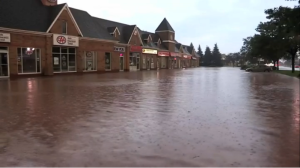
 Nothing pretty about this picture but it was the reality many in the city had to deal with last August. Thorpe contends that the formal affair at The Atrium will be well worth the $60 ticket price with dancing and live entertainment by the talented John Chantry, hors d’oeuvres reception, silent art auction, raffles for items such as spa packages and electronics, door prizes, and a champagne toast – all for a worthy cause.
Thorpe says that the storm and waste water infrastructure failed in May, June, and August of 2014, and that costly flood studies dating back 14+ years were seemingly ignored.
Furthermore adds Thorpe, citizens were not provided with essential emergency services for prompt sewage clean out or consultation on public health issues.
 The commercial sector suffered as well during the flood – no one is hearing how they dealt with the damage. “Emergency preparedness is something that every Burlington resident should be concerned about. We need to be confident that the City and the Region are prepared to take appropriate action during times of crises.”
 A Valentine Day event to get together and chill out and raise funds for further research. Tickets can be purchased online at WWW.EventBrite.ca – search for ‘Valentines Gala’ – or call 289-335-0329. Singles and couples welcome, senior and group discounts, 19+. * Transportation for seniors’ groups can be arranged.
The city has budgeted $4.5 million to do a study on what would have happened to other parts of Burlington had the same amount of raid dropped in Aldershot.
The HRASB hasn’t said what it is they want to independently research on nor have they set out a target as to how much money they need to raise.
Back in October, 2014 the HRASB wrote Regional Chair Gary Carr asking a number of questions.
Why, they wanted to know, did the representatives from the Burlington Flood Relief Foundation decline two invitations to attend sewer backup meetings thereby missing opportunities to connect with 350+ residents who were directly affected by sewage backup?
First, the organization was the Burlington Community Foundation and there job was to deal with two clearly defined groups of people: Those who did not have any insurance and those who were under-insured.
A meeting with 300+ people who didn’t meet these criteria would serve no purpose – and, the BCF was terribly over-worked dealing with those who did meet the criteria.
The members of HRASB and the people they represent have significant and justifiable complaints. The Regional government has basically stiffed them and failed to respond adequately to their real concerns. There is more detail on the HRASB web site at www.hrasb.com
There was an On line petition requesting a Town Hall meeting; that went nowhere. Everyone who signed the on-line petition also sent an email to Regional Chair Garry Carr – that didn’t produce any results either.
 Jane MacCaskill, CAO for the Region felt that elections got in the way of meeting the needs of residents whose homes were flooded. Regional CAO Jane MacCaskill published a press release in a local newspaper saying there would not be any public meetings with a municipal election taking place. For some reason MacCaskill feels the administration of a municipal government comes to a complete stop just because there is an election taking place,
The election is over – so now is there going to be a meeting? Thorpe doesn’t appear to be holding her breath.
There have been a few very poorly promoted Public Information events that were reportedly poorly attended.
Christina Thorpe is pushing for better transparency and more accountable. She thinks that the three law suits that have been filed against the Region for the way they handled the flood matters might be why they are being kind of quiet.
The people who lost so much due to the flood have big hearts – and they want to share the love on Valentine’s Day – and then use the money they raise to do some serious research. There is nothing more effective than a grass roots organization committed to their cause.
Related articles:
Open letter to the Regional chair – he didn’t respond.
By Staff
January 27, 2015
BURLINGTON, ON.
This is about as dirty as it gets.
Anyone who responded to this email will lose most of what they might have had in a bank account.
The email read like this:
VALUED CUSTOMER, A new Electronic Statement is available. Click Here to sign and update your details for Year 2015.
To review or change your email notification preferences, go to “Profile and Preferences” once inside Online Banking and then select “Email address and preferences”.
Please do not reply to this email, as it was sent from an unmonitored account.
BMO Online is offered by Bank of Montreal.
The Gazette banks’ with BMO. The thief used an email address that is linked to our domain. Somehow they got into the data base that lists the email addresses we have.
Had we clicked on the link they offered – it would have been “toast” for us.
Read email that relates to your banking very, very carefully. If in doubt – don’t.
By Pepper Parr
January 27, 2015
BURLINGTON, ON
The boys are at it again.
Mischa and Mel Aravena are part of a crew that will be putting on performances of Red, the six time Tony Award winning play, written by John Logan. The run begins January 29th at the Burlington Performing Arts Centre (BPAC).
Nortesur Productions, a Burlington based group is behind this initiative. The company is made up of the two Aravena boys and their Dad.
 Mischa is in the back, Mel in the foreground: moving the set for the Harold Pinter play “Betrayal” that they were painting in their driveway for a Hamilton Fringe Festival production. They were work shopping Red in Hamilton when Brian McCurdy, Executive Director of the Performing Arts Centre in Hamilton saw their work and decided to bring the production to Burlington.
McCurdy has done a lot to develop local talent on the BPAC stage.
 Red, a dramatic production has won six Tony Awards. Red is about Master Abstract Expressionist painter Mark Rothko has just landed the biggest commission in the history of modern art, a series of murals for New York’s famed Four Seasons Restaurant. In the two fascinating years that follow, Rothko works feverishly with his young assistant, Ken, in his studio on the Bowery. But when Ken gains the confidence to challenge him, Rothko faces the agonizing possibility that his crowning achievement could also become his undoing. Raw and provocative, RED is a searing portrait of an artist’s ambition and vulnerability as he tries to create a definitive work for an extraordinary setting. It is a fascinating exploration into the life of an angry and brilliant mind.
This level of critically acclaimed drama is not seen nearly often enough in Burlington.
The Aravena boys have had work in the Hamilton Fringe Festival. Mel does the production work – Mischa is the performer.
The production runs from Thursday January 29th through to Saturday February 7th.
Tickets available at the PAC box office.
Show Times
Jan 29 7:30 PM Feb 05 7:30 PM
Jan 30 7:30 PM Feb 06 7:30 PM
Jan 31 2:00 PM Feb 07 2:00 PM
Jan 31 7:30 PM Feb 07 7:30 PM
Tickets Available at the BPAC web site.
By phone: 905-681-6000
Regular Price: $29 + tax
Series Price: $25 + tax
Senior Price: $25 + tax
30 and under: $25 + tax
By Staff
January 26, 2105
BURLINGTON, ON
That is snow out there – and when that happens a well-oiled snow removal team swing into action and the business of moving snow begins.
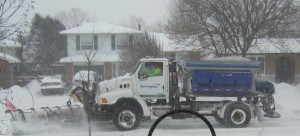
 Snow plows can clear both the primary and secondary roads in a three hour time frame. The city`s Roads and Parks Maintenance crew had 10 trucks on the road at 4:00 am salting both the primary and secondary roads.
By 1:00 pm there was more than 5 cm of snow on the road and that brings out the plows. It takes the city just over three hours to do a tour of both the primary and secondary roads using both city staff and the contractors that have working agreements with the city.
Much of this snow – flurries actually – are the result of what the weather people call the “lake effect” is limited for the most part to Burlington.
 Cathy Robertson: Director of Roads and Park Maintenance. If she has to – she can probably drive one of the plows. Cathy Robertson, Director of Roads and Parks Maintenance, has clearly honed her executive management skills – she is away from her desk in a place where there is a lot of sun until February.
By Pepper Parr
January 26, 2015
BURLINGTON, ON.
There just might be an opportunity for pilot private tree bylaw in the Roseland community.
Last week the Roseland residents met to learn what the city planning department was going to do with the recommendations made by the consultants who conducted the community character study that is now complete.
The character study done in Roseland was one of two the city had done. It wasn’t possible to arrive at any sense of consensus on the Indian Point community character study but there was much to work with in Roseland where residents resent developers buying up properties, clearing the land, demolishing a home and then seeking a variance at the Committee of Adjustment to sever the lot and build homes that many feel do not fit in with the look and feel of the community.
 A tree close to 100 years of, `honoured`by the community was cut down. The property owner has plans to seek a severance of the property. Roseland residents furious that things like this are allowed to happen. One of the issues is the cutting down of trees that are on private property. City council was not able to get a private tree bylaw passed during its last term of office. Mayor Rick Goldring was on for such a bylaw and there were several cogent, persuasive fact filled presentations made at the time but it wasn’t enough to get the four votes needed.
The Roseland residents might have created an opening for the Mayor who sat in on the meeting last week – and got more than an earful.
There was a superb opportunity for the Mayor to put forward his belief in the need for a private tree bylaw. He was given close to the last word during the meeting of residents and he made his typical comments; that he heard what they were saying and more yada, yada, yada. He did say a pilot tree bylaw was an intriguing idea. There was not even polite applause for the Mayor.
Jack Dennison, ward Councillor for the community then stood up and made his comments; thanking the planning staff and adding that it had been a productive meeting.
 Nothing unhealthy looking about this tree. Dianne Bonnell said “the level of residents’ frustration was palpable”, while another resident called the cutting down of trees an “absolute travesty” and left the room minutes later.
The residents at the meeting believed that the cutting down of 100 year old trees devalues the property of all the residents in the community and they are left feeling helpless. Some are beginning to move out of the community – they think the end of the Roseland they had chosen to live in was in sight.
What our Mayor could have done was this – told the community that he understood their frustration and that he was going to put a motion before council asking for a pilot private tree bylaw that would be restricted to the Roseland community and be in place for a number of years – three should do it.
The Mayor could have then turned to Councillor Dennison and asked him publicly if he would support such a motion.
But Rick Goldring doesn’t have that level of political chutzpah and for the next while majestic oak trees will be felled in the Roseland community.
It was a lost political opportunity for a Mayor who appears to have a tin ear when it comes to listening to the residents.
Related articles:
Council votes against a private tree bylaw.
Community survey doesn`t convince city council that private tree bylaw is needed.
By Staff
January 26, 2015
BURLINGTON, ON
Halton Region’s rapidly growing population has stretched the current capacity of local court resources and facility infrastructure causing delays for many legal proceedings. If you’ve had occasion to do anything at the Court House in Milton – you will agree with the Region’s conclusions.
 Superior Court housed in Milton where the structure needs a major upgrade – maybe an entirely new structure. “Our current court infrastructure does not meet the growth related needs for Halton,” said Regional Chair, Gary Carr. “We have been mandated to grow, but our legal infrastructure has not kept pace. Our system is stretched beyond capacity. Residents and legal professionals are feeling the pressures. “
Carr is working with local MPPs and Regional Council including the Mayor of Burlington, Rick Goldring, Mayor of Milton, Gord Krantz, Mayor of Halton Hills, Rick Bonnette and the Mayor of Oakville, Rob Burton, as we simply cannot wait any longer to see changes to this critical community service.”
Halton Regional Council will consider a resolution for continued support by the Province to address the shortfalls with Halton’s legal infrastructure. There are a number of pressing issues to be resolved including outdated court house facilities resulting in significant delays for legal proceedings.
 The Provincial Offences Court in Burlington has reached capacity. There were plans to build a new Court House on Palladin Way in the Alton community but that got scrubbed. Now the Region seems to be leading the push. Halton is including the issue of court resources and infrastructure shortfalls in its Provincial pre-budget submission later this month. In addition, the Region has requested a meeting with the Attorney General outlining the need for further action to ensure that legal facilities are in place to keep pace with mandated provincial growth. Halton’s advocacy efforts on this issue date back a number of years including a 2012 meeting with the Attorney General, John Gerretsen, where the Halton court situation was presented.
The Provincial Offenses Court House in Burlington is scheduled to be moved. Last March city staff brought a proposal to the City’s Community and Corporate Services Committee to combine two provincial offences courts—one in Milton and one in Burlington—to reside under one roof in Burlington at Walkers Line and Palladium Way.
Local residents were upset at not being informed – the city manager quickly withdrew the idea – turned out that all the players to make this happen weren’t in place.
Acting on behalf of the province, the City consulted with its municipal partners—Oakville, Burlington, Milton, Halton Hills—to get input into this location. Staff realized more feedback was needed, and put the proposal on hold, to be revisited in 2015.
In 2013 the city pointed out that Halton Court Services has the challenge of managing an increasing need for court resources. Courtrooms reached 100-per-cent capacity in 2011.
Growth continues throughout Halton Region. The number of charges has increased by 32 per cent since services were transferred to the municipal partners to manage in 2001. The municipal partners realize that more courtrooms, services and staff will be needed in the future.
Operating a single, consolidated court building would save the municipalities about $225,000 a year.
The zoning at Walkers Line and Palladium Way is business corridor use that allows for a range of industrial and office uses, including a courthouse. The roads at Walkers Line and Palladium Way are designed to manage traffic associated with business and commercial use.
Local residents asked some very pointed questions about transit service to the proposed location.
The City of Burlington has the authority to act on behalf of the provincial government when it comes to managing the Provincial Offences Court. The city consulted with key stakeholders and its partner municipalities in making the decision to house provincial offences courts in one building.
With the proposal withdrawn at the Standing committee level in Burlington there wasn’t much more to be said. The Region has now taken up the matter. Burlington doesn’t have a new city manager yet – Interim City Manager Pat Moyle is scheduled to turn in his keys before the end of the month.
Whatever the Region does later this month the matter will work its way to Burlington’s Community and Corporate Services Committee where residents will undoubtedly push for real input on design and transit concerns.
A key issue for some in the community was: Will my house value go down if a courthouse is built at Walkers Line and Palladium Way?
By Staff
January 24, 2015
BURLINGTON, ON.
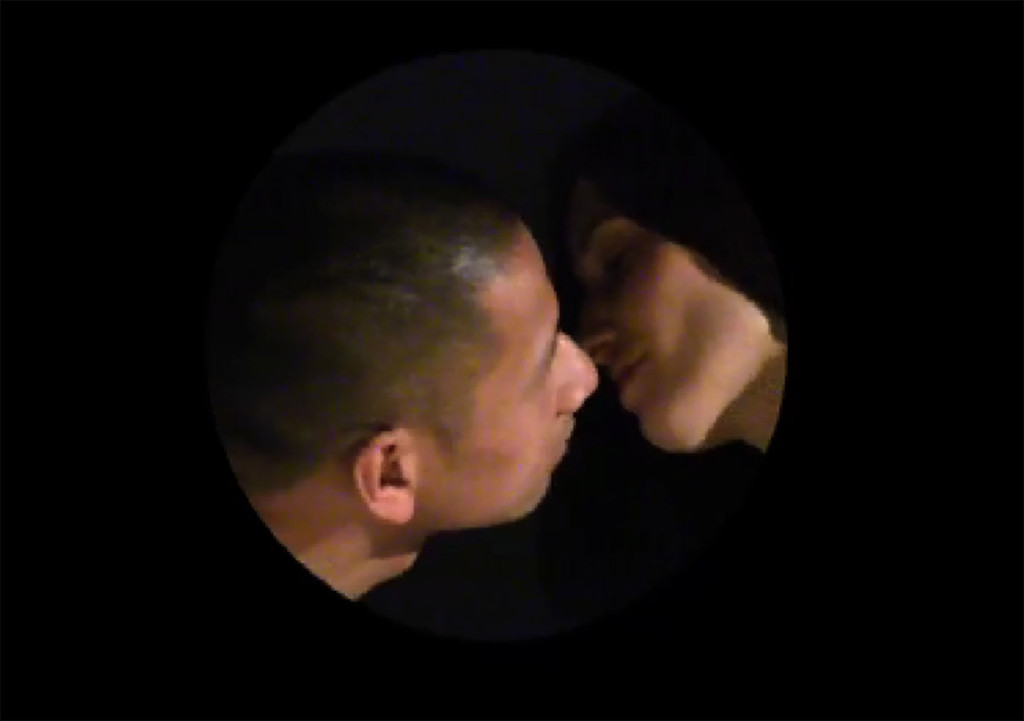
It was a different piece of “installation art”.
Jim Riley came up with this idea of filming people who are kissing each other. It was a little outside the comfort zone for some and we don’t know yet how people are going to react to the projections on the windows on the west side of the Art Gallery of Burlington.
 They are worth looking at. The way people of different ages handle “the kiss” is interesting – we will leave it at that. They are worth looking at. The way people of different ages handle “the kiss” is interesting – we will leave it at that.
The Gazette works closely with a number of staff at the AGB – the odds on favourite amongst the female staff member’s is the one they refer to as The Long Kiss.
Jim Riley explains video installation as an art form that combines video technology with installation art. Between 1970 and 1995, artists used TV to present their video art. The technology available today allows much bigger and bolder projections.
Love Kiss can be seen from Lakeshore Road using video projectors and two windows between dusk to 10 p.m., Monday through Thursday
The TV monitors, as well as the video projections, may also be viewed inside the gallery.
 Riley thinks the locale might become a spot for couple do pause sometime during Valentine’s Day. Riley thinks the locale might become a spot for couple do pause sometime during Valentine’s Day.
By Pepper Parr
January 23, 2015
BURLINGTON, ON
The wheels do at times move very slowly but they are at least moving a little.
The Burlington Community Foundation (BCF) announced on Wednesday that they have completed their review of 36 claims made for financial support for those who were financially damaged by the August 4th flood that dumped 191 mm of water on the city in a single day.
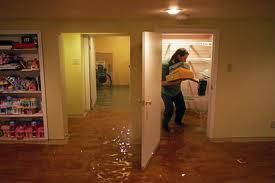
 Whatever people get in the way of financial support – there will never be enough to cover thew loss. Hundreds of people had to deal with situations like this in their basements, A total of 310 claims were received. Of the 36 that have been reviewed – 33 were approved and payment will be sent out. Claimants can expect to receive an email with a letter from the Burlington Community Foundation setting out the preliminary amount approved and the interim payment as well.
The Ontario Disaster Assistance Relief Program guidelines requires all 310 claims submitted to be reviewed before final payments can be made to claimants.
The interim claim disbursements will be 50% of the preliminary total amount approved. Total amounts approved by the Disaster Relief Committee (DRC) are preliminary and subject to change.
Once all 310 claims have been reviewed, the DRC can determine the final payment amounts and disburse final cheques. The committee’s goal is to have the process completed by the end of April.
People who lived in homes that were either under insured or uninsured were eligible for financial support. There are many homes in Burlington that cannot get insurance – other found that they were limited as tot he amount of insurance coverage they could buy.
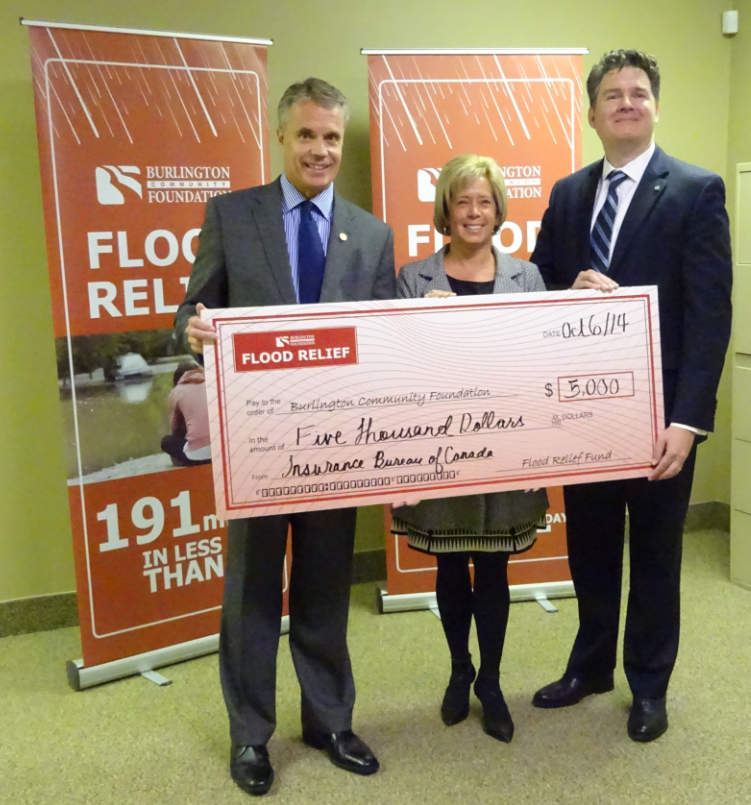
 Cheque for $20,000 from the Bank of Montreal was greatly received. Why so complicated? The BCF faces a bit of a supply and demand problem. They know how much money they have to distribute: $905,000,00 was raised from within the community which was matched by the province on a two for one basis which gives BCF a total of $2,715,000 to distribute.
How much will each claimant get? The BCF won’t know that number until all the claims are reviewed. Requiring people with pressing financial needs to wait until all the paper has been shuffled was a bit much – so the BCF decided to pay out 50% of the claim and once they know how much money is available – pay out the balance. That balance may not turn out to be exactly 50% – might be more, could be less.
At least they have finds moving.
The cheque sent out will actually come from the city of Burlington.
Those whose claims have been denied will also receive a letter and a phone call with an explanation as to why the claim was denied.
“The Claims Committee is working diligently and will continue meeting every two weeks to process each claim,” says Colleen Mulholland, President and CEO, Burlington Community Foundation. “We are extremely pleased that cheques will start going out within the next two weeks to assist eligible flood victims with their recovery efforts.”
By Staff
January 23, 2015
BURLINGTON, ON
It used to be that it was either a drug bust or a case of someone doing things that were not nice to people of the opposite sex in public place that kept the police busy – Mapleview Mall seemed to be the most popular spot for the sexual deviants.
But on the past couple of days the police have been kept busy arresting shoplifter.
Three men were arrested for shoplifting at Shoppers Drug Mart on Tuesday January 20, 2015 at approximately 7:55 pm; they had taken a large quantity of baby formula from the Shoppers Drug Mart at 1450 Headon Road in Burlington.
A store employee followed one of the suspects and was pushed from behind by a second suspect to allow both men to enter a vehicle and flee along with the third suspect and the licence plate of the vehicle was obtained.
At approximately 8:28 pm, police located the suspect vehicle near the Shoppers Drug Mart at 2080 Appleby Line in Burlington. One of the suspects was arrested near the vehicle while two other suspects were arrested after leaving the Shoppers Drug Mart with more stolen baby formula and cosmetics. Police have recovered all the stolen property from both stores.
Arrested and charged are:
Bruno ANTUNES (37 yrs) of Toronto (Held for Bail)
Theft under $5000
Robbery
Fail to comply with recognizance
Aristide CINELLI (37 yrs) of Toronto (Held for Bail)
Theft under $5000
Robbery
Flavio CINELLI (35 yrs) of Toronto (Held for Bail)
Theft under $5000
Robbery
Fail to comply with recognizance (three counts)
On Monday January 19, 2015 at approximately 8:15 PM, police were alerted by security officers working at The Bay store at the Burlington Mall, 777 Guelph Line about a theft in progress.
Security officers believed five males in the store were involved in a prior theft that occurred earlier the same day at The Bay in Oakville.
The five males exited the store through various doors with stolen merchandise. A responding officer immediately located two suspects at which time the officer was assaulted and the two males fled on foot after dropping a quantity of stolen merchandise. The officer involved was not seriously injured.
Police continued to search the area with the assistance of canine and one suspect was arrested near the mall. A short while later, police received information that two additional suspects possibly boarded a taxi which was then stopped by police in the area of Laurentian Drive and Harvester Road. These two suspects fled the taxi and one was quickly arrested while the other remains outstanding. Police recovered almost $1000 in stolen merchandise in the taxi.
It is believed the remaining suspects fled in a vehicle which was seen leaving the mall at an extremely high rate of speed.
Police are continuing to investigate with hopes of identifying these men who are described as being black males in their mid-twenties.
The following persons have been arrested and charged:
Nathan HOLDER (22 yrs) of Oakville (Held for Bail)
• Theft under $5000 (two counts)
• Possession of property obtained by crime under $5000
Courtney JESHURON (23 yrs) of Mississauga
• Theft under $5000
• Possession of property obtained by crime under $5000
• Breach of Recognizance
It’s been a busy day for the “shoplifting squad”
By Staff
January 21, 2015
BURLINGTON, ON
Premier Kathleen Wynne announced today that the Ontario government is increasing wages for early childhood educators and front-line child care professionals in licensed child care settings.
Starting this month, Ontario is implementing a wage increase of $1 per hour for eligible child care workers in the licensed child care sector. Another wage increase is set for next year.
The people who take care of the best future resource we have – get slightly more than a livable wage. Go figure. The increase will help close the wage gap between registered early childhood educators working in full-day kindergarten programs and child care professionals in licensed child care settings. Ontario’s investment to increase wages also supports efforts to recruit and retain highly qualified and talented educators, and supports parents in accessing safe and reliable care for their children.
It’s a start – now if the province would look seriously at a plan similar to the one in Quebec where child care is affordable – there will be more job opportunities for child care workers as well.
By Staff
January 21, 2015
BURLINGTON, ON.
The city wants to make the streets look nicer. A number of years ago they installed really nice looking bike racks – they were attractive – so much so that many people didn`t use them – they didn`t know they were bike racks.
 Lovely public art – it’s a bike rack. Hard to tell what its purpose is – needs a small sign – Park your bike here. Margaret Lindsay Holton, a local artist, tells of a person she saw chaining their bike to a pole that was beside one of the bike racks – the rack was so attractive people didn`t realize what they were for. “That was one of those occasions I wished I had had my camera with me” said Holton.
At some point the city might add small signs to the racks – saying what they are – they are very nice.
Through its public art program, the City of Burlington is inviting the public to provide suggested locations and themes for a series of local murals and is offering three ways to comment between now and Feb. 6.
“This is a great initiative that will Increase local artist participation in the City of Burlington’s public art program,” said Angela Paparizo, manager of arts and culture. “We’re excited to engage residents in the creative process through mural site selection and community storytelling and hope they will take advantage of the opportunity to shape art in their community.”
Murals are a new thing for Burlington. There was a poster put up on a building – the garage at the foot of Locust Street – that has great potential as a mural site.
Scarborough, Ontario went for murals in a big way. Might Burlington see work of this quality? Scarborough took to mural art in a big way and has done a great job. It will be interesting to see what the Burlington art community does.
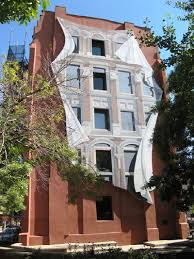
There is a fine mural on the Flat Iron building on Front Street in Toronto that has stood the test of time. Unfortunately the city mural program does not apply to private buildings.
The Burlington Mural Project is designed to tell local stories using local artists.
 Could this have been Burlington when it had radial lines in the city? The program has a budget of $5,000 to $10,000 for each mural and will commission small to medium-scale murals throughout the city, with one mural location and story selected for each of Burlington’s six wards.
 This mural on the Flat Iron building on Front Street in Toronto is on a private building. Burlington has decided its mural program will be on just city buildings – pity. These submissions will be reviewed by the city’s Public Art Implementation Team (PADIT) and a jury of citizens. Locations and artists will be chosen based on public input. The murals will be open exclusively to local Burlington artists. Free learning opportunities will be offered to artists who may not have experience creating public art and/or murals.
This program was developed in consultation with members of the local arts community. In October 2014, a brainstorming session was held with members of the local arts community. Based on this session and feedback, a Program Guide has been developed. Click here to access a copy.
Artist applications for the selected mural projects will be released in late February 2015.
The city will have a Public Art Booth at the Lowville Winter Games on Sunday, January 25 – share your ideas.
There is no limit on the number of submissions per resident.
By Staff
January 21, 2015
BURLINGTON, ON
The city web site is getting a serious make over.
Council was given a quick preview of what the public will see in the very near future. It is going to be a much more useful web site. In the past when one did a search you often got documents that were as much as ten years old but often not the one you wanted.
One of the “public involvement” aspects will be a photo submission. The city decided they didn’t want to use “stock” photos – so they are going to the public and asking anyone to submit a photograph.
The City will determine which photographs submitted will be used. They will select photos for use based on overall quality, scenic shots and community in action shots.
The photos selected will help to promote our community and may be part of the new City of Burlington website. The decisions of the City with respect to all aspects of the submission are final. All photos must have been taken in the City of Burlington and be submitted in one of the following categories:
• City of Burlington Arts and Culture
• City of Burlington Council
• City of Burlington Festivals and Events
• Living in Burlington
• City of Burlington Recreation
• City of Burlington Waterfront
• City Programs
Photos on the website will be changed on a seasonal basis – they will be looking for photo submissions on a regular basis.
It`s a good idea. You have to put up with all the baffle gab the legal department put in – just say yes to whatever they ask. When you see words like: irrevocable, perpetual, you know there was a lawyer in the room.
By submitting your photographs, you accept and agree to abide by these terms and conditions. If you are under the age of 18, then you must have the written permission of your parent or legal guardian to submit your photographs and your parent or legal guardian must accept and agree to abide by these terms and conditions.
If your photograph is chosen for use, you hereby grant The Corporation of the City of Burlington and any other parties designated by the City the irrevocable, perpetual, worldwide, transferable licence to use, edit, alter, reproduce, distribute, and publish your photograph in any manner and in any media for promotional matters or purposes of advertising, trade, display or exhibition. The City will not pay you or others any royalty, licence fee or any costs for such photograph. You also waive any moral rights that you may have in the photograph in favour of the City.
The City may or may not include any photo credits with the use of your photograph. That is really kind of cheap and mean spirited – if someone goes to the effort to submit a picture – the east the city can do is give a photo credit.
By submitting a photograph, you represent and warrant that the photograph you submit is an original work by you, that you own or control all of the rights in and to your photograph, and that such rights are free and clear of any and all third party claims or rights. You release the City and any other parties designated by the City from any liability associated with your submission. You understand that the City has no control over, and is not responsible for, any further use or misuse of your photograph by others. You agree to indemnify and hold harmless the City and any other parties designated by the City from all liabilities and losses arising out of or related to your submission or the rights granted herein.
If an individual appears in your photograph, you are responsible for obtaining the consent of that individual to have his/her likeness displayed and published by the City. The City may request Photo Consent forms from submitters.
By submitting your photograph, you consent to the use of your name and address (city and province/territory) without further compensation to you.
If you want to be part of animating the city`s web site and you can take a decent picture – join the parade.
Click here to submit a picture.
By Pepper Parr
January 20th, 2015
BURLINGTON, ON
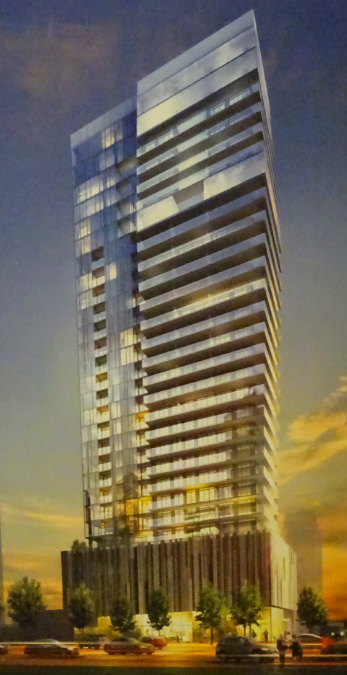
It was pretty clear after less than five minutes that the four people short of capacity in city hall’s council chamber that Burlington wasn’t going for the ADI development proposal to put a 28 storey tower on the corner of Martha and Lakeshore Road.
The standing room only crowd heard one of the shortest Planning department presentations the Gazette has heard in some time. Planner Rosa Bustamante covered the basics of the project and that was it.
 The scale and scope of a 28 storey structure on the corner of Martha and Lakeshore has astounded most people. Could it actually happen? Possible The event then moved into a Public Meeting at which delegations were heard. While the room was packed there were not all that many delegations.
Ward 5 Councillor Paul Sharman chaired the meeting; one got the sense that he thought it was being televised – he was certainly pumped.
There were no decisions to be made. It was a meeting to receive a report on the project from the Planners that outlined the basics – then the Public meeting which was required under the Planning Act.
Staff will now do a detailed report on the project and present it to Council – there may and there may not be a recommendation from Staff when they report.
Every member of Council was opposed to the project – but there were degrees of opposition. The project was described as “highly audacious” and “Over the top”
Councillor Craven said he was “not on for the proposal that is before us” leaving one to wonder what he was on for. The ADI Group is reported to have purchased land adjacent to the Aldershot Go station which is a part of Burlington that council wants to ssee developed as part of one of the mobility hubs that planners are working on.
Waterdown Road is undergoing a total rebuild from two lanes to five between Plains Road and Hwy 403 – this will be a major development and it looks at this point as if the ADI Group is going to be the major developer. Aldershot is ward 1 territory and Councillor Craven rules the roost over there. So he will become adjustable when it comes to deciding what should happen at the corner of Martha and Lakeshore in ward 2.
It was clear what the majority of Council thought, it was clear what the residents thought. The ADI Group planner saw it all quite differently.
His view was that provincial policy called for intensification and that the Big Move GO train project was put in place to move people around and that Burlington was one of the few growth centres left in the GTA – and while he didn’t actually say “’like it or not” this is what the province wants the ADI Group complies with the provincial policy.
 The red markers indicate where the ADI project would be built – two blocks west, on the waterfront the city has approved a 22 storey structure. As for Burlington’s Official Plan and its zoning bylaws – those things are in place – but they have been amended in the past and they can be amended – if not by City Council then by an application to the Ontario Municipal Board.
There was one number that got put on the table that puts the size and scope of the project into perspective.
The provincial target calls for 185 people per hectare of property. Burlington has set their target at 200 people per hectare which is what would go on the property if the four storey’s that the current zoning allows were built.
The ADI project would put 1661 people on that property. It is certainly audacious, over the top and outrageous but as Councillor noted “it is questionable that this Council will have any impact” on the final decision.
By Ray Rivers
January 20, 2015
BURLINGTON, ON
For a long while now I have criticized the federal government’s approach to managing the economy – focusing on energy exports to the exclusion of the rest of the economy.
Given the recent collapse in the global petroleum market and the United States move towards energy self-sufficiency, it is now apparent, even to the Prime Minister, that such a narrow-minded economic policy was short-sighted and dangerous.
So a new Stephen Harper is emerging, one desperately interested in doling out economic subsidies to a forgotten domestic manufacturing sector. Incentives to encourage a more diversified economy, which he now appears to appreciate, are crucial, not only for the economic health of Ontario and Quebec, but for the entire nation as a whole. So much manufacturing capacity has been lost over the past decade that today’s manufacturing sector is simply unable to make up the shortfall in national income lost by the oil exporters.
 Massive trucks haul earth that is laden with oil that has to be processed before there is a usable product. Low oil prices make this kind of operation uneconomical. Harper wasn’t the only one sleeping at the switch, thinking he could slip his way to prosperity on the petroleum gravy train. His nemesis, Russian president Putin, used his vast oil money to build his military instead of diversifying the Russian economy and now is in an even worse pickle than Canada. And then there is Mr. Harper’s former environment minister, now Alberta’s premier, who is facing a budget deficit and considering an Alberta first – a sales tax.
Not long ago, Canada had tried to bully the US into building the Keystone XL pipeline, hoping to reach Asian and European markets easier that way. But US :President Obama resisted our PM and it turns out he knew what he was doing. Nobody is going to buy dirty Alberta oil which costs more to produce than the $50 a barrel price today.
The new Republican controlled congress may still force Obama into that pipeline anyway, though I’m betting on Obama.
 Will these pipes every get buried and carry gas or bitumen to Texas or the Gulf of Mexico. The Alberta government certainly hopes they will – the environmentalists hope they get carted off somewhere else. It’s a legacy thing with the US president. Stopping Keystone, and slowing oil sands development, could be one of the few things Obama would have accomplished to help mitigate global climate change, after doing so little on that file during his eight years in office. On the other hand, Stephen Harper has done absolutely nothing about this issue.
Oh sure greenhouse gas (GHG) emissions in Canada dipped thanks to the 2008-2010 economic recession – but, as Bill Clinton would say, that was the economy stupid. The PM likes to claim Ontario’s renewable energy and coal phase-out reductions as his, though they were made without a lick of federal support.
This PM treats anything to do with the environment as anathema. For example, the Canadian government has recently shocked the rest of the world by objecting to the protection of 76 species being added to the Convention on International Trade in Endangered Species (CITES).
 Doesn’t look like oil – but once filly processed it will fuel your car – the question is at what cost to the environment. The environment should not be an ideological issue. A sustainable global environment is no more right or left than is a healthy growing economy. Yet climate change deniers continue to dominate conservative media and politics, denying what is plainly in their faces; that last year was the warmest on record, that the polar ice caps are melting faster than ever, and that ocean water levels are rising quicker than anyone ever predicted.
It was this PM who shredded the federal Environmental Assessment Act and gutted the time-honoured Fisheries Act in order to expedite more oil-sands development. And having promised to regulate oil-sector GHG emissions, again and again, he has repeatedly refused to do so. In fact, Canada, for the third time in a row, is trying to stop our North American free trade partners (NAFTA) from investigating the environmental effects of the huge tailings ponds created for Alberta’s oil sands.
Canada’s overall contribution to global GHG emissions is relatively modest, given our small population, but those emissions are more than proportionate when compared to many more populated nations. Brian Mulroney, one of Canada’s most environmentally oriented leaders, set this nation on a course to lead the world on the climate change issue back in 1992. Today’s Conservative government has relinquished that leadership and abdicated our responsibility to the planet by pulling out of the Kyoto Protocol and attempting to disrupt other international efforts to cut GHG emissions.
Manufacturing and product processing can become a solid core for the Ontario economy – if the needed investments in technology are made. It was during Mulroney’s time that Canada embraced the concept of sustainable development, originally defined by the Brundltand Commission in a report to the UN, titled “Our Common Future”. ‘Development that meets our needs without compromising the ability of future generations to meet their own needs’. The rate of development of the oil sands is spectacular and it would be even more so were the Keystone in place and the price of oil higher.
As the PM now realizes, tempering the energy extraction business and promoting a diverse and balanced economic growth and development strategy would have made the nation and his government less vulnerable to the vagaries we are seeing today. It would also have helped in meeting even the modest climate change targets we have set for ourselves.
 Ray Rivers writes weekly on both federal and provincial politics, applying his more than 25 years as a federal bureaucrat to his thinking. Rivers was a candidate for provincial office in Burlington where he ran against Cam Jackson in 1995, the year Mike Harris and the Common Sense Revolution swept the province. Ray Rivers writes weekly on both federal and provincial politics, applying his more than 25 years as a federal bureaucrat to his thinking. Rivers was a candidate for provincial office in Burlington where he ran against Cam Jackson in 1995, the year Mike Harris and the Common Sense Revolution swept the province.
Background links:
Canada’s Economy Economy Manufacturing Sector
Alberta Recession
Economy and Interest Rates Potential Carbon Pricing Hottest Year
Endangered Species
NAFTA and Oil Sands Rising Oceans Sustainable Development
By Staff
January 15, 2015
BURLINGTON, ON
Investigators in the Criminal Investigations Bureau have identified and interviewed the individual responsible for leaving a replica hand grenade inside the Metro Grocery Store on January 10th 2015.
Replica grenade: Why would anyone carry one in their picket? Investigation has found that there was no intent to threaten and/or cause alarm to any persons inside the store and no criminal offence has occurred.
 Police are believed to have interviewed this person about a replica grenade left on the service counter at a grocery store. Why would someone being walking and driving around town with a replica grenade in their pocket?
The Halton Regional Police Service wish to remind members of the public that if they wish to surrender unwanted firearms or weapons that they contact the Police non-emergency telephone number at 905-825-4777. Officers will attend to safely secure and take custody of these items.
Police remind the public to never transport unwanted firearms / weapons inside a vehicle or enter inside a Police station for this purpose.
Investigators wish to thank the public for their attention and interest in this matter.
By Staff
January 14, 2015
BURLINGTON, ON
There are some phony –counterfeit American $50.00 and $20.00 bills being passed at commercial businesses throughout the Region
Halton Regional Police have issued a warning to the public regarding a rise in the number of American counterfeit $50.00 and $20.00 bills being passed,
Fraud investigators have arrested two people caught passing the counterfeit bank notes in two separate incidents.
Royal Bank of Canada – Milton
On December 3, 2014, a female suspect attempted to exchange a counterfeit American $50.00 bill for authentic Canadian currency at the Royal Bank of Canada at 232 Guelph Street in the Town of Georgetown. The bank employee examined the bank note and determined it was counterfeit and seized it. Investigators identified the suspect who subsequently turned herself into police on January 12, 2015.
Accused:
Elaine SMITH, 58 years, of Milton has been charged with Possession of Counterfeit Money and Uttering Counterfeit Money
Great Canadian Super Store – Milton
On December 22, 2014, a male suspect attended the Real Canadian Super Store at 820 Main Street East in the Town of Milton and purchased two PlayStation consoles using counterfeit American bills. Approximately 30 minutes later, the same suspect returned and purchased two more PlayStation items using counterfeit American bills. Investigators identified the suspect and he turned himself into police on January 13, 2015.
Accused:
Kevon HENRY, 28 years, from Toronto has been charged with two counts of Possession of Counterfeit Money, two counts of Uttering Counterfeit Money and two counts of Proceeds of Crime.
Look closely at American bills that are given to you.
Anyone with information about the circulating counterfeit currency is asked to call the Regional Fraud Unit at 905 825-4747 ext 8739 or anyone with information on this or any other crime is asked to call Crime Stoppers at 1 800 222-8477 (TIPS) or through the web at www.haltoncrimestoppers.com or by texting “Tip201” with your message to 274637 (crimes).
By Staff
January 13, 2015
BURLINGTON, ON
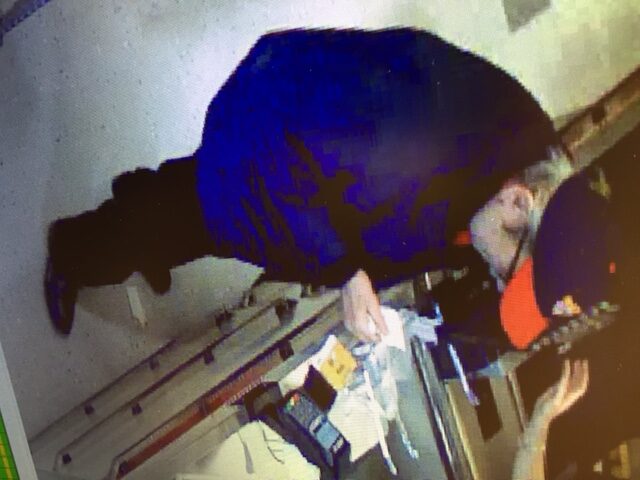
Halton Regional Police investigators have viewed the surveillance video from the Metro grocery store at Appleby Line and Upper Middle Road and are interested in identifying and speaking with an elderly white male depicted in the attached photos.
 Police would like to identify this man. This male was seen at the customer service counter at on Saturday January 10th 2015 at approximately 1:22 pm. Shortly after the male left the counter, the inert grenade was located.
Person of interest is believed to have driven away in this station wagon. The male was seen leaving the parking lot in a black van also depicted in the attached photo.
Last Saturday, a clerk at the Metro grocery got a huge surprise when what looked like a hand grenade was found on a counter.
The object was spotted at 1:35 pm when a store employee at the customer service desk found a replica inert hand grenade on the counter. The employee looked at the item and found that the bottom of the metal item was drilled out and was hollow. The employee took the item to an open area outside of the store.
Police services officers attended and examined the item and confirmed that the metal item was not an actual explosive device. The item is designed to look like a World War Two era hand grenade and may have been designed as a replica for training purposes only. In this incident there was no actual threat to public safety as the item is not an actual explosive device.
Police are attempting to determine if the replica item was left in the store intentionally or if it was accidentally left behind by some unknown person. There have been no threats to the store or anyone else at this time and this event is very unusual. The found item will be destroyed at a later time by the police service.
 Can you identify this person? Anyone with information that would assist in identifying this male are encouraged to contact Detective Joe Barr of the Burlington Criminal Investigations Bureau at 905-825-4747 Ext. 2385 or Crime Stoppers at 1-800-222-8477 (TIPS), or through the web at www.haltoncrimestoppers.com, or by texting “Tip201” with your message to 274637 (crimes).
By Pepper Parr
January 13, 2015
BURLINGTON, ON
Different citizens groups south of the QEW are gathering their forces to delegate at the statutory public meeting to consider a proposed Official Plan and Zoning By-Law amendment.
 The ADI group argues that the design of their 28 storey tower will serve as an excellent gateway on the eastern side of the city into the downtown core. Residents argue it will loom over the neighbourhood. The 22 storey Bridgewater project a couple of hundred yards away will reach 22 storeys into the air. On Monday January 19th, the Development and Infrastructure Committee of City Council holds a meeting to consider the recent application made by ADI Developments to build a 28 Story building at the corner of Martha Street at Lakeshore. In order for the building to move forward, the city has to approve changes to the Official Plan and change the By-Laws.
During the meeting they will discuss the staff report on the plan and zoning changes released earlier this week. The Gazette has been informed that the staff Report will not include a recommendation.
There will also be a Statutory Public meeting during the Standing Committee meeting. These Statutory meetings give the public an opportunity to comment on a proposal. Anyone can speak during the statutory meeting – one does not have to pre-register as a delegation.
Council will also listen to the public who wish to speak. They have invited delegations who register in advance in writing to Rosa Bustamante: rosa.bustamante@burlington.ca
There is a downtown Core Residents Association and St. Luke’s Anglican Church “centric” group that has been watching this proposal very closely. They are joined by literally hundreds of ward 2 residents who are very opposed. Most of city council appears to be opposed as well – the Mayor has certainly made his opposition to 28 storeys very clear. What council has not done is give any sense as to what they are prepared to accept.
During one of the St. Luke’s centric meetings, many core residents turned out to voice their opposition to the project – because “we are all inherently tied at the hip — what affects one, certainly does the other.”
Staff have released a report outlining the project in which they report more than 127 people have either telephone, written or email the city opposing the project.
In email comments from the Core Residential group they pointed out that “if you don’t comment in writing or request to say a few words at the Statutory meeting you won’t be able to object to the outcome if this all goes to the Ontario Municipal Board. And you know that if the city refuses the application of zone change it will and the city will need all of our support at the OMB.”
Having this application go to the Ontario Municipal Board is a significant concern to the city. The sense is that developers usually get what they want at the OMB – at least that has been Burlington’s experience.
Ward 2 Councillor Marianne Meed Ward points out that Oakville tends to do better at the OMB than Burlington.
What few people fully understand or appreciate is that any developer can walk into the planning department with a development proposal. The planners are required to listen and to explain how the city’s Official Plan and zoning bylaws would apply. While the public likes to believe the Official Plan and by-laws are written into stone – they are actually dynamic documents that get changed.
The city is required to review their Official Plan every five years and is in the process of reviewing their plan.
When a developer approaches the city and hears what the planners have to say about their proposal they can still submit a development application – even if the planners don’t think it’s all that good a plan.
 The Maranatha project on New Street was approved by Council but a residents group was opposed and they took it to the OMB – the hearing is scheduled for March. In most instances there is some negotiation and changes get made. The Maranatha project on New Street is a good example. The planners negotiated with the developer and council approved a building that was to be six storey’s high and well set back from the street. A handful of residents objected and they have taken their opposition to the project to the OMB.
Opposition to a development or a city council decision does work both ways.
When a planner takes a proposal to the city – the city has 180 days to g take the application to the OMB and ask them to approve the project.
A hearing is held and a decision rendered.
The ADI Group, the company that wants to build the 28 story structure at the intersection of Lakeshore Road and Martha tends to like to go to the OMB.
Rosa Bustamente, the city planner handling this file explains what the city is faced with”
“The 180 day appeal period begins after the applicant has provided the municipality with “a complete application” (as defined in the Planning Act) which includes the posting of the sign on the property. We provided correspondence to the applicant that their application was deemed complete, including the posting of the sign, on September 25, 2014. By my count, that would make the 180th day following that date March 24, 2015. If a Council fails to make a decision within 180 days of receiving a complete application, an applicant can file an appeal to the Ontario Municipal Board. It is my understanding that, in this case, the applicant would have grounds to file an appeal on March 25, 2015 if Council has not made a decision on or by March 24th, 2015.”
The Statutory meeting on January 19th is a part of the “clock ticking”
By Pepper Parr
January 13, 2015
BURLINGTON, ON.
The flood is history – the problems left are financial.
The Burlington Community Foundation is going through the 310 applications for financial assistance. Twenty two (22) have been approved and another 30 will be cleared this Friday.
 Funds for those people who had basements flooded will begin to be sent out early next week. 52 of the 310 claims have been processed to date. Once a Claim has been approved by the Claims committee it gets sent to the city and they issue the cheques on behalf of the Community Foundation.
Claims totaling $6 million have been received – the amount available for distribution is $2.9 million. One doesn’t have to be a rocket scientist to figure out people are not going to get what they were asking for in the way of financial support.
Those claims that have been approved, which will be paid out by the city, will see just 50% of the amount they will be given. The balance will be paid during the last week of the claim settling process.
The Claims committee has to figure out how they are going to spread the $2.9 million they have to distribute to the $6 million in claims that has come in.
Going through the claims is the task that gets managed by four volunteers working with the insurance adjuster hired by the Burlington Community Foundation to oversee the work done by the four Claims Committee volunteers; Mark Preston, Bruce Russell, Rick Burgess and Nancy Swietek.
 It was community organizations that came through as well as individuals who raised just under $1 million in 100 days – a remarkable feat. In the early stages of the fund raising campaign there were relatively few claims being submitted. It wasn’t until the last couple of days that people got their documents in – more than 100 during the last two days. Many people deeply involved in the fund raising and claims processing are still shaking their heads wondering why so many people waited until the last few days to submit documents.
Every nickel of the funds raised in the community is being distributed to the people who suffered from the flood. Every dollar raised in the community is being matched by $2 from the province’s ODRAP program.
The administrative costs are being picked up by the city as are the costs for having the Red Cross do all the work they did.
|
|





 By Staff
















 They are worth looking at. The way people of different ages handle “the kiss” is interesting – we will leave it at that.
 Riley thinks the locale might become a spot for couple do pause sometime during Valentine’s Day.







 By submitting your photographs, you accept and agree to abide by these terms and conditions. If you are under the age of 18, then you must have the written permission of your parent or legal guardian to submit your photographs and your parent or legal guardian must accept and agree to abide by these terms and conditions.
 By submitting your photograph, you consent to the use of your name and address (city and province/territory) without further compensation to you.





 Ray Rivers writes weekly on both federal and provincial politics, applying his more than 25 years as a federal bureaucrat to his thinking. Rivers was a candidate for provincial office in Burlington where he ran against Cam Jackson in 1995, the year Mike Harris and the Common Sense Revolution swept the province.