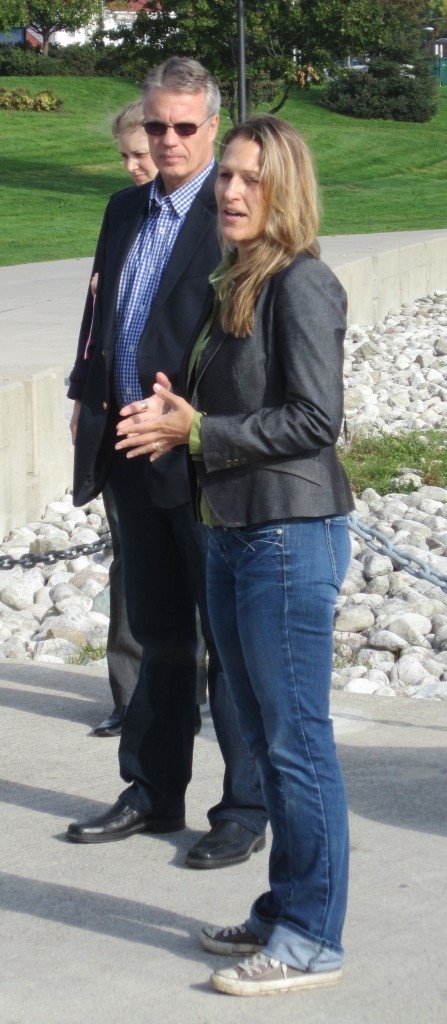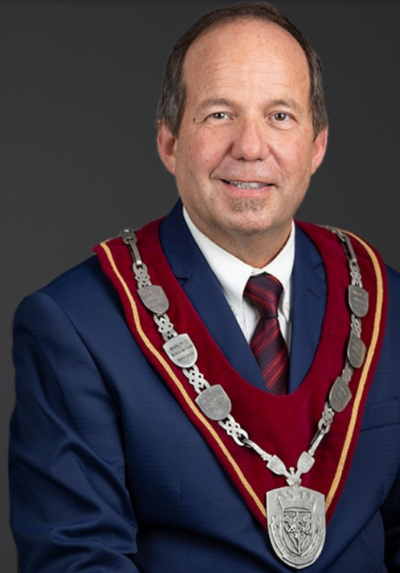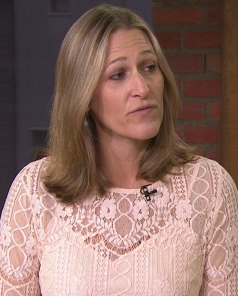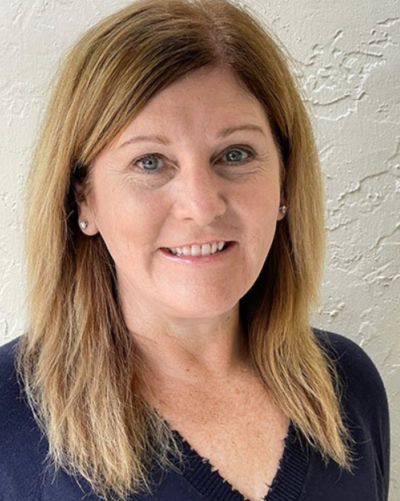
Zee Hamid, Progressive Conservative candidate on the election campaign trial. He won.
Conservative Zee Hamid handily beat out his Liberal opponent to win the right to represent the people of Milton at Queen’s Park in the May 2nd by-election. Little more that a quarter of the eligible voters bothered to come out for the vote, despite it being a lovely sunny and warm day. That is a sad testimony on the state of our democracy, no matter how you spin it.
Milton has grown by leaps and bounds over the decades since its mayor pushed regional council to introduce the ‘big pipe’. Pipes actually, one to bring fresh water from Lake Ontario and the other to return that water as sewage back to a lake where safe fish consumption is already severely limited.
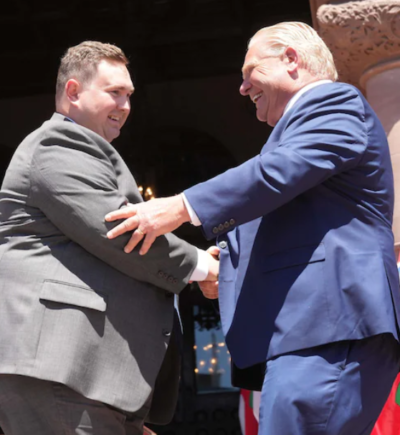
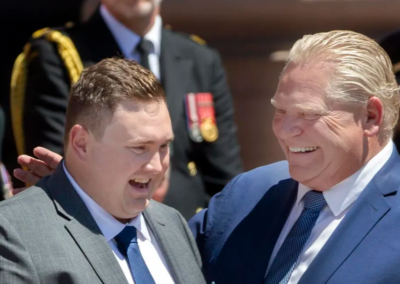
Premier Ford, Milton Mayor Gord Krantz and candidate Zee Hamid
Mayor Krantz, much like Ontario’s premier, is apparently in love with a 1960’s urban sprawl model of development. As its ‘eternal’ mayor, he has stacked the once charming farm community of Milton to overflowing with wall-to-wall housing and warehousing, destroying countless acres of quality farm and natural habitat, and saddling its rural residents with the high costs of maintaining sprawl development. One has to wonder why Milton was overlooked for inclusion as part of the provincial green belt in the first place.
Zee Hamid wasn’t always a Tory, having switched his colours for this election. He tried, unsuccessfully, for the federal Liberal nomination back in 2015 and had been a Liberal party donor up until fairly recently. Still, his record as a town councillor should help prepare him for his new role as MPP. And a good part of that record had been to promote exactly the kind of sprawl development over which his new party leader salivates. In which case Mr. Hamid is finally home.
Bonnie Crombie: Leader Ontario Liberal Party: She decided Milton was not winnable – and a win was vital.
This was the first provincial by-election since Bonnie Crombie won leadership of the provincial Liberals last December. There was an expectation that the new leader, who resides a stone’s throw away in Mississauga, would take advantage of the opportunity to win a seat and present herself where it matters most – at Queen’s Park. That she walked away, some would say chickened out, has to be a huge blow to the people who trusted her with their vote for leadership.
I had been a strong critic of Mr. Ford even before he stole the Tory nomination in what can only be described as a smelly right-wing coup on the eve of the 2018 election. At the time I wrote that Ford was ill equipped to lead a modern progressive province which Ontario had become since the turbulent days of Mike Harris. And he has done little to make me want to alter that sentiment.
But clearly there are a lot of people who feel differently about Ford and what the Progressive Conservative tribe he leads stands for. Somehow the entire Greenbelt fiasco, which was a disgraceful episode regardless whether the RCMP presses criminal charges, has been forgotten. The voting public showed up – or failed to show up – and rewarded the premier with another feather in his hat. There was also another by-election win in the Tory safe seat of Lambton-Kent-Middlesex to help boost the premier’s confidence and convince him that he is on the right track.
The Greenbelt fiasco and an ongoing RCMP investigation didn’t appear to matter to the voters that did show up for the btelection.
There was a time when even a hint of wrong doing spelled the end to a politician’s career. But today one can look south of the border to where a former president has been indicted on numerous criminal charges. And yet, incredibly, that has only enhanced the public’s affection for him. Perhaps Mr. Ford’s apparent fondness for breaking the rules helps explain this phenomenon which seems to result in his own popularity.
Particularly interesting is how the younger voters in the US have shifted their support from the person who claims to have done so much for them. Biden paid off a huge amount of university student debt and his policies have expanded the US labour force and reduced unemployment. Strangely the preference among the beneficiaries has been to throw their support to someone who opposed all of that and who is threatening to erode their democratic rights.
Social media is not capable of providing the depth needed to fully understand the changes taking place. For some reason society is limiting its sources of information at a time when credible sources are what is needed most.
Of course this younger generation generally shun TV news and won’t read newspapers to get their information. They prefer to tune in daily to unedited, virtually uncontrolled social media platforms – a grown up version of “kids say the funniest things” to get their daily dose of what is going on. At least the US has promised to ban Chinese controlled Tik Tok. The current large scale protests over Gaza have been traced directly to the vast amount of misinformation appearing daily on Tik Tok and other social media.
The Trudeau government also has been trying to do something to improve the quality of the content on online platforms and social media generally. It has introduced a number of laws, C-10/11 amending the Broadcast Act; C-18 The Online News Act; and C-63 The Online Harms Act. Governing media is a delicate rope walk and, of course the official opposition has generally opposed all of these new rules – at least until, and if, they form government.
There will be more opportunity to air those concerns as the clock ticks down to the next provincial election in 2026 and an even earlier federal election slated for October 2025. But the right thing to do after a by-election is congratulate the winner and hope that the trust of those who voted for Mr. Hamid will be truly earned.
Ray Rivers, a Gazette Contributing Editor, writes regularly applying his more than 25 years as a federal bureaucrat to his thinking. Rivers was once a candidate for provincial office in Burlington. He was the founder of the Burlington citizen committee on sustainability at a time when climate warming was a hotly debated subject. Ray has a post graduate degree in economics that he earned at the University of Ottawa. Tweet @rayzrivers
There has been a lot of talk recently at City Council meetings about democracy.
The look we got at the democratic process yesterday has to make one wonder.
The turnout was less than 25% – closer to 20%
Zee Hamid will be the MP for Milton once he is sworn in.
In Milton the Progressive Conservatives held the seat by a respectable margin.
Earlier in the day the New Democrats said in the Legislature that there was a report of email in the Premier’s office was being deleted from computers.
The email was related to the Greenbelt mess that the RCMP is still looking into.
By-elections are often seen as referendums on the government.
There were two by-elections in Ontario yesterday.
Both were won by the Progressive Conservatives. A part of the Milton riding includes the northern section of Burlington.
That is the clearest message the Premier could ask for – the public is Ok with us, we can keep doing what we have been doing.
And we do know what they have been doing.
Salt with Pepper is the musings, reflections and opinions of the publisher of the Burlington Gazette, an online newspaper that was formed in 2010 and is a member of the National Newsmedia Council.
Official Opposition Leader, Marit Stiles speaking in the Legislature
Ontario NDP and Official Opposition Leader, Marit Stiles, responded to new information on the Greenbelt scandal that confirms staff deleted emails.
“Each new evidence on the Greenbelt scandal is worse than the last. Deleting government emails is a crime. Let’s not forget that senior staff involved in the Liberal’s gas plant scandal went to jail for deleting emails.”
The “new evidence” Stiles refers to was made public by The Trillium, an online, subscriber only service. The Trillium is part of the Village Media, an organization that has 147 online newspapers in Canada
Stiles is saying that: “Doug Ford needs to come clean and stop hiding information from the people of Ontario.
Why did his staff delete emails about the Greenbelt scandal?
What was in those emails?
Now we’ll never know.
Enough is enough. I hope the Information and Privacy Commissioner and the RCMP criminal investigation get to the bottom of this. People deserve to know the truth.”
As temperatures start to climb this time of year, the Ontario government is encouraging people across the province to take precautions to prevent tick bites and reduce the risk of contracting Lyme disease and other tick-borne diseases, when enjoying the outdoors.
They are small – but still dangerous.
Lyme disease and other tick-borne diseases can cause potentially serious infections if you’re bitten by an infected blacklegged tick, commonly called a deer tick. If you have any symptoms such as fever, headache, chills, muscle and joint pain, fatigue and an expanding circular rash that resembles a bulls-eye, consult a health care provider as soon as possible.
“As we start enjoying the warmer weather again, it is important that we all take steps to protect ourselves and loved ones from tick bites and tick-borne diseases,” said Sylvia Jones, Deputy Premier and Minister of Health. “Blacklegged ticks are continuing to spread to new areas of the province, but by being proactive, we can combat the risk they pose and safely enjoy the beauty of Ontario over the coming months.”
If you are living, working, visiting, or enjoying outdoor activities in a wooded area, or an area with tall grass and bushes (including city gardens and parks) you are at greater risk of being bitten by a tick. You can protect yourself from tick bites by:
Wearing light-coloured clothing, so it’s easier to spot ticks.
Wearing long-sleeved shirts, long pants tucked into your socks, closed-toed shoes, or any special clothing designed to repel ticks.
Applying insect repellent containing DEET or icaridin on your exposed skin and your clothes.
Checking yourself, your children, and your pets for ticks after being outdoors. Any ticks found should be removed promptly.
Putting your clothes on high heat in a dryer for at least 10 minutes before washing them, after spending time outdoors.
A larger look at a tick.
Ticks are very small and hard to see. When found, it should be removed immediately using fine-tipped tweezers to grasp the tick as close to your skin as possible without crushing it. Once you have removed a tick, wash your skin with soap and water and then disinfect your skin and your hands with rubbing alcohol or an iodine swab. Before disposing of the tick, call or check the website of your local public health unit to get advice on how to identify the tick. You can also submit a photo of the tick toetick.ca for identification.
“As areas where ticks can be found continue to grow, so to do the risks of tick bites and tick-borne diseases,” said Dr. Kieran Moore, Chief Medical Officer of Health. “By being vigilant, wearing appropriate clothing and doing routine tick checks, we can avoid tick bites and ensure our trips outside are safe and healthy, in the months ahead.”
If you have any health concerns after a tick bite, consult a health care provider as soon as possible. Most cases of Lyme disease can be treated successfully with antibiotics, and pharmacists have been able to prescribe medication to treat tick bites to prevent Lyme disease since January 1, 2023.
Pam Damoff, MP for Oakville North Burlington announced today that”
Even great chapters come to an end, and it is time for this chapter of my career to end.
Pam Damoff at her best. She wanted to serve and now finds that the environment in the House is such that she can’t.
I will not be seeking re-election in the next election. While I know that I still have something to offer Canada, Ontario and my community, the hyper-partisan nature of politics today is not the environment that I see myself serving in. I continue to believe in public service and the power of each of us to make a positive difference in the lives of others.
I don’t know yet what the next chapter will be for me, but I do know that it will be in a role that will make a difference in the lives of others, as I have always striven to do. Sadly, I feel politics is no longer the best venue for me to do that in.
The current tone of politics, the drive for social media clips and likes, and the lack of respectful dialogue have drastically changed how we interact in parliament and in public. The tone and tenor of public discourse has deteriorated significantly, and I fear the loss of trust in public institutions we are seeing that is driven by misinformation and lies being spread by politicians and on social media.
Being a Member of Parliament these days is a different job – not one Pam Damoff was cut out for.
Unfortunately, the toxic drive for social media likes and clips among elected officials has hindered constructive conversations, exacerbated differences between us, and diminished our capacity to show empathy towards each other. The threats and misogyny I have experienced as a Member of Parliament are such that I often fear going out in public, and that is not a sustainable or healthy way to live.
Quite simply, politics is no longer for me and so it is time for me to turn the page on this chapter. Until the next election occurs, I will continue to represent Oakville North–Burlington and my office will continue to assist those in our community.
There are several sides on the Waterfront Hotel redevelopment.
Darko Vranich owner of the property wants to put up two tall, very tall – they will be the tallest in the city – if this development is approved.
The two towers are further apart in the most recent proposal and the bridge between the two towers is no longer part of the plan
The key issues that David Bronskill, representing the Waterfront Hotel, stated he believed the issues relevant to this hearing are:
– History of the project
Different views of the development as seen from different points in the city.
– Height
– Urban structure
– Parkland dedication
Chris Barnett, representing the City of Burlington stated the key issues are:
– Lake and Spencer Park accessibility and interface
– Over intensification – height and scale
– ROPA 48 – removal of UGC/MTSA
– Urban structure – recognizing the “secondary regional node” designated status by the Halton region
The entrance to the Pearle Hotel will be across the street from the hotel that is to be part of the redeveloped Waterfront Hotel site. The entrance to the garage for both hotels and the residential units is also on Elizabeth street.
Ira Keegan, representing the Pearle Hotel, located to the immediate east of the Waterfront Hotel, said the issues were:
– impact on the views to the Pearle hotel
– vehicle access to the Pearle hotel
The entrance to the hotel portion of the development and vehicle entrance to the garage will be on Elizabeth Street directly across from the Pearle Hotel.
The level at which the Gazette can report on this critical and important matter might be limited by Ontario Tribunal rules. We are following up on that.
Community Development Halton (CDH) is a non-profit organization committed to building a society in which diversity, equity, and social and economic justice are central to all aspects of our lives. CDH is made up of two pillar services: Social Planning and Research and Volunteer Halton.
Volunteer Halton is a flagship program of CDH with a focus on increasing public access to meaningful volunteer opportunities for all residents across Halton Region. Volunteer Halton is seeking a dynamic and creative post-secondary student with a passion for community development, digital promotion, and member engagement for the position of Volunteer & Community Engagement Officer for an 8-week term in Summer 2024.
The Volunteer & Community Engagement Officer will focus on launching the Volunteer Ambassador program, collecting data on outreach engagement and member organizations, and helping to promote volunteerism in Halton.
Specific Responsibilities
The Volunteer & Community Engagement Officer will be responsible for the following activities:
Volunteer Ambassador Program
Assist with recruiting, screening, and onboarding volunteers to
Participate in volunteer training
Secure locations to host volunteer information sessions and volunteer fairs across Halton Region.
Member Engagement
Connect with current nonprofit members via telephone or video call to confirm contact information and understand key challenges, documenting same.
Connect with current nonprofit members to understand key challenges, documenting
Assist with volunteer database management to confirm contacts, up-date files, mailing lists, etc.
Support volunteer-seekers in exploring opportunities using Volunteer Connector
Communications and Digital Promotion
Promoting recruitment needs of member organizations, connecting with volunteer- seekers, and promoting membership with CDH/Volunteer Halton via social media.
Assist volunteer-engaging organizations post and promote opportunities on Volunteer
Contribute content for monthly VIEWPOINT
Requirements
Enrolled in post-secondary education currently or for the Fall 2024 semester; focus on volunteer engagement or community development preferred.
An ability to provide quality customer
Effective problem-solving with the ability to
Database/data entry experience an
Good verbal and written communication and interpersonal skills to foster strong and long- lasting relationships with member organizations, volunteer-seekers, and the public.
Ability to work in a hybrid model; combination of in-person and remote
Access to a car or reliable transportation
Able to work independently and as part of a
A passion for collaborating with
A professional, enthusiastic, flexible, and energetic demeanour. Benefits
Career-related training in nonprofit and volunteer management
Access to learning materials
Support for skills development in volunteer engagement and Terms
Fixed-term contact, 8
35 hours per week, Monday to Friday, the occasional Saturday may be
$16.55 per hour plus 4% vacation
Start date: May 21, 2024
Interested candidates should submit their resume and cover letter to the attention of Heather Johnson, Director, Volunteer Halton at volunteer@cdhalton.ca. Applications will be accepted until 2:00pm on Wednesday May 8, 2024.
Since this is a funded position by Canada Summer Job grants, all applicants must be a youth
(Citizen, Permanent resident, or Conventional Refugee) between 15 -30 years of age to qualify.
Conservation Halton has curated native species kits for local residents to plant at home. With three kit types to choose from (full sun, shade & rain), growing a native plant garden is low cost, beneficial for pollinators, and enhances your curb appeal. By purchasing a Garden-in-a-Box this spring you can feel good knowing you are helping protect local habitats in our watershed.
Why Garden with Native Plants?
Native plants are adapted to thrive in our local environment and climate. They also:
Have beautiful colourful flowers
Require little to no watering once established
Lower maintenance compared to annual and perennial gardens
Provide food and shelter for bees, butterflies, and other insects
Help reduce the risk of flooding and erosion
Three types of non-invasive plant to choose from – curated by Conservation Halton
Garden-in-a-Box Kits
Each carefully curated kit is intended to be planted in an area roughly the size of a sheet of plywood (4 feet x 8 feet). The plants will fill out nicely in their second and third year of growth. If you prefer a very full garden, you may consider doubling the number of plants in your space.
How Garden-in-a-Box Works
Purchase your kit
Click on the “Order Your Kit” button below to be directed to our sales page
Select your kit(s) of choice and the number of kits you wish to purchase
Once you’re done shopping, select “Proceed to Checkout”
Present your email confirmation on pickup day
Pick up your kit — Saturday, May 25 between 10:00AM and 2:00PM
Bring your proof of purchase to Conservation Halton’s Administration Office at 2596 Britannia Road, Burlington, ON L7P 0G3
Your kit(s) will be ready for you when you arrive.
The terrain for senior riders is always challenging.
Conservation Halton has announced that Mountain Bike racing will take place on Tuesdays at the Kelso Conservation Area starting in May
Outdoor adventure seekers and mountain bike enthusiasts can now register for the popular Tuesday night Mountain Bike (MTB) Race Series.
For the past 16 years, the race series has attracted over 300 seasoned mountain bikers and budding athletes each week for an unforgettable experience on Kelso’s trails.
“We’re looking forward to having our local riding community back for another action-packed Mountain Bike Race Series,” said Craig Machan, Director, Parks & Operations at Conservation Halton.
“It’s a great opportunity for individuals and families to get active outdoors and build new relationships with fellow riders. Over the years, we’ve seen more young riders signing up for the series, and we hope to keep growing this community at Kelso and attracting more people to the sport.”
Racing in style with perfect control – a sports art form.
The MTB Race Series includes twelve races and four heats. Races start on May 14, 2024, and run every Tuesday night until the finale event on August 27, 2024. This year offers a new flexible schedule to accommodate races that are cancelled due to the weather. To suit different skill levels, the races are divided into the following categories:
Kids Race: Children as young as four-years-old can join the races in a closed circuit, completing as many laps as possible within twenty minutes
Beginner: In a longer closed circuit, riders will complete as many laps as possible in thirty minutes
Novice: Riders will complete one lap of a 6 to 8 km course
Intermediate: Riders in this new category will complete two laps of a 12 to 16 km course
Sport: Riders will complete two laps of a 12 to 18 km course
Expert: Advanced riders will complete three laps of the full course that is approximately 18 to 25 km
To kick off the MTB Race Series, Conservation Halton will be hosting an Open House and plate pick-up at Kelso on Tuesday, May 7, 2024, from 4:30 p.m. to 7:30 p.m.
Racers completing one of the courses at Kelso
Riders will get an opportunity to explore the course, avoid line-ups for plate pick-up on the first day of races, and ask Kelso’s MTB team questions about the race series.
Every year on April 22, Earth Day marks the anniversary of the birth of the modern environmental movement that was founded in 1970. Let’s take a look at the last half-century of mobilization for action:
Reference is made to what the Americans did – they did lead the battle for change. Canada became part of what is now an international movement years later. Last week BurlingtonGreen did a tree planting that 500 trees in Pathfinder Park.
THE ORIGINS OF EARTH DAY
In the decades leading up to the first Earth Day , Americans were consuming vast amounts of leaded gas through massive and inefficient automobiles. Industry belched out smoke and sludge with little fear of the consequences from either the law or bad press. Air pollution was commonly accepted as the smell of prosperity. Until this point, mainstream America remained largely oblivious to environmental concerns and how a polluted environment threatens human health.
The book that brought environmental issues to the forefront.
The stage was set for change with the publication of Rachel Carson’s New York Times bestseller Silent Spring in 1962. The book represented a watershed moment, selling more than 500,000 copies in 24 countries as it raised public awareness and concern for living organisms, the environment and the inextricable links between pollution and public health.
Is this part of the universe on life support?
Gaylord Nelson, the junior senator from Wisconsin, had long been concerned about the deteriorating environment in the United States. In January 1969, he and many others witnessed the ravages of a massive oil spill in Santa Barbara, California. Inspired by the student anti-war movement, Senator Nelson wanted to infuse the energy of student anti-war protests with an emerging public consciousness about air and water pollution. Senator Nelson announced the idea for a teach-in on college campuses to the national media, and persuaded Pete McCloskey, a conservation-minded Republican Congressman, to serve as his co-chair.
Senator Gaylord Nelson recruited Denis Hayes, a young activist, to organize the campus teach-ins and to scale the idea to a broader public, and they choose April 22, a weekday falling between Spring Break and Final Exams, to maximize the greatest student participation.
The name Earth Day, immediately sparked national media attention, and caught on across the country. Earth Day inspired 20 million Americans — at the time, 10% of the total population of the United States — to take to the streets, parks and auditoriums to demonstrate against the impacts of 150 years of industrial development which had left a growing legacy of serious human health impacts.
The source of the spill was a blow-out on January 28, 1969, 6 miles (10 km) from the coast on Union Oil’s Platform A in the Dos Cuadras Offshore Oil Field. Within a ten-day period, an estimated 80,000 to 100,000 barrels (3,400,000 to 4,200,000 US gal)[1] of crude oil spilled into the Channel and onto the beaches of Santa Barbara County in Southern California.
Groups that had been fighting individually against oil spills, polluting factories and power plants, raw sewage, toxic dumps, pesticides, freeways, the loss of wilderness and the extinction of wildlife united on Earth Day around these shared common values. Earth Day 1970 achieved a rare political alignment, enlisting support from Republicans and Democrats, rich and poor, urban dwellers and farmers, business and labor leaders.
By the end of 1970, the first Earth Day led to the creation of the United States Environmental Protection Agency and the passage of other first-of-their-kind environmental laws, including the National Environmental Education Act, the Occupational Safety and Health Act, and the Clean Air Act. Two years later congress passed the Clean Water Act. That is an exceptional collection of legislation that has made the world a better, healthier place.
The principal Earth Day event in 1980, held in Washington. D.C. across from the White House, capped a decade of substantial US environmental legislation, including the Endangered Species Act, Marine Mammal Protection Act, Superfund, Toxics Substances Control Act, the Resource Conservation and Recovery Act, and of course the Clean Air Act and Clean Water Act. It had seen the creation of the Environmental Protection Agency and the banning of DDT and of lead in gasoline. Earth Day continued to expand internationally during the 80’s, as did international policy initiatives.
As 1990 environmental leaders once again organized another major campaign. This time, Earth Day went truly global, mobilizing 200 million people in 141 countries and lifting environmental issues onto the world stage. Earth Day 1990 gave a huge boost to recycling efforts worldwide and helped pave the way for the 1992 United Nations Earth Summit in Rio de Janeiro.
As the millennium approached another campaign, this time focusing on global warming and pushing for clean energy. Earth Day 2000 combined the big-picture feistiness of the first Earth Day with the international grassroots activism of Earth Day 1990. Earth Day had the internet to help link activists around the world. There were now 5,000 environmental groups worldwide on board, reaching out to hundreds of millions of people in a record 184 countries.
Nearly one billion people around the world took action for the 40th anniversary of Earth Day. An estimated 20,000 partners took action on climate change and other environmental issues through climate rallies, Billion Acts of Green™; the objective was to engage civil leaders in plans to build a green economy, connected through the online action centre at EARTHDAY.ORG. Through the Global Day of Conversation, more than 200 elected officials in more than 39 countries took part in active dialogues with their constituents about their efforts to create sustainable green economies and reduce their carbon footprints.
It was no accident that the United Nations selected Earth Day to sign the most significant climate accord in the history of the climate and environmental movement: the Paris Agreement. On Earth Day 2016, world leaders from 175 nations broke a record by doing exactly that.
Earth Day 2020 was the 50th Anniversary of Earth Day. Activations included activities such as the Great Global CleanUp, Citizen Science, Advocacy, Education, and Street Art. The year’s theme for Earth Day 2020 was “Climate Action.” Due to the COVID-19 pandemic, many of the planned activities were moved online. Commemorating the 50th anniversary of Earth Day in the United States. In total, over 1 billion people worldwide participated in Earth Day actions, and 100 million observed the 50th anniversary in what is being referred to as the largest online mass mobilization in history.
Where are we today? The Ontario government wavers about Climate Change – and there are still deniers.
What is clear today is that we are perilously close to losing the Climate Change battle.
Make today your day to declare that you are the biggest part of saving the planet.
We are that close to losing it all.
If citizens of the world rise up in a united call for the creativity, innovation, ambition, and bravery that we need to meet our climate crisis and seize the enormous opportunities of a zero-carbon future this battle can be won.
“The Anxious Generation,” by Jonathan Haidt, is described as “erudite, engaging and combative in a New York Times Book Review. A must read for parents.
He writes about how we “hem and haw about the risks, failing to keep our kids safely grounded in nondigital reality. The result can no longer be ignored – anxiety, depression, suicidality – is plaguing our youth.
Haidt, a social psychologist, is a man on a mission to correct this collective failure. His first step is to convince us that youth are experiencing a “tidal wave” of suffering. In a single chapter and with a dozen carefully curated graphs, he depicts increases in mental illness and distress beginning around 2012. Young adolescent girls are hit hardest, but boys are in pain, too, as are older teens.
The timing of this is key because it coincides with the rise of what he terms phone-based childhood. From the late 2000s to the early 2010s, smartphones, bristling with social media apps and fueled by high-speed internet, became ubiquitous. Their siren call, addictive by design and perpetually distracting, quickly spirited kids to worlds beyond our control.
It wasn’t phones alone. A second phenomenon coincided with the rise of the machines: the decline of play-based childhood. This change started in the 1980s, with kidnapping fears and stranger danger driving parents toward fear-based overparenting. This decimated children’s unsupervised, self-directed playtime and restricted their freedom of movement.
With parents and children alike stuck in “Defend mode,” kids were in turn blocked from discovery mode, where they face challenges, take risks and explore — the building blocks of anti-fragility, or the ability to grow stronger through adversity. Compared to a generation ago, our children are spending more time on their phones and less on, well, sex, drugs and rock n’ roll. While fewer hospital visits and teen pregnancies are obvious wins, less risk-taking overall could stunt independence.
That’s why parents, he argues, should become more like gardeners who cultivate conditions for children to independently grow and flourish, and less like carpenters, who work obsessively to control, design and shape their offspring. We’ve overprotected our kids in the real world while underprotecting them in the virtual one, leaving them too much to their own devices, literally and figuratively.
It’s this one-two punch of smartphones plus overprotective parenting, Haidt posits, that led to the great rewiring of childhood and the associated harms driving mental illness: social deprivation, sleep deprivation, attention fragmentation and addiction. He has a lot to say about each of these.
Here is where his ideas and interpretation of research become contentious. Few would disagree that unhealthy use of social media contributes to psychological problems, or that parenting plays a role. But mental illness is complex: a multidetermined synergy between risk and resilience. Clinical scientists don’t look for magic-bullet explanations. They seek to understand how, for whom and in what contexts psychological problems and resilience emerge.
Haidt does recognize that nuance complicates the issue. Online — but not in the book — he and colleagues report that adolescent girls from “wealthy, individualistic and secular nations” who are “less tightly bound into strong communities” are accounting for much of the crisis. So perhaps smartphones alone haven’t destroyed an entire generation. And maybe context matters. But this rarely comes through in the book.
The final sections offer advice for reducing harmful, predatory aspects of technology and helping parents, educators and communities become more gardener and less carpenter. Some tips will be familiar (ban phones from school; give kids more independence). Other advice might give readers pause (no smartphones before high school; no social media before 16). Yet, taken together, it’s a reasonable list.
Still, Haidt is a digital absolutist, skeptical that healthy relationships between youth and social media are possible. On this point, he even rebuffs the U.S. Surgeon General’s more measured position. We’re better off banning phones in schools altogether, he asserts. Because, as he quotes a middle school principal, schools without phone bans are like a “zombie apocalypse” with “all these kids in the hallways not talking to each other.”
Whether or not you agree with the zombie apocalypse diagnosis, it’s worth considering the failure of prior absolutist stances. Nancy Reagan’s Just Say No drug campaign? A public health case study in what not to do. During the AIDS crisis, fear mongering and abstinence demands didn’t prevent unsafe sex. Remember the pandemic? Telling Americans to wear masks at all times undermined public health officials’ ability to convince them to wear masks when it really mattered.
Digital absolutism also risks blinding us to other causes — and solutions. In 1960s Britain, annual suicide rates plummeted. Many believed the drop was due to improved antidepressant medications or life just getting better. They weren’t looking in the right place. The phase-out of coal-based gas for household stoves blocked the most common method of suicide: gas poisoning. Means restriction, because it gives the despairing one less opportunity for self-harm, has since become a key strategy for suicide prevention.
Yes, digital absolutism might convince policymakers to change laws and increase regulation. It might be a wake-up call for some parents. But it also might backfire, plunging us into defense mode and blocking our path of discovery toward healthy and empowered digital citizenship.
THE ANXIOUS GENERATION: How the Great Rewiring of Childhood Is Causing an Epidemic of Mental Illness | By Jonathan Haidt | Penguin Press | 385 pp. | $30
Pouring over the 400 page federal 2024 budget document, one can’t help but be impressed with the breadth and scope of federal involvement in almost every facet of the lives of Canadians. It is a lot of money that gets spent by your federal government each year. This year that list of expenses is even longer thanks to the NDP demanding their pound of flesh for propping up the Liberal government.
The photo op reminds one of two students turning in their homework. Prime Minister Justin Trudeau and Finance Minister Freeland
The federal government has been forced to use the power of the purse to buy its way into areas which were once exclusively provincial. That is because the premiers of provinces like Alberta, Saskatchewan and Ontario are not meeting the needs and wants of their electorate. And the public doesn’t know, or even care, which government is responsible, but blame the feds if they don’t get what they want and need.”
So the feds have found their way into having to develop their own health care, dental care, pharmacare, education and child care programs. Provincial governments are involved in some of these but none of these new initiatives would be happening without federal leadership or funding. And now there is a billion dollar school food program, filling a void left open by most provinces and some parents.
The federal government was late in getting to the point where they would play a direct role in getting housing built. The provinces left them no other option.
Housing has taken a front seat in this budget as the feds have plunged headlong into dealing directly with municipalities to meet the hugely unmet demand for accommodation spaces across the country. The provinces may resent the federal intrusion into their back yard, but Canadians feel it is a federal responsibility. So it’s in the budget. Of course, cutting the bank rate, which is driving up mortgages across the country, and limiting immigration would also help solve the housing crisis.
Justin Trudeau came to power, unlike his political opponents, arguing for even more deficit financing to grow the economy. And it’s been a spotty growth record, marred by the pandemic and the acute inflationary supply shortages immediately following. Still, Canada posted one of the highest growth rates over the past couple years among the G7, though not on a per capita basis thanks to the flood of new immigration we’ve seen.
Economists these days prefer to talk about debt as a percentage of the GDP. Still, when the cost of financing the debt is more costly than what the government contributes to health care, that is troubling. Canada’s debt to GDP ratio, which is about half of that of our southern neighbours, had been slowly declining until Covid came knocking at our door. The budget predicts that ratio will get back to where it left off and continue its downward trajectory.
That will be helped by the big news in this budget that taxes are finally going up for those who can most afford them. There are about 40,000 Canadians who earn over $250,000 in capital gains and only pay income tax on half of that. The capital gains tax for those folks is rising from 50% to 67%. That is still well below the 75% rate once imposed by former PM Mulroney.
A younger Justin Trudeau made it clear from the beginning – he was going to work for the middle class – more votes in that demographic.
And why would capital gains be treated any differently from employment income – why shouldn’t it be taxed at 100% like other earned income? Capital gains, much like an inheritance or casino winnings are windfalls but they are spent and saved just like earned income. Why do we treat them as a free lunch?
Income tax rates have not been touched in this or other recent budgets. One of the first acts of the Trudeau administration was to cut taxes for the middle class, which the PM claims helped lift more than one million Canadians out of poverty. And to pay for that he created a new top federal income tax bracket of thirty three percent.
But Canada, with its publicly financed health care is still a relative tax bargain for its citizens. We still have the lowest marginal tax rate in the G7. For example, the richest Americans are taxed at 37%. Also, Canada’s corporate income tax rate is the 4th lowest in the G7 at 26.2%. And taxation of new business investment at 13%, compared to the USA at 17.8%, is the lowest in the G7.
Unquestionably this is a progressive budget and those who don’t believe in government playing a bigger support role in our lives will disapprove. Still we know from our experience with the Canada Health Act that universal publicly funding universal programs are less costly to society overall. It’s a known fact that Canadians pay something like half what Americans do for a health care system with better outcomes, despite some access issues.
So those naysayers are on the wrong side of history. As we are forced into the age of fighting to save the planet from the potential ravages of climate change we need to get used to governments playing an even bigger role. But we need to pay for what we are demanding. And making the wealthiest Canadians pay a fairer share by raising the inclusion rate on capital gains is just a start.
Ray Rivers, a Gazette Contributing Editor, writes regularly applying his more than 25 years as a federal bureaucrat to his thinking. Rivers was once a candidate for provincial office in Burlington. He was the founder of the Burlington citizen committee on sustainability at a time when climate warming was a hotly debated subject. Ray has a post graduate degree in economics that he earned at the University of Ottawa. Tweet @rayzrivers
On April 16th the federal government introduced its eighth budget. Using the term “fiscal guardrails” to describe their approach to deficit spending the Liberals plan to add another $39.8 billion to the national debt.
We have wonderful social programs and it is amazing to see this government adding to them. Canada is the only country in the world with healthcare coverage but no prescription medication coverage for people under 65 (outside of hospitals). The budget takes a tentative first step towards correcting this.
The problem with adding new social programs is that we need a fair way, for every generation, to pay for these programs.
Debt and Deficit
Federal debt
The federal debt load, the sum of all unpaid government deficits, is now around $1.2 trillion. These numbers are so big they become meaningless. Dividing $1.2 trillion by the population of the country, 40 million, we get something more meaningful. The federal government has borrowed, on behalf of each person in Canada, about $30,000. Using the same line of calculation and a population of 16 million, the Ontario government has borrowed, on behalf of each person in Ontario, about $26,850.
Adding the two totals together, a baby born today, in Ontario, owes $56,850. Is this fair to the newborn generation?
Another way to look at this problem is to compare healthcare dollars with the interest payments on the $1.2 trillion debt. The federal government will transfer, to the provinces, $49 billion for healthcare and will pay $54 billion in interest payments on the debt. If the current government, and previous governments, had actually had any fiscal guardrails, far more money would be going to healthcare, something the current generation of seniors might see as fair.
Trudeau has added more money to the total debt than all previous prime ministers combined going back to 1867. This burden will be transferred to future generations, once again calling into question the statement “Fairness for every generation”.
The federal government has added 100,000 employees to the payroll. In 2015 there were 257,034 employees, in 2023 there were 357,247 employees. Healthcare is a provincial responsibility; the growth didn’t take place in healthcare. In spite of Trudeau promising, in 2015, to reduce the use of consultants, consulting fees have increased 60% (2015 to 2023).
The Liberals have failed to make the civil service more productive either through the use of technology or other means, and have failed to control the size of the civil service. Arrivecan is just one example. With such massive growth in both public sector employment, and in the use of consultants, there must be opportunities to reduce government spending to pay for new social programs offering true fairness for every generation.
Tax the Wealthy
In 1990 there were twelve countries in Europe with a wealth tax, today there are three. In France, between 2000 and 2012, an estimated 42,000 millionaires left the country. Over time, as wealthy people leave, tax revenues decline. France repealed their wealth tax in 2018.
While the Liberals play checkers, Canada’s millionaires and billionaires have accountants and lawyers who play chess. Can a billionaire move to the Caymen Islands, a tax haven, and fly their private jet to Toronto for meetings? Why not, Trudeau hops in a plane with less thought than the rest of put into taking an Uber.
The Fraser Institute, a conservative think tank estimates that the top 20% of Canadian income earners pay more than half of total taxes. Statements like “the wealthy must pay their fair share” may already be true. Link to the reportHERE.
The 2024 Forbes list of billionaires shows there are 67 billionaires in Canada with a combined wealth of $314 billion. This is a very small number of people, I bet all 67 can fit in the Prime Minister’s jet. A tax system that encourages and allows more people to become billionaires will generate more tax revenue for all Canadians.
The change in the capital gains inclusion rate will cause real and long-term damage to our economy. Tobi Lutke, one of our billionaires and a cofounder of Shopify, posted this on “X” immediately after the budget was released. “Canada has heard rumours about innovation and is determined to leave no stone unturned in deterring it”.
Tech companies, in particular, need venture capital funding to grow. The changes in capital gains taxation will deter venture capitalists from investing in Canada. In the US, the tax rate on capital gains is a flat 21%. We are simply not competitive. Small and medium sized businesses, in every sector, now have one more difficulty to overcome when trying to attract capital to grow. How many Canadian venture capital firms will relocate to the US and simply stop investing in Canada?
Housing Costs
Someone in the federal Liberal government fell asleep at the switch, the result is that Canada’s rate of immigration is unsustainable. Immigration is wonderful but schools, healthcare, roads, and housing need to keep up.
Oval Court: A high rise development planned for Burlington
The budget completely ignores the fact that the Liberal government created the housing shortage.
Now that the opinion polls have forced the government to wake up the Liberals really have no choice but to spend tax dollars, collected from all Canadians, to create more housing. Burlington has already received $21 million in federal housing funding and the money has gone into processes, not physical housing. I really hope this new round of federal money goes into homes instead of more photo ops to boost the Liberal party’s sagging popularity.
Is this article almost finished?
Almost.
There are many budget details still to be released. The government expects to raise $6 billion with a new digital services tax. Will this be just another tax along the lines of charging HST on top of the carbon tax? We’ll have to wait and find out.
The Liberal government has forgotten that Canada needs a vibrant and growing private sector that can be taxed, fairly, to pay for our social programs. Companies in Canada need to compete against companies around the world, employee housing costs, personal tax rates, and corporate tax rates are major factors in this competition.
Inflation is a problem for everyone, the Bank of Canada has asked all levels of government to reign in their deficit spending so that interest rates can come down. Borrowing $40 billion just pours gasoline on the inflation fire. Here’s a new slogan: Budget 2024: Un-Fairness for every generation.
I sometimes wonder if Trudeau understands the difference between a million, a billion, or a trazillion.
Eric Stern is a Burlington resident, a retired businessman in the private sector and said to handle a pool stick better than most of the people he plays with.
Hassaan Basit is busy tidying up last minute tasks, the Conservation Halton as staff prepare to say goodbye to the best leader they have had in decades. His replacement has some pretty big shoes to fill.
Haassan Basit becomes the City Manager Monday of next week.
Meanwhile staff at City Hall get ready to welcome Hassaan as their new city manager on Monday. The public doesn’t know much about Hassaan – one reader labelled him the Mayor’s sock puppet. They couldn’t be further from the truth.
City Manager Tim Commisso.
One wonders if Tim Cammisso will leave a letter in the bottom drawer of his desk setting out for Hassaan what he has in front of him
Commisso told City Council at his last meeting earlier this week that he had been working with Haassan for a number of months during which he had introduced him to some of the senior staff.
People need to understand that Hassaan Basit and Marianne Meed Ward have worked together for a number of years.
She was a city representative on the Conservation Authority as far back as 2014. They each have a good measure of each other. He knows what he is getting into and she knows what she has.
Councillor Sharman put it very well when he described Hassaan as both strategic and good with numbers.
The Gazette has worked with five different City Managers – each had their own style. Some understood media and worked with us; others didn’t understand media and didn’t like media. You can imagine how those relationships worked out.
Hassaan Basit did not grow and mature as an executive in a municipal environment.
My experience during the 12 years the I have covered Burlington and the years prior to that when I covered municipal governments in Bradford and Barrie Ontario was that they were not interested in giving clear, direct answers to the public.
The culture within municipal governments is set by people who spend their careers at different municipalities. They work and interact with each other on a regular basis. Using Tim Commisso as an example: he started with Burlington and stayed in different jobs as he was promoted from department to department for 20 years; left Burlington to become the City Manager in Thunder Bay, spent a few years in the private sector and returned to Burlington as City Manager.
In those years he formed a very solid network of senior level people within the municipal sector. Very few move from the municipal sector to the province where they might work with Municipal Affairs and Housing. Municipal people rarely move to the private sector.
Some may take exception with the “not interested in giving clear, direct answers” statement. Let me give you two examples – there are many. Every city has reserve funds – some of them are mandated. We once published the complete list. There was a point when Commisso decided that rather than make the complete list available he would group the reserve funds and give totals for the group – meaning the public didn’t have the full picture.
The floating docks at LaSalle Park Marina
Many were stunned when the city sucked $4 million out of the Hydro Reserve Account to fund the LaSalle Marina upgrade to the floating docks.
Earlier this week a delegator had some questions about the tax bills that were going to be sent out. Councillor Sharman admitted that he didn’t understand much of the language on a tax bill. Sharman asked if perhaps a note could be included with the tax bill. There was no interest from any other Councillor in letting the public know what the numbers on their tax bill meant.
Hassaan hasn’t been infected with that municipal virus. He walks his talk.
A number of years ago he came to the conclusion that if he was going to manage to make any changes at Conservation Halton he needed more revenue. The fees for using the conservation properties were decent and were seen as a place where revenue could be improved.
In the municipal world staff figure out what they need and they raise prices.
He walks his talk, he is direct and doesn’t fudge his answers – at least not when I knew him.
Hassaan took a different approach. He met with different groups and asked what they liked and what they didn’t like and how they would feel if fees were put in place for things that were free.
He listed and because there was a strong trust relationship he had people telling him they would accept a fee just as long as it was reasonable.
Bringing that approach to a municipality is a challenge, one that Hassaan Basit was fully aware of when he applied for the job.
It would be unreasonable to expect much in the way of visible changes in the first six months. Hassaan will listen, use those opportunities when staff ask for some direction to quietly make suggestions. He is politically astute – has no problem reaching out.
By October 2026 we will have a clear sense as to what kind of a City Manager he has turned out to be and the direction he will take the city.
Everyone will have advice for him and I am no different.
My advice to Hassaan Bait is to be in touch with Lori Jivan at the Finance department and ask her how he he accesses the Loaves and Fishes account.
We don’t think the Mayor expects those Councillors who are opposed to her grasp on the Strong Mayor powers to go away quietly.
Lisa Kearns has made it clear she has more to say – for example:
It is true, Council did unanimously accept a petition with 633 signatures and growing, 71+ correspondence supporting the petition and heard three delegations in support of the petition “Restoration of Democracy at Burlington City Council.”
Councillor Kearns goes after the Mayor.
BUT…despite that, the mayor doubled down on her ‘rationale’ for retaining arguably the most crushing power – full decision-making regarding the City Manager/CAO stays with the Mayor. That means the highest corporate position in the City can be hired or fired by the highest elected position. Power is centralized in the city between two positions – shedding the governance board (Council by majority vote), through to the corporate lead (City Manager/CAO), and then duly through to Staff.
A new and concerning element has been introduced via Strong Mayor Legislation – influence. The introduction of an invisible threat is confusing to staff and harmful to elected officials. Strong Mayor powers create an element of influence which democracy should be free of. The question is raised, when a CAO owns a decision, is it free of influence in the absence of a council decision? The majority of council holds that all decisions and directions of council should be grounded in majority decision.
The majority of Council is not okay with this. Yet, the mayor has “had many discussions with residents, community leaders, staff and other mayors and heard a wide diversity of views.” A recent post states, “it is truly unfortunate that our discussions have been marred by misinformation and misunderstanding of the legislation.”
Maybe we should question where the misinformation is coming from? Let’s see some receipts. Nothing shared with Council, nothing in the public record (save one correspondence drawn on heavily in remarks), no counter petition, no supportive delegations…so where then does this justification come from if not from Council or Constituency?
It is even more deceptive that the mayor’s account posted that “Burlington Council Unanimously Approves Receiving Petition Related to Democracy”, as if to signal that the case is closed and all is well. In fact, nothing could be further from the truth. Misinformation.
The‘Open Letter’by the mayor, viewed by 1700 people doesn’t hold water. A recent interview that purports two of the powers have been shed, with silence on the remaining power is misinformation by omission. Lofty accusations that “for the most part” Councillors haven’t violated the Code of Good Governance regarding the roles of “Council to Govern” (the irony) is accusatory and unfounded – the reader assumes that ‘for the other part’ they have. Now the reader is misled into believing that there is a Council in violation of Good Governance afoot – how convenient, despite being false. This then supports that the retention of this remaining super power in the hands of the mayor is the only way to save the incoming CAO from any unadjudicated violations between management and governance.
I am certain that if there was a chance to launch an integrity complaint against any Councillor for breaching the Code of Good Governance that it would be on blast already – in fact – I invite an investigation just to prove this accusation wrong.
After council yesterday, all that the community, majority of council, delegates, engaged citizens and perhaps the media are left with is more peddling of weak rationale and a strong signal that any strong mayor that cannot listen continues to be a danger to our democracy. Hiding behind compliance with terrible provincial legislation does not dismiss the informed voice of the community. Posting decisions after they are made is not transparency. Telling those who challenge that they “might not understand it yet” is not accountability. And, holding a minority position on a critical matter is not democracy.
Keep pushing folks, if you want a Better Burlington, looks like you are going to have to demand it.
Mayor Meed Ward is using every communications tool she has to get her story out on the decisions she has made on how she will use her Strong Mayor powers. Meed Ward once said that she has 17 platforms on which she can communicate. She also has a Communication specialist on staff.
The relevant thing about a democracy is that citizens decide who is going to lead the government.
We do that by holding elections – some politicians take the position that you elected me and I can do the job as I see it.
Modern democracies have governments that listen to their constituents on a regular basis. In Burlington we have people delegating to their city council. For an unfortunate period of time there were very few delegations. The people who did the delegating began to feel they were not being heard
That has changed. Delegators know that they are not being heard and have decided that, nevertheless, they are going to speak and on Tuesday they did speak.
The Council Chamber was far from full. That smiling face at center right is former ward 3 Councillor John Taylor who was busy taking notes.
Two delegators: Ann Marsden and Lynn Crosby did a superb job of reminding Mayor Meed Ward of just what her job was and what it wasn’t.
There is little doubt that they had any impact on the Mayor. She is too committed to the Strong Mayor powers she has – the public is going to have to wait it out until October of 2026 – 30 months away – when they can elect a different Mayor. Who the other candidates for the Office of Mayor will be is unknown at this point – what was important today is what Marsden and Crosby had to say.
Read on – they were both right on.
Ward 2 resident Lynn Crosby delegating before Council. She was a significant part of Meed Ward’s election team.
Crosby was there to present the Petition for Restoration of Democracy at Burlington City Council and Opposing the Strong Mayor Powers.
“It is truly sad to find myself feeling the need to delegate to ask my own mayor and council to stand up for democracy and its basic tenet of majority rule and that I’m doing it for a second time because it seems the Mayor may need more convincing.
“I understand that in filing the petition last Friday, we were too late. We erred. As a result, we needed a 2/3’s majority vote today to allow the petition to be received. I thank you all for voting to approve the receipt of the petition. It is certainly ironic that our protocols could ever block a peoples’ petition, the sole subject of which is the return of democracy to council. I note that our rules require 2/3’s of you to bypass a procedural filing deadline but only one of you, the Mayor, can hire and fire the CAO or overrule the elected representatives of almost 200,000 people.
“The petition was started on March 26 and as of this morning there are over over 600 signatures. The petition is in support of the Motion by Councillors Nisan, Stolte and Galbraith in which they asked the Mayor to delegate to Council the powers and duties assigned to the head of council with respect to the City Manager, as well as asking her to delegate other powers and duties to council as outlined in that Motion. We intend to keep the petition active until such time as the Mayor agrees to all of council’s requests.
“We are both disappointed and surprised by the Mayor’s decision, as expressed late last week in her ‘open letter’, which some residents may have seen. When all her supporting verbiage is stripped away, what remains, the single end result, is the fact that she is willing to surrender only one of the Strong Mayor powers and this one only to the City Manager and CAO – an unelected official who reports only to her rather than to Council as a whole.
“Without conceding to the council request in its entirety, and instead cherry picking one power only, the Mayor has made things worse. One main intent of the Council motion was that our elected Councillors should have equal say in the hiring and firing of senior staff, including the City Manager. Allowing the Mayor alone to have this power, or her now giving it to the City Manager while the Mayor retains sole authority over he or she effectively concentrates all the power with the Mayor. There is no change. For all practical purposes, you have the Mayor and an unelected official selected by the Mayor running the organization.
As Councillor Nisan recently opined in the Hamilton Spectator, “whether used or sheathed, the mere presence of this weapon can wreak havoc on a municipal administration like Burlington’s. It not only undermines local democratic institutions, but potentially also creates a municipal administration rife with the opportunity for dysfunction as staff may be in constant fear of the strong mayor and being “next.””.
Speaking of the Mayor ward 2 resident Lynn Crosby said “she’s heard from us now.”
“This doesn’t change at all with the Mayor retaining her power to hire and fire the City Manager and then delegating to him the power to potentially do her bidding in regard to the hiring and firing of senior staff. I also suggest that council look at the current version of the petition – some of the most recent names may interest you when pondering Councillor Nisan’s words regarding staff, particularly recent exits.
“The Mayor has said in the past that she hadn’t heard directly from the public that they were opposed to the strong mayor powers. While I respectfully suggest that if that is what she thought, she wasn’t paying attention to the commentary that was circulating out in the community, the fact is, she’s heard from us now.
“I ask council to accept the petition today as valuable feedback received from hundreds of Burlington residents; read the comments on it and Mayor please return all powers that you can as requested by the majority of your council.”
Marsden:
Ann Marsden took a slightly different tack saying “The most important part of the request that Nisan, Galbraith and Stolte was that the Mayor delegate to Council the powers and duties assigned to the head of council under the Municipal Act, with respect to the City Manager.
Thursday April 11, 2024 Mayor Meed Ward publicly made it clear she was not going to give up that power.
What is even more troubling with the Burlington Mayor’s position is the statement she made to Grant Lafleche of the Hamilton Spectator published on April 11, 2024.
“She said (the Mayor) having these powers (to hire the CAO) protects the CAO from “undue pressure behind the scenes by any member of council.” According to Lafleche Mayor Meed Ward refused to say if she believed Councillors were manipulating City Manager Tim Commisso. .
“Further, Mayor Meed Ward claimed in the LaFleche article that it was important that the CAO and the Mayor, were compatible. Compatibility with the Mayor and indeed all members of Council is something that can never be decided until time proves it is so. More important than compatibility with the Mayor, however, is the ability of CAO to be free to take a stand at Council when the Mayor or indeed any member of council is promoting a path that will see them acting outside any legislation and thereby putting the City at immense risk.
“Besides raising the issue publicly that Mayor Meed Ward believes she needs to protect a very experienced and talented CAO from her fellow Councillors she has, in our minds, spoken publicly about fellow members of Council in a manner that our Code of Governance and “Respect in the Workplace Policy” prohibits.
We believe there is only one way Mayor Meed Ward can fix this. Publish a decision immediately after this Council meeting that reverses her decision and delegates the powers to hire the CAO to council with a majority rule and commit not to undelegate this power.
Sadly the chances of that happening are the same as Anne running a 20 yard dash.
“For the Mayor to make the changes four of the seven member Council asked her to do would mean she had listened to what constituents had to say.”
The City rarely sends out media releases on the hiring of new staff. Those that they do send out have, to date, been about very senior people.
The following came from the city this morning:
The City of Burlington is announcing the hiring of two new directors to Burlington Digital Services – Richard Liu, Director of Information Technology, and Chinelo Okereke, Director of Digital Strategy and User-Centric Services. These appointments support the delivery of the City’s Digital Business Strategy, designed to prepare and shift the organization for transformational changes in digital approaches and architecture.
In announcing the two new hires the city wants the public to know that people really do want to work for Burlington.
Chinelo (Chinny) Okereke and Richard Liu
Richard Liu
Mr. Liu has been appointed as the City’s Director of Information Technology, effective April 8, 2024. He joined the City of Burlington in November 2022 as the Principal of Digital Enterprise Architecture. Mr. Liu brings over 20 years of experience in technology leadership roles to the City. Prior to his most recent role at the City, he held senior leadership positions with the Government of Nova Scotia’s Digital Services, mostly notably as the Director of Enterprise Architecture for over 10 years. He has also held positions in the private sector at CGI Consulting, and CARIS Inc.
With a commitment to digital transformation, strategy, and enterprise architecture, Mr. Liu has been instrumental in spearheading major digital initiatives, including the implementation of public cloud strategies and migrations, artificial intelligence (AI) solutions, and the modernization of legacy technology systems.
Mr. Liu holds a Master of Computer Science from the University of New Brunswick and a Bachelor of Science in Computer Science from Southwest Jiaotong University in China. His professional certifications include a COBIT 2019 Foundation certificate, an Information Technology Infrastructure Library (ITIL) certificate, and designations as a Business Relationship Management Professional (BRMP), and TOGAF 9 Certified Enterprise Architecture Practitioner.
Chinelo (Chinny) Okereke
Ms. Okereke joined the City of Burlington as the new Director of Digital Strategy and User-Centric Services on March 25, 2024. Ms. Okereke is an accomplished senior technology transformation leader. Prior to joining the City, she was the Enablement, Transformation and Operations Lead for Walmart Canada’s Insights & Analytics Centre of Excellence, created to accelerate the organization’s digital transformation agenda. She has also held positions at the Royal Bank of Canada including driving the strategic enablement of the technology function, and program managing RBC’s global innovation accelerator for employees.
Throughout her career, Ms. Okereke has acquired extensive experience in driving large transformation programs and leading successful digital initiatives that increase customer satisfaction, user engagement and employee experience. She has also led the development of user-friendly digital platforms to transform customer interactions.
Ms. Okereke holds a Master of Management Sciences (Technology) from Waterloo University, and a Bachelor of Science, Economics from the University of Toronto. She has certifications in product management, change management and Agile Project Management. She has also served as a part-time instructor for colleges, teaching innovation, change management and business management.
In their roles at the City of Burlington, Mr. Liu, Ms. Okereke, and their teams will be responsible for helping to execute aspects of the City’s Digital Business Strategy. The strategy outlines actions and investments that take advantage of technology and data to optimize and transform the way City services are delivered. The strategy will guide the delivery of services and ensure they meet the needs of the community, are easy to use, and cost efficient.
Regarding agencies board and commissions and Integrity Commissioner advice? Would Counsellor Bentivegna like to speak to his motion?
Councillor Angelo Bentivegna gets caught up in a Performing Arts governance problem – mostly because he wasn’t kept informed on some of the decisions being made.
I’m not sure. Do I need to read it? No, I don’t need to but I would like to speak briefly about it. I guess learning from experience that sometimes when we’re on boards or different elements that we’re exposed to and not intentionally, you know, we vote on certain issues and again, with all good intentions, and sometimes we get to a situation where there’s an unintended consequences that occurs when we get to this horseshoe (Council Chamber) in terms of having to make a decision or a vote, whether it’s financial or otherwise.
All I’m asking here is for some clarity for us through the Integrity Commissioner so that the governance of what we’re doing is being properly followed. I guess that’s really what I’m hoping – that we’re going to get support for this and I want to thank staff for helping me out on this and putting us on the right path.
Emilie Cote, Director of Parks, Recreation and Culture represents the City on the Performing Arts Board.
Mayor Meed Ward commented: I really support the work that you’ve done Angelo to bring this forward. This has been an issue that has vexed us since, I started in 2010. And my only question would be, and maybe this is already contemplated, would be really for you, Emily, around would there be value in engaging a governance and independent governance person as well on these matters? I know some of the advice I’ve gotten from governance folks is very helpful. It is different than Integrity Commissioner – both are important. So it’s not an either or here and wondering if that is something that you will consult in and bringing back recommendations.
Cote responds: Absolutely. So that’s the intent, to kind of marry the two together to get some advice from a governance expert and then have the Integrity Commissioner also speak to some of those recommendations.
They then voted on the Motion memorandum regarding agencies boards and commissions and Integrity Commissioner advice. The Motion was in the Agenda but never displayed during the meeting.
All those in favour and any opposed? And that carries.
What in heaven’s name were they talking about?
There was a point at which Councillor Bentivegna represented the City on the Performing Arts Board. His term was over and he was replaced by Emilie Cote who is the Director of Parks, Recreation and Culture.
This is the first time we recall a Staff member replacing an elected person on the Performing Arts Board.
The issue Cote had to deal with was the shake up taking place at Performing Arts where, for a period of time it didn’t appear that the organization had a functioning board.
Performing Arts Executive Director Tammy Fox
Performing Arts Executive Director Tammy Fox had explained to Council in November just what she was having to deal with.
Given that the city puts a significant amount of money into BPAC they wanted to get to the bottom of the issue and ordered that an independent consult be brought in, at BPAC expense, to put forward a series of recommendations.
That happened.
It was a thorough Governance Review that Council accepted and wanted to see put in place. This was all done on the QT. No public involvement.
Then there was a call for new directors that closed February 16th. No word yet on how that is working out.
Biggest free event festival in the country.
Executive Director Tammy Fox is busy making the Sound of Music part of the Performing Arts Centre even though there is no mention of that happening in the current Strategic Plan.
A decision to have the Performing Arts Centre as the presenter of the Sound of Music (SoM) and to invest some cash into the event is not small potatoes.
There are many really good reasons for aligning the SoM with the Performing Arts organization. The biggest one being that the BPAC stages are not used all that much during the June SoM events. Makes all the sense in the world to bring the two closer together.
Surely someone did a thorough risk analysis and ask all those pesky cost benefit questions.
Sound of Music Chair Steve Cusson with BPAC Executive Director Tammy Fox who is expected to make the SoM event an even bigger success
The Strategic Plan in place currently covers a period that ended in 2023. The words Sound of Music don’t event appear in the current document.
One of the more immediate benefits is that Tammy Fox, the BPAC Executive Director knows the entertainment business better than anyone else in this city. She is on a first name basis with anyone that matters.
Fox is reported to have said on November 16th, 2023 that substantial resources have been invested in updating the strategic plan, including the board’s best practices.
There is a full Board in place but there are no co-ordinates to reach any of them.
That is not a healthy situation – the people who make the decisions have to be available if transparency is to have any meaning.
Don’t blame this on the Executive Director – she has to work in what must be an awkward situation – not that she is ever going to say that.
During last night’s Evening of Celebration, United Way Halton & Hamilton honoured community donors and partners following a fundraising campaign that raised $12,500,000.
This year’s fundraising campaign marked a historic milestone, with the largest amount ever raised for our community’s vital programs and initiatives.
The target was reached!
The atmosphere was electric at the Burlington Convention Centre, where over 600 attendees came together. Local leaders, labour partners, supportive organizations, and dedicated non-profit agencies from across Halton and Hamilton celebrated growing together to support the community as this year’s fundraising campaign came to a close.
In its first year, the Local Love Community Match helped propel the incredible generosity of the Halton & Hamilton community. For every $4 donated to this year’s campaign, an additional $1 was matched by supportive community members and organizations. This collaboration helped to increase support for vital programs aimed at improving lives and strengthening our communities.
“I’m truly amazed by the overwhelming generosity of our community this year. With the most vulnerable among us facing immense challenges, these funds will play a crucial role in supporting critical programs,” remarked Brad Park, President and CEO of United Way Halton & Hamilton. “The unwavering support we’ve received from our donors is incredibly inspiring, particularly during these challenging times for nonprofits. We are deeply grateful for their care and commitment to making a positive impact in our community.”
The night’s virtual event was hosted by Chris Mai, former Weather Network personality and current media teacher, with an appearance by Matt Wickham, Senior Vice President, Sales and Operations at Cogeco and United Way Halton & Hamilton’s 2023-2024 Campaign Cabinet Chair.
Claude DeMone, Regional President, Southwestern Ontario, RBC
The incoming Cabinet Chair for next year’s campaign was also announced at the event. Claude DeMone, Regional President, Southwestern Ontario, RBC, was thrilled to share his excitement for helping lead next year’s campaign.
“Our community showed up in a big way, helping us reach a historic fundraising milestone. With last year’s assistance to over 143,000 individuals, we’re highly motivated to extend our reach even further. Despite a 68% increase in demand for social services programs, and over 50% of agencies having wait lists, we’re hopeful these funds will help increase critical support to those who need it the most,” said Park.
Throughout the evening, United Way presented the Step Up for the Community Award, The Game Changer Award, Leading the Way Award, Champions of Change Award, Inspiring Local Love Award, the Labour of Love Award and the Leading the Way in Philanthropy Award, in recognition of the profound influence of this community’s generosity over the past year.
Mayor Meed Ward had several opportunities to speak to City Council when they met for most of Monday and Tuesday of this week.
She appears to have taken a pass on that opportunity and decided instead to write an Open Letter.
It is all there, for you to read. Nothing has changed, but that is an opinion you should reach on your own. The complete OPEN LETTER can be reached HERE
The question we have for the Mayor is:
Have you met individually and personally with the four members of Council that are, to date, rock hard in their view that they want you to relinquish some of the Strong Mayor powers you hold. In the news letters that members of Council send out none, other than ward 2 Councillor Lisa Kearns, have made public comments on what you have done.
In your Open letter you point out that:
Of the 44 municipalities that have received the additional powers and duties under the legislation, 12 Mayors delegated all duties that could be delegated, 16 delegated none of the duties, and 16 delegated some of them.
I read that information, that you made public, to mean that most municipalities have shared the Strong Mayor powers.
Your colleagues are waiting to hear what you have to say at the scheduled April 16th meeting of City Council.
Use the word “reset”. I can hardly wait to learn just what you mean by that.
That you chose to send the Open Letter suggests you are feeling the heat.
I see that as a good sign.
Salt with Pepper is the musings, reflections and opinions of the publisher of the Burlington Gazette, an online newspaper that was formed in 2010 and is a member of the National Newsmedia Council.