 November 27, 2013 November 27, 2013
By Pepper Parr
BURLINGTON, ON. The province is doing everything it can to get you into an electric car. Announced this morning at the Oakville GO station – electric vehicle charging stations are up and running at five GO stations in the Greater Toronto and Hamilton Area to make it easier for drivers to use environmentally friendly transportation.
 Starting today, Aurora, Centennial, Lincolnville, Oakville and Whitby GO stations will offer charging stations for electric vehicles. Starting today, Aurora, Centennial, Lincolnville, Oakville and Whitby GO stations will offer charging stations for electric vehicles.
Ajax, Burlington, Pickering, Erindale and Clarkson GO stations will open electric vehicle charging facilities in early 2014.
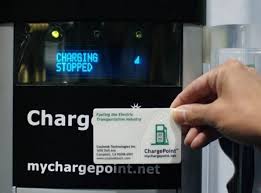 ChargePoint cards are available now. why not put everything on the existing PRESTO card Charging a car will be free for the first month; after that, each charging session will cost $2.50. Electric vehicle users can wave a credit card or a Chargepoint smart card over a card reader to pay for their electric vehicle charging access.
$2.50 a charge? It cost me $68.74 to fill my tank.
 The ultimate electric car charging station: Solar panels shaped like trees with plug-ins for cars – why not fill GO station parking lots with these things? The provincial government says the new stations are part of a three-year pilot program, which may be expanded depending on demand.

 November 26, 2013 November 26, 2013
By Pepper Parr
BURLINGTON, ON. There are times when you are the butt of the joke and the best thing you can do is go along with the laugh at your expense. It’s part of our political culture and the truly good politicians learn to laugh at themselves.
The people in the Beachway have an issue with their Ward Councillor and the way he voted so enthusiastically against what they felt was their interests. It was Councillor Craven’s enthusiasm for getting rid of all the homes that make up the Beachway community and the glee and smugness he displayed that just rubbed the people in the community the wrong way.
 As a Standing Committee chair, Ward 1 Councillor Rick Craven is as good as it gets. Handling delegations and accepting the ideas of other people – not as good. But he wins elections. Councillor Craven is the best Standing Committee chair the city has. He is a rabid advocate for Aldershot. Touch that community and you have Rick Craven to deal with. At a recent Standing Committee he used the phrase “how dare you” when some Members of Council disagreed with the amount of money he wanted to see spent on completing the Plains Road Village Vision.
And, Craven deserves credit for the way he has managed to upgrade Plains Road from what was once a highway that had all the speeding traffic that is part of a throughput road. Plains Road today is one of the most attractive roads in the city. The planters and other amenities make it a nice road to drive along and when it is completed and Craven has the bicycle lanes he wants, it will be a pleasant road to bike along to get to the Royal Botanical Gardens.
The Beachway residents had hoped their Council member might be as kind to them and their plight as he has been towards the Plains Road Village Vision but Craven has never liked the Beachway community – sees them as people who threaten the world as he sees it.
The Beachway, which draws more people than Aldershot will ever see, hasn’t had as much as a dime spent on plantings, park benches or a decent upgrade to the old rail bed that is now a walking path. Not much in the way of signage on the western end of the Beachway either
 Trim well maintained homes – do we bulldoze buildings like this for park space? Katherine Henshell, a lawyer who maintained her office in the Beachway community for a time and explained to a Council Standing Committee that the “willing buyer/willing seller” phrase that was being tossed around was close to a joke. Council heard one of the most common sense explanations about how the Beachway community was being robbed of a fair value for their properties should they decide to sell.
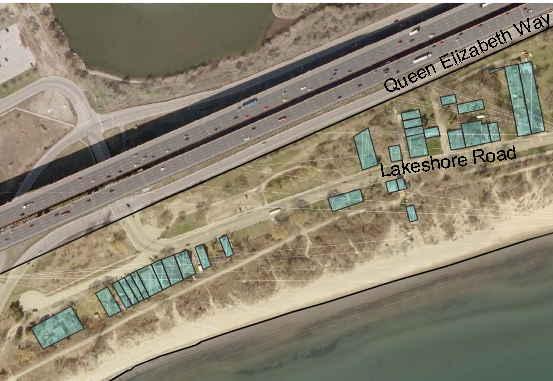 This is the location of the 30 homes the Regional government would like to at some point buy and demolish and turn into a park. They have a fight on their hands even though the Region won the first round. The community put up a good fight – the city, after a lot of debate, came out with a luke warm decision that sort of said there could be a community down on the waterfront but it didn’t have all that much punch to the motion that went to the Regional Council – which is where the decision on the Beachway was eventually going to be made.
When the issue went to the Conservation Authority the Beachway residents got a bit of a break. On a tie vote the Authority said they were not prepared to move forward without a budget in place to buy the homes that would have to go if there was ever going to be a park in the Beachway. The price to buy out the 30 home owners was at the $10 million point.
The debate then moved to the Regional Committee level where after hours of argument the Committee found that they could not come up with a recommendation everyone on the committee could agree on so it went to Regional Council without a recommendation – something quite unusual at the Regional level.
But when it was debated at the Region – it didn’t matter what argument was put forward – this item was going to be approved with the real push coming from an Oakville council member who put a motion on the floor.
 The significant seven had varying ideas with what should happen to the Beachway Park. some saw it as a place that needed to be made nothing but park while others thought it should continue as a small but tightly knit community. Dennison thought some of the properties could be redeveloped and new housing put in place. what was evident was the paucity of their creative thinking. There were all kinds of amendments and amendments to amendments but the drift was clear – this was going to pass. The Burlington crew did their best, however Burlington’s city council wasn’t really of one voice – and it showed.
Part of the motion that was passed has the Region developing a draft plan for the park and a process that would come up with a plan to purchase the homes from the current owners on a willing seller/willing buyer basis. Expropriation was off the table.
 An attractive.ell maintained home in the Beachway – the owner struggles to ensure that it will be xxx The Beachway residents were crushed – but these are a resilient bunch of people who have that streak in them that the residents of the Toronto Islands have. That community was under threat for yours and a lot of the houses on those islands were bulldozed – but today there is a vibrant community on those islands that makes the space safe for the public and a delight to visit. For those who live on the Toronto Islands – the place is a paradise to live on.
Henshell, who lives a couple of houses over from where the ward 1 councillor lives (that must get awkward) needed to let Craven know that the Beachway community was not going to go quietly into the night. Depend on the small Beachway community to become a burr under the saddle that Craven rides into the election in October of next year.
There is already one candidate ready to file papers in January to run against Craven who may well choose to take a run at the Burlington seat when the province goes to the poll, as expected, in the Spring. Craven trounced Jane McKenna when she took a flyer and ran against him. With the right team, and Craven does have a team, he could beat McKenna.
Craven has also mouthed words about possibly taking a run at the office of Mayor; probably not a good career move.
Henshell’s proposal was more tongue in cheek than real. What was surprising was how some people spent real-time on thinking about how to deal with. To suggest that the ward Councillors property be turned into a park made a lot of sense to Henshell who argues that if her house could be turned into a park then there was no reason not to consider turning the ward Councillors home into a park if an argument could be put forward that had some merit. Henshell argues that her proposal has as much merit as the plan to turn 30 homes in the Beachway into a park.
Henshell explains that Bird Watching is the fastest growing recreational activity in the world. More people consider themselves birdwatchers than hunters, hikers or even skiers. A designated park for the purposes of Bird Watching would be a unique feature to Burlington which would grow tourism, create jobs and strengthen the economy. It creates an opportunity for Burlington to become a world renowned city recognized for the preservation, protection and study of birds and wildlife. Henshell neglected to mention that such a park would add to the city’s luster as the safest medium-sized city in Canada
She provided data that claims: some 46 million Americans are birders, their average age is 49 and they have better than average education and income levels. Just the kind of people Burlington wants to attract. 54% of birders are female and 46% are male. 72% of birders are married.
 This lot once had a house on it. Its future might be to become part of a parking lot – none knows at this point what kind of a park would be created if all the houses were bought and torn down. This is a great demographic which Henshell is suggesting the city might want to reach out to with a place where people can spend time watching and identifying different bird species. It could become Point Pelee north if we do it right.
“Birders contribute $32 billion dollars in retail sales annually in the United States which generated $85 billion in economic benefits and created 863,406 jobs.” Burlington would surely want a piece of that pie.
“Bird watching is a therapeutic tool that provides social, emotional and physical benefits. Promoting this recreational activity within a senior citizen community can keep senior citizens engaged and active and has similar positive results as pet therapy.”
Henshell failed to propose that a branch of the Seniors’ Centre be included in the Bird Sanctuary. “Socialization and sharing observations and memories promote community and brings people together and reduces isolation. Studies continue to prove the enormous stress-reducing capabilities of animals. A simple connection to nature can provide an emotional benefit to reduce feelings of anxiety and loneliness.” The prime location for the Bird Watching Park would be adjacent to the Bird Sanctuary, as designated by Conservation Halton.
“There exists no public access to this Bird Sanctuary as it is bordered by private residences. A public portal to this Bird Sanctuary would allow Burlington residents to access the benefits of viewing birds in their nests during seasons of migration. As birds have migratory habits, location is key to allow for optimal viewing of rare birds”, explained Henshell.
“The existing Bird Sanctuary is located near the Royal Botanical Gardens and the Burlington landmark of Easterbrook. Tourism would thrive in this area as bird watching, flower viewing and nature viewing are complimentary pursuits.
“Moreover, there are a number of senior citizens homes in the area, some of which already provide transportation services to The Royal Botanical Gardens and which could expand this service to the proposed bird watching park.
 Those three indents in the curb were the driveways to houses that used to line Lakeshore Road. They were part of an active, vibrant community that has 30 homes left – which the Region would like to buy out over time and tear everything down and make it a massive park that will get used heavily for the summer months and become a no mans land in the winter. And we all know what happens in space that is not occupied or patrolled. “Of the private residents located adjacent to the Bird Sanctuary, one property is particularly isolated from the others and is large enough to support a public park for the purposes of bird watching. It is recommended that 614 Bayshore Boulevard, Burlington, Ontario be acquired to allow for park land. This property provides adequate space, viewing capabilities and a quiet tranquility which is necessary for birders to pursue this recreational activity.”
“Other adjacent properties either do not provide adequate land, do not have desirable viewing capabilities, have limited access or do not have self-containment capabilities and therefore cannot be considered.
City hall records indicate that 614 Bayshore Boulevard, Burlington, Ontario is the home of Ward 1 Councilor Rick Craven and his family.
“Economic growth through tourism maintains the current principles for the vision for the future of Burlington. The City of Burlington needs to take advantage of opportunities that meet city objectives while considering the needs and health benefits of the residents, adds Henshell in her proposal.
Burlington has always been fortunate in having citizens who see the potential for new ideas and aren’t in the least bit shy about putting those ideas into the public realm.
 A typical Beachway cottage – one of many that lined LAkeshore road. There was nothing upscale about the structures but they were home to a community hat was vital and robust – part of the DNA still seen in the community. Neither the planners or the politicians fully understand the community. There was a time when Jack Dennison represented that part of the city. Henshell wants the city to hold a public meeting a) to discuss the need for a designated park for bird watchers; b) to support the acquisition of 614 Bayshore Boulevard, and, c) to allow for comments from the public to show their support of this initiative. She copied every member of Council as well as the top levels of the city hall staff and included Wild Birds Unlimited, the Toronto Ornithological Club, the Hamilton Parrot Club and the media.
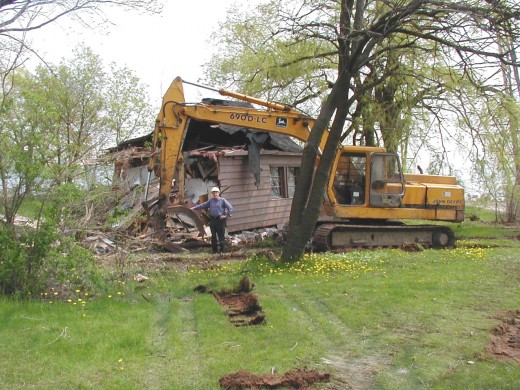 The last of the cottages that were on leased land to be demolished meeting its end with the back hoe. The Beachway Park residents will fight for the next few years to ensure that not one more house in the park get torn down. The Post took up the story and gave it significant coverage reporting that Henshell said she had no problem with “changing the Craven property into a park – he had no problem changing my property into a park”. Craven is reported to have said he has no intentions to sell and was reluctant to comment further but did say that: “We understand and know exactly what’s really happening here.”
The Mayor is reported to have said the “proposal” caught him off guard
Somewhere along the way people at city hall, who we assume are all high school graduates, forgot the work of Johnathon Swift and what satire is.
 The proposal was a satire with a touch of sarcasm that drew comments showing that some people at city hall don’t have a sense of humour. Not so funny is that there are people at the General Manager and Director level who are taking this seriously and have spent time wondering how to respond. The proposal was a satire with a touch of sarcasm that drew comments showing that some people at city hall don’t have a sense of humour. Not so funny is that there are people at the General Manager and Director level who are taking this seriously and have spent time wondering how to respond.
The Beachway community is showing a level of spunk that Councillor Craven specifically never did understand and Council as a whole was just not in touch with. The Beachway, for the majority of this Council, is not a real place, not something they can see as a place that could become a unique part of the city with a charm and mystery all its own. Burlington is still clinging to the ticky tacky bungalows and the monster homes plus all the every so correct communities we have now.
Councillor Lancaster, who as a young girl was not allowed to spend any of her time in the Beachway – it was not the kind of place a proper young woman spent time in – did however have it right when she said all the residents have to do is just not sell their homes and if they have to sell find a buyer who wants to live in a community like the Beachway.
This is one of those receive and file, send an acknowledging letter and perhaps pass it along to Councillor Craven for comment.
Additional articles on the Beachway and its council member:
Election material available.
 November 25. 2013 November 25. 2013
By Pepper Parr
BURLINGTON, ON. A city hall with a sense of humour? We didn’t see that when a resident sent in a proposal that would turn a Council member’s home into a park – but that’s another story.
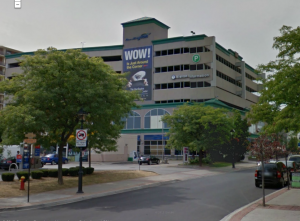 For the month of December you will be able to park here free and then for every Saturday during the year. Sound of Music week as well? Downtown Burlington has had a problem with parking and decided to change the channel and get people to focus on the downtown experience and forget about the parking.
To get people into this new way of looking at the parking issue the city decided there would be no cost to park downtown for the month of December and once we are into the New Year there will be no cost for parking downtown on Saturdays. That’s good news – the trick now was to get the news out.
Someone out there came up with the idea of doing a short video – it is a hoot. See for yourself.
Ward 2 Councillor Marianne Meed Ward got herself all worked up when she said: “You asked for it; we delivered: Park FREE in downtown Burlington on street and in city lots/parking garage for the month of December, and every Saturday starting in January. Free parking starts one day early this year, Sat. Nov. 30, in time for Black Friday and Shop the Neighbourhood events.”
Let’s see if it makes a difference. Will free parking get you downtown? Will the merchants along Brant Street decorate their stores this year – few did last year – and make it an experience. The price for the parking is right – now let’s see what the Burlington Downtown Business Association does with this new tool to draw the good people of Burlington into the downtown core.
 November 22, 2013 November 22, 2013
By Pepper Parr
BURLINGTON, ON. Has a Convention ever come to Burlington? Even a small one? Doesn’t look as if anyone in the corporate or association world has ever seen Burlington as a destination. Wonder why?
Part of the reason is the city didn’t really have anything in the way of facilities for a small convention. All Burlington has is geography – properly promoted one can go a long way with how you look. Other than water falling over the edge of a cliff – what else has Niagara Falls got going for it?
 Team Burlington: Flying the flag for the Mother Corporation – or just blowing smoke? Team Burlington made its annual report to the Development and Infrastructure Standing Committee last week – my colleague at the media table slipped me a note while the presenter droned on – “terrible” she has scribbled on the agenda. Dismal was my thought.
Team Burlington was formed in 2001, one of the former Mayor Rob McIssaac’s ideas that hasn’t quite jelled – it needs a hard look. That isn’t likely to happen for some time – the administration is going to have their hands re-formatting the way the city works.
The idea in 2001 was to “bring the major city economic development organizations together to form a dynamic team that is focused on the creation of a progressive and vibrant city with a unique Approach to business development services. Partners include: the Aldershot Business Community, Burlington Downtown Business Association, Burlington Economic Development Corporation, Burlington Chamber of Commerce, Burlington Hydro, City of Burlington and Tourism Burlington.” Only a public relations flack could write a sentence like that.
The city is a bit conflicted with what it wants. The chilli Half Marathon brings 5000+ people into the city – downtown is certainly vibrant when they are there, but there is a bunch of people who live along Lakeshore Road who want the city to have the marathon run somewhere else. That Marathon is one of the best things the city has going for it. Many people don’t realize that Burlington is seen amongst the running crowd as the place with some of the best races in the province.
In 2012 Team Burlington lists the Mayor’s One Dream as an achievement. Not something most people would put on their resume. That event was poorly thought through, was a bit of a disaster from an operational point of view and after spending $50,000 there is yet to be anything in the way of ideas from the two-day event.
The Team Burlington Report says the event – that event did no such thing.“solidified the direction of the city’s Strategic Plan and reinforced the work. Poppycock
 With the Economic Development Corporation getting a face lift as well as a couple of major organ transplants the purpose of Team Burlington is no longer clear. The city will learn about that when the BEDC format is unveiled. Production at BEDC has been pathetic and it is going to take at least six months to stabilize that place. With the Economic Development Corporation getting a face lift as well as a couple of major organ transplants the purpose of Team Burlington is no longer clear. The city will learn about that when the BEDC format is unveiled. Production at BEDC has been pathetic and it is going to take at least six months to stabilize that place.
Everyone in this city talks about the vibrant, progressive downtown – I’ve never managed to see it. The city does have a small Tourism office that is filled with brochures telling you everything you ever wanted to know about what is going on in town and the people behind the counters smile and are helpful.
After sitting through the Team Burlington presentation – “uninspired” is an understatement.
There was no information – just a recitation of what are close to mickey mouse events. They had a Christmas gathering – really. There was one very good event that pulled together hospitality related groups to tie them into the War of 1812 celebrations. The presenters were as good as it gets, there was a lot of very useful information. But there was a problem – just one person from the hospitality sector showed up. The woman who put on the event for Tourism Burlington was a “fire cracker”: focused, motivated, and innovative – but she left town, a decision she made.
The report has statements like this:
“Team Burlington continues to evolve and be recognized as a leading edge and unique business development model, both within our City boundaries and beyond. The Team plans to continue this mandate to support and increase economic development in the City.” Corporate happy talk at its best.
Why do the people who sign off on these reports let things like this get out to the public?
Not sure where the credit for the new signage that is popping up all over town should go -good looking stuff – the information needed is all up there. There are some who quibble with the design.
 November 20, 2013 November 20, 2013
By Pepper Parr
BURLINGTON, ON. Just because lawyers have managed to wrap up the Airpark differences in appeals to a higher court doesn’t mean nothing is happening up there on that 100 + piece of property that has a $4.5 million mortgage on it. Those payments have to be made month after month and given that there are no more truckloads of revenue producing landfill being dumped on what Vanessa Warren, founder of the Rural Burlington Greenbelt Coalition once described as a “toxic dump”one has to wonder how the bills are being paid.
 Layout of the Airpark lands. This is an older photograph that doesn’t clearly show the runway that runs diagonally from lower right to upper left. The landfill dumping was always seen as illegal by the north Burlington residents. They wish the city had listened to them earlier. When the city did begin listening – and it was hard to ignore Vanessa Warren and her delegations – things moved along rather briskly and the dumping stopped.
The city got itself into Court and a Judge declared that the Burlington site plan bylaw was valid and had to be adhered to which was seen as a win. The residents thought they saw some light at the end of the tunnel they have been in for the last five years.
Almost everyone expected there to be an appeal – and sure enough, the Airpark filed their appeal within 36 hours of the decision being handed down. With the differences now mired in the legal process, which tends to move at a glacial pace, what happens on the site while the lawyers do their paper work?
At least one lawyer involved in this is fighting to retain his professional chops as a leading expert in federal airport regulations. If the city’s arguments hold the lecturing and consulting work could well dry up and the client base will send him packing the way city council did when he first delegated there.
There is still the contaminant issue to be dealt with. When the July 11th report from Terrapex, a respected environmental consulting and engineering firm hired by the City, submitted their report, they said 60% of the soil sample reports provided to them posed a serious threat to the environment and to the neighboring landowners who rely entirely on well water.
MOE did not agree with the Terrapex document and said the samples analyzed met MOE standards. Because there is not an adequate record of just where that landfill came from and what’s in it – the Ontario Ministry of the Environment (MOE) asked that some testing of the soils and water that runs off the Airpark site be done.
Back in August, the MOE informed the City that the Airpark had agreed to co-operate with them and test for off-site adverse effects (leaching) into groundwater of any contaminants that might be present within the fill dumped on their lands – and that this would be done by installing test wells around the outer perimeter of the filled locations. Those wells were eventually drilled in late September by Airpark contractors.
The September MOE testing was done at the periphery of the airpark but the city is not being allowed to see the results. MOE told the city to use a Freedom of Information request to get the data. The city did that and we are told the request was denied.
Something doesn’t smell right here.
 These people are not drilling for oil – it is believed they have sunk a drill to test the make up of the landfill dumped on the property in the last 18 months. On Tuesday morning around 9 am., a large, unmarked white cargo truck rolled into the center of the south-west portion of the Airpark land, to the west of its main runway. Some heavy equipment was unloaded and the drilling of a test well began. One observer wondered why a professional environmental testing company wouldn’t have its name or logo on the truck. The area being tested has landfill dumped by King Paving who did much of the work on that portion of the Airpark.
Could it be that the MOE periphery testing raised some questions and that brought about the need to test in the centre of the airpark?
 No markings on the truck. Who does it belong to?  All the key players in the Airpark dispute: On the left standing city lawyer Blake Hurley, in front of him lawyer Ian Blue hired to argue the city’s case in Court. Scott Stewart, city general manager leaning forward and talking to Roger Goulet, Ken Woodruff and Monte Dennison. In the row behind Rural Burlington Greenbelt Coalition founder Vanessa No one knows yet who asked for the testing, why it is being done and who is paying for it. With no markings on the vehicles that rolled out onto the property we don’t even know who is doing the testing.
There is a larger question that the city of Burlington and the Region have to think through and that is: what should happen to the Airpark? If the city wins the appeal (expect a win at the Appeal level to be taken to the Supreme Court of Canada – that’s how important this issue is) and the Airpark finds that it has to adhere to at least some municipal oversight – what does the city want to see done in that part of the municipality.
Up until now Airpark president Vince Rossi has trampled all over senior city staff. Not a smart move on Rossi’s part. The city now needs to begin thinking what it requires in the way of site alteration on that land. It is currently a small airport and it can remain that way for as long as Rossi can afford to pay the bills. As a small sleepy airport it barely paid for itself. When Rossi bought the place he had big plans for that land. He tried putting up a communications tower, making the place a giant location for a used car auction site and then worked at closing a deal to have the place used as a helicopter pilot training school for the Chinese government. So far he hasn’t managed to make any of the ideas actually work – such is the world of entrepreneurship. It is not easy and for every success there are thousands of failures.
 Vince Rossi, president of Burlington Executive Airpark Inc., at a meeting with members of the Rural Burlington Greenbelt Coalition that took place in a barn a couple of hundred yards from the end of his largest runway. There was a time when a business person could go it alone and swashbuckle their way through almost anything – those days are gone, now you collaborate and work within a system that can be slow and sluggish.
This evening, Councillors Taylor and Lancaster will be meeting with north Burlington residents at a public meeting where there might be an opportunity to get a sense of what they think should happen with the Airport lands.
Rossi has a pilot’s license and clearly has an affinity for aviation. Burlington badly needs entrepreneurs who are prepared to take risks but it needs people who will work with the city to set out and achieve a common goal. Rossi may not have the temperament to work with people in a collaborative manner. One of the things that every business person knows, or will eventually learn the hard way, is that you cannot beat city hall. And in Burlington city hall cannot be bought.
 November 19, 2013 November 19, 2013
By Pepper Parr
BURLINGTON, ON. The item on the Agenda was to approve the Special Events Team plans for 2013/14. The Staff report recommended that Staff be given authority to approve events that have taken place previously and have gotten a successful post event reports and that they be given the authority to automatically approve minor events.
There are 151 events on the calendar with attendances that range from less than 25 to more than 200,000 people. More than 635,000 people took part in events during 2012.
The creation of the Special events Team has streamlined the process with everything coming to the one committee that includes: Parks and Recreation, Roads and Parks Maintenance, Fire, Building, Transportation, Transit, Health Department and Halton Regional Police Services. This gets everyone at the same table. The process now has staff from Parks and Recreation and Transportation meeting and passing information along to others. It wasn’t working.
The city came up with a collection of “process improvements” that Council has been asked to approve. After a long and arduous meeting the Standing Committee agreed to receive and file the report which will bring it back to Council on the 25th where it should get approved. Much needed changes were made; Kudos to staff on this one.
The following are new events scheduled for 2013/14: Ride for Betty, St. Timothy’s Run, Move – a-thon, Yoga by the Pier, Epic Ride, Spin for Limbs, Miles for Smiles, This Magic Moment Concert and the Marque d’Elegance Street Festival
There was a two-line mention in the report about the Chilly Half Marathon that has taken place in March of each year since 2009.
“Chilly Half Marathon has been questioned by a resident affected by the event. The resident who is requesting rerouting will be delegating at the committee meeting.” That was an understatement. Lakeshore residents turned in a petition with 150 names and had 10 people delegating to the Standing Committee – they did not want the Marathon being run along Lakeshore Road. After more than two hours of delegations and discussion they were still at it.
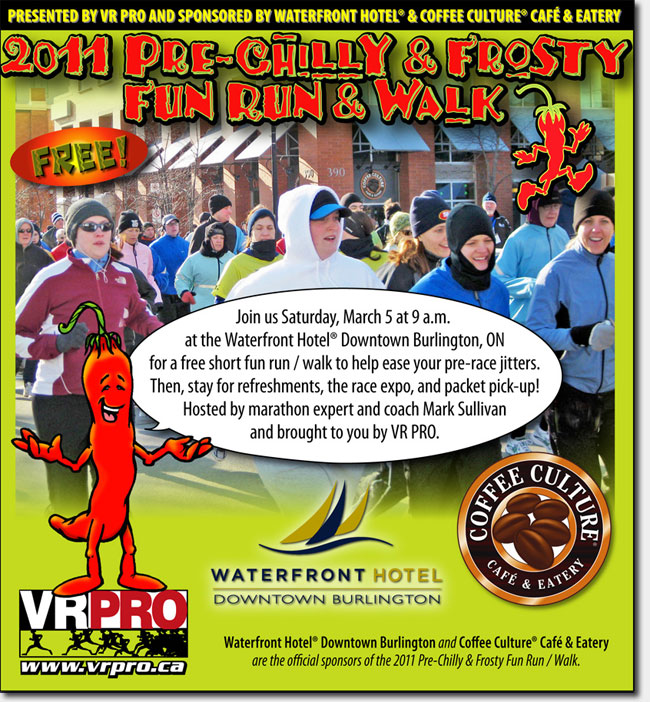 The race is a major event for the city. The Esso station at the eastern end of the race losses out but the downtown core does exceptionally well. The race “officially” starts at 10:05 which puts it smack in the middle of church time. It is scheduled to run for 3 hours and 15 minutes. And that’s the problem for the people whose streets run into Lakeshore from the south side – they are basically land-locked for the duration of the race. Starting the race earlier is an option – some suggested starting as early as 7:00 am and being done by 10:00 am. That would take away from the excitement and momentum that builds up and probably cut down on the attendance.
Is there a compromise out there that will work? Were people willing to meet with open minds? There wasn’t much of that to be seen at the Standing Committee meeting.
When the Santa Clause parade takes place on Guelph Line and New Street a lot of people get locked in and there is nowhere near the number of complaints that the Chilly Half generates. Why the difference? Mostly attitude on the part of the people who are inconvenienced. Those along New Street see the Santa Clause parade as part of the season they take part in. The Lakeshore people don’t see the Chilly Half Marathon as something they are a part of.
Not everyone was opposed to the event. Colin Cameron, Pastor at the Holy Cross Evangelical Lutheran Church took the position that if you can’t beat them – then work with them. He stands out on Lakeshore Road during the race offering Blessings and fresh fruit to the runners as they work their way back towards Brant Street – all 5000 of them.
The good pastor told of an 80-year-old parishioner who took issue with a police officer who wasn’t prepared to let her drive her car along Lakeshore Road. When asked what she would do her response was: “Well they are going to have to catch me aren’t they?”
Pastor Cameron in his refreshingly amusing comments referred to those who take part in the marathon as member of the St. Mattress and All Sheets parish. He talked as well about how his church coped with all the runners on Lakeshore on that Sunday in March.
Other residents objected to being locked in their homes while the marathon takes place. Traffic from all of the side streets on the south side of Lakeshore Road have their access limited while the race takes place. That can be very frustrating and a significant concern as was evident from several of the delegations.
Dr. Rita Moeinafar-Combden wanted the race organizers to be more forthcoming with their for profit agenda and stop hiding behind the veil their modest donations to the hospital.
Carol and Ian Milne Smith pulled Edmund Burke into the debate with his remark that “All government …is founded on compromise and barter” and the Milne-Smith don’t see much of either.
Nick and Dianne Leblovic delegated as a tag team – she spoke first and complained that the public process has failed and she wants city council to be responsive to public input – which if they delegations were fully understood they wanted the road opened so that caterers could get to the streets that run south of Lakeshore road.
Ms Leblovic maintained the city reneged on a commitment they made last May which was when they decided to do their own research and knock on doors and hold meetings.
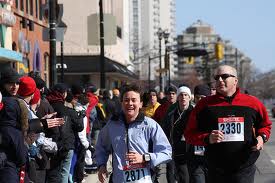 They do flood the streets. They met with the churches, they got names on a petition and while they believe it is a great event they want a change in the route. The Leblovic research revealed that the amount donated to the hospital was far less than many people imagined and that seems to have changed a lot of minds.
Ms Leblovic argued that more than 5000 people are locked into their homes for more than four hours. People do have limited access to Lakeshore Road while the race is being run. Traveling along Lakeshore Road this past three months has been limited due to the new water and sewage pipes being put down.
Ms Leblovic would like to see the race started much earlier and points out that sunrise on March 2, 2014 is 6:54 am. Is a change in the start time an accommodation the race organizer and the city can make? Ms Leblovic also pointed out that some consideration has to be given to “rolling openings” as well as putting caps on the number of participants. Her list of concerns has merit: what it doesn’t have, apparently, is enough meat on the bones to attract city staff to meeting with her to bring about some changes.
Nicholas Leblovic followed his wife to the podium and presented three alternate routes that he felt had merit. One was a loop around Mainway that would have the runners going through an industrial community; a second along the Waterfront Trail to Confederation Park in Hamilton and a third that used parts of Lakeshore Road and the North Service Road.
None compares all that favourably to the current Lakeshore route, however the Waterfront Trail route does have merit.
Mr. Leblovic wanted to see a committee created with representation from VR Pro, city staff and the Leblovic group. Staff doesn’t want to see any such committee and VR Pro will take part only if they have to.
As we listened to the delegations it was apparent that there is some significant hardship for some people. It was also evident that many of the Lakeshore residents just plain don’t want that race in their community and evident as well that the city isn’t going to do all that much about the complaints.
The Leblovic’s and the community they represent have a legitimate concern that is not being addressed. Both Diane and Nicholas could see the writing on the wall and left the Standing Committee meeting before all the talking between council and staff had been completed.
Councillor Meed Ward did feel that a committee could be struck that would have staff and the Lakeshore residents meeting to iron out the problems – and there are some problems. She couldn’t get anyone to vote with her for a committee. Staff was happy with what they have, Kelly Arnott loves the situation and it looks as if things will not change. There are people living south of Lakeshore Road who are being short-changed. Will this become a political issue in the Oct 2014 election? Think you can bet on that.
Greg Pace who organized the Moon in June event delegated as well. He has gone along with a change staff suggested that will have his event rolled into the Sound of Music Festival. What got Pace all kinds of brownie points was the revelation that 41% of his race revenue goes to a charity. Pace did ask Staff to reserve the date he had last year so that he can go back to that date if things don’t work out with his race becoming part of the Sound of Music program.
 The finish line Kelley Arnott of V-Pro also delegated and did her best to answer the questions put to her. There was a lot of spin to the answers given. Many people thought the Marathon was an event to raise funds for the hospital. The hospital does get some money from the marathon – it was difficult to nail Arnott down on exactly how much had been given in donations and she wasn’t prepared to let anyone near the financial records of the organization but she did say she would make financial statements available to council members on a confidential basis.
What the public saw was two sides with markedly different interests. The Lakeshore residents who resent Lakeshore Road being closed led by the Leblovic’s who deeply resent the closure. One Council member described Diane Leblovic as a determined activist. You can bet on her not giving up on this issue.
One the other side there was Kelly Arnott who runs a very popular and profitable race; that is the business her company is in and they do this very well. VR Pro appears to organize about a dozen races each year. Their Chilly Half race is seen as the standard for the running community. Arnott put out the figure of $3 million as the amount they have raised for charities. What she would not say is what percentage of the revenue raised gets into the hands of the hospital.
 VR Pro pricing schedule VR Pro earns its money from registration fees which come in at basically $75 per racer for the Chilly Half Marathon. The number of actual racers seemed to vary. One report had it at 5000, Arnott seemed to be saying it was 4000 and there was a projection of 6000 for the 2014 event. Use the lowest number and multiply that by the $75 fee and you come up with a substantial $300,000 in revenue. Yes there are expenses but the Chilly Half Marathon is one hot revenue generator for VR Pro.
Arnott said her revenue was $340,000 from the race in 2012 and that expenses came in at $300,000
The Burlington restaurants love the event. The operator of the No Frills supermarket on Brant has no love for the event NAME says the runners park their cars in his lot and plug it up leaving no space for his regular customers.
The Esso station at the turning point for the run doesn’t like it – he closes his gas station for the day – no one can get to his station and he resent losing a day’s revenue.
City staff want the event to continue and have come to the conclusion that the current route is the best one available. The runners love the route – it is flat and the view along the road suits them just fine.
Despite several attempts on the part of Council members to have a committee formed staff said again and again that a committee set up to guide their thinking was not needed.
 Nick Leblovic has been a part of civic life for a long time. He served as the Chair of the Waterfront Access Protection and Advisory Committee/ Diane Leblovic once served as a school board trustee. In this photograph Leblovic is seen on the right. Mayor Goldring told the meeting that he and Councillor Dennison had offered to meet with the Leblovic’s but the offer was turned down which was enough for Councillor Craven. He took the position that the city offered to help – the offer was turned down – and that was it. The Leblovic’s are adamant – if you don’t want to talk about a route change then there won’t be much of a conversation with them.
The Leblovic’s have an ongoing issue with public access to property. An article in the Orangeville Citizen, a community newspaper that has been around since 1974, reported that a “property squabble can be traced to 2001, when Nicholas Leblovic, a Toronto lawyer with a summer home on Balm Beach, made the first application under the Boundaries Act to extend his property line to the water’s edge. But the Marion’s are the only ones to cordon off their property — even though any of the others could do the same, transforming the beach into barricaded corridors.”
The news article went on to say: “Thankfully, Kim Craitor, Liberal MPP for Niagara Falls, has introduced a private member’s bill, the Great Lakes Shoreline Right of Passage Act, which would guarantee the public’s ability to walk all the shorelines of the Great Lakes. It’s now awaiting committee review and surely should be approved, either as is or as a government bill with the same purpose.”
The news article concluded by saying: “As we see it, this should be a matter for our legislators, not the courts. Provincial law should reflect a clear (overwhelming?) public interest in having all the Great Lakes shoreline accessible to everyone, not just a relative handful of rich property owners.”
The Standing Committee received and filed the Staff report which one can expect to see made final at Council on the 25th. Chilly Half Marathon will take place on Sunday March 2, 2014.
 November 18, 2013 November 18, 2013
By Pepper Parr
BURLINGTON, ON. Has a Convention ever come to Burlington? Even a small one? Doesn’t look as if anyone in the corporate or association world has ever seen Burlington as a destination. Wonder why?
Part of the reason is the city didn’t really have anything in the way of facilities for a small convention. All Burlington has is geography – properly promoted one can go a long way with how you look. Other than water falling over the edge of a cliff – what else has Niagara Falls got going for it?
 The Delta Hotel will give the city some first class convention space that could radically change the way the city is seen by the small corporate convention community. Add the Performing Arts Centre to the portfolio and the city has a good offering. Now to put a team in place that could work with the Delta Hotel organization.. We don’t have that in place today. Burlington now has the Performing Arts Centre and should see shovels in the ground in 2015 when construction starts on the Delta hotel that is part of the Bridgewater development on Lakeshore Road. The Delta wanted to be open to participate in the Pan Am Games in 2015. So there is convention potential – even if it is small.
Team Burlington made its annual report to the Development and Infrastructure Standing Committee last week – my colleague at the media table slipped me a note while the presenter droned on – “terrible” she had scribbled on the agenda. Dismal was my thought.
The Team Burlington partners include City of Burlington, Burlington Chamber of Commerce, Burlington Economic Development Corporation, Burlington Downtown Business Association, Tourism Burlington, Aldershot Village BIA, and Burlington Hydro.
Team Burlington was formed in 2001, one of the former Mayor Rob MacIsaac’s ideas that hasn’t quite jelled – it needs a hard look. That isn’t likely to happen for some time – the administration is going to have their hands re-formatting the way the city works. The Tourism potential is there – creating a contact point within the city and promoting the opportunity could begin – even if the city brought someone in on a part-time basis.
The idea in 2001 was to “bring the major city economic development organizations together to form a dynamic team that is focused on the creation of a progressive and vibrant city with a unique approach to business development services. Only a public relations flack could write a sentence like that.
The city is a bit conflicted with what it wants. The Chilly Half Marathon brings 5000+ people into the city – downtown is certainly vibrant when they are there. But there is a bunch of people who live along Lakeshore Road who want the city to have the marathon run somewhere else. That Marathon is one of the best things the city has going for it. Many people don’t realize that Burlington is seen amongst the running crowd as the place with some of the best races in the province.
For 2012 Team Burlington lists the Mayor’s One Dream as an achievement. Not something most people would put on their resume. That event was poorly thought through, was a bit of a disaster from an operational point of view and after spending $50,000 there is yet to be anything in the way of ideas from the two-day event.
The Team Burlington Report says the event “solidified the direction of the city’s Strategic Plan and reinforced the work”. Poppycock – that event did no such thing.
With the Economic Development Corporation getting a face lift as well as a couple of major organ transplants the purpose of Team Burlington is no longer clear. The city will see some clarity when the revised BEDC format is unveiled at the April 2014 AGM. Deliverables at BEDC has been pathetic and it is going to take at least six months to stabilize that place.
After sitting through the Team Burlington presentation – “uninspired” is an understatement.
 Located in the lower levels of the municipal parking garage on Locust many of the Team Burlington members have modern offices and a decent restaurant with a sidewalk patio. There was no information – just a recitation of what are close to mickey mouse events. They had a Christmas gathering – really. There was one very good event that pulled together hospitality related groups to tie them into the War of 1812 celebrations. The presenters were as good as it gets, there was a lot of very useful information. But there was a problem – just one person from the hospitality sector showed up. The woman who put on the event for Tourism Burlington was a “fire cracker”: focused, motivated, and innovative – but she left town, a decision she made.
The report has statements like this:
“Team Burlington continues to evolve and be recognized as a leading edge and unique business development model, both within our City boundaries and beyond. The Team plans to continue this mandate to support and increase economic development in the City.” Corporate happy talk at its best.
Why do the people who sign off on these reports let things like this get out to the public?
Not sure where the credit for the new signage that is popping up all over town goes. Good looking stuff – the information needed is all up there. There are some who quibble with the design.
Everyone in this city talks about the vibrant, progressive downtown – I’ve never managed to see it. The small Tourism office is filled with brochures telling you everything you ever wanted to know about what is going on in town and the people behind the counters smile and are helpful.
 November 18, 2013 November 18, 2013
By Pepper Parr
BURLINGTON, ON. Is it an appropriate place for a restaurant that will have a patio on the roof of the building that is being built to handle up to 80 people? Depends on where you live. There will be seating for 90 people on the ground floor level.
The working name for the new restaurant is expected to be Casey’s. it is part of the franchise chain that operates East Side Mario’s and other brands. The Casey’s operation will start out as a corporate operation rather than a franchise.
Glen Wellings, the planning consultant representing FCHT Holdings (Ontario) Corporation, a unit of First Capital that basically owns the intersection. They operate the mall on the north-east side as well as the smaller strip mall on the north-west side.
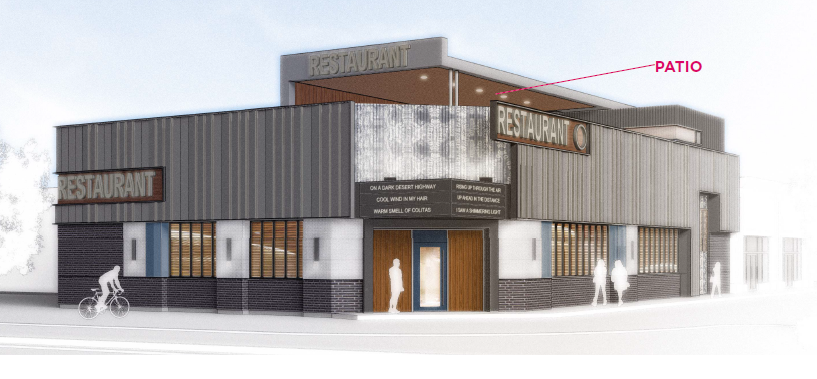 Architectural rendering of the proposed Casey’s restaurant at New and Appleby Line was described at a Public Meeting last week. A restaurant can have a patio at the ground level – to create a roof top patio they need an amendment to the zoning bylaw. The event was a Public meeting where anyone can show up to speak. The Public meeting format gives city staff an opportunity to hear what residents feel about a proposal. Staff then meet with the restaurant operators and return to Council with a plan and a recommendation that, ideally, meets all the concerns that came up at the public meeting.
The planners assured everyone they have made managing and buffering the sound a significant part of the design. Containing sound is not easy.
A number of the residents have a major concern about parking which they contend is a very tough go as it is. There is a martial arts school right next to the location which used to be home to the TD Bank. Some feel that parking will not be an issue – if there isn’t space outside Casey’s – patrons will just park across the street.
After the meeting an area resident opined that the plan was to make the roof a place where smokers could drink. The current bylaw calls for no smoking within 9 metre of a building – one has to assume that would apply to the 9 metres above the roof patio.
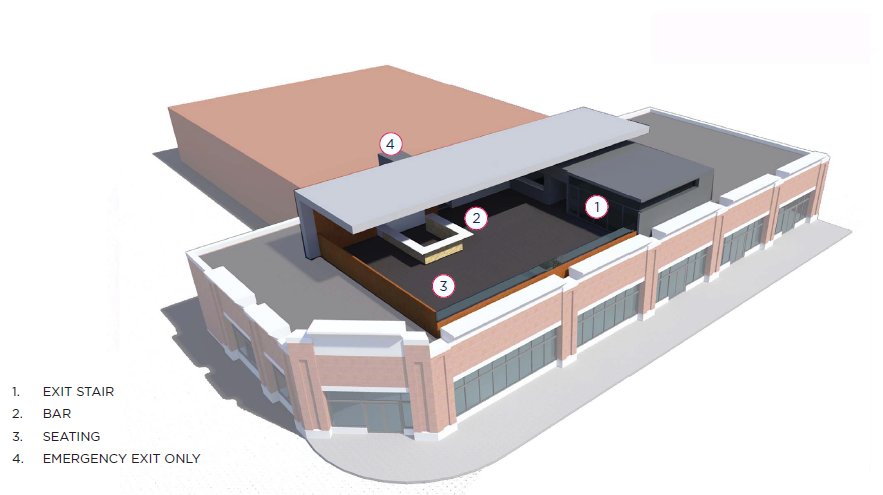 The developers application is for an amendment to the zoning bylaw that would permit a rooftop patio. Sound control was a concern to residents. The architects have included barriers they believe will control the sound. The manager of the location lives in Burlington and gave the Standing Committee every assurance he could that the parking issues were more than manageable and that sound disturbance would not be as issue.
Well – try a sulky summer evening with breezes floating in off the lake and wonder aloud where that sound is going to go. It will be noisy; pleasantly so and acceptable to the community? To early to tell. Much depends on how responsible the operators of the restaurant are and the kind of clientele they attract. If you see half a dozen motorcycles in the parking lot – you know there is a problem.
The operators of the chain have done their market research and believe there is a place for what they want to operate. These people do their homework – if they got it right the neighbourhood will have a pleasant place to get out for a meal and a drink and spend some time on that patio – assuming the place isn’t populated by smokers.
 November 16, 2013 November 16, 2013
By Staff
BURLINGTON, ON. This is what you would call a `”coup” The Different Drummer is bringing Margaret Atwood to town. The Drummer along with, Bryan Prince Bookseller and Random House of Canada will have Atwood at Royal Botanical Gardens on Thursday, November 28 7pm
 Margaret Atwood; one of the country’s finest writers. Ian Elliott, the guy behind the counter at the Drummer is “deeply honoured” to announce what is a rare local appearance by an international, leading literary figure.
 Atwood will discuss her work and the issues at the heart of the final volume in her enthralling dystopian trilogy, MaddAddam. Atwood will discuss her work and the issues at the heart of the final volume in her enthralling dystopian trilogy, MaddAddam.
Tickets are $10. Please contact us at (905) 639 0925 or diffdrum@mac.com to reserve.
 November 15, 2013 November 15, 2013
By Pepper Parr
BURLINGTON, ON. The Burlington Executive Airpark has decided to appeal the decision that found the city of Burlington site modification bylaw to be valid.
One needs to look at the time line on this decision to appeal. Justice Murray released his decision at just before 5:00 pm on Wednesday the 13th. These things are often sent by fax and would have gone to the offices of the lawyer who argued the case.
That suggests that Vince Rossi and his legal team were up late Wednesday and then spent all of Thursday reviewing the decision and the applicable case law.
They then have to draft their documents and file them at the Court House in Milton and then have the documents served on the city, which they are reported to have done Friday afternoon.
 An early photograph of the Airpark property. There are now two runways and a lot more landfill now than there was when this picture was taken. The lines indicate the extent of the holdings. The news release announcing the decision to appeal did not come from the lawyers representing the Airpark but instead came from Tim Crawford who has been an advisor to Vince Rossi.
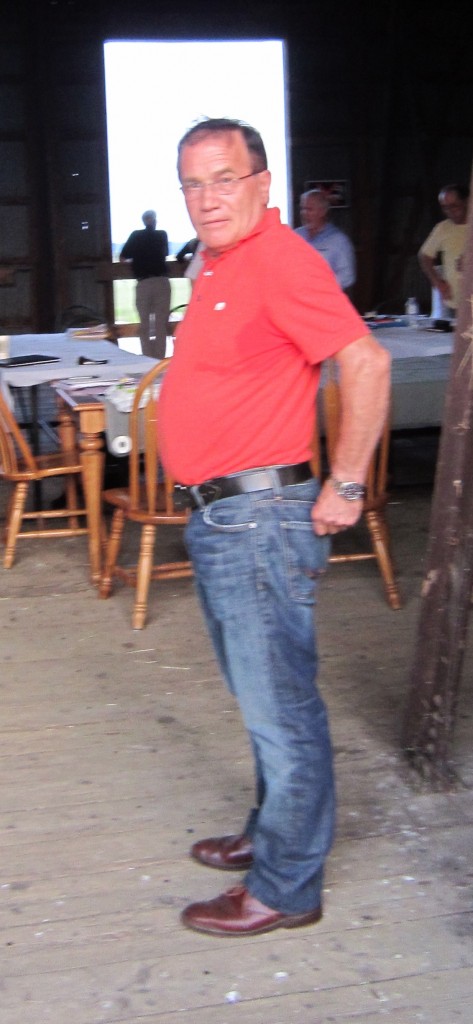 Vince Rossi at a community meeting held in a barn a couple of hundred yards from the end of one of the airport runways The grounds for the appeal are twofold: arguing that Justice Murray erred in law and that there is a fundamental constitutional issue to be argued as well. That pulls the Attorney General of Canada and the Attorney General of Ontario into the case. When you involve federal and provincial governments you move into a pace that is best described as glacial. Someone is buying time.
There is a lot of Vince Rossi’s money at risk. He owns the land, has a $4 million mortgage to service and will have to keep his development plans on hold until he has a decision.
Selling gas to small planes isn’t going to pay the bills.
Earlier in the week, on Monday, King Paving removed all their equipment from the site. King was the company that hauled the bulk of the landfill onto the Airpark site.
The relationship between King Paving, Tim Crawford and Vince Rossi is a complex one. Both King Paving and Crawford have offices in the same building in Burlington. Crawford is in the aircraft insurance business and while he claims that he does not have a financial interest in the Airpark and does not earn fees from the company, many believe there is a benefit in there for him somewhere.
When the Airpark issue was heard at the Region, Crawford who expected to do a 10 minute delegation, was kept hopping with some close to hostile questions from the Regional Councillors. They kept him on his feet for close to an hour and gave him quite the grilling
Vince Rossi is a relationship builder. He seeks out people with power and influence and manages to get them to do some of his bidding. When he needed to send a fax to the Minister of Finance the document went from the offices of Hazel McCallion, Mayor of Mississauga. When a fax from the Mayor of Mississauga arrives – attention is paid to it.
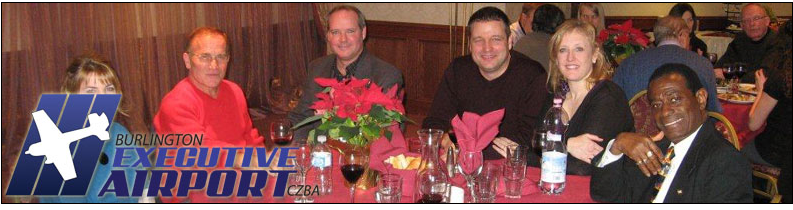 Lisa Raitt, second from the right, Tim Crawford centre behind the flowers and Vince Rossi in the red sweater. The flowers suggest a Christmas event. Rossi has developed a better than working relationship with Lisa Raitt, the MP for Halton – good business. That relationship is such that Raitt shows up at some of the Airpark social events.
Rossi has done the same thing with Burlington`s Ward 6 Councillor Blair Lancaster. She has held at least two ward corn roasts at the Airpark
Relationships are good to have but they will never beat a positive cash flow which many suspect is something the Burlington Executive Airpark does not have.
The saga continues.
Background:
Rossi meets with residents; his lawyer fails to browbeat city council.
Airpark landfill damage cannot be seen from Appleby Line.
City gets details on landfill damage – not a pretty picture.
City thinks about road access suspensions to airpark property.
It all came to the attention of city council back in may.
 November 15, 2013 November 15, 2013
By Pepper Parr
BURLINGTON, ON. So – what’s next with the air park? The city won – the airpark people can appeal – they’ve got 30 days plus a couple of jiggle days to decide what they want to do. The final date for an appeal is December 18. The two lawyers representing the Airpark will be going over the decision with a fine tooth comb looking for grounds to appeal – assuming their client can come up with what it is going to cost to file an appeal.
Meanwhile the city will pull together its team – that will include Ian Blue, the lawyer the city hired to argue the case, and the internal staff that have worked this file.
The city bylaw is pretty specific –
An applicant for a Permit must submit a Control Plan as part of its application which must contain, inter alia, a map showing the location of the site, the site boundaries and the number of factors, the current and proposed use of the site, location of lakes, streams, wetlands, channels, ditches and other watercourses and other bodies of water on the site, the location of the predominant soil types, the existing site topography at a contour level not to exceed 0.5 m, the proposed final elevations of the site, the location and dimensions of temporary soil, or silt stockpiles and provisions maintaining site control measures during construction.
And if the decision stands this is what the Air Park is going to have to comply with.
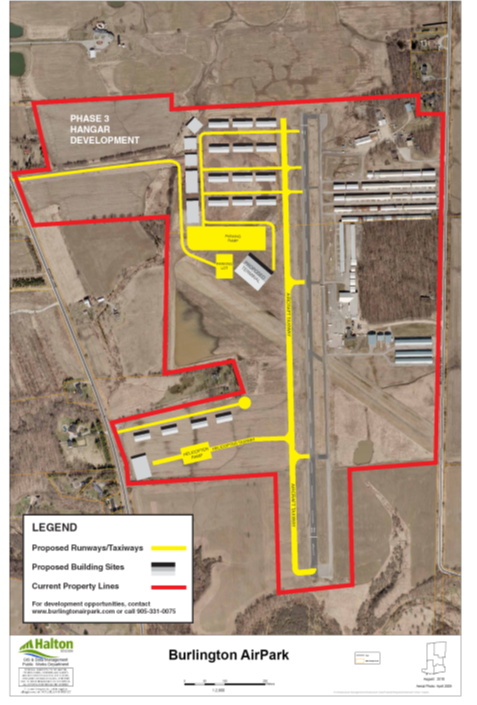 This Regional government map shows they knew what the plans were – but they didn’t do anything – instead bought the Vince Rossi argument that the airpark was federally regulated. The challenge is going to be for the city to find a way for the Airpark to comply. City General Manager Scott Stewart explains the Airpark will have to hire a consultant and put forward a proposal on how they think they can comply with the bylaw. Expect to see a lot of back and forth on this one. Vince Rossi has never given an inch in his previous dealings with the city.
The relationship Rossi established with the Ward Councillor Blair Lancaster, which bothered the people whose property was being harmed environmentally and de-valued financially, is not going to get Rossi out of this one. There is one resident who has probably lost 50% of the value of her property now that there are 30 foot hills either side of her lot.
Many felt that Lancaster, was far too close to Vince Rossi. They felt her sitting beside him at a community meeting was a dumb decision and when she was spotted walking out of the court house with Rossi some wondered if any of the confidential information Lancaster is given as a Council member was working its way to Rossi.
 Ward 6 Councillor Blair Lancaster held some of her ward meetings at the Airpark. Area residents didn’t fully appreciate in 2011 and 2012 how tight she was with Vince Rossi. Lancaster had spent a few minutes with Ian Blue, the city’s lawyer and Scott Stewart, general manager for Development and Infrastructure and the point man on this file, after the Judge completed the hearing. Lancaster then walked from the Court house to her car with Rossi. The political optics were terrible – one would expect the Council member to be mindful of her position.
The north Burlington residents have been meeting with senior city staff at regular Saturday morning get togethers at a coffee shop and have been kept in the loop. One hopes that the city will have at least some of that Saturday morning group at the table as they work out how to get the Air Park to comply with the bylaw.
The city expects Rossi to comply with the bylaw using some of the money he made from landfill dumping fees – problem is much of that money doesn’t show up on the Airpark’s financial statements. So where is that money – and we are not talking chump change here.
During the hearing before Justice Murray, Ian Blue managed to slip in the fact that the $2 million plus per year, earned by the Air Park in 2011 and 2012 and a smaller sum in 2013 did not appear on the company’s financial statements. Many want to know where that money went.
The public does know that there is something in the order of $4 million in mortgages on the Airpark property – hard to understand how that debt is going to be serviced with no more dumping fees coming in. Might the TD Bank end up foreclosing on the property and offering t sell it to the city who might operate the place as a municipal airport?
Stranger things have happened. Jeff Fielding, city manager, has council convinced to let him come up with business cases for what he calls Enterprise Corporations. A municipal; airport could be just another enterprise.
Assuming the court case is not appealed the city has some major thinking to do. First how to fix the damage that was done and then to decide just what it wants to do in terms of how it grows north Burlington. It is a development no go zone, designated as agricultural but doesn’t really support an agricultural industry. There are a number equine operations up there, places where you can pick your own berries and pumpkins and quite a bit of hay and soy bean farming.
The mess the city got itself in with the Airpark development was because there was no one paying any attention. The residents were telling anyone who would listen that there was a massive landfill operation going on up there and when people at the Region, city hall and the Conservation Authority made telephone calls they were told that the Airpark came under federal jurisdiction and for a time everyone let it go at that.
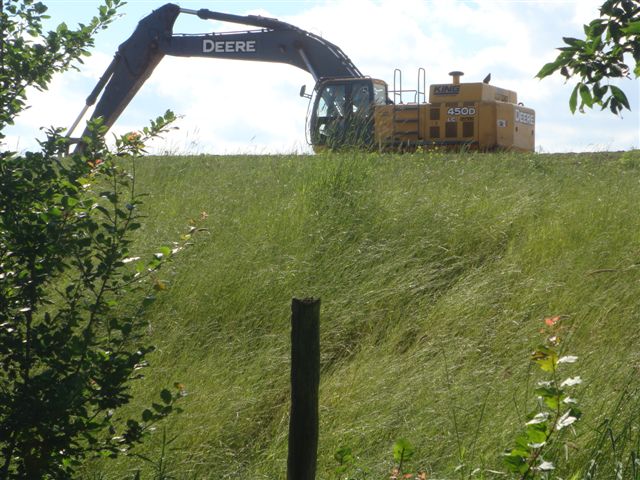 Will this mountain of landfill ever get taken out? It wasn’t until Vanessa Warren formed an organization and went public at both the Regional and city levels that we saw some action on the part of the city. They sent people up and took a look around; the Mayor visited several of the properties and left stunned by what he saw and is reported to have been on the phone to the city manager as he drove out of one property saying he was appalled at what was being done.
The city, to its credit, grabbed this one by the horns and moved quickly and with more certainty and confidence than was ever seen under the term of the previous city manager. When Glenn Grenier, a lawyer representing the Air Park, delegated to city council the city manager advised the Mayor on three occasions during the meeting to send the man packing. Fielding, who is a man you do not want to cross, exchanged words with Grenier in the Council Chamber foyer later. That should have been signal enough for the thickest of mindsets to figure out they had a fight on their hands. But Vince Rossi has never indicated that he took listening very seriously.
Right now he is reading and re-reading Justice Murray’s decision and telling his lawyers to find a hole in the document; give him something to crawl through.
 November 12, 2013. November 12, 2013.
By Pepper Parr
BURLINGTON, ON. It was a report requesting approval to explore new service delivery models and if it gets the approval the city manager is asking for – it will change drastically the way the city is run.
If we don’t change the way we run the city – what we have today is just not sustainable.
 City manager Jeff Fielding: About to put his stamp on the way the city has to be run. The report comes directly from city manager Jeff Fielding’s desk and is the first look we get of his longer term thinking. It is a strong report, it takes the city in a direction it has not been before.
Now Fielding has to debate his ideas with a Council that has never seen anything like this before and there are several members who will have difficulty grasping what Fielding wants to do.
His mission is to identify and report back on opportunities that will support the sustainability and quality of directly delivered services.
Fielding believes he can get this done in a month. He already knows what he wants to do and has the team that will get it done during the next two years already lined up.
City Council has not seen what Fielding is putting before them. The first step of the long term plan took place All Hallows Eve when the Executive Director of the Economic Development Corporation was given his walking papers.
The Economic Development Corporation will hold its AGM in April – expect it to dissolved and become a city department.
Look for the creation of what Fielding calls Enterprise Corporations – free standing organizations that will probably not report to any of the Standing Committees.
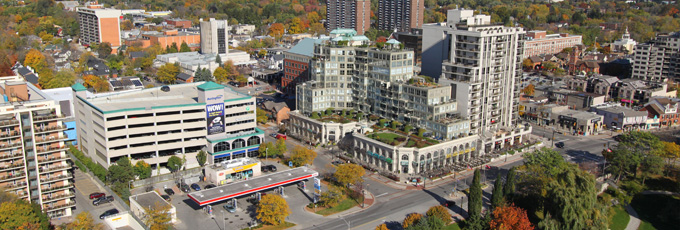 Developers have done a great job with condo creation along the Lakeshore Road. The city has not managed to find a way to get the developers to put some of the economic lands into production. There are five of the things on the “thinking board”.
Economic Development Corporation: This corporation would oversee strategic investment and to potentially hold strategic land assets.BEDC is currently in the process of developing this concept.
Real Estate Asset Management Corporation: This corporation would control civic facility assets to increase asset value and
potentially create a revenue stream (dividend) from increased asset value.The City’s Real Estate Office and Corporate Strategic Initiatives have taken the lead in developing this concept.
Service Based Corporation: This corporation, in partnership with Burlington Electric Services Inc. (BESI) (which is managed under the Burlington Hydro Board), would serve as an in sourced business to operate a select group of services currently managed in-house by each of the parties.
The initial services considered (storm water management, street lighting, tree trimming, right of way access, etc.) and would involve minimal risk to the taxpayers while representing an opportunity to establish and/or enhance existing common or shared services. What this translates into is: should street lighting be a tax supported service? Could the city and hydro create an organization that handles all tree trimming. These are significant changes.
Cultural Enterprises Corporation will not be advanced at this point but you can see where the city is going. This corporation would manage culturally – focused revenue generating businesses.This concept aligns with the theme of the Cultural Master Plan.
The final Enterprise Corporation would focus on energy and would establish and manage the City’s revenue generating energy service delivery model.
For each concept, a comprehensive business case , inclusive of a legal and decision-making framework , will be developed in order to-identify and assess the benefits, costs and risks as well as determine the recommended course of action. Each concept will have a revenue generation and/or cost saving focus, and will only engage in more traditional municipal service functions when it is deemed to be advantageous by Council.
Enterprise Corporations, like other operating models, have inherent advantages and disadvantages. For example, an arm’s-length organization has the ability to act quickly and adjust to market pressures, but on its own, may not be as sensitive to social and/or political issues. Conversely, the City’s current model, inclusive of public engagement, has been successful in addressing wider community issues, but can result in slower decision making.
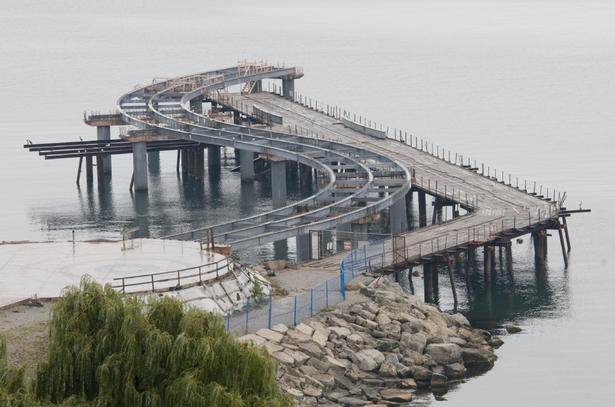 The lesson learned on the building of the pier was the need for a tight working relationship between the builder, the project manager and city hall. If the public ever gets to see just how terrible the relationship was with the project managers they will demand better staffing in the Engineering department. When a second contractor was given the job the city had some top notch people doing their jobs. There is no perfect service delivery mechanism, so it is important to investigate these concepts in order to identify the operating model that offers the “best fit”. What will be vital, when public spending is limited, is a clear understanding of the City’s objectives within a wider social-economic context.
“The evaluation of which service delivery vehicle might best achieve the City’s identified objectives will include an analysis of whether the service is best delivered in-house only, by a combination of in-house resources and a special purpose vehicle (ex. municipal service board) or by an independent development corporation.”
This is heady stuff. What doesn’t appear evident is this: Where is the public input in all this? And why, politically, are ideas like this coming forward when we are less than a year out from a municipal election?
Where is the concept of Community Engagement in all this. We do have an engagement Charter – it’s on a shelf somewhere in city hall.
 Burlingtonians will show up for public meetings and take an active part in any discussion – but they have to be given background briefings and decent opportunity to study and prepare. Fielding doesn’t talk much about public involvement – but he does explain how he will marshal the staff he has and assign them to this task.
Each concept will be investigated in accordance with the following principles:
1.Alignment with the City’s strategic plan and objectives.
2. Preservation of services that are core to the municipality and its citizens.
3. Transparency with respect to the approach, assumptions and risk considerations.
4. Accountability to Council, citizens and identified interested parties.
5. Positive social or environmental impact, or at minimum, socially or Environmentally neutral.
6. Return on investment will be measured by several metrics, with a primary focus on enhanced service delivery and long-term sustainability.
7. Adaptable and flexible to expeditiously take advantage of emergent opportunities.
8. Risk tolerance will be viewed in the context of its position as a subsidiary of the municipality.
9. Legal authority and framework for establishing the service delivery vehicle and its relationship with the municipal council.
10. Conflict of interest considerations.
In order to provide consistency with decision-making and support,a staff resource will be reassigned. This reassignment will be
managed by utilizing a vacant FTE.
To provide context, many private sector organizations have small strategic staff groups that focus on identifying and fostering Innovative growth opportunities; some are referred to as mergers and acquisitions while others may go under the banner of sustainable development. Patterning a small (temporary staff) group on this model would allow the City to coordinate service delivery and corporate services in a new and innovative way.
 Given the depth and breadth of the analysis required, the investigation stage is estimated to take between 18-24 months; depending on staff availability and resourcing. Given the depth and breadth of the analysis required, the investigation stage is estimated to take between 18-24 months; depending on staff availability and resourcing.
All this is going to cost money – however this time Fielding does not have to go to council members with hat in hand. Burlington Hydro is a wholly owned subsidiary of the city and each year it takes its surplus – call them profits – and pays the city a dividend which gets tucked into one of the reserve accounts and used to lower the tax rate. Last year the dividend was $750,000 but it didn’t get put into a fund that would reduce taxes – it was set aside as a sort of piggy bank for the project Fielding is taking to Council on Tuesday.
There is more to this than just some fiddling with the way services are delivered. City hall staff are currently working through a list they call the portfolio – what does the city do for the taxpayers?
 Staff and Council members went through six days of Strategic Plan development in 2011. None of the issues set out in Fielding s report came up in the Strat Plan discussions. does the city have the bench strength it needs on both Council and the staff side to pull off what Fielding says we have to do> It is a bold, new approach to civic administration. Fielding isn’t taking the city through this exercise because he thinks it’s a nice idea. He has come to the conclusion that we must look at the cost of what we deliver and find less expensive ways to do what we do.
Thus those Enterprise Corporations.
One of the ongoing problems Burlington has had is the quality of its relationships with other levels of government and agencies. Fielding maintains Burlington’s approach to service delivery and economic growth will require support from various governmental agencies and officials and local businesses. A dedicated resource in this area has the potential to drive Burlington’s priorities forward by leveraging the relationships with several levels of government and local business. The role of an Inter-Governmental Affairs Officer has the potential to secure support, thereby establishing our platform for growth, and is recommended for consideration. Many thought the Economic Development Executive Director would be doing this job. That didn’t happen.
Staff is in the early stages of investigating opportunities through the potential formation of a targeted enterprise corporation. The intended purpose of the corporation(s) would be to undertake business opportunities that will generate new sustainable revenues and/or cost savings for the City in order to offset the municipal tax levy.
Notice the consistent use of the words “new sustainable revenues” and “cost savings”? Fielding realizes that the tax base we have isn’t going to cover the costs. He will do what he can to cut costs but Fielding doesn’t look like a budget slasher. Council probably wouldn’t let him cut all that deeply anyway – they do need to get re-elected.
 He has already explained to Council that the Industrial Commercial sector is not bringing in what it should be bringing in, in terms of tax revenue. Part of the reason for that is the terrible performance of the economic Development Corporation. Burlington has some serious catching up to do – and we are competing with every other municipality out there for those companies that set up shop and create jobs. He has already explained to Council that the Industrial Commercial sector is not bringing in what it should be bringing in, in terms of tax revenue. Part of the reason for that is the terrible performance of the economic Development Corporation. Burlington has some serious catching up to do – and we are competing with every other municipality out there for those companies that set up shop and create jobs.
Add to that the difficulty the city has had with several of the developers with very large lands holdings that are zoned “economic” The property owners would much rather put housing on that land. They’ve not been able to convince the city to let them do that – so they do nothing. And that is a big “ouch” for all of us.
Buried in all this is a very significant change in customer service. You saw it mentioned in the remuneration report on Council member salaries. There is the suggestion that Council members might not really need the six admin assistants that are in place now – the thinking is that better, more focused customer service at the counters and bigger use of the internet and creating a totally different delivery of information with the e-Gov stuff the city is working on will solve all the problems.
That is pie in the sky bureaucratic thinking. Keeping people who are in touch with constituents and their problems at the right hand of every Council member is much better public service. Watch for the battle that takes place on this one.
Fielding has produced a fine piece of work. Council now has to debate the merits and then it has to bring the public onside. Nothing will happen before the end of the year and come 2014 members of Council move into election mode.
With the decisions the city manager wants Council to make and the direction he feels the city has to go and all the changes that will entail – there is a need for strong public debate.
 November 11, 2013 November 11, 2013
By Staff
BURLINGTON, ON. MP Mike Wallace will be hosting a seminar for young adults aged 18-30 on Thursday, Nov. 14 from 7-9 p.m. at the Burlington Central Library, 2331 New St.
Employment Options for Young Adults will feature four guest panelists representing the financial, health care, manufacturing and food sectors will talk about accessing the job market in specific industries and learn about current hiring trends and what they can do to get the competitive edge and stand out from other applicants.
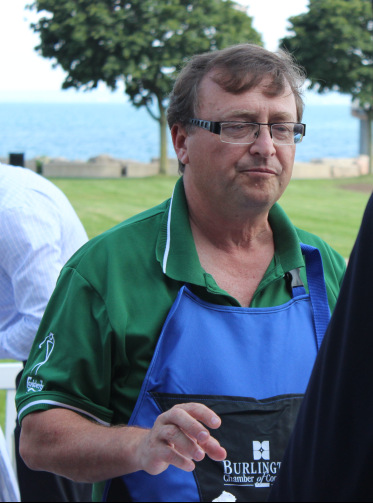 Burlington MP Mike Wallace – flipping burgers at a Chamber of Commerce event. The Region recently held a Job Fair that attracted 800 skilled and motivated job seekers who met with 43 employers from across Halton. Halton Region’s Economic Development Strategy has been successful in attracting new business to Halton but those companies don’t seem to be choosing Burlington as their home base.
The unemployment rate for the Region in the second quarter of 2013 remained historically low at 4 per cent, markedly lower that the region’s five year average unemployment rate of 5.6 per cent and significantly lower than the provincial rate of 7.5 per cent.
There seems to be a data gap in there somewhere – unemployment at 4% with 800 people showing up at a job fair?
 Several of the courses given at the Centre for Skills Development & Training are fully booked months in advance – the students usually know where they are going to be working before they graduate. Wallace get is right when he says: “Employment is integral to a healthy economy.” While job creation has traditionally been seen as a local and provincial responsibility the federal government has come up with a plan that would cost share the training of new people in new jobs. The provinces are suggesting the federal government turn those funds over to the provinces and let them design programs that meet the specific needs of each province.
At least they are talking about training people. With technology surrounding everything we do – and that technology changes almost every 90 days – keeping people fully trained and productive as opposed to just employed is a prime concern.
Co-host for the seminar is the Centre for Skills Development & Training.
For information or to register, call 905-639-5757 or email mike.wallace.c1@parl.gc.ca.
Background:
Training classes:
 November 8, 2013 November 8, 2013
By Pepper Parr
BURLINGTON, ON. Liberal government has decided that if they can’t get the private sector to use the cash hoard they have then they will spend their way of out the mess we got into back in 2008 when Wall Street almost bankrupted the world.
 Charles Sousa, Ontario’s Minister of Finance told the provincial Legislature on Thursday that the government’s economic plan, released today, “makes strategic investments in people and infrastructure to support an innovative business climate.” And just what is an “innovate” business climate? Sounds like corporate happy talk. Charles Sousa, Ontario’s Minister of Finance told the provincial Legislature on Thursday that the government’s economic plan, released today, “makes strategic investments in people and infrastructure to support an innovative business climate.” And just what is an “innovate” business climate? Sounds like corporate happy talk.
The government’s plan “builds on the province’s strengths and the potential of our people and is the surest, fairest way to balance the budget by 2017-18.”
The government maintains that the opposition wants drastic, across-the-board cuts to the vital programs and services on which the people of Ontario rely. “That will harm our economy, not help it. The people of Ontario are worried about the future and they need the support, steady hand and investment of their government.” said the Minister.
“We choose to address our economic challenges by investing in our future: giving individuals, communities and industries the tools and opportunities they deserve. And so in the Fall Economic Statement I announced a number of actions, including:
We will create two new ways to fund crucial infrastructure investments without raising taxes – The Trillium Trust and the introduction of Green Bonds
We will spend $35 billion over three years to modernize infrastructure, creating 100,000 jobs a year
We will work with businesses to identify tools that encourage them to invest their cash reserves in the economy, creating jobs, improving productivity and leading to province-wide growth
We will introduce Ontario’s first ever Seniors Grant to help non-profit community groups promote healthy, active and engaged seniors across the province
We will work to make sure everyone in Ontario can retire with comfort and secure
We will make it easier for Ontario’s small businesses to hire and grow by cutting the Employer Health Tax for 60,000 Ontario small businesses.”
 So what does the Fall Economic Statement mean for you? So what does the Fall Economic Statement mean for you?
It means your government claims that you will have the support you need to care for your families and contribute to the economy. It means communities across Ontario will be safe and strong. And it means Ontario will promote a competitive environment that draws investment and creates jobs.
Might this also mean our government is changing direction and repositioning itself before it goes to the polls for your support.
Let’s see what they can do – but please – actually do something before you ask for our vote.
 November 4, 2013 November 4, 2013
By Pepper Parr
BURLINGTON, ON. October 31st – was not a trick, nor was it a treat for the Executive Director of the Burlington Economic Development Corporation (BEDC) – he was relieved of his keys and his access to the city`s information systems and informed that he was being relieved of his duties immediately.
Kyle Benham has served as the Executive Director of the BEDC for a number of years. He came to Burlington in 2008 from Toronto`s economic development corporation and brought some people with him.
 Kyle Benham, former Executive Director of Burlington’s Economic Development Corporation Benham and the city were never a good fit. The city has not brought in anything significant in terms of new business and has seen a number of major organizations move to what they felt were greener pastures.
There are a number of situations that were being handled by the BEDC, the IKEA file being one that has been badly managed. A replacement has not been announced.
Changes were also made to the BEDC board of directors which is far too large and has a number of organizations that hold seats to protect their interests rather than advance those of the city.
Economic development has been a major blot of the city`s copy book. It may take as much as a year to find the person the city needs to get that train moving. Then there will have to be changes to the department and a strategy put in place.
Will the city keep economic development as a standalone arm’s length operation or will that work be brought in-house and if it is brought in-house which General Manager will oversee the work. These decisions have probably been made – it will just take some time for the city to make an announcement.
The decision to remove Benham was the first necessary step. The only reasonable comment is that it took them long enough.
Now that board has to pull itself together, work hard as a team and begin to make up for the lost time.
 October 31, 2013 October 31, 2013
By Pepper Parr
BURLINGTON, ON. It doesn’t take long to get the gist of Murray Hogarth. If you listen and watch his eyes you realize that Murray did it his way – he beat the big guys, he beat big oil.
He did it through hard work and being very fast on his feet. With a very successful company running smoothly Murray Hogarth was able to turn the whole operation over to two of his sons and use his time keeping a sharp eye on them.
Born in Napanee, raised there – after high school he got himself along the 401 to Kingston where he enrolled as an engineering student at Queen’s University and realized very quickly that wasn’t the road he wanted to travel and switched to Arts & Science but found that all the lab work wasn’t all that inspiring either. Murray realized he was a doer – he needed to be out in the field, talking to people, thinking through his ideas and planning. Murray was probably born a planner.
During his high school years he had an orchestra – 10 piece set up that he used to earn his keep. Blew a trumpet and played events that included his high school and the Ontario Ladies College in Brockville.
 Murray and Diana Hogarth in the sun room of their Lakeshore Road home. Murray`s parents ran a retail operation in Napanee that specialized in gift items and fine china. He worked the shop with his brother when he wasn`t renting the golf club for dances. Murray was probably making money before he was out of short pants.
In `53 he was hired by what was then British American Oil company (they became Gulf oil) and given a territory in Scarborough where he made sure 40 gas stations were meeting their sales targets. Murray soaked it all up and within a year the company moved him to Windsor where it was a much bigger business. He watched over the gas stations as well as farm and industrial accounts.
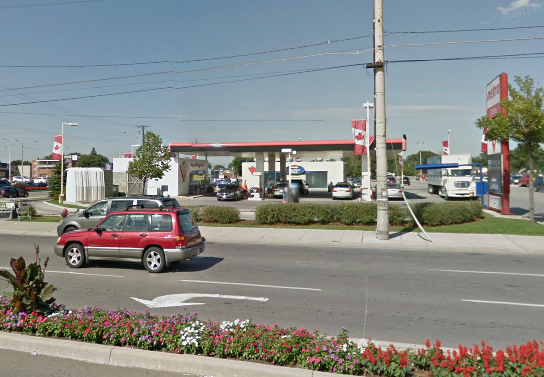 The first Pioneer gas station – it didn’t look like this the day it opened but it has been open every day since November 1956. In those days there were very few individual gas station operators to speak of; everything was run by the national brands – the Americans had private operators but the idea hadn`t taken hold in Canada – yet. One of the corporate accounts Murray serviced was a single station – Beaver, that grew and was eventually sold to Shell Oil. But before that sale took place Murray became a chum of the owner and the two of them tried some of the American ideas – Murray was in the process of becoming the man who would create the most successful private brand oil and gas operation in the country. The only thing they don`t do is refine or run a pipeline operation – yet.
Windsor was a great proving ground for Murray. If you saw an opportunity you were able to go ahead and develop it. The relationship with the Beaver operator flourished. They liked the ideas they saw being developed across the river in Detroit and tried many of them in Windsor. After two and a half years in Windsor Murray began to wonder why he was working for big oil – he made his move.
Every weekend Murray would drive to Hamilton and scout that market. He knew the blue-collar market and he believed he knew how to market to it better than anyone else. He didn’t know a soul in town when he first got there but he knew he needed a market just like Windsor and focused on Hamilton. He found what he was looking for at the corner of Upper James and Mohawk. Murray leased the land, which he later bought and began to build the empire that today has 200 stations in Ontario and a clutch of them in Manitoba where he took over a bunch of Esso Stations.
There was a bit of swamp on the land that Murray was going to build his station on and he knew that at some point he would need to fill that in. Then he noticed a contractor doing some grade work and hauling away the fill. Murray invited the contractor to dump that fill in the swampy land he had leased.
 Murray Hogarth: Reflective and able to focus on pet project with the operation of the gas companies now in the hands of his sons. That Upper James station is still operating – it has never closed since he first opened in November of 1956. It began as a 24/7 operation and has stayed that way. When Murray chose that first Hamilton station the world of gas stations first saw the wily mind of a mater marketer. In those days Upper James and Mohawk were just across the County line – and Hamilton had an early closing bylaw. That first Pioneer station was 150 feet beyond the County line.
Murray saw Hamilton as a market that was small enough for a private operator to be recognized yet big enough for him to grow in. And grow he did. Buying property meant a need for capital or earnings that could pay for the second and third stations.
Murray put his money into property and marketing. In the early days he will tell you gas stations didn’t have canopies over the pumps; Murray put in canopies. Most of the stations were a single island with maybe two pumps. Murray wanted volume so he put in three islands with two pumps at each so that four, six or eight cars could swallow that gas.
Gas stations were pretty bland looking places. Murray brightened them up and because he stays open long hours he put in as much fluorescent lighting as he could afford. He gas station business was never going to be the same.
He put up bunting, flags and offered deals and lower prices. In those days stations carried several brands of oil at different price points. Murray carried several and made sure that the brand with his name on it was the lowest price.
He was the first to put booths with cash registers out where the pumps were so that people could pay quickly and move on – making room for another customer.
He was one of the very first, if not the first, to create a loyalty program that gave customers another reason to return. Car washes were added to the mix.
 Created marketing tools that led the way. The Pioneer loyalty program rewards its customer with cash rebates that are printed on the receipt. Air Miles doesn’t give you that. Growing the business was no slam dunk – there was more than one very close call – three of them in fact , but what kept the chain alive was Murray’s ability to make quick decisions. “I didn’t have a board that I had to meet with”; one gets the impression that Murray Hogarth isn’t all that big on corporate committees either.
Listening to Murray explain the corporate structure and the way he moved two of his sons into the company and gave them increasing levels of responsibility, one assumes the man has an MBA. No, Murray worked from the pit of his stomach and a developed understanding of his customer base. He learned by doing and from his mistakes. He looked for opportunities to give staff all the responsibility they could handle. He was a task master – with a heart.
While retired, it doesn’t take long to see a pair of eyes that don’t miss much and at the same time have that twinkle that tells you – Murray Hogarth did it his way – and he beat the big guys. He did it with a strong, supportive wife who may not have actually pumped gas but she was in every one of those stations in the early days and when Murray leaves out a fact – she is quick to remind him that they acquired a string of stations in Manitoba from Esso.
 Diana Hogarth – five boys and a husband build a business doth a career make. She is also a noted designer. Murray first laid eyes on Diana when she was ten. She was the sister of one of Murray’s best friends. Years later that friend asked Murray to go to a dance with him – Murray couldn’t hustle up a date and the friend suggested he ask his sister Diana. “Ask her just for laughs” the friend suggested and the Murray and Di story began. The two of them, almost in unison say: “and we’ve ben laughing ever since”.
We interviewed Murray and Diana Hogarth in the sun room of their Lakeshore Road home, nicely decorated with good art and sculpture tastefully sprinkled throughout the house. Murray soaks up the sun as he recovers from surgery. With the interview nearing its end Diana gets up to see her guest out and touches Murray on the shoulder asking: “Are you ready for some lunch”.
Today, son Tim is the Chairman and Chief Executive Officer of the company while another son heads up the marketing side.
Arching over the different t corporations is the “family” firm – Pioneer Energy where Murray, Di and the five boys sit as Directors with two outside directors to create strategy and guide everything.
Murray took in part of the Community Foundation celebration last weekend. Recovering (very nicely by the way) from serious surgery, he chose not to give a speech and had his son Tim fill in for him.
Tim was not there to laud his parents. He spoke about giving back to the community and the lessons his Dad had taught him and his brothers.
“Typical of my father’s entrepreneurialism” said Tim, “Murray recognized that while we can’t always predict what lies ahead, we can always make sure we are prepared to seize the opportunity or meet the need when it arises. And that is what this is all about. It’s never too late… philanthropy, as Murray and Diana have proven time and again, has no retirement age.”
Tim had taken up the philosophical torch from his Dad.
Murray was big on giving back to a community that has given to him. His early involvement in growing community was with the Hamilton Community Foundation where he served as president. He reminds people that Hamilton and Burlington didn’t always work that well together. Burlington wasn’t contributing the way some felt it should and Murray got behind a movement to create a Burlington Community Foundation, and was its first president. “I wrote them their first cheque” he adds with a modest measure of pride.
Diana – they call her Di, runs the household and still puts in time at her design business. Do not call Diana Hogarth a decorator – “decorators”, she will tell you, almost dismissively, “paint walls or hang wall paper”. Diana is a designer and if the sun room we met in is an example of her work – there are a number of homes in this community that have been very, very nicely done.
She and Murray raised five boys, two of whom are in the family business. Between them they have 13 children. Gregory, twins Tim and Geoffrey, Christopher and Peter. Tim and Geoffrey are at Pioneer. Peter, Tim and Greg are heavily involved in the franchise business with Wendy’s and Tim Hortons being their biggest operations. Peter is also in the home building business.
Murray and Diana Hogarth were recognized last weekend by the Burlington Community Foundation as the Philanthropists of the Year. The evening they were recognized, the family announced a gift of $1 million to the Joseph Brant Hospital which they gave through the Burlington Community Foundation.
A small room that serves as a bit of an office just inside the front door of their home, that has every inch of its walls covered in either book shelves or pictures that Diana refers to as the “rogue’s gallery”. The pictures capture the boys and their families – there are 13 grandchildren, at the various stages of their lives.
Tim said to the audience at the Masquerade Ball where Murray and Diana were honoured: “We experienced and watched the struggles of Dad and Mom establishing a business and trying to make it work and grow. Our father invested his life savings along with a small loan from his father and brother to get the business started.
 Murray Hogarth with sons Geoff and a representative from the Ontario Federation of Anglers and Hunters “We boys had absolutely no clue of the hardships and challenges our parents faced in trying to make their dreams a reality. Being oblivious can sometimes be a wonderful thing! Somehow it all magically seemed to work out- the business took flight and grew bigger.. but as my brothers and I soon would learn from Dad.. you create your own magic with hard work, passion and a commitment to succeed and the rest will take care of itself.”
“As their sons, we couldn’t ask for better role models on how to live and lead a successful life. Back in the 60’s.. Burlington was a relatively small community and somehow while having to support five boys, a new fledgling business, and pay the mortgage my parents still found time to give to the community and support local causes.
“I remember my mother being very involved in the Junior League as well as launching and chairing the first campaign in Burlington for the Heart & Stroke Foundation and actively canvassing many evenings and weekends.”
“Regardless, of the challenges they faced as the years went by they always supported their community and that philosophy infected us. Murray explains that the Masquerade Ball was the occasion he used to pass the torch to his sons. I showed them how it’s done – now I expect them to lead in their own fashion.”
Today, the Burlington Community Foundation manages $7.5 million, with 67 endowed funds from individuals, families, corporations and agencies. It has granted over $1.6 million, and touched over 41 charities and non-profit organizations in the past twelve months. That is success by any measure! And that is how a gift of $100,000 can multiply.
Former Burlington Mayor Rob MacIsaac put it very well when he said that first $100,000 “really sparked a coming of age for philanthropy for our city… and demonstrated a level of leadership that paved the way for many donations since.”
For the Hogarth’s the question they ask about philanthropy is: “Isn’t that why we’re here? The welfare of our community, of others, IS our concern. It is not a burden, but an opportunity.”
‘Why not share is a question worth asking yourself. Business is not just all about making money. Although, critically important, it is not how you create value. Money is the offshoot of value – not the cause of it. That is something both my parents have always believed in.
 Murray Hogarth: Can you see the twinkle in his eye? He did do it his way. They gave through the Hamilton Community Foundation, which Murray eventually chaired. And went on to help establish the Burlington Community Foundation and then the Napanee Community Foundation in Murray’s original home town with his brother Don.
And they set up the Pioneer Energy Foundation and Pioneer Energy Fund in 1999 as projects to mark Canada’s Millennium.
As Murray puts it: “This public / private foundation model is an efficient way for businesses and families to give back in perpetuity to the areas and projects of their community where there is the most need, both now and in the future.”
And that’s the key: “in perpetuity”. It’s the gift that keeps on giving, keeps on benefitting the community. It ensures “sustainability”.
That’s when Murray Hogarth’s quiet smile builds up. He did it his way and it worked. His boys will now carry the torch – expect it to burn as brightly in their hands.
 October 28th, 2013 October 28th, 2013
By Pepper Parr
BURLINGTON, ON. It’s that time of year again – Halloween yes – but much more interesting is the Annual Art in Action Studio tour which this year will include 29 artistes in eight locations.
 This Studio Tour event is now in its 11th year. There are some of the old standards and at couple of places that might better be given a rest but this is still very much a superb opportunity to get out and see what the city’s arts community has to offer. This Studio Tour event is now in its 11th year. There are some of the old standards and at couple of places that might better be given a rest but this is still very much a superb opportunity to get out and see what the city’s arts community has to offer.
 Premier Arts event for November in the city. Not to be missed. If this event is one that you’ve done in the past there is an opportunity to see the growth in artists you’ve watched and see how they have perhaps grown and changed.
There are two we have been watching and appreciating the changes, the growth and the new directions they are going in. Last year there were a few that weren’t on the tour and we missed them.
The tour lasts two days. You will find yourself bumping into the same people at different locations and striking up friendships and talking about what you saw that you liked.
November 2 and 3.
 A Helen Griffiths piece. This artist continues to both surprise and delight. Art in Action runs the Studio Tour which gives artists exposure which never hurts. The organization also has a scholarship is gives each year. Last year $1,500 went to Michelle Nguyen, a Robert Bateman High School graduate studying landscape architecture at the University of Guelph.
 Fratesi has pieces at the Burlington Art Centre where her work can be rented from the Art Bank Cheryl Goldring and Don Graves handle fundraising for the group which pay for studio tour advertising and scholarships.
New to the Studio Tour this year are: Tamara Kwapich (Studio 5), Lois Shaw (Studio 6) and Donna Fratesi (Studio 1) and Rachel Quinteros (Studio 4)
 October 29, 2013 October 29, 2013
By Pepper Parr
BURLINGTON, ON. The four Burlington Rotary organizations in Burlington got trashed by local media and people involved in the Santa Clause parade when all they did was advise the parade committee that they were changing their priorities.
Burlington’s four Rotary Clubs have put up $1250 each year for the past ten years to support the annual Santa Claus parade that is organized by a citizen’s committee chaired by Gunther Kaschuba. The parade committee says they were blindsided – the Rotarians didn’t see it that way and will be dealing with the parade people in due course.
Rotary pays full freight for a float of their own in the parade plus putting a cheque for $5000 on the table each year. In the past they have asked for some corporate recognition as Rotary moves forward with plans to enlarge their membership and re-focus their projects.
 The Santa Claus parade has taken place for more than 45 years in Burlington. Organized by a citizens group that works out of the city’s Festivals and Events office it is the premier holiday event in the city. The elves have got a spot of trouble to manage with one of their benefactors this time around. Like any organization, Rotary continually looks at its program and reviews the effectiveness of what they are doing. They apparently came to the conclusion that the Santa Claus parade was no longer part of the way they wanted to interact with the community. Rotary has yet to issue a statement. Because there are four different groups in Burlington – it is not always easy to come up with a single voice but the message to the Santa people was that the end of their participation had arrived.
One might quibble that perhaps more time could have been given but the parade organization, which has never issued a financial statement that we are aware of, has in the past been somewhat high-handed with the way they manage the event.
 Colorful to say the least. For Rotarians right relationships are paramount and, after listening to a number of people, one gets the impression that there was more wrong than right with the way the Santa parade people managed one of their biggest benefactors.
The parade will take place Sunday, December 1st beginning at 2:00 pm at the intersection of Prospect and Guelph Line. Somehow the financial problems will get worked out. Remembering to thank people for their contributions and not to take them for granted is one of the life lessons most of us get at our parents knee.
 October 27, 2013 October 27, 2013
By Pepper Parr
BURLINGTON, ON. It was a SOLD OUT event. No numbers yet on exactly how much was raised but the auctioneer was really busy for a part of the evening.
 Angelo Paletta worked the room of the Burlington Community Foundation Masquerade ball like a politician running for office. It was a fun night where Angelo Paletta, this year’s Patron for the Burlington Community Foundation annual fund-raiser, worked the tables so well one might have thought he was running for office.
 There were there to dine, to dance, to raise additional funds and just have a good time. The setting made all that possible. The Burlington Convention Centre was very nicely decorated with the event where the masquerade theme dominated.
The evening was part social, part fund-raiser and the occasion when Murray and Diane Hogarth the Philanthropists of the year were celebrated and honoured for what they have given back to the community.
 This wasn’t an occasion to take name of identify the “usual suspects” but a time to catch people in an environment they are comfortable in. Deals and conversations are always part of the social mix. The Burlington Community Foundation is an organization that works on several levels for the city. Besides holding a boffo ball – it has a structure that serves the people who want to donate some of the wealth and their talent to the community. The Hogarth’s are the first couple recognized as philanthropists in Burlington and they are the fourth to be so honoured. Predecessors were: Don Smith, Kevin Brady, Doug Leggat and now Diana and Murray Hogarth.
The Foundation collaborates with individuals and corporations to build endowments, give grants and connect community leadership. There are currently more than 55 funds overseen by the Foundation with Donour Designated, Donour Advised, specific fields of interest; scholarship based and unrestricted funds.
Philanthropy is not just people giving money – it is service to the community where talent is as relevant as the size of the cheque that might be written.
Each year the Foundation produces a Vital Signs report setting out where the city is on a number of different socio-economic levels and highlighting areas of specific concern to the community.
 That is a great smile! Mental Health was highlighted as a very serious concern and one that will be given more attention through a Roundtable the Foundation will sponsor in the New Year.
There are other organizations that use the Foundation to distribute funds into the community. The Halton Heros leave the funds they have raised with the Foundation and have the organization deliver the funds when there is a need. The service allows an organization to focus on fund raising and not get bogged down with the investment and management of the funds raised.
 How two women can have a conversation and ignore a Bobby Orr sweater defied understanding – well male understanding anyway.  When it came to bidding for items it was clear this woman knew what she wanted.  Foundation Executive Director Collen Mullholland makes sure the event Patron Angelo Paletta stays on track  Fist full of dollars. One unique auction item was a high end purse stuffed with cask. The winning bidder got the purse and a tax receipt for the cash which went to the Foundation.  He needed just that much more – and the deal might have been done or perhaps it was just that much more for the golf ball to go into the hole. We will never know which.  A ball is a social event – where people spend as much time walking as they dancing and dining. Gives everyone a chance to check out the gowns as well.  You dance with the person who brought you – and dance they did.  Do the masques hid the beauty?   This wouldn’t be a Burlington organization if there wasn’t an invitational golf tournament as well. The Foundation distributes funds to an extensive list of organization including ArtHouse, Bay Area Restoration, Bruce Trail, Burlington Art Centre , Canadian Mental Health Association, Conservation Halton Foundation, Danielle’s Place, Easter Seals, Food for Life, Habitat for Humanity, Halton Food for Thought, Reach Out Centre for Kids ROCK, , Start2Finish and the YMCA. This wouldn’t be a Burlington organization if there wasn’t an invitational golf tournament as well. The Foundation distributes funds to an extensive list of organization including ArtHouse, Bay Area Restoration, Bruce Trail, Burlington Art Centre , Canadian Mental Health Association, Conservation Halton Foundation, Danielle’s Place, Easter Seals, Food for Life, Habitat for Humanity, Halton Food for Thought, Reach Out Centre for Kids ROCK, , Start2Finish and the YMCA.
Later in the week the Foundation will announce what was raised and move on to the next project which in a few short months will be the Roundtable on Mental Health and the impact that is having on our community.
We asked Ashley to cover the Masquerade Ball, seen as the premier social event in Burlington, where the funds raised go to the Burlington Community Foundation.
One table insisted on posing for the camera – something we don’t do much of. We prefer to catch people as they are rather than what they want the camera to see. But this bunch of happy campers had bid on a Bahamas Cruise and invited our photographer to tag along and do an expose on the crowd. This might be a Burlington Ashley Sloggett could get used to
 A night out doesn’t mean the home front doesn’t have to be looked after – this couple work the phones – perhaps to determine just where the kids are. I’ll call this one – you call that one.
 October 24, 2013 October 24, 2013
By Pepper Parr
BURLINGTON, ON. You know that culture has some traction in Burlington when city council members ask what a Poetry Slam is and when Councillor Jack Dennison suggests the he might even drop by the Black Bull on Guelph Line and hear how Tomy Bewick, a construction worker delivers his message.
Bewick runs the Burlington Poetry Slam, an event most Councillors knew absolutely nothing about; yet it is an organization that has been given a Canada Council grant to bring together Slam poetry artists from across the country. In Burlington, whoda thunk?
After a close to brutal session at the Regional offices in Oakville where council members took part in a vote that marked the beginning of the end of the Beachway Park community, council met in Burlington to discuss the basics of a Cultural Action Plan and then decide what they wanted to do.
 Teresa Seaton, center, organizer of the Art in Action Tour, thinks through a response at one of the Cultural Action Plan sessions. She is one of 250 people organized as an Arts and Culture Collective in Burlington. They didn’t make any decisions – it was far too late and everyone was far too tired to be able to make sensible decisions, but Burlington did get to see the outline of a community that few really knew existed. The Arts and Culture Collective, a group of more than 250 people organized on-line, didn’t really know each other but they have become a voice and they want a seat at the table where the decisions are made. Nine of their members delegated and laid out their aspirations for a Cultural Action Plan. They have certainly “informed” the plan the city wants t create but there is still some distance between the bureaucrats and the artists.
 The Collective had done their homework – they knew what they wanted – now to actually get it – that’s their challenge. The delegations were listened to, heard and engaged. This is not something that happens for many delegations at our city hall. All too often Council members sit there close to mute as people take their case, their concerns and their hopes the city’s leaders. That wasn’t the case Wednesday night.
Organized as the Arts and Culture collective in July the thing grew from some 20 people who took part in the first meeting to the 250 people who exchange thoughts and ideas on-line and have learned how to deal with city hall and bring about changes.
The process began a couple of years ago when the city hired Jeremy Freiburg to prepare a report on just what Burlington had and didn’t have going for it in terms of culture. Everyone knew about the newly minted Performing Arts Centre and everyone knew about the Burlington Art Centre but few of the many ever went to the place to look and see and feel the art over there.
Freiburger’ s report dug up all kinds of data on where Burlingtonians spent their cultural dollars – far too much of it gets spent outside the city. He mapped where people go and how much they spend. He told us what people wanted in terms of culture.
What he revealed was a city that really didn’t have a solid cultural tradition. We saw a city that chooses to go elsewhere for its culture and entertainment, partly because, they feel, there isn’t anything they like here.
Some thought Freiburger was going to deliver a set of recommendations on what the city should do next – but he chose not to do that. Instead he gave them the data they needed to begin to figure out what they want to do.
And that is when the Collective began to form. The people who met, first wanted to be able to do their art here in this city and not have to go to Hamilton or Toronto – but there was no place, no space, nor any expectation, that there was indeed a local arts community. The city didn’t know they were there and they didn’t know each other.
The group – the Collective – had surfaced and is telling the city that they are here and they want to be involved.
 The artists came from every possible discipline. They met to talk through what the city should include in its Cultural Action Plan – then they had to figure out how to actually control that plan once it’s established. Artists don’t march to the same drummer that the rest of us do – schedules and rules aren’t their strength and it was difficult for the collective to pull together a large number of people.
Because many of the artists were working by themselves they didn’t know many of the people who were doing the same thing. Trevor Copp, who ended up being the leader/spokesperson for the group came up with the idea of holding a Speed Dating event at a local pub. The idea was that people would gather and sit with others for a couple of minutes and then move on to another table and meet someone else. Such is the state of relationship building in this world. It was a good idea, novel and it had the potential to work. But very few people showed up. Copp didn’t miss a step – he chose to see the upside, the bright side and pulled together a meeting that saw less than a dozen people talk about what they wanted in the way of an arts community.
That conversation will get reported on at greater length at another time – what we saw was a group that is thinking this through and while the plan is still in the formative stage city hall now has to work with people who are the arts community – we just didn’t know they were there.
Bureaucrats being bureaucrats they decided to have Copp become part of the Steering Committee that was to fashion a plan out of the data the Freiburger report provided and once a plan is in place, put together a schedule and time frames to implement it.
One of the major beefs the artists had, was that there were no artists on the steering committee. The addition of Trevor Copp and Rosanna Dewey to the Steering Committee that had people who administer funds but didn’t “do” art was a significant step. The challenge now is to ensure that Copp and Dewey don’t get co-opted and turned into bureaucrats. Power can be very seductive.
Dewy is an artist in her own right and part of the Burlington Fine Arts Association, which has a temperament quite a bit different from that of many of the members of the “collective”.
That there is a change taking place in the cultural temperature of the city is evident. Freiburger maintains that the change began with the unveiling of the Spiral Stella outside the Performing Arts Centre – debatable. One of the occasions that signaled the change was the “No Vacancy” event that took place at the Waterfront Hotel.
This was “avante garde” for Burlington and while the event lasted less than four hours and experienced a small loss it brought out people who hunger for depth and maturity in their cultural menu – the No Vacancy – which will take place again next year, showed that it can happen in Burlington and is happening in Burlington.
 Performing Arts Centre Brian McCurdy makes a point with the Mayor. He is making points all over the city as he brings about a different working relationship with the Centre and the city. City Hall and the Tourist people see the arts as something that could perhaps attract people to the city. The Executive Director of the Performing Arts Centre has been in town long enough to have figured out what we have and don’t have and has already shown that his institution is able to be flexible with the performance community.
All good signs – but like a great recipe, there is something to the way you flick the rest to get that meal on the table and make an occasion to be remembered.
Council will meet early in November to get down to the nitty-gritty of spending money – and at the rate this council is spending the artists had better move quickly or there won’t be any left.
With a little luck the artists will be at the table helping people whose experience is in parks and recreation learn how to move beyond swimming schedules and volleyball games to events that stir the soul. Mind you, watching Maurice “The Rocket” Richard put another one past a Toronto goal tender is certainly something to stir the soul.
|
|