 By Pepper Parr By Pepper Parr
May 7th, 2026
BURLINGTON, ON
It has taken longer than expected, but the public will get to hear what the developers have planned for the property at 1200 King Road.
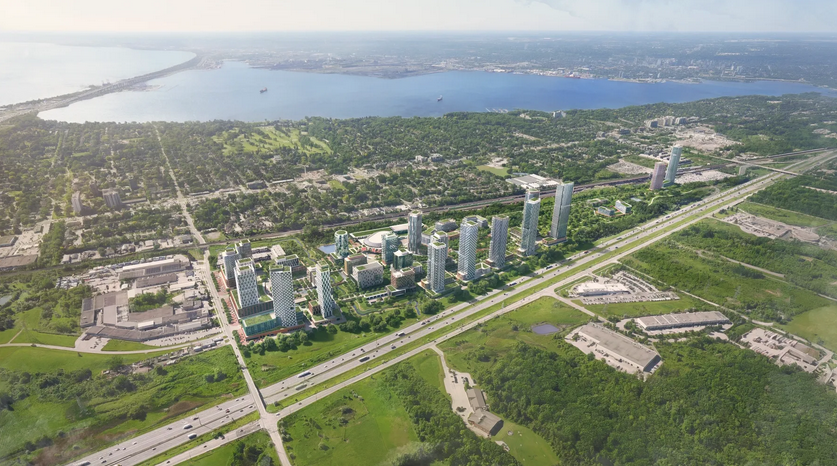 Rendering of the Alinea Development: Bound by King Road on the East; Aldershot GO station on the west; Highway 403 on the north, and the railway tracks on the south. The Alinea Group is proposing:
to amend the Official Plan and Zoning By-law for the lands located at 1200 King Road to permit a mixed use development consisting of 26 development blocks including: four mixed use development blocks, an entertainment block, three educational blocks, six residential blocks, a park block, two natural heritage system blocks, three blocks associated with Indian Creek, two storm-water management pond blocks, one landscape buffer block, two MTO property line blocks and one future development block.
- Official Plan Amendment: 505-03/26
- Zoning By-law Amendment: 520-04/26
Benjamin Kissner is the city planner on the file.
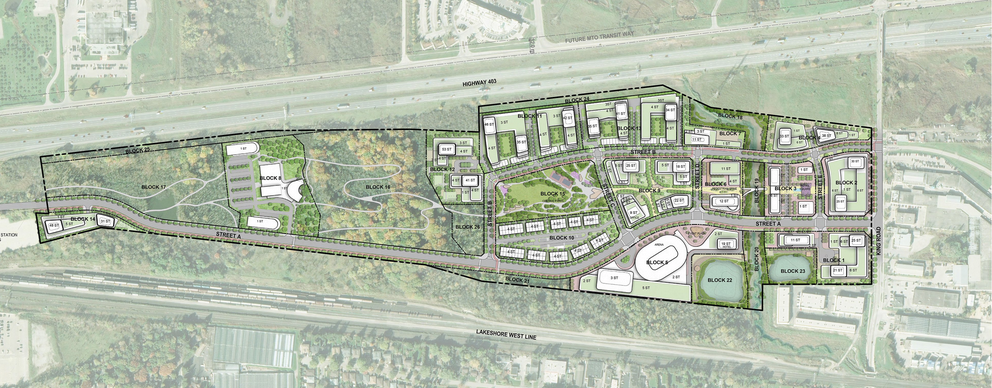 Planned street locations and boundaries for the many development blocks that will be created.
The Statutory Public meeting will take place on June 9th, at City Hall
426 Brant St., Burlington, ON L7R 3Z6
905-335-7777, ext. 7913
- Official Plan Amendment: 505-03/26
- Zoning By-law Amendment: 520-04/26
The renderings are conceptual at this point.

 By Pepper Parr By Pepper Parr
May 6th, 2026
BURLINGTON, ON
An update on who is running for office.
Slim pickings at this point – a lot of retreads from past elections
Running for Mayor:
Lisa Kearns
Rory Nisan
No firm word on what Mayor Meed Ward plans to do.
Running in Ward 1:
Kelvin Galbraith
2022 election results:
City and Regional Councillor- Ward 1
Name of Candidate Votes
Kelvin GALBRAITH 4155 Elected
Robert RADWAY 240
Radway has advised the Gazette that he has an appointment to meet with the City Clerk later this week. Radway ran against Gailbrath in 2022
Running in Ward 2
Masha Brar
Gary Carr
Running in Ward 3:
Tony Brecknock
Brecknock ran in ward 4 in the 2022 election
2022 Election results
City and Regional Councillor- Ward 4
Name of Candidate Votes
Tony BRECKNOCK 1833
Olivia DUKE 1748
Shawna STOLTE 3591 Elected
Eden WOOD 467
Running in Ward 4:
Chris Carter
Olivia Duke
Email: olivia@oliviaduke.ca
Website: oliviaduke.ca
Shawna Stolte did say she would be just a two-term Council member when she first ran in 2028. She has said that she plans to run in 2026 but has yet to actually file nomination papers.
Running in Ward 5:
Paul Sharman
Phone: 905-320-7467
Email: paul@paulsharman.ca
Running in Ward 6:
Osob Adus
No detail for this candidate
Angelo Bentivegna
Phone: 905-973-6923
Email: angelo.bentivegna@gmail.com
Rowen Fraser
Email: rowen@rowrowforcouncil.com
Website: rowrowforcouncil.com
 By Pepper Parr By Pepper Parr
May 5th, 2026
BURLINGTON, ON
Correction: The original headline was incorrect. It has been replaced.
It was an occasion for the students at MM Robinson High School to both share and hear the story about a former school principal, Melville Marks Robinson, popularly known as “Bobby”, who is recognized as the founder of the Commonwealth Games.
The students gathered in the gymnasium with more than 250 seated on the floor as the occasion began when a piper entered the gym.
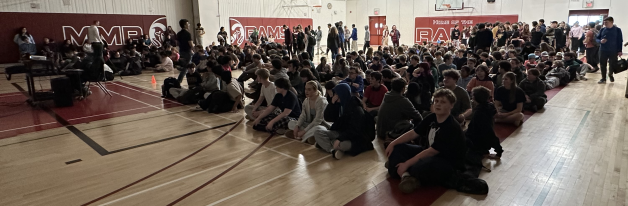 MMR students gather in the gymnasium to hear about the Games. The school is named after Melville Marks Robinson, the man who created the idea for the Games. They were told about two statements “Bobby” always pressed upon people:
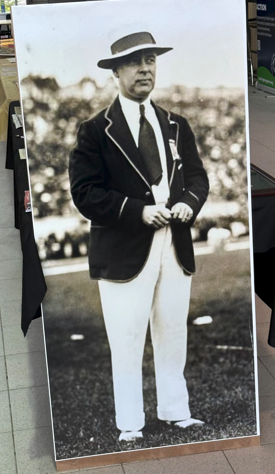 “Bobby” Robinson keeping a close eye on what is taking place. Believe in yourselves and believe in your dreams.
It was his dream that resulted in the first-ever games held in Hamilton in August of 1930. At that time, they were known as the British Empire Games.
There were six sports: athletics (track and field), boxing, lawn bowls, rowing, swimming/diving, and wrestling.
Eleven countries took part in the 59 events that involved 400 athletes who were billeted in the Prince of Wales School next to the Civic stadium, where they slept two dozen to a classroom. The participant nations were Australia, Bermuda, British Guyana, Canada, England, Northern Ireland, Newfoundland, New Zealand, Scotland, South Africa and Wales.
The Hamilton Games ran at a cost of $97,973.00.
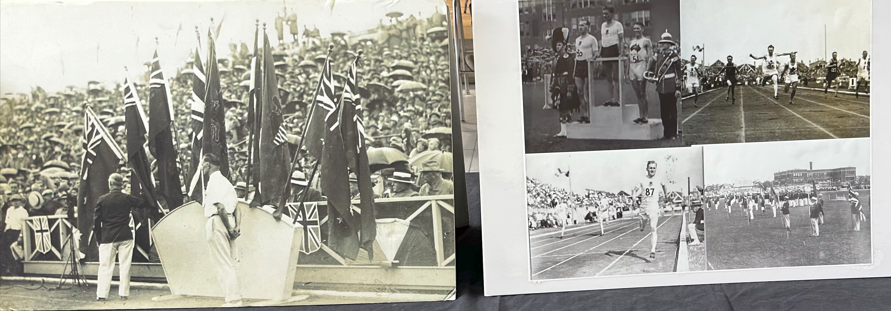 Left: Crowds watching the games in rainy weather. Right: Some of the sports taking place. The podium used to present the medals was first used at the 1930 Games. It was later adopted as a practice in the Olympic Games.
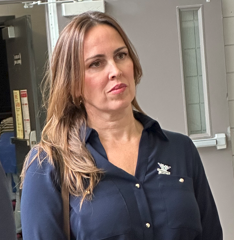 Claire Carver Dias Claire Carver Dias, current president of Commonwealth Sport Canada, has been active in the games both as a participant who won two gold medals in synchronized swimming at the 2002 Commonwealth Games.
She describes the games as friendly, focused on excellence, inclusion and human rights – Sports with a Social Purpose.
The Social Purpose is seen as an organization that is:
- First International Games to achieve Gender Equality, with more medaling events for women than men.
- First, and only, international Games to have a Reconciliation Action Plan, respecting and celebrating Aboriginal cultures and leaving a lasting and meaningful legacy through employment and training and procurement.
- First, and only, international Games to integrate a Para-Sport program as full medal status.
- First International Major Games franchise holder to embed Human Rights across all operations and programs
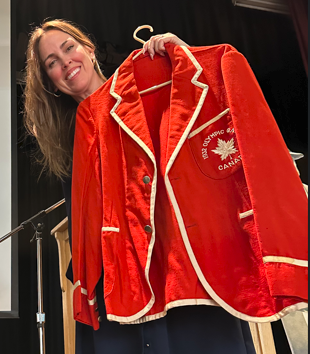 Claire Carver Dias holding one of the jackets worn by officials at the 1930 and 1934 Games The Commonwealth Games are seen as a clean sport. There isn’t any negative comment about the Games. Athletes are not automatically awarded prize money for winning medals. Any monetary rewards are provided by individual countries, their National Commonwealth Games Associations, or governments, which vary significantly.
 Lou Frapporti Lou Frapporti was the Host and organizer of the event that took place at MMR on Tuesday and for the commemorative event that will take place on Wednesday at the Gazebo in Spencer Smith Park.. He was part of the group in Hamilton that worked to bring the 2030 games to the city. The provincial government chose to financially support the FIFA games, which meant the Commonwealth Games for 2030 will be held in India.
When asked: Why put so much personal time into commemorating what happened almost 100 years ago, Frapporti said: “To me it is about community. People see what has been done in the past and bring those values forward to become part of the society we have today. “Bobby” Robinson was a remarkable human being who made something happen. We can’t just let that history, his achievements, drift away.
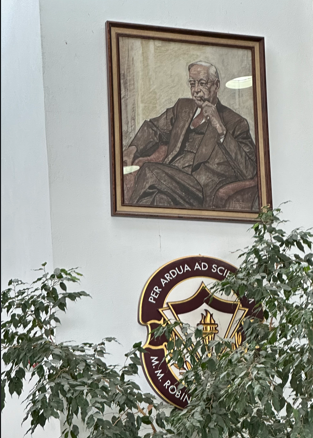 Melville Marks Robinson At the end of the day, as the students drifted back to their classrooms they knew a lot more about the man their school is named after. As a model of giving back to the larger community is all about is as good as it gets.
When students glance up at the painting high up on the wall overlooking the main foyer, they can reflect on what leadership is.
Is there a future for the Commonwealth Games?
The world certainly needs this kind of organization. The 74-member nations aren’t a United Nations but it is succeeding what it set out to do. The Games were always aligned with the British Monarchy, which didn’t look as if it had all that much hope when Prince Charles became King Charles III. He wasn’t seen as showing all that much promise until very recently, when he was in the United States and did a superb job of handling President Trump without creating a diplomatic incident.
Is there a future for the Commonwealth Games in Canada?
There is if Claire Carver Dias keeps doing what she is doing. Calgary expressed an interest. Could the Games return to Hamilton at some point? Expect Lou Frapporti to become the strongest advocate.
Something to keep in mind. There is a strong movement in Alberta to pull out of Confederation, and Quebec always seems to want to leave.
We will have a new Governor General soon. Louis Arbour might find that a slightly tighter relationship with the Monarchy could be something that helps keep the country together. Mark Carney and King Charles are close friends.
Having the Commonwealth Games in Canada in 2034 is something people will begin to think about.
 By Pepper Parr By Pepper Parr
May 4th, 2026
BURLINGTON, ON
If you want to understand just how much damage social media can do – read on.
Writing in a column for the Toronto Star, Susan Delacourt said:
It could be easy to get complacent about a looming Alberta independence referendum — polls show that most Albertans prefer to remain in Canada and hey, we’ve had referendums before in Canada, including two on Quebec independence.
 The referendum in 1995 was a battle to keep Quebec in Canada but also to keep Canada a multicultural country. But those referendums were held before social media and other data-management technology paved the way for rampant disinformation and privacy compromises. They were also not held in the shadow of Donald Trump, whose own national security strategy, published earlier this year, claimed the right to interfere in politics of the Western Hemisphere to assert U.S. dominance even outside its borders.
Last week, CSIS reported that foreign interference in Canadian democracy is very much alive and growing ever more complex each year. The report didn’t flag anything substantial coming from the U.S., but is anyone ruling that out?
 The Alberta Separation referendum has given US President a wedge that he can use to achieve his 51st state dream. Earlier this year there was a flurry of attention to what Trump could get out of Alberta independence, when it was revealed that Alberta separatists had held meetings with people close to the White House and when U.S. Treasury Secretary Scott Bessent said openly that Alberta is a “natural partner” for the United States.
But that attention kind of died down until late last week with the news of this data breach.
Carney is right to be deeply concerned. It has been said that Alberta independence was much on his mind when he embarked on what’s known as the memo of understanding on pipelines and climate with Premier Danielle Smith’s government.
We also shouldn’t forget that Carney lived through the Brexit drama when he headed the Bank of England, and saw how quickly a separation movement took off, even as people were saying Britain would never leave the European Union.
 The United Kingdom has yet to recover from the Brexit experience. Carney likely knows that an Alberta independence referendum, in this day and age, would bear more resemblance to Brexit than any of the Quebec sovereignty votes of the past century. He would also have some vivid memories of the role that data played in that vote, notably by the Cambridge Analytica firm (which also helped in Trump’s 2016 victory, for those who may have forgotten.)
Canada does have foreign influence watchdog now after the initiative was stalled for years. His name is Anton Boegman, and he’s a former chief electoral officer in British Columbia.
Earlier this year, Boegman told CBC News that he believed his mandate extended to provincial politics too, including referendums held there. Alberta could be the first big test for him and his office. And the Centurion leak, we can hope, is a big warning flag for what he — and this country’s unity — could be up against.
 By Gazette Staff By Gazette Staff
May 4th, 2026
BURLINGTON, ON
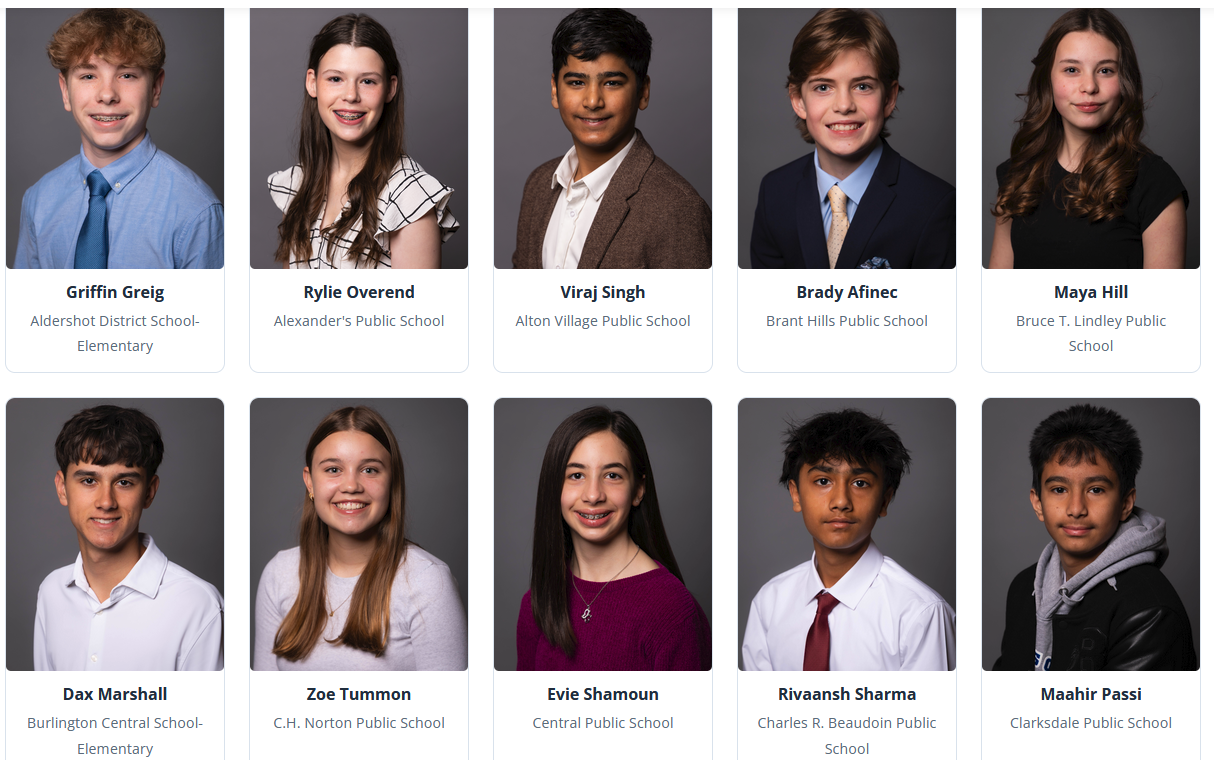
The Halton District School Board is proud to recognize the success of 109 students at the 42nd annual Celebration of Student Excellence event at Dr. Frank J. Hayden Secondary School (3040 Tim Dobbie Dr, Burlington) on Thursday, May 7 at 7 p.m. Each year, one student from each HDSB elementary and secondary school is honoured for their excellence in self-improvement, enhancing the school and/or local community, citizenship, student leadership, academics, vocational studies and specialized programs or extra-curricular activities.
Friends and family are invited to celebrate by viewing the livestream of the event which will be available on the HDSB website (hdsb.ca) on Thursday, May 7 at 7 p.m. A recording of the event will remain online for families to view afterward.
For more information including a list of recipients, visit the Student Excellence Awards webpage.
“As we recognize the accomplishments of these 109 students during Education Week, we are reminded of the lasting impact a strong educational foundation has on a student’s future,” says Curtis Ennis, Director of Education for the Halton District School Board. “Our Students of Excellence have demonstrated outstanding leadership, citizenship and academic achievement – qualities that will support them well into the future. It is inspiring to see our 2024-2028 Multi-Year Strategic Plan come to life through the dedication and efforts of each recipient. The HDSB is proud to celebrate your achievements and the difference you are making in your schools and communities.”
The Elementary School Students recognized for their Excellence.

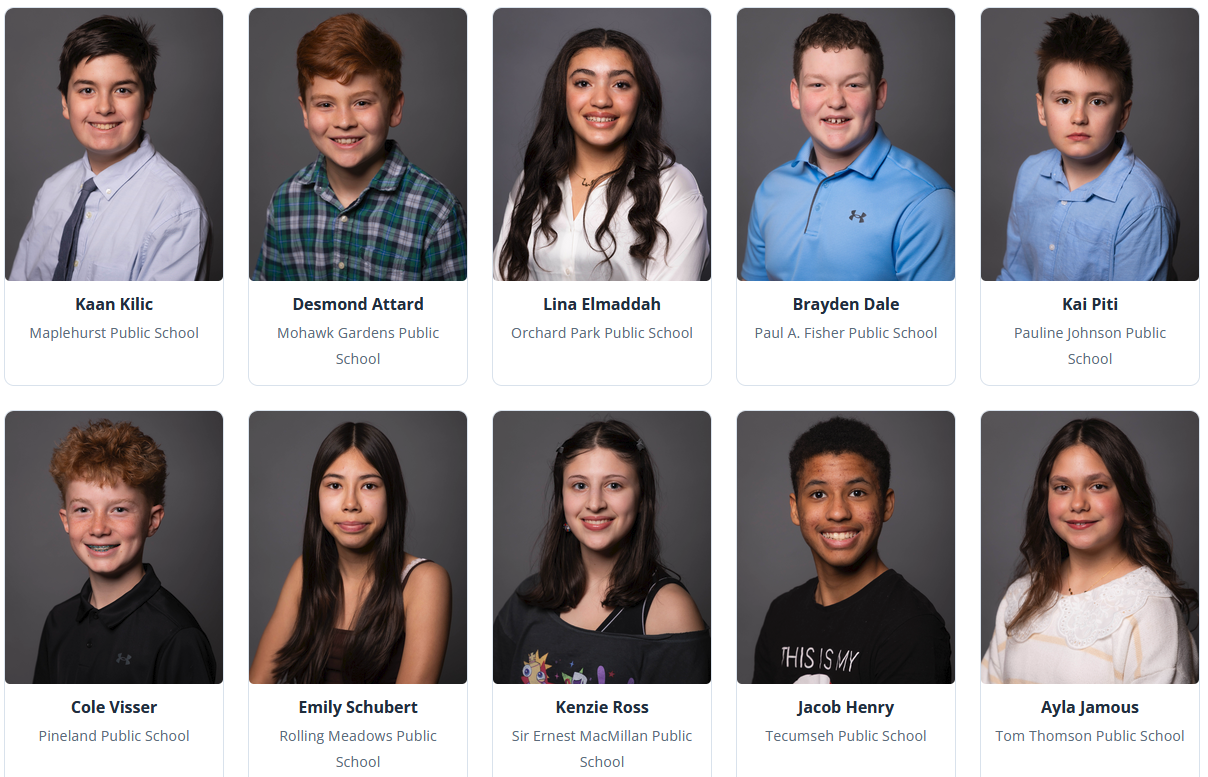
The Secondary School Students recognized for their Excellence.

As you peruse the faces of these students, you can see just how diverse the population of the city has become.
By Gazette Staff
May 5th, 2025
BURLINGTON, ON
 Current Regional Chair decides to run for a Burlington City Council seat. Gary Carr, the current Chair of the Halton Regional government, filed papers yesterday to run as a candidate for Ward 2 seat in Burlington.
Some might wonder why Gary would leave a higher level of government to serve in a lower level.
The reason is that the job he currently has is expected to disappear when the provincial government names new Directors to lead the Regional governments across the province.
There are different views on Carr serving at the municipal level. Should he win the Ward 2 seat he would bring a tremendous deapth of experience to the job.
 Brad Harness Brad Harness, publisher of the Burlington Independent was expected to file his nomination papers. No word yet on what he will do
Sean Campbell, Founder of Burlington Helping Burlington, was talking about running for the seat as well.
We will look to them for comment.
By Sadie Smith Smith
May 5th, 2026
BURLINGTON, ON
You already tap, transfer, and pay without thinking about it. Digital payments now handle most transactions in Canada, but the system behind them still runs on a mix of old and new. The gap between how people pay and how the system works is where things are changing fastest.
 Tap at the counter, send an e-transfer, pay a bill online; it has become routine for most people. Most payments in Canada now happen without cash. Tap at the counter, send an e-transfer, pay a bill online; it has become routine for most people. The scale is large. More than 23.3 billion transactions moved through the system last year, with total value reaching $12.7 trillion. In Burlington, it is just how things get paid for now, whether it is a coffee, splitting a bill, or sending money from a phone in a few seconds.
What People Are Actually Using Right Now
The numbers show where things stand. Credit cards account for about 34% of transaction volume, debit cards sit close to 30%, and account-to-account transfers make up roughly 15%, with cash now down near 12%. That mix matters because it shows there is no single system running the show. Cards still carry most of the load, but transfers have moved well past the point of being a backup option.
Interac e-Transfer has become part of daily use. Rent gets paid that way. Small business invoices get settled that way. People send money between each other without opening their wallets. That changes expectations. Speed is no longer a bonus; it is built into the way transactions work.
Local Services Start Following the Same Logic
City services are starting to move in the same direction. Burlington is planning a two-year on-demand transit pilot that leans on app-based booking, route adjustments, and real-time data to decide how vehicles move. The idea is simple: respond to what people are doing rather than forcing them into fixed routes.
That approach lines up with how payments already work. You do not wait for a batch process to clear or a system to catch up. The action happens first, and the system adjusts around it. Transit, billing, and payments are starting to operate on the same expectation, which is immediate response with minimal friction.
Businesses Still Run a Hybrid System
 The consumer side has moved fast, but the business side shows a more balanced picture. About 89% of Canadian businesses accept debit and credit cards, 63% accept Interac e-Transfer, and 49% take mobile payments, while 96% still accept cash. Cash has not disappeared, even if it shows up less often. The consumer side has moved fast, but the business side shows a more balanced picture. About 89% of Canadian businesses accept debit and credit cards, 63% accept Interac e-Transfer, and 49% take mobile payments, while 96% still accept cash. Cash has not disappeared, even if it shows up less often.
Most businesses are not planning to go fully cashless. The system stays mixed because different customers want different options, and businesses do not want to lose a sale over payment method. That keeps the infrastructure broad, even as behaviour leans heavily toward digital.
Choosing Where Transactions Happen
Paying is one part of the process. Deciding where to transact has become just as important. People compare platforms before they commit, whether they are paying a bill, booking a service, or using an online product. That comparison tends to centre on speed, reliability, and how quickly money moves in and out.
The detail behind that comparison has tightened up. Payment methods, processing times, and withdrawal windows are no longer background information; they sit right up front, and they influence decisions before any money moves. That is where newer platforms try to stand out, by making those details easier to see and quicker to act on. Casino.org has tested new online casinos and ranked them based on factors such as withdrawal speed and overall reliability. That kind of evaluation reflects a broader pattern: people expect clear information before they choose where to spend or move money, and platforms that meet those expectations stand out fast.
Digital payments dominate behaviour, but physical space has not gone anywhere. Construction has started on the new Civic Square in Burlington, with work expected to continue into early 2027. The project changes how people move through the downtown core and how they use public space.
That still matters because transactions do not only happen online. People meet, shop, and spend in physical locations, even if the payment itself is digital. The space forms the activity, and the payment method follows.
The two sit together, not in competition.
The System Has Settled Into Daily Use
 A quick tap and payment is made. The behaviour is already in place. People pay quickly, expect immediate confirmation, and move on. The underlying system is still catching up in parts, with a mix of older infrastructure and newer tools working side by side. That balance shows up in the numbers, in how businesses operate, and in how local services are being designed.
That gap between behaviour and infrastructure is where most of the pressure sits now, and it is what drives the next round of changes across the system.
Nothing about it looks experimental anymore. It is routine.
 By Natalie Mehra, By Natalie Mehra,
May 4th, 2026
BURLINGTON, ON
I’ve been thinking about our failure to stop the privatization of home & long-term care — a disaster that has contributed to death and suffering on a scale none of us ever imagined. We cannot let them do the same to our hospitals, nor our blood services, mental health & addictions, primary care, public health & the rest. We must find a way draw a line under this period of privatization and shift to rebuilding. And we must do it soon.
 If we don’t fight back they will not stop. Quite the opposite. In fact, we are now facing an emboldened set of well-financed and politically connected interests. It can feel overwhelming but we have to remember our own power. We outnumber them, by far. We need to inspire that mass of people who believe and care, make it visible, impossible to ignore, and as powerful as we can possibly be. If we don’t fight back they will not stop. Quite the opposite. In fact, we are now facing an emboldened set of well-financed and politically connected interests. It can feel overwhelming but we have to remember our own power. We outnumber them, by far. We need to inspire that mass of people who believe and care, make it visible, impossible to ignore, and as powerful as we can possibly be.
We have done it before and we won! Let’s show them what we are capable of doing together.
It was almost thirty years ago when the Mike Harris government started privatizing long-term care and home care. The 1995 budgets (federal and provincial) were the most regressive in Canadian history to that time.
Truthfully, at the time, we really didn’t know much about the privatization of the delivery of health care services. But we were about to learn.
 The balance of who owned long-term care and home care had fundamentally shifted. By 2003, when the Ontario Liberals won the election and the Conservative Harris/Eves government left, the balance of who owned long-term care and home care had fundamentally shifted. What was once a majority public and non-profit care became a majority private and for-profit. Ever since, the consequences have been suffered by people needing care, their families and the staff working to care for them.
What started as private “mom-and-pop shops” were bought up or pushed out as the for-profit chains moved in. Today, our health care landscape is dominated by large chain for-profit long-term and home care companies. Profits came from de-unionizing the workforce in home care and reducing wages and working conditions in both sectors. Also — and this is critical for people using those services — from reducing the number of care workers and thus the amount of care.
A study done by the Ontario Auditor General of home care showed that by 2015, the billing rates to the public purse for home care companies were double what the actual nurses and PSWs were paid. They charged the province double what they paid. On top of that, they took an additional 18% in administration. For their part, in 2003, the federal government tried to reverse their cuts but privatization by the provinces had already taken hold and funding — more and more — was being shunted off to profits.
In Ontario’s profit-dominated home care system, less than half of Ontario’s public home care funding actually makes it to the front-lines of care — from nursing to physio, occupational therapy, speech-language pathology, social work, and personal support.
In home care the consequences are hidden in individual homes. Often, the stories are never made public of people waiting for home care that never shows up due to perilous staffing shortages, of elderly people who have been pushed off home care rolls in favour of post-surgical patients being moved out more quickly to facilitate the hospital cuts, of the impossible cost of paying for private home care, of workers living in poverty and more.
The home care clients, as they call them, and the families of long-term care are near to my heart and will forever haunt my conscience.
In long-term care, the pandemic laid bare what turning long-term care into a profit-seeking industry actually means for human beings. The for-profits had far higher infection and death rates compared to publicly owned and non-profit long-term care homes. Those owned by chains and private equity firms had the highest death rates.
That horrific, reprehensible, tragic record — which exploded into the public eye in the pandemic — was not new, though the pandemic brought everything to a scale never before seen.
 The higher death rates were the case prior to the pandemic also. The higher death rates were the case prior to the pandemic also.
It is no wonder. While the for-profits have taken their profits literally every month of every year. Even as their residents died in droves in conditions that would result in jail time if it were done to a pet, they didn’t provide the care residents needed. Residents who are human beings deserving of compassion, love, and care in the last months of their lives, were deprived of it. In those homes that are chronically understaffed, staff describe having to choose who is going to get care and who isn’t.
Over the years, the industry has intertwined with government leading to many close connections and lobbying power. They systematically push for more funding and less regulation — including required nurse to patient ratios, staffing levels, inspections and enforcement. Despite a lot of PR promises getting actual improvements in care levels has been very difficult to achieve.
 Natalie Mehra is the Executive Director of the Ontario Health Coalition. Natalie Mehra is the Executive Director of the Ontario Health Coalition.
The Ontario Health Coalition (OHC) is a non-profit, non-partisan, public-interest activist network of over 400 grassroots community organizations. It advocates for protecting and enhancing Ontario’s public healthcare system, strongly opposing the privatization of services and promoting the principles of the Canada Health Act, including universal and accessible care. Burlington is one of the few communities that does not have an OHC community organization.
By Pepper Parr
May 4th, 2026
BURLINGTON, ON
How can a political party without a leader poll higher than the political party that currently governs the province?
Only in Ontario.
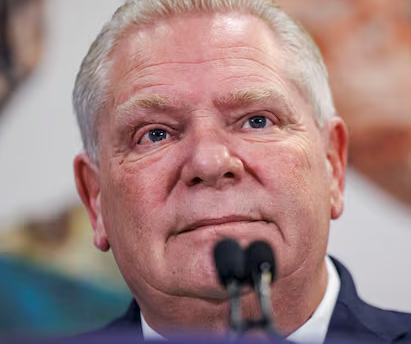 The leaderless Ontario Liberals have nudged in front of the Progressive Conservatives, according to a new poll released in the aftermath of the premier’s private jet reversal and changes to freedom-of-information laws. The leaderless Ontario Liberals have nudged in front of the Progressive Conservatives, according to a new poll released in the aftermath of the premier’s private jet reversal and changes to freedom-of-information laws.
 A Liaison Strategies survey put Doug Ford’s Progressive Conservatives at 36 per cent, just behind the Liberals, who were at 38 per cent. The distance between the two is within the margin of error. A Liaison Strategies survey put Doug Ford’s Progressive Conservatives at 36 per cent, just behind the Liberals, who were at 38 per cent. The distance between the two is within the margin of error.
The Ontario NDP, which sits as the official Opposition, were at 20 per cent and the Greens at four per cent.
David Valentin, principal at Liaison Strategies, suggested the Progressive Conservatives have seen their support dropping for some time.
“While the decay may have been slowed down by government advertising, the jet fiasco has pushed the PCs down even lower and they now find themselves in second place,” he wrote in a statement.
Has the public finally clued in?
How much lower do the Ford polling numbers have to go before Doug Ford pulls the plug and announces his plans to call a Leadership Convention and look for a replacement?
The Progressive Conservatives have enough time to find a new leader and begin to polish up the brand and be ready for the next election.
The Liberals will choose their new leader at an event in November.
Related news story:
Bains much more than a long shot to lead the provincial Liberals
By Pepper Parr
May 3rd, 2026
BURLINGTON, ON
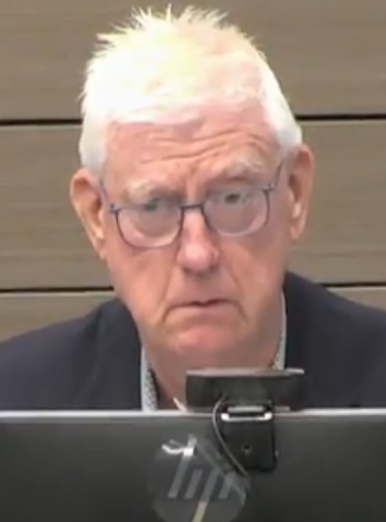 Ward 5 Councillor Paul Sharman Ward 5 Councillor Paul Sharman has announced that he will run for re-election on October 26th.
He has served as a Councillor since 2010.
In his announcement, he said he “would meet with people in their communities if that is what they want.”
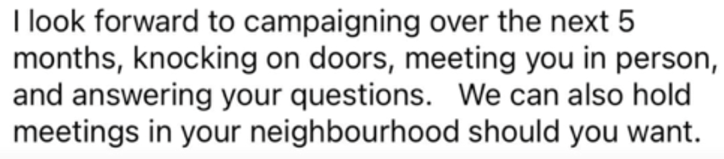
There are a lot of questions that need asking.
Sharman has not been a public transit advocate, but in the recent past there appeared to be a change in his thinking.
Related news story:
Sharman speaks out on what Argo can do for Burlington
 By Pepper Parr By Pepper Parr
May 2nd, 2026
BURLINGTON, ON
A Gazette reader commented yesterday that what Burlington needs on City Council is a lawyer and some businessmen.
The City has a lawyer to manage the legal problems.
A municipality is not a business. A business is owned by people who expect it to make a profit.
 Council members are elected to create policy and give Staff directions and to represent the interests of the people who elected them. Municipalities strive to ensure there is a surplus at the end of each fiscal year.
Municipal Councillors have one job: to serve their constituents. To know their constituents and to live in the ward they represent.
They are not elected to run the city. Staff are hired to do that
No personal agendas – they are there to listen and to lead – when it is appropriate.
 When we bow our heads and listen to the Last Post and Reveille, we are promising the men and women who gave their lives to protect the democracy we have that we will do the job. That is what you are expected to do on October 26th. When an individual casts a ballot, they are underlining what they feel on Remembrance Day: honouring the tens of thousands of men and women who died in the two World Wars to ensure that we could live in a democracy.
The citizens vote to ensure that the promise is kept by electing people who understand grassroots democracy.
On election day, voters give the power they have; their inalienable right to decide for themselves, to whichever government level they are electing and expect that person to represent them honestly.
It is as simple as that. When we wander off that path – well look to the south of us to see what can happen.
By Pepper Parr
May 2nd, 2026
BURLINGTON, ON
City Hall was accepting nomination forms from those who wanted to be candidates in the October 26th municipal government.
Running for Mayor
City Hall was accepting nomination forms from those who wanted to be candidates in the October 26th municipal government on Friday.
Ward 2 Councillor Lisa Kearns and Ward 3 Councilor Rory Nisan filed their forms on Monday.
Kearns has a very robust website and plans laid out for an active campaign.
 Kearns decided it was either to get elected as mayor or to leave politics entirely.  Rory Nisan, candidate for Mayor Nisan has a website with little in the way of content. His decision to run for Mayor did not come as a complete surprise.
Ward 1 candidate:
At this point, the only nominated candidate is Kelven Galbraith
Ward 2 candidate:
Nothing yet. There are two people who have said they will file papers: Brad Harness and Sean Cameron might be holding back until they learn what Regional Chair Gary Carr will do. He is rumoured to be interested. He attended the Ward 2 meeting that took place last week.
Ward 3 candidate:
Nothing yet. With current Ward 3 Councilor Rory Nisan throwing his hat in the ring to become Mayor the ward is wide open.
Ward 4 candidate:
This is where things have heated up. Current Councillor Shawna Stolte will face Oliva Duke who ran against her in 2022 and got 1748 votes; Stolte won the seat with 3591 votes. Chris Carter has also filed nomination papers and has a website in place.
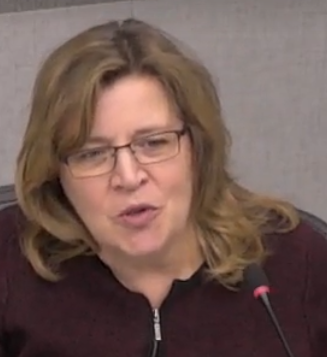 Current Ward 2 Councillor Shawna Stolte 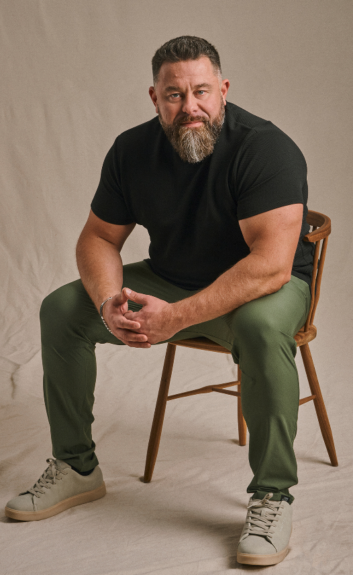 Chris Carter, Ward 4 candidate  Olivia Duke, trying a second time to serve the residents of Ward 4 Ward 5 candidate:
Nothing yet. Everyone will be waiting to see what current Councillor Paul Sharman decides to do. His decision to run again is not a certainty.
Ward 6 candidate:
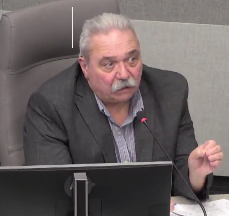 Current Ward 6 Councillor Angelo Bentivegna Angelo Bentivegna has filed his papers and is expected to have his van decorated again.
Some elections get very active, particularly when there is an electorate that is grumpy and unhappy. Names that are being talked about have Karina Gould reported to be considering a run for Mayor and Mayor Meed Ward taking a look at the federal seat, should Gold jump into municipal politics. Rumours like this have to be taken with a grain of salt. However, Gould is reported to have visited Marianne Meed Ward at her home.
By Pepper Parr
May 1st, 2026
BURLINGTON, ON
One of the first things people need to know about Lisa Kearns is that Kearns Road was not named after the family.
Lisa comes from a very humble, working-class family that has strong Catholic roots. All her elementary and high school education took place in Catholic schools.
She had part-time jobs through high school and university.
All this information came out of a long interview on a rainy Saturday afternoon.
Once it was clear that Kearns was going to run for Mayor I had asked Kearns to do a sit-down interview and tell me all about who she was, what the core values were, and where she had worked after graduating from university.
 I asked for pictures of her childhood days – she brought hundreds of them. “Just how much do you want” asked Kearns. “Everything” I said. She arrived for the interview with one of those expanding file folders stuffed with more than 100 photographs. “This is who I am” she said.
The I am consists of my Mother and Father, a brother and a sister.
 Lisa Kearns before starting school.  Grade two was great fun for Kearns This wasn’t a family that went to Florida – they were stay-at-home people who went camping and enjoyed fishing
Lisa had part-time after-school and weekend jobs at variety stores and a deli that were close to the family’s Hamilton home.
She was like any other normal child in what was a pretty solid household.
She did Halloween like any other child, had an entry in a Science Fair, and an award for being a good public speaker at the elementary level.
While at Western University she majored in political science, was part of the politcal science club.
Out of university an early job was selling billboard advertising space during an economy that was in trouble. Keeping clients during aneconomic downturn is what selling is all about. Kearns earned her bonus every year.
She moved on to Life Labs, where she was responsible for procurement. Left that company to become the ward 2 Councillor in 2018. There were great expectations back then. Kerns was one of five newbies on a seven-member council. Expecting some turnover from the previous ward Councillor, Kearns saw nothing but a pile of papers on the desk.
By the middle of her second term it was becoming clear to Kerns that council had become close to dysfunctional. It just wasn’t working – and had gotten confrontational.
 Running around during a Halloween party.  A Science Fair exhibit with a sense of humour  A Public Speaking award earned at the elementary school level. After sorting through the pictures and commenting on them I asked Lisa – “Why are you doing this – why are you running for the Office of Mayor.”
Her response was interesting.
“While it is very early in the 2026 election process, as I look back to where I am now, I don’t think I fully realized what I was stepping into.
“I know I can do a better job.”
“What we have now can’t be it.
“In my bones, I just know we can do a better job.
“Council has become very confrontational – and confrontation isn’t who I am.”
It is far too early in the municipal election process to have a really clear picture of what kind of mayor Kearns would be should she win. If what has been published elsewhere it looks like Councillor Nisan will also run for Mayor. Nothing on what current Mayor Mead Ward and what she plans to do.
A couple of weeks before the Saturday interview, I had asked Kearns, “What kind of Mayor do you want to be ?”
She didn’t understand the question right away, so I rephrased it. “Do you want to be a Rob MacIsaac or a Walter Mulkewich?” She said she didn’t know. But during the Saturday interview, she said she had thought about it and was very clear: She wanted to be a MacIsaac Mayor.
 Rob MacIsaac was the Mayor who brought the idea for the Pier to the Council table. He was a builder – Lisa Kearns wants to follow those footsteps. Rob MacIsaac put the idea for the Pier on the table, he was behind the move to tear down the old police station on Locust and have the Performing Arts Centre built. He was the force behind the creation of Team Burlington that put the Chamber of Commerce and the Burlington Economic Development Corporation in the new building that had several floors of parking above.
Rob MacIsaac was a builder who changed some of how the downtown core worked.
I am chasing down a tip I got from a usually solid source; and have reached out to someone who could confirm the information I have. If true, it will change the political landscape during the election we are now into.
This is going to be a very very interesting municipal election for Burlington. The second person I am reaching out to would have access to some information I picked up yesterday.
 By Pepper Parr By Pepper Parr
May 1st, 2026
BURLINGTON, ON
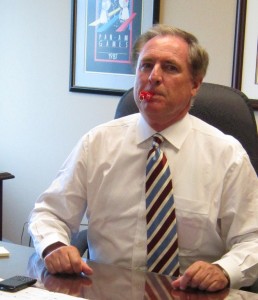 A piece of plastic got turned into a multinational corporate endeavour. Innovative financing and a measure of moxie made it all come together.  Gallagher scored the goal that made the difference in the fifth game of round one in the Stanley Cup playoff series. There is a guy in Burlington who has done very well selling a pea-less whistle he invented to the sports community.
The Habs, Sabres and Raptors are on at the same time tonight.
Ron Foxcroft plans on watching all three.
I’ll stick with the Habs – they can close out the first round of the Stanley Cup playoffs in Montreal tonight.
The city will go bonkers.
By Gazette Staff
May 1st, 2026
BURLINGTON, ON
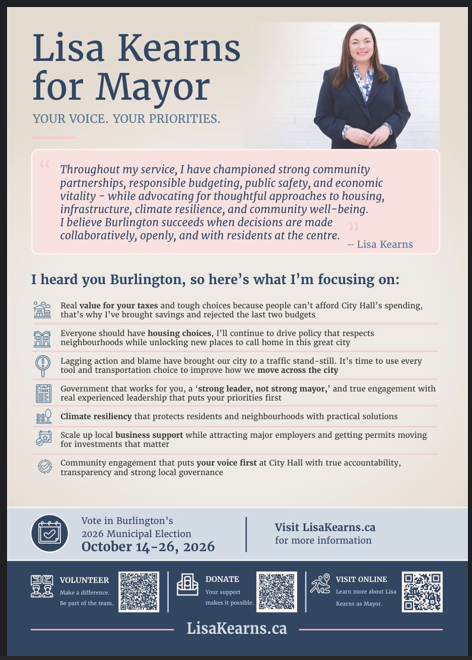
Lisa Kearns files her nomination papers and immediately puts out flyer.
Looks like a well oiled election campaign.
By Pepper Parr
May 1st, 2026
BURLINGTON, ON
In a lengthy comment published on Facebook, Ward 5 Councillor Paul Sharman shared his views on transit, They are evolving.
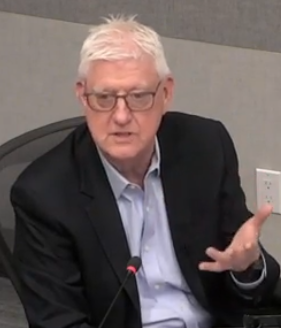 Councillor Sharman: “We all can see with our own eyes, that most of the time buses in Burlington have mostly empty seats.” “I would catch the bus if they were more convenient. I spent my entire childhood and youth years depending on public transit. I have never described the Burlington Transit in any demeaning way. Indeed, a bus that now costs over $1m to purchase, which requires significant maintenance, and will be replaced after 12 years, is a thing of beauty. Our drivers are well managed, courteous and friendly people, who care about their work.
That never describing Transit in a demeaning way is a huge stretch.
“I have pointed out what we all can see with our own eyes, that most of the time buses in Burlington have mostly empty seats. Empty seats = idle capacity, which costs a fortune.
“The Burlington 2026 transit budget is $37m, fare collection is about $6m, ie 16% of cost. A very large proportion of riders live in Hamilton, coming to work here, for which we are grateful, but they are also subsidized by Burlington property taxes. Average daily number of rides is about 9500, which = about 4700 people riding to where they are going and back again. Deduct the riders who live in Hamilton and do not pay Burlington property taxes, you can see that for Burlington property tax payers it means that about 98.5% them of do not use the service for which they will pay $31m out of their own pockets. That is $157 annually collected for every person in Burlington who don’t use our buses or $516 annually from every property tax payer.
“There are reasons why Burlington property tax payers don’t catch the bus system. The system is designed around large capacity buses, fixed routes and a fixed schedule. Routes and bus stops are designed such that every home is within 400 mtrs walk of a stop, which is a long way for people in a hurry, or people who find such a walk difficult. Some stops have shelters others not, but they are pretty cold in winter…. especially if you miss the first bus you intended to catch. We can do so much better.
“Many of the increasing number of older adults continue to drive into their later years because walking to a bus stop or inconvenience does not work for them. Nor for most people. Further, did you know that Handy Vans are only available to people who have a doctors certificate. Handi Van riders find they have to book a ride up to 2 weeks in advance to be certain to get a seat, and may have to get a taxi home later if their appointment goes too long.
 Appleby GO station parking lot. “Burlington residents drive to the GO station because it is convenient time wise and access to their own transportation is at the door. They will pay the considerable cost of owning a car because of accessibility and convenience.
“Modern technology, suitable vehicles, operators such as Argo exist and are already operating around the world, in Canada and in Ontario. On demand rider cost would be the same as present
“Older drivers, commuters and everyone else can simply call for a ride when they want one. Ridership will increase dramatically at a massively reduced cost to tax payers. If anyone has any doubt of whether what other municipalities and people who need transportation already know, just order an Uber, that the cost will four times more than a bus for a local ride.
“Burlington can continue to offer large bus service on the few routes that justify them, but even on those routes, small vehicles will do the job outside peak hours. We might even need more bus drivers!
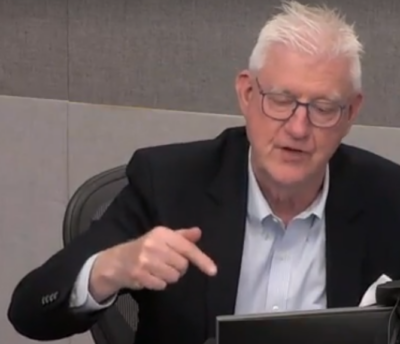 Sharman: insists he is a numbers man. “I am a numbers person and it is my belief that 1) $37m is massively excessive; 2) riders will take advantage of a convenient on demand service that will pick them up where they are, when they want to be picked up, and dropped off where they wish to go; 3) that ridership will increase dramatically, which will have the effect of increasing $ total fares collected: 4) increased fare revenue will cause total cost to tax payers to reduce and therefore reduce taxes! Win, win, win.
“If nothing else staff should try this out.”
What Sharman fails to reveal is that Burlington Transit is already using Argo buses to transport people who had asked for HandiVan service
Related news story:
 By Ray Rivers By Ray Rivers
May 1st, 2026
BURLINGTON, ON
Mr. Poilievre is having a field day mocking the Carney government for creating a wealth fund. There are something like thirty such funds around the world. Alberta’s former premier Lougheed created the provincial Heritage Saving Fund in 1976, built with the substantial petroleum royalties at the time and based on the fear, back then, that the province might eventually run out of the black gold.
Despite criticism that the Alberta fund over the years has been treated like an ATM, more like a chequing than a saving account, and accessed whenever the government felt it needed cash, it has grown to over $30 billion today and is targeted to hit $250 billion some day in the future. Unlike Alberta though, the federal government gets very little in the way of oil and gas royalties.
 These war loans were heavily subscribed to – note the picture of the King and Queen at the time. So the plan for Canada’s new national wealth fund will be based on a $25 billion endowment by the feds and open investment to private corporations and presumably individuals with a little extra cash in their pockets. That might end up as something akin to investing in a war bond to fund rebuilding the economy in this economic war with the USA.
The details are yet to come – most likely only after a board of directors is constituted. Canada already has a large pool of capital in the Canada Pension Plan, which currently is approaching $800 billion in value. However, being largely composed of obligatory contributions by future pensioners, the government is wise not to mess with one of the world’s most successful pension funds.
Poilievre’s claims that a wealth fund should be financed by federal budgetary surpluses is a laudatory but naive notion given that for almost twenty years, since the 2008 economic recession, neither the Liberal nor Conservative governments have ever generated a budgetary surplus. Fellow Tory Doug Ford was all about eliminating deficits as well, that is until he became premier and realized that the prospect of raising taxes or cutting essential programs has a political as well as a social and economic cost.
And Poilievre’s demand that the federal government remove all gas taxes would just add another eight billion dollars to the current deficit. That kind of math helps explains why he thinks he understands economics better than the sitting PM with his Harvard and Oxford degrees and his record as central banks governor. The complexity of higher finance clearly seems to evade the Tory leader’s comprehension – so he lashes out as best he can, accusing the PM of directing government policy to further enrich himself and his former business associates – essentially accusing him of corruption.
 Poilievre has once again been transformed into attack dog mode. But perhaps what is most concerning about Mr. Poilievre, who has once again been transformed into attack dog, is his lack of faith in Canadians and his inference that Canada doesn’t have enough wealth to start a fund – that Canada only has debt and that the new Sovereign wealth fund is just another debt fund. This is not the time to depreciate the country, especially if you are a political leader hoping one day to govern.
Canada is widely considered the 18th richest nation on earth with the 11th largest economy. Not bad for a nation of just over 40 million people, about half a percent of the planet’s population. According to the International Monetary Fund Canada has the strongest fiscal position in the G7, with the lowest net debt-to-GDP ratio, at just under 12% and a triple A credit rating.
 Ray Rivers, a Gazette Contributing Editor, writes regularly applying his more than 25 years as a federal bureaucrat to his thinking. Rivers was once a candidate for provincial office in Burlington. He was the founder of the Burlington citizen committee on sustainability at a time when climate warming was a hotly debated subject. Ray has a post graduate degree in economics that he earned at the University of Ottawa. Tweet @rayzrivers Ray Rivers, a Gazette Contributing Editor, writes regularly applying his more than 25 years as a federal bureaucrat to his thinking. Rivers was once a candidate for provincial office in Burlington. He was the founder of the Burlington citizen committee on sustainability at a time when climate warming was a hotly debated subject. Ray has a post graduate degree in economics that he earned at the University of Ottawa. Tweet @rayzrivers
Background links
Wealth Funds – Poilievre on Wealth Fund – Wealth Funds – Alberta Heritage Fund – Brookfield Funds –
By Pepper Parr
May 1st, 2026
BURLINGTON, ON
An Abacus poll found Ford’s Progressive Conservatives at 37 per cent with the leaderless Liberals, who elect a new chief Nov. 21, at 36 per cent, a statistical tie. Marit Stiles’ New Democrats remain in third place with 17 per cent while Mike Schreiner’s Greens were at five per cent.
Say that again: A political party with no leader is a point behind the Premier of the province
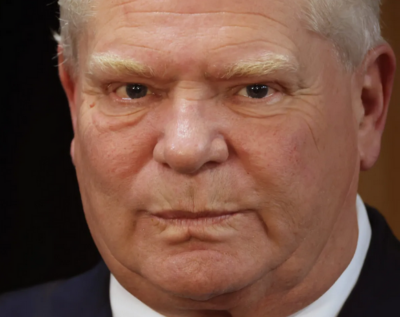 Doug Ford: Time to say as little as possible and hope the public concerns blow over. The poll found Ford’s Progressive Conservatives at 37 per cent with the leaderless Liberals, who elect a new chief Nov. 21, at 36 per cent, a statistical tie. Marit Stiles’ New Democrats remain in third place with 17 per cent while Mike Schreiner’s Greens were at five per cent.
Abacus president David Coletto said two recent contentious moves by the premier appear to have hurt the Tories.
First, Ford’s decision to amend the Freedom of Information and Protection of Privacy Act to retroactively exclude the release of his records and those of ministers, parliamentary assistants and aides.
Second, his $28.9 million purchase of a 2016 Bombardier Challenger 650 executive jet to be used for official travels.
The public will begin to focus on the municipal election, which take place on October 26TH – nominations opened today.
 By Pepper Parr By Pepper Parr
April 29th, 2026
BURLINGTON, ON’
Ramp up the access to psychological services for High School students.
The province is considering banning students from looking at a social media when they are in schools.
Those students who were never able to discipline their use of being on their cell phone for much more than five minutes will be going into withdrawal.
Parents should take some responsibility for this, but they too are addicted to their cell phones.
 I’ll call this one – you call that one.  Students have forgotten how to have conversations. Minister of Education Paul Calandra says the province will be working closely with the federal government on a social media ban for kids under a certain age.
He also says he is considering implementing an “outright ban” of cellphones on school properties, with some medical exemptions.
Manitoba Premier Wab Kinew’s government recently announced that it plans to ban children from using social media accounts and artificial intelligence chatbots, starting in classrooms.
Federal Culture Minister Marc Miller has said the government is seriously considering a law enforcing age limits on social media use, as Australia has done.
 This is what a generation of parents has let happen to their children.
 By Pepper Parr By Pepper Parr
April 29th, 2026
BURLINGTON, ON
It is accepted by most people that there is a shortage of Handi Vans in Burlington.
These buses are a door-to-door service offered by Burlington Transit to people with disabilities. The service is available to registered customers who are unable to use a conventional bus.
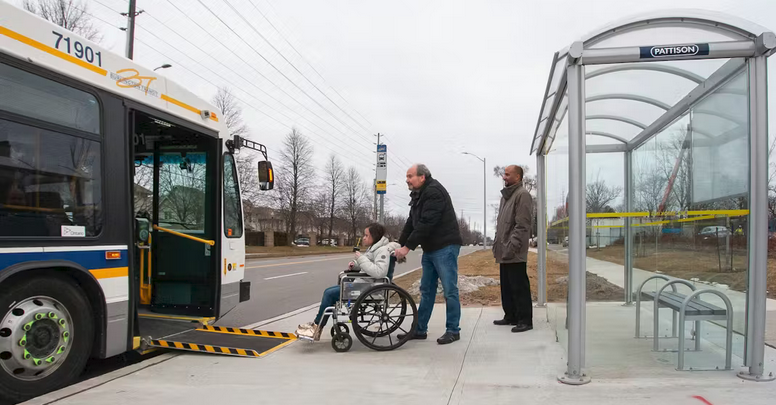
These are the vehicles that transport people with disabilities from where they live to where they want to go, be it a doctor’s appointment, a visit to a family member, or to do some shopping.
The van holds about xxx people and have ramps that make it possible for people with wheel chairs to embark and disembark.
When a Handi-Van is needed, the customer calls Burlington Transit and explains where they want to go, often as much as two weeks before the transportation is needed.
People apply to use this form of transit by completing the specialized transit application. The form has to be signed by their doctor. How they get to the doctor to have the form signed when they don’t have access to the Handi-Van service is something they figure out.
Handi-Van schedulers are available Monday to Friday, 8 a.m. to 5 p.m., excluding holidays.
The customers know the people in the xxx department very well – they have been talking to each other for years.
The service works, but it means there is an awful lot of waiting around, which is the life of those who are disabled.
We will return to the Handi-Van service and its limitations.
The transit people are looking for ways to create a transit service that is not confined to buses running specific transit routes. They are looking for small buses that would work as an on-demand service for specific parts of the city. Funds were allocated for the Transit service to prepare for a study that would xxxx
Argo, a privately owned company located in Brantford, is a service that uses electrically propelled buses to transport people. They have a computer application that allows people to log n and request transportation. The user gets a response, and the closest Argo bus picks them up. That is a simplification of how the Argo system works.
The problem with the Argo system is that it takes control of who people call transit service out of the hands of the city transit service.
At some point, the city may decide they want to outsource that service – but that is not a decision that has been made.
One of the Argo buses was on display at a recent transportation and transit event hosted by Councillors Sharman and Kearns.
The Gazette recently met with a Burlington Senior who has been using the HandiVan service for more than a decade.
On March 18th this person was picked up by an Argo bus that was returning to her John Street address from the Mandarin restaurant. It took an hour and 20 minutes to complete the trip. One could walk the distance in that amount of time.
On April 21st, this person took an Argo bus from Burlington Centre to her John Street residence. This person concluded tat the driver of the Argo bus did not know the city very well.
Our question is: Why do people requiring HandiVan service find themselves being moved around by an Argo bus?
Does the city have a working agreement with Argo that has not been made public?
Who is covering any of the liability insurance needed?
There are more questions that answers on this issue.
|
|