Residents can now find information about Burlington’s 2026 municipal election in one place at myvoteburlington.ca. Voting will take place between Oct. 14 and 26, 2026.
Residents are encouraged to visit the new election website to learn more about:
getting on the voters list
voting options (online or in person at an advanced poll/on election day)
running as a candidate
working as election staff
registering as a third-party advertiser
In October 2026, eligible voters in Burlington will vote to elect:
All seven of these people want to be re-elected. Two of them want to be Mayor
Most of these people will want to be returned to office.
Mayor of Burlington* (1)
Six members of Burlington City Council* (one per ward)
Regional Chair of Halton Region** (1)
School Board Trustee(s) – Vote for trustees in one of four school boards, based on your school support. Choose from:
Halton Catholic District School Board
Halton District School Board
Conseil scolaire Viamonde
Conseil scolaire catholique Mon Avenir
*The Mayor and City Councillors also sit on Halton Regional Council.
**If passed, the proposed Better Regional Governance Act, 2026, will change the Halton Regional Chair to a Provincially appointed position. Burlington’s election website will be updated if and when the Act receives Royal Assent.
Nominations open on May 1st and close on August 20th, 2026
Municipal elections give residents the opportunity to choose who makes key decisions for their city. With nearly 60 per cent of Canada’s core infrastructure owned, operated, and maintained by municipalities like Burlington, local elections play an important role in shaping the services residents depend on.
There are four ways to vote in Burlington’s 2026 municipal election:
online, using Internet voting, from Oct. 14 to 23, 2026
in person at advance polls, on Oct. 17 and 20, 2026
in person on election day, Oct. 26, 2026
by proxy (more details to come)
Quick Facts
Elections for municipal government are held every four years in Ontario.
On Earth Day, Wednesday, April 22nd, The Beer Store (TBS) is offering consumers 20% more value on empty alcohol containers. This is an additional 20% on the existing $0.10 and $0.20 cent deposit for alcohol containers purchased in Ontario.
“Annually millions of people return around 1.6 billion empty alcohol containers for reuse and recycling,” said Roy Benin, President and Chief Executive Office of BDL and TBS. “In recognition of Earth Day, we want to invite people to visit a beer Store to get 20% more in deposit money back.”
Tis promotion is only applicable to empty alcohol containers purchased in Ontario and returned for deposit refund at Beer Store retail locations. Kegs are excluded from this promotional offer. Returning empty wine, spirit and beer containers to Beer Store locations or authorized Empty Container Dealers is the best way for consumers to reclaim their deposit and make a positive contribution to the environment. Deposits can be reclaimed at both TBS retail stores and authorized Empty Container Dealers; however, this promotion is only valid at TBS retail locations.
“If you have empties in your basement or garage, Earth Day is the time to bring them back, get 20% more, and get your deposit back,” added Roy Benin.
Returning Empty Alcohol Containers
The Beer Store launched an Empty Return Locator to make it easier than ever to find a Beer Store or alternative retailer that accepts empty alcohol containers so consumers can get their deposit back.
In 2025, Beer Store customers brought back approximately 1.6 billion empty alcohol containers for reuse, recycling and to get deposit money back. The Beer Store is Ontario’s proven recycling and reuse solution for empty alcohol containers, including beer bottles and cans, as well as wine and spirit containers sold in Ontario. In almost 100 years of operation TBS has successfully collected for reuse or recycling over 170 billion empty alcohol containers. In fact, the Beer store collects more containers annually than we sell.
From the homepage of www.thebeerstore.ca, in the navigation bar select ‘Returning Empties’. This menu will drop down, then select ‘where to Return Empties’.
The 2026 Tax Levy By-law reflects the culmination of the budget process at both the City and the Region of Halton.
The overall combined 2026 urban residential taxes, for Burlington residents increased by $43.70 or 4.50% per $100,000 of current value assessment (CVA).
All property taxes must be billed within the calendar year. Property taxes are billed twice a year, referred to as interim and final taxes.
Final Tax bills will be sent out in May with the due dates for the payment of final property taxes due June 23rd, 2026, and September 23rd, 2026.
That’s all you really need to know. If you don’t like the rate at which taxes have increased, you get to vote Council out of Office on October 246th.
The rest is all about the process:
School Board offices for the Region
This report presents an overview of the 2026 property tax rates for the City, Region, and school boards as required by legislation. The tax rates for the City and Region are based on the 2026 budget requirements, while the tax rates for education are provided by the Province.
Through the Municipal Act, the municipality shall annually levy the amount required for the purposes of the City, Region of Halton, and respective school boards.
Purpose of report:
The 2026 final tax rates are submitted to Council for approval in the form of the 2026 Tax Levy By-law
Key findings:
The tax rates for the City and the Region are based on the 2026 approved budget requirements, while the tax rates for school purposes are provided by the Province.
The Municipal Act, 2001 requires the lower tier municipality to issue and collect property taxes on behalf of the upper tier and school boards.
Implications:
The 2026 Tax Levy By-law, once approved, will provide the authority to levy and issue final property tax bills to all property owners in the City of Burlington.
Background
On December 2, 2025, at a Special Council meeting, Mayor and Council approved the 2026 Operating Budget for the City, resulting in a net tax levy of $280,849,396.
On March 10, 2026, Council approved the budgets for the Burlington Downtown Business Improvement Area and the Aldershot Business Improvement Area (BIAs).
Council has approved the Downtown Parking area tax levy which results in the calculated special 2026 tax rates based on the assessed values.
Region of Halton Crest
The Region of Halton tax rates and related tax policy are approved on April 15, 2026, prior to the City Council meeting.
On December 5, 2025, the Province published and provided municipalities with the 2026 education tax rates by filing Ontario Regulation 297/25 amending O.Reg. 400/98.
The 2026 Final Tax Rates are submitted to Council for approval in the form of the 2026 Tax Levy By-Law.
Analysis
In accordance with the Municipal Act, 2001, tax policies are set at the regional level for all local municipalities. The Region of Halton Council approval of tax policies for 2026 is scheduled for April 15th. Details of the 2026 Tax Policy can be found in the Region of Halton’s Finance Report (FN-08-26).
The overall combined 2026 urban residential taxes, for Burlington residents, increased by $43.70 or 4.50% per $100,000 of CVA. Rural residential property taxes will increase by $40.38 or 4.46% per $100,000 of CVA.
Recommendation Details
Approval of the 2026 Tax Levy By-law (FIN-01-26) for the levying of tax rates.
Political fortunes can change at any moment. The Signal, a collaboration between the Toronto Star and Vox Pox Labs, models thousands of polls to bring you one of the most consistently accurate election forecasts in Canada.
Media reports have 57% of Tory voters want Poilievre to lead.
The plan was to create a pathway from the front of St. Luke’s Anglican Church to Lakeshore Road overlooking Lake Ontario.
It should have been a simple change. But nothing is simple when it comes to changes at the municipal level.
Remove the pavement, add a paved pathway and create a pleasant walkway. Simple.
The plan is for a bit of a wall setting up the entrance to the walkway at the Lakeshore entrance.
The problem was that the church didn’t own all the land.
All kinds of paperwork to turn that small piece of land from a parking lot to a pathway.
The City’s Chief Financial Officer is going to have to incorporate the ongoing operating impacts for maintenance of the new pathway and related elements into the 2027 multi-year budget simulation, to an upset limit of $30,000.
When completed, the view from the steps of St. Luke’s Anglican to Lake Ontario will be what Joseph Brant had in mind when he had the church built on the land. If you are in the area, check when the church is open for a tour. Worth the time to visit.
In 2026, our digital trail is now more important than ever before. With companies and governments now able to track our every move online very easily, people are wondering whether digital assets like the top cryptocurrencies are the best way to ensure more privacy. Here are some of the key factors to take into account.
Why Do We All Want a Lighter Digital Footprint?
Digital assets can be used to fund an account without linking your main bank account or card to the casino.
It’s easy to misunderstand the desire for more privacy as people having some sort of secret. Looking at this in an old-fashioned way, you have to wonder what a person seeking more privacy wants to hide. However, secrecy isn’t the goal for most internet users these days. Rather, we want to maximize our personal and financial safety in an increasingly digital world.
By making sure that you have fewer details online, you reduce the risk of being the victim of a targeted data hack. If little or none of your sensitive data is held online, there is far less risk of any harm coming from a data breach.
We also need to consider the fear of price discrimination. Although it sounds far-fetched if you haven’t heard of it before, many algorithms are already sophisticated enough to track our spending habits and location if allowed to. This means that you can end up paying higher prices based on where you live or even if you’re using a premium smartphone to access a store.
Avoiding social engineering is another key issue. Over-sharing online is now potentially risky, as malicious actors can learn a surprising amount about you by following your digital trail. The more details you provide online, the greater the risk of your data being used against you at some point.
Crypto Casinos Let You Gamble With No Worries
One of the most interesting ways that cryptos have boosted our privacy comes from the world of iGaming. If we look at the example of this site, where we can play casino games with Bitcoin, we see almost instant deposits and withdrawals. Digital assets can be used to fund an account without linking your main bank account or card to the casino.
This means that you can avoid using your most sensitive personal information when you start gambling. That’s a big win for a lot of players who would rather keep their banking details separate from their digital lives. As well as Bitcoin (BTC), coins like Tether (USDT), Ethereum (ETH), and Litecoin (LTC) are among the tokens that are accepted.
The iGaming sector has been one of the pioneers in using the blockchain to enhance privacy standards. However, this doesn’t restrict your playing opportunities. After funding an account with your chosen crypto, you still get to choose from the same slots and table games as someone who has used their fiat currency to get started. The overall setup doesn’t change; you’ve just got more flexible options for payments and withdrawals.
This social media post shows how crypto casinos have carved out a place in the modern entertainment industry while retaining the elements that made slots so popular in the past. Humor is a big element of connecting with the modern customer base!
We’ve become used to seeing tokens like Bitcoin as a pseudo-anonymous financial solution. Everyone can see your transactions on the blockchain, but they don’t know who has been making them. That’s a satisfying outcome for most people and is usually sufficient from a privacy perspective.
However, it is possible at times for someone to link your identity to one of your transactions, which reduces this anonymity. For this reason, some people lean toward coins that are specifically focused on true privacy. This is usually achieved through advanced measures like ring signatures and zero-knowledge proofs, which effectively hide the sender and the receiver, as well as the amount sent.
Financial Freedom in an Increasingly Transparent World
The way that we can move money instantly across the planet is one of the 21st century’s most exciting developments. Recent studies show that autonomous agents prefer to hold Bitcoinrather than fiat currencies. This acknowledges the value of the speed, privacy, and convenience of digital assets.
By focusing on the privacy benefits of cryptos, we can see that this shift is about getting more control and financial freedom. You might be surprised to see how much of your personal information is now available online. As people become more aware of this danger, we’re sure to see a rush to gain more privacy without losing our ability to pay easily.
Whether you work online and get paid in stablecoins or just want to pay for online entertainment conveniently, this is about working out what suits you best. The move to a digital world carries some new risks, but boosting our financial privacy is one way of dealing with them.
Can this be taken to mean that warm weather is about to arrive?
The City’s seasonal patio program for 2026 is launching. The downtown sidewalk detours for patios will be installed April 21 to 24 and will be in place until Oct. 31, 2026.
These sections of the sidewalk will be detoured onto the road with traffic barriers. These barriers will help with pedestrian safety.
The sidewalk detours for patios are being installed in downtown Burlington on:
The north side of Pine Street between Elizabeth Street and Pearl Street
The east side of John Street between Pine Street and Lakeshore Road
The north side of Lakeshore Road between Brant Street and John Street
The north side of Lakeshore Road between Locust Street and Brant Street
More detours may be installed throughout patio season, as needed, up until Oct. 31, 2026.
The popularity of crypto trading has experienced exploding growth, and with it, a large number of crypto exchanges have emerged, all promising the best features, the lowest fees and the highest security. While many platforms have come and gone, BTCC Crypto Exchange has stood the test of time, evolving into a top-tier futures trading exchange offering flexible leverage, competitive fees and innovative tools such as copy trading. It is also fully regulated in multiple jurisdictions, providing an additional layer of security and trust for traders.
In this article, we will take a close look at the BTCC cryptocurrency exchange. By the end of the article, ‘BTCC Exchange Review,’ you will have a clear idea of all its pros and cons, platform features, supported coins, user experience, security, fees, customer service, etc.
What is BTCC: A Brief Overview
Founded back in 2011, BTCC is a seasoned player in the cryptocurrency exchange arena with a history of reliability and trustworthiness. With a mission of providing a trading platform that is fair and reliable in every sense, BTCC is dedicated to reliability, efficiency, security, diverse altcoin offerings, and unique features, making it a standout choice for crypto enthusiasts.
BTCC operates globally and places great emphasis on complying with local regulations. It holds regulatory licenses in various countries, including the USA, Canada and Europe. Since its inception, BTCC has weathered numerous bull and bear markets without suffering a single hack, establishing itself as one of the most trusted exchanges in operation.
BTCC offers diverse services, providing spot, futures, and copy trading. Besides, BTCC boasts a free demo trading feature, making it a great option for beginners seeking a reliable practice environment. Besides, in addition to cryptocurrency trading, BTCC offers the innovative feature of tokenized stocks, which enables traders to gain exposure to non-crypto assets like gold, silver, and U.S. stocks. Overall, whether you are a novice trader or a seasoned one, BTCC can always cater to your demand with its unique solutions.
Pros & Cons of BTCC: A Brief Summary
While the BTCC platform boasts several key features and advantages that help it stand out, no platform is perfect, and the BTCC platform is no exception.
Although we liked the BTCC platform’s features, such as its competitive fee structure and robust security, there is still room for improvement in the BTCC exchange. If you don’t have time to read the full review, here is a brief summary to help you to get to know the exchange.
BTCC Pros
BTCC Cos
● Offer flexible leverage for crypto futures trading
● Industry-leading security with no hacks or security breach accidents reported
● Competitive futures trading fee structure, with taker fee ranging from 0.03% to 0.06% and maker fee ranging from 0.01% to 0.03%
● Supports copy trading, demo trading and spot trading
● Excellent customer service
● Rich educational guides for new traders
● Lack of crypto staking feature
Cryptocurrencies Available on BTCC
As a leading crypto exchange, BTCC supports over 380 assets, including a selection of major and mid-cap cryptocurrencies. The wide selection of tradeable coins enables investors to diversify their digital portfolios and explore various investment opportunities in the digital currency market. Investors can easily find that except for more established coin like Bitcoin (BTC), Ethereum (ETH) and more the exchange provides, BTCC also offers access to newer but equally promising alternatives such as Litecoin (LTC), Ripple (XRP), etc.
The selection of tradable coins is expected to grow as BTCC is constantly dedicated to innovation and accepting new but promising digital currencies. BTCC platform’s commitment to listing new and promising digital assets has also been a key factor in its growth, as it allows users to access emerging markets early on. For those looking to explore new opportunities in the vast and ever-evolving world of cryptocurrencies, BTCC is an ideal choice with its updated and diversified range of cryptocurrencies.
BTCC Fees
Fee structure is an important metric that investors would focus on when selecting an exchange. Most crypto exchanges charge two different types of trading fees: taker fees and maker fees. Charging high fees means less return for investors. Thankfully, BTCC boasts a distinct advantage with its competitive fee structure and discounts for VIP customers.
BTCC offers a highly competitive fee structure that is particularly appealing to futures traders. For spot trading, maker fees are set at 0.2%, while taker fees are 0.3%. However, it is in futures trading that the platform truly distinguishes itself, with maker fees dropping to just 0.03% and taker fees to 0.06%.
VIP users also benefit from even more favorable rates, featuring maker fees as low as 0.01% and taker fees as low as 0.03%, depending on their trading volume and account tier. These exceptionally low fees establish BTCC as a leading choice for cost-conscious futures traders looking to maximize profitability while minimizing trading costs in the highly competitive cryptocurrency market.
Therefore, if you are a VIP client at BTCC, the benefit you can get access to is generous. Users can enjoy VIP-exclusive perks, including discounts on trading fees, access to exclusive campaigns, BTCC merch, priority customer support, fast withdrawal, and many more. A complete VIP fee table can be found in the picture below:
BTCC Security
When it comes to trading cryptocurrency, security is a top concern for most traders. BTCC is undoubtedly one of the safest crypto exchanges in the world. With constant commitment to safety, BTCC has reported zero hacks or security breach to date since its inception. In an industry where security issues are quite common, this is a remarkable achievement.
So, what makes BTCC stand out in terms of security? To safeguard its customers’ safety, BTCC adopts several security measures, like segregated 1:1 storage of user funds, account-level security measures, Two-Factor Authentication (2FA), and SSL encryption. Additionally, BTCC’s transparent approach to security audits and its commitment to regulatory compliance have earned it a reputation for trustworthiness in the industry.
Through these measures, BTCC manages to secure the safety of its clients. Besides, this platform is fully compliant with anti-money laundering regulations and identity authentication, which adds to BTCC’s safety. For those placing great emphasis on trading safety, BTCC is a top choice.
BTCC Ease of Use
A user-friendly platform is usually more appealing to traders, particularly novice investors. When selecting the best crypto exchange, ease of use is a significant factor to consider. BTCC’s layout is well organized, with clear categorization of trading pairs, order books, and charts—all of which are essential for making informed trading decisions.
BTCC features a clean, intuitive interface designed to streamline navigation for all users. By eliminating unnecessary complexity, the platform delivers a seamless trading experience perfectly tailored to both novice investors and seasoned professionals. In addition to a capable charting system, BTCC displays data such as a coin’s 24-hour price change, 24-hour low/high and daily volume. As a well-designed trading platform, BTCC is easy to use and accessible to the vast majority.
BTCC Exchange Features and Advantages
As a more established exchange with a global footprint, BTCC provides a large number of advanced trading features to cater to various requirements of its clients. Next, we will list the major advanced trading features and advantages that exist on BTCC Exchange.
Crypto Futures Trading
BTCC mainly specializes in futures trading. Over 350 cryptocurrencies USDT-margined perpetual futures contracts are available on BTCC platform. For crypto futures trading, BTCC offers two distinct types of crypto futures:
USDT-Margined Futures: Settled in USDT, these futures contracts enable users to trade on 300+ popular cryptocurrencies, including BTC, ETH, DOGE, XRP, SOL, and many others.
Coin-Margined Futures: Settled in various cryptocurrencies, coin-margined futures offer traders the flexibility to diversify their portfolios across a wide array of digital assets.
Futures Copy Trading
The copy trading platform on BTCC is very active.
An intriguing feature BTCC provides is copy trading, which serves as an automated trading tool that enables users to replicate the trades of professional traders and other high-performing traders. This is ideal for beginners or those who want to trade without actively managing positions. Through this type of trading, users can easily replicate the trades of experienced traders in real time. The copy trading platform on BTCC is very active.
BTCC offers two ways one can engage in copy trading—fixed ratio and fixed amount. Through the copy trading, expert traders can also earn a profit share of 10% to 15% of the copier’s trade. Notably, BTCC claims to cover your first copy trade from losses. Over each campaign period, new copy traders can receive up to 50 USDT in trading funds for coverage if they close their first copy trade and it results in a loss.
However, slots are limited to the first 1000 users that must be new copy traders.
Spot Trading
In May 2024, spot trading feature (Beta) was officially launched on BTCC. Since spot trading feature debuted on BTCC in early May, there are more and more tradable pairs supporting spot trading on both the BTCC web and app platforms. At present, there are 380+ spot trading pairs offered on the BTCC platform.
Generally speaking, the BTCC spot trading feature is a convenient way to obtain desired spot holdings in a user-friendly trading environment with moderate risk levels due to the absence of leverage. Supported order types for spot trading on BTCC include: Limit order, Market order, Trigger limit order and Trigger market order.
Demo Trading
For those beginners who are very concerned about trading risks and trading funds, BTCC offers a demo trading system, which enables investors to improve their trading performance without sacrificing capital. After registration, all customers receive a $100,000 demo account, which provides users with a detailed understanding of how the platform works without risking any real funds. Users access the demo trading functionality from the Futures section on the web version.
Tokenized Stocks & Commodities Futures
In 2022, BTCC expanded its offerings beyond cryptocurrencies by introducing commodity and stock tokenized futures. Currently, over 35 popular stocks, including Intel, Microsoft, Apple and Amazon, can be traded on BTCC with up to 20x leverage. In addition, gold and silver can be traded on BTCC with up to 150x leverage.
These tokenized futures are settled in USDT, which greatly enhances accessibility and convenience for traders. This is a distinctive feature offered by only a handful of platforms. If you are looking for traditional assets, including stocks, gold, silver or indices such as the S&P 500, BTCC has everything you need.
Forex Trading
At present, BTCC offers USDT-margined tokenized forex futures with a leverage of up to 50x. Currently, EUR, GBP, AUD, and NZD USDT-margined tokenized forex futures are supported. Those seeking a high return from forex trading can log in to BTCC to start trading.
Instant Crypto-to-Crypto Convert
Crypto-to-crypto convert tool enables you to do this instantly.
Converting one crypto asset for another can sometimes lead to significant fees. With BTCC, users can easily and quickly to convert one cryptocurrency into another. This feature is particularly useful if you want to rebalance your portfolio or capitalize on market opportunities without going through the more complicated process of spot trading.
For example, if you want to quickly swap Bitcoin for Ethereum without waiting for an ideal market order, the crypto-to-crypto convert tool enables you to do this instantly. This makes portfolio management more efficient and hassle-free.
BTCC Customer Service
BTCC enjoys a good reputation in terms of customer service. If you are confused or have any problem in the process of trading currencies, you can access 24/7 support via various channels, including live chat, email, and social media. This commitment to customer service is a major advantage for BTCC Exchange, as it ensures that users’ concerns are addressed promptly and effectively.
BTCC also has official profiles on various social media platforms, including X (formerly Twitter), LinkedIn, Instagram, YouTube and Facebook. The website provides a support center and a section with blogs and news for users seeking assistance.
Is BTCC Legit?
With a long operation history of 15 years, BTCC boasts an impressive user base and a stellar track record. As one of the oldest exchanges around the world, BTCC puts a strong emphasis on conducting business in various countries and regions under the premise of lawfulness and compliance. Currently, BTCC has obtained regulatory licenses in a variety of countries.
Specifically, BTCC received a crypto license issued by the Financial Crimes Enforcement Network (FinCEN) in the USA and a crypto license issued by the Financial Transactions and Reports Analysis Centre of Canada (FINTRAC). In 2022, BTCC also received a cryptocurrency license from the Registrar of Legal Entities of Lithuania, enabling the platform to offer crypto trading services in Lithuania and other European countries.
Final Thoughts
With the offering of over 380 cryptocurrencies and advanced trading features like perpetual futures, crypto copy trading, demo trading, tokenized assets, etc., BTCC emerges as one of the most well-respected cryptocurrency exchanges in the industry, playing a key role in the development of crypto trading. Notably, BTCC has an impeccable 15-year history in the crypto industry, free from any security incidents.
Whether you are a retail trader or a professional trader, BTCC can always meet your demand with its unique solutions and advantages. To enjoy a delightful crypto trading experience,sign up with BTCCtoday!
Two days after the Star revealed Queen’s Park had bought a used Bombardier Challenger jet for the premier’s use, a chastened Ford said the aircraft would be sold.
Premier Doug Ford’s $28.9 million “gravy plane” has crashed and burned, said the Star
“Despite the best of intentions, I have heard and agree that now is not the right time for the expense of a government plane,” the premier said in a terse statement Sunday.
Focus Burlington published an excellent piece on how people decide to vote for.
Stephen White
Stephen White uses data from the 2018 election to show what vote splitting did during that election. There is a lesson here for the people in Burlington who take the time to vote.
We are less than two weeks out from the opening of candidates filing their nomination papers to run in October’s municipal election. Across the city, there have been rumblings of various candidates considering running for elected office.
Challengers in an election need an appreciation of three key factors. First, the duties and time commitment involved in being a councillor or mayor. Second, the effort required to mount a credible campaign. Finally, a realistic appraisal of their chances of success.
In a previous article, I wrote about what it would take to mount a successful campaign. Realistically, to have a legitimate chance of winning a council seat, one would need to raise at least $10K and have a team of 10-15 dedicated volunteers for canvassing, literature drop-offs, and other activities. For the mayor’s office, you can probably multiply these numbers by a factor of at least three to five.
The Devil is in the Details
The truth is that incumbents in this city often owe much of their electoral success to vote splitting. Vote splitting occurs when multiple candidates opposed to the incumbent’s platform and candidacy decide to run individually. For those seeking a change, the results don’t always bode positively.
Think back to 2018. The previous mayor and council had caused widespread dismay throughout the city. Voters were angry and on edge over a number of issues, ranging from intensification to traffic. There were no acclamations that year, and multiple challengers in many wards.
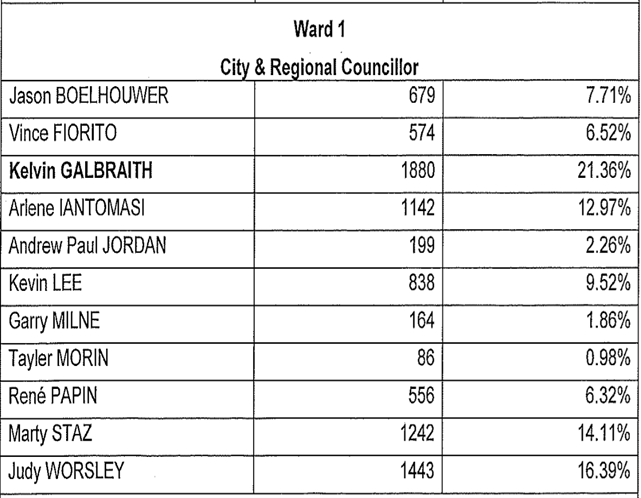
Ward 1 presented the most telling example of a council race with far too many candidates. In a crowded electoral field of eleven candidates, the incumbent won with just over 21% of the vote. 7 of the 11 candidates garnered less than 10% of the popular vote.
Ward 5 was another interesting race. The major issue in that campaign was the proposed redevelopment of the Lakeside Village Shopping Plaza. There were four candidates challenging the incumbent. Paul Sharman edged out his closest opponent, Wendy Moraghan, by only six percentage points. Had one or two other candidates not run, the final result would likely have been much different.
The Ward 4 results from that year highlight what happens when a community consolidates behind one opponent, and there is a clear choice between the incumbent and his/her challenger.
How to Avoid Vote Splitting
Clearly, vote splitting favours incumbents. However, for residents considering running for municipal office, how can they avoid vote splitting? Here are some options.
First, nominations open May 1st. By the end of August, they will close. At that point, the slate of candidates for each ward is set. If multiple candidates are running against the incumbent, those with similar philosophies and approaches should meet to realistically assess their prospects of success. As mentioned, if even one candidate in Ward 5 had done this in 2018, the results would likely have been considerably different.
Second, brand identification, visibility, and profile are necessary to mount an effective campaign. For example, if you had three candidates with aligned philosophies who are challenging an incumbent, but two have no visible public profile, limited prior community involvement, inadequate funding and only nominal support, then they should “take one for the team”, exit the race, and throw their support to the sole remaining contender. The candidate with the most funds and volunteers has a greater chance of success than those without.
Third, in order to evaluate their level of support, candidates should consider this. There are 122 days between May 1st and August 31st. According to the 2021 Census, there are approximately 73,180 households in Burlington. That works out to between 10,000 and 14,000 per ward. Assuming a candidate filed their nomination papers early and their campaign team spent a reasonable amount of time campaigning (e.g., 5 days per week, 8 hours per day), one would realistically expect they could knock on 200 homes per day and probably 1,000 per week. In a ten to fourteen-week stretch, they could probably reach every household in the ward at least once.
If, by the end of August, a candidate hasn’t commenced canvassing, it isn’t impossible to get up to speed. However, by the time they start canvassing, their opponents who entered the race early have already finished their first canvass and may be initiating a second. Is it realistic to think a late entrant can catch up? Maybe. Maybe not.
The Early Bird Usually Catches the Worm
Truly, those late to the game are at a competitive disadvantage. If they are committed to running, then get in early. If not, then recognize the need for a massive infusion of resources and funding in a much shorter timeframe to overcome their opponent’s lead.
While a social media campaign will secure some brand recognition, understanding that politics is about making a connection is crucial. Often, that comes through personal contact, not by sitting in a home office cranking out another YouTube video or posting a blog.
Nelson High School has advanced to the Provincial run-off of the National Theatre School Dramafest.
The Nelson High School students who will be moving along to the provincial level for their play: Disconnected.
In what was one of the most competitive festivals, Nelson was one of three schools selected to move on to the provincial level.
Central High School and M. M.Robinson High School also participated in the Regional competition at Gravenhurst. Nelson is the only one of the three who has moved on to the Provincial level.
August Frade, Michelle Stern and Zainab Majid
Nelson took home the following awards:
Stage Management Award for Maya MacLachlan (only one of these awards is given)
Award of Excellence for Playwriting for August Frade, Michelle Stern and Zainab Majid
Award of Excellence for Acting for the entire ensemble
Outstanding Production award (this is the award that moves them on to the Provincial level.
The next stop is the Ontario Provincial Showcase – Wednesday, May 20th to Saturday, May 23rd at York University in Toronto.
Enjoy treats with an international twist in celebration of Mother’s Day.
Join Katie Cyr of Monarch Tea Co. and Diane Bentivegna of Mrs. B’s Gifthouse as they explore the world of tea and dessert pairings.
Inspired by the special exhibition “eat make share: a taste of immigration“ from Pier 21, the evening will feature three teas paired with three internationally inspired treats from Mrs. B’s – a biscotti, meringue, and macaroon. Guests will have the opportunity to view the special exhibition an hour prior to the tea tasting workshop.
A tea cocktail and mini scones from COBS will be served during the first hour.
Tickets are $55/person ($50/members) and include a 1-hour workshop with 3 tea and treat pairings, a signature tea cocktail, a mini scone from COBS and admission to the Museum galleries.
Doors open at 6pm, and the workshop begins at 7pm. Guests can view the Museum galleries before or after the workshop. Galleries include the current special exhibit, “eat make share: a taste of immigration.” This is a 19+ event.
Many faith groups are addressing their current and future sustainability and have discovered how converting their under-utilized land and/or buildings to housing will help your community, generate substantial revenues and create a sustainable and thriving future for your faith group!
The Halton Faith Network (HFN) is teaching congregations how to listen to their current housing challenges are and then helps them to explore and determine what housing solutions are available.
They point to a situation in London where a congregation was able to create 73, one and two bedroom affordable home.
Based on your ambitions, HFN then introduces you to a selection of qualified developers and contractors with a proven record of cost-effective and timely completion and help support you every step of the way.
They can provide links to other faith groups that have built similar homes.
The Halton Faith Network is holding an Information session on MONDAY MAY 11TH 7:00-9:00 PM at the Port Nelson United Church, 3132 South Drive, Burlington, ON
Please RSVP by phone or email by May 7th!
Contact us today for your free phone consultation:
If you’ve ever looked at a survey or plot plan and noticed notes like “utility easement” or “right-of-way,” you’re not alone if your first thought was: Wait… does someone else own part of my yard?
An easement doesn’t mean someone owns your property. It simply means another person (or company) has a legal right to use a specific portion of it for a specific purpose. Easements are very common – especially in neighborhoods with established utility lines and drainage systems.
Understand just what the easement is before you buy.
What is an easement (plain English)?
An easement is a legal permission that allows someone else to use part of your property – without owning it.
Think of it like this:
You still own the land.
But someone else may have the right to access it (or run something through it), usually with rules about what they can and can’t do.
The most common easements (and what they look like in real life) 1) Utility easements
These are the most common. They allow utility companies access to maintain things like power lines, gas lines, water and sewer lines, and cable/internet infrastructure. Why it matters: You may be limited on what you can build over that area. Even if you can plant grass or use it day-to-day, the utility company typically needs the right to access it if repairs are ever needed. 2) Drainage easements
These are designed to move water safely through or around properties, especially in rainy areas, on slopes, or in neighborhoods with engineered stormwater systems. Why it matters: Certain changes – like altering grading, adding retaining walls, or installing hardscaping – can interfere with drainage and create costly problems. 3) Access/driveway easements
These give a neighbor the legal right to cross part of your property – common with shared driveways, “flag lots,” rural homes, or lake properties. Why it matters: Even if the neighbor rarely uses it, you generally can’t block it, and it’s smart to understand who maintains it. 4) Right-of-way easements
These often relate to roads, alleys, paths, or public access routes. Why it matters: They can affect where fences, gates, and landscaping can go – especially near lot edges.
When easements become a big deal
Most homeowners don’t think about easements until they want to:
build a shed, ADU, addition, or pool
install a fence or gate
pour a patio or driveway extension
plant large trees or add retaining walls
Some people are hard to persuade – meeting a neighbour before you buy can help avoid future problems.
The key thing tnow: if a utility needs access, improvements in the easement area might be disturbed or removed to reach lines. It’s not personal – it’s what the easement allows.
How to find out if a property has easements (and where they are)
Easements may show up in:
Title documents (often during purchase)
Survey/plot plan (best visual for location)
Disclosures/HOA docs (sometimes)
City/county records (if you need deeper detail)
Quick tip: If you’re buying and already dreaming up projects, ask about easements early – before you fall in love with a backyard plan that doesn’t match what’s on paper.
Easements are usually normal and manageable. What matters is the type, the location, and what you want to do with the property. If you’re buying and want help reviewing surveys/title paperwork – or you’re planning upgrades – I’m happy to help you spot easements early so there are no surprises later.
Neighbor-Proof Your Home (Nicely): Simple Ways to Add Privacy Without Starting a Fence War
Want a little more privacy at home without turning it into an awkward neighbor situation? Totally fair. The key is to think “soft separation” instead of “fortress mode.” Here are practical, good-looking ways to create breathing room – while keeping things friendly.
Start with the “where do we feel exposed?” map
Before you buy anything, stand in these spots and look around: front porch, living room windows at night, patio seating area, primary bedroom. Most homes only have one or two true privacy pain points. Target those first and you’ll spend less for better results.
Use landscaping as your first line of privacy
Plants are the easiest way to create privacy without looking like you’re building a wall.
Layering works best: low shrubs + medium plants + one taller element (like a small tree) looks natural and intentional.
Fast coverage: tall planters with grasses or bamboo-like varieties (non-invasive options) can screen a patio quickly.
Evergreens = year-round: if you’re exposed in winter, choose something that doesn’t go bare.
Neighbor-friendly bonus: greenery often looks like an upgrade for both yards.
Add “zones” instead of barriers
Privacy often comes from repositioning, not blocking.
Turn seating so you’re facing inward (toward the house, garden, or fire pit).
Use an outdoor rug + chairs to define a “room.”
A pergola or shade sail adds a ceiling effect that feels cozy – even without tall walls.
Window privacy that still looks bright
If your issue is inside-facing-out:
Sheer curtains for daytime softness
Top-down/bottom-up shades (light in, privacy maintained)
Frosted window film for bathrooms, sidelights, or street-facing windows These are affordable, renter-friendly in many cases, and don’t scream “I don’t like my neighbors.”
Become a friend.
If you do a fence or screen, keep it classy (and compliant)
Sometimes a fence is the right move – especially for pets or safety. The “no drama” approach:
Confirm property lines and check for easements before you dig.
Follow local rules/HOA guidelines on height and materials.
Choose designs that feel warm: horizontal slats, lattice tops, or black aluminum can look clean without being harsh.
Consider splitting costs if it’s a shared benefit – but only if the relationship supports it.
The secret ingredient: communication
A simple heads-up goes a long way:
“Hey! We’re adding a little privacy screen on the patio so we can enjoy it more – just wanted to let you know.”
That one sentence prevents misunderstandings and keeps things friendly.
One things happened on Friday that have more than just the potential to change the way Ontario is governed.
Navdeep Bains
(1) Navdeep Bains advised his employer that he was resigning. Bains was the Chief Corporate Affairs officer at Rogers Communications. What was an unconfirmed report that Bains was thinking about running for the leadership of the Ontario Liberal Party was now very real.
(2) The plans Nate Erwin- Smith had to get himself elected as a member of the provincial legislature were now null and void. Erskine-Smith is a Member of the House of Commons who is running for the Scarborough West provincial with the stated intention of runnong for the party leadership when he is elected. That should have been if and when he is elected.
(3) Premier Doug Ford now knows he has a problem. An educated guess is that he will choose not to run and bow out after serving three terms as Premier of the province.
Navdeep Bains has decided to leave Rogers effective May 8.
Numerous Liberal Party insiders describe Bains as a well-regarded industry and science minister, saying he has been inundated with calls urging him to seek the Ontario Liberal crown.
At last weekend’s federal Liberal convention in Montreal, Bains was working the hospitality suites to garner support.
He has also been calling Ontario Grit MPs and MPPs at Queen’s Park to gauge the temperature.
Bains had briefly considered running in the 2023 contest won by Bonnie Crombie, who resigned four months ago, he decided the timing wasn’t right for his young family.
Bains would radically alter the leadership landscape because he has experience rebuilding a political party and going from opposition to government, and is known as an effective organizer and fundraiser.
He represented the old riding of Mississauga—Brampton South from 2004 to 2011 and, after losing his seat in the Liberals’ 2011 defeat to prime minister Stephen Harper’s Conservatives, he helped Trudeau win power in 2015, representing Mississauga—Malton and serving in cabinet until 2021.
Oil and gas prices are rising due to the war on Iran. This analysis examines how the Canadian oil industry stands to profit as a result. While every effort should be made to end the war on Iran, Canadian governments should, given the circumstances, tax the current and upcoming corporate windfall and reinvest that money for the greater public good.
Cashing in: If oil prices remain at current levels for the next 12 months, the Canadian oil industry is on track to make $90 billion in profits, which is $60 billion more than it would have earned without the war.
A new recovery dividend: In 2022, the federal government introduced a one-time, 15 per cent tax on excess pandemic profits from the financial sector. Applying that 15 per cent rate on the excess profits of the oil industry could generate $9 billion over the next 12 months.
A more ambitious model: Tax fairness advocates have called for a 33 per cent windfall tax on profits above 120 per cent of pre-crisis profit levels. Applied to the oil industry today, that approach could generate $18 billion over the next 12 months.
Learning from the war effort: In 1940, the Canadian government applied a 75 per cent tax on all profits above a company’s pre-war average profits. Applying that rate to the oil industry in our current price scenario could generate a staggering $46 billion over the next year in public revenues on top of regular royalties and taxes.
For Canada’s oil regions, the current windfall could very well be the industry’s final boom. That makes it all the more important that proceeds be reinvested into economic diversification and industrial planning.
The Canadian oil and gas industry is making an extra $170 million in profits every day due to the U.S. and Israeli war in Iran, which has driven up global oil prices by more than 50 per cent.
In the first month of the war, the Canadian oil industry made after-tax profits in excess of $6 billion dollars, which is $4 billion more than it pocketed the month before. If oil prices stay this high for 12 months, the industry is on track for $90 billion in profits, which is $60 billion more than it would have earned without the war.
Despite the periodic assurances of the U.S. administration, there is little indication that the conflict in Iran will resolve either quickly or smoothly. To better understand the potential impacts of different oil prices on industry profits, we have developed one baseline scenario and two forward-looking scenarios.
First is the Pre-War Baseline, which is based on data from the six months leading up to the war, including an average oil price of US$65 per barrel (Brent crude, converted to a West Texas Intermediate price of CAD$84). Second is a Current Price Scenario, which assumes the average oil price over the past two weeks of US$105 (CAD$139) per barrel continues to hold for the next 12 months. Third is an Escalating Crisis Scenario, wherein oil prices rise to US$130 (CAD$171) per barrel—a doubling of pre-war levels, which is a similar trajectory to the 1979 oil shock. For each scenario, we estimate revenues, expenses (including royalties and taxes) and profits for the Canadian oil industry.
The sign speaks for itself.
The difference between the baseline and current price scenarios represents the trajectory we are on right now. As noted above, it amounts to a potential $60 billion in excess profits for the Canadian oil industry over the next 12 months. The gap between the baseline and escalating crisis scenarios—a potential situation where prices go even higher than they are today—amounts to $100 billion in excess profits for the industry. In either case, those windfalls are piled on top of the $30 billion in profits the Canadian oil industry was already expected to rake in over the next 12 months.
The war on Iran is a humanitarian, environmental and political crisis that is likely to do far more harm than good for Iranians and the international community. Profiteering by the oil industry is just one of the many dark and predictable consequences of American Imperialism.
If there is a silver lining here, it is in rising public revenues due to the royalties and taxes paid by the oil industry in Canada. In the first month of the war, net revenues from the sector jumped from an estimated $4 billion up to $10.6 billion. Although the industry captured 61 per cent of that increase—a rise in estimated after-tax profits from $2.4 billion to $6.4 billion—the other 39 per cent went to the public. We estimate that royalty payments in March 2026 increased from $1 billion to $2.8 billion while corporate income tax payments (federal and provincial) increased from $500 million to $1.4 billion.
Already, the Government of Alberta is raking in an extra $40-60 million per day due to the war-induced oil shock. Just last month, the province projected a $9.4 billion deficit, but it is now on track to balance the budget within months (and post a major surplus by the end of the year).
(Note that the preceding figures are based on an average oil price of CAD$128 during the month of March, but will be higher in each month moving forward due to a higher baseline oil price.)
While the public is receiving a share of the proceeds from the oil shock, it is not automatically a fair share. What the federal and provincial governments need to decide is whether the oil industry should be allowed to profiteer on this crisis or whether a greater share of those profits should be redirected toward the public good.
In our current price scenario, the oil industry is on track for $90 billion in after-tax profits over the next 12 months, which is equivalent to more than three per cent of GDP. That’s a lot of money. But, more importantly, that money is coming from somewhere. The oil industry did not suddenly get more productive. Those profits are the result of a redistribution away from global energy consumers, including Canadian workers and businesses.
Canadian households spend upwards of $5 billion per month on transport fuels, so the consumer price tag of war on Iran due to higher gasoline and diesel prices alone is already closing in on $1 billion. Costs to businesses, supply chains, home heating and more push the actual economic costs even higher, which will almost certainly be reflected in higher inflation for months to come. Indeed, the last oil price shock in 2022 cost the average Canadian household $12,000, and this one is looking to be much worse.
In other words, the Canadian oil industry is getting rich on the back of a global economy struggling with high fuel prices and deep instability. To make matters worse, a large share of those proceeds will go to the majority American shareholdersof the biggest oil companies operating in Canada, such as Imperial Oil, a subsidiary of ExxonMobil. Oil workers, in contrast, receive nothing but higher gas prices, as increased profits have little bearing on wages or hiring in an industry where jobs have been in structural decline since 2014.
In that context, Canadian governments should be considering options for taxing the excess profits of the oil industry, something that the Alberta Federation of Labour, 350.org and others have recently called for. There are several models to consider for ensuring that the benefits of this crisis, such as they are, offset some of the costs.
In 2022, the federal government introduced the Canada Recovery Dividend, a one-time, 15 per cent tax on excess pandemic profits from the financial sector. Applying that 15 per cent rate on the excess profits of the oil industry—that is, applying it only to profits that exceed the pre-war baseline—would generate around $800 million per month ($9 billion over the next 12 months) in our current price scenario.
A more ambitious model comes from Canadians for Tax Fairness, which proposes a 33 per cent windfall tax on profits above 120 per cent of pre-crisis profit levels. Applied to the oil industry in our current price scenario, that would generate $1.5 billion dollars per month ($18 billion over the next 12 months).
History, however, provides an even more radical model. In 1940, the Canadian government introduced the Excess Profits Tax Act, which applied a 75 per cent tax on all profits above a company’s pre-war average profits (with various nuances). Applying that rate to the oil industry in our current price scenario would generate $4 billion per month (a staggering $46 billion over the next year) in public revenues on top of regular royalties and taxes.
Incredibly, even if the public assumed such a large cut of the industry’s war-driven proceeds with a 75 per cent windfall tax in place, the oil industry would still make $44 billion in after-tax profit in the next year, which is still $14 billion more than it would have made without the war on Iran. In our escalating crisis scenario, where prices go even higher than they are now, a 75 per cent windfall tax would direct $78 billion into public coffers and the oil industry would still enjoy $55 billion in profit.
Table with 5 columns and 3 rows. (column headers with buttons are sortable)
Additional public revenues (Current Price scenario)
Oil industry after-tax profits (Current Price scenario)
Canada Recovery Dividend: 15 per cent on profits above $1 billion
$0.8 billion
$9 billion
$6.8 billion
$81 billion
Canadians for Tax Fairness: 33 per cent on profits above 120 per cent of pre-crisis profit levels
$1.5 billion
$18 billion
$6 billion
$72 billion
Excess Profits Tax Act: 75 per cent on all profits above pre-crisis profit levels
$3.9 billion
$46 billion
$3.7 billion
$44 billion
Consider what the federal government could do with an extra $46 billion.
On the one hand, any money that goes into general revenues could be used to advance any number of public policy priorities. It could address the problem of hallway medicine and doctor shortages, for example, or fund years of public pharmacare and dental care. It could increase the federal government’s affordable housing budget several times over. It could help stabilize a post-secondary education sector in crisis. It could also cover the majority of Canada’s $63 billion in new defence spending.
However, there is a strong case to be made that any windfall revenues should be reinvested in addressing the direct costs and structural causes of the current crisis.
At its core, vulnerability to the oil shock is a function of fossil fuel dependence. The less we need to burn oil, the less the price of oil matters. That has implications for Canada as both a producer and a consumer of fossil fuels.
On the consumption side, we should be aggressively decarbonizing our economy to insulate households from future (or continued) oil price shocks. That $46 billion could pay for five to 10 years of free public transit across the country, for example. It could pay for the purchase and installation of four to five million heat pumps—more than enough to replace most home heating oil systems and gas furnacesin Canada. Or it could pay for a million electric vehicle charging ports, meeting all of Canada’s consumer EV infrastructure needs for the next two decades.
On the production side, we need to recognize that the current windfall will not last forever. Oil demand was already forecast to peak within a decade, and the Iran crisis may have pushed the peak forward by several years. Rather than seeking new sources of oil, which would be to the benefit of the Canadian oil industry, the crisis is encouraging energy-importing countries to double down on renewables and other clean tech. The UK, for example, just required all new homes to be built with heat pumps and rooftop solar panels as a direct response to the war on Iran.
For Canada’s oil regions, the current windfall could very well be the industry’s final boom. That makes it all the more important that proceeds be reinvested into economic diversification and industrial planning, especially in Alberta, where the government may collect tens of billions of dollars in unexpected revenues this year even without a new windfall tax.
We need to skate where the puck is going to be. A windfall tax on the oil industry can help us get there.
About the authors:
Hadrian Mertins-Kirkwood (he/him) is a senior researcher and political economist at the Canadian Centre for Policy Alternatives. His work focuses on federal economic, social and environmental policy, especially in the areas of climate change, artificial intelligence and industrial strategy. Hadrian edits the monthly Shift Storm newsletter on climate and labour.
David McDonald joined the CCPA as its Senior Ottawa Economist in 2011, although he has been a long time contributor as a research associate. Since 2008, he has coordinated the Alternative Federal Budget, which takes a fresh look at the federal budget from a progressive perspective. David has also written on a variety of topics, from child care to income inequality to federal fiscal policy. He is a regular media commentator on national policy issues, often speaking to the CBC, Globe and Mail, Toronto Star and Canadian Press. David received his BA from the University of Windsor and his MA from the University of Guelph, both in Philosophy.
An exclusive production run of Avro Arrow models will be limited to approximately 800 pieces. Canadian Warplane Heritage Museum suggests this will inevitably be a collector’s item.
PRE-ORDER NOW & SAVE!
Reg. $299.99SALE $249.99
Sale pricing ends May 31. Pre-order now for November/December delivery. Free shipping in Canada.
The FIFA World Cup 2026 community event will take place at Spencer Smith Park on Thursday, July 9.
The event is expected to be free but that is what Toronto thought when their community event was announced.
Burlington has set aside $160,000 to cover the cost of the event,
City Council meets on Tuesday – more information should be available at that time.
The illustration set out below was provided by FIFA
The rendering was provided by FIFA. Quite why something so generic was released is hard to understand.
FIFA will be holding these events at 26 communities across the country, featuring “live match viewings, football-themed activations, cultural programming, music, food, and moments of national pride”.
The event will bring football fans together for live match viewings, football-themed activations, cultural programming, music, food, and moments of national pride.
FIFA uses the word football to define what we know as soccer.
Conservation Halton advises that the Watershed Conditions Statement – Flood Outlook issued on April 15, 2026 has been extended. Over the past 96 hours, total rainfall of 30-65 mm has been measured across the watershed. Environment Canada has issued a Special Weather Statement forecasting 10-20 mm of rainfall Saturday morning through Saturday afternoon with the risk of a thunderstorm that could increase this amount. As a result, saturated ground conditions will increase water runoff from this rainfall and contribute to further elevated water levels in creeks within our jurisdiction.
Rushing creek water is not where children should be playing.
Widespread flooding is not anticipated, however, fast flowing water and flooding of low-lying areas, natural floodplains, and areas with poor drainage may be expected.
Conservation Halton is asking all residents and children to keep a safe distance from all watercourses and structures such as bridges, culverts, and dams. Elevated water levels, fast flowing water, and cold water temperatures, combined with slippery conditions along stream banks continue to make these locations extremely dangerous. Please alert children in your care of these imminent dangers.
Conservation Halton will continue to monitor stream and weather conditions and will issue an update to this Watershed Conditions Statement – Flood Outlook message as conditions warrant.
This Watershed Conditions Statement – Flood Outlook will be in effect through Monday April 20, 2026.






 By Gazette Staff


 By Gazette Staff
 On Earth Day, Wednesday, April 22nd, The Beer Store (TBS) is offering consumers 20% more value on empty alcohol containers. This is an additional 20% on the existing $0.10 and $0.20 cent deposit for alcohol containers purchased in Ontario.
 The Beer Store launched an Empty Return Locator to make it easier than ever to find a Beer Store or alternative retailer that accepts empty alcohol containers so consumers can get their deposit back.

 By Gazette Staff
 By Gazette Staff


 By Norm Coles
 The iGaming sector has been one of the pioneers in using the blockchain to enhance privacy standards. However, this doesn’t restrict your playing opportunities. After funding an account with your chosen crypto, you still get to choose from the same slots and table games as someone who has used their fiat currency to get started. The overall setup doesn’t change; you’ve just got more flexible options for payments and withdrawals.
 By Gazette Staff
 The sidewalk detours for patios are being installed in downtown Burlington on:
 In this article, we will take a close look at the BTCC cryptocurrency exchange. By the end of the article, ‘BTCC Exchange Review,’ you will have a clear idea of all its pros and cons, platform features, supported coins, user experience, security, fees, customer service, etc.


 Specifically, BTCC received a crypto license issued by the Financial Crimes Enforcement Network (FinCEN) in the USA and a crypto license issued by the Financial Transactions and Reports Analysis Centre of Canada (FINTRAC). In 2022, BTCC also received a cryptocurrency license from the Registrar of Legal Entities of Lithuania, enabling the platform to offer crypto trading services in Lithuania and other European countries.
 By Gazette Staff


 By Gazette Staff

 By Gazette Staff
 A tea cocktail and mini scones from COBS will be served during the first hour.
 The Halton Faith Network (HFN) is teaching congregations how to listen to their current housing challenges are and then helps them to explore and determine what housing solutions are available.




 By Pepper Parr
 Bains had briefly considered running in the 2023 contest won by Bonnie Crombie, who resigned four months ago, he decided the timing wasn’t right for his young family.

 Hadrian Mertins-Kirkwood (he/him) is a senior researcher and political economist at the Canadian Centre for Policy Alternatives. His work focuses on federal economic, social and environmental policy, especially in the areas of climate change, artificial intelligence and industrial strategy. Hadrian edits the monthly Shift Storm newsletter on climate and labour.