 By Gazette Staff By Gazette Staff
August 25th, 2025
BURLINGTON, ON
We received a note from a Gazette reader about traffic congestion during the weekend. Drivers inched along Lakeshore Road from Martha in the east to Mapleview in the west..
The side streets that flowed into Lakeshore were more stop than start.
The disruption is the result of road closures related to the maintenance work being done on the xxx lanes BETTER
Dennis Hewko, a North Shore Boulevard East resident wrote us: .
Dear Sir or Madam
I am a resident of Burlington and I lover the downtown and waterfront access and this summer on weekends when the Skyway Bridge is closed southbound for repairs the Downtown Core of Burlington specifically Northshore and Lakeshore become congested as commuters on the QEW try to bypass the traffic congestion by using side roads and thus also congest all the side streets in Burlington.
There is a very simple solution, close the access ramps to the QEW southbound from Lakeshore and Northshore and then commuters will not use these core arteries feeding downtown Burlington. This was actually done once this summer but for some reason it has not been done since.
I sent a letter to the Mayor and the response, which you can see below is very disappointing as the Mayor offloads this issue saying this is the MTO’s decision to control the access ramps ! I fully understand who is officially responsible for closing these access ramps but the City of Burlington needs to have an open dialogue with the MTO and being advocating for these ramps to be closes when they close southbound lanes to ensure that the City of Burlington does not become gridlocked.
Below is my letter to the Mayor, their response and my response.
Dennis Hewko,
 Transportation issued notices, often as late as the day before, and once on the day of the closures. Hewko to the Mayor:
So once again the residents of Burlington were stuck in a traffic gridlock as the MTO closed down 2 lanes on the sky way bridge for repair work on the weekend and the City of Burlington Failed to communicate with the MTO to have the access ramps from North Shore and Lakeshore to QEW South bound closed so that commuters would not try to use these roads as by pass roads for the QEW back up.
So disappointing that such an easy solution as closing these access ramps can enable the citizens of Burlington to have access to the down town core and enjoy the water front, restaurants and shops instead citizens are forced to stay in their homes unless they want to sit in a traffic gridlock for hours
Disappointed Citizen: Dennis Hewko, North Shore Boulevard East
Mayors Office responded:
Thank you for reaching out to share your perspective. I brought your email to the Mayor’s attention and she certainly understands the disruption caused by ongoing construction on provincially owned highways.
I wanted to make sure my previous response was received as it clarifies the jurisdiction of closing highway on/off ramps. The City’s Transportation team communicate with the Ministry of Transportation and provide their input on projects that affect Burlington. If you would like to advocate to the Ministry of Transportation separately on this item, you could reach out to the Hon. Prabmeet Singh Sarkaria.
Kind regards and a lovely rest of your day and week.
Hannelie van Niekerk | Executive Administrator: Office of Mayor Marianne Meed Ward | City of Burlington
Hewko responds:
The Mayor offloads this issue saying this is the MTO’s decision to control the access ramps ! I fully understand who is officially responsible for closing these access ramps but the City of Burlington needs to have an open dialogue with the MTO and begin advocating for these ramps to be closed when they close southbound lanes to ensure that the City of Burlington does not become gridlocked.
Mayor
The City’s Transportation team communicate with the Ministry of Transportation and provides their input on projects that affect Burlington. If you would like to advocate to the Ministry of Transportation separately on this item, you could reach out to the Hon. Prabmeet Singh Sarkaria.
 Photographed at the AMO conference. Third from the right: Hon. Prabmeet Singh Sarkaria, Ministor of Transportation; far left Burlington MPP Natalie Pierre. HEWKO TO THE Mayor – AFTER she responded to him
Thank you for your response, I did get your last response suggesting that I reach out to the MTO which I find very disappointing. As a citizen of Burlington we elect officials who then hire and oversee administrative staff to advocate on the behalf of citizens of Burlington to ensure that Citizens best interests are being looked after. So I am expecting the City of Burlington elected officials to ensure that the City Traffic department has developed an open communication channel with the MTO and that they are taking the necessary action to ensure that when the MTO does lane closures that the impact is minimized on the citizens of Burlington and specifically access to the downtown core of Burlington. This is EASILY done by closing the south bound access from Lake Shore and North Shore when southbound EW lanes are closed on the Skyway Bridge. ( This was done for 1 weekend ) This then ensures that commuters are not using the City of Burlington streets to bypass the QEW resulting in traffic jams in the downtown core of Burlington and roads leading to the downtown core ie) Lake Shore and North Shore, making transiting in the City impossible.
Please ask that a line of communication is established with the MTO and if the Traffic Department is unable to achieve an agreement with the MTO on closing QEW southbound access from Lakeshore and North Shore when the Sky Way Bridge south bound lanes are closed, that the elected City Officials take this on with the Provincial Government so this can be achieved. At the end of the day all these decisions are being made by people and we need to ensure that the best decisions are being made as the impact of poor decisions makes Burlington unlivable during these Sky Way Bridge South Bound Lane Closures.
Mayor Meed Ward issued a report on what she and four members of Council managed to achieve at the AMO conference that took place earlier in the month:
Met with the Minister of Transportation, the Honourable Prabmeet Singh Sarkaria
Burlington Skyway Bridge
-
-
- Ministry of Transportation (MTO) officials recognized the ongoing need for careful coordination with City of Burlington to communicate and ease local traffic impacts. Next steps will include more communication from the MTO to drivers and looking at additional mitigation measures during Burlington Skyway Bridge lane closures. This will work towards the City’s goal to minimize spillover impacts during necessary maintenance.
What does that mean? The deck of the bridge has to be maintained- better notice would help.
What it comes down to is poor, very poor communication from the Ministry of Transportation. The city just repeats what MTO puts out.

 By Pepper Parr By Pepper Parr
August 25th, 2025
BURLINGTON, ON
Ontario’s Education Minister Paul Calandra has floated the idea of reforming school boards and even scrapping elected school trustees. Reports suggest a “deeper question is emerging: “does the province even need school boards at all?”
 School Board meetings were well attended when the debate over which high schools were to be closed. The people of Burlington had a very clear answer to that question. In 2018 the Halton District School Board came to the conclusion that two of the seven high schools should be closed. While the public didn’t agree with that position, what they really disagreed with was the decision to close Central High School.
Strong public protest and a school board trustee meeting that went well past midnight resulted in the closing of Bateman High School.
Lester B. Pearon was scheduled to be closed, and while many regretted the loss of the school, they realized that enrollment was not high enough to keep it open.
Minister of Education Calandra says the province’s current school governance model is “outdated” and that he is “open to” eliminating elected trustees altogether.
While the idea alarmed education experts, trustees, and opposition parties, who say the move would erase 175 years of local democratic representation in public education, others, including the Montreal Economic Institute, a right-wing think tank, say this is a long-overdue rethink of a costly and often redundant bureaucracy.
Interesting – not a word at this point from any of the HDSB trustees.
Are they going to just roll over and let it happen?
We will have more for you on this story.
 By Lydia Havens By Lydia Havens
August 25th, 2025
BURLINGTON, ON
For many college students in Canada, handling multiple assignments, balancing part-time work, and keeping up with deadlines can feel overwhelming. The right digital tools and academic support services can make studying easier by helping students manage time, collaborate better, and access reliable guidance when needed. From advanced organizational apps to professional writing assistance, these tools provide structure and reduce stress.
Canadian Academic Support and Writing Help
 The right digital tools and academic support services can make studying easier. Canadian universities set high expectations, and college assignment help often becomes essential. Students often face tight deadlines and multiple assignments at once. This is where professional essay writing services can become a lifeline, providing tailored academic help and saving time. By relying on experts, students can learn how to structure papers effectively, gain clarity on complex topics, and avoid falling behind.
Beyond writing itself, these services support research and citation formatting, areas where many college students struggle. For instance, a business student preparing a case study may know the content but lack experience in APA or MLA style. A professional editor can polish the work, ensuring it meets academic standards without altering the student’s original argument. Used responsibly, such support serves as a guide rather than a crutch.
Grammar and plagiarism checkers
Accuracy matters when producing academic work. Grammar and plagiarism checkers ensure papers meet standards of originality and clarity. For college students still developing their writing style, these tools highlight common mistakes, suggest corrections, and protect against unintentional plagiarism. Used alongside guidance from professors, they provide a valuable safety net.
 Grammarly and QuillBot are widely used in Canadian universities because they integrate directly with browsers and word processors. Imagine a student finishing a late-night essay: the checker identifies missing commas, suggests smoother phrasing, and confirms that cited material is paraphrased correctly. The result is a document that communicates ideas more clearly and avoids academic integrity issues. Grammarly and QuillBot are widely used in Canadian universities because they integrate directly with browsers and word processors. Imagine a student finishing a late-night essay: the checker identifies missing commas, suggests smoother phrasing, and confirms that cited material is paraphrased correctly. The result is a document that communicates ideas more clearly and avoids academic integrity issues.
Rewriting tools
Sometimes ideas are strong but lack refinement. Rewriting tools help rephrase sentences for clarity, adjust tone, and improve readability. Services like WritePaper also combine rewriting support with personalized feedback, giving students not only stronger drafts but also an understanding of how to write more effectively in the future.
For those seeking broader academic help beyond rewriting, exploring reviews of the best-rated essay writing services can provide insights into which platforms are the most reliable and trusted by other students
This is particularly useful for international learners. For example, a student whose first language is not English may write excellent content but struggle with fluency. A rewriting tool can smooth out awkward phrasing without losing meaning. Over time, exposure to these revisions becomes a learning experience, helping the student write more confidently on their own.
Digital Tools for Better Organization
Academic success is closely tied to organization. Students who plan ahead and allocate their hours effectively are less likely to fall into last-minute stress. Digital tools allow college students to manage both daily routines and long-term goals with confidence.
Note-taking apps
Gone are the days of carrying stacks of notebooks. Modern note-taking apps allow for neatly organized, searchable, and cloud-synced notes. They make lectures easier to review and provide a central hub for class materials. This flexibility also supports college assignment help, since notes can be shared with classmates working on the same project.
Apps like OneNote, Notion, and Evernote are especially popular because they integrate text, images, and even audio recordings. For example, a science major can record a lecture, annotate slides, and attach lab results all in one digital notebook. Later, when collaborating on an assignment, these notes can be exported or shared with group members instantly. Such features move note-taking from passive transcription to active learning.
Better time management as a student
One of the biggest challenges is staying on track with multiple tasks. Tools that encourage better time management let students break down projects into smaller, achievable steps. Apps with reminders and calendar integration prevent deadlines from sneaking up. With a clear schedule, college students can balance academic and personal responsibilities more effectively, leaving more room for study breaks and healthy routines.
Applications like Google Calendar and Trello make scheduling interactive. A student working on a term paper might use Trello to map out research, drafting, and revision as separate stages. Color-coded labels indicate priority, while calendar alerts ensure progress is steady. Over time, these habits train students to approach assignments with foresight rather than panic, an ability that is invaluable during exam season.
Tools that Will Improve Your Communication
 Managing group assignments is notoriously difficult. Different schedules, uneven participation, and unclear roles often complicate collaboration. Strong communication skills are vital in today’s collaborative academic environment. Whether it’s working on a team presentation or sharing files for research, digital platforms improve communication between students and ensure everyone stays aligned.
Group project management
Managing group assignments is notoriously difficult. Different schedules, uneven participation, and unclear roles often complicate collaboration. Group project management platforms simplify the process by assigning tasks, setting deadlines, and tracking progress. For college students, this reduces confusion and keeps everyone accountable, ultimately making group work smoother and more efficient.
Slack and Microsoft Teams are two tools that have become common in Canadian classrooms. They allow students to create channels for specific projects, host quick video calls, and share updates in real time. For example, a history group preparing a joint presentation can post sources in a dedicated chat, assign sections to each member, and meet virtually without the hassle of long email chains. This structure mimics workplace collaboration and prepares students for professional environments.
File sharing and storage
Reliable file sharing ensures that no one misses an update or loses access to important materials. Cloud-based platforms allow college students to store, organize, and distribute files instantly. These services also offer version history, so accidental deletions or changes don’t ruin an entire project. They provide both convenience and security, ensuring that students can focus on content rather than logistics.
 Google Drive, Dropbox, and OneDrive dominate this space. Consider a business student collaborating on a marketing plan: one teammate can upload visuals, another can draft financials, and a third can refine the text — all in the same shared folder. Because files update in real time, the group avoids duplicate versions and last-minute confusion. This reliability makes cloud storage one of the most indispensable study tools today. Google Drive, Dropbox, and OneDrive dominate this space. Consider a business student collaborating on a marketing plan: one teammate can upload visuals, another can draft financials, and a third can refine the text — all in the same shared folder. Because files update in real time, the group avoids duplicate versions and last-minute confusion. This reliability makes cloud storage one of the most indispensable study tools today.
Final Thoughts
 College students have to manage assignments, track progress, and collaborate more effectively. Academic life in Canada pushes students to stay organized and adapt to constant demands. Digital tools provide clarity, helping them manage assignments, track progress, and collaborate more effectively. Stronger communication and reliable access to resources allow learners to focus less on logistics and more on meaningful study.
Professional writing support adds another layer of security for those facing heavy workloads. By combining apps, platforms, and academic assistance, Canadian students can approach their studies with more confidence. These resources not only make studying easier but also prepare them with habits that will prove useful well beyond university.
 By Alicia Anderson By Alicia Anderson
August 25th, 2025
BURLINGTON, ON
In the late 1990s the creation of the internet meant that Canada began to shift away from traditional to digital television. In January 2003, CITY-TV gave their first digital news broadcast. This was followed by the digital broadcast of the Heritage Classic National Hockey League Game on 22 November 2003 was one of the events that helped to push digital entertainment into the mainstream entertainment sector.
Throughout the 2010s the use of digital entertainment continued to increase, however the rate of growth was relatively slow in comparison to some other first world countries. 2016 saw a notable increase in digital broadcasting services that also featured high definition content. The main driver that really helped to push the revolution forward was the Covid-19 Pandemic. During this period there was a massive shift to digital platforms across all age groups. Lockdown restrictions meant that individuals had to find new ways to entertain themselves and stay connected with friends and loved ones.
 The pandemic changed everything. Canadians joined social platforms to help combat the feeling of isolation that covid restrictions created. The number of social platform users skyrocketed by 2.4 million in 2020 alone. Many Canadians joined social platforms to help combat the feeling of isolation that covid restrictions created. The number of social platform users skyrocketed by 2.4 million in 2020 alone. The entertainment sector in Canada has been transformed over the past several years and there is an increased number of users who choose digital entertainment as a way to enjoy affordable fun online activities.
Digital Platforms are Providing Engaging and Affordable Entertainment for Canadians
Before the onset of the digital revolution socialising was a physical activity where individuals would gather together and share ideas, attend cinema, go to bars, and enjoy gaming in physical land based casinos.
Most of the population is now connected to the internet (95.2%) which accounts for about 38 million members of the country’s population. As a result, there has been a significant transformation in how free time is spent. Canadians are increasingly turning to affordable digital entertainment options across a variety of different platforms and enjoy entertainment across different platforms and there has been an increase in mobile first usage due to its convenience and easy accessibility and developers quickly realised that mobile phones are increasingly becoming the most common device used to access most forms of digital entertainment. There has been a notable increase in users who choose the convenience of enjoying online digital entertainment from the comfort of their homes as opposed to traditional activities where they would physically interact with other individuals.
Streaming services and on-demand content are a popular choice among Canadians that range from on demand viewing such as Netflix, Amazon, Hulu, and Disney+ has created a vast array viewing content to choose from and even offers access to niche programmes, international and indie films. By choosing on-demand services, Canadians can enjoy film and television programmes at a time that is convenient for them and there is even an option to download content to watch offline.
Streaming services are also used to enjoy live concerts on YouTube and Vimeo and many other platforms that are either much cheaper than attending a land based performance or even offered free. Music on demand platforms such as Spotify, Apple Music, and YouTube music means that Canadians can have on an offline access their favourite tunes when they wish.
Social media has almost 80% of the population interacting on a daily basis. The most popular sites are Instagram, Facebook, and YouTube. Whatsapp is one of the most common forms of instant messaging used.
Casual gaming is a popular pastime especially among the adult Canadian population who enjoy puzzle and word games. Strategy, role-playing games, and first person team based games are regularly enjoyed.
 You could go online during a coffee break and spend a few minutes playing with slot machines. Online slot games are one of the most popular online games in Canada. They were first introduced in the mid 1990s and the perfect activity for Canadian gamers who seek a low-cost fun way to unwind in the comfort of their homes. Online gambling is one of the fastest growing industries in Canada and most gamers are between the age of thirty and fifty. The closure of many land based casinos during the pandemic has helped to increase the number of online gamers significantly.
Enjoy Thrilling Entertainment on A Budget with Online Slot Games at Casino Days Canada
Whether you are a seasoned player or new to slots, you should explore the latest slots at Casino Days. There are over 4,500 online games with something that will appeal to every taste and budget. Explore the many different themed slot games that range from the thrill of Sweet Bonanza with its fabulous candy filled dynamic to the ever popular Book of Dead slot game that takes you on a journey into the mystical world of ancient Egypt. Whatever theme you choose, these dynamic games will keep you coming back for more thrills and excitement and offer the chance to win big rewards.
Slots range in complexity from the classic 3-reel games to feature packed theme park rides. The most complex versions offer options such as feature buy, cascading reels, and several ways for form paylines. The games all come with different levels of risk and payouts and are designed for gamers that enjoy playing on a budget.
Playing slots is very straightforward. Begin by placing your wager and pressing the “spin” button. This sets the reels in motion and you will need to watch so see if a payline forms or not. Depending on your choice of slot game, the lines are formed either horizontally or vertically, and there are some games that do not have any paylines, instead players win when enough symbols appear anywhere on the reels.
There are two ways that slots can be played at Casino Days:
Free demo mode: There is no money involved in this type of play. These games are played with virtual money and feature the same game play and maths as the real money games. Any money that is won however cannot be withdrawn.
For real money: Players who want to play for real money need to set up a player account in a few easy steps. Once the account has been approved, players sign in and deposit money using one of the convenient secure payment methods and then the fun really begins with the possibility of winning big prizes!
 Launched in 2020, Casino Days is a relatively new entrant to the online gaming scene. They are fully licensed with several different licenses that cover Canada. Ontario’s licence is issued by iGaming Ontario and outside of the province there are other sub-licenses issued by the Curaçao Gaming Control Board and the Kahnawake Gaming Commission meaning that all Canadian Players can enjoy the thrill of online gaming legally. Launched in 2020, Casino Days is a relatively new entrant to the online gaming scene. They are fully licensed with several different licenses that cover Canada. Ontario’s licence is issued by iGaming Ontario and outside of the province there are other sub-licenses issued by the Curaçao Gaming Control Board and the Kahnawake Gaming Commission meaning that all Canadian Players can enjoy the thrill of online gaming legally.
Casino Days dedication to offering fair gaming, regular third party audits, robust security measures to protect sensitive user and financial details, as well as access to responsible gaming tools, and one of the largest curated gaming libraries has made it a preferred destination for discerning Canadian gamers. Open your account today and embark on the gaming adventure of your life!
 By Gazette Staff By Gazette Staff
August 22nd, 2025
BURLINGTON. ON
 Storeys.com By the numbers:
$112
—
The decrease in monthly mortgage payments needed to afford a home in Toronto between June and July.
49%
—
The share of Canadian renters aged 18 to 24 that are spending more than half of their after-tax income on rent.
28%
—
The percentage of Canadians who say tariffs have caused them to reconsider taking out a mortgage.
1.7%
—
The year-over-year rise in the Consumer Price Index in July, with shelter prices up 3%.
$1.8B
—
The amount of additional funding Premier Doug Ford announced Ontario will be investing in the Municipal Housing Infrastructure Program, bringing the fund’s total to $4 billion.
1/37
—
The share of mortgage holders that missed a credit payment during Q2, compared to 1/19 for non-mortgage holders.
This data was first published by Storey
By Tania Bourassa-Ochoa,
August 22nd, 2025
BURLINGTON, ON
At the national level, housing starts continued to show growth in July, according to the latest data shared by the Canada Mortgage and Housing Corporation (CMHC). The agency reported that the total monthly seasonally adjusted annual rate (SAAR) of starts hit a multi-year high, rising by 4% from 283,523 units in June to 294,085 units last month.
Tania Bourassa-Ochoa, CMHC’s Deputy Chief Economist, says the first seven months of this year have been stronger than the same timeframe in 2024, thanks largely to increased multi-unit starts in the Prairie Provinces and Québec. However, she also points out that the growth we’re seeing now was initiated some time ago.
“These persistently elevated national results are reflective of investment decisions made months or even years ago, highlighting the influence of previous market conditions and builder sentiment on current construction trends,” Bourassa-Ochoa says.

Commentary from TD economist Rishi Sondhi underscores that starts in July hit the highest level since September 2022, and also provides further context for this growth. “The hearty trend in homebuilding is being underpinned by the rental market, where gains have likely been supported by powerful population growth in the past and government financing programs targeting this sector.”
However, right now, we’re seeing economic uncertainty and slowed immigration that’s preventing new housing from being proposed and pre-sold, and meanwhile, rents in some major markets are on the decline. So while Sondhi says building permit levels suggest starts will remain sturdy in the near term, he also notes that foundation pouring is likely to taper off in the longer term.
“We anticipate some cooling taking place in 2026. Population growth is slowing and asking rents are dropping in several jurisdictions. Meanwhile, building activity in the ownership market is likely to remain subdued, weighed on by past declines in pre-construction home sales,” he says.
Taking a closer look at July’s growth, actual year-over-year housing starts were up 4% from 22,610 units in July 2024 to 23,464 units last month, and year-to-date, starts were also up 4% at 137,875 units. Zooming out, the six-month trend in housing starts, which is a six-month moving average of SAAR of total starts, increased 3.7% to 263,088 units in July.
Regionally, starts continued to vary last month, with Canada’s three largest cities — Toronto, Vancouver, and Montreal — reporting substantially different outcomes.
Starting with the strongest centre, Montreal saw a 212% year-over-year increase in actual housing starts, driven by significantly higher multi-unit starts. Alberta also saw marked growth, with Edmonton posting a 36% annual increase in starts and Calgary recording a 22% year-to-date increase despite falling 24% year over year for the month of July. Nicole Lechter, senior real estate analyst with national accounting firm RSM Canada, attributes the province’s impressive numbers, in part, to a lack of rent control. “With no rent control capping returns, Alberta has become a magnet for investors and the 49,000 new residents arriving in 2025,” says Lechter.
In Vancouver, despite starts rising 24% year over year, Lechter says vacancies are climbing and developers are likely to pull back, adding that Indigenous-led development could help fill the gaps. “Top-tier rates [are] already at 12.2% and slower population growth [is] tempering demand,” she says. “Indigenous partnerships will help sustain momentum, as they are key to unlocking housing in the region by bypassing municipal bottlenecks, accelerating approvals, and delivering large-scale rental projects.”
Meanwhile Toronto continued to struggle in July, with starts falling 69% year over year and 49% year to date, driven by a decrease in multi-unit and single-detached starts. “High development costs continue to choke new rental supply in Toronto,” says Lechter.
Without policy reform, the downward spiral is likely to continue.”
 By Pepper Parr By Pepper Parr
August 23rd, 2025
BURLINGTON, ON
It is a difficult play, about difficult issues, with some remarkable performances.
Never the 51st State is about Two Bridges; Two Nations and Two Invasions.
It is running at the Staircase Theatre in Hamilton this evening, Sunday and again on the 28th, 29th and 30th.
It is not a funny play, but there are a lot of lines that will earn more than a chuckle from the audience..
It draws together the challenges facing the situations in Canada that has a border threatened by its closest neighbour, ally, and trading partner and the invasion of Ukraine by Russia and the ongoing bloody battle.
Maria Zaichenko, a Ukrainian citizen currently living in Canada while her husband serves on the front lines, plays the part of a Ukrainian soldier defending her country. She visits with her husband frequently.
 Maria Zaichenko, a Ukrainian citizen currently living in Canada while her husband serves on the front lines in Ukraine. For Zaichenko the play is very personal. She heard of the production through friends in her church community and felt a strong desire to be a part of it. “I went to the audition and gave it my all.” For Director Rivers, having Zaichenko on stage gave his production a level of authenticity he didn’t expect.
Emily Bolyea, has two roles in the play: a municipal council member who all too painfully represents what Ontario has in the way of municipal Councillors and later in the play as the wife of General Hull, finding that she has to stand up for her husband, who can no longer stand up for himself. She excelled in both roles.
Tecumseh, played by Derek Groulx, a member of the Mohawk tribe that is part of the Iroquois Confederacy, has a withering few words for General Brock when he responds to a Brock remark about the residential schools. As Tecimseh, he is consistently stoic while attempting to tolerate what is taking place.
 Ray Rivers as American General Hull, opposite Emily Bolyea who plays Hull’s wife. Rivers, who wrote and directed the play also plays the part of American General Hull, who basically gives up any effort to defend Detroit in the War of 1812. Rivers conveys a tired old man who just wants to go home. He didn’t want the job in the first place. Rivers uses body language to great effect. The wife was the one with the words.
There is a lot of history in this play. Much that will be new to many in the audience. Rivers did an excellent job of researching the background.
While not a native of Ukraine, Rivers has a lineage that includes the country that he has visited several times and taught English to Ukrainian students.
 The Canard River Bridge was a strategically vital choke point in the 1812 war’s early stages. It controlled access to Detroit.The bridge that was never defended by the Americans allowing British soldiers to take Detroit. After much debate in 2012, the bridge was named the Hancock-Dean 1812 Bridge to Nationhood. Images of two bridges, the one in Canada at which the fate of Detroit was determined in the war of 1812 and a bridge in the Ukraine that had to be held if the Russian advances were to be stopped: both bridges serve as the backdrop for what is taking place. The bridge in Canada is still in place. Few realize the significance of the structure and the role it played in the war of 1812,
The bridge in Ukraine was something that had to be held if the Russians were to be stopped. Holding proved to be impossible – so the Ukrainians blew it up.
The play doesn’t present any resolutions, but it does set out the challenges Canada faces with a President that is both unpredictable and capricious
The play was produced by the Classical Theatre Company, an amateur group active in the Ancaster and Hamilton communities.
Use of four huge LED screens that provide different backdrops for various scenes describing the setting – who is on the stage, what they are doing and where and when it is taking place, proved to be very useful.
The production had a $4000 budget – profits, if there are any, will be distributed amongst the cast members.
The producers of the play will be donating the LED screens to the Staircase Theatre. They were used very effectively in this production
Never a 51st State will leave people thinking about what the cast had to say about the future of Canada’s relationship with the United States, and how the war in Ukraine will eventually be decided. Today Ukraine peace seems out of reach.
Maria Zaichenko wants to go home.
 By Chritna Yudina By Chritna Yudina
August 23rd, 2025
BURLINGTON, ON
 Soccer in Canada has its own style. It borrows from Europe, picks up ideas from around the world, and mixes in local conditions. Cold weather, long travel, and different playing surfaces all shape how teams play. Canadian squads are still building a clear soccer identity, but some patterns show up often. Above all, adaptability stands out. Sports enthusiasts can be closer to the action by following rg.org latest news and updates. Soccer in Canada has its own style. It borrows from Europe, picks up ideas from around the world, and mixes in local conditions. Cold weather, long travel, and different playing surfaces all shape how teams play. Canadian squads are still building a clear soccer identity, but some patterns show up often. Above all, adaptability stands out. Sports enthusiasts can be closer to the action by following rg.org latest news and updates.
Defensive Organization
Defense usually comes first. Canadian teams often keep their shape tight, leaving little room for opponents. A backline works like a newsroom team, each player knowing their role and sticking to it. The idea is to stay compact and patient. Much like hockey, defenders push attackers wide, making it hard to cut straight toward the goal. It is simple, but it works.
 The job is to protect the defense and move the ball safely forward. Midfield Control
The midfield acts as a link between defense and attack. Think of it as the hub where everything passes through. Canadian teams often use two deeper midfielders, sometimes called a double pivot. Their job is to protect the defense and move the ball safely forward. This style values security more than flash. Critics say it can slow attacks, but it gives the team balance.
Attacking Transitions
Quick counters are a trademark. When possession changes, Canadian teams like to move the ball forward right away. It is like breaking news that cuts through the noise. Wide players stretch the field, pulling defenders out of position. Forwards then get more space to attack. Timing is everything here, and Canadian squads train hard on this. With fitness levels high and wide fields common, this approach suits them well.
Set Pieces
Free kicks and corners matter a lot. These plays are like press releases, carefully planned and timed. Teams rehearse routines so players know exactly where to be. Against stronger opponents, open-play chances can be scarce. That makes set pieces a lifeline. Global research shows how often these moments decide matches, even if success rates vary by level. Canadian teams have learned to lean on them.
Adaptability and Growth
 If we had to define Canada’s soccer in just one word, it would, without a doubt, be “flexible”. If we had to define Canada’s soccer in just one word, it would, without a doubt, be “flexible”. Travel distances, weather changes, and a wide range of opponents demand constant adjustments. Coaches often tweak lineups and formations depending on who they face. Some say this prevents Canada from building one clear style. Others see it as an edge, since it makes the teams harder to predict. Studies on soccer development in Canada show the picture is still changing. New findings will likely reshape how these tactics are understood.
Conclusion
Canadian soccer mixes caution and ambition. Teams build on strong defense, steady midfield setups, quick breaks, and smart set pieces. These choices come from both global soccer habits and local Canadian realities. The style continues to grow as the game expands across the country. For those curious, coaching groups, Canadian universities, and international research offer more to explore. The story is still unfolding, and the tactics will keep shifting as the sport develops.
By Gazette Staff
August 22nd, 2025
BURLINGTON, ON
Canada’s Largest Ribfest will run from Friday, Aug. 29 to Monday, September 1, at Spencer Smith Park.
There is an admission fee of $4 for the general public and $2 for seniors over 65 and teens aged 13 to 18. Free for kids 12 and under.
 Ribfest asks for a $4. entry fee (It used to be just $2). If you looked around there was still some sitting room. The weather was close to perfect and the music was good – great way to bring a summer to a close. An Entry fee to pay for a meal!
And the Sound of Music can’t get itself to the point where they can ask for as little as a twoonie for a weekend of music.
 The numbers are huge – the crowds love the event.
Rotary makes a profit and returns those profits to the community. Sound of Music loses money and is close to coming to an end.
Something certainly not in alignment here.
By Gazette Staff
August 22nd, 2025
BURLINGTON, ON
City of Burlington’s mayor, some councillors and staff recently attended the Association of Municipalities of Ontario (AMO) 2025 Annual General Meeting and Conference in Ottawa to meet with provincial government leaders. The City delegation, led by Mayor Marianne Meed Ward, sought to advance Burlington’s top strategic priorities, such as environmental sustainability, economic health and housing, with provincial leaders to encouraging outcomes.
Look on it as a report card on what City Councillors (not all of them) and the Mayor achieved while in Ottawa
Burlington representatives met with government officials including cabinet ministers, MPPs and industry contributors to discuss and advocate for housing affordability; protecting local greenspaces; providing predictable infrastructure and transit funding to municipalities; local economic growth and skills development.
Strategic discussions took place with:
- Minister of Municipal Affairs and Housing, the Honourable Rob Flack
- Minister of Transportation, the Honourable Prabmeet Singh Sarkaria
- Minister of Energy and Mines, the Honourable Stephen Lecce
- Minister of Natural Resources, the Honourable Mike Harris
- Minister of Colleges, Universities, Research Excellence and Security, the Honourable Nolan Quinn
- Parliamentary Assistant to the Minister of Finance, M.P.P. Michelle Cooper
Outcomes from these delegation meetings include:
Burlington Skyway Bridge
- Ministry of Transportation (MTO) officials recognized the ongoing need for careful coordination with City of Burlington to communicate and ease local traffic impacts. Next steps will include more communication from the MTO to drivers and looking at additional mitigation measures during Burlington Skyway Bridge lane closures. This will work towards the City’s goal to minimize spillover impacts during necessary maintenance.
What does that mean? The deck of the bridge has to be maintained- better notice would help.
Address housing affordability and homelessness
- Ministry of Municipal Affairs and Housing (MMAH) confirmed that the review of City of Burlington’s Official Plan Amendment No. 2 will soon be complete that will enable the advancement of several key housing development approval improvements including the adoption of a Community Permitting and Planning System (CPPS) that would simplify multiple pre-application documents into a single application. This will enable the City to prepare a CPP Bylaw for the City’s three MTSAs.
That had to be done – did it mean a trip to Ottawa to meet with the Minister when all the other municipalities wanted to meet with the man.
Protecting local greenspaces
-
- Ministry of Natural Resources (MNR) staff engaged in strategic dialogue with the Burlington delegation around advancing the options to protect areas around Mount Nemo and the Niagara Escarpment. This significant Burlington greenspace could be protected by using provincial land designations that would prohibit or limit certain types of land uses and aggregate extractions. Burlington requested that the province redesignate the lands at Mount Nemo as Escarpment Natural and Escarpment Protection to ensure the long-term viability of our local ecosystems.
Very important – no mention of what the city got in the way of response.
Mohawk College expansion to Burlington
-
- Ministry of Colleges, Universities, Research Excellence and Security (MCURES) officials discussed the college’s planned healthcare-focused campus expansion into the City of Burlington with Burlington’s delegation and Mohawk College President, Paul Armstrong. Moving forward, MCURES remains strategically engaged with the college and the City in the planning process for this transformative investment to advance skills development and grow Ontario’s economy.
Now this one made sense. It was a place where all the people involved were in the room; City people, Ministry people, and people from Mohawk College. Hopefully there was enough time to cover all the bases.
Electricity Infrastructure
-
- The Ministry of Energy and Mines (MEM) team engaged in a lengthy discussion with Burlington delegates to better understand local energy infrastructure challenges and its impacts on municipal housing starts. The group engaged in conversations with City staff about the actions and investments required to support Burlington and its development partners in unlocking further housing potential through electricity infrastructure. They came to a mutual recognition that additional provincial resources may be required to advance prospective projects, particularly in Burlington’s Major Transit Station Areas (MTSAs).
I was with them on this one until the word “may” was used.
Strengthening the Municipal-Provincial Fiscal Relationship to Protect Our Communities
- Ministry of Finance (MOF) officials recognized the challenging impacts that current economic conditions are having on municipalities and provided assurances that municipalities will be eligible for future components of the province’s $5B Building Ontario Fund so planned municipal priority projects can proceed on time and on budget.
The Burlington delegation, Ward 1 Councillor Kelvin Galbraith, Ward 3 Councillor Rory Nisan, Ward 5 Councillor Paul Sharman; Ward 6 Councillor Angelo Bentivegna; CAO Curt Benson; Head of Corporate Affairs, Leah Bortolotti and Corporate Strategic Leads of Government Relations, Jayson Doll and Paul Szachlewicz, participated in strategic meetings and conference programming relevant to Burlington’s Strategic Plan priorities.
Municipalities are creatures of the province. Expecting the province to give up very much of the power they have is unrealistic. But they will continue to press for more.
Mayor Meed Ward serves as the Chair of Ontario’s Big City Mayors (OBCM) and led OBCM’s discussions with:
- Deputy Premier, and Minister of Health, the Honourable Sylvia Jones
- Minister of Finance, the Honourable Peter Bethlenfalvy
- Minister of Municipal Affairs and Housing, the Honourable Rob Flack
- Minister of Infrastructure, the Honourable Kinga Surma
- Attorney General, the Honourable Doug Downey
- Solicitor General, the Honourable Michael Kerzner
- Associate Attorney General, the Honourable Michael Tibollo
- Associate Minister of Mental Health and Addictions, the Honourable Vijay Thanigasalam
The Province of Ontario Government made these announcements responding directly to key municipal priorities for AMO members:
- The Municipal Housing Infrastructure Program (MHIP) will invest an additional $1.6 billion to speed up construction on homes and critical infrastructure. This investment nearly doubles the Municipal Housing Infrastructure Program (MHIP) to $4 billion, building on the province’s most recent $400 million increase in the 2025 provincial budget and giving municipalities and Indigenous communities the resources to build roads, bridges and water systems for new housing.
- The new Capital Funding Program (CFP) will build more long-term care homes faster, especially in regions like the Greater Toronto and Hamilton Area (GTHA) and northern Ontario impacted by labour shortages, supply chain constraints and other challenges. This new funding model is part of the government’s plan to protect Ontario by creating good jobs and building for the future, while making sure seniors get the quality of care and quality of life they need and deserve.
- The province’s $1.2B Building Faster Fund (BFF) eligibility criteria will be amended to better reflect current market conditions and the efforts of local municipalities to achieve provincially mandated housing starts. The BFF provides $400 million in annual funding for three years (2024-26) to municipalities that are on target to meet provincial housing targets by 2031. Municipalities that reach 80 per cent of their annual target each year become eligible for funding based on their share of the overall goal of 1.5 million homes. Municipalities that exceed their target receive a bonus on top of their allocation.
The City of Burlington will continue to advocate to all levels of government to advance the strategic priorities of Council and looks forward to future opportunities to engage with both federal and provincial officials.
Association of Municipalities of Ontario (AMO) is a non-profit organization representing most of Ontario’s municipal governments. AMO supports and enhances strong and effective municipal government in Ontario and promotes the value of municipal government as a vital and essential component of Ontario and Canada’s political systems. Each year, Burlington leads a delegation to the conference and arranges meetings with key ministries and Members of Cabinet, and opposition party leaders to discuss and advocate for the City’s top priorities.
This year’s conference had over 3,000 attendees in Ottawa for three days of education, delegation meetings and networking opportunities.
 From left to right: Burlington Ward 5 Councillor Paul Sharman, Mohawk College President, Paul Armstrong, Burlington Ward 6 Councillor, Angelo Bentivegna, Burlington Mayor Marianne Meed Ward, and Burlington Chief Administrative Officer, Curt Benson, at the Rogers Centre in Ottawa for the 2025 AMO Conference.
By Pepper Parr
August 22nd, 2025
BURLINGTON, ON
Premier Doug Ford said earlier this week that he was unaware of any financial concerns with the funding of the $800 million theme park that he wants to see built at Ontario Place.
 95 year lease with nothing in the way of public consultation. Ford just does it – land grabs, a tunnel under the 401, and now this – while 700,000 people are looking for jobs and the government consistently fails to meet housing targets. The Ford government has signed a controversial plan to place the 145 acres on a 95-year lease with the Swiss mega-spa builder Therme Group without public consultation or environmental assessments.
 Trees are ripped from the ground to make way for a playground. Construction has already begun, with trees ripped out on the west side of the site.
Ford is playing with the truth. He may not have read anything published about the potential financial problems – but he has staff who pay very close attention to issues that could become problems.
Ford’s position is – it is going to be built and it is going to be great.
He is big on the blustering stuff. Mouth moves – brain doesn’t engage kind situation.
And that is unfortunate for a number of reasons.
 Doug Ford – Premier of a province. Leaders set examples. Heck if the Premier doesn’t tell the truth – then I don’t have to tell the truth.
That kind of behaviour erodes public trust – very hard to get it back once it is lost.
At the political level they all do it – and we let them continue by electing them.
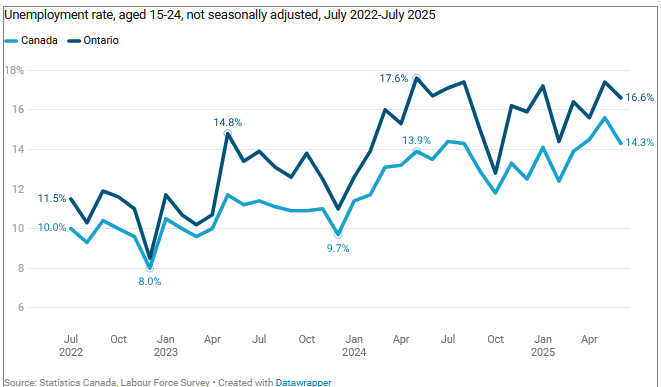
A close look at the facts: housing prices – rents – and unemployed young people. These are facts and they need to be addressed.
August 22nd, 2025
BURLINGTON, ON
Economists with RBC are sounding the alarm on a housing construction slowdown that could hit Ontario far earlier than expected.
Canada Mortgage and Housing Corporation (CMHC) released new housing starts data this week, and, on the surface, there was something of a rosy tone. The government agency reported that the seasonally-adjusted annual rate (SAAR) of housing starts edged up 4% in July to 294,085 units, marking the highest level of starts since September 2022.
That would give you the impression that starts, defined as the moment the foundation on a new build has been poured, are on a good trajectory, however, it’s more indicative of development intention from the past. As stated by CMHC’s Deputy Chief Economist Tania Bourassa-Ochoa in a press release from Monday, the “persistently elevated national results are reflective of investment decisions made months or even years ago, highlighting the influence of previous market conditions and builder sentiment on current construction trends.”
Meanwhile, a new report released Wednesday by economists at RBC further points out that while starts are up nationally, construction in the country’s most populated province is sorely down.
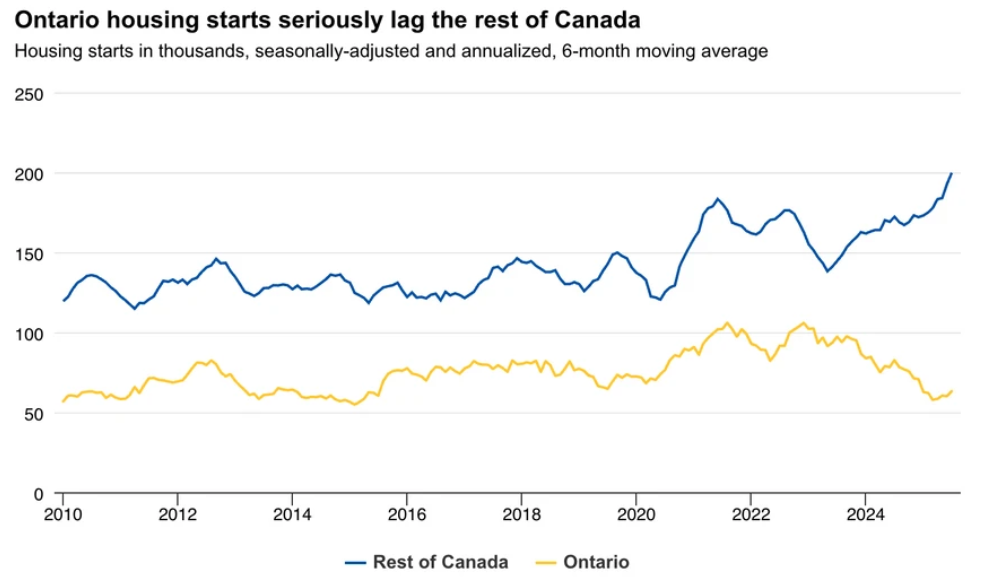 CMHC, Statistics Canada, RBC Economics “Ontario stands out with a steep decline since mid-2024, particularly in the Greater Toronto Area. British Columbia has also seen a moderation, but to a much lower extent,” writes RBC Assistant Chief Economist Robert Hogue. “This divergence is concerning, because it threatens to perpetuate severe affordability problems that exert social and economic hardship on Canadians in these regions.”
“While homebuilders and municipalities are keen to respond, factors like the high development and building costs in Ontario, and substantial inventory are weighing on the initiation of new projects. This raises concern about whether future housing stock can meet demand,” Hogue goes on to say.
According to CMHC’s data, Ontario saw 62,700 starts in July, compared to 77,900 the same month last year, representing a massive 24% drop. “Ontario’s six-month average has fallen to the lowest level in a decade — trending in the opposite direction of what’s needed to achieve the provincial government’s ambitious goal of building 1.5 million new homes over 10 years,” says Hogue. “It’s a similar, albeit less pronounced, situation in BC.”
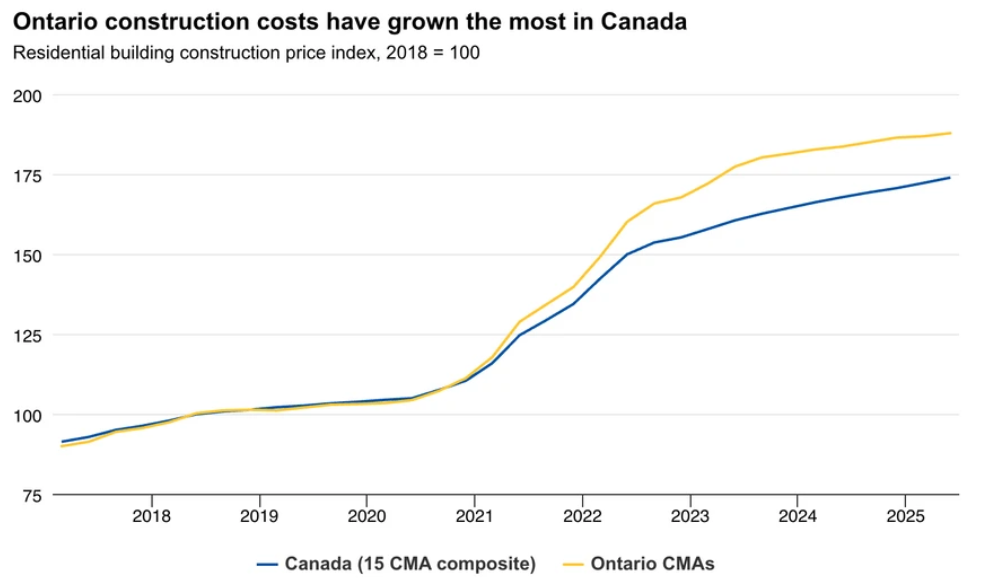 Statistics Canada, RBC Economics Alberta and Atlantic Canada are experiencing all-time highs in residential construction, the report posits, so what’s holding back starts in Ontario?
“High development and construction costs are major barriers. Builders saw a rapid escalation of expenses for land, labour, and materials, compounded by municipal development charges and other fees in the past several years,” writes Hogue. “These costs make it exceedingly difficult to bring new housing projects to market at prices prospective buyers can afford, particularly in the expensive GTA.”
Beyond that, Hogue underscores that the supply overload in Ontario, which makes new inventory less attractive than resale, is due to the lower price-point and high availability of the latter. “Meanwhile, investor interest in pre-construction condos — a key driver of housing starts in the GTA — has nearly collapsed,” he adds. “The Bank of Canada’s earlier interest rate hikes, a cooling rental market and declining condo prices have deterred investors, leading to a sharp drop in pre-construction condo sales. Without investor confidence, many projects are unable to get off the ground, further stalling new construction.”
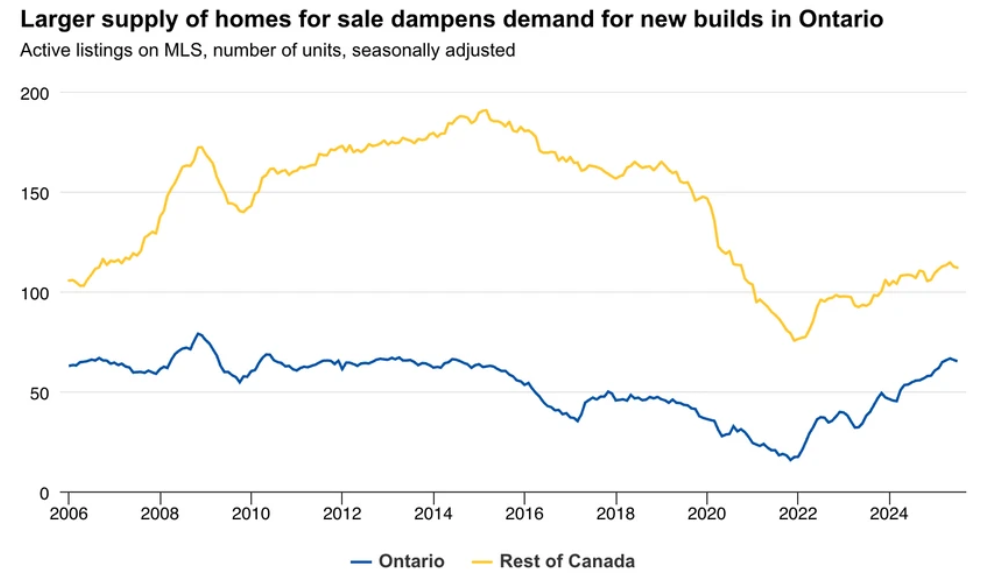 Canadian Real Estate Association, RBC Economics On top of all of that, Ontario municipalities like Toronto are “issuing more building permits than builders are acting on,” which points to a “major bottleneck” in costs, says the report. Hogue specifically points to development charges, which oftentimes prevent projects from pencilling out.
“The full impact of the current slowdown in housing starts won’t be felt for years in Ontario. It can take two, three or more years to complete a large multi-unit project once the foundation has been poured,” he adds. “Indeed, the GTA market is still absorbing the wave of condo units completed in 2024 started during the pandemic or even earlier. Units currently under construction (more than 93,000 units as of July) are just 11% off from all-time highs in the region, which suggests completions are likely to stay relatively plentiful (albeit diminishing) in the near term.”
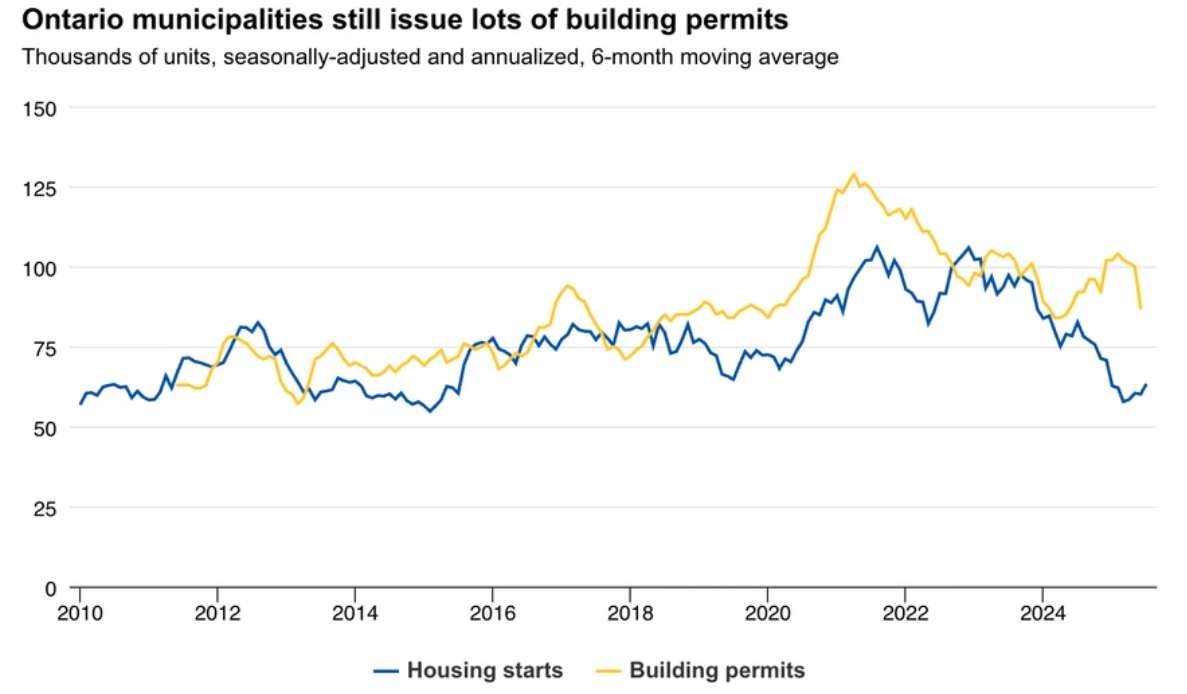 CMHC, Statistics Canada, RBC Economics Hogue underscores that Ontario’s housing construction pipeline, if not addressed, will taper outby 2026. “Any material drop in completions causing a slowdown in the housing stock’s expansion would make it that much harder to close the province’s housing supply gap,” he adds. “It could increase the shortfall and aggravate the affordability crisis if it coincides with a rebound in population growth once Canada’s immigration policy is readjusted.”
This is a topic that has been discussed at length by industry stakeholders, and some are calling the impending reality a “construction cliff.”
Even more troubling is the fact that industry leaders were calling for the “cliff” to materialize by 2027 or 2028, but economists with RBC are forecasting it to happen even sooner.
Originally published in Storey
By Gazette Staff
August 22nd, 2025
BURLINGTON, ON
The Ministry of Transportation is working on the rehabilitation of the QEW Niagara Bound lanes of the Burlington Bay Skyway bridge and will be closing 2 (two) Niagara Bound (Eastbound) lanes (out of 4 existing lanes) for bridge deck rehabilitation.

Specifically:
- 2 (two) lanes out of 4 existing, on the QEW Niagara Bound will be closed from 10:00pm Friday August 22, until 5:00am Monday August 25, weather dependent.
It is expected that there will be traffic delays throughout the weekend.
Advance signing and notification will be provided to motorists so they can plan an alternate route.
Travellers can visit http://511on.ca/ or @511Ontario for updates on work and traffic impacts.
By Maren Telfor
August 22, 2025
BURLINGTON, ON
Tutoring has become one of the most effective ways for Canadian students to improve academically, build confidence, and develop lifelong learning skills. With classrooms often being too crowded to provide one-on-one attention, tutors offer a personalized approach that helps students overcome challenges and achieve their goals. Whether it’s preparing for a difficult math test, improving essay writing skills, or simply developing better study habits, tutoring provides structure and encouragement where it is most needed. Families seeking professional support can explore trusted services such as tutor Oakville, which offer customized programs designed to meet the needs of every learner.
To get the best results, however, students and parents should approach tutoring with a clear plan and active participation. Below are five recommendations that can help maximize the benefits of tutoring sessions in Canada.
 A shared understanding of the purpose of their sessions. 1. Set Clear Goals from the Start
Tutoring becomes most effective when both the student and the tutor begin with a shared understanding of the purpose of their sessions. Without a clear direction, lessons can feel scattered and less impactful. Goals provide structure, focus, and motivation, guiding each meeting toward meaningful progress. For example, a student may want to raise their math grade by a certain percentage, strengthen reading comprehension, or learn effective strategies for time management before entering university. When these objectives are defined from the very beginning, the tutor can prepare lessons that are not only personalized but also measurable in terms of results. Parents contribute by ensuring that their expectations are communicated and by helping their children remain consistent with their efforts. Having well-defined goals also makes it easier to monitor progress, celebrate milestones, and adjust strategies when needed, ensuring that every tutoring session leads to long-term growth.
- Maintain Consistency in Sessions
One of the most common reasons tutoring does not deliver strong results is irregular attendance. Many families treat it as an occasional resource, but meaningful academic improvement requires steady and consistent engagement. When students attend sessions regularly, learning builds naturally and concepts are reinforced until they become second nature. Irregular sessions, by contrast, often lead to forgotten lessons and recurring struggles. To avoid this, it is helpful to establish a routine where tutoring becomes a natural part of the student’s weekly schedule, much like school or extracurricular activities.
 Meaningful academic improvement requires steady and consistent engagement. Key benefits of consistent tutoring include:
-
Steady reinforcement of new material, which helps knowledge stay fresh.
Prevention of learning gaps that often reappear when lessons are missed.
Reduced stress and anxiety before exams or major assignments.
A stronger sense of discipline and accountability in academic life.
Families who approach tutoring with this mindset typically see not only improved grades but also more confidence and less stress in their children’s approach to learning.
- Encourage Active Participation
 Student willingness to participate ensures that those lessons are fully understood. Tutoring is not designed to be a passive experience where students simply listen and take notes. True progress happens when learners actively engage with the material, ask questions, and openly share their struggles. A student who feels safe enough to admit confusion about a subject can gain clarity much faster than one who remains silent. Tutors provide explanations and examples, but it is the student’s willingness to participate that ensures those lessons are fully understood. Parents can support this process by reminding children that tutoring sessions are judgment-free spaces where mistakes are not failures but opportunities to learn.
Over time, students who take an active role in their tutoring develop not only a deeper understanding of the subjects but also critical life skills such as independence, problem-solving, and confidence that extend beyond the classroom.
- Apply Learning Outside of Tutoring Sessions
While tutoring sessions provide valuable guidance, it is the application of these lessons in everyday schoolwork and personal study that solidifies progress. A concept learned with the tutor becomes part of long-term knowledge only when the student practices it repeatedly in different contexts. For instance, math strategies introduced during tutoring should be applied when solving homework problems, and writing techniques learned in a session should appear in essays and school assignments. The more frequently a student uses these skills, the more natural and lasting they become.
Ways to apply tutoring outside of sessions include:
- Reviewing notes and reworking examples provided by the tutor.
- Using new problem-solving methods on regular homework.
- Practicing writing techniques in both academic and personal projects.
- Setting aside quiet study time at home to reinforce recent lessons.
When families encourage this type of practice, the benefits of tutoring extend far beyond the sessions themselves, turning short-term improvements into lasting academic growth.
- Build a Strong Partnership with the Tutor
 A strong partnership ensures that tutoring is not just about solving problems in the short term but also about creating a supportive learning environment. Tutoring works best when it is seen as a team effort involving the tutor, the student, and the parents. Open communication allows the tutor to tailor their teaching methods, ensures that progress is transparent, and keeps everyone accountable. Parents can support this partnership by checking in on their child’s development, asking thoughtful questions, and staying informed about challenges and improvements. At the same time, students should feel encouraged to express what helps them learn most effectively, as well as what areas still feel unclear.
A strong partnership ensures that tutoring is not just about solving problems in the short term but also about creating a supportive learning environment that adapts to the student’s evolving needs. This collaboration transforms tutoring from a series of lessons into a long-term investment in both academic achievement and personal growth.
Successful vs. Unsuccessful Tutoring Approaches: Comparing Table
| Approach |
Successful Tutoring |
Unsuccessful Tutoring |
| Goal Setting |
Clear, measurable, and specific |
Vague or undefined |
| Session Consistency |
Regular weekly sessions |
Sporadic or irregular attendance |
| Student Involvement |
Active questioning and participation |
Passive listening with little effort |
| Application Outside Sessions |
Practice in schoolwork and at home |
Ignoring lessons after tutoring ends |
| Communication |
Open discussion with tutor and parents |
Lack of feedback or collaboration |
Why Recommendations Matter
Tutoring is not just about hiring someone to help with schoolwork—it is about creating an effective system that empowers students to grow academically and personally. By setting clear goals, maintaining consistency, encouraging participation, applying lessons outside of sessions, and building strong partnerships, families can ensure that tutoring delivers long-term results. In a country like Canada, where academic expectations are high and students face increasing pressure to succeed, following these recommendations can make the difference between temporary improvements and lasting success. Tutoring, when approached strategically, becomes more than an academic support system—it becomes a foundation for lifelong confidence and achievement.
FAQ
What age is best to start tutoring?
Tutoring can be valuable at any age. Younger students benefit from building strong foundations early, while high school and university students often need help with more advanced subjects or exam preparation. Starting tutoring sooner can help prevent learning gaps from developing.
Is online tutoring as effective as in-person sessions?
Online tutoring is highly effective when supported by interactive tools and clear communication. Many Canadian families prefer online sessions for their convenience, while others choose in-person tutoring for face-to-face engagement. The choice often depends on the student’s learning style and personal preference.
How often should tutoring sessions take place?
Most experts recommend at least one to two sessions per week for consistent progress. Regular scheduling ensures that students stay on top of their studies and retain information, rather than cramming before exams or assignments.
 Tutoring, becomes more than an academic support system—it becomes a foundation for lifelong confidence and achievement. How can parents support tutoring at home?
Parents can help by creating a quiet study space, encouraging practice outside of tutoring sessions, and staying in touch with the tutor about progress. Their involvement reinforces the lessons learned and helps keep students motivated.
What should I look for in a tutor?
A good tutor should combine subject expertise with patience, adaptability, and strong communication skills. It’s important that the tutor connects well with the student and builds trust, creating a positive environment where the learner feels comfortable and encouraged.
 By Gazette Staff By Gazette Staff
August 21st, 2025
BURLINGTON, ON
Effective immediately, the Burlington Fire Department has lifted the open-air burning ban, issued on Aug. 12, 2025.
 Fire Department has lifted the open-air burning ban. Residents who live in rural designated burning areas, with valid open-air burning permits, can resume open-air burning.
Those with permits are reminded to follow the bylaw and conditions of their permit. Permit holders are advised to use extreme caution.
The City thanks residents for their cooperation and consideration of fire safety during the open-air burning ban.
For more information about Burlington’s open-air burning by-law, approved burn areas and fire safety tips, visit: www.burlington.ca/openairburning.
Burlington is a city where people, nature and business thrive. Sign up to learn more about Burlington at burlington.ca/subscribe and follow @CityBurlington on social media.
Mat Williamson, Chief Fire Prevention Officer: “The current weather conditions and recent rainfall have led to the decision to lift the open-air burning ban in Burlington. The Burlington Fire Department will continue to monitor and assess the fire risk. While the fire ban has been lifted, residents should still use extra caution when burning outdoors. Open-air burning is only allowed in approved rural areas of Burlington and requires an open-air burning permit.”
 By Pepper Parr By Pepper Parr
August 21st, 2025
BURLINGTON, ON
Serena Ryder is bringing her Merry Myths Tour to Burlington in December. Special Guest Lydia Persaud will be with her.
Wed, Dec 17, 2025, at 7:30pm
 Ryder and her Merry Myth Tour – in December This holiday season, acclaimed Canadian artist Serena Ryder invites you on a musical journey into the heart of the season’s most beloved traditions with Merry Myths – a festive concert inspired by the folklore, stories, and symbols that shape our ideas of the holiday season.
Serena blends timeless holiday classics with her signature soulful songs. With powerful vocals, joyful energy, and heartfelt storytelling Serena creates an unforgettable evening that celebrates connection, community, and the magic of the season.
Tickets are on sale to Members now! Preferred seating will be held for Gold and Platinum Members until Thurs, Aug 21 at 4:00pm.
Tickets will go on sale to the general public on Sat, Aug 23 at 12:00pm.
By Gazette Staff
August 21st, 2025
BURLINGTON, ON
With lazy, hazy August days soon giving way to school bells and homework, Michael Savage says parents should slowly start re-introducing September routines now to give children the strongest start to the year.
 The Brock University Professor of Educational Studies says that’s especially true for families that opted to have a more unstructured summer rather than taking part in a slew of camps and other activities. The Brock University Professor of Educational Studies says that’s especially true for families that opted to have a more unstructured summer rather than taking part in a slew of camps and other activities.
“Introducing more structure and school-type activities over these next few weeks is important because otherwise it’s like jumping into a cold pool when you’re hot — it will be a shock to the system,” he says.
Savage, who has a background in education and clinical psychology and was also an elementary and secondary school teacher, says kicking back in the summer has proven benefits.
“There is absolutely good rationale for giving them a break; children and adolescents need to destress because toxic stress does build up and can lead to educational and mental health issues,” he says.
That’s part of what drove this year’s “feral/wild summer” social media trend, he says, which encouraged families to provide more time for independent play and exploration during the summer break instead of racing from one planned activity to the next.
 “Research has shown that unstructured play for children is beneficial for problem solving, social skills and co-operative skills,” “Research has shown that unstructured play for children is beneficial for problem solving, social skills and co-operative skills,” Savage says. “Really, unstructured time and play is beneficial for people of all ages because you cannot have your entire life dictated by somebody else. If you do, you won’t be able to think as independently, be as creative or be able to take risks, and you will have more anxiety and depressive symptoms as a result.”
It’s important, however, not to take an all-or-nothing approach, he says.
“The key, as with almost everything, is that you want to have a balance between structured versus unstructured play,” Savage says. “It’s not one-size-fits-all approach, either. You have to look at your circumstances and child and find an individualized plan that works for your family.”
He says access to safe spaces for free play, arranging appropriate supervision, limiting screen time and navigating financial barriers are important considerations when incorporating more free play.
“If you have a child on the autism spectrum or with attention deficit hyperactivity disorder, you will also want to have some level of structure in place all the time, because unstructured environments for people with those particular challenges can be exacerbating,” he adds.
Savage encourages families to spend the remaining summer days balancing between safely engaging in unstructured play and building routines that will help kids be successful in the classroom.
He suggests gradually trying to roll back bedtimes to get children ready for earlier wake-up routines, playing educational games and reading independently and as a family, and spending time socializing with school friends.
Educators should also take an easing-in approach when returning to the classroom, he says.
 They’ll want to be doing some review and reinforcement — particularly in math. “It’s very important for educators to recognize that students will not be at the optimal level when they first enter the classroom in September,” Savage says. “They’ll want to be doing some review and reinforcement — particularly in math, because research shows there is often a lot of loss there due to the ‘summer slide’ phenomenon — and not expect students to take on new material right away.”
He also suggests striking a balance between drilling down on the fundamentals and engaging with one another to build a sense of community in the classroom.
“Let students get used to working with each other, being in the school environment and getting into the routines again — as well as having a say in what those routines are,” Savage says. “From a psychological point of view, allowing students to have a say in what that structure looks like is beneficial. If they do, there will be more buy-in and they will then help you enforce those rules overall.”
 By Tom Parkin By Tom ParkinAugust 21st, 2025
BURLINGTON, ON
Young worker unemployment is up. But it’s not them, it’s the economy (stupid).
As the national unemployment rate has climbed, many news reports have focused on a specific group of victims: young workers.
Unemployment is most sharply up in Ontario, with now 700,000 joblessness. Ontario’s unemployment rate has increased from 0.1 percentage point below the national rate in April 2023 to a full point above in July 2025.
Within Ontario, unemployment is highest in the manufacturing cities of Windsor and Oshawa, at 10.2 and 9.7 per cent. Unaffordable Toronto, the recent ground-zero of a housing inflation and market explosion, is third at 9.0 per cent.
But there’s an alternate view on unemployment, one that shifts the focus from Ontario’s economic problem in manufacturing and affordability to the victims. That narrative shift has real dangers. Or opportunity.
A focus on economic problems can lead to economic analysis, public pressure and hopefully economic solutions.
A focus on who is unemployed can easily divert people into moralizing, helping a politician dodge responsibility for lousy economic management. And it doesn’t take much work to divert people onto age-old moralizing about what’s wrong with young people today.
Aiding dodgy politicians are systemic reasons news media prefers the youth employment narrative rather than focusing on economic problems.
It’s a simpler story. Explaining that soaring housing costs crushed affordability, in turn crushing consumer spending, in turn crushing jobs means maintaining public attention on the bouncing ball. That’s hard. Victim stories are simple. The interviews and pictures are more compelling.
And youth unemployment is a story for a national audience. For almost any news reporter, there is a bias toward crafting a story interesting to a bigger audience. The economic problems of Ontario manufacturing and Toronto unaffordability that are driving national unemployment (including among young workers) are not national stories.
There are some great reporters who take their local or topic beats seriously. But business and economics reporters are full up with Trump tariff stories. Those reporting on Ontario politics are overwhelmed by Ford’s “flood the zone” approach.
At press conferences, Ford yarbles from flights of fantasy to threats of action not in his jurisdiction. Some of those words deserve a mention at the end of a news story. But in a celebrity-focused media space, this inanity gets top space. In the gossipy style of the Toronto Star, inanity doesn’t just lead, it headlines.
Do we need to remind business reporters that Canada can’t fight Trump with 700,000 Ontario workers’ hands tied behind their backs? Or tell certain Queen’s Park reporters to leave gossip, celebrity and inanity to the National Inquirer, 700,000 Ontarians don’t have a job?
Those reminders bring us back to young workers.
It’s always those least integrated into the labour market who suffer most from unemployment.
As hiring slows, finding a job is tougher — and toughest for those with short resumes. And because they are just starting out, more young people are job hunting. So when unemployment rises, young people are the canaries in the coal mine.
Ontario’s 700,000 unemployed workers are a massive waste of economic potential and a massive social cost. Ontario cannot beat back Trump’s attacks when 700,000 workers are sidelined from the fight.
Politicians can try to divert attention onto victims and away from causes, using systemic media biases to help them. But actually helping unemployed young workers requires a reminder that full employment and households with paycheques is how we best protect a strong and independent Canada.
 By Gazette Staff By Gazette Staff
August 21st, 2025
BURLINGTON, ON
 Rory Nisan Ward 3 Councillor Rory Nisan makes mention of the forthcoming City Budget and explains that “Budgets are more than dollars and cents. They fund the services you depend on like safe streets, reliable transit, resilient infrastructure, welcoming parks, flood protection and swift emergency response.
“Work to build the 2026 budget is underway, beginning with the 2026 Financial Forecast report (FIN-24-25). The forecast report is one of the first steps in the annual budget process and provides a preliminary look at the economic pressures and service needs that will shape the 2026 city budget. Burlington City Council approved the 2026 Financial Forecast report on July 15, 2025, with a focus on limiting tax impacts for residents.
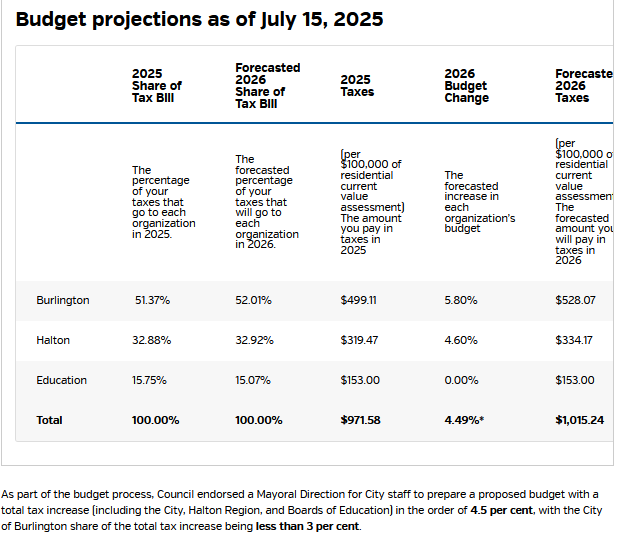
The Burlington Finance people continue to fudge the numbers.
In the column: 2026 Budget Change the number that matters to you is the 5.80%. The 4.49% at the bottom of that column is pure mathematical rubbish.
The less than 3% mentioned in the cut line is a hope – that probably doesn’t have even a prayer going for it.
Watch for those occasions when the Finance people tell you what the impact of the budget is likely to be. Impact is not a unit of measure. Each person is “impacted” differently depending on their circumstances.
There is a lot of mumbo jumbo to the way Burlington Finance people tell you what you are going to be taxed.
You deserve better in the way of financial stewardship from the city.
By Gazette Staff
August 21st, 2025
BURLINGTON, ON
 Changes have been made on some departure times. Check the schedule for lines you travel on. Metrolinx has made some changes to its schedule
With the start of school around the corner, they are sharing service updates that include new GO Transit options, returning school service, and schedule changes on some routes.
Starting Tuesday, September 2nd, they are adjusting train service to better reflect actual travel times. Some trains on the Lakeshore West line will depart a few minutes earlier or later. Customers are encouraged to check the schedules before travelling.
As the summer winds down, seasonal GO Bus service to Canada’s Wonderland, Toronto Zoo and route 17B (University of Waterloo/Burlington GO) will wrap up for the year.
The last day for these services will be Sunday, August 24th.
GO is also taking students back to school. As in previous years, GO Bus service to post-secondary schools will be reinstated starting on Saturday, August 30th, with new additional express trips:
Route 15A –McMaster / Burlington
|
|